

- Industry Size (2026)
- USD 287 Mn
- Forecast (2036)
- USD 1223.1 Mn
- CAGR (2026 to 2036)
- 15.6%
Ultra-Localized Soil Insecticide Micro-Dose Capsule Market Forecast and Outlook 2026 to 2036
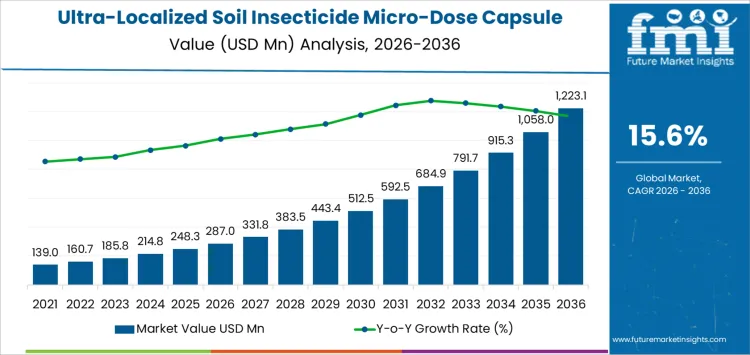
The global ultra-localized soil insecticide micro-dose capsule market is poised for rapid growth, projected to expand from USD 287 million in 2026 to USD 1,223.1 million by 2036, with a strong CAGR of 15.6%. Biodegradable polymer microcapsules lead the market with a 37% share due to their eco-friendly nature and precise insecticide delivery. This technology reduces environmental impact by targeting pests in the specific soil zone, minimizing the use of chemicals. In terms of application methods, in-furrow application holds the largest share at 46%, offering the highest precision by placing insecticides directly in the planting zone, where pest activity is most concentrated. These technologies are driving the shift toward eco-friendlier and efficient pest management systems, providing growers with a better way to combat soil-dwelling pests like wireworms, grubs, and root maggots.
Quick Stats for Ultra-Localized Soil Insecticide Micro-Dose Capsule Market
- Ultra-Localized Soil Insecticide Micro-Dose Capsule Market Value (2026): USD 287 million
- Ultra-Localized Soil Insecticide Micro-Dose Capsule Market Forecast Value (2036): USD 1,223.1 million
- Ultra-Localized Soil Insecticide Micro-Dose Capsule Market Forecast CAGR: 15.6%
- Leading Capsule Technology in Ultra-Localized Soil Insecticide Micro-Dose Capsule Market: Biodegradable Polymer Microcapsules (37%)
- Key Growth Regions in Ultra-Localized Soil Insecticide Micro-Dose Capsule Market: USA, Brazil, India, China, France
- Key Players in Ultra-Localized Soil Insecticide Micro-Dose Capsule Market: BASF SE, Bayer CropScience, Syngenta Group, Corteva Agriscience, FMC Corporation
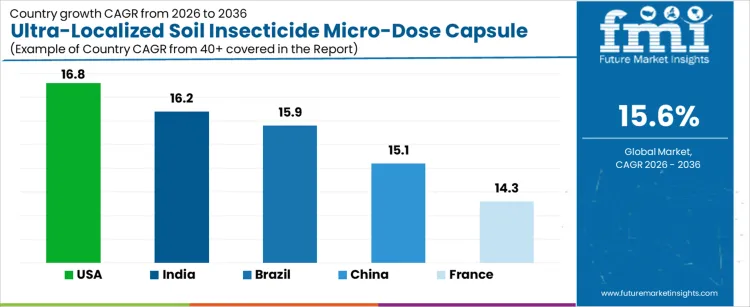
India leading the growth at a 16.2% CAGR, driven by the country’s expanding agricultural sector and need for efficient pest control. The USA follows with a 16.8% growth rate, supported by precision agriculture adoption and regulatory pressures for eco-friendly solutions. Brazil’s market grows at 15.9%, fueled by the demand for localized and eco-friendly pest control in large-scale farming. China and France also show steady growth at 15.1% and 14.3%, respectively, as they implement advanced pest management technologies to enhance crop protection and reduce pesticide use. The demand for precision, localized solutions is expected to continue growing across all these regions.
Ultra‑Localized Soil Insecticide Micro‑Dose Capsule Market Key Takeaways
| Metric | Value |
|---|---|
| Industry Value (2026) | USD 287 million |
| Forecast Value (2036) | USD 1,223.1 million |
| Forecast CAGR (2026–2036) | 15.6% |
How is the Global Ultra‑Localized Soil Insecticide Micro‑Dose Capsule Sector Advancing?
The global ultra‑localized soil insecticide micro‑dose capsule market is growing rapidly as agricultural producers seek precision pest control solutions that minimize environmental impact and maximize effectiveness. Ultra‑localized micro‑dose capsules are designed to deliver targeted doses of insecticidal actives directly to the soil zone where pests threaten seedling establishment and root health. By concentrating treatment in specific soil strata and reducing overall chemical volume, these capsules help limit off‑target exposure, lower input costs, and reduce the potential for adverse effects on non‑target organisms and soil biology. This precision approach aligns with the broader shift toward eco-friendly and integrated pest management practices that emphasize reduced chemical loads and greater application efficiency.
Demand for micro‑dose capsule technologies is increasing across major crops including cereals, legumes, and high‑value horticultural crops, driven by pressure to control soil insect pests such as wireworms, grubs, and root maggots. Advances in capsule formulation and release mechanisms have improved active ingredient stability and release kinetics, ensuring that insecticides remain effective over critical early growth periods. These improvements enable growers to achieve consistent pest suppression while reducing the frequency and amount of active ingredients applied. Adoption is also supported by regulatory trends that favor reduced chemical footprints and encourage precision application technologies that help farms meet environmental compliance targets.
Ultra‑localized soil insecticide micro‑dose capsule market is expected to continue its strong growth as precision agriculture technologies expand and growers increasingly adopt data‑driven approaches to pest management. Challenges such as the need for field‑specific guidance on capsule placement, variability in soil conditions, and initial costs for transitioning to micro‑dose systems may influence adoption rates. Nevertheless, the focus on targeted, environmentally responsible pest control and the demonstrated benefits in efficacy and resource use will sustain demand for ultra‑localized soil insecticide micro‑dose capsules globally.
What Is the Segment-Wise Analysis for the Global Ultra-Localized Soil Insecticide Micro-Dose Capsule Market?
The global ultra-localized soil insecticide micro-dose capsule market is segmented by capsule technology type and application method. Biodegradable polymer microcapsules lead the market with a 37% share, as they offer an eco-friendly and effective solution for controlled pesticide delivery. Other significant capsule technologies include controlled-release gel capsules, clay-based encapsulated granules, and lipid-matrix micro-dose capsules. In terms of application methods, in-furrow application holds the largest share at 46%, followed by seed-zone placement, micro-granular spot application, and precision planter-integrated dosing.
Why Do Biodegradable Polymer Microcapsules Lead the Global Ultra-Localized Soil Insecticide Micro-Dose Capsule Market?
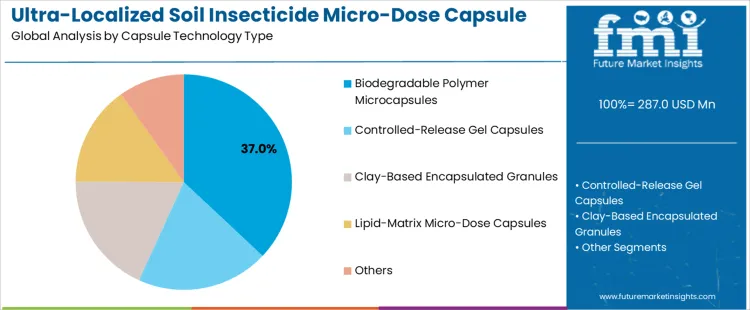
Biodegradable polymer microcapsules hold a 37% share in the global ultra-localized soil insecticide micro-dose capsule market due to their eco-friendly nature and ability to deliver insecticides effectively while minimizing environmental impact. These microcapsules break down naturally in the soil, ensuring that no harmful residues are left behind. Biodegradable polymer microcapsules provide controlled and precise insecticide release, ensuring targeted pest control without affecting non-target organisms. As the agricultural industry moves toward eco-friendlier pest management solutions, biodegradable microcapsules offer an effective, environmentally responsible choice, contributing to their dominance in the market.
Why Does In-Furrow Application Hold the Largest Market Share in the Ultra-Localized Soil Insecticide Micro-Dose Capsule Market?
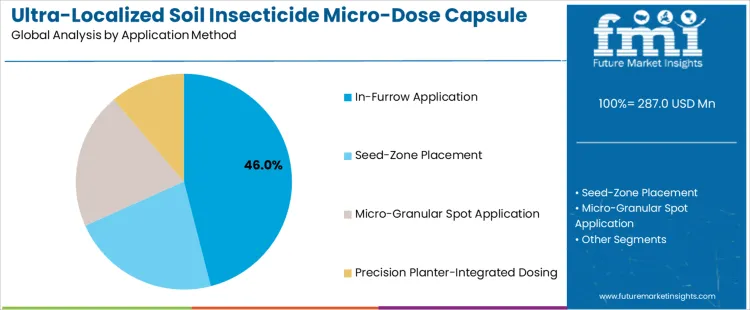
In-furrow application holds the largest share of 46% in the global ultra-localized soil insecticide micro-dose capsule market due to its precision in placing insecticides directly in the planting zone, where pest activity is most concentrated. This method ensures that insecticides are applied directly to the root zone, where they are most effective in controlling soil-dwelling pests. In-furrow application minimizes pesticide waste and reduces environmental impact by targeting specific areas, making it an ideal solution for efficient pest management. Its widespread adoption in precision agriculture continues to drive its dominance in the market.
What is Shaping the Ultra‑Localized Soil Insecticide Micro‑Dose Capsule Market?
The ultra‑localized soil insecticide micro‑dose capsule market is shaped by the need for targeted pest control with minimal environmental impact. These micro‑dose capsules release precise amounts of insecticide directly in the soil zone where pests, such as rootworms and grubs, attack crops. As growers face increasing restrictions on broad‑spectrum soil insecticides and seek solutions that reduce off‑target exposure, localized dosing technologies are gaining traction. Advances in encapsulation chemistry, controlled release mechanisms, and precision application systems are driving product innovation.
What Factors Are Driving the Ultra‑Localized Soil Insecticide Micro‑Dose Capsule Market?
Ultra‑localized soil insecticide micro‑dose capsule market is driven by demand for effective, precision‑targeted pest control that minimizes environmental and non‑target effects. Micro‑dose capsules deliver active ingredients only where needed, reducing overall pesticide use and lowering cost per application. Regulatory pressure to limit residual soil insecticides and protect soil health is accelerating adoption of more localized strategies. Growers also appreciate improved safety, less worker exposure, and compatibility with conservation tillage and eco-friendly farming practices. Integration with precision agriculture tools such as GPS‑guided applicators and variable‑rate technology enhances placement accuracy. These factors collectively support the shift toward micro‑dose soil insecticide solutions.
What Challenges Are Limiting Adoption of Ultra‑Localized Soil Insecticide Micro‑Dose Capsules?
Adoption is limited by concerns over cost, technology complexity, and variability in field performance. Micro‑dose formulations and precision delivery systems can carry higher upfront prices compared with conventional soil insecticides, which may deter cost‑sensitive growers. Some users may be cautious about switching technologies without clear, localized efficacy data across varied soil types and pest pressures. Integration with existing planting or application equipment can require investment in specialized hardware and training. Limited awareness about optimal timing and placement, as well as regulatory ambiguity in some regions regarding novel delivery formats, can slow broader uptake.
What is the Growth Outlook for the Ultra-Localized Soil Insecticide Micro-Dose Capsule Market by Country?
| Country | CAGR (%) |
|---|---|
| USA | 16.8% |
| Brazil | 15.9% |
| China | 15.1% |
| India | 16.2% |
| France | 14.3% |
The ultra-localized soil insecticide micro-dose capsule market is growing steadily, with the USA leading at a 16.8% CAGR, driven by increasing demand for precision agriculture and environmentally friendly pest control solutions. Brazil follows closely with 15.9%, supported by its large agricultural base and the adoption of innovative pest management methods. China’s market grows at 15.1%, driven by the need to improve agricultural productivity and minimize pesticide use. India’s market grows at 16.2%, as the country increasingly adopts efficient crop protection technologies to improve soil health and reduce pest-related damage. France’s market grows at 14.3%, driven by the demand for localized, eco-friendly insecticide solutions in eco-friendly farming practices.
Why is the USA Leading in the Ultra-Localized Soil Insecticide Micro-Dose Capsule Market?
The USA’s ultra-localized soil insecticide micro-dose capsule market is growing at 16.8%, driven by the increasing adoption of precision agriculture technologies and a growing focus on eco-friendly pest control practices. Micro-dose capsules offer an efficient, eco-friendly solution for targeting soil-borne insect pests, reducing the need for widespread pesticide application and minimizing environmental impact. As farmers in the USA seek ways to improve pest control efficacy while reducing pesticide use, the demand for localized solutions like micro-dose capsules is rising. The USA’s strong regulatory environment and emphasis on reducing chemical use in agriculture further boost the market’s growth. With the growing focus on improving soil health and enhancing crop yields, the market for ultra-localized soil insecticide micro-dose capsules is expected to continue its expansion.
What is Driving the Growth of the Ultra-Localized Soil Insecticide Micro-Dose Capsule Market in Brazil?
Brazil’s ultra-localized soil insecticide micro-dose capsule market is growing at 15.9%, driven by the country’s vast agricultural sector, which is highly dependent on efficient pest management solutions. As Brazil continues to lead global crop production, particularly in soybeans, sugarcane, and coffee, there is a growing need for targeted, eco-friendly pest control technologies. Micro-dose capsules offer a solution by delivering insecticides directly to the soil, minimizing waste and reducing the environmental impact of broad pesticide application. The adoption of precision agriculture and integrated pest management practices in Brazil is fueling the market for localized insecticide solutions. As farmers continue to prioritize crop protection and durability, Ultra-localized soil insecticide micro-dose capsules market is expected to grow steadily in Brazil.
How is the Ultra-Localized Soil Insecticide Micro-Dose Capsule Market Expanding in China?
China’s ultra-localized soil insecticide micro-dose capsule market is growing at 15.1%, supported by the country’s large-scale agricultural industry and the increasing need for more efficient pest control methods. As China works to modernize its agricultural sector, there is a rising demand for solutions that target pests precisely while minimizing chemical usage. Micro-dose capsules are gaining popularity for their ability to deliver insecticides directly to the soil, effectively controlling pests with minimal environmental impact. The Chinese government’s focus on eco-friendly farming practices and the growing push for precision agriculture are contributing to the market’s growth. With China’s agricultural sector facing pressure to improve efficiency and reduce pesticide residues, the demand for ultra-localized soil insecticide solutions is expected to continue to rise.
What is Contributing to the Growth of the Ultra-Localized Soil Insecticide Micro-Dose Capsule Market in India?
India’s ultra-localized soil insecticide micro-dose capsule market is growing at 16.2%, driven by the country’s expanding agricultural base and increasing need for efficient pest control solutions. India’s diverse agricultural landscape faces challenges from soil-borne insect pests, and the adoption of micro-dose capsules allows for targeted treatment with reduced pesticide use. These capsules improve the effectiveness of pest management while minimizing the environmental impact. The growing emphasis on eco-friendly farming practices and integrated pest management solutions in India is driving the demand for more localized, eco-friendly insecticide options. As India’s agricultural sector continues to modernize and improve productivity, the market for ultra-localized soil insecticide micro-dose capsules is set to expand further.
What is Driving the Growth of the Ultra-Localized Soil Insecticide Micro-Dose Capsule Market in France?
France’s ultra-localized soil insecticide micro-dose capsule market is growing at 14.3%, supported by the country’s strong commitment to eco-friendly farming and eco-friendly crop protection practices. As European farmers face increasing pressure to reduce pesticide use and protect the environment, micro-dose capsules are becoming a popular solution. These capsules offer a precise, localized method of insecticide application, reducing the environmental impact and enhancing crop protection. France’s agricultural industry, which places high value on eco-friendly practices, is increasingly adopting precision agriculture technologies that include micro-dose insecticide systems. With the rise of integrated pest management (IPM) and the push for environmentally responsible farming, the market for ultra-localized soil insecticide micro-dose capsules is expected to continue growing in France.
How Are Companies Competing in the Ultra-Localized Soil Insecticide Micro Dose Capsule Market?
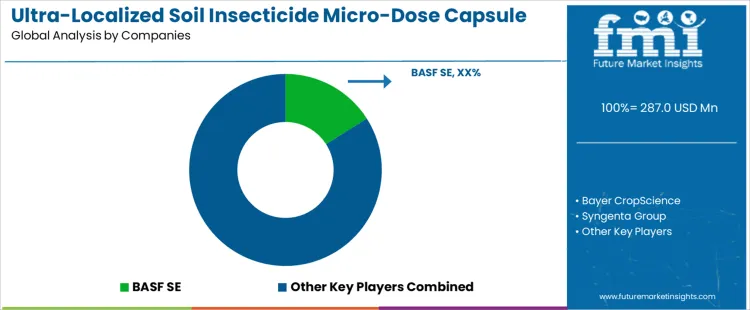
In the ultra-localized soil insecticide microdose capsule market BASF SE, Bayer CropScience, Syngenta Group, Corteva Agriscience, and FMC Corporation are positioned with product brochures that emphasize precision pest control with minimal input volumes. At BASF SE brochures, microdose capsules are described with targeted release mechanisms that deliver active ingredients directly where soil pests reside. Performance data is showcased with trial results on key rootworm and grub species. Application guidance is detailed with placement recommendations to maximize efficacy and minimize non-target exposure. At Bayer CropScience materials microdose soil capsules are presented as part of integrated pest management solutions. Application timing, soil type fit, and compatibility with seed treatments are highlighted. Technical summaries and visual aids are used to support decision making in diverse cropping systems.
Syngenta Group collateral presents microdose capsule technologies with a focus on consistent performance across varied soil conditions. Product briefs include efficacy charts and dosing guidance that support agronomists and consultants. At Corteva Agriscience product brochures describe encapsulated insecticides engineered for ultraprecise delivery and prolonged activity in pest hotspots. Rate curves and pest suppression data are shown to help growers evaluate value relative to broader soil insecticide programs. FMC Corporation literature emphasizes innovative microencapsulation platforms with clear instructions on placement and integration with other soil fertility and protection inputs.
Key Players in Ultra-Localized Soil Insecticide Micro-Dose Capsule Market
- BASF SE
- Bayer CropScience
- Syngenta Group
- Corteva Agriscience
- FMC Corporation
Scope of Report
| Items | Values |
|---|---|
| Quantitative Units (2026) | USD million |
| Capsule Technology Type | Biodegradable Polymer Microcapsules, Controlled-Release Gel Capsules, Clay-Based Encapsulated Granules, Lipid-Matrix Micro-Dose Capsules, Others |
| Application Method | In-Furrow Application, Seed-Zone Placement, Micro-Granular Spot Application, Precision Planter-Integrated Dosing |
| Regions Covered | Asia Pacific, Europe, North America, Latin America, Middle East & Africa |
| Countries Covered | USA, China, Japan, South Korea, India, Australia & New Zealand, ASEAN, Germany, UK, France, Italy, Spain, Nordic, BENELUX, Brazil, Chile, Mexico, Saudi Arabia, Other GCC Countries, Turkey, South Africa, Other African Union |
| Key Companies Profiled | BASF SE, Bayer CropScience, Syngenta Group, Corteva Agriscience, FMC Corporation |
| Additional Attributes | Dollar sales by capsule technology type, application method, and region; regional CAGR and growth outlook; distribution channels including agricultural suppliers, seed treatment manufacturers, and service providers; innovation trends in ultra-localized soil insecticide capsules; competitive positioning of global vs regional suppliers. |
Ultra-Localized Soil Insecticide Micro-Dose Capsule Market by Segments
Capsule Technology Type:
- Biodegradable Polymer Microcapsules
- Controlled-Release Gel Capsules
- Clay-Based Encapsulated Granules
- Lipid-Matrix Micro-Dose Capsules
- Others
Application Method:
- In-Furrow Application
- Seed-Zone Placement
- Micro-Granular Spot Application
- Precision Planter-Integrated Dosing
Region:
- Asia Pacific
- China
- Japan
- South Korea
- India
- Australia & New Zealand
- ASEAN
- Rest of Asia Pacific
- Europe
- Germany
- United Kingdom
- France
- Italy
- Spain
- Nordic
- BENELUX
- Rest of Europe
- North America
- United States
- Canada
- Mexico
- Latin America
- Brazil
- Chile
- Rest of Latin America
- Middle East & Africa
- Kingdom of Saudi Arabia
- Other GCC Countries
- Turkey
- South Africa
- Other African Union
- Rest of Middle East & Africa
Frequently Asked Questions
How big is the ultra-localized soil insecticide micro-dose capsule market in 2026?
The global ultra-localized soil insecticide micro-dose capsule market is estimated to be valued at USD 287.0 mn in 2026.
What will be the size of ultra-localized soil insecticide micro-dose capsule market in 2036?
The market size for the ultra-localized soil insecticide micro-dose capsule market is projected to reach USD 1,223.1 mn by 2036.
How much will be the ultra-localized soil insecticide micro-dose capsule market growth between 2026 and 2036?
The ultra-localized soil insecticide micro-dose capsule market is expected to grow at a 15.6% CAGR between 2026 and 2036.
What are the key product types in the ultra-localized soil insecticide micro-dose capsule market?
The key product types in ultra-localized soil insecticide micro-dose capsule market are biodegradable polymer microcapsules, controlled-release gel capsules, clay-based encapsulated granules, lipid-matrix micro-dose capsules and others.
Which application method segment to contribute significant share in the ultra-localized soil insecticide micro-dose capsule market in 2026?
In terms of application method, in-furrow application segment to command 46.0% share in the ultra-localized soil insecticide micro-dose capsule market in 2026.
Preview the report firsthand - request a free sample
Get SampleGet the brochure for pricing and purchase details.
Get PDFTable of Content
- Executive Summary
- Global Market Outlook
- Demand-side Trends
- Supply-side Trends
- Technology Roadmap Analysis
- Analysis and Recommendations
- Market Overview
- Market Coverage / Taxonomy
- Market Definition / Scope / Limitations
- Market Background
- Market Dynamics
- Drivers
- Restraints
- Opportunity
- Trends
- Scenario Forecast
- Demand in Optimistic Scenario
- Demand in Likely Scenario
- Demand in Conservative Scenario
- Opportunity Map Analysis
- Product Life Cycle Analysis
- Supply Chain Analysis
- Investment Feasibility Matrix
- Value Chain Analysis
- PESTLE and Porter’s Analysis
- Regulatory Landscape
- Regional Parent Market Outlook
- Production and Consumption Statistics
- Import and Export Statistics
- Market Dynamics
- Global Market Analysis 2021 to 2025 and Forecast, 2026 to 2036
- Historical Market Size Value (USD Million) Analysis, 2021 to 2025
- Current and Future Market Size Value (USD Million) Projections, 2026 to 2036
- Y-o-Y Growth Trend Analysis
- Absolute $ Opportunity Analysis
- Global Market Pricing Analysis 2021 to 2025 and Forecast 2026 to 2036
- Global Market Analysis 2021 to 2025 and Forecast 2026 to 2036, By Capsule Technology Type
- Introduction / Key Findings
- Historical Market Size Value (USD Million) Analysis By Capsule Technology Type , 2021 to 2025
- Current and Future Market Size Value (USD Million) Analysis and Forecast By Capsule Technology Type , 2026 to 2036
- Biodegradable Polymer Microcapsules
- Controlled-Release Gel Capsules
- Clay-Based Encapsulated Granules
- Lipid-Matrix Micro-Dose Capsules
- Others
- Y-o-Y Growth Trend Analysis By Capsule Technology Type , 2021 to 2025
- Absolute $ Opportunity Analysis By Capsule Technology Type , 2026 to 2036
- Global Market Analysis 2021 to 2025 and Forecast 2026 to 2036, By Application Method
- Introduction / Key Findings
- Historical Market Size Value (USD Million) Analysis By Application Method, 2021 to 2025
- Current and Future Market Size Value (USD Million) Analysis and Forecast By Application Method, 2026 to 2036
- In-Furrow Application
- Seed-Zone Placement
- Micro-Granular Spot Application
- Precision Planter-Integrated Dosing
- Y-o-Y Growth Trend Analysis By Application Method, 2021 to 2025
- Absolute $ Opportunity Analysis By Application Method, 2026 to 2036
- Global Market Analysis 2021 to 2025 and Forecast 2026 to 2036, By Region
- Introduction
- Historical Market Size Value (USD Million) Analysis By Region, 2021 to 2025
- Current Market Size Value (USD Million) Analysis and Forecast By Region, 2026 to 2036
- North America
- Latin America
- Western Europe
- Eastern Europe
- East Asia
- South Asia and Pacific
- Middle East & Africa
- Market Attractiveness Analysis By Region
- North America Market Analysis 2021 to 2025 and Forecast 2026 to 2036, By Country
- Historical Market Size Value (USD Million) Trend Analysis By Market Taxonomy, 2021 to 2025
- Market Size Value (USD Million) Forecast By Market Taxonomy, 2026 to 2036
- By Country
- USA
- Canada
- Mexico
- By Capsule Technology Type
- By Application Method
- By Country
- Market Attractiveness Analysis
- By Country
- By Capsule Technology Type
- By Application Method
- Key Takeaways
- Latin America Market Analysis 2021 to 2025 and Forecast 2026 to 2036, By Country
- Historical Market Size Value (USD Million) Trend Analysis By Market Taxonomy, 2021 to 2025
- Market Size Value (USD Million) Forecast By Market Taxonomy, 2026 to 2036
- By Country
- Brazil
- Chile
- Rest of Latin America
- By Capsule Technology Type
- By Application Method
- By Country
- Market Attractiveness Analysis
- By Country
- By Capsule Technology Type
- By Application Method
- Key Takeaways
- Western Europe Market Analysis 2021 to 2025 and Forecast 2026 to 2036, By Country
- Historical Market Size Value (USD Million) Trend Analysis By Market Taxonomy, 2021 to 2025
- Market Size Value (USD Million) Forecast By Market Taxonomy, 2026 to 2036
- By Country
- Germany
- UK
- Italy
- Spain
- France
- Nordic
- BENELUX
- Rest of Western Europe
- By Capsule Technology Type
- By Application Method
- By Country
- Market Attractiveness Analysis
- By Country
- By Capsule Technology Type
- By Application Method
- Key Takeaways
- Eastern Europe Market Analysis 2021 to 2025 and Forecast 2026 to 2036, By Country
- Historical Market Size Value (USD Million) Trend Analysis By Market Taxonomy, 2021 to 2025
- Market Size Value (USD Million) Forecast By Market Taxonomy, 2026 to 2036
- By Country
- Russia
- Poland
- Hungary
- Balkan & Baltic
- Rest of Eastern Europe
- By Capsule Technology Type
- By Application Method
- By Country
- Market Attractiveness Analysis
- By Country
- By Capsule Technology Type
- By Application Method
- Key Takeaways
- East Asia Market Analysis 2021 to 2025 and Forecast 2026 to 2036, By Country
- Historical Market Size Value (USD Million) Trend Analysis By Market Taxonomy, 2021 to 2025
- Market Size Value (USD Million) Forecast By Market Taxonomy, 2026 to 2036
- By Country
- China
- Japan
- South Korea
- By Capsule Technology Type
- By Application Method
- By Country
- Market Attractiveness Analysis
- By Country
- By Capsule Technology Type
- By Application Method
- Key Takeaways
- South Asia and Pacific Market Analysis 2021 to 2025 and Forecast 2026 to 2036, By Country
- Historical Market Size Value (USD Million) Trend Analysis By Market Taxonomy, 2021 to 2025
- Market Size Value (USD Million) Forecast By Market Taxonomy, 2026 to 2036
- By Country
- India
- ASEAN
- Australia & New Zealand
- Rest of South Asia and Pacific
- By Capsule Technology Type
- By Application Method
- By Country
- Market Attractiveness Analysis
- By Country
- By Capsule Technology Type
- By Application Method
- Key Takeaways
- Middle East & Africa Market Analysis 2021 to 2025 and Forecast 2026 to 2036, By Country
- Historical Market Size Value (USD Million) Trend Analysis By Market Taxonomy, 2021 to 2025
- Market Size Value (USD Million) Forecast By Market Taxonomy, 2026 to 2036
- By Country
- Kingdom of Saudi Arabia
- Other GCC Countries
- Turkiye
- South Africa
- Other African Union
- Rest of Middle East & Africa
- By Capsule Technology Type
- By Application Method
- By Country
- Market Attractiveness Analysis
- By Country
- By Capsule Technology Type
- By Application Method
- Key Takeaways
- Key Countries Market Analysis
- USA
- Pricing Analysis
- Market Share Analysis, 2025
- By Capsule Technology Type
- By Application Method
- Canada
- Pricing Analysis
- Market Share Analysis, 2025
- By Capsule Technology Type
- By Application Method
- Mexico
- Pricing Analysis
- Market Share Analysis, 2025
- By Capsule Technology Type
- By Application Method
- Brazil
- Pricing Analysis
- Market Share Analysis, 2025
- By Capsule Technology Type
- By Application Method
- Chile
- Pricing Analysis
- Market Share Analysis, 2025
- By Capsule Technology Type
- By Application Method
- Germany
- Pricing Analysis
- Market Share Analysis, 2025
- By Capsule Technology Type
- By Application Method
- UK
- Pricing Analysis
- Market Share Analysis, 2025
- By Capsule Technology Type
- By Application Method
- Italy
- Pricing Analysis
- Market Share Analysis, 2025
- By Capsule Technology Type
- By Application Method
- Spain
- Pricing Analysis
- Market Share Analysis, 2025
- By Capsule Technology Type
- By Application Method
- France
- Pricing Analysis
- Market Share Analysis, 2025
- By Capsule Technology Type
- By Application Method
- India
- Pricing Analysis
- Market Share Analysis, 2025
- By Capsule Technology Type
- By Application Method
- ASEAN
- Pricing Analysis
- Market Share Analysis, 2025
- By Capsule Technology Type
- By Application Method
- Australia & New Zealand
- Pricing Analysis
- Market Share Analysis, 2025
- By Capsule Technology Type
- By Application Method
- China
- Pricing Analysis
- Market Share Analysis, 2025
- By Capsule Technology Type
- By Application Method
- Japan
- Pricing Analysis
- Market Share Analysis, 2025
- By Capsule Technology Type
- By Application Method
- South Korea
- Pricing Analysis
- Market Share Analysis, 2025
- By Capsule Technology Type
- By Application Method
- Russia
- Pricing Analysis
- Market Share Analysis, 2025
- By Capsule Technology Type
- By Application Method
- Poland
- Pricing Analysis
- Market Share Analysis, 2025
- By Capsule Technology Type
- By Application Method
- Hungary
- Pricing Analysis
- Market Share Analysis, 2025
- By Capsule Technology Type
- By Application Method
- Kingdom of Saudi Arabia
- Pricing Analysis
- Market Share Analysis, 2025
- By Capsule Technology Type
- By Application Method
- Turkiye
- Pricing Analysis
- Market Share Analysis, 2025
- By Capsule Technology Type
- By Application Method
- South Africa
- Pricing Analysis
- Market Share Analysis, 2025
- By Capsule Technology Type
- By Application Method
- USA
- Market Structure Analysis
- Competition Dashboard
- Competition Benchmarking
- Market Share Analysis of Top Players
- By Regional
- By Capsule Technology Type
- By Application Method
- Competition Analysis
- Competition Deep Dive
- BASF SE
- Overview
- Product Portfolio
- Profitability by Market Segments (Product/Age /Sales Channel/Region)
- Sales Footprint
- Strategy Overview
- Marketing Strategy
- Product Strategy
- Channel Strategy
- Bayer CropScience
- Syngenta Group
- Corteva Agriscience
- FMC Corporation
- BASF SE
- Competition Deep Dive
- Assumptions & Acronyms Used
- Research Methodology


