

- Industry Size (2025)
- USD 0.5 Bn
- Forecast (2035)
- USD 1.0 Bn
- CAGR (2025 to 2035)
- 6.8%
Handheld XRF Analyzers Market Size and Share Forecast Outlook 2025 to 2035
The Handheld XRF Analyzers Market is estimated to be valued at USD 0.5 billion in 2025 and is projected to reach USD 1.0 billion by 2035, registering a compound annual growth rate (CAGR) of 6.8% over the forecast period.
Quick Stats for Handheld XRF Analyzers Market
- Handheld XRF Analyzers Market Value (2025): USD 0.5 billion
- Handheld XRF Analyzers Market Forecast Value (2035): USD 1.0 billion
- Handheld XRF Analyzers Market Forecast CAGR: 6.8%
- Leading Segment in Handheld XRF Analyzers Market in 2025: Qualitative Data (40.0%)
- Key Growth Regions in Handheld XRF Analyzers Market: North America, Asia-Pacific, Europe
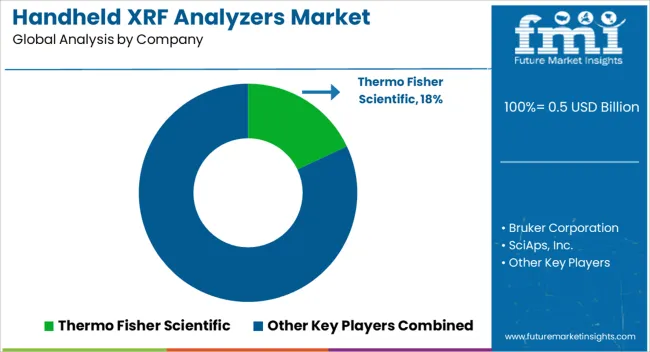
- Top Key Players in Handheld XRF Analyzers Market: Thermo Fisher Scientific, Bruker Corporation, SciAps, Inc., Olympus Corporation (Evident), Hitachi High-Tech Corporation, Rigaku Corporation, HORIBA Ltd., AMETEK (SPECTRO Analytical)

Handheld XRF Analyzers Market Key Takeaways
| Metric | Value |
|---|---|
| Handheld XRF Analyzers Market Estimated Value in (2025 E) | USD 0.5 billion |
| Handheld XRF Analyzers Market Forecast Value in (2035 F) | USD 1.0 billion |
| Forecast CAGR (2025 to 2035) | 6.8% |
Why is the Handheld XRF Analyzers Market Growing?
The Handheld XRF Analyzers market is being shaped by growing demand for rapid and non-destructive elemental analysis across multiple industries. Currently, the market is experiencing steady growth as industries seek portable and efficient solutions for quality control, regulatory compliance, and field testing. The future outlook is expected to remain positive, driven by advancements in detector technologies, improved battery life, and enhanced software capabilities that allow for greater accuracy and faster results.
Increasing awareness regarding environmental monitoring, mining, metal analysis, and hazardous material detection has accelerated the adoption of handheld XRF analyzers. The growing need for real-time decision-making, along with stricter government regulations, is pushing industries to adopt tools that can quickly analyze material composition without laboratory dependence.
Investment in portable testing solutions is being encouraged by the need to reduce downtime and lower operational costs As the technology becomes more accessible and cost-effective, future opportunities are expected to expand into sectors such as food safety, archaeology, and manufacturing, further propelling market growth.
Segmental Analysis
The handheld xrf analyzers market is segmented by data test, industry/end use, modularity, and geographic regions. By data test, handheld xrf analyzers market is divided into Qualitative Data, Quantitative Data, and Semi-Quantitative Data. In terms of industry/end use, handheld xrf analyzers market is classified into Environmental Science, Mining Industries, Research And Academics, and Archaeometry. Based on modularity, handheld xrf analyzers market is segmented into Portable Analyzers and Stationary Analyzers. Regionally, the handheld xrf analyzers industry is classified into North America, Latin America, Western Europe, Eastern Europe, Balkan & Baltic Countries, Russia & Belarus, Central Asia, East Asia, South Asia & Pacific, and the Middle East & Africa.
Insights into the Qualitative Data Segment
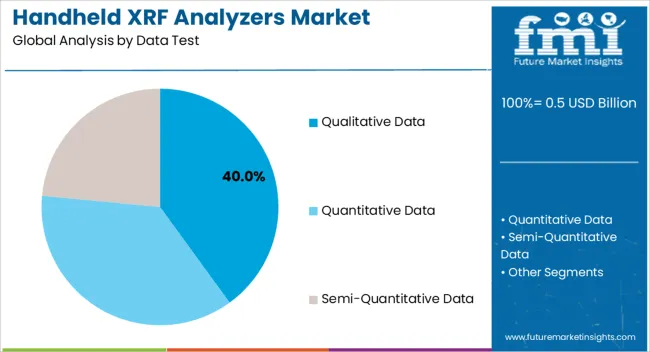
The Qualitative Data segment is expected to account for 40.00% of the Handheld XRF Analyzers market revenue share in 2025, positioning it as a leading segment. The preference for qualitative analysis is being attributed to its role in providing quick and accurate elemental identification in field conditions where laboratory equipment cannot be easily accessed. Industries such as mining, metal recycling, and quality control rely on handheld XRF analyzers to rapidly verify the presence of specific elements without elaborate sample preparation.
The ability to instantly assess material composition helps in making timely decisions regarding extraction, classification, and regulatory compliance. Furthermore, advancements in software interfaces and intuitive reporting have made qualitative tools more user-friendly, thereby encouraging adoption by non-specialist operators.
The reduced need for complex training and laboratory infrastructure has contributed to the wide acceptance of handheld analyzers in various industries The growing trend toward portable and flexible testing solutions continues to reinforce the dominance of the qualitative data segment, as faster results and ease of use remain essential requirements for operational efficiency.
Insights into the Environmental Science Segment
The Environmental Science segment is projected to hold 35.00% of the Handheld XRF Analyzers market revenue share in 2025, making it one of the most prominent application areas. This position has been supported by increasing environmental concerns and the rising need for on-site contamination analysis, soil assessment, and water quality monitoring. Handheld XRF analyzers are widely adopted by environmental agencies and consulting firms because they enable rapid field testing without the need for sample transport or specialized laboratories.
The segment has been further driven by regulatory requirements that mandate frequent monitoring of hazardous materials, heavy metals, and pollutants in air, soil, and water. The portability and ease of operation allow environmental scientists to conduct more frequent and extensive field surveys, ensuring faster reporting and intervention.
Technological improvements that enhance detection limits and expand the range of measurable elements have strengthened the trust in handheld devices for environmental analysis As sustainability initiatives gain momentum globally, the reliance on handheld XRF analyzers for environmental assessment is expected to grow, creating substantial long-term opportunities for this segment.
Insights into the Portable Analyzers Segment
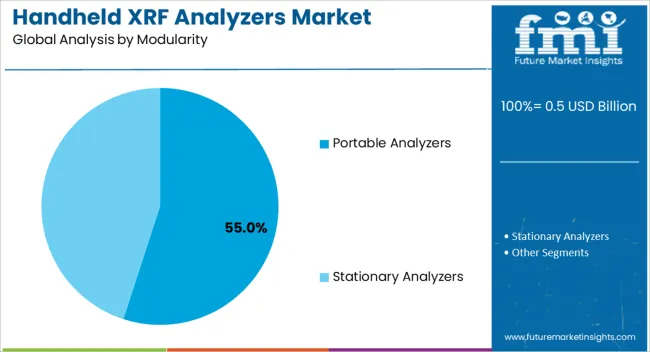
The Portable Analyzers segment is forecasted to hold 55.00% of the Handheld XRF Analyzers market revenue share in 2025, establishing it as the largest modularity segment. The strong presence of this segment is being driven by its unmatched flexibility and convenience for on-the-go testing in diverse field environments. The growing emphasis on reducing laboratory dependency and cutting operational downtime has led industries to prefer portable solutions that deliver immediate analysis without compromising accuracy.
Portable analyzers have been increasingly adopted in mining, construction, manufacturing, and environmental testing, where mobility is essential for inspections and assessments. The light weight, ergonomic design, and rugged construction of portable analyzers have further reinforced their practicality in harsh field conditions.
Additionally, advances in wireless connectivity and integrated software platforms have enabled seamless data collection, storage, and reporting, which enhances their operational efficiency As industries continue to prioritize rapid decision-making and cost-effective testing solutions, portable analyzers are expected to maintain their dominance, offering scalable solutions that align with both operational and environmental objectives.
Market Overview
Handheld XRF Analyzers Market Overview
Handheld XRF analyzers, commonly known as X-ray fluorescent analyzers, use a non-destructive analytical technique, to determine the elemental composition of a material. Non-destructive techniques are commonly preferred by end users as the sample is not altered while testing. Newly-upgraded handheld XRF analyzers have the capability to identify samples that are difficult to identify or samples that are out of compliance.
Attributing to the high investments in research and development and high demand for the discovery of new metals around the globe, manufacturers are focusing on launching handheld XRF analyzers with upgraded features, which are helpful in precisely determining the chemical composition of a material.
Handheld XRF analyzers are also used to verify the presence of new metals. There is massive demand for handheld XRF analyzers in industries such as agriculture and mining, which drives the growth of the handheld XRF analyzers market.
Analysis of Handheld XRF Analyzers Market By Key Countries
| Country | CAGR |
|---|---|
| China | 9.2% |
| India | 8.5% |
| Germany | 7.8% |
| France | 7.1% |
| UK | 6.5% |
| USA | 5.8% |
| Brazil | 5.1% |
Country-wise Analysis
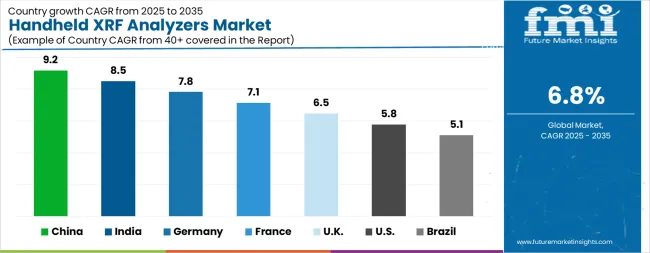
The Handheld XRF Analyzers Market is expected to register a CAGR of 6.8% during the forecast period, exhibiting varied country level momentum. China leads with the highest CAGR of 9.2%, followed by India at 8.5%. Developed markets such as Germany, France, and the UK continue to expand steadily, while the USA is likely to grow at consistent rates. Brazil posts the lowest CAGR at 5.1%, yet still underscores a broadly positive trajectory for the global Handheld XRF Analyzers Market. In 2024, Germany held a dominant revenue in the Western Europe market and is expected to grow with a CAGR of 7.8%. The USA Handheld XRF Analyzers Market is estimated to be valued at USD 180.6 million in 2025 and is anticipated to reach a valuation of USD 316.8 million by 2035. Sales are projected to rise at a CAGR of 5.8% over the forecast period between 2025 and 2035. While Japan and South Korea markets are estimated to be valued at USD 26.5 million and USD 13.3 million respectively in 2025.
Key Players in the Handheld XRF Analyzers Market
- Thermo Fisher Scientific
- Bruker Corporation
- SciAps, Inc.
- Olympus Corporation (Evident)
- Hitachi High-Tech Corporation
- Rigaku Corporation
- HORIBA Ltd.
- AMETEK (SPECTRO Analytical)
Scope of the Report
| Item | Value |
|---|---|
| Quantitative Units | USD 0.5 Billion |
| Data Test | Qualitative Data, Quantitative Data, and Semi-Quantitative Data |
| Industry/End Use | Environmental Science, Mining Industries, Research And Academics, and Archaeometry |
| Modularity | Portable Analyzers and Stationary Analyzers |
| Regions Covered | North America, Europe, Asia-Pacific, Latin America, Middle East & Africa |
| Country Covered | United States, Canada, Germany, France, United Kingdom, China, Japan, India, Brazil, South Africa |
| Key Companies Profiled | Thermo Fisher Scientific, Bruker Corporation, SciAps, Inc., Olympus Corporation (Evident), Hitachi High-Tech Corporation, Rigaku Corporation, HORIBA Ltd., and AMETEK (SPECTRO Analytical) |
Handheld XRF Analyzers Market by Segments
Data Test:
- Qualitative Data
- Quantitative Data
- Semi-Quantitative Data
Industry/End Use:
- Environmental Science
- Mining Industries
- Research And Academics
- Archaeometry
Modularity:
- Portable Analyzers
- Stationary Analyzers
Region:
- North America
- USA
- Canada
- Mexico
- Latin America
- Brazil
- Chile
- Rest of Latin America
- Western Europe
- Germany
- UK
- Italy
- Spain
- France
- Nordic
- BENELUX
- Rest of Western Europe
- Eastern Europe
- Russia
- Poland
- Hungary
- Balkan & Baltic
- Rest of Eastern Europe
- East Asia
- China
- Japan
- South Korea
- South Asia and Pacific
- India
- ASEAN
- Australia & New Zealand
- Rest of South Asia and Pacific
- Middle East & Africa
- Kingdom of Saudi Arabia
- Other GCC Countries
- Turkiye
- South Africa
- Other African Union
- Rest of Middle East & Africa
Frequently Asked Questions
How big is the handheld XRF analyzers market in 2025?
The global handheld XRF analyzers market is estimated to be valued at USD 0.5 billion in 2025.
What will be the size of handheld XRF analyzers market in 2035?
The market size for the handheld XRF analyzers market is projected to reach USD 1.0 billion by 2035.
How much will be the handheld XRF analyzers market growth between 2025 and 2035?
The handheld XRF analyzers market is expected to grow at a 6.8% CAGR between 2025 and 2035.
What are the key product types in the handheld XRF analyzers market?
The key product types in handheld XRF analyzers market are qualitative data, quantitative data and semi-quantitative data.
Which industry/end use segment to contribute significant share in the handheld XRF analyzers market in 2025?
In terms of industry/end use, environmental science segment to command 35.0% share in the handheld XRF analyzers market in 2025.
Preview the report firsthand - request a free sample
Get SampleGet the brochure for pricing and purchase details.
Get PDFTable of Content
- Executive Summary
- Global Market Outlook
- Demand-side Trends
- Supply-side Trends
- Technology Roadmap Analysis
- Analysis and Recommendations
- Market Overview
- Market Coverage / Taxonomy
- Market Definition / Scope / Limitations
- Market Background
- Market Dynamics
- Drivers
- Restraints
- Opportunity
- Trends
- Scenario Forecast
- Demand in Optimistic Scenario
- Demand in Likely Scenario
- Demand in Conservative Scenario
- Opportunity Map Analysis
- Product Life Cycle Analysis
- Supply Chain Analysis
- Investment Feasibility Matrix
- Value Chain Analysis
- PESTLE and Porter’s Analysis
- Regulatory Landscape
- Regional Parent Market Outlook
- Production and Consumption Statistics
- Import and Export Statistics
- Market Dynamics
- Global Market Analysis 2020 to 2024 and Forecast, 2025 to 2035
- Historical Market Size Value (USD Million) Analysis, 2020 to 2024
- Current and Future Market Size Value (USD Million) Projections, 2025 to 2035
- Y-o-Y Growth Trend Analysis
- Absolute $ Opportunity Analysis
- Global Market Pricing Analysis 2020 to 2024 and Forecast 2025 to 2035
- Global Market Analysis 2020 to 2024 and Forecast 2025 to 2035, By Data Test
- Introduction / Key Findings
- Historical Market Size Value (USD Million) Analysis By Data Test , 2020 to 2024
- Current and Future Market Size Value (USD Million) Analysis and Forecast By Data Test , 2025 to 2035
- Qualitative Data
- Quantitative Data
- Semi-Quantitative Data
- Y-o-Y Growth Trend Analysis By Data Test , 2020 to 2024
- Absolute $ Opportunity Analysis By Data Test , 2025 to 2035
- Global Market Analysis 2020 to 2024 and Forecast 2025 to 2035, By Industry/End Use
- Introduction / Key Findings
- Historical Market Size Value (USD Million) Analysis By Industry/End Use, 2020 to 2024
- Current and Future Market Size Value (USD Million) Analysis and Forecast By Industry/End Use, 2025 to 2035
- Environmental Science
- Mining Industries
- Research And Academics
- Archaeometry
- Y-o-Y Growth Trend Analysis By Industry/End Use, 2020 to 2024
- Absolute $ Opportunity Analysis By Industry/End Use, 2025 to 2035
- Global Market Analysis 2020 to 2024 and Forecast 2025 to 2035, By Modularity
- Introduction / Key Findings
- Historical Market Size Value (USD Million) Analysis By Modularity, 2020 to 2024
- Current and Future Market Size Value (USD Million) Analysis and Forecast By Modularity, 2025 to 2035
- Portable Analyzers
- Stationary Analyzers
- Y-o-Y Growth Trend Analysis By Modularity, 2020 to 2024
- Absolute $ Opportunity Analysis By Modularity, 2025 to 2035
- Global Market Analysis 2020 to 2024 and Forecast 2025 to 2035, By Region
- Introduction
- Historical Market Size Value (USD Million) Analysis By Region, 2020 to 2024
- Current Market Size Value (USD Million) Analysis and Forecast By Region, 2025 to 2035
- North America
- Latin America
- Western Europe
- Eastern Europe
- East Asia
- South Asia and Pacific
- Middle East & Africa
- Market Attractiveness Analysis By Region
- North America Market Analysis 2020 to 2024 and Forecast 2025 to 2035, By Country
- Historical Market Size Value (USD Million) Trend Analysis By Market Taxonomy, 2020 to 2024
- Market Size Value (USD Million) Forecast By Market Taxonomy, 2025 to 2035
- By Country
- USA
- Canada
- Mexico
- By Data Test
- By Industry/End Use
- By Modularity
- By Country
- Market Attractiveness Analysis
- By Country
- By Data Test
- By Industry/End Use
- By Modularity
- Key Takeaways
- Latin America Market Analysis 2020 to 2024 and Forecast 2025 to 2035, By Country
- Historical Market Size Value (USD Million) Trend Analysis By Market Taxonomy, 2020 to 2024
- Market Size Value (USD Million) Forecast By Market Taxonomy, 2025 to 2035
- By Country
- Brazil
- Chile
- Rest of Latin America
- By Data Test
- By Industry/End Use
- By Modularity
- By Country
- Market Attractiveness Analysis
- By Country
- By Data Test
- By Industry/End Use
- By Modularity
- Key Takeaways
- Western Europe Market Analysis 2020 to 2024 and Forecast 2025 to 2035, By Country
- Historical Market Size Value (USD Million) Trend Analysis By Market Taxonomy, 2020 to 2024
- Market Size Value (USD Million) Forecast By Market Taxonomy, 2025 to 2035
- By Country
- Germany
- UK
- Italy
- Spain
- France
- Nordic
- BENELUX
- Rest of Western Europe
- By Data Test
- By Industry/End Use
- By Modularity
- By Country
- Market Attractiveness Analysis
- By Country
- By Data Test
- By Industry/End Use
- By Modularity
- Key Takeaways
- Eastern Europe Market Analysis 2020 to 2024 and Forecast 2025 to 2035, By Country
- Historical Market Size Value (USD Million) Trend Analysis By Market Taxonomy, 2020 to 2024
- Market Size Value (USD Million) Forecast By Market Taxonomy, 2025 to 2035
- By Country
- Russia
- Poland
- Hungary
- Balkan & Baltic
- Rest of Eastern Europe
- By Data Test
- By Industry/End Use
- By Modularity
- By Country
- Market Attractiveness Analysis
- By Country
- By Data Test
- By Industry/End Use
- By Modularity
- Key Takeaways
- East Asia Market Analysis 2020 to 2024 and Forecast 2025 to 2035, By Country
- Historical Market Size Value (USD Million) Trend Analysis By Market Taxonomy, 2020 to 2024
- Market Size Value (USD Million) Forecast By Market Taxonomy, 2025 to 2035
- By Country
- China
- Japan
- South Korea
- By Data Test
- By Industry/End Use
- By Modularity
- By Country
- Market Attractiveness Analysis
- By Country
- By Data Test
- By Industry/End Use
- By Modularity
- Key Takeaways
- South Asia and Pacific Market Analysis 2020 to 2024 and Forecast 2025 to 2035, By Country
- Historical Market Size Value (USD Million) Trend Analysis By Market Taxonomy, 2020 to 2024
- Market Size Value (USD Million) Forecast By Market Taxonomy, 2025 to 2035
- By Country
- India
- ASEAN
- Australia & New Zealand
- Rest of South Asia and Pacific
- By Data Test
- By Industry/End Use
- By Modularity
- By Country
- Market Attractiveness Analysis
- By Country
- By Data Test
- By Industry/End Use
- By Modularity
- Key Takeaways
- Middle East & Africa Market Analysis 2020 to 2024 and Forecast 2025 to 2035, By Country
- Historical Market Size Value (USD Million) Trend Analysis By Market Taxonomy, 2020 to 2024
- Market Size Value (USD Million) Forecast By Market Taxonomy, 2025 to 2035
- By Country
- Kingdom of Saudi Arabia
- Other GCC Countries
- Turkiye
- South Africa
- Other African Union
- Rest of Middle East & Africa
- By Data Test
- By Industry/End Use
- By Modularity
- By Country
- Market Attractiveness Analysis
- By Country
- By Data Test
- By Industry/End Use
- By Modularity
- Key Takeaways
- Key Countries Market Analysis
- USA
- Pricing Analysis
- Market Share Analysis, 2024
- By Data Test
- By Industry/End Use
- By Modularity
- Canada
- Pricing Analysis
- Market Share Analysis, 2024
- By Data Test
- By Industry/End Use
- By Modularity
- Mexico
- Pricing Analysis
- Market Share Analysis, 2024
- By Data Test
- By Industry/End Use
- By Modularity
- Brazil
- Pricing Analysis
- Market Share Analysis, 2024
- By Data Test
- By Industry/End Use
- By Modularity
- Chile
- Pricing Analysis
- Market Share Analysis, 2024
- By Data Test
- By Industry/End Use
- By Modularity
- Germany
- Pricing Analysis
- Market Share Analysis, 2024
- By Data Test
- By Industry/End Use
- By Modularity
- UK
- Pricing Analysis
- Market Share Analysis, 2024
- By Data Test
- By Industry/End Use
- By Modularity
- Italy
- Pricing Analysis
- Market Share Analysis, 2024
- By Data Test
- By Industry/End Use
- By Modularity
- Spain
- Pricing Analysis
- Market Share Analysis, 2024
- By Data Test
- By Industry/End Use
- By Modularity
- France
- Pricing Analysis
- Market Share Analysis, 2024
- By Data Test
- By Industry/End Use
- By Modularity
- India
- Pricing Analysis
- Market Share Analysis, 2024
- By Data Test
- By Industry/End Use
- By Modularity
- ASEAN
- Pricing Analysis
- Market Share Analysis, 2024
- By Data Test
- By Industry/End Use
- By Modularity
- Australia & New Zealand
- Pricing Analysis
- Market Share Analysis, 2024
- By Data Test
- By Industry/End Use
- By Modularity
- China
- Pricing Analysis
- Market Share Analysis, 2024
- By Data Test
- By Industry/End Use
- By Modularity
- Japan
- Pricing Analysis
- Market Share Analysis, 2024
- By Data Test
- By Industry/End Use
- By Modularity
- South Korea
- Pricing Analysis
- Market Share Analysis, 2024
- By Data Test
- By Industry/End Use
- By Modularity
- Russia
- Pricing Analysis
- Market Share Analysis, 2024
- By Data Test
- By Industry/End Use
- By Modularity
- Poland
- Pricing Analysis
- Market Share Analysis, 2024
- By Data Test
- By Industry/End Use
- By Modularity
- Hungary
- Pricing Analysis
- Market Share Analysis, 2024
- By Data Test
- By Industry/End Use
- By Modularity
- Kingdom of Saudi Arabia
- Pricing Analysis
- Market Share Analysis, 2024
- By Data Test
- By Industry/End Use
- By Modularity
- Turkiye
- Pricing Analysis
- Market Share Analysis, 2024
- By Data Test
- By Industry/End Use
- By Modularity
- South Africa
- Pricing Analysis
- Market Share Analysis, 2024
- By Data Test
- By Industry/End Use
- By Modularity
- USA
- Market Structure Analysis
- Competition Dashboard
- Competition Benchmarking
- Market Share Analysis of Top Players
- By Regional
- By Data Test
- By Industry/End Use
- By Modularity
- Competition Analysis
- Competition Deep Dive
- Thermo Fisher Scientific
- Overview
- Product Portfolio
- Profitability by Market Segments (Product/Age /Sales Channel/Region)
- Sales Footprint
- Strategy Overview
- Marketing Strategy
- Product Strategy
- Channel Strategy
- Bruker Corporation
- SciAps, Inc.
- Olympus Corporation (Evident)
- Hitachi High-Tech Corporation
- Rigaku Corporation
- HORIBA Ltd.
- AMETEK (SPECTRO Analytical)
- Thermo Fisher Scientific
- Competition Deep Dive
- Assumptions & Acronyms Used
- Research Methodology


