

- Industry Size (2026)
- USD 174.2 Mn
- Forecast (2036)
- USD 352.4 Mn
- CAGR (2026 to 2036)
- 7.30%
Harmonic Drive Telescope Mounts Market Forecast and Outlook 2026 to 2036
The harmonic drive telescope mounts market is expected to grow from USD 174.2 million in 2026 to USD 352.4 million by 2036, reflecting a CAGR of 7.30%. Despite promising growth, the market faces several execution risks. The upside potential lies in technological innovations and increasing investments in space research, which could stimulate demand for high-precision telescope mounts. Adoption may be slower in emerging markets due to high costs and the complexity of integrating these systems with existing telescope setups. Economic factors, such as fluctuating research budgets and reduced funding for space exploration, add sensitivity to market performance. The requirement for high-precision components and specialized materials increases production costs, further impacting affordability. To succeed, companies must manage these risks while balancing innovation and cost-effectiveness. They need to stay flexible and respond quickly to evolving market conditions, technological shifts, and changing consumer demand to secure a competitive edge in this expanding sector.
Quick Stats for Harmonic Drive Telescope Mounts Market
- Harmonic Drive Telescope Mounts Market Value (2026): USD 174.2 Million
- Harmonic Drive Telescope Mounts Market Forecast Value (2036): USD 352.4 Million
- Harmonic Drive Telescope Mounts Market Forecast CAGR (2026–2036): 7.30%
- Leading Type of Harmonic Drive Telescope Mounts: GoTo (Motorized) Harmonic Mounts
- Key Growth Regions in Harmonic Drive Telescope Mounts Market: Asia Pacific, North America, Europe, Latin America, Middle East & Africa
- Top Key Players in Harmonic Drive Telescope Mounts Market: WarpAstron, ZWO (Zhen Wang Optical), MLAstro, Sky-Watcher (Synta), Astro-Physics, Takahashi Seisakusho
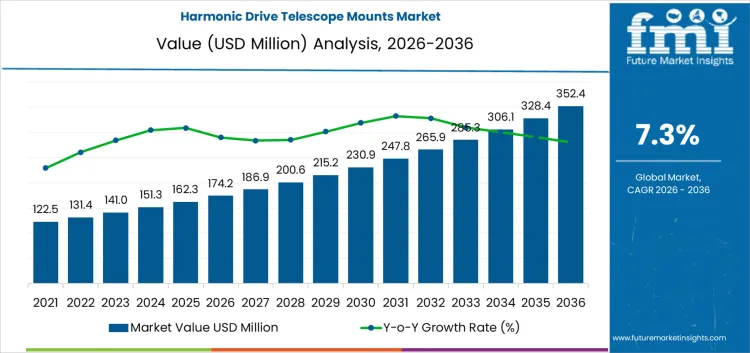
Harmonic Drive Telescope Mounts Market Key Takeaways
| Metric | Value |
|---|---|
| Harmonic Drive Telescope Mounts Market Value (2026) | USD 174.2 Million |
| Harmonic Drive Telescope Mounts Market Forecast Value (2036) | USD 352.4 Million |
| Harmonic Drive Telescope Mounts Market Forecast CAGR 2026 to 2036 | 7.30% |
Why is the Harmonic Drive Telescope Mounts Market Growing?
The harmonic drive telescope mounts market is expanding as the demand for high-precision, reliable, and stable mounting systems for telescopes grows. Harmonic drive technology, known for its high torque and low backlash characteristics, is essential for precise movement and positioning of telescopes, which is critical in both amateur and professional astronomy. The rising interest in astronomy, coupled with technological advancements, is boosting the adoption of these mounts for both ground-based and space observation platforms.
Technological innovations in harmonic drive systems are supporting growth in the harmonic drive telescope mounts market. Improvements in gear designs, material strength, and compactness have enhanced the performance of harmonic drive telescope mounts, making them more suitable for advanced telescopic applications. These innovations help achieve smoother tracking of celestial objects, reducing vibration and increasing accuracy, which is essential for high-end observatories and research telescopes.
Growing investments in space exploration, scientific research, and educational institutions are contributing to the market’s growth. The increasing affordability of advanced telescopic systems and growing participation in stargazing and astronomy-related activities are also driving demand for reliable, precision-engineered mounts. Together, these factors are supporting steady growth in the harmonic drive telescope mounts market over the forecast period.
What Does The Segment Overview Indicate About The Harmonic Drive Telescope Mounts Market?
The harmonic drive telescope mounts market is segmented by type and application, reflecting the different operational needs and preferences across astronomy and observational fields. Equatorial harmonic mounts lead the type segment with approximately 45% share, favored for their ability to track celestial objects with high precision. Other types, including altazimuth, GoTo (motorized), and multi-mode mounts, serve specialized needs such as ease of use, automation, and multi-purpose operation. On the application side, amateur astronomy and astrophotography dominate with 60% share, as hobbyists and enthusiasts seek advanced, user-friendly tracking solutions. Educational, research institutions, and commercial applications follow with varying degrees of demand.
Why Do Equatorial Harmonic Mounts Hold The Leading Type Share In The Harmonic Drive Telescope Mounts Market?
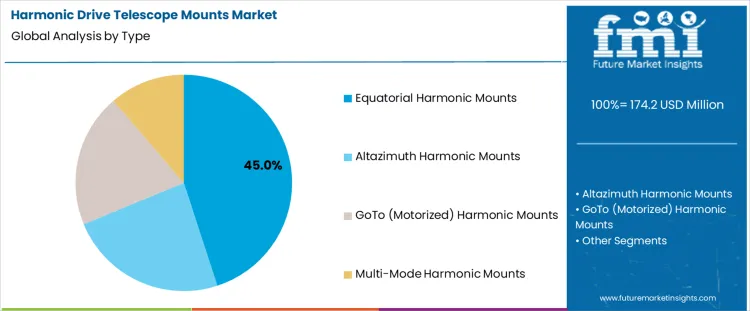
Equatorial harmonic mounts hold the largest 45% share in the harmonic drive telescope mounts market due to their ability to track celestial objects with greater accuracy. These mounts are ideal for astronomical observations, as they follow the rotation of the Earth on a single axis, compensating for the Earth's rotation and ensuring stable object tracking over long periods. Their precision is essential for astrophotography and scientific observations, where steady tracking is crucial for capturing detailed images. The equatorial mount's design supports higher payload capacities, making it suitable for a wide range of telescopes. This functionality and its proven design make equatorial mounts the most popular choice among amateur astronomers and professional institutions alike.
How Does Amateur Astronomy & Astrophotography Drive Application Demand In The Harmonic Drive Telescope Mounts Market?
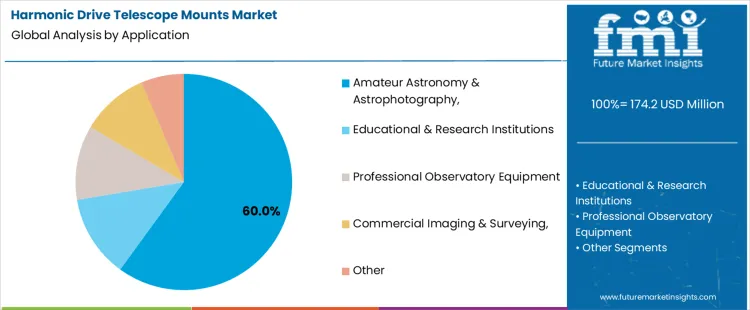
Amateur astronomy and astrophotography drive the largest share of demand in the harmonic drive telescope mounts market, contributing 60% share, as hobbyists and astrophotographers increasingly seek advanced, precise mounts for long-duration stargazing and image capturing. These applications require mounts that can provide smooth, continuous tracking of celestial objects to ensure sharp and clear images. The rise in interest for high-quality astrophotography, coupled with the availability of relatively affordable high-tech mounts, fuels this demand. As digital imaging and automation technologies advance, more enthusiasts and professionals turn to harmonic drive systems for their ability to handle complex tracking and imaging tasks with ease. The growing availability of user-friendly interfaces further expands this segment's reach.
What Are the Key Dynamics for the Harmonic Drive Telescope Mounts Market?
The harmonic drive telescope mounts market is driven by the growing need for high-precision tracking systems in both professional astronomy and amateur telescope applications. Increased investment in space exploration, research facilities, and deep-space observatories is pushing demand for advanced telescope mounts. Technological advancements in materials, manufacturing processes, and motor control systems are enhancing the performance and cost-effectiveness of harmonic drive mounts. However, challenges such as high costs, integration complexity, and limited scalability for smaller telescopes remain. As technological improvements continue and the space exploration sector expands, demand for harmonic drive telescope mounts is expected to continue growing, particularly in high-performance applications.
What Challenges Are Limiting the Widespread Use of Harmonic Drive Telescope Mounts?
The harmonic drive telescope mounts market faces challenges related to cost, integration complexity, and limited scalability for smaller applications. Harmonic drive systems, while offering superior precision, tend to be more expensive than traditional gear systems, limiting their use in entry-level or amateur telescopes. The complexity of integrating harmonic drive systems with telescope control systems and ensuring compatibility with various sensors and devices may also hinder widespread adoption. The precision required in mounting systems for advanced applications means that manufacturing processes need to adhere to very strict tolerances, adding to production costs and time-to-market for new designs.
How Are Technological Advances Improving the Harmonic Drive Telescope Mounts Market?
Technological advancements are enhancing the harmonic drive telescope mounts market by improving both performance and affordability. Innovations in material science, such as the use of high-strength, lightweight composites and alloys, are improving the durability and load-bearing capacity of mounts. Advances in motor control and automation systems are increasing the precision of harmonic drive systems, enabling smoother and more responsive tracking. Innovations in design, such as modular components and improved lubrication systems, are reducing maintenance requirements and extending the lifespan of mounts. These technological improvements are making harmonic drive systems more accessible and reliable for a broader range of telescope applications.
What is the Country-Wise Growth Outlook for the Harmonic Drive Telescope Mounts Market?
The harmonic drive telescope mounts market is growing as demand for precision mounts in astronomy, space research, and observatories rises. China leads with a CAGR of 12%, driven by government-backed space programs, research initiatives, and increasing investments in observatory infrastructure. The USA follows closely with an 11.5% CAGR, supported by advanced space exploration and private-sector interest in space telescopes. Japan records a CAGR of 10.8%, fueled by technological advancements in space observation equipment and high-precision mount systems. India shows a CAGR of 10.2%, reflecting growth in both government-led and commercial space research and development. Germany grows at 9.5% CAGR, with its established aerospace sector and focus on scientific research, supporting demand for harmonic drive telescope mounts in observatories and space missions.
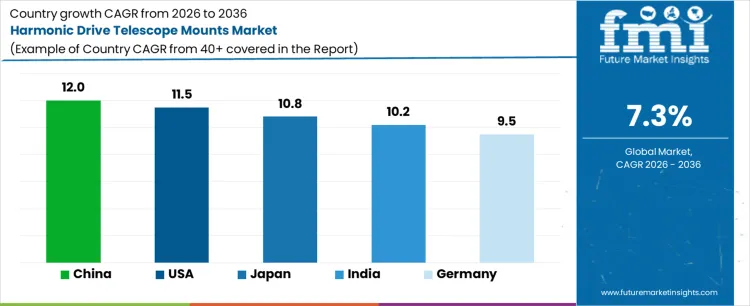
| Country | CAGR |
|---|---|
| China | 12% |
| USA | 11.5% |
| Japan | 10.8% |
| India | 10.2% |
| Germany | 9.5% |
Why is China Leading the Harmonic Drive Telescope Mounts Market?
Demand for harmonic drive telescope mounts in China is growing at a CAGR of 12%, driven by significant government investments in space exploration, astronomy research, and observatory infrastructure. China’s space agency, CNSA, has been increasing funding for satellite launches, lunar exploration missions, and ground-based telescopes. The country’s growing space research initiatives and an expanding number of observatories are pushing the demand for high-precision telescope mounts, including harmonic drive systems. As China continues to prioritize space science and technological advancements, the demand for reliable and durable telescope mounts that offer fine control and stability in extreme environments is also increasing. The rise of private-sector space ventures and space observatories, along with technological advancements in automation and satellite observation, are driving the need for efficient harmonic drive mounts. The strong government support, combined with China’s fast-growing space exploration sector, ensures that the country remains a dominant player in the global market for harmonic drive telescope mounts.
What is driving the USA’s Growth in the Harmonic Drive Telescope Mounts Market?
Sales for harmonic drive telescope mounts in the USA are growing at a CAGR of 11.5%, fueled by the country’s robust space exploration programs, private-sector advancements, and high demand for precision astronomy equipment. The USA’s extensive space missions, including those by NASA and private companies such as SpaceX, have led to increased investments in space observatories, telescopes, and satellite systems. Precision-driven applications such as space-based telescope mounts require harmonic drive systems to ensure accurate, high-performance motion control. The growing trend of private companies launching space telescopes, observing celestial phenomena, and providing public access to space-based imaging is further propelling the demand for advanced telescope mount technologies. Furthermore, research institutions and universities across the USA are heavily investing in improving the quality and efficiency of space observation systems. As the country’s space research and private commercial space exploration sectors continue to expand, the USA is expected to remain a leading player in the harmonic drive telescope mounts market.
What Is Supporting Japan’s Growth in the Harmonic Drive Telescope Mounts Market?
Demand for harmonic drive telescope mounts in Japan is increasing at a CAGR of 10.8%, supported by the country’s leading position in space exploration, satellite research, and high-precision astronomical equipment manufacturing. Japan’s space agency, JAXA, has been increasing its focus on space-based telescopes, satellite systems, and lunar missions, which require advanced harmonic drive mounts for accurate positioning and stability. As Japan’s scientific community continues to explore deep space and conduct astronomical observations, the demand for advanced telescope mounts that ensure precision and high reliability grows. Japanese manufacturers are known for their innovation in producing high-quality, durable telescope mounts capable of withstanding harsh environmental conditions. Japan's increasing interest in private space initiatives and its role in international space collaborations are further driving demand for harmonic drive systems. The combination of government-backed projects and cutting-edge technological advancements in space observation ensures continued growth for Japan in the global harmonic drive telescope mounts market.
What Is Contributing to India’s Growth in the Harmonic Drive Telescope Mounts Market?
Demand for harmonic drive telescope mounts in India is expanding at a CAGR of 10.2%, driven by the country’s expanding space missions and increasing investment in scientific research infrastructure. India’s space agency, ISRO, has been making significant strides in space exploration, satellite technology, and ground-based astronomical research. The demand for precise, reliable telescope mounts, including harmonic drive systems, is rising as India continues to develop and enhance its space observatories and research programs. India is also focusing on launching space telescopes and expanding its ground-based observatories, contributing to the growing need for high-performance, high-precision equipment for astronomical observation. The increasing collaboration between government and private space organizations, as well as the rise of commercial space activities, is also pushing the demand for advanced telescope mount solutions. With its growing space sector and increasing investments in scientific research, India is well-positioned for continued growth in the harmonic drive telescope mounts market.
What Is Driving Growth in Germany’s Harmonic Drive Telescope Mounts Market?
Sales for harmonic drive telescope mounts in Germany are rising at a CAGR of 9.5%, supported by the country’s strong aerospace industry and its leadership in European space exploration. Germany’s role in the European Space Agency (ESA) and its focus on space research and observation drive the demand for high-precision, reliable equipment, including harmonic drive telescope mounts. The country’s growing network of space observatories and satellite programs requires advanced motion control systems capable of fine adjustments and stability in extreme conditions. Germany is also home to several key manufacturers of space electronics, who play a vital role in the production of high-performance telescope mounts. As European space exploration intensifies and demand for satellite-based research and deep-space observation grows, Germany continues to invest in the development of precision-engineered telescope mount systems. With a strong aerospace and scientific research foundation, Germany is well-positioned to contribute to the global demand for harmonic drive telescope mounts.
How Are Leading Companies Competing And Differentiating In The Harmonic Drive Telescope Mounts Market?
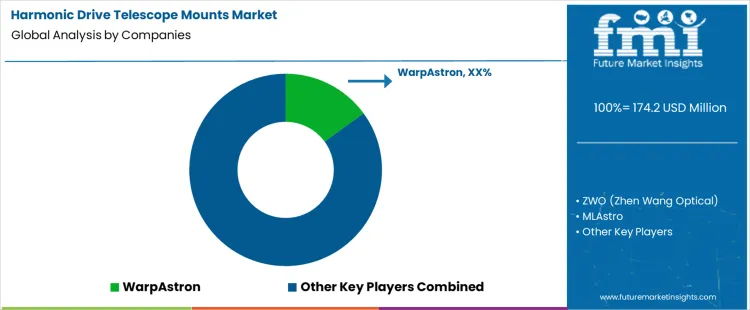
Competition in the harmonic drive telescope mounts market is being shaped by precision, stability, and ease of use. WarpAstron is being positioned around high-performance, compact harmonic drive systems designed for both amateur and professional astronomers. Product brochures emphasize smooth motion control, minimal backlash, and robust load capacity for large telescopes. ZWO (Zhen Wang Optical) differentiates itself through advanced motorized mounts with easy integration into astrophotography setups, promoting high tracking accuracy, rapid adjustments, and user-friendly software interfaces for both beginners and experts. MLAstro focuses on offering custom-built harmonic drive mounts for high-end telescopes, highlighting tailored solutions for specific astronomical needs and exceptional tracking stability.
Operational excellence and global accessibility are being leveraged by Sky-Watcher (Synta) and Astro-Physics. Sky-Watcher is promoting its reliable and precise harmonic drive mounts with a focus on user-friendly features, durability, and exceptional support, catering to both novice and advanced telescope users. Astro-Physics is being positioned as a premium brand, focusing on ultra-precise mounts for high-end astronomy equipment, emphasizing stability, minimal vibration, and precision engineering that ensures pinpoint accuracy for astrophotography and observatory setups.
A different competitive approach is being taken by Takahashi Seisakusho and Suzhou Synta Optical Technology. Takahashi Seisakusho focuses on high-end, handcrafted harmonic drive mounts with impeccable quality control, offering solutions for professional astronomers who demand the utmost precision. Suzhou Synta Optical Technology, as part of the larger Synta group, provides competitive pricing with reliable performance for a broad range of telescopic needs, emphasizing value and consistency for a global market. Across the market, differentiation is driven by tracking performance, durability, and integration with advanced telescope systems, with companies focusing on providing precise, reliable, and user-centric solutions for astronomers worldwide.
Key Players in Harmonic Drive Telescope Mounts Market
- WarpAstron
- ZWO (Zhen Wang Optical)
- MLAstro
- Sky‑Watcher (Synta)
- Astro‑Physics
- Takahashi Seisakusho
Scope of Report
| Attributes | Description |
|---|---|
| Quantitative Unit | USD Million |
| Type | Equatorial Harmonic Mounts, Altazimuth Harmonic Mounts, GoTo (Motorized) Harmonic Mounts, Multi-Mode Harmonic Mounts |
| Application | Amateur Astronomy & Astrophotography, Educational & Research Institutions, Professional Observatory Equipment, Commercial Imaging & Surveying, Other |
| Regions Covered | Asia Pacific, Europe, North America, Latin America, Middle East & Africa |
| Countries Covered | China, Japan, South Korea, India, Australia & New Zealand, ASEAN, Rest of Asia Pacific, Germany, United Kingdom, France, Italy, Spain, Nordic, BENELUX, Rest of Europe, United States, Canada, Mexico, Brazil, Chile, Rest of Latin America, Kingdom of Saudi Arabia, Other GCC Countries, Turkey, South Africa, Other African Union, Rest of Middle East & Africa |
| Key Companies Profiled | WarpAstron, ZWO (Zhen Wang Optical), MLAstro, Sky-Watcher (Synta), Astro-Physics, Takahashi Seisakusho |
| Additional Attributes | Market size and CAGR projections from 2026 to 2036 by type, application, and region; detailed analysis of demand by telescope type and application; key drivers such as technological advancements in motorized mounts, rising interest in astrophotography, and educational & research applications; competitive landscape with company strategies and product offerings; emerging trends in automation and high-precision instruments. |
Harmonic Drive Telescope Mounts Market by Key Segments
Type:
- Equatorial Harmonic Mounts
- Altazimuth Harmonic Mounts
- GoTo (Motorized) Harmonic Mounts,
- Multi‑Mode Harmonic Mounts
Application:
- Amateur Astronomy & Astrophotography,
- Educational & Research Institutions
- Professional Observatory Equipment
- Commercial Imaging & Surveying,
- Other
Region:
- Asia Pacific
- China
- Japan
- South Korea
- India
- Australia & New Zealand
- ASEAN
- Rest of Asia Pacific
- Europe
- Germany
- United Kingdom
- France
- Italy
- Spain
- Nordic
- BENELUX
- Rest of Europe
- North America
- United States
- Canada
- Mexico
- Latin America
- Brazil
- Chile
- Rest of Latin America
- Middle East & Africa
- Kingdom of Saudi Arabia
- Other GCC Countries
- Turkey
- South Africa
- Other African Union
- Rest of Middle East & Africa
Bibliography
- National Aeronautics and Space Administration. (2024). NASA astrophysics roadmap 2024: Exploring origins and destinies of galaxies, stars, and planets (NASA SP-2024-6103). NASA.
- European Space Agency. (2024). ESA astronomy and space science missions 2030+: Mission roadmap and technical priorities (ESA BR-452). ESA.
- International Astronomical Union. (2024). Standards of accuracy for telescope mount calibration and tracking (IAU Symposium No. 382). Cambridge University Press.
- European Southern Observatory. (2024). ESO annual report 2024: Observatory infrastructure and instrument development. ESO.
Frequently Asked Questions
How big is the harmonic drive telescope mounts market in 2026?
The global harmonic drive telescope mounts market is estimated to be valued at USD 174.2 million in 2026.
What will be the size of harmonic drive telescope mounts market in 2036?
The market size for the harmonic drive telescope mounts market is projected to reach USD 352.4 million by 2036.
How much will be the harmonic drive telescope mounts market growth between 2026 and 2036?
The harmonic drive telescope mounts market is expected to grow at a 7.3% CAGR between 2026 and 2036.
What are the key product types in the harmonic drive telescope mounts market?
The key product types in harmonic drive telescope mounts market are equatorial harmonic mounts, altazimuth harmonic mounts, goto (motorized) harmonic mounts and multi‑mode harmonic mounts.
Which application segment to contribute significant share in the harmonic drive telescope mounts market in 2026?
In terms of application, amateur astronomy & astrophotography, segment to command 60.0% share in the harmonic drive telescope mounts market in 2026.
Preview the report firsthand - request a free sample
Get SampleGet the brochure for pricing and purchase details.
Get PDFTable of Content
- Executive Summary
- Global Market Outlook
- Demand-side Trends
- Supply-side Trends
- Technology Roadmap Analysis
- Analysis and Recommendations
- Market Overview
- Market Coverage / Taxonomy
- Market Definition / Scope / Limitations
- Market Background
- Market Dynamics
- Drivers
- Restraints
- Scenario Forecast
- Demand in Optimistic Scenario
- Demand in Likely Scenario
- Demand in Conservative Scenario
- Opportunity Map Analysis
- Product Life Cycle Analysis
- Supply Chain Analysis
- Investment Feasibility Matrix
- Value Chain Analysis
- PESTLE and Porter’s Analysis
- Regulatory Landscape
- Regional Parent Market Outlook
- Production and Consumption Statistics
- Import and Export Statistics
- Global Market Analysis 2021 to 2025 and Forecast, 2026 to 2036
- Historical Market Size Value (USD Million) Analysis, 2021 to 2025
- Current and Future Market Size Value (USD Million) Projections, 2026 to 2036
- Y-o-Y Growth Trend Analysis
- Absolute $ Opportunity Analysis
- Global Market Pricing Analysis 2021 to 2025 and Forecast 2026 to 2036
- Global Market Analysis 2021 to 2025 and Forecast 2026 to 2036, By Type
- Introduction / Key Findings
- Historical Market Size Value (USD Million) Analysis By Type, 2021 to 2025
- Current and Future Market Size Value (USD Million) Analysis and Forecast By Type, 2026 to 2036
- Equatorial Harmonic Mounts
- Altazimuth Harmonic Mounts
- GoTo (Motorized) Harmonic Mounts
- Multi‑Mode Harmonic Mounts
- Equatorial Harmonic Mounts
- Y-o-Y Growth Trend Analysis By Type, 2021 to 2025
- Absolute $ Opportunity Analysis By Type, 2026 to 2036
- Global Market Analysis 2021 to 2025 and Forecast 2026 to 2036, By Application
- Introduction / Key Findings
- Historical Market Size Value (USD Million) Analysis By Application, 2021 to 2025
- Current and Future Market Size Value (USD Million) Analysis and Forecast By Application, 2026 to 2036
- Amateur Astronomy & Astrophotography,
- Educational & Research Institutions
- Professional Observatory Equipment
- Commercial Imaging & Surveying,
- Other
- Amateur Astronomy & Astrophotography,
- Y-o-Y Growth Trend Analysis By Application, 2021 to 2025
- Absolute $ Opportunity Analysis By Application, 2026 to 2036
- Global Market Analysis 2021 to 2025 and Forecast 2026 to 2036, By Region
- Introduction
- Historical Market Size Value (USD Million) Analysis By Region, 2021 to 2025
- Current Market Size Value (USD Million) Analysis and Forecast By Region, 2026 to 2036
- North America
- Latin America
- Western Europe
- Eastern Europe
- East Asia
- South Asia and Pacific
- Middle East & Africa
- Market Attractiveness Analysis By Region
- North America Market Analysis 2021 to 2025 and Forecast 2026 to 2036, By Country
- Historical Market Size Value (USD Million) Trend Analysis By Market Taxonomy, 2021 to 2025
- Market Size Value (USD Million) Forecast By Market Taxonomy, 2026 to 2036
- By Country
- USA
- Canada
- Mexico
- By Type
- By Application
- By Country
- Market Attractiveness Analysis
- By Country
- By Type
- By Application
- Key Takeaways
- Latin America Market Analysis 2021 to 2025 and Forecast 2026 to 2036, By Country
- Historical Market Size Value (USD Million) Trend Analysis By Market Taxonomy, 2021 to 2025
- Market Size Value (USD Million) Forecast By Market Taxonomy, 2026 to 2036
- By Country
- Brazil
- Chile
- Rest of Latin America
- By Type
- By Application
- By Country
- Market Attractiveness Analysis
- By Country
- By Type
- By Application
- Key Takeaways
- Western Europe Market Analysis 2021 to 2025 and Forecast 2026 to 2036, By Country
- Historical Market Size Value (USD Million) Trend Analysis By Market Taxonomy, 2021 to 2025
- Market Size Value (USD Million) Forecast By Market Taxonomy, 2026 to 2036
- By Country
- Germany
- UK
- Italy
- Spain
- France
- Nordic
- BENELUX
- Rest of Western Europe
- By Type
- By Application
- By Country
- Market Attractiveness Analysis
- By Country
- By Type
- By Application
- Key Takeaways
- Eastern Europe Market Analysis 2021 to 2025 and Forecast 2026 to 2036, By Country
- Historical Market Size Value (USD Million) Trend Analysis By Market Taxonomy, 2021 to 2025
- Market Size Value (USD Million) Forecast By Market Taxonomy, 2026 to 2036
- By Country
- Russia
- Poland
- Hungary
- Balkan & Baltic
- Rest of Eastern Europe
- By Type
- By Application
- By Country
- Market Attractiveness Analysis
- By Country
- By Type
- By Application
- Key Takeaways
- East Asia Market Analysis 2021 to 2025 and Forecast 2026 to 2036, By Country
- Historical Market Size Value (USD Million) Trend Analysis By Market Taxonomy, 2021 to 2025
- Market Size Value (USD Million) Forecast By Market Taxonomy, 2026 to 2036
- By Country
- China
- Japan
- South Korea
- By Type
- By Application
- By Country
- Market Attractiveness Analysis
- By Country
- By Type
- By Application
- Key Takeaways
- South Asia and Pacific Market Analysis 2021 to 2025 and Forecast 2026 to 2036, By Country
- Historical Market Size Value (USD Million) Trend Analysis By Market Taxonomy, 2021 to 2025
- Market Size Value (USD Million) Forecast By Market Taxonomy, 2026 to 2036
- By Country
- India
- ASEAN
- Australia & New Zealand
- Rest of South Asia and Pacific
- By Type
- By Application
- By Country
- Market Attractiveness Analysis
- By Country
- By Type
- By Application
- Key Takeaways
- Middle East & Africa Market Analysis 2021 to 2025 and Forecast 2026 to 2036, By Country
- Historical Market Size Value (USD Million) Trend Analysis By Market Taxonomy, 2021 to 2025
- Market Size Value (USD Million) Forecast By Market Taxonomy, 2026 to 2036
- By Country
- Kingdom of Saudi Arabia
- Other GCC Countries
- Turkiye
- South Africa
- Other African Union
- Rest of Middle East & Africa
- By Type
- By Application
- By Country
- Market Attractiveness Analysis
- By Country
- By Type
- By Application
- Key Takeaways
- Key Countries Market Analysis
- USA
- Pricing Analysis
- Market Share Analysis, 2025
- By Type
- By Application
- Canada
- Pricing Analysis
- Market Share Analysis, 2025
- By Type
- By Application
- Mexico
- Pricing Analysis
- Market Share Analysis, 2025
- By Type
- By Application
- Brazil
- Pricing Analysis
- Market Share Analysis, 2025
- By Type
- By Application
- Chile
- Pricing Analysis
- Market Share Analysis, 2025
- By Type
- By Application
- Germany
- Pricing Analysis
- Market Share Analysis, 2025
- By Type
- By Application
- UK
- Pricing Analysis
- Market Share Analysis, 2025
- By Type
- By Application
- Italy
- Pricing Analysis
- Market Share Analysis, 2025
- By Type
- By Application
- Spain
- Pricing Analysis
- Market Share Analysis, 2025
- By Type
- By Application
- France
- Pricing Analysis
- Market Share Analysis, 2025
- By Type
- By Application
- India
- Pricing Analysis
- Market Share Analysis, 2025
- By Type
- By Application
- ASEAN
- Pricing Analysis
- Market Share Analysis, 2025
- By Type
- By Application
- Australia & New Zealand
- Pricing Analysis
- Market Share Analysis, 2025
- By Type
- By Application
- China
- Pricing Analysis
- Market Share Analysis, 2025
- By Type
- By Application
- Japan
- Pricing Analysis
- Market Share Analysis, 2025
- By Type
- By Application
- South Korea
- Pricing Analysis
- Market Share Analysis, 2025
- By Type
- By Application
- Russia
- Pricing Analysis
- Market Share Analysis, 2025
- By Type
- By Application
- Poland
- Pricing Analysis
- Market Share Analysis, 2025
- By Type
- By Application
- Hungary
- Pricing Analysis
- Market Share Analysis, 2025
- By Type
- By Application
- Kingdom of Saudi Arabia
- Pricing Analysis
- Market Share Analysis, 2025
- By Type
- By Application
- Turkiye
- Pricing Analysis
- Market Share Analysis, 2025
- By Type
- By Application
- South Africa
- Pricing Analysis
- Market Share Analysis, 2025
- By Type
- By Application
- USA
- Market Structure Analysis
- Competition Dashboard
- Competition Benchmarking
- Market Share Analysis of Top Players
- By Regional
- By Type
- By Application
- Competition Analysis
- Competition Deep Dive
- WarpAstron
- Overview
- Product Portfolio
- Profitability by Market Segments (Product/Age /Sales Channel/Region)
- Sales Footprint
- Strategy Overview
- Marketing Strategy
- Product Strategy
- Channel Strategy
- ZWO (Zhen Wang Optical)
- MLAstro
- Sky‑Watcher (Synta)
- Astro‑Physics
- Takahashi Seisakusho
- Suzhou Synta Optical Technology
- WarpAstron
- Competition Deep Dive
- Market Dynamics
- Assumptions & Acronyms Used
- Research Methodology


