

- Industry Size (2025)
- USD 127.0 Mn
- Forecast (2035)
- USD 268.5 Mn
- CAGR (2025 to 2035)
- 7.8%
Hemisqualane Market Forecast and Outlook 2025 to 2035
In 2025, the hemisqualane market is valued at USD 127.0 million and is projected to reach USD 268.5 million by 2035 at a CAGR of 7.8%. Early expansion is shaped by its growing use as a lightweight emollient and silicone alternative across skin care, hair care, and color cosmetics. Liquid solution remains the dominant product form due to ease of incorporation into serums, oils, and leave-on conditioners.
Skin care represents the largest end-use segment at 11.5%, supported by rising use in facial oils, barrier-repair creams, and makeup primers. Procurement focuses on texture performance, oxidative stability, and sensory neutrality. Supply growth is closely tied to sugarcane-derived feedstock processing and hydrogenation capacity at specialty ingredient producers.
Quick Stats of the Hemisqualane Market
- Hemisqualane Market Value (2025): USD 127.0 million
- Hemisqualane Market Forecast Value (2035): USD 268.5 million
- Hemisqualane Market Forecast CAGR (2025 to 2035): 7.8%
- Leading Product Form in Hemisqualane Market: Powder (14.6%)
- Key Growth Regions in Hemisqualane Market: Asia Pacific, Europe
- Top Players in Hemisqualane Market: BASF SE, Croda International, Evonik Industries, Symrise (incl. IFF/Givaudan actives), Dow / Dow Inc., Ashland, Clariant, Seppic / Others
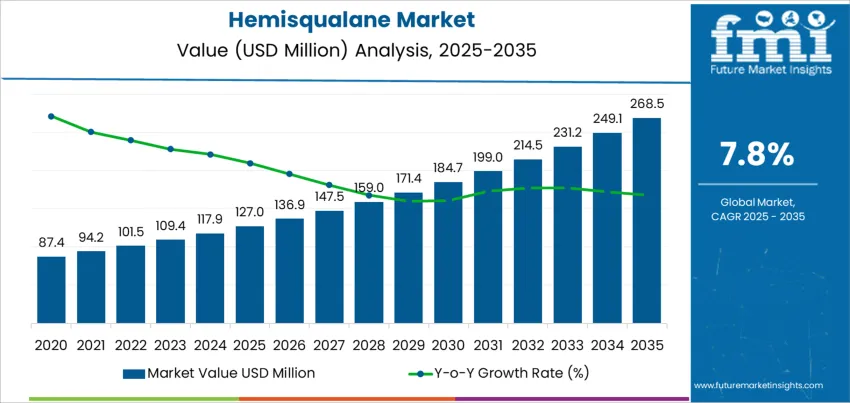
What is the Growth Forecast for the Hemisqualane Market through 2035?
After 2030, market growth reflects deeper formulation penetration rather than simple category adoption. Market value rises from about USD 184.7 million in 2030 toward USD 268.5 million by 2035 as higher hemisqualane loading is applied in scalp treatments, sun care products, and professional dermocosmetic formulations. Baby and kids care also adds steady incremental demand through fragrance-free and low-residue formulations.
Concentrates, emulsions, and oil-based formats expand as brands diversify delivery systems for different viscosity targets. Key suppliers include BASF SE, Croda International, Evonik Industries, Symrise, Dow, Ashland, Clariant, and Seppic, supported by regional blenders. Long-term value creation is governed by feedstock cost control, purity specification tightening, and sustained demand for lighter sensory profiles across premium personal care portfolios.
The global hemisqualane market expands from USD 127.0 million in 2025 to USD 171.4 million by 2030, registering an absolute increase of USD 44.4 million in the first half of the forecast period. This phase is shaped by the rapid repositioning of hemisqualane as a primary emollient alternative to conventional silicones in skincare, haircare, and color cosmetics. Demand growth is driven by its lightweight sensory profile, oxidative stability, and compatibility with sulfate-free and leave-on formulations. Large-scale adoption by mass-premium beauty brands and private-label personal care manufacturers accelerates volume uptake. During this stage, value growth is supported by expanded use in conditioners, serums, sunscreens, and makeup bases where slip, spreadability, and non-greasy finish are core performance requirements.
From 2030 to 2035, the market accelerates from USD 171.4 million to USD 268.5 million, adding USD 97.1 million in the second half of the decade. This back-weighted expansion reflects deeper penetration into full-formula systems across skincare, professional haircare, and dermatological products, where hemisqualane increasingly replaces multiple lubricant inputs within a single formulation. Demand also strengthens in hybrid skincare-makeup products and dermatologist-backed lines that favor stable, low-irritation emollients. As fermentation-based and bio-derived production capacity scales and cost structures improve, hemisqualane transitions from a premium texture modifier into a structurally embedded emollient platform, materially lifting global market value through 2035.
Hemisqualane Industry Key Takeaways
| Metric | Value |
|---|---|
| Industry Value (2025) | USD 127.0 million |
| Forecast Value (2035) | USD 268.5 million |
| Forecast CAGR (2025 to 2035) | 7.8% |
How Is the Hemisqualane Market Developing Across Personal Care and Cosmetic Formulations?
The hemisqualane market developed as formulators sought lightweight alternatives to traditional emollients that deliver slip, spreadability, and fast absorption without heavy residue. Conventional silicones and mineral based oils faced growing formulation constraints due to sensory preferences and ingredient screening by brands and consumers. Hemisqualane gained attention because it offers dry touch performance similar to silicones while aligning with plant derived ingredient strategies.
Early adoption was concentrated in hair care products where smooth feel, shine control, and reduced build up were key performance goals. Over time, facial care, body lotions, and color cosmetics incorporated hemisqualane to improve texture and blendability. Its compatibility with a wide range of actives and stability in both water free and emulsion systems supported broader formulation adoption.
Future growth of the hemisqualane market will be shaped by shifts in ingredient transparency, sensory optimization, and hybrid performance positioning between natural and synthetic emollients. As brands simplify ingredient lists while maintaining high performance expectations, hemisqualane will gain relevance as a multifunctional carrier and sensory modifier.
Expansion is expected across skin barrier products, scalp treatments, and lightweight makeup where fast absorption and non-greasy finish matter most. Barriers include reliance on specific feedstock supply chains, cost sensitivity in mass market formulations, and substitution risk from other plant derived emollients with similar sensory profiles. Long term growth will depend on consistent raw material availability, formulation flexibility, and sustained preference for lightweight skin feel across beauty categories.
How Are End Use Application and Product Form Structuring the Demand for Hemisqualane?
The demand for hemisqualane is structured by end use application and product form. Skin care represents 11.5% of total demand, followed by body care, hair care, sun care, color cosmetics, men grooming, baby and kids care, and dermocosmetic and professional care. By product form, powder accounts for 14.6% of total consumption, followed by granules and agglomerates, flakes, pellets and prills, liquid solutions, high active concentrates, dispersions and suspensions, emulsions, pastes, gels, wax or solid block formats, and oils. Demand behavior is shaped by emollient performance, volatility control, sensory finish, oxidative stability, and compatibility with both anhydrous and water based formulation systems.
Why Does Skin Care Lead the Hemisqualane End Use Demand?
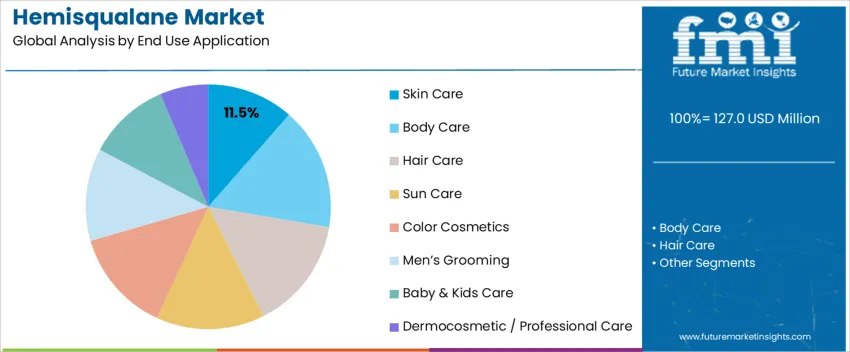
Skin care accounts for 11.5% of total hemisqualane demand due to its performance as a lightweight emollient that mimics the skin natural lipid profile without leaving greasy residue. Hemisqualane is valued for its fast spreading behavior, low comedogenic risk, and ability to soften the stratum corneum while maintaining breathability. These characteristics support its use in moisturizers, facial serums, barrier repair lotions, and daily hydration products where comfort and rapid absorption are required.
Skin care formulators favor hemisqualane for its oxidative stability compared with heavier natural oils. It performs reliably in anti-aging, acne prone, and sensitive skin products where pore occlusion and heavy after feel are avoided. Its neutral odor and clarity also preserve fragrance balance and aesthetic transparency. These sensorial performance advantages, safety positioning, and broad formulation compatibility sustain skin care as the leading end use segment within hemisqualane demand.
Why Does Powder Lead the Hemisqualane Product Form Demand?
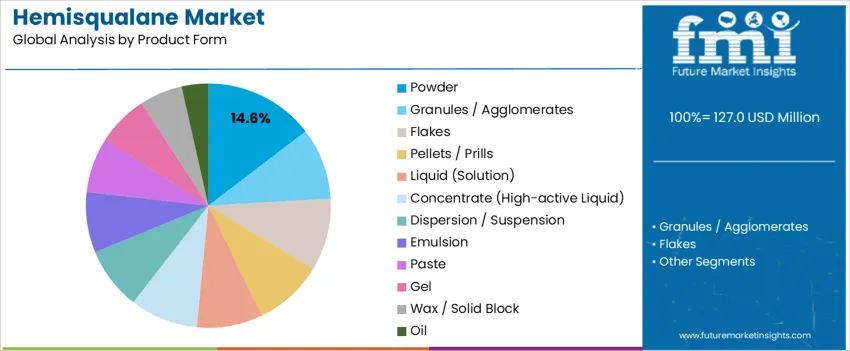
Powder accounts for 14.6% of total hemisqualane demand due to its improved handling control, shelf stability, and suitability for structured blending systems used in advanced formulation environments. Powdered hemisqualane allows controlled release during processing, which supports uniform dispersion in emulsions, gels, and solid cosmetic formats without premature phase separation. Low moisture exposure reduces oxidation risk and maintains consistent sensorial performance during extended storage.
Powder form also supports more precise concentration adjustment during high volume production, which is critical for maintaining repeatable skin feel across multiple batches. It integrates efficiently into premix systems used for balms, sticks, pressed powders, and functional solids where liquid migration must be limited. Packaging in moisture barrier containers preserves flow characteristics and physical integrity during transport. These processing control, storage durability, and formulation precision advantages position powder as the leading product form within the hemisqualane demand structure.
Why Has Hemisqualane Emerged as a Texture Architect Rather Than a Trend Ingredient?
Hemisqualane has gained global relevance not through branding narratives but through its ability to solve formulation texture conflicts that traditional emollients struggle with. It delivers dry-slip spreadability without silicone residue, oil heaviness, or alcohol volatility. This gives formulators rare control over after-feel across serums, sunscreens, hair conditioners, and color cosmetics. Its performance sits between volatile solvents and dense lipids, allowing precise sensory tuning. Demand is therefore rooted in tactile engineering rather than in marketing-led replacement of controversial ingredients.
How Do Sugar-Based Feedstocks and Hydrogenation Processes Shape Supply Behavior?
Hemisqualane is produced through hydrogenation of sugar-derived or plant-based intermediates rather than petroleum refining. This ties supply to agricultural carbohydrate streams such as sugarcane or corn glucose rather than to crude oil cycles. Refining requires strict control over chain length to achieve hemisqualane rather than heavier squalane fractions. Yield efficiency depends on catalyst performance and feedstock purity. These process dependencies make hemisqualane supply an outcome of biochemical refining discipline rather than bulk commodity distillation.
What Cost Sensitivity and Volatility Performance Limits Broader Mass Adoption?
Despite its sensory advantages, hemisqualane faces resistance in price-sensitive mass formulations where traditional emollients remain cheaper. Its volatility profile, while beneficial for light feel, limits occlusive performance in barrier-heavy creams. It also lacks the long-chain cushion preferred in high-lipid cold-climate products. These functional boundaries restrict its universal substitution across all oil roles. As a result, usage concentrates in high-spread formulations where feel and finish outweigh cost and occlusivity demands.
How Are Hybrid Skincare, Weightless Haircare, and Silicone Reduction Reframing Demand?
Future demand for hemisqualane is being shaped by hybrid formulations that blur skincare, makeup, and haircare boundaries. Weightless foundations, serum-conditioners, and skin tints depend on fast-evaporating emollients with zero tack. Hemisqualane supports silicone reduction strategies without forcing abrupt sensory compromise. Scalp care and fine-hair treatments also favor it due to low residue and rapid absorption. These shifts show hemisqualane evolving into a cross-category sensory tool rather than remaining confined to niche clean-beauty formulations.
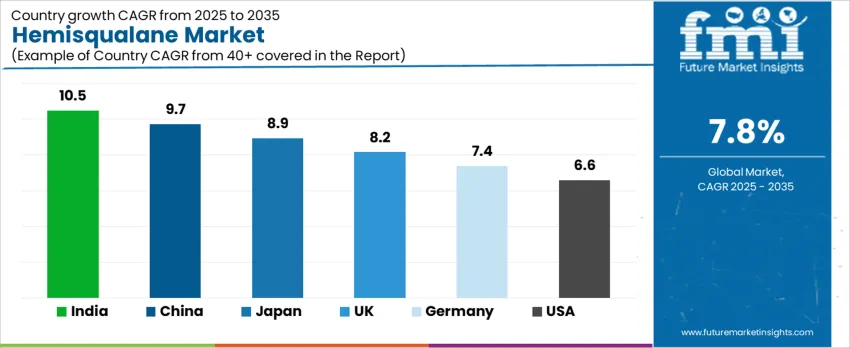
What Is the Global Growth Outlook for the Hemisqualane Industry by Country?
| Country | CAGR (%) |
|---|---|
| India | 10.5% |
| China | 9.7% |
| Japan | 8.9% |
| UK | 8.2% |
| Germany | 7.4% |
| USA | 6.6% |
The hemisqualane industry is showing steady global expansion across major cosmetic and personal care markets, with India at a 10.5% CAGR. Growth in India is supported by rising use of lightweight emollients in hair care, skincare, and hybrid cosmetic formulations, as well as by expanding domestic manufacturing of specialty ingredients. China follows at 9.7%, driven by strong personal care production capacity and rising demand for silicone-alternative conditioning agents.
Japan at 8.9% reflects stable adoption in premium hair care and skincare products focused on texture and sensory performance. The UK and Germany record 8.2% and 7.4% growth, respectively, supported by clean-label formulation trends and plant-based ingredient substitution. The USA at 6.6% reflects a mature yet steadily advancing market driven by premium beauty brands and demand for multifunctional formulations.
What Is Accelerating Hemisqualane Adoption in India?
Hemisqualane demand in India is expanding at a CAGR of 10.5% through 2035, driven by rising clean beauty production, lightweight hair care formulations, and hybrid skincare oils. Domestic cosmetic brands use hemisqualane in fast-absorbing serums, silicone-free hair oils, and barrier-repair lotions. Urban consumers favor non-greasy textures in daily skincare routines. Imports dominate supply due to the absence of large-scale local esterification capacity. Demand remains formulation-led and retail-driven, shaped by strengthening premium beauty positioning, expanding dermatology brand portfolios, and steady growth of online cosmetic retail channels.
- Lightweight serums anchor primary cosmetic demand
- Silicone free hair care supports repeat usage
- Import based sourcing dominates ingredient supply
- Ecommerce platforms expand national product visibility
How Is China Scaling Industrial Production of Hemisqualane?
Growth in China reflects a CAGR of 9.7% through 2035 for hemisqualane utilization, supported by large scale emollient manufacturing, personal care contract production, and export oriented beauty ingredient processing. Hemisqualane is used in facial oils, styling serums, and makeup formulations requiring slip and spreadability. Domestic chemical processing ensures cost control and consistent output. Export focused suppliers serve international cosmetic brands. Demand remains production driven and volume oriented, aligned with beauty manufacturing throughput, private label brand expansion, and steady integration of biodegradable emollients across mass market personal care products.
- Contract manufacturing drives high volume emollient usage
- Styling serums support repeat formulation demand
- Domestic processing stabilizes pricing and availability
- Export processing strengthens global ingredient supply
Why Does Japan Maintain Strong Demand for Hemisqualane?
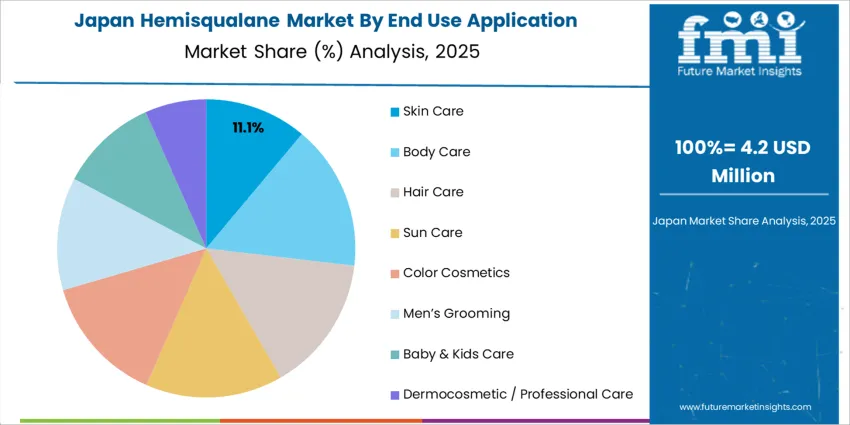
Demand in Japan is increasing at a CAGR of 8.9% through 2035 for hemisqualane usage, sustained by minimal texture skincare preferences, high purity formulation standards, and advanced hair treatment development. Hemisqualane is applied in essence lotions, leave in hair treatments, and sensitive skin emulsions. Domestic refinement supports strict quality consistency. Dermatology focused brands favor hemisqualane for low irritation performance. Demand stays quality driven and application focused, supported by aging population skincare needs, continuous cosmetic formulation upgrades, and strong consumer trust in lightweight emollient technologies.
- Essence lotions sustain daily facial care usage
- Leave in hair treatments anchor professional demand
- Domestic refinement stabilizes purity consistency
- Sensitive skin products support regulated cosmetic use
What Is Supporting Hemisqualane Market Expansion in the United Kingdom?
Growth in the UK is advancing at a CAGR of 8.2% through 2035 for hemisqualane demand, supported by clean beauty innovation, vegan personal care adoption, and premium haircare expansion. Hemisqualane appears in frizz control serums, lightweight facial oils, and makeup primers. Independent beauty brands and salon channels support steady brand penetration. Imports dominate sourcing. Demand remains retail driven and ingredient focused, shaped by rising silicone free product demand, steady growth of premium hair treatments, and strong penetration of biodegradable emollients across clean beauty product lines.
- Vegan beauty trends drive formulation demand
- Frizz control products support haircare volume
- Salon channels sustain professional usage
- Imported sourcing dominates ingredient supply
How Is Germany Integrating Hemisqualane into Regulated Skincare and Haircare?
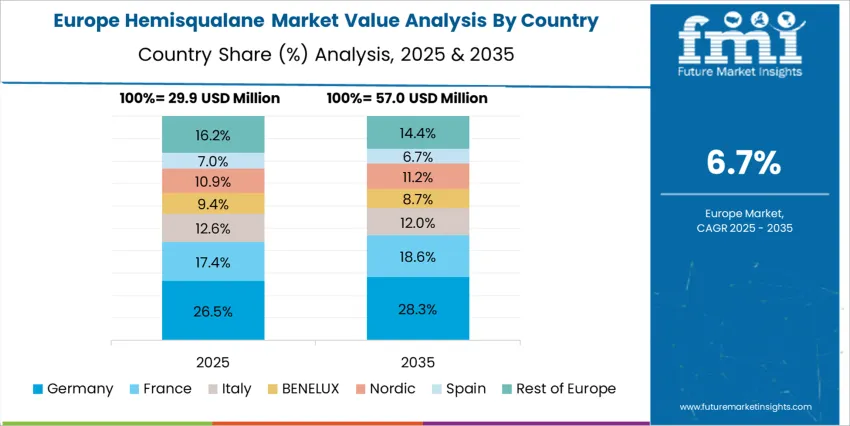
Growth in Germany reflects a CAGR of 7.4% through 2035 for hemisqualane consumption, driven by certified natural cosmetics, pharmacy grade hair treatments, and regulated dermaceutical formulations. Hemisqualane is used in scalp repair lotions, sensitive skin creams, and restorative hair oils. Strict testing, documentation, and labeling standards guide ingredient qualification. Imports remain the primary supply route. Demand stays quality focused and regulation aligned, supported by preventive scalp care habits, controlled cosmetic usage, and steady expansion of biodegradable emollients across pharmacy and certified organic retail networks.
- Certified natural cosmetics anchor regulated demand
- Scalp repair treatments support haircare usage
- Testing standards shape supplier qualification
- Pharmacy retail stabilizes long term product turnover
What Is Driving Measured Hemisqualane Growth in the United States?
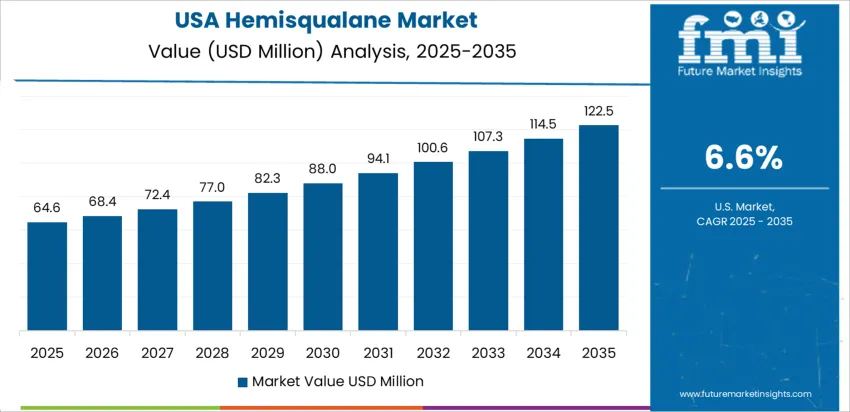
Expansion in the United States is moving at a CAGR of 6.6% through 2035 for hemisqualane demand, supported by clean beauty brand development, hybrid skincare oils, and salon grade haircare innovation. Hemisqualane appears in glow serums, lightweight moisturizers, heat protection sprays, and styling oils. Coastal beauty markets lead early adoption, with gradual expansion into national retail chains. Imports supply most raw material. Demand remains innovation driven and application diverse, shaped by rising demand for silicone alternatives and steady premium hair treatment product development across professional and consumer beauty channels.
- Hybrid skincare oils drive daily facial care demand
- Heat protection sprays support styling applications
- Salon grade hair products sustain professional uptake
- Import dependence dominates national ingredient sourcing
What Is Driving the Global Demand for Hemisqualane and Who Are the Key Suppliers Supplying It
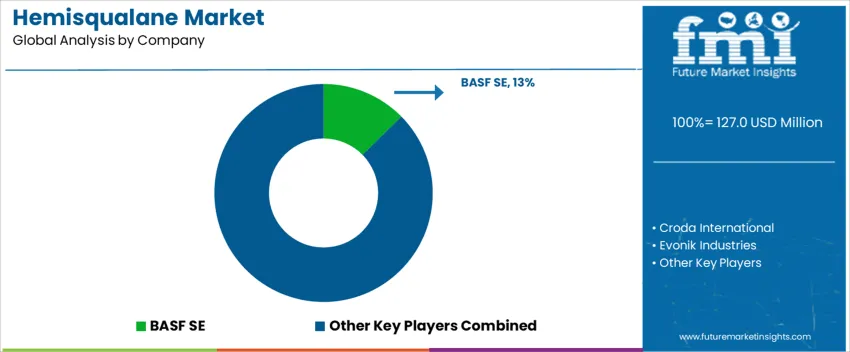
Global demand for hemisqualane is rising as personal-care and cosmetic manufacturers increasingly seek lightweight, fast-absorbing emollients that provide smooth skin feel without greasiness. Hemisqualane, a plant-derived C13-15 alkane, offers excellent spreadability, moisturization, and compatibility with a wide range of formulations. Its ability to enhance texture, stabilize active ingredients, and deliver a silky finish makes it desirable in skincare, haircare, sun care, and color cosmetics. Rising consumer preference for clean-label, naturally derived, and environmentally conscious ingredients further supports its adoption. Growth in premium skincare, anti-aging products, and multifunctional cosmetic formulations also drives market expansion as brands incorporate hemisqualane to improve product performance, feel, and sensory attributes.
Key global suppliers shaping the hemisqualane market include BASF SE, Croda International, Evonik Industries, Symrise, including IFF/Givaudan actives, Dow Inc., Ashland, Clariant, and specialty firms such as Seppic, Lubrizol, Lonza, and Inolex. Large ingredient producers supply high-volume, standardized hemisqualane suitable for mass-market cosmetic and personal-care formulations, ensuring consistent quality and regulatory compliance. Specialty firms provide purified, application-specific variants designed for premium or niche products.
Key Players in the Hemisqualane Market
- BASF SE
- Croda International
- Evonik Industries
- Symrise (incl. IFF/Givaudan actives)
- Dow / Dow Inc.
- Ashland
- Clariant
- Seppic
- Others
Scope of the report
| Items | Values |
|---|---|
| Quantitative Units (2025) | USD million |
| End-Use Applications | Skin Care, Body Care, Hair Care, Sun Care, Color Cosmetics, Men’s Grooming, Baby & Kids Care, Dermocosmetic / Professional Care |
| Product Forms | Powder, Granules/Agglomerates, Flakes, Pellets/Prills, Liquid (Solution), Concentrate (High-active Liquid), Dispersion/Suspension, Emulsion, Paste, Gel, Wax / Solid Block, Oil |
| Regions Covered | Asia Pacific, Europe, North America, Latin America, Middle East & Africa |
| Countries Covered | China, Japan, South Korea, India, Australia & New Zealand, ASEAN, Germany, United Kingdom, France, Italy, Spain, Nordic, BENELUX, USA, Canada, Mexico, Brazil, Chile, Saudi Arabia, Turkey, South Africa, plus 40+ additional countries globally |
| Key Companies Profiled | BASF SE, Croda International, Evonik Industries, Symrise (incl. IFF/Givaudan actives), Dow Inc., Ashland, Clariant, Seppic, Lubrizol, Lonza, Inolex |
| Additional Attributes | Dollar by sales breakdown by region, country, end-use, and product form; global growth projections; multi-sector adoption (cosmetic, nutraceutical, functional food); extract bioactivity profiling; iodine and polyphenol standardization; contract harvesting; vertical integration; supply chain stability; regulatory compliance; sensory and bioavailability performance |
Hemisqualane Market Segmentation
End Use Application:
- Skin Care
- Body Care
- Hair Care
- Sun Care
- Color Cosmetics
- Men’s Grooming
- Baby & Kids Care
- Dermocosmetic / Professional Care
Product Form:
- Powder
- Granules / Agglomerates
- Flakes
- Pellets / Prills
- Liquid (Solution)
- Concentrate (High-active Liquid)
- Dispersion / Suspension
- Emulsion
- Paste
- Gel
- Wax / Solid Block
- Oil
Region
-
Asia Pacific
- China
- Japan
- South Korea
- India
- Australia & New Zealand
- ASEAN
- Rest of Asia Pacific
-
Europe
- Germany
- United Kingdom
- France
- Italy
- Spain
- Nordic
- BENELUX
- Rest of Europe
-
North America
- United States
- Canada
- Mexico
-
Latin America
- Brazil
- Chile
- Rest of Latin America
-
Middle East & Africa
- Kingdom of Saudi Arabia
- Other GCC Countries
- Turkey
- South Africa
- Other African Union
- Rest of Middle East & Africa
Frequently Asked Questions
How big is the hemisqualane market in 2025?
The global hemisqualane market is estimated to be valued at USD 127.0 million in 2025.
What will be the size of hemisqualane market in 2035?
The market size for the hemisqualane market is projected to reach USD 268.5 million by 2035.
How much will be the hemisqualane market growth between 2025 and 2035?
The hemisqualane market is expected to grow at a 7.8% CAGR between 2025 and 2035.
What are the key product types in the hemisqualane market?
The key product types in hemisqualane market are skin care, body care, hair care, sun care, color cosmetics, men’s grooming, baby & kids care and dermocosmetic / professional care.
Which product form segment to contribute significant share in the hemisqualane market in 2025?
In terms of product form , powder segment to command 14.6% share in the hemisqualane market in 2025.
Preview the report firsthand - request a free sample
Get SampleGet the brochure for pricing and purchase details.
Get PDFTable of Content
- Executive Summary
- Global Market Outlook
- Demand-side Trends
- Supply-side Trends
- Technology Roadmap Analysis
- Analysis and Recommendations
- Market Overview
- Market Coverage / Taxonomy
- Market Definition / Scope / Limitations
- Market Background
- Market Dynamics
- Drivers
- Restraints
- Opportunity
- Trends
- Scenario Forecast
- Demand in Optimistic Scenario
- Demand in Likely Scenario
- Demand in Conservative Scenario
- Opportunity Map Analysis
- Product Life Cycle Analysis
- Supply Chain Analysis
- Investment Feasibility Matrix
- Value Chain Analysis
- PESTLE and Porter’s Analysis
- Regulatory Landscape
- Regional Parent Market Outlook
- Production and Consumption Statistics
- Import and Export Statistics
- Market Dynamics
- Global Market Analysis 2020 to 2024 and Forecast, 2025 to 2035
- Historical Market Size Value (USD Million) Analysis, 2020 to 2024
- Current and Future Market Size Value (USD Million) Projections, 2025 to 2035
- Y-o-Y Growth Trend Analysis
- Absolute $ Opportunity Analysis
- Global Market Pricing Analysis 2020 to 2024 and Forecast 2025 to 2035
- Global Market Analysis 2020 to 2024 and Forecast 2025 to 2035, By End Use Application
- Introduction / Key Findings
- Historical Market Size Value (USD Million) Analysis By End Use Application , 2020 to 2024
- Current and Future Market Size Value (USD Million) Analysis and Forecast By End Use Application , 2025 to 2035
- Skin Care
- Body Care
- Hair Care
- Sun Care
- Color Cosmetics
- Men’s Grooming
- Baby & Kids Care
- Dermocosmetic / Professional Care
- Y-o-Y Growth Trend Analysis By End Use Application , 2020 to 2024
- Absolute $ Opportunity Analysis By End Use Application , 2025 to 2035
- Global Market Analysis 2020 to 2024 and Forecast 2025 to 2035, By Product Form
- Introduction / Key Findings
- Historical Market Size Value (USD Million) Analysis By Product Form, 2020 to 2024
- Current and Future Market Size Value (USD Million) Analysis and Forecast By Product Form, 2025 to 2035
- Powder
- Granules / Agglomerates
- Flakes
- Pellets / Prills
- Liquid (Solution)
- Concentrate (High-active Liquid)
- Dispersion / Suspension
- Emulsion
- Paste
- Gel
- Wax / Solid Block
- Y-o-Y Growth Trend Analysis By Product Form, 2020 to 2024
- Absolute $ Opportunity Analysis By Product Form, 2025 to 2035
- Global Market Analysis 2020 to 2024 and Forecast 2025 to 2035, By Region
- Introduction
- Historical Market Size Value (USD Million) Analysis By Region, 2020 to 2024
- Current Market Size Value (USD Million) Analysis and Forecast By Region, 2025 to 2035
- North America
- Latin America
- Western Europe
- Eastern Europe
- East Asia
- South Asia and Pacific
- Middle East & Africa
- Market Attractiveness Analysis By Region
- North America Market Analysis 2020 to 2024 and Forecast 2025 to 2035, By Country
- Historical Market Size Value (USD Million) Trend Analysis By Market Taxonomy, 2020 to 2024
- Market Size Value (USD Million) Forecast By Market Taxonomy, 2025 to 2035
- By Country
- USA
- Canada
- Mexico
- By End Use Application
- By Product Form
- By Country
- Market Attractiveness Analysis
- By Country
- By End Use Application
- By Product Form
- Key Takeaways
- Latin America Market Analysis 2020 to 2024 and Forecast 2025 to 2035, By Country
- Historical Market Size Value (USD Million) Trend Analysis By Market Taxonomy, 2020 to 2024
- Market Size Value (USD Million) Forecast By Market Taxonomy, 2025 to 2035
- By Country
- Brazil
- Chile
- Rest of Latin America
- By End Use Application
- By Product Form
- By Country
- Market Attractiveness Analysis
- By Country
- By End Use Application
- By Product Form
- Key Takeaways
- Western Europe Market Analysis 2020 to 2024 and Forecast 2025 to 2035, By Country
- Historical Market Size Value (USD Million) Trend Analysis By Market Taxonomy, 2020 to 2024
- Market Size Value (USD Million) Forecast By Market Taxonomy, 2025 to 2035
- By Country
- Germany
- UK
- Italy
- Spain
- France
- Nordic
- BENELUX
- Rest of Western Europe
- By End Use Application
- By Product Form
- By Country
- Market Attractiveness Analysis
- By Country
- By End Use Application
- By Product Form
- Key Takeaways
- Eastern Europe Market Analysis 2020 to 2024 and Forecast 2025 to 2035, By Country
- Historical Market Size Value (USD Million) Trend Analysis By Market Taxonomy, 2020 to 2024
- Market Size Value (USD Million) Forecast By Market Taxonomy, 2025 to 2035
- By Country
- Russia
- Poland
- Hungary
- Balkan & Baltic
- Rest of Eastern Europe
- By End Use Application
- By Product Form
- By Country
- Market Attractiveness Analysis
- By Country
- By End Use Application
- By Product Form
- Key Takeaways
- East Asia Market Analysis 2020 to 2024 and Forecast 2025 to 2035, By Country
- Historical Market Size Value (USD Million) Trend Analysis By Market Taxonomy, 2020 to 2024
- Market Size Value (USD Million) Forecast By Market Taxonomy, 2025 to 2035
- By Country
- China
- Japan
- South Korea
- By End Use Application
- By Product Form
- By Country
- Market Attractiveness Analysis
- By Country
- By End Use Application
- By Product Form
- Key Takeaways
- South Asia and Pacific Market Analysis 2020 to 2024 and Forecast 2025 to 2035, By Country
- Historical Market Size Value (USD Million) Trend Analysis By Market Taxonomy, 2020 to 2024
- Market Size Value (USD Million) Forecast By Market Taxonomy, 2025 to 2035
- By Country
- India
- ASEAN
- Australia & New Zealand
- Rest of South Asia and Pacific
- By End Use Application
- By Product Form
- By Country
- Market Attractiveness Analysis
- By Country
- By End Use Application
- By Product Form
- Key Takeaways
- Middle East & Africa Market Analysis 2020 to 2024 and Forecast 2025 to 2035, By Country
- Historical Market Size Value (USD Million) Trend Analysis By Market Taxonomy, 2020 to 2024
- Market Size Value (USD Million) Forecast By Market Taxonomy, 2025 to 2035
- By Country
- Kingdom of Saudi Arabia
- Other GCC Countries
- Turkiye
- South Africa
- Other African Union
- Rest of Middle East & Africa
- By End Use Application
- By Product Form
- By Country
- Market Attractiveness Analysis
- By Country
- By End Use Application
- By Product Form
- Key Takeaways
- Key Countries Market Analysis
- USA
- Pricing Analysis
- Market Share Analysis, 2024
- By End Use Application
- By Product Form
- Canada
- Pricing Analysis
- Market Share Analysis, 2024
- By End Use Application
- By Product Form
- Mexico
- Pricing Analysis
- Market Share Analysis, 2024
- By End Use Application
- By Product Form
- Brazil
- Pricing Analysis
- Market Share Analysis, 2024
- By End Use Application
- By Product Form
- Chile
- Pricing Analysis
- Market Share Analysis, 2024
- By End Use Application
- By Product Form
- Germany
- Pricing Analysis
- Market Share Analysis, 2024
- By End Use Application
- By Product Form
- UK
- Pricing Analysis
- Market Share Analysis, 2024
- By End Use Application
- By Product Form
- Italy
- Pricing Analysis
- Market Share Analysis, 2024
- By End Use Application
- By Product Form
- Spain
- Pricing Analysis
- Market Share Analysis, 2024
- By End Use Application
- By Product Form
- France
- Pricing Analysis
- Market Share Analysis, 2024
- By End Use Application
- By Product Form
- India
- Pricing Analysis
- Market Share Analysis, 2024
- By End Use Application
- By Product Form
- ASEAN
- Pricing Analysis
- Market Share Analysis, 2024
- By End Use Application
- By Product Form
- Australia & New Zealand
- Pricing Analysis
- Market Share Analysis, 2024
- By End Use Application
- By Product Form
- China
- Pricing Analysis
- Market Share Analysis, 2024
- By End Use Application
- By Product Form
- Japan
- Pricing Analysis
- Market Share Analysis, 2024
- By End Use Application
- By Product Form
- South Korea
- Pricing Analysis
- Market Share Analysis, 2024
- By End Use Application
- By Product Form
- Russia
- Pricing Analysis
- Market Share Analysis, 2024
- By End Use Application
- By Product Form
- Poland
- Pricing Analysis
- Market Share Analysis, 2024
- By End Use Application
- By Product Form
- Hungary
- Pricing Analysis
- Market Share Analysis, 2024
- By End Use Application
- By Product Form
- Kingdom of Saudi Arabia
- Pricing Analysis
- Market Share Analysis, 2024
- By End Use Application
- By Product Form
- Turkiye
- Pricing Analysis
- Market Share Analysis, 2024
- By End Use Application
- By Product Form
- South Africa
- Pricing Analysis
- Market Share Analysis, 2024
- By End Use Application
- By Product Form
- USA
- Market Structure Analysis
- Competition Dashboard
- Competition Benchmarking
- Market Share Analysis of Top Players
- By Regional
- By End Use Application
- By Product Form
- Competition Analysis
- Competition Deep Dive
- BASF SE
- Overview
- Product Portfolio
- Profitability by Market Segments (Product/Age /Sales Channel/Region)
- Sales Footprint
- Strategy Overview
- Marketing Strategy
- Product Strategy
- Channel Strategy
- Croda International
- Evonik Industries
- Symrise (incl. IFF/Givaudan actives)
- Dow / Dow Inc.
- Ashland
- Clariant
- Seppic
- Others
- BASF SE
- Competition Deep Dive
- Assumptions & Acronyms Used
- Research Methodology


