

- Market Size (2026)
- USD 860.7 Mn
- Forecast (2036)
- USD 1824.1 Mn
- CAGR (2026 to 2036)
- 7.8%
How big is HFO Cleaning Solvents Market size?
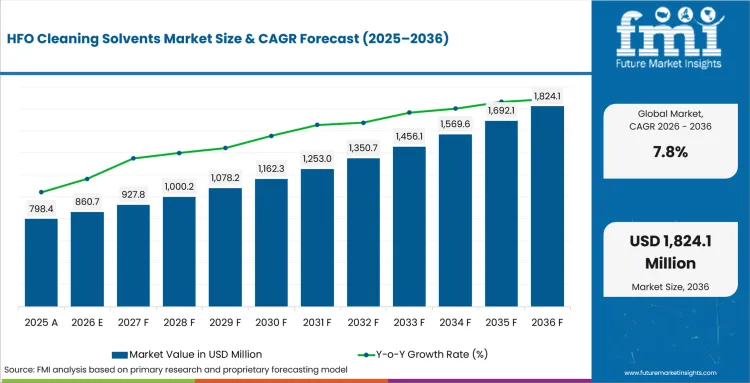
USD 860.7 million in 2026 and USD 1824.1 million by 2036 at 7.8% CAGR.
Sales in HFO cleaning solvents market are projected to grow at 7.8% CAGR through 2036, driving valuation to USD 1824.1 million by 2036 from USD 860.7 million in 2026. Formulators actively use specialized chemical platforms managing regulatory constraints and preserving vital technical evidence. In April 2026, American Chemistry Council reported stating its index for major customer demand within chemical manufacturing leaped into positive territory. Accessing extensive material availability influences wider candidate screening across both solvent discovery and industrial degreasing programs. Such specialized distribution platforms help product developers create compliant fluid options faster and more efficiently.
United States and Germany accounts are expected to prioritize validation records and application-family continuity. South Korea and France accounts are likely to emphasize local tooling access and faster supply response. Organizations in United States and Europe prioritize clear evidence lineage and controlled access. In February 2026, European Chemicals Agency reported for 145 active substances undergoing review for biocidal product authorization. Growing enterprise compliance directly supports extensive use of specialized software across regional formulation teams.
Key Takeaways for HFO Cleaning Solvents Market
- Demand for HFO cleaning solvents is driven by shorter development cycles, with chemical companies favoring fluids comparing degreasing options within defined technical and regulatory constraints.
- Direct chemical supply is forecast to garner 46.0% share of sales model in 2026, influenced by shared access across distributed purchasing teams and centralized inventory maintenance.
- Neat solvent is estimated to lead delivery form with 44.0% share in 2026, backed by multi-constraint assessment across flammability and toxicity requirements.
- Inconsistent specifications and incomplete testing records represent primary barriers limiting dependable recommendations and enterprise-level implementation.
- Competition focusses on Honeywell, Chemours, Arkema, AGC Chemicals, Daikin, Solvay, Enviro Tech International, MicroCare, Techspray, and Inventec Performance Chemicals, with providers differentiating based on chemical knowledge and engineering assistance.
Analyst Perspective
“Solvent substitution decisions extend beyond simple chemical equivalence into complete regulatory and operational compliance verification. Engineering teams evaluate long-term toxicity documentation and surface interaction profiles to prevent site-level qualification delays. Lasting commercial expansion relies on backing environmental safety claims with verifiable physical testing records across specific cleaning protocols.”
- Nikhil Kaitwade, Principal Analyst at Future Market Insights
How is HFO Cleaning Solvents Market segmented?
The HFO cleaning solvents industry is segmented by HFO chemistry, cleaning application, delivery form, end use, sales model, compliance driver, and region.
The HFO cleaning solvents market is segmented by HFO chemistry, cleaning application, delivery form, end use, sales model, compliance driver, and region. HFO chemistry coverage includes HFO-1233zd-based Solvents and related blends serving distinct performance requirements. Cleaning application coverage addresses precision electronics cleaning together with vapor degreasing. Delivery form assessment and end-use retrieval complete analytical coverage across product development. Sales model coverage spans direct chemical supply, specialty distributors, and equipment bundled options. Compliance driver coverage includes low GWP replacement and nonflammability targets. Regional coverage includes North America and Latin America together with Western Europe. Eastern Europe and East Asia extend analysis across established formulation industries. South Asia and Pacific with Middle East and Africa complete geographic assessment.
What makes HFO-1233zd-based solvents central to HFO chemistry selection?
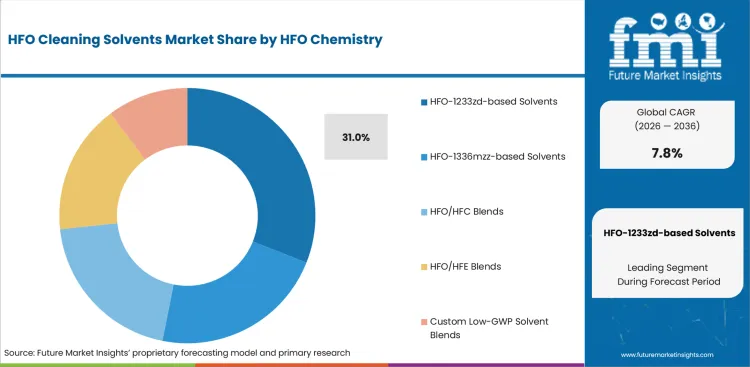
HFO-1233zd-based solvents address safety mandates, maintaining acceptable degreasing efficacy across automated industrial production lines. Environmental agencies enforce strict phase-down schedules for older fluorinated compounds, pushing engineering teams toward compliant alternatives. U.S. Environmental Protection Agency published final rules on March 20, 2026, establishing specific workplace exposure limits affecting 12.5 million industrial workers in the manufacturing facilities. Technical personnel evaluate vapor pressure characteristics ensuring compatible hardware operation during continuous wash cycles.
- HFO-1233zd-based solvents are estimated to secure 31.0% share in 2026 addressing primary specification needs with fewer operational exceptions. Facility managers inspect purity certificates confirming compliance with national environmental safety standards prior to purchase order release.
- Alternative chemical formulations remain available for specialized immersion tasks requiring distinct boiling point parameters. Production engineers review thermodynamic compatibility data verifying performance across legacy degreasing equipment.
Why does precision electronics cleaning lead cleaning application demand?
Precision electronics cleaning dominates category by preventing microscopic particulate failures across sensitive circuit assemblies in modern manufacturing plants. High-density component packaging requires specialized fluids possessing extremely low surface tension parameters to penetrate tight clearances. Deloitte reported in February 2026 global semiconductor industry revenues reached USD 618 billion driven by infrastructure expansion. Assembly line managers prioritize non-conductive fluid properties preventing electrical shorting during automated wash cycles.
- Precision electronics cleaning is forecast to capture 27.0% share in 2026, aided by expanding semiconductor production volumes. Manufacturers demand residue-free evaporation maintaining critical signal integrity across multi-layer printed circuit boards.
- Alternative cleaning applications serve heavy-duty industrial degreasing operations and specialized component maintenance tasks. Quality assurance personnel verify contaminant removal efficacy using standardized analytical testing protocols.
Why does neat solvent lead delivery form demand?
Neat solvent combines cost and performance during early candidate screening. Processing limits and evaporation targets narrow workable options prior to laboratory preparation. Arkema challenged participating aerospace contractors in April 2025 to reduce consumption rates by up to 20.0%, reinforcing demand for multi-constraint formulation support. Physical trials confirm matrix behavior and cleaning performance during final product approval.
- In 2026, neat solvent is anticipated to account for 44.0% share owing to its role in screening commercially workable candidates. Constraint comparison removes unsuitable options prior to large-scale resource allocation.
- Aerosol cleaner and drum bulk liquid formats support specialized maintenance needs during later application stages. Reclaimed formats confirm environmental goals during final specification approval.
What supports electronics manufacturing across end use demand?
Electronics manufacturing drives consumption through continuous component miniaturization trends in global technology production hubs requiring specialized surface preparation. Fabricators deploy automated cleaning lines demanding consistent solvent purity levels to maintain high production yields. Statistics Korea reported 8.2% expansion in electronic equipment manufacturing activity during January 2026, boosting baseline chemical consumption volumes by 140,000 tonnes annually. Production engineers require comprehensive toxicological profiles prior to approving factory floor deployment of novel chemical agents.
- Electronics manufacturing is projected to command 33.0% share in 2026, propelled by zero-defect tolerance mandates. Quality assurance departments verify solvent lot consistency preventing catastrophic batch failures during final assembly.
- Secondary end-use sectors consume specialized cleaning agents for life-safety component maintenance and heavy machinery upkeep. Operational supervisors review maintenance logs confirming adherence to scheduled solvent replacement intervals.
What makes direct chemical supply central to sales model selection?
Direct chemical supply promotes shared specification work across supplier and customer engineering teams. Technical briefs and validation records stay available inside one controlled workspace. Chemours reported 40 distribution agreements in March 2026, demonstrating recurring collaboration across scientific development programs. Centralized quoting reduces duplicate testing across participating laboratories and customer business units.
- Direct chemical supply is predicted to represent 46.0% share of sales model in 2026, driven by shared access across distributed purchasing groups. Customer teams assess identity controls and regional availability during enterprise platform reviews.
- Specialty chemical distributors contribute to companies requiring localized inventory and rapid replenishment. Local ownership increases maintenance duties across safety updates and compliance administration.
What supports low GWP replacement across compliance driver demand?
Regional emission rules extend technical guidance across customer development programs. Honeywell reported service coverage across 120 global jurisdictions in July 2026, promoting demand for maintained regional compliance guidance. Customer teams retain authority for matrix testing and final specification approval. Chemical suppliers retain detailed knowledge about exposure limits and processing tolerance across degreasing applications.
- By compliance driver, low GWP replacement is likely to hold 38.0% share in 2026 since being driven by proprietary product knowledge supporting substitution reviews. Controlled assistance connects technical records with customer formulation needs.
- Nonflammability need manages safety specifications across hazardous work environments. VOC reduction emphasizes regulatory adherence across varied regional mandates.
What are drivers, restraints, and opportunities in HFO Cleaning Solvents Market?
Regulated chemistry replacement forces buyers to prove use conditions prior to purchase. Approved chemistries with clear application instructions gain share among contractors needing audit-ready documentation.
- Driver: Sourcing teams need wider candidate comparison without multiplying avoidable physical experiments across every product program. Structured evaluation eliminates redundant trials during initial concept screening.
- Restraint: Inconsistent specifications and testing records weaken chemical reliability during technical approval and product release. Unverified performance metrics extend safety qualification timelines.
- Opportunity: Controlled platforms connect fluid knowledge with experiments and approved scale-up learning across related development programs. Verified performance history accelerates commercialization across secondary industrial applications.
Sourcing teams compare expanding chemical combinations under tighter environmental and cost requirements. ASTM International issued ASTM G93/G93M:2025 guidelines for precision cleaning agents in 2025, providing clear application instructions across 29 documented pages for contractors needing audit-ready documentation. Enterprise familiarity with standardized analysis reduces training barriers during initial formulation assessment.
Evidence quality restricts adoption across specifications and safety testing records. U.S. Environmental Protection Agency updated Significant New Alternatives Policy guidelines for cleaning solvents in March 2026, mandating cross-media analysis across 7 distinct risk factors. Formulators need consistent units and revision histories across regulatory records.
European Commission adopted Delegated Regulation EU 2026/447 in February 2026, restricting carbon dioxide exposure below 0.1% volume limits across occupational environments. Greater data depth supports wider candidate evaluation under documented scientific conditions. Governed scientific records create expansion potential across fluid discovery and maintenance programs.
How are country CAGRs aligned in HFO Cleaning Solvents Market?
| Country or Market | CAGR |
|---|---|
| South Korea | 7.5% |
| France | 7.1% |
| United States | 6.8% |
| Germany | 6.4% |
| Japan | 6.1% |
Source: Future Market Insights analysis, 2026.
How do country-level CAGRs compare in HFO Cleaning Solvents Market?
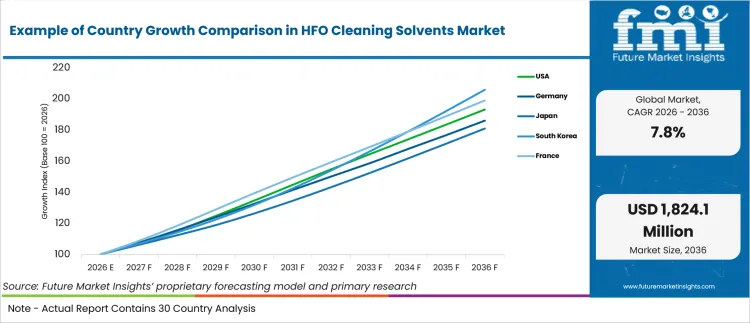
Country comparison shows gradual step-down across markets covered. South Korea occupies upper ends of ranges, followed by France. United States forms middle positions across disclosed comparisons. Germany and Japan complete lower forecast bands. A 1.4 percentage-point spread separates South Korea from Japan. Profiled rates reflect comparable expansion prospects under distinct implementation conditions.
- South Korea is anticipated to lead comparisons and place East Asia at upper forecast positions.
- France is likely to follow South Korea and maintain limited differences from leading rates.
- United States is expected to occupy middle bands under established enterprise specification review practices.
- Germany and Japan are projected to complete comparisons under documentation-intensive approval systems.
- Profiled rates create gradual downward slopes without sharp national separation.
Markets carrying similar CAGRs are expected to present distinct entry conditions based on regulatory maintenance and supplier-record quality. Full report coverage includes North America, Latin America, Europe, East Asia, South Asia and Pacific, Middle East and Africa.
Country-wise Analysis
- HFO cleaning solvents industry in South Korea is forecast to expand at 7.5% CAGR between 2026 and 2036, guided by localized rule maintenance and formal product-testing requirements. Regional onboarding needs encourage platforms supporting structured supplier records and maintained regulatory content. Statistics Korea listed 8.2% expansion in manufacturing activity within electronic equipment sectors in January 2026, reinforcing demand for formulation records connected with documented testing.
- National Institute of Statistics and Economic Studies reported 115.5 points on producer price indices for chemical products in May 2026, increasing formulation volumes across domestic producers. Expanding processing activity creates more specification records and ingredient substitutions across product programs. Demand in France is estimated to rise at 7.1% CAGR during study periods, aided by domestic manufacturing depth and localized platform requirements.
- Established enterprise software use promotes formulation-platform assessment across prominent United States chemical companies. Sector in United States is projected to record 6.8% CAGR from 2026 to 2036, reflecting established R&D operations and formal product-release controls. Federal Reserve reported capacity utilization for chemical manufacturing reaching 75.5 percent in April 2026, demonstrating enterprise familiarity across larger organizations.
- Sales in Germany are anticipated to scale at 6.4% CAGR during forecast periods, underpinned by enterprise software familiarity and separate national rule maintenance. Federal Statistical Office of Germany reported industrial production volumes dropping by 3.3% across specialized sectors in March 2026, influencing initial platform consideration across established companies. Configurable approval routes and maintained national content influence enterprise deployment decisions.
- Documentation-led reviews place emphasis on source records and controlled user permissions. Industry in Japan is predicted to grow at 6.1% CAGR during assessment periods, backed by formal governance practices across ingredient and chemical manufacturers. Ministry of Economy, Trade and Industry recorded industrial indices maintaining stable levels above 95.0 points in February 2026, highlighting established bases for specialist software assessment
Who are notable companies in HFO Cleaning Solvents Market?
Honeywell, Chemours, Arkema, AGC Chemicals, Daikin, Solvay, Enviro Tech International, MicroCare, Techspray, and Inventec Performance Chemicals are notable companies shaping HFO cleaning solvents market.
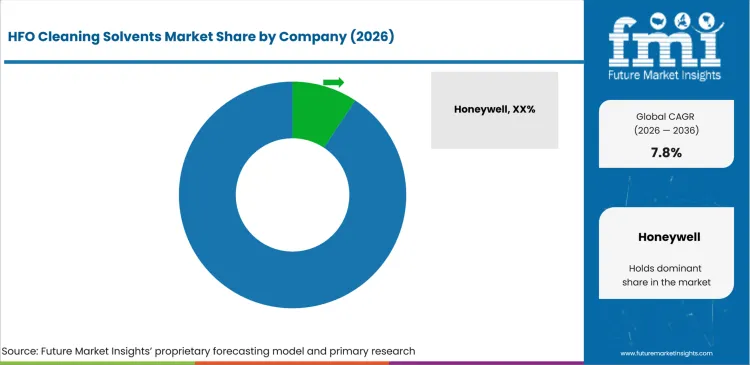
Competition in the sector centers on evidence quality and material science support across enterprise programs. Chemical groups use application laboratories and proprietary technical content during customer development. Formulation specialists focus on candidate comparison across precision cleaning constraints and environmental requirements. Discovery providers connect chemical screening with physical validation and fluid development. Buyer review covers data ownership and specialist access during implementation and renewal.
- Honeywell and Chemours compete based on application knowledge connected with customer formulation services. Product teams assess response quality across reformulation work and technical problem resolution.
- Arkema and AGC Chemicals focus on solvency expertise connected with controlled development tools. Manufacturing companies assess evidence depth across compatibility and performance decisions during candidate review.
- Daikin focuses on engineered formulation across product briefs and technical constraints. Customer teams assess output transparency and physical test handoff during platform review.
- Solvay and Enviro Tech International compete by specialized fluid discovery across industrial applications. MicroCare adds targeted flux removal supported by cleaning applications guidance.
Competitive Benchmarking: HFO Cleaning Solvents Market
| Company | Regulatory Fit | Application Specificity | Documentation Quality | Geographic Reach |
|---|---|---|---|---|
| Honeywell | High | High | High | Global or multi-region |
| Chemours | High | High | High | Global or multi-region |
| Arkema | High | Medium | Medium | Global or multi-region |
| AGC Chemicals | Medium | High | Medium | Regional and selected export markets |
| Daikin | Medium | Medium | Medium | Regional and selected export markets |
| Solvay | Medium | Medium | Medium | Regional and selected export markets |
| Enviro Tech International | Medium | Medium | Medium | Regional and selected export markets |
| MicroCare | Low | Medium | Medium | Specialist or channel-led markets |
| Techspray | Low | Low | Low | Specialist or channel-led markets |
| Inventec Performance Chemicals | Low | Low | Low | Specialist or channel-led markets |
Source: Future Market Insights competitive analysis, 2026.
Key Developments in HFO Cleaning Solvents Market
- In August 2025, Chemours reported digitized compliance management across fluid development operations. Company information connected chemical databases with quicker review and stronger environmental records.
- In January 2026, Arkema launched advanced precision agents for development decisions across component programs. Company information connected performance data with opportunity ranking during early purchasing review.
- In March 2026, Honeywell launched Solstice specialty fluids for heavy-duty industrial solvents. Company information connected technical evidence with early commercial review across aerospace projects.
HFO Cleaning Solvents Market Report Scope
| Coverage field | Report scope |
|---|---|
| Market breakdown | HFO cleaning solvents market breakdown includes HFO chemistry, cleaning application, delivery form, end use, sales model, compliance driver, and region. |
| Market Definition | HFO cleaning solvents market revenue includes product and system sales directly linked to degreasing applications. It excludes broad parent categories where product is not commercial item being purchased. |
| Regions Covered | North America, Latin America, Western Europe, Eastern Europe, East Asia, South Asia and Pacific, Middle East and Africa. |
| Countries Covered | United States, Germany, Japan, South Korea, France and more than 25 additional countries complete full report coverage. |
| Key Companies Profiled | Honeywell, Chemours, Arkema, AGC Chemicals, Daikin, Solvay, Enviro Tech International, MicroCare, Techspray, and Inventec Performance Chemicals. |
| Forecast Period | 2026 to 2036 |
| Approach | Hybrid bottom-up and top-down methodology uses segment shares and country CAGRs. Company activity and buyer adoption support final market reconciliation. |
Source: Future Market Insights analysis, 2026.
HFO Cleaning Solvents Market - Research Methodology
| Method | Approach |
|---|---|
| Primary Research | FMI analysts gathered input from manufacturers, service providers, technology developers, distributors, end users, procurement teams, and subject-matter experts. Interviews examined purchasing decisions, product or service evaluation, adoption barriers, approval requirements, pricing considerations, and expectations for technical or commercial support. Respondents were also asked what evidence is required before a trial, pilot, or initial order develops into regular purchasing. |
| Desk Research | Desk research covered government statistics, regulatory publications, trade data, industry associations, technical literature, standards, company filings, product information, and official corporate announcements. Sources were reviewed for relevance, publication date, geographic coverage, and consistency with the defined market scope. Claims relating to performance, applications, approvals, capacity, investment, and commercial activity were retained only when supported by credible public evidence. |
| Market Sizing and Forecasting | The market model combined the baseline value with historical performance, segment structure, pricing and volume indicators, adoption levels, company participation, and country-level demand conditions. Forecast assumptions considered economic activity, investment trends, regulatory developments, technology adoption, purchasing cycles, supply availability, and barriers to wider market use. Segment and regional estimates were reconciled before the final market total was calculated. |
| Data Validation | Estimates were checked against multiple independent indicators, including public data, company activity, trade patterns, industry developments, and findings from primary interviews. Validation also tested whether products, services, applications, and company revenues fell within the defined market boundaries. Adjacent categories, unsupported claims, overlapping revenues, and activities without direct market relevance were excluded to reduce double counting and maintain consistency across segments and countries. |
Source: Future Market Insights analysis, 2026.
HFO Cleaning Solvents Market by Segments
HFO Cleaning Solvents Market segmented by HFO Chemistry:
- HFO-1233zd-based Solvents
- HFO-1336mzz-based Solvents
- HFO/HFC Blends
- HFO/HFE Blends
- Custom Low-GWP Solvent Blends
HFO Cleaning Solvents Market segmented by Cleaning Application:
- Precision Electronics Cleaning
- Vapor Degreasing
- Aerospace Parts Cleaning
- Metal Surface Cleaning
- Flux Removal
- Medical Device Cleaning
HFO Cleaning Solvents Market segmented by Delivery Form:
- Neat Solvent
- Aerosol Cleaner
- Drum / Bulk Liquid
- Reclaimed / Recycled Solvent
HFO Cleaning Solvents Market segmented by End Use:
- Electronics Manufacturing
- Aerospace & Defense
- Medical Devices
- Automotive Components
- Industrial MRO
HFO Cleaning Solvents Market segmented by Sales Model:
- Direct Chemical Supply
- Specialty Chemical Distributors
- Cleaning Equipment Bundled
HFO Cleaning Solvents Market segmented by Compliance Driver:
- Low GWP Replacement
- Nonflammability Need
- VOC / HAP Reduction
- Residue-free Cleaning
HFO Cleaning Solvents Market segmented by Region:
- North America
- United States
- Canada
- Latin America
- Brazil
- Mexico
- Argentina
- Chile
- Western Europe
- Germany
- France
- United Kingdom
- Italy
- Spain
- Benelux
- Nordics
- Eastern Europe
- Poland
- Czech Republic
- Romania
- Hungary
- East Asia
- China
- Japan
- South Korea
- South Asia and Pacific
- India
- ASEAN
- Australia and New Zealand
- Middle East and Africa
- GCC Countries
- South Africa
- Türkiye
- Israel
Research Sources and Bibliography
- American Chemistry Council. (2026, April 15). Chemical manufacturing economic sentiment index jumps in Q1.
- Arkema. (2026, January 10). Advanced precision agents for component programs.
- ASTM International. (2026, January 5). Global standards for precision cleaning agents.
- Chemours. (2025, August 22). Digitized compliance management across fluid development operations.
- European Chemicals Agency. (2026, February 18). Biocidal products authorization review status.
- Federal Reserve. (2026, April 12). Industrial production and capacity utilization report.
- Federal Statistical Office of Germany. (2026, March 10). Industrial production volumes across chemical sectors.
- Honeywell. (2026, March 14). Solstice specialty fluids for industrial cleaning.
- Ministry of Economy, Trade and Industry. (2026, February 20). Chemical industry production indices report.
- National Institute of Statistics and Economic Studies. (2026, May 14). Producer price index in industrial production.
- Statistics Korea. (2026, January 28). Manufacturing activity and electronic component production report.
- U.S. Environmental Protection Agency. (2026, March 22). Significant New Alternatives Policy regulations and final rules.
- Deloitte. (2025, February 4). 2025 global semiconductor industry outlook. Deloitte Insights.
- Statistics Korea. (2026, January 28). Manufacturing activity and electronic component production report. Government of South Korea.
- U.S. Environmental Protection Agency. (2026, March 20). Significant New Alternatives Policy regulations and final rules. U.S. Government Publishing Office.
- Deloitte. (2025, February 4). 2025 global semiconductor industry outlook. Deloitte Insights.
- Statistics Korea. (2026, January 28). Manufacturing activity and electronic component production report. Government of South Korea.
- U.S. Environmental Protection Agency. (2026, March 20). Significant New Alternatives Policy regulations and final rules. U.S. Government Publishing Office.
This bibliography is provided for reader reference and is not exhaustive. The full report contains complete reference list and detailed citations.
This Report Answers
- What is market size of HFO cleaning solvents market in 2026 and 2036?
- What operating pressures support demand for HFO cleaning solvents?
- Why does direct chemical supply hold its position in sales model?
- How does neat solvent influence downstream demand in delivery form?
- Why does low GWP replacement hold its position in compliance driver?
- How do country growth rates differ across South Korea, France, United States, Germany, and Japan?
- Which companies provide main categories of product or service?
- What limits adoption in HFO cleaning solvents?
- What should decision-makers evaluate prior to purchasing HFO cleaning solvents?
Frequently Asked Questions
How big is the HFO Cleaning Solvents Market in 2026?
The HFO cleaning solvents market is valued at USD 860.7 million in 2026 and is forecast to reach USD 1824.1 million by 2036. Growth is supported by regulated fluorinated-compound phase-downs that push formulators toward compliant chemistries across electronics, precision cleaning, and industrial degreasing programs worldwide.
What is the CAGR of the HFO Cleaning Solvents Market from 2026 to 2036?
The HFO cleaning solvents market grows at a CAGR of 7.8% between 2026 and 2036, supported by regulatory phase-down schedules and workplace exposure limits that push manufacturers toward compliant, low-GWP fluid chemistries across precision electronics cleaning and industrial degreasing applications globally.
Which sales model leads the HFO Cleaning Solvents Market?
Direct chemical supply accounts for 46.0% of the HFO cleaning solvents market by sales model in 2026, driven by shared access across distributed purchasing teams and centralized inventory maintenance that keeps technical briefs and validation records within one controlled supplier-customer workspace.
How much will the HFO Cleaning Solvents Market add between 2026 and 2036?
The HFO cleaning solvents market is set to add USD 963.4 million between 2026 and 2036, growing from USD 860.7 million to USD 1824.1 million as regulatory phase-downs and compliance-driven substitution expand adoption across electronics manufacturing and industrial degreasing programs worldwide.
Who are the leading companies in the HFO Cleaning Solvents Market?
Ten companies lead the HFO cleaning solvents market, including Honeywell, Chemours, Arkema, AGC Chemicals, Daikin, Solvay, Enviro Tech International, MicroCare, Techspray, and Inventec Performance Chemicals, competing through regulatory-fit chemistries, application specificity, and documentation quality across global and regional formulation networks.
Preview the report firsthand - request a free sample
Get SampleGet the brochure for pricing and purchase details.
Get PDFTable of Content
- Key Takeaways
- Market Size and CAGR
- Top Growth Driver
- Fastest Growing Segment
- Leading Region
- Key Companies
- Emerging Opportunities
- Executive Summary
- Global Market Outlook
- Demand-side Trends
- Supply-side Trends
- Technology Roadmap Analysis
- Analysis and Recommendations
- Analyst Perspective (What is happening? Why now? What should investors know?)
- Key Questions Answered
- How large is the market?
- What is the CAGR?
- What are key trends?
- Which region dominates?
- Who are the leaders?
- Market Overview
- Market Coverage / Taxonomy
- Market Definition / Scope / Limitations
- Research Methodology
- Chapter Orientation
- Analytical Lens and Working Hypotheses
- Market Structure, Signals, and Trend Drivers
- Benchmarking and Cross-market Comparability
- Market Sizing, Forecasting, and Opportunity Mapping
- Research Design and Evidence Framework
- Desk Research Programme (Secondary Evidence)
- Expert Input and Fieldwork (Primary Evidence)
- Tooling, Models, and Reference Databases
- Data Engineering and Model Build
- Quality Assurance and Audit Trail
- Market Background
- Market Dynamics (Drivers, Restraints, Opportunity, Trends)
- Scenario Forecast (Optimistic, Likely, Conservative)
- Impact Analysis
- AI Impact
- Sustainability Impact
- Regulatory Impact
- Technology Impact
- Consumer / Buyer Analysis
- Purchase Drivers
- Adoption Barriers
- Buyer Journey
- Opportunity Map Analysis
- Product Life Cycle Analysis
- Supply Chain Analysis
- Investment Feasibility Matrix
- Value Chain Analysis
- PESTLE and Porter's Analysis
- Regulatory Landscape
- Regional Parent Market Outlook
- Production and Consumption Statistics
- Import and Export Statistics
- Global Market Analysis and Forecast, 2021 to 2036
- Historical Market Size Value (USD Million) Analysis, 2021 to 2025
- Current and Future Market Size Value (USD Million) Projections, 2026 to 2036
- Y-o-Y Growth Trend Analysis
- Absolute $ Opportunity Analysis
- Global Market Pricing Analysis, 2021 to 2036
- Global Market Analysis and Forecast, By HFO Chemistry, 2021 to 2036
- Introduction / Key Findings
- Historical Market Size Value (USD Million) Analysis By HFO Chemistry, 2021 to 2025
- Current and Future Market Size Value (USD Million) Analysis and Forecast By HFO Chemistry, 2026 to 2036
- HFO-1233zd-based Solvents
- HFO-1336mzz-based Solvents
- HFO/HFC Blends
- HFO/HFE Blends
- Custom Low-GWP Solvent Blends
- HFO-1233zd-based Solvents
- Y-o-Y Growth Trend Analysis By HFO Chemistry, 2021 to 2025
- Absolute $ Opportunity Analysis By HFO Chemistry, 2026 to 2036
- Global Market Analysis and Forecast, By Cleaning Application, 2021 to 2036
- Introduction / Key Findings
- Historical Market Size Value (USD Million) Analysis By Cleaning Application, 2021 to 2025
- Current and Future Market Size Value (USD Million) Analysis and Forecast By Cleaning Application, 2026 to 2036
- Precision Electronics Cleaning
- Vapor Degreasing
- Aerospace Parts Cleaning
- Metal Surface Cleaning
- Flux Removal
- Medical Device Cleaning
- Precision Electronics Cleaning
- Y-o-Y Growth Trend Analysis By Cleaning Application, 2021 to 2025
- Absolute $ Opportunity Analysis By Cleaning Application, 2026 to 2036
- Global Market Analysis and Forecast, By Delivery Form, 2021 to 2036
- Introduction / Key Findings
- Historical Market Size Value (USD Million) Analysis By Delivery Form, 2021 to 2025
- Current and Future Market Size Value (USD Million) Analysis and Forecast By Delivery Form, 2026 to 2036
- Neat Solvent
- Aerosol Cleaner
- Drum / Bulk Liquid
- Reclaimed / Recycled Solvent
- Neat Solvent
- Y-o-Y Growth Trend Analysis By Delivery Form, 2021 to 2025
- Absolute $ Opportunity Analysis By Delivery Form, 2026 to 2036
- Global Market Analysis and Forecast, By End Use, 2021 to 2036
- Introduction / Key Findings
- Historical Market Size Value (USD Million) Analysis By End Use, 2021 to 2025
- Current and Future Market Size Value (USD Million) Analysis and Forecast By End Use, 2026 to 2036
- Electronics Manufacturing
- Aerospace & Defense
- Medical Devices
- Automotive Components
- Industrial MRO
- Electronics Manufacturing
- Y-o-Y Growth Trend Analysis By End Use, 2021 to 2025
- Absolute $ Opportunity Analysis By End Use, 2026 to 2036
- Global Market Analysis and Forecast, By Sales Model, 2021 to 2036
- Introduction / Key Findings
- Historical Market Size Value (USD Million) Analysis By Sales Model, 2021 to 2025
- Current and Future Market Size Value (USD Million) Analysis and Forecast By Sales Model, 2026 to 2036
- Direct Chemical Supply
- Specialty Chemical Distributors
- Cleaning Equipment Bundled
- Direct Chemical Supply
- Y-o-Y Growth Trend Analysis By Sales Model, 2021 to 2025
- Absolute $ Opportunity Analysis By Sales Model, 2026 to 2036
- Global Market Analysis and Forecast, By Compliance Driver
- Introduction / Key Findings
- Historical Market Size Value (USD Million) Analysis By Compliance Driver, 2021 to 2025
- Current and Future Market Size Value (USD Million) Analysis and Forecast By Compliance Driver, 2026 to 2036
- Low GWP Replacement
- Nonflammability Need
- VOC / HAP Reduction
- Residue-free Cleaning
- Low GWP Replacement
- Y-o-Y Growth Trend Analysis By Compliance Driver, 2021 to 2025
- Absolute $ Opportunity Analysis By Compliance Driver, 2026 to 2036
- Global Market Analysis and Forecast, By Region, 2021 to 2036
- Introduction
- Historical Market Size Value (USD Million) Analysis By Region, 2021 to 2025
- Current Market Size Value (USD Million) Analysis and Forecast By Region, 2026 to 2036
- North America
- Latin America
- Western Europe
- Eastern Europe
- East Asia
- South Asia and Pacific
- Middle East & Africa
- Market Attractiveness Analysis By Region
- North America Market Analysis and Forecast, By Country, 2021 to 2036
- Historical Market Size Value (USD Million) Trend Analysis By Market Taxonomy, 2021 to 2025
- Market Size Value (USD Million) Forecast By Market Taxonomy, 2026 to 2036
- By Country
- USA
- Canada
- By HFO Chemistry
- By Cleaning Application
- By Delivery Form
- By End Use
- By Sales Model
- By Compliance Driver
- By Country
- Market Attractiveness Analysis
- By Country
- By HFO Chemistry
- By Cleaning Application
- By Delivery Form
- By End Use
- By Sales Model
- By Compliance Driver
- Key Takeaways
- Latin America Market Analysis and Forecast, By Country
- Historical Market Size Value (USD Million) Trend Analysis By Market Taxonomy, 2021 to 2025
- Market Size Value (USD Million) Forecast By Market Taxonomy, 2026 to 2036
- By Country
- Brazil
- Mexico
- Chile
- Rest of Latin America
- By HFO Chemistry
- By Cleaning Application
- By Delivery Form
- By End Use
- By Sales Model
- By Compliance Driver
- By Country
- Market Attractiveness Analysis
- By Country
- By HFO Chemistry
- By Cleaning Application
- By Delivery Form
- By End Use
- By Sales Model
- By Compliance Driver
- Key Takeaways
- Western Europe Market Analysis and Forecast, By Country
- Historical Market Size Value (USD Million) Trend Analysis By Market Taxonomy, 2021 to 2025
- Market Size Value (USD Million) Forecast By Market Taxonomy, 2026 to 2036
- By Country
- Germany
- UK
- Italy
- Spain
- France
- Nordic
- BENELUX
- Rest of Western Europe
- By HFO Chemistry
- By Cleaning Application
- By Delivery Form
- By End Use
- By Sales Model
- By Compliance Driver
- By Country
- Market Attractiveness Analysis
- By Country
- By HFO Chemistry
- By Cleaning Application
- By Delivery Form
- By End Use
- By Sales Model
- By Compliance Driver
- Key Takeaways
- Eastern Europe Market Analysis and Forecast, By Country
- Historical Market Size Value (USD Million) Trend Analysis By Market Taxonomy, 2021 to 2025
- Market Size Value (USD Million) Forecast By Market Taxonomy, 2026 to 2036
- By Country
- Russia
- Poland
- Hungary
- Balkan & Baltic
- Rest of Eastern Europe
- By HFO Chemistry
- By Cleaning Application
- By Delivery Form
- By End Use
- By Sales Model
- By Compliance Driver
- By Country
- Market Attractiveness Analysis
- By Country
- By HFO Chemistry
- By Cleaning Application
- By Delivery Form
- By End Use
- By Sales Model
- By Compliance Driver
- Key Takeaways
- East Asia Market Analysis and Forecast, By Country
- Historical Market Size Value (USD Million) Trend Analysis By Market Taxonomy, 2021 to 2025
- Market Size Value (USD Million) Forecast By Market Taxonomy, 2026 to 2036
- By Country
- China
- Japan
- South Korea
- By HFO Chemistry
- By Cleaning Application
- By Delivery Form
- By End Use
- By Sales Model
- By Compliance Driver
- By Country
- Market Attractiveness Analysis
- By Country
- By HFO Chemistry
- By Cleaning Application
- By Delivery Form
- By End Use
- By Sales Model
- By Compliance Driver
- Key Takeaways
- South Asia and Pacific Market Analysis and Forecast, By Country
- Historical Market Size Value (USD Million) Trend Analysis By Market Taxonomy, 2021 to 2025
- Market Size Value (USD Million) Forecast By Market Taxonomy, 2026 to 2036
- By Country
- India
- ASEAN
- Australia & New Zealand
- Rest of South Asia and Pacific
- By HFO Chemistry
- By Cleaning Application
- By Delivery Form
- By End Use
- By Sales Model
- By Compliance Driver
- By Country
- Market Attractiveness Analysis
- By Country
- By HFO Chemistry
- By Cleaning Application
- By Delivery Form
- By End Use
- By Sales Model
- By Compliance Driver
- Key Takeaways
- Middle East & Africa Market Analysis and Forecast, By Country
- Historical Market Size Value (USD Million) Trend Analysis By Market Taxonomy, 2021 to 2025
- Market Size Value (USD Million) Forecast By Market Taxonomy, 2026 to 2036
- By Country
- Kingdom of Saudi Arabia
- Other GCC Countries
- Türkiye
- South Africa
- Other African Union
- Rest of Middle East & Africa
- By HFO Chemistry
- By Cleaning Application
- By Delivery Form
- By End Use
- By Sales Model
- By Compliance Driver
- By Country
- Market Attractiveness Analysis
- By Country
- By HFO Chemistry
- By Cleaning Application
- By Delivery Form
- By End Use
- By Sales Model
- By Compliance Driver
- Key Takeaways
- Key Countries Market Analysis
- USA
- Pricing Analysis
- Market Share Analysis, 2025
- By HFO Chemistry
- By Cleaning Application
- By Delivery Form
- By End Use
- By Sales Model
- By Compliance Driver
- Canada
- Pricing Analysis
- Market Share Analysis, 2025
- By HFO Chemistry
- By Cleaning Application
- By Delivery Form
- By End Use
- By Sales Model
- By Compliance Driver
- Mexico
- Pricing Analysis
- Market Share Analysis, 2025
- By HFO Chemistry
- By Cleaning Application
- By Delivery Form
- By End Use
- By Sales Model
- By Compliance Driver
- Brazil
- Pricing Analysis
- Market Share Analysis, 2025
- By HFO Chemistry
- By Cleaning Application
- By Delivery Form
- By End Use
- By Sales Model
- By Compliance Driver
- Chile
- Pricing Analysis
- Market Share Analysis, 2025
- By HFO Chemistry
- By Cleaning Application
- By Delivery Form
- By End Use
- By Sales Model
- By Compliance Driver
- Germany
- Pricing Analysis
- Market Share Analysis, 2025
- By HFO Chemistry
- By Cleaning Application
- By Delivery Form
- By End Use
- By Sales Model
- By Compliance Driver
- UK
- Pricing Analysis
- Market Share Analysis, 2025
- By HFO Chemistry
- By Cleaning Application
- By Delivery Form
- By End Use
- By Sales Model
- By Compliance Driver
- Italy
- Pricing Analysis
- Market Share Analysis, 2025
- By HFO Chemistry
- By Cleaning Application
- By Delivery Form
- By End Use
- By Sales Model
- By Compliance Driver
- Spain
- Pricing Analysis
- Market Share Analysis, 2025
- By HFO Chemistry
- By Cleaning Application
- By Delivery Form
- By End Use
- By Sales Model
- By Compliance Driver
- France
- Pricing Analysis
- Market Share Analysis, 2025
- By HFO Chemistry
- By Cleaning Application
- By Delivery Form
- By End Use
- By Sales Model
- By Compliance Driver
- India
- Pricing Analysis
- Market Share Analysis, 2025
- By HFO Chemistry
- By Cleaning Application
- By Delivery Form
- By End Use
- By Sales Model
- By Compliance Driver
- ASEAN
- Pricing Analysis
- Market Share Analysis, 2025
- By HFO Chemistry
- By Cleaning Application
- By Delivery Form
- By End Use
- By Sales Model
- By Compliance Driver
- Australia & New Zealand
- Pricing Analysis
- Market Share Analysis, 2025
- By HFO Chemistry
- By Cleaning Application
- By Delivery Form
- By End Use
- By Sales Model
- By Compliance Driver
- China
- Pricing Analysis
- Market Share Analysis, 2025
- By HFO Chemistry
- By Cleaning Application
- By Delivery Form
- By End Use
- By Sales Model
- By Compliance Driver
- Japan
- Pricing Analysis
- Market Share Analysis, 2025
- By HFO Chemistry
- By Cleaning Application
- By Delivery Form
- By End Use
- By Sales Model
- By Compliance Driver
- South Korea
- Pricing Analysis
- Market Share Analysis, 2025
- By HFO Chemistry
- By Cleaning Application
- By Delivery Form
- By End Use
- By Sales Model
- By Compliance Driver
- Russia
- Pricing Analysis
- Market Share Analysis, 2025
- By HFO Chemistry
- By Cleaning Application
- By Delivery Form
- By End Use
- By Sales Model
- By Compliance Driver
- Poland
- Pricing Analysis
- Market Share Analysis, 2025
- By HFO Chemistry
- By Cleaning Application
- By Delivery Form
- By End Use
- By Sales Model
- By Compliance Driver
- Hungary
- Pricing Analysis
- Market Share Analysis, 2025
- By HFO Chemistry
- By Cleaning Application
- By Delivery Form
- By End Use
- By Sales Model
- By Compliance Driver
- Kingdom of Saudi Arabia
- Pricing Analysis
- Market Share Analysis, 2025
- By HFO Chemistry
- By Cleaning Application
- By Delivery Form
- By End Use
- By Sales Model
- By Compliance Driver
- Türkiye
- Pricing Analysis
- Market Share Analysis, 2025
- By HFO Chemistry
- By Cleaning Application
- By Delivery Form
- By End Use
- By Sales Model
- By Compliance Driver
- South Africa
- Pricing Analysis
- Market Share Analysis, 2025
- By HFO Chemistry
- By Cleaning Application
- By Delivery Form
- By End Use
- By Sales Model
- By Compliance Driver
- USA
- Market Structure Analysis
- Competition Dashboard
- Competition Benchmarking
- Market Share Analysis of Top Players
- By Regional
- By HFO Chemistry
- By Cleaning Application
- By Delivery Form
- By End Use
- By Sales Model
- By Compliance Driver
- Emerging Startups
- Innovation Benchmarking
- Competition Analysis
- Competition Deep Dive
- Honeywell
- Overview
- Product Portfolio
- Profitability by Market Segments
- Sales Footprint
- Strategy Overview
- Marketing Strategy
- Product Strategy
- Channel Strategy
- Chemours
- Arkema
- AGC Chemicals
- Daikin
- Solvay
- Enviro Tech International
- MicroCare
- Techspray
- Inventec Performance Chemicals
- Honeywell
- Case Studies
- Success Stories
- Recent Developments
- Competition Deep Dive
- Assumptions & Acronyms Used


