

- Industry Size (2026)
- USD 2.2 Bn
- Forecast (2036)
- USD 4.5 Bn
- CAGR (2026 to 2036)
- 7.4%
High-Recyclability Mono-Material Flexible Packaging Market Forecast and Outlook 2026 to 2036
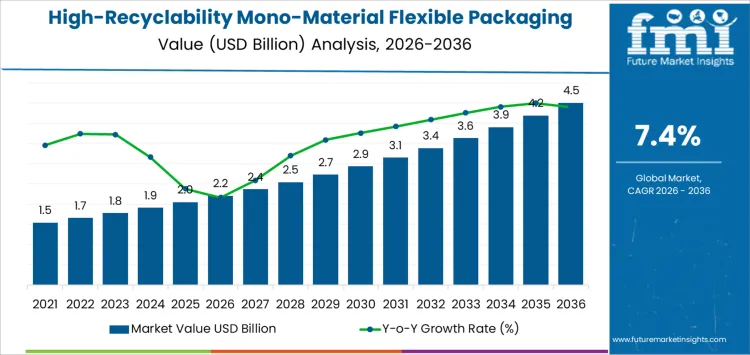
The high-recyclability mono-material flexible packaging market is valued at USD 2.2 billion in 2026 and is projected to reach USD 4.5 billion by 2036, reflecting a CAGR of 7.4%. The long-term value accumulation curve shows a consistent upward trajectory, with incremental value growth accumulating steadily over the decade. Early years (2026–2031) contribute foundational value, rising from USD 1.5 billion to approximately USD 3.0 billion in cumulative market worth. This stage reflects gradual adoption across FMCG, food, and personal care packaging segments, driven by sustainability initiatives and regulatory pressures favoring recyclable mono-materials.
From 2031 to 2036, cumulative value accelerates, adding USD 1.5 billion to reach USD 4.5 billion by 2036. Growth during this period is underpinned by broader industry adoption, standardized production processes, and repeat procurement across established brands. The accumulation curve indicates compounding benefits from sustained use of mono-material packaging, cost efficiencies, and improved recycling infrastructure. By 2036, long-term value reflects both direct revenue expansion and indirect advantages such as operational efficiencies, material savings, and alignment with circular economy practices, demonstrating structural resilience and sustainable accumulation of market worth over time.
Quick Stats of the High-Recyclability Mono-Material Flexible Packaging Market
- High-Recyclability Mono-Material Flexible Packaging Market Value (2026): USD 2.2 billion
- High-Recyclability Mono-Material Flexible Packaging Market Forecast Value (2036): USD 4.5 billion
- High-Recyclability Mono-Material Flexible Packaging Market Forecast CAGR (2026-2036): 7.4%
- High-Recyclability Mono-Material Flexible Packaging Market Leading Packaging Format: Stand-up Pouches (40%)
- High-Recyclability Mono-Material Flexible Packaging Market Key Growth Regions: India, China, USA, Brazil, Germany, Japan
- High-Recyclability Mono-Material Flexible Packaging Market Top Players: Amcor, Mondi, Sealed Air, Bischof + Klein, Huhtamaki (flexibles), UFlex, Klabin
What is the Growth Forecast for the High-Recyclability Mono-Material Flexible Packaging Market through 2036?
From 2026 to 2031, the high-recyclability mono-material flexible packaging market grows from USD 2.2 billion to approximately USD 3.0 billion, representing the first half-decade weighted growth phase. Growth during this period is weighted toward early adopters in food, beverage, and personal care sectors, where regulatory pressures and sustainability commitments drive selective adoption. Value additions are higher in the latter years of this interval as converters optimize material formulations, improve barrier performance, and integrate designs into high-volume production lines. Earlier years reflect slower uptake due to validation cycles and limited supply chain readiness.
Between 2031 and 2036, the market expands from roughly USD 3.0 billion to USD 4.5 billion, marking the second half-decade weighted growth phase. Growth accelerates as adoption broadens across multi-SKU portfolios, private-label lines, and global production networks. Annual value additions in this phase are significantly higher, reflecting wider procurement, repeat ordering, and integration into automated packaging systems. Early half-decade growth focused on qualification and selective deployment, whereas later expansion is driven by scaled implementation, higher per-unit usage, and normalized inclusion of high-recyclability mono-material formats in standard flexible packaging specifications.
High Recyclability Mono Material Flexible Packaging Market Key Takeaways
| Metric | Value |
|---|---|
| Market Value (2026) | USD 2.2 billion |
| Forecast Value (2036) | USD 4.5 billion |
| Forecast CAGR (2026-2036) | 7.4% |
How Is Demand Evolving for High-Recyclability Mono-Material Flexible Packaging?
Early demand for high-recyclability mono-material flexible packaging arose from limitations in multi-layer films that hindered sorting and recycling. Traditional flexible packaging combined incompatible polymers for barrier performance, leading to low recovery rates in mechanical recycling streams. Manufacturers and converters began exploring mono-material alternatives that retained functional performance while simplifying end-of-life processing. Historical growth reflected pilot programs and targeted adoption in segments such as snack foods, pouches, and retail ready packaging where recycling claims influenced retailer selection. Uptake was cautious, shaped by material cost premiums, performance tradeoffs, and inconsistent recycling infrastructure. Packaging decisions prioritized incremental improvements over full system redesign, keeping early adoption concentrated in brands with sustainability mandates rather than broad market penetration.
Future demand for high-recyclability mono-material flexible packaging is expected to diverge from past patterns by aligning more closely with regulatory requirements and circular economy frameworks. Emerging policies in major economies are imposing recyclability standards, recycled content mandates, and reporting obligations that will drive broader adoption. Packaging developers are expanding mono-material solutions using engineered polymers and novel sealing technologies to meet barrier and mechanical performance needs. Recyclers are investing in infrastructure capable of processing mono-material films, improving collection and throughput rates. Unlike historical demand oriented around pilot projects and brand differentiation, future growth will be anchored in compliance, recyclability performance metrics, and integration into established recycling systems. Adoption will broaden across consumer packaged goods categories as cost premiums decrease and end-of-life outcomes become measurable.
What Factors Are Affecting the Demand for High Recyclability Mono Material Flexible Packaging Market in Terms of End Use Application and Packaging Format and Type?
Demand for high recyclability mono material flexible packaging is segmented by end use application and packaging format and type across food and consumer goods categories. Snacks and confectionery applications account for about 35% of total demand, making this the leading end use segment. Pet food, ready meals, retail and FMCG products, and dairy alternatives represent additional application areas without disclosed share splits. These segments differ in shelf life requirements, barrier needs, and pack size variation. Mono material formats are selected to align with recycling stream compatibility and regulatory targets. Packaging format and type influence sealing performance, product protection, and visual appeal. Together, these segments explain demand formation based on volume intensity, compliance pressure, and functional packaging requirements rather than aesthetic differentiation.
What Drives Demand by End Use Application in the High Recyclability Mono Material Flexible Packaging Market?
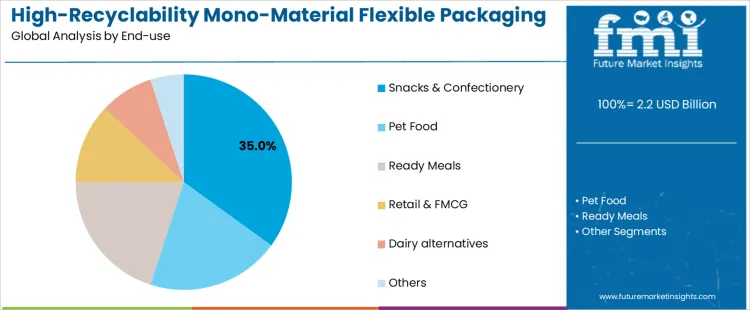
Snacks and confectionery lead demand with a 35% share due to high unit volumes and short consumption cycles. Producers in this segment adopt mono material packaging to simplify waste handling while maintaining product freshness. Pet food applications rely on flexible formats for durability and portion control. Ready meals require packaging that supports reheating compatibility and controlled barrier performance. Retail and FMCG products adopt mono material structures to meet retailer packaging guidelines. Dairy alternatives use flexible packs to support chilled distribution and frequent product innovation. Adoption intensity aligns with packaging turnover and regulatory exposure. End use demand therefore reflects packaging volume concentration rather than premium positioning across product categories.
Application driven demand remains steady because flexible packaging is embedded in product delivery models. Snack producers prioritize consistency and line efficiency. Pet food manufacturers balance strength and seal reliability. Ready meal producers integrate mono material formats cautiously to protect shelf life. Retail brands adopt where recyclability claims align with packaging standards. Dairy alternative producers adjust formats gradually to match filling equipment. These patterns limit volatility. End use segmentation highlights structural reliance on flexible packaging rather than discretionary format shifts. Demand therefore follows compliance alignment and operational continuity across food and FMCG applications.
How Does Packaging Format and Type Shape Demand for High Recyclability Mono Material Flexible Packaging Market?
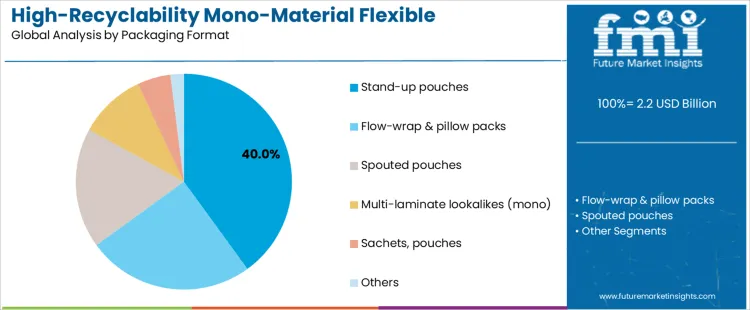
Stand up pouches account for about 40% of total demand, making them the leading packaging format. Their dominance reflects versatility across snacks, pet food, and retail products. Flow wrap and pillow packs are used for high speed snack and confectionery lines. Spouted pouches serve ready meals and liquid or semi liquid products. Mono material laminate lookalikes replicate traditional multilayer appearance while remaining recyclable. Sachets and small pouches support portion control and sampling formats. Packaging format selection depends on filling speed, shelf presentation, and material compatibility. Demand follows established flexible packaging usage patterns rather than structural format replacement.
Stand up pouches maintain leadership due to strong shelf presence and adaptable sizing. Flow wrap formats remain essential for continuous production lines. Spouted pouches address functional dispensing needs. Mono laminate lookalikes support brand continuity without altering recycling profiles. Sachets persist in price sensitive and trial driven categories. Producers favor formats compatible with existing machinery to avoid capital disruption. This constrains rapid format transitions. Packaging format and type therefore stabilize demand by reinforcing widely used flexible structures while enabling recyclability alignment within familiar designs.
How Is High Recyclability Mono Material Flexible Packaging Being Applied Across Consumer Goods and Food Products?
Use appears in packaging lines where recyclability, barrier performance, and material simplification are critical. Snack brands adopt mono material pouches to streamline recycling while maintaining shelf life. Confectionery and bakery producers apply them for portioned packs where transparency and seal integrity are important. Personal care and household product manufacturers use mono films for refill pouches and sachets to reduce multi-material waste. These applications reflect operational priorities tied to end-of-life management, material consistency, and barrier functionality rather than purely aesthetic or promotional objectives.
What Operational and Material Conditions Support Adoption of High-Recyclability Mono Material Flexible Packaging?
Selection aligns with facilities aiming to maintain throughput while meeting recycling compliance. Packaging engineers favor films that provide uniform sealing and barrier performance across roll widths. Filling lines require consistent pouch formation, accurate dosing, and heat sealing reliability. Logistics and warehousing teams benefit from lighter, uniform packaging that optimizes space and reduces shipping costs. Brands leverage mono materials to simplify collection and processing for end consumers and municipal recycling programs. These conditions arise from operational efficiency, sustainability targets, and regulatory compliance in structured production environments.
Which Practical Considerations Limit Wider Use of High-Recyclability Mono Material Flexible Packaging?
Barrier properties may be lower than multi-layer laminates, limiting shelf life for highly sensitive products. Processing parameters, such as sealing temperature and line speed, require careful calibration. Cost per unit can be higher during transition from conventional multi-material films. Limited availability of suitable mono-material grades may restrict design flexibility. Consumer recycling infrastructure must support material recovery to realize environmental benefit. These factors result in selective adoption where recyclability, operational feasibility, and product protection outweigh cost and processing constraints.
What is the Demand for High Recyclability Mono Material Flexible Packaging by Country?
| Country | CAGR (%) |
|---|---|
| USA | 8.0% |
| Germany | 7.0% |
| China | 11.0% |
| India | 12.0% |
| Brazil | 8.0% |
| Japan | 5.0% |
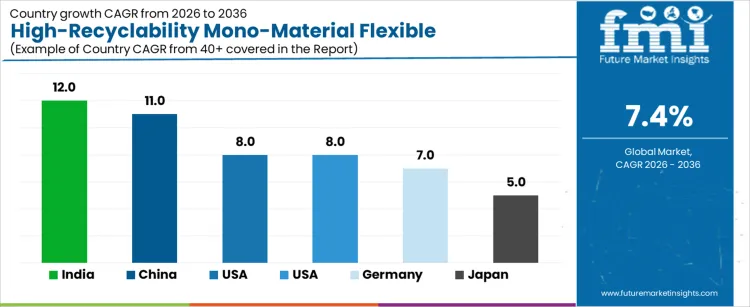
The demand for high recyclability mono material flexible packaging varies across countries, driven by sustainability initiatives, food and beverage packaging needs, and regulatory pressures. India leads with a 12.0% CAGR, supported by increasing adoption of recyclable packaging in FMCG, snacks, and personal care products. China follows at 11.0%, driven by large scale manufacturing and growing consumer preference for eco-friendly packaging. The USA grows at 8.0%, reflecting steady adoption among branded food, beverage, and healthcare packaging. Brazil records 8.0%, shaped by organized retail expansion and sustainable packaging awareness. Germany posts 7.0%, supported by regulatory compliance and established recycling systems, while Japan grows at 5.0%, reflecting mature markets and stable adoption of recyclable flexible formats.
How Is High-Recyclability Flexible Packaging Driving Growth in the United States?
In the United States, revenue from the High-Recyclability Mono-Material Flexible Packaging Market is expanding at a CAGR of 8.00% through 2035, driven by adoption of single-material packaging solutions to improve recyclability, reduce environmental impact, and maintain product protection. Manufacturers are integrating mono-material films for beverages, snacks, personal care, and ready-to-eat foods distributed through retail and industrial channels. Domestic suppliers are producing flexible films with uniform material composition to ensure compatibility with recycling streams. Stable production volumes, recurring packaging requirements, and regulatory compliance are sustaining predictable procurement across packaging operations nationwide.
- Beverage, snack, personal care, and ready-to-eat food producers adopt mono-material flexible packaging
- Single-material films improve recyclability and environmental compliance
- Domestic suppliers produce films compatible with recycling streams
- Recurring packaging needs sustain predictable procurement volumes
How Do Sustainability Standards Shape Demand in Germany?
Germany continues to record steady growth in the High-Recyclability Mono-Material Flexible Packaging Market at a CAGR of 7.00% through 2035, supported by stringent environmental and recycling regulations. Manufacturers are using mono-material flexible films for packaged foods, beverages, and personal care products to meet sustainability and regulatory requirements. Demand is concentrated in retail and industrial packaging segments. Domestic producers provide high-quality flexible films with consistent composition and reliable barrier performance. Compliance-driven procurement practices and stable industrial output are sustaining measured adoption across packaging operations nationwide.
- Environmental and recycling regulations support adoption of mono-material flexible packaging
- Packaged foods, beverages, and personal care products anchor demand
- Domestic producers provide films with consistent material composition and barrier properties
- Compliance-driven procurement sustains steady adoption levels
How Is Industrial and Retail Expansion Accelerating Adoption in China?
In China, revenue from the High-Recyclability Mono-Material Flexible Packaging Market is growing at a CAGR of 11.00% through 2035, driven by expansion of industrial packaging and modern retail networks. Manufacturers are adopting mono-material flexible films for snacks, beverages, and ready-to-eat meals to improve recyclability and reduce environmental impact. Demand is strong across e-commerce, urban retail, and industrial packaging channels. Domestic suppliers are scaling production of high-recyclability flexible films. High output volumes and structured procurement practices are sustaining rapid adoption nationwide.
- Industrial and retail expansion drives adoption of mono-material flexible packaging
- Snacks, beverages, and ready-to-eat meals are primary applications
- Domestic suppliers scale production of high-recyclability films
- High output volumes sustain consistent adoption
How Is Organized Food and Beverage Manufacturing Supporting Growth in India?
India is witnessing strong expansion in the High-Recyclability Mono-Material Flexible Packaging Market at a CAGR of 12.00% through 2035, supported by growth in organized food, beverage, and personal care manufacturing. Manufacturers are integrating mono-material flexible films to reduce plastic waste, comply with environmental regulations, and improve recycling efficiency. Demand is rising across urban retail, e-commerce, and institutional food supply channels. Domestic suppliers are offering cost-aligned high-recyclability films suitable for high-volume production. Expanding retail networks and organized manufacturing are sustaining robust procurement nationwide.
- Organized food, beverage, and personal care manufacturing increases demand for mono-material flexible packaging
- Urban retail and e-commerce channels drive high-volume adoption
- Domestic suppliers provide cost-aligned high-recyclability films
- Retail expansion and organized production sustain procurement growth
How Are Consumer Goods Shipments Supporting Adoption in Brazil?
Brazil is seeing steady growth in the High-Recyclability Mono-Material Flexible Packaging Market at a CAGR of 8.00% through 2035, supported by increasing shipments of packaged foods, beverages, and personal care products. Manufacturers are using mono-material flexible films to enhance recyclability, reduce environmental impact, and maintain product integrity during transport. Demand is concentrated in organized retail and regional distribution hubs. Domestic producers are expanding film production and improving quality consistency. Growth in retail and product availability is sustaining recurring procurement across packaging operations nationwide.
- Packaged foods, beverages, and personal care products drive adoption of mono-material flexible films
- Single-material design improves recyclability and environmental compliance
- Domestic producers expand production and ensure quality consistency
- Retail and distribution growth sustain recurring procurement
How Does Mature Packaging Demand Influence Stability in Japan?
Japan is maintaining measured growth in the High-Recyclability Mono-Material Flexible Packaging Market at a CAGR of 5.00% through 2035, supported by mature packaging markets and selective adoption of recyclable flexible films. Brands apply mono-material packaging for beverages, personal care, and specialty food products. Demand remains focused on material uniformity, recyclability, and regulatory compliance. Domestic suppliers emphasize precise film extrusion and consistent quality. Stable consumption patterns and replacement-driven purchasing are sustaining predictable procurement across established packaging operations nationwide.
- Mature markets favor selective adoption of high-recyclability mono-material flexible films
- Beverages, personal care, and specialty foods anchor baseline demand
- Domestic suppliers ensure precise film extrusion and consistent quality
- Replacement-driven purchasing sustains procurement continuity
Which Companies Are Shaping Competition in The High Recyclability Mono Material Flexible Packaging Market Across Food and Consumer Applications?
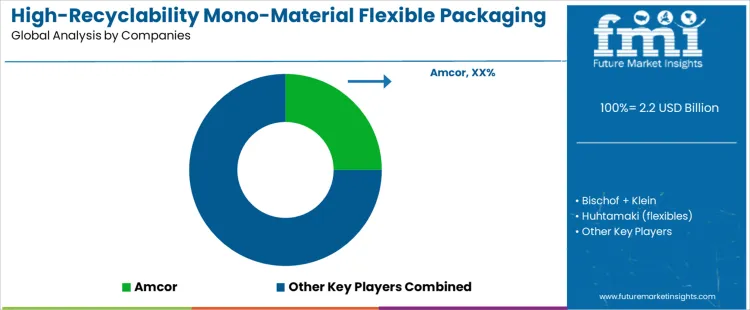
Competition in the High Recyclability Mono Material Flexible Packaging Market is led by packaging producers adapting flexible structures to meet recycling compatibility requirements. Amcor, Mondi, and Sealed Air play a central role through mono polyethylene and mono polypropylene formats used in food, beverage, and household product packaging. Their influence is supported by material engineering depth and established relationships with brand owners seeking simplified packaging structures. Huhtamaki flexibles contributes through reformulated flexible packs designed for functional performance while maintaining material uniformity. These companies compete on seal integrity, barrier performance, machinability, and consistency across high volume production environments. Adoption is shaped by compatibility with existing filling lines and downstream collection systems rather than visual differentiation.
Regional specialists and material focused producers add competitive diversity. Bischof + Klein holds a strong position in Europe, supplying mono material films tailored to regional recycling guidelines and converter requirements. UFlex participates through flexible packaging solutions targeting emerging markets and export oriented food processors seeking compliant material formats. Klabin supports the market through paper based and hybrid flexible structures that align with mono material principles within selected applications. Local converters play an important role by adapting film thickness, coatings, and sealing properties to national requirements. Competitive positioning depends on material validation cycles, customer qualification timelines, and the ability to balance performance with recyclability expectations across varied end use conditions.
Key Players in the High Recyclability Mono Material Flexible Packaging Market
- Amcor
- Mondi
- Sealed Air
- Bischof + Klein
- Huhtamaki (flexibles)
- UFlex
- Klabin
Scope of the Report
| Items | Values |
|---|---|
| Quantitative Units (2026) | USD billion |
| End-use / Application | Snacks & Confectionery; Pet Food; Ready Meals; Retail & FMCG; Dairy Alternatives; Others |
| Packaging Format / Type | Stand-up Pouches; Flow-wrap & Pillow Packs; Spouted Pouches; Multi-laminate Lookalikes (Mono); Sachets & Small Pouches; Others |
| Material | Mono-PE / Mono-PP; Mono-PE / Recyclable PE; Mono-PP Formulations; Recyclable PE Blends; Mono-Polymer Systems; Others |
| Technology | Mono-material Laminates, Solvent-Free Lamination; New Sealant & Barrier Coatings; High-Speed Form/Fill/Seal Adaptation; Receptacle Printing & Sealing Technology; Improved Barrier Coatings; Others |
| Region | Asia Pacific; Europe; North America; Latin America; Middle East & Africa |
| Countries Covered | China; Japan; South Korea; India; Australia & New Zealand; ASEAN; Germany; United Kingdom; France; Italy; Spain; Nordic; BENELUX; United States; Canada; Mexico; Brazil; Chile; Kingdom of Saudi Arabia; Other GCC Countries; Turkey; South Africa; Other African Union; Rest of Asia Pacific; Rest of Europe; Rest of Latin America; Rest of Middle East & Africa |
| Key Companies Profiled | Amcor; Mondi; Sealed Air; Bischof + Klein; Huhtamaki (Flexibles); UFlex; Klabin |
| Additional Attributes | Dollar by sales across end-use applications, packaging formats, and materials; Stand-up pouches lead due to versatility and shelf presence; Mono-material laminates enable recyclability without compromising barrier performance; Integration with high-speed form/fill/seal lines supports operational efficiency; Growth driven by regulatory compliance, sustainability targets, and brand environmental commitments; Incremental adoption preferred to minimize capital and tooling disruption; Repeat procurement and multi-SKU deployment reinforce structural demand; Material engineering, sealant development, and barrier optimization enhance recyclability and functionality; Adoption patterns reflect volume concentration, regulatory exposure, and functional packaging requirements rather than aesthetic changes |
High Recyclability Mono Material Flexible Packaging Market Segmentation
End-use / Application:
- Snacks & Confectionery
- Pet Food
- Ready Meals
- Retail & FMCG
- Dairy alternatives
- Others
Packaging Format / Type:
- Stand-up pouches
- Flow-wrap & pillow packs
- Spouted pouches
- Multi-laminate lookalikes (mono)
- Sachets, pouches
- Others
Material:
- Mono-PE / Mono-PP
- Mono-PE / recyclable PE
- Mono-PP formulations
- Recyclable PE blends
- Mono-polymer systems
- Others
Technology:
- Mono-material laminates, solvent-free lamination
- New sealant & barrier coatings
- High-speed form/fill/seal adaptation
- Receptacle printing & sealing tech
- Improved barrier coatings
- Others
Region:
- Asia Pacific
- China
- Japan
- South Korea
- India
- Australia & New Zealand
- ASEAN
- Rest of Asia Pacific
- Europe
- Germany
- United Kingdom
- France
- Italy
- Spain
- Nordic
- BENELUX
- Rest of Europe
- North America
- United States
- Canada
- Mexico
- Latin America
- Brazil
- Chile
- Rest of Latin America
- Middle East & Africa
- Kingdom of Saudi Arabia
- Other GCC Countries
- Turkey
- South Africa
- Other African Union
- Rest of Middle East & Africa
Frequently Asked Questions
How big is the high-recyclability mono-material flexible packaging market in 2026?
The global high-recyclability mono-material flexible packaging market is estimated to be valued at USD 2.2 billion in 2026.
What will be the size of high-recyclability mono-material flexible packaging market in 2036?
The market size for the high-recyclability mono-material flexible packaging market is projected to reach USD 4.5 billion by 2036.
How much will be the high-recyclability mono-material flexible packaging market growth between 2026 and 2036?
The high-recyclability mono-material flexible packaging market is expected to grow at a 7.4% CAGR between 2026 and 2036.
What are the key product types in the high-recyclability mono-material flexible packaging market?
The key product types in high-recyclability mono-material flexible packaging market are snacks & confectionery, pet food, ready meals, retail & fmcg, dairy alternatives and others.
Which packaging format segment to contribute significant share in the high-recyclability mono-material flexible packaging market in 2026?
In terms of packaging format, stand-up pouches segment to command 40.0% share in the high-recyclability mono-material flexible packaging market in 2026.
Preview the report firsthand - request a free sample
Get SampleGet the brochure for pricing and purchase details.
Get PDFTable of Content
- Executive Summary
- Global Market Outlook
- Demand-side Trends
- Supply-side Trends
- Technology Roadmap Analysis
- Analysis and Recommendations
- Market Overview
- Market Coverage / Taxonomy
- Market Definition / Scope / Limitations
- Market Background
- Market Dynamics
- Drivers
- Restraints
- Opportunity
- Trends
- Scenario Forecast
- Demand in Optimistic Scenario
- Demand in Likely Scenario
- Demand in Conservative Scenario
- Opportunity Map Analysis
- Product Life Cycle Analysis
- Supply Chain Analysis
- Investment Feasibility Matrix
- Value Chain Analysis
- PESTLE and Porter’s Analysis
- Regulatory Landscape
- Regional Parent Market Outlook
- Production and Consumption Statistics
- Import and Export Statistics
- Market Dynamics
- Global Market Analysis 2021 to 2025 and Forecast, 2026 to 2036
- Historical Market Size Value (USD Million) Analysis, 2021 to 2025
- Current and Future Market Size Value (USD Million) Projections, 2026 to 2036
- Y-o-Y Growth Trend Analysis
- Absolute $ Opportunity Analysis
- Global Market Pricing Analysis 2021 to 2025 and Forecast 2026 to 2036
- Global Market Analysis 2021 to 2025 and Forecast 2026 to 2036, By End-use
- Introduction / Key Findings
- Historical Market Size Value (USD Million) Analysis By End-use , 2021 to 2025
- Current and Future Market Size Value (USD Million) Analysis and Forecast By End-use , 2026 to 2036
- Snacks & Confectionery
- Pet Food
- Ready Meals
- Retail & FMCG
- Dairy alternatives
- Others
- Y-o-Y Growth Trend Analysis By End-use , 2021 to 2025
- Absolute $ Opportunity Analysis By End-use , 2026 to 2036
- Global Market Analysis 2021 to 2025 and Forecast 2026 to 2036, By Packaging Format
- Introduction / Key Findings
- Historical Market Size Value (USD Million) Analysis By Packaging Format, 2021 to 2025
- Current and Future Market Size Value (USD Million) Analysis and Forecast By Packaging Format, 2026 to 2036
- Stand-up pouches
- Flow-wrap & pillow packs
- Spouted pouches
- Multi-laminate lookalikes (mono)
- Sachets, pouches
- Others
- Y-o-Y Growth Trend Analysis By Packaging Format, 2021 to 2025
- Absolute $ Opportunity Analysis By Packaging Format, 2026 to 2036
- Global Market Analysis 2021 to 2025 and Forecast 2026 to 2036, By Material
- Introduction / Key Findings
- Historical Market Size Value (USD Million) Analysis By Material, 2021 to 2025
- Current and Future Market Size Value (USD Million) Analysis and Forecast By Material, 2026 to 2036
- Mono-PE / Mono-PP
- Mono-PE / recyclable PE
- Mono-PP formulations
- Recyclable PE blends
- Mono-polymer systems
- Others
- Y-o-Y Growth Trend Analysis By Material, 2021 to 2025
- Absolute $ Opportunity Analysis By Material, 2026 to 2036
- Global Market Analysis 2021 to 2025 and Forecast 2026 to 2036, By Technology
- Introduction / Key Findings
- Historical Market Size Value (USD Million) Analysis By Technology, 2021 to 2025
- Current and Future Market Size Value (USD Million) Analysis and Forecast By Technology, 2026 to 2036
- Mono-material laminates, solvent-free lamination
- New sealant & barrier coatings
- High-speed form/fill/seal adaptation
- Receptacle printing & sealing tech
- Improved barrier coatings
- Others
- Y-o-Y Growth Trend Analysis By Technology, 2021 to 2025
- Absolute $ Opportunity Analysis By Technology, 2026 to 2036
- Global Market Analysis 2021 to 2025 and Forecast 2026 to 2036, By Region
- Introduction
- Historical Market Size Value (USD Million) Analysis By Region, 2021 to 2025
- Current Market Size Value (USD Million) Analysis and Forecast By Region, 2026 to 2036
- North America
- Latin America
- Western Europe
- Eastern Europe
- East Asia
- South Asia and Pacific
- Middle East & Africa
- Market Attractiveness Analysis By Region
- North America Market Analysis 2021 to 2025 and Forecast 2026 to 2036, By Country
- Historical Market Size Value (USD Million) Trend Analysis By Market Taxonomy, 2021 to 2025
- Market Size Value (USD Million) Forecast By Market Taxonomy, 2026 to 2036
- By Country
- USA
- Canada
- Mexico
- By End-use
- By Packaging Format
- By Material
- By Technology
- By Country
- Market Attractiveness Analysis
- By Country
- By End-use
- By Packaging Format
- By Material
- By Technology
- Key Takeaways
- Latin America Market Analysis 2021 to 2025 and Forecast 2026 to 2036, By Country
- Historical Market Size Value (USD Million) Trend Analysis By Market Taxonomy, 2021 to 2025
- Market Size Value (USD Million) Forecast By Market Taxonomy, 2026 to 2036
- By Country
- Brazil
- Chile
- Rest of Latin America
- By End-use
- By Packaging Format
- By Material
- By Technology
- By Country
- Market Attractiveness Analysis
- By Country
- By End-use
- By Packaging Format
- By Material
- By Technology
- Key Takeaways
- Western Europe Market Analysis 2021 to 2025 and Forecast 2026 to 2036, By Country
- Historical Market Size Value (USD Million) Trend Analysis By Market Taxonomy, 2021 to 2025
- Market Size Value (USD Million) Forecast By Market Taxonomy, 2026 to 2036
- By Country
- Germany
- UK
- Italy
- Spain
- France
- Nordic
- BENELUX
- Rest of Western Europe
- By End-use
- By Packaging Format
- By Material
- By Technology
- By Country
- Market Attractiveness Analysis
- By Country
- By End-use
- By Packaging Format
- By Material
- By Technology
- Key Takeaways
- Eastern Europe Market Analysis 2021 to 2025 and Forecast 2026 to 2036, By Country
- Historical Market Size Value (USD Million) Trend Analysis By Market Taxonomy, 2021 to 2025
- Market Size Value (USD Million) Forecast By Market Taxonomy, 2026 to 2036
- By Country
- Russia
- Poland
- Hungary
- Balkan & Baltic
- Rest of Eastern Europe
- By End-use
- By Packaging Format
- By Material
- By Technology
- By Country
- Market Attractiveness Analysis
- By Country
- By End-use
- By Packaging Format
- By Material
- By Technology
- Key Takeaways
- East Asia Market Analysis 2021 to 2025 and Forecast 2026 to 2036, By Country
- Historical Market Size Value (USD Million) Trend Analysis By Market Taxonomy, 2021 to 2025
- Market Size Value (USD Million) Forecast By Market Taxonomy, 2026 to 2036
- By Country
- China
- Japan
- South Korea
- By End-use
- By Packaging Format
- By Material
- By Technology
- By Country
- Market Attractiveness Analysis
- By Country
- By End-use
- By Packaging Format
- By Material
- By Technology
- Key Takeaways
- South Asia and Pacific Market Analysis 2021 to 2025 and Forecast 2026 to 2036, By Country
- Historical Market Size Value (USD Million) Trend Analysis By Market Taxonomy, 2021 to 2025
- Market Size Value (USD Million) Forecast By Market Taxonomy, 2026 to 2036
- By Country
- India
- ASEAN
- Australia & New Zealand
- Rest of South Asia and Pacific
- By End-use
- By Packaging Format
- By Material
- By Technology
- By Country
- Market Attractiveness Analysis
- By Country
- By End-use
- By Packaging Format
- By Material
- By Technology
- Key Takeaways
- Middle East & Africa Market Analysis 2021 to 2025 and Forecast 2026 to 2036, By Country
- Historical Market Size Value (USD Million) Trend Analysis By Market Taxonomy, 2021 to 2025
- Market Size Value (USD Million) Forecast By Market Taxonomy, 2026 to 2036
- By Country
- Kingdom of Saudi Arabia
- Other GCC Countries
- Turkiye
- South Africa
- Other African Union
- Rest of Middle East & Africa
- By End-use
- By Packaging Format
- By Material
- By Technology
- By Country
- Market Attractiveness Analysis
- By Country
- By End-use
- By Packaging Format
- By Material
- By Technology
- Key Takeaways
- Key Countries Market Analysis
- USA
- Pricing Analysis
- Market Share Analysis, 2025
- By End-use
- By Packaging Format
- By Material
- By Technology
- Canada
- Pricing Analysis
- Market Share Analysis, 2025
- By End-use
- By Packaging Format
- By Material
- By Technology
- Mexico
- Pricing Analysis
- Market Share Analysis, 2025
- By End-use
- By Packaging Format
- By Material
- By Technology
- Brazil
- Pricing Analysis
- Market Share Analysis, 2025
- By End-use
- By Packaging Format
- By Material
- By Technology
- Chile
- Pricing Analysis
- Market Share Analysis, 2025
- By End-use
- By Packaging Format
- By Material
- By Technology
- Germany
- Pricing Analysis
- Market Share Analysis, 2025
- By End-use
- By Packaging Format
- By Material
- By Technology
- UK
- Pricing Analysis
- Market Share Analysis, 2025
- By End-use
- By Packaging Format
- By Material
- By Technology
- Italy
- Pricing Analysis
- Market Share Analysis, 2025
- By End-use
- By Packaging Format
- By Material
- By Technology
- Spain
- Pricing Analysis
- Market Share Analysis, 2025
- By End-use
- By Packaging Format
- By Material
- By Technology
- France
- Pricing Analysis
- Market Share Analysis, 2025
- By End-use
- By Packaging Format
- By Material
- By Technology
- India
- Pricing Analysis
- Market Share Analysis, 2025
- By End-use
- By Packaging Format
- By Material
- By Technology
- ASEAN
- Pricing Analysis
- Market Share Analysis, 2025
- By End-use
- By Packaging Format
- By Material
- By Technology
- Australia & New Zealand
- Pricing Analysis
- Market Share Analysis, 2025
- By End-use
- By Packaging Format
- By Material
- By Technology
- China
- Pricing Analysis
- Market Share Analysis, 2025
- By End-use
- By Packaging Format
- By Material
- By Technology
- Japan
- Pricing Analysis
- Market Share Analysis, 2025
- By End-use
- By Packaging Format
- By Material
- By Technology
- South Korea
- Pricing Analysis
- Market Share Analysis, 2025
- By End-use
- By Packaging Format
- By Material
- By Technology
- Russia
- Pricing Analysis
- Market Share Analysis, 2025
- By End-use
- By Packaging Format
- By Material
- By Technology
- Poland
- Pricing Analysis
- Market Share Analysis, 2025
- By End-use
- By Packaging Format
- By Material
- By Technology
- Hungary
- Pricing Analysis
- Market Share Analysis, 2025
- By End-use
- By Packaging Format
- By Material
- By Technology
- Kingdom of Saudi Arabia
- Pricing Analysis
- Market Share Analysis, 2025
- By End-use
- By Packaging Format
- By Material
- By Technology
- Turkiye
- Pricing Analysis
- Market Share Analysis, 2025
- By End-use
- By Packaging Format
- By Material
- By Technology
- South Africa
- Pricing Analysis
- Market Share Analysis, 2025
- By End-use
- By Packaging Format
- By Material
- By Technology
- USA
- Market Structure Analysis
- Competition Dashboard
- Competition Benchmarking
- Market Share Analysis of Top Players
- By Regional
- By End-use
- By Packaging Format
- By Material
- By Technology
- Competition Analysis
- Competition Deep Dive
- Amcor
- Overview
- Product Portfolio
- Profitability by Market Segments (Product/Age /Sales Channel/Region)
- Sales Footprint
- Strategy Overview
- Marketing Strategy
- Product Strategy
- Channel Strategy
- Bischof + Klein
- Huhtamaki (flexibles)
- UFlex
- Klabin
- Mondi
- Sealed Air
- Amcor
- Competition Deep Dive
- Assumptions & Acronyms Used
- Research Methodology


