

- Industry Size (2026)
- USD 1.42 Bn
- Forecast (2036)
- USD 3.39 Bn
- CAGR (2026 to 2036)
- 9.1%
Humidity Testers Market Size, Market Forecast and Outlook By FMI
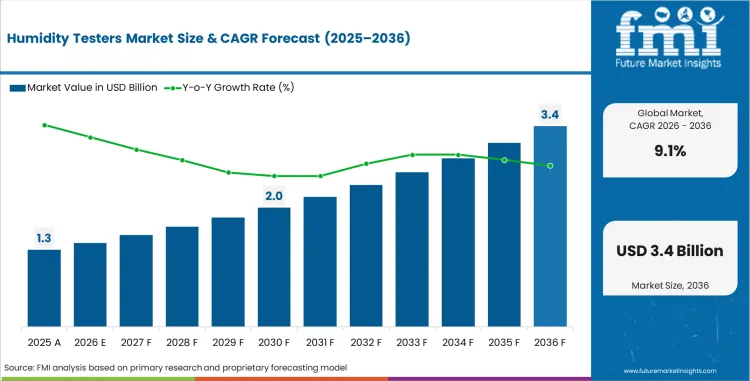
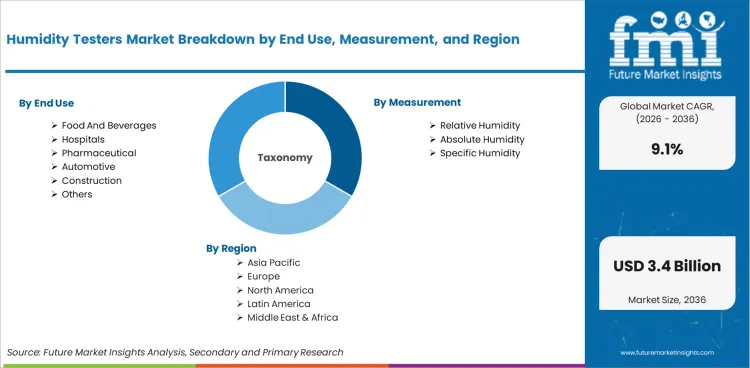
The humidity testers market was valued at USD 1.30 billion in 2025, projected to reach USD 1.42 billion in 2026, and is forecast to expand to USD 3.39 billion by 2036 at a 9.1% CAGR.
Summary of Humidity Testers Market
- The market is forecast to touch USD 3.39 billion by 2036.
- Annual growth of 9.1% is projected across the 2026-2036 forecast horizon.
- In 2025, market value was pegged at USD 1.30 billion.
- The forecast period unlocks an incremental opportunity worth USD 1.97 billion.
- Food And Beverages leads by End Use with 30.0% share in 2026.
- Relative Humidity leads by Measurement with 45.0% share in 2026.
- Demand is driven by tightening food safety and pharmaceutical GMP regulations requiring validated continuous humidity monitoring at critical control points in production and storage environments.
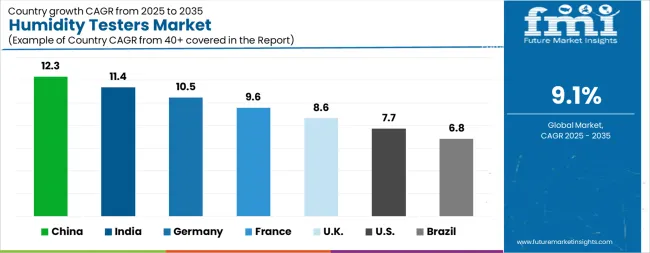
- Among key countries, China leads at 12.3% CAGR, followed by India at 11.4%, Germany at 10.5%, France at 9.6%, UK at 8.6%.
Humidity Testers Market Key Takeaways
| Metric | Details |
|---|---|
| Industry Size (2026) | USD 1.42 billion |
| Industry Value (2036) | USD 3.39 billion |
| CAGR (2026-2036) | 9.1% |
Source: Future Market Insights, 2026
Tightening environmental control standards across pharmaceutical storage, food processing, and semiconductor manufacturing, combined with expanding IoT-enabled facility monitoring adoption, are driving sustained procurement of precision humidity measurement instruments across industrial and institutional end-use sectors.
Industrial humidity measurement has transitioned from periodic manual spot-checking to continuous automated monitoring integrated into facility management systems. FMI analysts observe that food and beverage manufacturers operating under FSMA and EU food safety compliance mandates now require validated humidity data logging at every critical control point in production and storage environments. Pharmaceutical cold chain operators managing temperature and humidity excursion documentation for regulatory audit readiness are specifying connected humidity testers with cloud-based data reporting capability as a minimum procurement standard.
Country-level growth trajectories reflect regulatory stringency differences, industrial monitoring infrastructure maturity, and IoT adoption velocity across facility management applications. China at 12.3%, India at 11.4%, Germany at 10.5%, France at 9.6%, UK at 8.6%, USA at 7.7%, Brazil at 6.8%. China leads growth driven by expanding pharmaceutical GMP compliance requirements and food safety monitoring mandates across cold chain logistics networks. India follows with strong adoption as FSSAI food safety regulations and pharmaceutical facility certification programs drive humidity monitoring equipment procurement. Germany and France sustain European growth through stringent industrial workplace environment monitoring standards and building management system modernization. The United Kingdom and United States maintain steady expansion through healthcare facility accreditation requirements and data center environmental control investment. Brazil advances as food export certification programs require documented humidity monitoring in processing and storage facilities.
Humidity Testers Market Definition
The Humidity Testers Market encompasses precision measurement instruments designed to quantify moisture content in air and gas environments across industrial, commercial, and institutional applications. Core product categories include portable handheld humidity meters, fixed-installation humidity transmitters, data-logging hygrometers, dew point analyzers, and IoT-connected continuous monitoring systems. Measurement technologies span capacitive polymer sensing, chilled mirror dew point detection, and resistive element humidity measurement, serving applications across food and beverage processing, pharmaceutical manufacturing and storage, hospital and healthcare facility management, automotive paint shop environmental control, construction moisture assessment, and general industrial environmental monitoring.
Humidity Testers Market Inclusions
Market scope includes humidity measurement instrument hardware, replacement sensor elements, calibration accessories, and bundled monitoring software sold with humidity testing equipment. Revenue from portable, fixed-installation, and connected monitoring product categories across all end-use and regional segments is included.
Humidity Testers Market Exclusions
The scope excludes standalone temperature measurement instruments without humidity sensing capability, general-purpose weather stations marketed for consumer home use, soil moisture meters for agricultural applications, and laboratory-grade gas analysis systems where humidity measurement is a secondary function.
Humidity Testers Market Research Methodology
- Primary Research: Analysts conducted structured interviews with pharmaceutical quality assurance directors, food processing facility managers, data center operations engineers, and industrial instrumentation procurement specialists to map product selection criteria and compliance-driven procurement dynamics.
- Desk Research: Data collection phases aggregated FDA pharmaceutical GMP guidance documents, FSMA food safety compliance requirements, EU workplace environment monitoring directives, and published calibration standard specifications from national metrology institutes.
- Market-Sizing and Forecasting: Baseline values derive from a bottom-up aggregation of product-level and service-level revenue data, applying region-specific adoption curves and regulatory timeline assumptions to project future demand trajectories through the forecast period.
- Data Validation and Update Cycle: Projections are cross-validated against publicly reported revenue guidance from leading industry participants, government procurement disclosures, and published market data from recognized multilateral organizations.
Why is the Humidity Testers Market Growing?
The Humidity Testers market is being driven by the rising need for accurate environmental monitoring across diverse industries. The current market environment is shaped by increasing adoption of humidity measurement systems in areas where product quality, safety, and process efficiency are directly impacted by moisture levels. The demand is being supported by stricter regulatory requirements, growing automation in manufacturing processes, and the need for real-time monitoring in sensitive environments.
Technological advancements in sensor design and data connectivity have improved the accuracy and reliability of measurement systems, making them more cost-effective and easier to deploy. The future outlook of the market is expected to remain positive as sectors such as food and beverages, pharmaceuticals, and electronics continue to prioritize quality assurance and compliance.
The integration of humidity monitoring into smart systems is also anticipated to enhance operational efficiency and predictive maintenance Increasing awareness about environmental control and energy optimization is further contributing to the expansion of this market, offering significant growth opportunities for measurement solutions that can adapt to evolving industry requirements.
Segmental Analysis
The humidity testers market is segmented by end use, measurement, and geographic regions. By end use, humidity testers market is divided into Food And Beverages, Hospitals, Pharmaceutical, Automotive, Construction, and Others. In terms of measurement, humidity testers market is classified into Relative Humidity, Absolute Humidity, and Specific Humidity. Regionally, the humidity testers industry is classified into North America, Latin America, Western Europe, Eastern Europe, Balkan & Baltic Countries, Russia & Belarus, Central Asia, East Asia, South Asia & Pacific, and the Middle East & Africa.
Insights into the Food and Beverages Segment
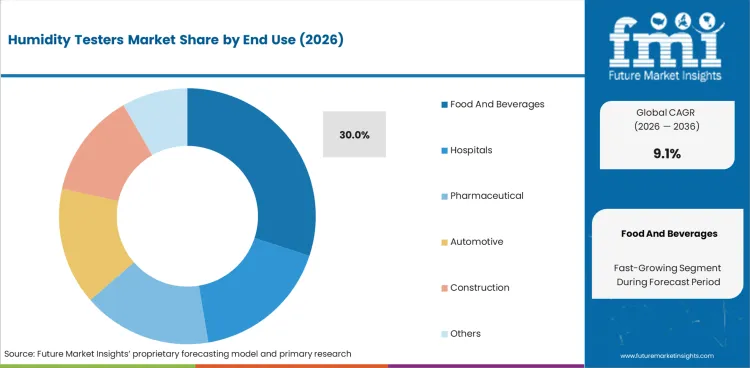
The Food and Beverages segment is expected to hold 30.00% of the total Humidity Testers market revenue in 2026, making it the leading end use segment. This prominence is being attributed to the critical role of humidity control in ensuring product quality, shelf life, and safety throughout production, storage, and transportation.
In environments where food processing and packaging are involved, maintaining precise humidity levels has become essential to prevent spoilage, microbial growth, and texture degradation. The segment’s growth is being supported by increasing investments in quality management systems and compliance with food safety standards across global supply chains.
The adoption of humidity testers is being accelerated by the need to monitor conditions in real time, allowing for immediate corrective actions and reducing product losses As consumer expectations for freshness and quality rise, and regulatory bodies enforce stricter standards, the demand for humidity measurement solutions within the food and beverage sector is expected to remain robust, driving further investments in advanced sensor technologies.
Insights into the Relative Humidity Measurement Segment
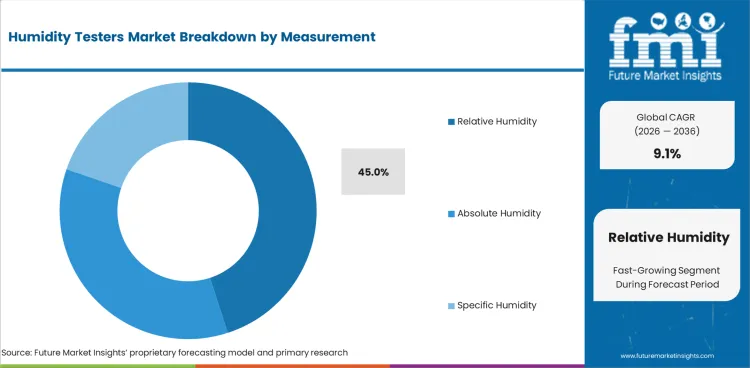
The Relative Humidity measurement segment is projected to account for 45.00% of the Humidity Testers market revenue in 2026, establishing it as the largest measurement category. This dominance is being driven by its wide applicability across industries where the moisture content in the air plays a crucial role in operational stability and product integrity. The measurement of relative humidity is being favored because it provides essential data needed for environmental control in manufacturing, storage, and laboratory settings.
Real-time tracking of relative humidity has enabled proactive adjustments in processes, helping to maintain optimal conditions and prevent losses due to moisture fluctuations. The segment’s growth is further supported by the integration of smart monitoring systems that allow seamless data collection and automated reporting.
In sectors such as food and beverages, pharmaceuticals, and electronics, where environmental consistency is critical, relative humidity measurement is being considered a fundamental requirement With increasing focus on product quality, safety, and energy efficiency, the demand for relative humidity monitoring solutions is expected to remain strong in the coming years.
Market Overview
Humidity Testers Market: Introduction
Growing demand from hospitals and the construction sector is fuelling the growth of the global humidity Testers market. Few of the important applications of humidity Testers are monitoring concrete setting, monitoring of moisture level, management of environment for agriculture and horticulture, controlling environment for data center, food and beverages, broadcast equipment and others.
Humidity Testers are used to measure relative humidity, absolute humidity, specific humidity and others. Humidity Testers witness high adoption in the hospital sector as hospital environment requires specific humidity to maintain the quality of vaccines, drugs, critical medical devices, blood/tissues, etc. Also, humidity is a key parameter for maintaining purity, drug safety and efficacy. Humidity measurement is a challenging and critical parameter for neonatal areas, procedural rooms and others.
Humidity Testers are vital equipments which measure humidity and significantly reduce the chances of occurrence of various health issues. Dry air causes many health related issues, such as sore throat, dry eyes, dry nasal passage, cold and flu, bloody nose, chapped skin and lips, itchy dry skin, which increases the chances of occurrence of asthma, allergies and other complex health problems.
According to the USA Environmental Protection Agency (EPA), the level of indoor humidity must be below 60%. The USA EPA recommends that the ideal humidity level must be between 30% and 50%. Various regional and international regulatory bodies are conducting various health awareness programs, which are responsible for increasing the awareness about healthy living.
All these factors are significantly influencing the global humidity testers market. Several developments in humidity Testers with reference to technology are expected to drive the growth of the global humidity Testers market during the forecast period.
Analysis of Humidity Testers Market By Key Countries
.webp "Top Country Growth Comparison Humidity Testers Market Cagr (2026 2036)")
| Country | CAGR |
|---|---|
| China | 12.3% |
| India | 11.4% |
| Germany | 10.5% |
| France | 9.6% |
| UK | 8.6% |
| USA | 7.7% |
| Brazil | 6.8% |
Country-wise Analysis
The Humidity Testers Market is expected to register a CAGR of 9.1% during the forecast period, exhibiting varied country level momentum. China leads with the highest CAGR of 12.3%, followed by India at 11.4%. Developed markets such as Germany, France, and the UK continue to expand steadily, while the USA is likely to grow at consistent rates. Brazil posts the lowest CAGR at 6.8%, yet still underscores a broadly positive trajectory for the global Humidity Testers Market. In 2024, Germany held a dominant revenue in the Western Europe market and is expected to grow with a CAGR of 10.5%.
Key Players in the Humidity Testers Market
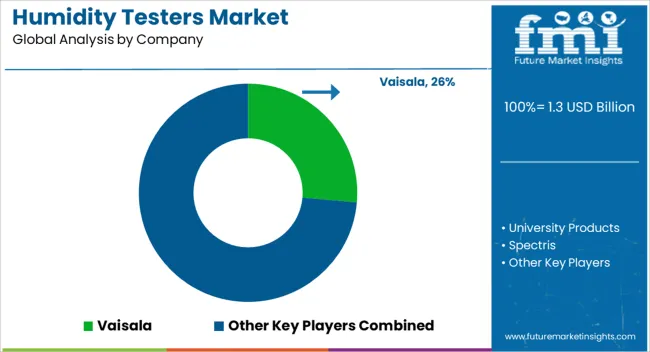
- Vaisala
- University Products
- Spectris
- AVTECH Software
- Process Sensing Technologies
- Caption Data
- Ambetronics Engineers
- General Tools & Instruments
- Testo
Scope of the Report
| Metric | Value |
|---|---|
| Quantitative Units | USD 1.42 billion to USD 3.39 billion, at a CAGR of 9.1% |
| Market Definition | The Humidity Testers Market encompasses precision measurement instruments designed to quantify moisture content in air and gas environments across industrial, commercial, and institutional applications. Core product categories include portable handheld humidity meters, fixed-installation humidity transmitters, data-logging hygrometers, dew point analyzers, and IoT-connected continuous monitoring systems. Measurement technologies span capacitive polymer sensing, chilled mirror dew point detection, and resistive element humidity measurement, serving applications across food and beverage processing, pharmaceutical manufacturing and storage, hospital and healthcare facility management, automotive paint shop environmental control, construction moisture assessment, and general industrial environmental monitoring. |
| Segmentation | End Use: Food And Beverages, Hospitals, Pharmaceutical, Automotive, Construction, Others; Measurement: Relative Humidity, Absolute Humidity, Specific Humidity |
| Regions Covered | North America, Latin America, Europe, East Asia, South Asia, Oceania, Middle East & Africa |
| Countries Covered | China, India, Germany, France, UK, USA, Brazil, and 40 plus countries |
| Key Companies Profiled | Vaisala, University Products, Spectris, AVTECH Software, Process Sensing Technologies, Caption Data, Ambetronics Engineers, General Tools & Instruments, Testo |
| Forecast Period | 2026 to 2036 |
| Approach | Forecasting models apply a bottom-up methodology starting with product-level revenue metrics and cross-validate projections against enterprise spending guidance and regulatory adoption timelines. |
Humidity Testers Market by Segments
End Use:
- Food And Beverages
- Hospitals
- Pharmaceutical
- Automotive
- Construction
- Others
Measurement:
- Relative Humidity
- Absolute Humidity
- Specific Humidity
Region:
- North America
- USA
- Canada
- Mexico
- Latin America
- Brazil
- Chile
- Rest of Latin America
- Western Europe
- Germany
- UK
- Italy
- Spain
- France
- Nordic
- BENELUX
- Rest of Western Europe
- Eastern Europe
- Russia
- Poland
- Hungary
- Balkan & Baltic
- Rest of Eastern Europe
- East Asia
- China
- Japan
- South Korea
- South Asia and Pacific
- India
- ASEAN
- Australia & New Zealand
- Rest of South Asia and Pacific
- Middle East & Africa
- Kingdom of Saudi Arabia
- Other GCC Countries
- Turkiye
- South Africa
- Other African Union
- Rest of Middle East & Africa
Bibliography
- 1. USA Food and Drug Administration. (2024). Current Good Manufacturing Practice (CGMP) Regulations: Environmental Monitoring Guidance. FDA.
- 2. European Committee for Standardization. (2024). EN 15251: Indoor Environmental Input Parameters for Design and Assessment of Energy Performance of Buildings. CEN.
- 3. International Organization for Standardization. (2024). ISO 17025: General Requirements for the Competence of Testing and Calibration Laboratories. ISO.
- 4. Food Safety and Standards Authority of India. (2024). FSSAI Food Safety Compliance Regulations: Storage and Transportation Standards. FSSAI.
- 5. Vaisala Corporation. (2024). Annual Report 2024. Vaisala investor relations filing.
- 6. National Institute of Standards and Technology. (2024). NIST Calibration Services: Humidity Measurement. NIST.
This bibliography is provided for reader reference. The full Future Market Insights report contains the complete reference list with primary research documentation.
Frequently Asked Questions
How large is the demand for Humidity Testers Market in the global market in 2026?
Demand for humidity testers market in the global market is estimated to be valued at USD 1.42 billion in 2026.
What will be the market size of Humidity Testers Market in the global market by 2036?
Market size for humidity testers market is projected to reach USD 3.39 billion by 2036.
What is the expected demand growth for Humidity Testers Market in the global market between 2026 and 2036?
Demand for humidity testers market is expected to grow at a CAGR of 9.1% between 2026 and 2036.
Which End Use is poised to lead global sales by 2026?
Food And Beverages accounts for 30.0% share in 2026, leading the end use segment based on FMI analysis.
How significant is the role of Relative Humidity in driving Humidity Testers Market adoption in 2026?
Relative Humidity represents 45.0% of segment share in 2026, reflecting sustained demand across the measurement category.
What is driving demand in China?
China is projected to grow at a CAGR of 12.3% during 2026 to 2036, driven by targeted infrastructure investments and favorable policy frameworks supporting market expansion.
What is Humidity Testers Market and what is it mainly used for?
The Humidity Testers Market encompasses precision measurement instruments designed to quantify moisture content in air and gas environments across industrial, commercial, and institutional applications. Core product categories include portable handheld humidity meters, fixed-installation humidity transmitters, data-logging hygrometers, dew point analyzers, and IoT-connected continuous monitoring systems.
How does FMI build and validate the Humidity Testers Market forecast?
Forecasting models apply a bottom-up methodology starting with product-level and service-level revenue metrics and cross-validate projections against publicly reported enterprise guidance and regulatory adoption data.
Preview the report firsthand - request a free sample
Get SampleGet the brochure for pricing and purchase details.
Get PDFTable of Content
- Executive Summary
- Global Market Outlook
- Demand-side Trends
- Supply-side Trends
- Technology Roadmap Analysis
- Analysis and Recommendations
- Market Overview
- Market Coverage / Taxonomy
- Market Definition / Scope / Limitations
- Research Methodology
- Chapter Orientation
- Analytical Lens and Working Hypotheses
- Market Structure, Signals, and Trend Drivers
- Benchmarking and Cross-market Comparability
- Company Annual and Sustainability Reports
- Peer-reviewed Journals and Academic Literature
- Corporate Websites, Product Literature, and Technical Notes
- Earnings Decks and Investor Briefings
- Statutory Filings and Regulatory Disclosures
- Technical White Papers and Standards Notes
- Trade Journals, Industry Magazines, and Analyst Briefs
- Conference Proceedings, Webinars, and Seminar Materials
- Government Statistics Portals and Public Data Releases
- Press Releases and Reputable Media Coverage
- Specialist Newsletters and Curated Briefings
- Sector Databases and Reference Repositories
- FMI Internal Proprietary Databases and Historical Market Datasets
- Subscription Datasets and Paid Sources
- Social Channels, Communities, and Digital Listening Inputs
- Additional Desk Sources
- Expert Input and Fieldwork (Primary Evidence)
- Primary Modes
- Qualitative Interviews and Expert Elicitation
- Quantitative Surveys and Structured Data Capture
- Blended Approach
- Why Primary Evidence is Used
- Field Techniques
- Interviews
- Surveys
- Focus Groups
- Observational and In-context Research
- Social and Community Interactions
- Stakeholder Universe Engaged
- C-suite Leaders
- Board Members
- Presidents and Vice Presidents
- R&D and Innovation Heads
- Technical Specialists
- Domain Subject-matter Experts
- Scientists
- Physicians and Other Healthcare Professionals
- Governance, Ethics, and Data Stewardship
- Research Ethics
- Data Integrity and Handling
- Primary Modes
- Tooling, Models, and Reference Databases
- Data Engineering and Model Build
- Data Acquisition and Ingestion
- Cleaning, Normalisation, and Verification
- Synthesis, Triangulation, and Analysis
- Quality Assurance and Audit Trail
- Market Background
- Market Dynamics
- Drivers
- Restraints
- Opportunity
- Trends
- Scenario Forecast
- Demand in Optimistic Scenario
- Demand in Likely Scenario
- Demand in Conservative Scenario
- Opportunity Map Analysis
- Product Life Cycle Analysis
- Supply Chain Analysis
- Investment Feasibility Matrix
- Value Chain Analysis
- PESTLE and Porter’s Analysis
- Regulatory Landscape
- Regional Parent Market Outlook
- Production and Consumption Statistics
- Import and Export Statistics
- Market Dynamics
- Global Market Analysis 2021 to 2025 and Forecast, 2026 to 2036
- Historical Market Size Value (USD Million) Analysis, 2021 to 2025
- Current and Future Market Size Value (USD Million) Projections, 2026 to 2036
- Y-o-Y Growth Trend Analysis
- Absolute $ Opportunity Analysis
- Global Market Pricing Analysis 2021 to 2025 and Forecast 2026 to 2036
- Global Market Analysis 2021 to 2025 and Forecast 2026 to 2036, By End Use
- Introduction / Key Findings
- Historical Market Size Value (USD Million) Analysis By End Use , 2021 to 2025
- Current and Future Market Size Value (USD Million) Analysis and Forecast By End Use , 2026 to 2036
- Food And Beverages
- Hospitals
- Pharmaceutical
- Automotive
- Construction
- Others
- Food And Beverages
- Y-o-Y Growth Trend Analysis By End Use , 2021 to 2025
- Absolute $ Opportunity Analysis By End Use , 2026 to 2036
- Global Market Analysis 2021 to 2025 and Forecast 2026 to 2036, By Measurement
- Introduction / Key Findings
- Historical Market Size Value (USD Million) Analysis By Measurement, 2021 to 2025
- Current and Future Market Size Value (USD Million) Analysis and Forecast By Measurement, 2026 to 2036
- Relative Humidity
- Absolute Humidity
- Specific Humidity
- Relative Humidity
- Y-o-Y Growth Trend Analysis By Measurement, 2021 to 2025
- Absolute $ Opportunity Analysis By Measurement, 2026 to 2036
- Global Market Analysis 2021 to 2025 and Forecast 2026 to 2036, By Region
- Introduction
- Historical Market Size Value (USD Million) Analysis By Region, 2021 to 2025
- Current Market Size Value (USD Million) Analysis and Forecast By Region, 2026 to 2036
- North America
- Latin America
- Western Europe
- Eastern Europe
- East Asia
- South Asia and Pacific
- Middle East & Africa
- Market Attractiveness Analysis By Region
- North America Market Analysis 2021 to 2025 and Forecast 2026 to 2036, By Country
- Historical Market Size Value (USD Million) Trend Analysis By Market Taxonomy, 2021 to 2025
- Market Size Value (USD Million) Forecast By Market Taxonomy, 2026 to 2036
- By Country
- USA
- Canada
- Mexico
- By End Use
- By Measurement
- By Country
- Market Attractiveness Analysis
- By Country
- By End Use
- By Measurement
- Key Takeaways
- Latin America Market Analysis 2021 to 2025 and Forecast 2026 to 2036, By Country
- Historical Market Size Value (USD Million) Trend Analysis By Market Taxonomy, 2021 to 2025
- Market Size Value (USD Million) Forecast By Market Taxonomy, 2026 to 2036
- By Country
- Brazil
- Chile
- Rest of Latin America
- By End Use
- By Measurement
- By Country
- Market Attractiveness Analysis
- By Country
- By End Use
- By Measurement
- Key Takeaways
- Western Europe Market Analysis 2021 to 2025 and Forecast 2026 to 2036, By Country
- Historical Market Size Value (USD Million) Trend Analysis By Market Taxonomy, 2021 to 2025
- Market Size Value (USD Million) Forecast By Market Taxonomy, 2026 to 2036
- By Country
- Germany
- UK
- Italy
- Spain
- France
- Nordic
- BENELUX
- Rest of Western Europe
- By End Use
- By Measurement
- By Country
- Market Attractiveness Analysis
- By Country
- By End Use
- By Measurement
- Key Takeaways
- Eastern Europe Market Analysis 2021 to 2025 and Forecast 2026 to 2036, By Country
- Historical Market Size Value (USD Million) Trend Analysis By Market Taxonomy, 2021 to 2025
- Market Size Value (USD Million) Forecast By Market Taxonomy, 2026 to 2036
- By Country
- Russia
- Poland
- Hungary
- Balkan & Baltic
- Rest of Eastern Europe
- By End Use
- By Measurement
- By Country
- Market Attractiveness Analysis
- By Country
- By End Use
- By Measurement
- Key Takeaways
- East Asia Market Analysis 2021 to 2025 and Forecast 2026 to 2036, By Country
- Historical Market Size Value (USD Million) Trend Analysis By Market Taxonomy, 2021 to 2025
- Market Size Value (USD Million) Forecast By Market Taxonomy, 2026 to 2036
- By Country
- China
- Japan
- South Korea
- By End Use
- By Measurement
- By Country
- Market Attractiveness Analysis
- By Country
- By End Use
- By Measurement
- Key Takeaways
- South Asia and Pacific Market Analysis 2021 to 2025 and Forecast 2026 to 2036, By Country
- Historical Market Size Value (USD Million) Trend Analysis By Market Taxonomy, 2021 to 2025
- Market Size Value (USD Million) Forecast By Market Taxonomy, 2026 to 2036
- By Country
- India
- ASEAN
- Australia & New Zealand
- Rest of South Asia and Pacific
- By End Use
- By Measurement
- By Country
- Market Attractiveness Analysis
- By Country
- By End Use
- By Measurement
- Key Takeaways
- Middle East & Africa Market Analysis 2021 to 2025 and Forecast 2026 to 2036, By Country
- Historical Market Size Value (USD Million) Trend Analysis By Market Taxonomy, 2021 to 2025
- Market Size Value (USD Million) Forecast By Market Taxonomy, 2026 to 2036
- By Country
- Kingdom of Saudi Arabia
- Other GCC Countries
- Turkiye
- South Africa
- Other African Union
- Rest of Middle East & Africa
- By End Use
- By Measurement
- By Country
- Market Attractiveness Analysis
- By Country
- By End Use
- By Measurement
- Key Takeaways
- Key Countries Market Analysis
- USA
- Pricing Analysis
- Market Share Analysis, 2025
- By End Use
- By Measurement
- Canada
- Pricing Analysis
- Market Share Analysis, 2025
- By End Use
- By Measurement
- Mexico
- Pricing Analysis
- Market Share Analysis, 2025
- By End Use
- By Measurement
- Brazil
- Pricing Analysis
- Market Share Analysis, 2025
- By End Use
- By Measurement
- Chile
- Pricing Analysis
- Market Share Analysis, 2025
- By End Use
- By Measurement
- Germany
- Pricing Analysis
- Market Share Analysis, 2025
- By End Use
- By Measurement
- UK
- Pricing Analysis
- Market Share Analysis, 2025
- By End Use
- By Measurement
- Italy
- Pricing Analysis
- Market Share Analysis, 2025
- By End Use
- By Measurement
- Spain
- Pricing Analysis
- Market Share Analysis, 2025
- By End Use
- By Measurement
- France
- Pricing Analysis
- Market Share Analysis, 2025
- By End Use
- By Measurement
- India
- Pricing Analysis
- Market Share Analysis, 2025
- By End Use
- By Measurement
- ASEAN
- Pricing Analysis
- Market Share Analysis, 2025
- By End Use
- By Measurement
- Australia & New Zealand
- Pricing Analysis
- Market Share Analysis, 2025
- By End Use
- By Measurement
- China
- Pricing Analysis
- Market Share Analysis, 2025
- By End Use
- By Measurement
- Japan
- Pricing Analysis
- Market Share Analysis, 2025
- By End Use
- By Measurement
- South Korea
- Pricing Analysis
- Market Share Analysis, 2025
- By End Use
- By Measurement
- Russia
- Pricing Analysis
- Market Share Analysis, 2025
- By End Use
- By Measurement
- Poland
- Pricing Analysis
- Market Share Analysis, 2025
- By End Use
- By Measurement
- Hungary
- Pricing Analysis
- Market Share Analysis, 2025
- By End Use
- By Measurement
- Kingdom of Saudi Arabia
- Pricing Analysis
- Market Share Analysis, 2025
- By End Use
- By Measurement
- Turkiye
- Pricing Analysis
- Market Share Analysis, 2025
- By End Use
- By Measurement
- South Africa
- Pricing Analysis
- Market Share Analysis, 2025
- By End Use
- By Measurement
- USA
- Market Structure Analysis
- Competition Dashboard
- Competition Benchmarking
- Market Share Analysis of Top Players
- By Regional
- By End Use
- By Measurement
- Competition Analysis
- Competition Deep Dive
- Vaisala
- Overview
- Product Portfolio
- Profitability by Market Segments (Product/Age /Sales Channel/Region)
- Sales Footprint
- Strategy Overview
- Marketing Strategy
- Product Strategy
- Channel Strategy
- University Products
- Spectris
- AVTECH Software
- Process Sensing Technologies
- Caption Data
- Ambetronics Engineers
- General Tools & Instruments
- Testo
- Vaisala
- Competition Deep Dive
- Assumptions & Acronyms Used


