

- Industry Size (2026)
- USD 57.9 Mn
- Forecast (2036)
- USD 165.9 Mn
- CAGR (2026 to 2036)
- 11.10%
Hypersonic Testbed Additive Jet Blades Market Forecast and Outlook 2026 to 2036
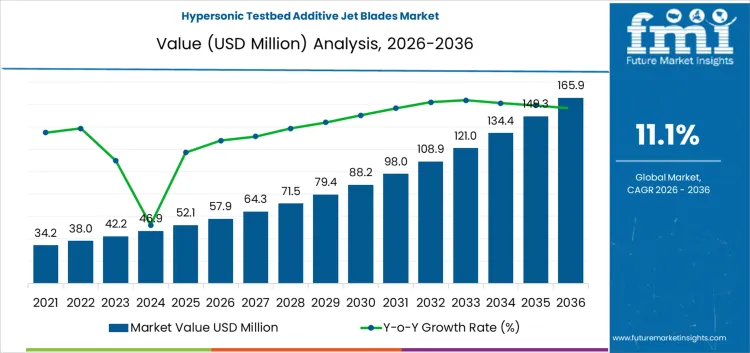
The hypersonic testbed additive jet blades market is valued at USD 57.9 million in 2026 and is projected to reach USD 165.9 million by 2036, expanding at a CAGR of 11.10% over the forecast period. Commercial importance is being set by the cost of iteration in hypersonic propulsion programs, where compressed test calendars and limited facility slots make faster component turns financially meaningful. Buyer intent is concentrated among defense agencies and OEM R&D groups that prioritize schedule certainty, controlled build quality, and repeatable performance under extreme test conditions.
Procurement decisions are typically justified through total program efficiency shorter lead times reduce idle testbed time, while fewer redesign loops lower engineering burn and rework. Spending is also influenced by risk management, since high-temperature blade failures can cascade into expensive engine damage and lost test windows. Between 2026 and 2036, decision-making impact is expected to favor suppliers that can align with stringent qualification pathways and deliver consistent output across small batches, supporting predictable experimentation rather than one-off prototypes. As programs mature, value will increasingly accrue to partners that stabilize throughput and documentation requirements.
Quick Stats for Hypersonic Testbed Additive Jet Blades Market
- Hypersonic Testbed Additive Jet Blades Market Value (2026): USD 57.9 Million
- Hypersonic Testbed Additive Jet Blades Market Forecast Value (2036): USD 165.9 Million
- Hypersonic Testbed Additive Jet Blades Market Forecast CAGR 2026 to 2036: 11.10%
- Leading Engine Type in Hypersonic Testbed Additive Jet Blades Market: Scramjet Engines
- Leading Customer Segment in Hypersonic Testbed Additive Jet Blades Market: Defense Agencies
- Key Growth Regions in Hypersonic Testbed Additive Jet Blades Market: North America, Europe, Asia Pacific
- Top Key Players in Hypersonic Testbed Additive Jet Blades Market: GE Aerospace, Pratt & Whitney, Rolls-Royce, Safran, MTU Aero Engines, IHI Corporation
Hypersonic Testbed Additive Jet Blades Market Key Takeaways
| Metric | Value |
|---|---|
| Industry Value (2026) | USD 57.9 Million |
| Forecast Value (2036) | USD 165.9 Million |
| Forecast CAGR 2026 to 2036 | 11.10% |
How Is the Global Hypersonic Testbed Additive Jet Blades Market Advancing?
The global hypersonic testbed additive jet blades market is advancing steadily, driven by increasing investment in hypersonic research and testing programs by defense agencies and aerospace organizations. Additively manufactured jet blades are increasingly used in hypersonic testbeds to support rapid prototyping, high-temperature testing, and iterative design validation under extreme operating conditions.
A key driver supporting market growth is the need for advanced propulsion components capable of withstanding extreme thermal loads, high rotational speeds, and intense aerodynamic stress associated with hypersonic flight regimes. Additive manufacturing enables the production of complex blade geometries with integrated cooling channels and optimized material distribution, which are difficult to achieve using conventional manufacturing techniques. This capability is particularly valuable for experimental testbed environments where design flexibility and rapid iteration are critical.
Ongoing advancements in metal additive manufacturing processes and high-temperature alloys are further accelerating market expansion. Improvements in powder bed fusion technologies, material consistency, and post-processing techniques are enhancing blade performance, reliability, and repeatability. As hypersonic testing programs continue to scale and demand for rapid component development increases, the additive jet blades market supporting hypersonic testbeds is expected to experience sustained growth over the forecast period.
What Is the Segment-Wise Overview of the Hypersonic Testbed Additive Jet Blades Market?
The hypersonic testbed additive jet blades market is shaped by propulsion architecture priorities and defense-driven demand. Scramjet engines lead with a 37% share, reflecting their central role in sustained hypersonic propulsion testing and the need for additively manufactured blades capable of withstanding extreme thermal and aerodynamic stress. Additive manufacturing supports rapid design iteration and complex cooling geometries required for scramjet validation. On the customer side, defense agencies dominate with a 72% share, driven by national hypersonic research programs and classified testbed development. Their focus on performance validation, rapid prototyping, and controlled testing environments positions defense agencies as the primary demand drivers in this market.
Why Do Scramjet Engines Lead the Hypersonic Testbed Additive Jet Blades Market?
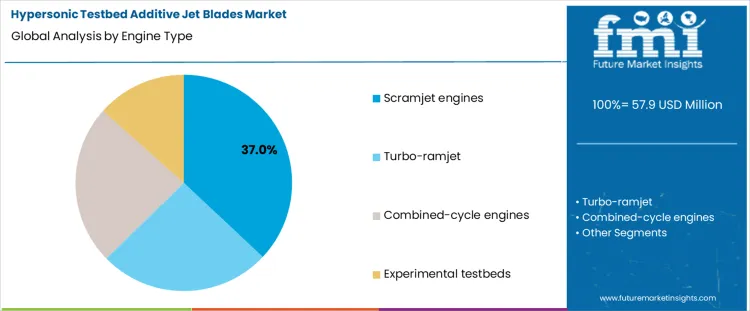
Scramjet engines account for 37% of engine-type demand in the Hypersonic Testbed Additive Jet Blades Market due to their critical role in sustained hypersonic propulsion research. Scramjets operate efficiently at extremely high Mach speeds, requiring jet blades that can withstand intense thermal loads, high-pressure airflow, and rapid combustion dynamics. Additive manufacturing enables the production of complex blade geometries with internal cooling channels, lightweight lattice structures, and advanced material combinations that are difficult to achieve using conventional methods. These capabilities are essential for experimental scramjet testing, where rapid design iteration and performance optimization are priorities. As hypersonic programs advance toward higher speed thresholds and longer test durations, demand for additively manufactured jet blades tailored for scramjet engines continues to dominate this market segment.
Why Do Defense Agencies Dominate Demand in the Hypersonic Testbed Additive Jet Blades Market?
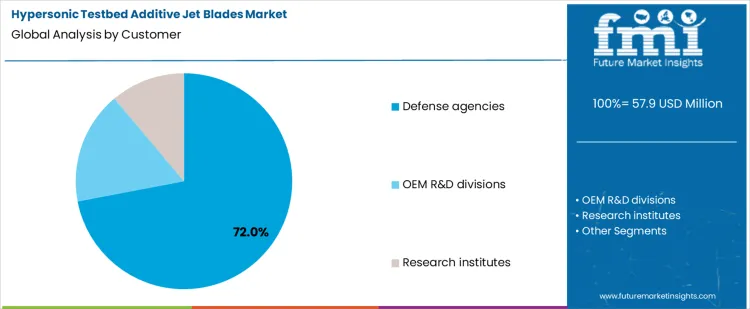
Defense agencies represent 72% of total customer demand, making them the primary drivers of the Hypersonic Testbed Additive Jet Blades Market. National defense programs lead hypersonic research efforts focused on next-generation propulsion, high-speed strike systems, and advanced flight test platforms. These programs require specialized jet blades capable of operating under extreme thermal and mechanical conditions, where additive manufacturing offers rapid prototyping, customization, and accelerated testing cycles. Defense agencies prioritize controlled development environments, classified testing, and fast iteration timelines, all of which favor in-house or closely managed additive manufacturing workflows. Sustained government funding and long-term strategic interest in hypersonic capabilities continue to support strong procurement activity, reinforcing defense agencies as the dominant customer group.
What Are the Key Dynamics for the Hypersonic Testbed Additive Jet Blades Market?
The hypersonic testbed additive jet blades market is driven by the need to support advanced aerospace propulsion testing for hypersonic flight technologies. Additive manufacturing (AM) jet blades are increasingly utilized in hypersonic testbeds due to their ability to produce complex geometries, high-performance alloys, and integration of cooling channels that improve thermal and structural performance. Key market dynamics include the emphasis on next-generation aerospace research, demand for rapid prototyping and iterative testing, and strategic defense investments in hypersonic capabilities. Testbed facilities and aerospace OEMs are adopting additive jet blade solutions to validate engine performance under extreme temperatures and stress conditions.
Why Is the Hypersonic Testbed Additive Jet Blades Market Growing?
The market is growing as governments, defense agencies, and aerospace companies accelerate development of hypersonic vehicles for strategic, commercial, and research applications. Hypersonic flight places extreme demands on turbine and compressor components, making conventional manufacturing methods inadequate for meeting performance requirements. Additive manufacturing enables optimized blade designs with reduced weight, enhanced durability, and integrated cooling features that are critical for hypersonic airflow environments. Investment in advanced test infrastructure, coupled with collaborative research programs between industry and national laboratories, is increasing demand for additive jet blade technologies tailored for hypersonic testbeds.
How Are the Key Drivers Shaping the Hypersonic Testbed Additive Jet Blades Market?
Key drivers shaping the market include expanding defense budgets allocated to hypersonic propulsion programs and increasing collaboration between aerospace OEMs and additive manufacturing specialists. Advances in AM alloys and process control have improved material properties such as creep resistance and fatigue life, making AM blades more viable for high-temperature testing. The need for rapid design iteration and short development cycles is encouraging adoption of additive techniques over traditional casting or machining. Strategic technology roadmaps emphasizing autonomy, advanced materials, and propulsion efficiency are further reinforcing the importance of additive jet blades in testbed environments.
What Is the Growth Outlook for the Hypersonic Testbed Additive Jet Blades Market by Country?
| Country | CAGR (%) |
|---|---|
| USA | 11.5% |
| UK | 11.0% |
| France | 10.5% |
| Australia | 10.0% |
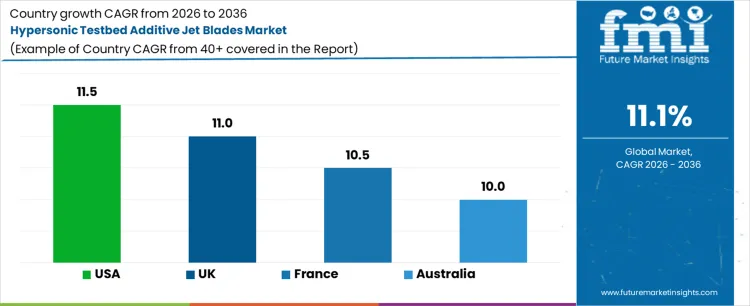
The hypersonic testbed additive jet blades market is expanding as nations accelerate hypersonic propulsion testing and validation. The USA leads at 11.5%, driven by extensive defense programs and advanced testing infrastructure. The UK follows at 11.0%, supported by growing investment in propulsion research and rapid prototyping capabilities. France grows at 10.5%, benefiting from strong aerospace engineering expertise and defense-led hypersonic initiatives. Australia expands at 10.0%, supported by international collaborations and rising domestic research investment. As hypersonic systems move closer to deployment, demand for additively manufactured jet blades in testbed applications is expected to increase across these regions.
What Is Driving the Growth of the Hypersonic Testbed Additive Jet Blades Market in the USA?
The hypersonic testbed additive jet blades market in the USA is growing at a CAGR of 11.5%, driven by strong defense-funded hypersonic research and extensive testing infrastructure. The USA leads global hypersonic development programs focused on propulsion, materials validation, and thermal performance testing. Additively manufactured jet blades are increasingly used in hypersonic testbeds due to their ability to withstand extreme temperatures, high rotational speeds, and rapid design iterations. Defense agencies and aerospace primes are prioritizing additive manufacturing to accelerate prototyping, reduce lead times, and enable complex blade geometries not achievable through conventional methods. Continued investment in wind tunnels, propulsion test facilities, and experimental hypersonic platforms is increasing demand for advanced jet blade components. Collaboration between government labs, aerospace OEMs, and additive manufacturing specialists further supports market growth. As hypersonic programs advance toward operational readiness, demand for additively manufactured jet blades is expected to remain strong.
How Is the Hypersonic Testbed Additive Jet Blades Market Expanding in the UK?
The hypersonic testbed additive jet blades market in the UK is expanding at a CAGR of 11.0%, supported by growing investment in advanced propulsion research and defense aerospace programs. The UK is strengthening its hypersonic testing capabilities through national laboratories and partnerships with international defense organizations. Additive jet blades are gaining traction for testbed engines due to their rapid production cycles and suitability for experimental configurations. The ability to iterate blade designs quickly is critical for validating airflow behavior, thermal resistance, and structural integrity under hypersonic conditions. UK aerospace firms and research institutions are also leveraging additive manufacturing to reduce material waste and development timelines. Government-backed funding for next-generation aerospace technologies further supports adoption. As the UK expands its hypersonic testing infrastructure and collaborative research initiatives, demand for additively manufactured jet blades is expected to grow steadily.
What Is Supporting Growth of the Hypersonic Testbed Additive Jet Blades Market in France?
The hypersonic testbed additive jet blades market in France is growing at a CAGR of 10.5%, driven by the country’s strong aerospace engineering base and focus on advanced defense technologies. France’s involvement in hypersonic propulsion research and experimental flight programs is increasing the need for specialized testbed components. Additive jet blades enable precise control over blade geometry and internal cooling structures, which are essential for hypersonic testing environments. French aerospace organizations are adopting additive manufacturing to support rapid prototyping and iterative testing cycles. Collaboration between defense agencies, aerospace manufacturers, and research institutes is strengthening domestic capabilities. In addition, France’s emphasis on high-performance materials and thermal management supports demand for advanced blade designs. As hypersonic research progresses, additive jet blades are expected to play a growing role in France’s testbed programs.
How Is the Hypersonic Testbed Additive Jet Blades Market Developing in Australia?
The hypersonic testbed additive jet blades market in Australia is expanding at a CAGR of 10.0%, supported by increasing investment in hypersonic research and international defense collaborations. Australia is developing hypersonic test facilities and propulsion programs in partnership with allied nations, driving demand for advanced testbed components. Additive manufacturing is particularly attractive for Australian programs due to its ability to support low-volume, high-complexity production without extensive tooling. Additively manufactured jet blades enable faster experimentation and validation under extreme operating conditions. Growth in domestic aerospace research capabilities and government funding for advanced defense technologies further supports market expansion. Australia’s focus on building sovereign defense and aerospace capabilities is also encouraging local adoption of additive manufacturing technologies. As hypersonic testing activity increases, demand for additive jet blades is expected to rise steadily.
How Are Companies Competing in the Hypersonic Testbed Additive Jet Blades Market?
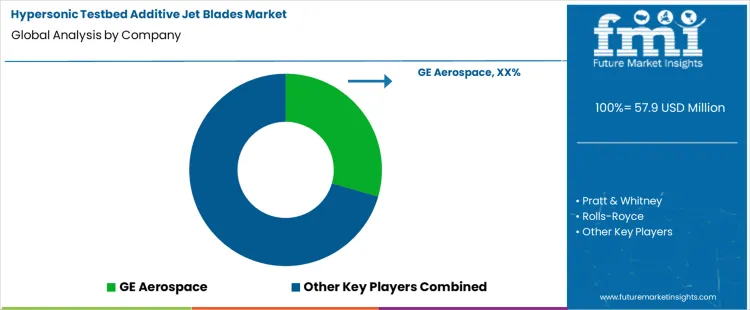
Competition in the hypersonic testbed additive jet blades market is driven by extreme thermal resistance, structural integrity at very high rotational speeds, and the ability to rapidly iterate blade designs for experimental propulsion systems. Hypersonic testbeds subject jet blades to temperatures, pressures, and vibrational loads far beyond conventional aerospace environments, making advanced materials and additive manufacturing precision critical. Companies differentiate by how effectively they use metal additive manufacturing to optimize internal cooling channels, complex geometries, and rapid prototyping while meeting stringent performance and safety requirements.
GE Aerospace, Pratt & Whitney, and Rolls-Royce compete through advanced additive manufacturing platforms and deep propulsion system expertise. GE Aerospace emphasizes additive-designed turbine and compressor blades with intricate cooling architectures that cannot be produced through traditional methods, supporting fast design iteration for hypersonic research programs. Pratt & Whitney focuses on materials science, powder metallurgy, and additive processes that enhance blade durability and thermal stability under extreme conditions. Rolls-Royce differentiates through digital design, simulation-led development, and additive techniques that enable lightweight yet robust blade structures tailored for experimental and demonstrator engines.
Safran, MTU Aero Engines, and IHI Corporation compete through collaborative R&D, materials innovation, and integration with testbed programs. Safran applies advanced alloys and additive processes to improve blade efficiency and thermal tolerance, often in partnership with research institutions and defense agencies. MTU Aero Engines focuses on additive repair, component optimization, and validation of additively manufactured blades for high-stress applications. IHI Corporation leverages precision manufacturing and advanced metallurgy to support hypersonic propulsion testbeds, emphasizing reliability and repeatability. Across the market, competitive advantage is defined by additive design freedom, high-temperature material performance, rapid iteration capability, and close alignment with hypersonic research and testing requirements.
Key Players in Hypersonic Testbed Additive Jet Blades Market
- GE Aerospace
- Pratt & Whitney
- Rolls-Royce
- Safran
- MTU Aero Engines
- IHI Corporation
Scope of Report
| Attributes | Description |
|---|---|
| Quantitative Unit (2026) | USD Million |
| Engine Type | Scramjet Engines, Turbo-Ramjet, Combined-Cycle Engines, Experimental Testbeds |
| Customer | Defense Agencies, OEM R&D Divisions, Research Institutes |
| Regions Covered | Asia Pacific, Europe, North America, Latin America, Middle East & Africa |
| Countries Covered | China, Japan, South Korea, India, Australia & New Zealand, ASEAN, Rest of Asia Pacific, Germany, United Kingdom, France, Italy, Spain, Nordic, BENELUX, Rest of Europe, United States, Canada, Mexico, Brazil, Chile, Rest of Latin America, Kingdom of Saudi Arabia, Other GCC Countries, Turkey, South Africa, Other African Union, Rest of Middle East & Africa |
| Key Companies Profiled | GE Aerospace, Pratt & Whitney, Rolls-Royce, Safran, MTU Aero Engines, IHI Corporation |
| Additional Attributes | Dollar sales by engine type and customer; regional market size and forecast analysis; growth outlook across major regions; adoption trends of additive-manufactured jet blades in hypersonic testbed programs; assessment of material performance requirements, rapid prototyping intensity, and demand patterns across defense-led and experimental propulsion research initiatives. |
Hypersonic Testbed Additive Jet Blades Market by Key Segments
Engine Type
- Scramjet engines
- Turbo-ramjet
- Combined-cycle engines
- Experimental testbeds
Customer
- Defense agencies
- OEM R&D divisions
- Research institutes
Region
- Asia Pacific
- China
- Japan
- South Korea
- India
- Australia & New Zealand
- ASEAN
- Rest of Asia Pacific
- Europe
- Germany
- United Kingdom
- France
- Italy
- Spain
- Nordic
- BENELUX
- Rest of Europe
- North America
- United States
- Canada
- Mexico
- Latin America
- Brazil
- Chile
- Rest of Latin America
- Middle East & Africa
- Kingdom of Saudi Arabia
- Other GCC Countries
- Turkey
- South Africa
- Other African Union
- Rest of Middle East & Africa
Bibliography
- National Aeronautics and Space Administration (NASA). (2024). Additive Manufacturing for Hypersonic Propulsion Components: Design and Thermal Performance Assessment. NASA Technical Reports Server (NTRS).
- U.S. Department of Defense. (2023). Hypersonic Propulsion Materials and Manufacturing Roadmap: Additive Fabrication for High-Temperature Turbomachinery. Office of the Under Secretary of Defense for Research and Engineering.
- European Space Agency (ESA). (2024). Advanced Manufacturing Technologies for High-Temperature Aerospace Components in Hypersonic Flight Applications. European Space Agency Publications.
- Defence Science and Technology Laboratory (Dstl). (2023). Additive Manufacturing in Defence Aerospace: Thermal-Mechanical Validation for Hypersonic Engine Components. U.K. Ministry of Defence.
- National Institute of Standards and Technology (NIST). (2024). Measurement Science for Metal Additive Manufacturing at Extreme Temperatures. U.S. Department of Commerce.
Frequently Asked Questions
How big is the hypersonic testbed additive jet blades market in 2026?
The global hypersonic testbed additive jet blades market is estimated to be valued at USD 57.9 million in 2026.
What will be the size of hypersonic testbed additive jet blades market in 2036?
The market size for the hypersonic testbed additive jet blades market is projected to reach USD 165.9 million by 2036.
How much will be the hypersonic testbed additive jet blades market growth between 2026 and 2036?
The hypersonic testbed additive jet blades market is expected to grow at a 11.1% CAGR between 2026 and 2036.
What are the key product types in the hypersonic testbed additive jet blades market?
The key product types in hypersonic testbed additive jet blades market are scramjet engines, turbo-ramjet, combined-cycle engines and experimental testbeds.
Which customer segment to contribute significant share in the hypersonic testbed additive jet blades market in 2026?
In terms of customer, defense agencies segment to command 72.0% share in the hypersonic testbed additive jet blades market in 2026.
Preview the report firsthand - request a free sample
Get SampleGet the brochure for pricing and purchase details.
Get PDFTable of Content
- Executive Summary
- Global Market Outlook
- Demand-side Trends
- Supply-side Trends
- Technology Roadmap Analysis
- Analysis and Recommendations
- Market Overview
- Market Coverage / Taxonomy
- Market Definition / Scope / Limitations
- Market Background
- Market Dynamics
- Drivers
- Restraints
- Opportunity
- Trends
- Scenario Forecast
- Demand in Optimistic Scenario
- Demand in Likely Scenario
- Demand in Conservative Scenario
- Opportunity Map Analysis
- Product Life Cycle Analysis
- Supply Chain Analysis
- Investment Feasibility Matrix
- Value Chain Analysis
- PESTLE and Porter’s Analysis
- Regulatory Landscape
- Regional Parent Market Outlook
- Production and Consumption Statistics
- Import and Export Statistics
- Market Dynamics
- Global Market Analysis 2021 to 2025 and Forecast, 2026 to 2036
- Historical Market Size Value (USD Million) Analysis, 2021 to 2025
- Current and Future Market Size Value (USD Million) Projections, 2026 to 2036
- Y-o-Y Growth Trend Analysis
- Absolute $ Opportunity Analysis
- Global Market Pricing Analysis 2021 to 2025 and Forecast 2026 to 2036
- Global Market Analysis 2021 to 2025 and Forecast 2026 to 2036, By Engine Type
- Introduction / Key Findings
- Historical Market Size Value (USD Million) Analysis By Engine Type , 2021 to 2025
- Current and Future Market Size Value (USD Million) Analysis and Forecast By Engine Type , 2026 to 2036
- Scramjet engines
- Turbo-ramjet
- Combined-cycle engines
- Experimental testbeds
- Scramjet engines
- Y-o-Y Growth Trend Analysis By Engine Type , 2021 to 2025
- Absolute $ Opportunity Analysis By Engine Type , 2026 to 2036
- Global Market Analysis 2021 to 2025 and Forecast 2026 to 2036, By Customer
- Introduction / Key Findings
- Historical Market Size Value (USD Million) Analysis By Customer, 2021 to 2025
- Current and Future Market Size Value (USD Million) Analysis and Forecast By Customer, 2026 to 2036
- Defense agencies
- OEM R&D divisions
- Research institutes
- Defense agencies
- Y-o-Y Growth Trend Analysis By Customer, 2021 to 2025
- Absolute $ Opportunity Analysis By Customer, 2026 to 2036
- Global Market Analysis 2021 to 2025 and Forecast 2026 to 2036, By Region
- Introduction
- Historical Market Size Value (USD Million) Analysis By Region, 2021 to 2025
- Current Market Size Value (USD Million) Analysis and Forecast By Region, 2026 to 2036
- North America
- Latin America
- Western Europe
- Eastern Europe
- East Asia
- South Asia and Pacific
- Middle East & Africa
- Market Attractiveness Analysis By Region
- North America Market Analysis 2021 to 2025 and Forecast 2026 to 2036, By Country
- Historical Market Size Value (USD Million) Trend Analysis By Market Taxonomy, 2021 to 2025
- Market Size Value (USD Million) Forecast By Market Taxonomy, 2026 to 2036
- By Country
- USA
- Canada
- Mexico
- By Engine Type
- By Customer
- By Country
- Market Attractiveness Analysis
- By Country
- By Engine Type
- By Customer
- Key Takeaways
- Latin America Market Analysis 2021 to 2025 and Forecast 2026 to 2036, By Country
- Historical Market Size Value (USD Million) Trend Analysis By Market Taxonomy, 2021 to 2025
- Market Size Value (USD Million) Forecast By Market Taxonomy, 2026 to 2036
- By Country
- Brazil
- Chile
- Rest of Latin America
- By Engine Type
- By Customer
- By Country
- Market Attractiveness Analysis
- By Country
- By Engine Type
- By Customer
- Key Takeaways
- Western Europe Market Analysis 2021 to 2025 and Forecast 2026 to 2036, By Country
- Historical Market Size Value (USD Million) Trend Analysis By Market Taxonomy, 2021 to 2025
- Market Size Value (USD Million) Forecast By Market Taxonomy, 2026 to 2036
- By Country
- Germany
- UK
- Italy
- Spain
- France
- Nordic
- BENELUX
- Rest of Western Europe
- By Engine Type
- By Customer
- By Country
- Market Attractiveness Analysis
- By Country
- By Engine Type
- By Customer
- Key Takeaways
- Eastern Europe Market Analysis 2021 to 2025 and Forecast 2026 to 2036, By Country
- Historical Market Size Value (USD Million) Trend Analysis By Market Taxonomy, 2021 to 2025
- Market Size Value (USD Million) Forecast By Market Taxonomy, 2026 to 2036
- By Country
- Russia
- Poland
- Hungary
- Balkan & Baltic
- Rest of Eastern Europe
- By Engine Type
- By Customer
- By Country
- Market Attractiveness Analysis
- By Country
- By Engine Type
- By Customer
- Key Takeaways
- East Asia Market Analysis 2021 to 2025 and Forecast 2026 to 2036, By Country
- Historical Market Size Value (USD Million) Trend Analysis By Market Taxonomy, 2021 to 2025
- Market Size Value (USD Million) Forecast By Market Taxonomy, 2026 to 2036
- By Country
- China
- Japan
- South Korea
- By Engine Type
- By Customer
- By Country
- Market Attractiveness Analysis
- By Country
- By Engine Type
- By Customer
- Key Takeaways
- South Asia and Pacific Market Analysis 2021 to 2025 and Forecast 2026 to 2036, By Country
- Historical Market Size Value (USD Million) Trend Analysis By Market Taxonomy, 2021 to 2025
- Market Size Value (USD Million) Forecast By Market Taxonomy, 2026 to 2036
- By Country
- India
- ASEAN
- Australia & New Zealand
- Rest of South Asia and Pacific
- By Engine Type
- By Customer
- By Country
- Market Attractiveness Analysis
- By Country
- By Engine Type
- By Customer
- Key Takeaways
- Middle East & Africa Market Analysis 2021 to 2025 and Forecast 2026 to 2036, By Country
- Historical Market Size Value (USD Million) Trend Analysis By Market Taxonomy, 2021 to 2025
- Market Size Value (USD Million) Forecast By Market Taxonomy, 2026 to 2036
- By Country
- Kingdom of Saudi Arabia
- Other GCC Countries
- Turkiye
- South Africa
- Other African Union
- Rest of Middle East & Africa
- By Engine Type
- By Customer
- By Country
- Market Attractiveness Analysis
- By Country
- By Engine Type
- By Customer
- Key Takeaways
- Key Countries Market Analysis
- USA
- Pricing Analysis
- Market Share Analysis, 2025
- By Engine Type
- By Customer
- Canada
- Pricing Analysis
- Market Share Analysis, 2025
- By Engine Type
- By Customer
- Mexico
- Pricing Analysis
- Market Share Analysis, 2025
- By Engine Type
- By Customer
- Brazil
- Pricing Analysis
- Market Share Analysis, 2025
- By Engine Type
- By Customer
- Chile
- Pricing Analysis
- Market Share Analysis, 2025
- By Engine Type
- By Customer
- Germany
- Pricing Analysis
- Market Share Analysis, 2025
- By Engine Type
- By Customer
- UK
- Pricing Analysis
- Market Share Analysis, 2025
- By Engine Type
- By Customer
- Italy
- Pricing Analysis
- Market Share Analysis, 2025
- By Engine Type
- By Customer
- Spain
- Pricing Analysis
- Market Share Analysis, 2025
- By Engine Type
- By Customer
- France
- Pricing Analysis
- Market Share Analysis, 2025
- By Engine Type
- By Customer
- India
- Pricing Analysis
- Market Share Analysis, 2025
- By Engine Type
- By Customer
- ASEAN
- Pricing Analysis
- Market Share Analysis, 2025
- By Engine Type
- By Customer
- Australia & New Zealand
- Pricing Analysis
- Market Share Analysis, 2025
- By Engine Type
- By Customer
- China
- Pricing Analysis
- Market Share Analysis, 2025
- By Engine Type
- By Customer
- Japan
- Pricing Analysis
- Market Share Analysis, 2025
- By Engine Type
- By Customer
- South Korea
- Pricing Analysis
- Market Share Analysis, 2025
- By Engine Type
- By Customer
- Russia
- Pricing Analysis
- Market Share Analysis, 2025
- By Engine Type
- By Customer
- Poland
- Pricing Analysis
- Market Share Analysis, 2025
- By Engine Type
- By Customer
- Hungary
- Pricing Analysis
- Market Share Analysis, 2025
- By Engine Type
- By Customer
- Kingdom of Saudi Arabia
- Pricing Analysis
- Market Share Analysis, 2025
- By Engine Type
- By Customer
- Turkiye
- Pricing Analysis
- Market Share Analysis, 2025
- By Engine Type
- By Customer
- South Africa
- Pricing Analysis
- Market Share Analysis, 2025
- By Engine Type
- By Customer
- USA
- Market Structure Analysis
- Competition Dashboard
- Competition Benchmarking
- Market Share Analysis of Top Players
- By Regional
- By Engine Type
- By Customer
- Competition Analysis
- Competition Deep Dive
- GE Aerospace
- Overview
- Product Portfolio
- Profitability by Market Segments (Product/Age /Sales Channel/Region)
- Sales Footprint
- Strategy Overview
- Marketing Strategy
- Product Strategy
- Channel Strategy
- Pratt & Whitney
- Rolls-Royce
- Safran
- MTU Aero Engines
- IHI Corporation
- GE Aerospace
- Competition Deep Dive
- Assumptions & Acronyms Used
- Research Methodology


