

- Market Size (2026)
- USD 258.6 Mn
- Forecast (2036)
- USD 421.2 Mn
- CAGR (2026 to 2036)
- 5.0%
How big is Ice Bags Market in 2026?
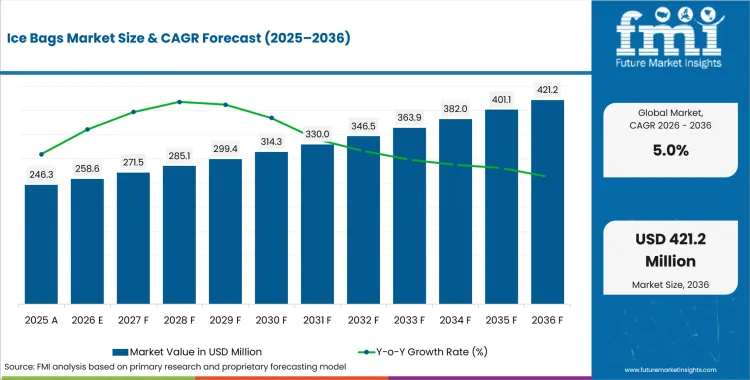
USD 258.6 million in 2026 and USD 421.2 million by 2036 at a 5.0% CAGR.
Demand for ice bags is projected to rise from USD 258.6 million in 2026 to USD 421.2 million by 2036 at a 5.0% CAGR. Packaged-ice production creates a recurring requirement for bags that survive filling and delivery. Reddy Ice announced in January 2026 that its Arctic Glacier transaction would combine operating footprints across the United States, Mexico and Canada. That scale keeps food packaging film qualification and replenishment reliability tied to every filled unit rather than to a generic packaging claim.
Country requirements also change the evidence needed before a bag format is accepted. South Korea's Ministry of Food and Drug Safety published national edible-ice safety inspection results in July 2026 after checks across summer foodservice channels. The national program keeps controlled handling and traceability relevant where South Korea carries the highest profiled CAGR. Suppliers therefore need local compliance records alongside closure security and frozen-film performance for the intended packaged-ice route.
Key Takeaways of Ice Bags Market
- Packaged-ice production sustains repeat bag demand because every filled unit must survive storage, delivery and customer handling.
- In 2026, drawstring bags are estimated to account for 39.0% of closure type demand because manual closure supports routine bag handling.
- LDPE is projected to hold 51.0% of material demand in 2026 because flexible film supports common ice-bag conversion requirements.
- Bags holding 5 to 10 lb are anticipated to account for 41.0% of capacity demand in 2026 because this range fits common retail and foodservice purchasing occasions.
- Seasonal replenishment can strain inventory when a producer or distributor has not matched the chosen closure, film, and capacity to the expected packaged-ice route.
- Directly evidenced participants include Reddy Ice, Arctic Glacier Premium Ice, Home City Ice and Inno-Pak. Market analysis also uses current regulator and packaged-ice safety records.
Analyst Perspective
Ice bags earn repeat use when the closure, film, capacity, and delivery route fit how packaged ice is produced, stocked, and handled. Reliable formats protect the filled bag and enable distributors to replenish the intended account without introducing avoidable breakage or handling steps.
- Nandini Roy Choudhury, Principal Consultant, Future Market Insights
How is the Ice Bags Market segmented?
The ice bags market is segmented by closure type, material, capacity, end use, sales channel, and region.
Closure type includes drawstring, twist-tie, zip-lock closure, and heat-seal. Material includes LDPE, HDPE, and compostable plastics. Capacity covers up to 5 lb, 5 to 10 lb, 10 to 20 lb, and above 20 lb. End use includes foodservice and hospitality, retail stores, convenience stores, and ice manufacturers and vending. Sales channels include distributors, direct sales, and e-commerce.
Why do drawstring bags lead demand within the closure type category?
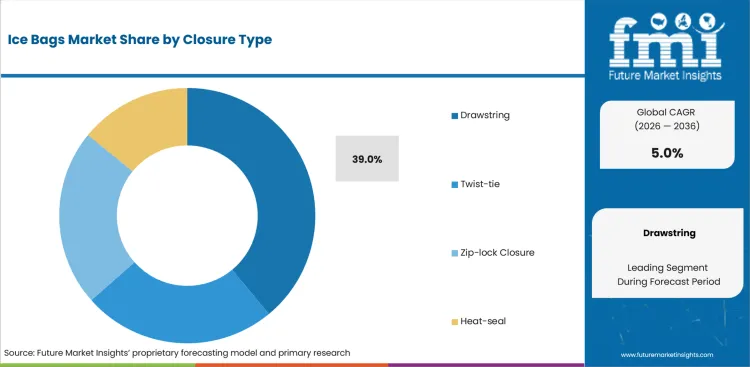
Drawstring bags fit accounts that need a closure users can reopen without separate sealing equipment. Retail handling makes that convenience more valuable where filled bags pass through self-service stores and seasonal outlets. In January 2026 the National Park Service sought a campground vendor required to sell bagged ice at a site that historically hosts about 50,000 campers each season. The official retail requirement shows why familiar freezer bags and easy handling remain commercially relevant even when closure choice varies by account.
- By closure type, drawstring bags are estimated to hold 39.0% in 2026 owing to familiar manual handling and routine bag closure.
- Ice suppliers select closure systems that protect filled bags while remaining practical for the intended packing and retail handling route.
Why does LDPE lead demand within the material category?
LDPE remains practical where converters need flexible film that tolerates frozen handling and common sealing methods. The European Commission's February 2026 food-contact materials guidance confirms that plastic packaging touching food must comply with safety rules designed to prevent harmful migration. That requirement makes PE films a qualification decision rather than a resin-price choice. Suppliers still need the finished bag to retain strength through filling and transport before the material can support repeat packaged-ice orders.
- LDPE is projected to represent 51.0% of material demand in 2026 as flexible film fits common ice-bag conversion requirements.
- Ice-bag film must maintain bag integrity under frozen conditions while supporting the selected closure and capacity range.
Why does 5 to 10 lb lead demand within the capacity category?
The 5 to 10 lb range fits retail accounts that need manageable bags without moving into large party-size formats. The USA Justice Department's 2026 packaged-ice case separates retail-chain demand from airline and airline-catering demand because those buyers use different service routes and operating requirements. That split makes food storage bags and capacity planning part of account qualification. A supplier therefore benefits when the selected size can move through the customer's existing handling route without adding avoidable repacking or equipment changes.
- Bags holding 5 to 10 lb are forecast to account for 41.0% of capacity demand in 2026 because the range fits routine retail and foodservice purchases.
- This capacity range helps suppliers balance manageable bag size with enough product for repeat commercial and consumer use.
Why does foodservice and hospitality lead demand within the end use category?
Foodservice and hospitality accounts use packaged ice repeatedly for beverage service and catered events. In March 2026 South Korea's Ministry of Food and Drug Safety announced inspections of edible ice used at foodservice businesses before the summer demand period. The inspection program links hygiene control directly with commercial ice handling rather than with prepared-food packaging in general. Food bags used for packaged ice therefore need to support dependable replenishment while the producer maintains the sanitation controls required for the filled product.
- Foodservice and hospitality are anticipated to represent 35.0% of end use demand in 2026 due to the reason that recurring beverage and event service requires dependable packaged-ice replenishment.
- Commercial users favor ice bags that match their capacity needs and arrive through a dependable delivery or wholesale route.
Why do distributors lead demand within the sales channel category?
Distributor economics depend on route density because packaged ice must be replenished before seasonal peaks exhaust store inventory. The USA Justice Department reported in January 2026 that Reddy Ice sold across 37 states and the District of Columbia before its Arctic Glacier transaction. Large geographic coverage makes delivery scheduling and local inventory access part of supplier selection. Distributors can therefore create value by matching bag capacity and replenishment frequency to each retail or commercial account rather than treating every delivery point as identical.
- Distributors are projected to hold 43.0% of sales channel demand in 2026 owing to local stock availability and scheduled replenishment.
- Distribution networks help producers keep suitable ice-bag capacities available during seasonal peaks without requiring each account to manage separate supply routes.
What are the drivers, restraints and opportunities in the Ice Bags Market?
Material rules and off-premises handling raise qualification demand while fragmented recovery systems increase switching costs and leave room for standard lower-plastic formats.
- Driver: Packaged-ice buyers require bag closure, material, capacity, and handling performance that fit the intended ice route.
- Restraint: A closure or film suited to one bag size or route may not suit a different packaged-ice handling configuration.
- Opportunity: Suppliers can offer directly evidenced drawstring, twist-tie, zip-lock, or heat-seal formats that match the stated capacity and channel.
Closure, material, capacity, and route compatibility govern ice-bag selection
Sanitation evidence raises the value of bag integrity across the packaged-ice route. The International Packaged Ice Association reported in March 2026 that two independent studies found contamination risk where packaged ice was produced without recognized sanitation and quality-control standards. The finding ties safe handling to validated water quality and hygienic processing. Buyers therefore assess high barrier packaging films and closure performance as part of a controlled filled-product route rather than as an isolated packaging specification.
Film and closure must be assessed as one ice-bag configuration
Material substitution can trigger new qualification work even when the bag format does not change. In May 2026 the USA Food and Drug Administration released a scientific evaluation covering eight phthalates still authorized as plasticizers for food-contact use. That review reinforces the need to document the exact food-contact chemistry used in flexible packaging. Ice-bag converters therefore face switching costs when a new film structure changes compliance evidence or sealing behavior before the revised bag can enter recurring production.
Distribution routes determine practical capacity and replenishment requirements
Regional asset transfers can create openings for suppliers that already serve packaged-ice routes. A February 2026 Justice Department asset-preservation order supported divestitures designed to keep competing packaged-ice operations viable during the Reddy Ice transaction. The remedy protects manufacturing and distribution capacity rather than a generic packaging channel. Suppliers that can pair compliant bags with dependable production and delivery support can therefore compete for transferred accounts as regional service networks are reorganized.
Which country CAGRs are covered in the Ice Bags Market?
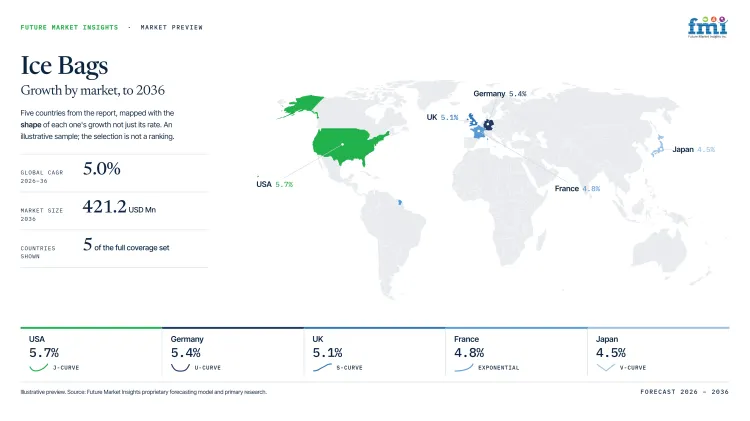
| Country | CAGR |
|---|---|
| South Korea | 6.0% |
| USA | 5.7% |
| Germany | 5.4% |
| UK | 5.1% |
| Japan | 4.5% |
How do country-level CAGRs compare in the Ice Bags Market?
The countries carry a 1.5 percentage-point CAGR spread and require different evidence around food safety, labeling and route economics. South Korea leads at 6.0%, followed by the USA at 5.7%, Germany at 5.4%, the UK at 5.1% and Japan at 4.5%. The ranking measures forecast pace rather than bag fitness, so suppliers still qualify closure and material performance for each national route.
- In South Korea, suppliers need to align bag capacity and film specification with the intended packaged-ice distribution route rather than relying on a one-size-fits-all format.
- In the USA, packaged-ice bags must withstand production, cold storage, transportation, retail display, and commercial replenishment without compromising performance.
- Germany places greater emphasis on selecting film and closure combinations that match the required bag size, handling conditions, and end-use channel.
- In the UK, distributor reach and appropriately sized bag formats play a major role in serving both retail customers and foodservice operators effectively.
- Japan favors packaged-ice solutions that have been validated for the specific handling and distribution conditions in which they will be used.
CAGR measures pace rather than current revenue, so installed production, local route coverage, and seasonal replenishment still shape commercial attractiveness. The full report provides country-level CAGR analysis across North America, Latin America, Western Europe, Eastern Europe, East Asia, South Asia and Pacific, and Middle East and Africa.
Country-wise Analysis
- Ice bags demand in the USA is projected to record 5.7% CAGR through 2036 as national distribution keeps packaged ice close to recurring retail demand. The Justice Department reported in January 2026 that Reddy Ice generated about USD 511 million in annual revenue and sold packaged ice across 37 states plus the District of Columbia. That national footprint gives bag converters a broad test of whether closure and film choices survive repeated loading. Players in the market serving cold chain packaging routes still need replenishment support matched to the retail account. Scale strengthens access only when the filled bag stays intact from production through customer handling.
- UK packaged-ice demand is driven by a mature frozen-food retail system where shelf availability and convenient handling shape repeat purchases. The Office for National Statistics assigned a 2026 CPI weight of 1.9407 to the broader edible ices and ice cream class. That national series does not measure packaged water ice directly but it confirms continued expenditure tracking across frozen ice categories. Ice bags demand in the UK is forecast to expand at 5.1% CAGR over the forecast period. Manufacturers linking food packaging formats to this route still need direct proof that the bag suits frozen water ice rather than transferring performance claims from broader retail categories.
- Germany is estimated to post 5.4% CAGR for ice bags through 2036 as packaged beverage ice remains visible in national household spending measurement. Destatis includes ice cubes for beverages in its 2026 continuous household budget expenditure list. That national treatment frames commercial potential without replacing direct tests on the finished bag. Companies selecting packaging films still need food-contact documentation plus closure security at the intended capacity. Repeat orders therefore depend on film strength and reliable account replenishment rather than on the spending category alone. The commercial route is strongest where those records travel with the bag specification used by distributors.
- Japanese packaged-food suppliers operate under a national labeling framework that received another formal update on April 1 2026. The Consumer Affairs Agency published the fortieth amendment to its food-labeling notice and updated its related question-and-answer record on the same date. Adoption of ice bags in Japan is estimated to expand at 4.5% CAGR by 2036. Companies using flexible plastic packaging must keep required information legible while the filled unit remains suitable for frozen handling. The slower profiled pace increases the value of disciplined qualification because unnecessary closure or film changes can add conversion work without improving route performance.
- South Korea's ice bags outlook is anticipated to advance at 6.0% CAGR through 2036, as the country combines active national oversight of edible ice with a distribution system that places sanitation records close to commercial purchasing. The Ministry of Food and Drug Safety published summer inspection results in July 2026 covering edible ice and related foodservice handling. Those checks keep traceability and filling controls visible when suppliers qualify bags for repeat use. Bag specifications therefore need to match the packed-ice process and the intended local route rather than rely on a generic material claim.
Who are the notable companies in the Ice Bags Market?
Reddy Ice, Arctic Glacier Premium Ice, Home City Ice, Inno-Pak.
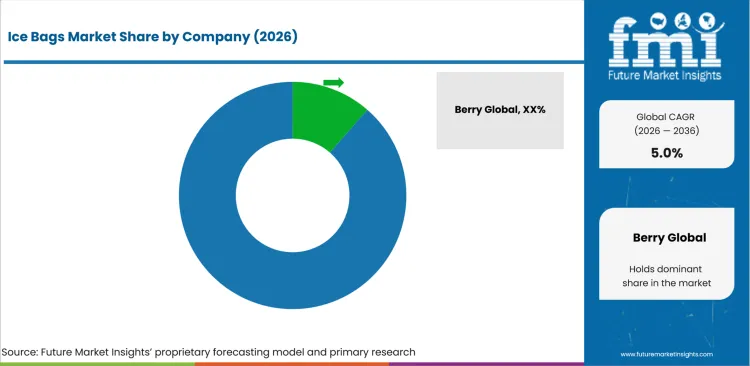
Competition separates large packaged-ice producers from regional operators and bag converters because buyers need filled-product supply plus dependable packaging support.
- Reddy Ice and Arctic Glacier compete through broad manufacturing and distribution networks while Home City Ice remains a large independent packaged-ice producer in the United States.
- Inno-Pak remains in the authorized company set through its packaging role inside Archer Foodservice Partners. A March 2026 corporate transaction broadened Archer's foodservice platform without being treated as direct proof of an ice-bag launch.
- Buyers compare route coverage and bag reliability before recurring orders because packaged ice loses value quickly when stock or package integrity fails.
Competitive Benchmarking: Ice Bags Market
| Company | Closure and Bag-Format Coverage | Material and Film Capability | Capacity and Channel Coverage | Geographic Reach |
|---|---|---|---|---|
| Reddy Ice | Medium | Medium | High | North America |
| Arctic Glacier Premium Ice | Medium | Medium | High | North America |
| Home City Ice | Medium | Medium | High | United States |
| Inno-Pak | High | High | Medium | North America |
Key Developments in the Ice Bags Market
- In February 2026, Reddy Ice completed its acquisition of Arctic Glacier and combined packaged-ice operations across the United States, Mexico and Canada.
- In February 2026, Columbia Basin Ice was designated to receive Washington packaged-ice manufacturing and distribution assets under the federal divestiture remedy.
- In February 2026, Oregon Ice was designated to receive Oregon customer relationships and packaged-ice assets under the same competition-preserving remedy.
Key Players in the Ice Bags Market
Packaged-Ice Producers and Distribution Platforms
- Reddy Ice
- Arctic Glacier Premium Ice
- Home City Ice
Ice-Bag and Flexible-Film Suppliers
- Inno-Pak
Ice Bags Market - Report Scope
| Coverage field | Report scope |
|---|---|
| Market breakdown | By closure type, material, capacity, end use, sales channel, and region. |
| Quantitative Units | Revenue in USD million and CAGR in %. |
| Market Definition | Ice bags for packaged ice, defined by closure type, material, capacity, end use, sales channel, and the relevant packing and delivery route. |
| Regions Covered | North America, Latin America, Western Europe, Eastern Europe, East Asia, South Asia and Pacific, and Middle East and Africa. |
| Countries Covered | South Korea, USA, Germany, UK, Japan, and 20+ countries included in the full report. |
| Key Companies Profiled | Reddy Ice, Arctic Glacier Premium Ice, Home City Ice, Inno-Pak. |
| Forecast Period | 2026 to 2036. |
| Approach | Primary and secondary research with market triangulation. |
Ice Bags Market - Research Methodology
| Method | Approach |
|---|---|
| Primary Research | FMI analysts gathered input from manufacturers, service providers, technology developers, distributors, end users, procurement teams, and subject-matter experts. Interviews examined purchasing decisions, product or service evaluation, adoption barriers, approval requirements, pricing considerations, and expectations for technical or commercial support. Respondents were also asked what evidence is required before a trial, pilot, or initial order develops into regular purchasing. |
| Desk Research | Desk research covered government statistics, regulatory publications, trade data, industry associations, technical literature, standards, company filings, product information, and official corporate announcements. Sources were reviewed for relevance, publication date, geographic coverage, and consistency with the defined market scope. Claims relating to performance, applications, approvals, capacity, investment, and commercial activity were retained only when supported by credible public evidence. |
| Market Sizing and Forecasting | The market model combined the baseline value with historical performance, segment structure, pricing and volume indicators, adoption levels, company participation, and country-level demand conditions. Forecast assumptions considered economic activity, investment trends, regulatory developments, technology adoption, purchasing cycles, supply availability, and barriers to wider market use. Segment and regional estimates were reconciled before the final market total was calculated. |
| Data Validation | Estimates were checked against multiple independent indicators, including public data, company activity, trade patterns, industry developments, and findings from primary interviews. Validation also tested whether products, services, applications, and company revenues fell within the defined market boundaries. Adjacent categories, unsupported claims, overlapping revenues, and activities without direct market relevance were excluded to reduce double counting and maintain consistency across segments and countries. |
Ice Bags Market by Segments
Ice Bags Market segmented by Closure Type:
- Drawstring
- Twist-tie
- Zip-lock Closure
- Heat-seal
Ice Bags Market segmented by Material:
- LDPE
- HDPE
- Compostable Plastics
Ice Bags Market segmented by Capacity:
- Up to 5 lb
- 5 to 10 lb
- 10 to 20 lb
- Above 20 lb
Ice Bags Market segmented by End Use:
- Foodservice & Hospitality
- Retail Stores
- Convenience Stores
- Ice Manufacturers & Vending
Ice Bags Market segmented by Sales Channel:
- Distributors
- Direct Sales
- E-commerce
Ice Bags Market by Region:
- North America
- United States
- Canada
- Latin America
- Brazil
- Mexico
- Chile
- Rest of Latin America
- Western Europe
- Germany
- United Kingdom
- Italy
- Spain
- France
- Nordics
- Benelux
- Rest of Western Europe
- Eastern Europe
- Russia
- Poland
- Hungary
- Balkan and Baltic States
- Rest of Eastern Europe
- East Asia
- China
- Japan
- South Korea
- South Asia and Pacific
- India
- ASEAN
- Australia and New Zealand
- Rest of South Asia and Pacific
- Middle East and Africa
- Kingdom of Saudi Arabia
- Other GCC Countries
- Türkiye
- South Africa
- Other African Union Countries
- Rest of Middle East and Africa
Research Sources and Bibliography
- Reddy Ice. (2026, January 30). Reddy Ice Announces Agreement to Acquire Arctic Glacier.
- Ministry of Food and Drug Safety. (2026, July 30). Summer edible ice safety inspection results.
- National Park Service. (2026, January 30). Great Sand Dunes Seeks Vendor to Operate the Pinion Flat Campground Store in the Park.
- European Commission. (2026, February 23). Food Contact Materials.
- USA Department of Justice. (2026, February 18). United States v. Reddy Ice LLC, et al. Proposed Final Judgment and Competitive Impact Statement.
- Ministry of Food and Drug Safety. (2026, March 26). Edible ice safety inspection for foodservice businesses.
- USA Department of Justice. (2026, January 30). Justice Department Requires Reddy Ice to Divest Assets to Proceed with Proposed Acquisition of Arctic Glacier.
- International Packaged Ice Association. (2026, March 17). New Independent Studies Confirm: Packaged Ice Produced Without Industry Standards Can Become Contaminated.
- USA Food and Drug Administration. (2026, May 27). FDA Advances Post-Market Review of Phthalates Used in Food Contact Materials.
- USA Department of Justice. (2026, February 2). Corrected Asset Preservation and Hold Separate Stipulation and Order.
- Office for National Statistics. (2026, August 19). CPI WEIGHTS 01.1.8.5 Edible ices and ice cream.
- Federal Statistical Office of Germany. (2026). Ausgabenliste 2026.
- Consumer Affairs Agency. (2026, April 1). Revision of Food Labeling Standards.
- Reddy Ice. (2026, February 18). Reddy Ice Announces Successful Closing of the Acquisition of Arctic Glacier.
- Wynnchurch Capital. (2026, March 30). Archer Foodservice Partners to Acquire Sterno Foodservice Business.
This bibliography is provided for reader reference and is not exhaustive. The full report contains the complete reference list and detailed citations
This Report Answers
- How large is the ice bags market in 2026 and 2036?
- Which operating conditions support repeat ice-bag demand across packaged-ice routes?
- Which closure type holds the leading approved share in 2026?
- Why does LDPE remain the leading material within the authorized segmentation?
- How do capacity and end-use requirements change ice-bag qualification?
- Which companies and regional operators shape packaged-ice competition?
- What limits wider adoption when material rules and route requirements change?
Frequently Asked Questions
How big is the Ice Bags Market in 2026?
The ice bags market is valued at USD 258.6 million in 2026 and is projected to reach USD 421.2 million by 2036. Growth depends on closure security, film suitability, bag capacity, and replenishment through the intended packaged-ice route.
What is the CAGR of the Ice Bags Market from 2026 to 2036?
The ice bags market is projected to grow at a CAGR of 5.0% between 2026 and 2036. Expansion depends on whether the selected closure, material, capacity, and channel preserve bag integrity from packing through delivery.
Which closure type leads the Ice Bags Market?
The drawstring segment is expected to hold 39.0% of closure type demand in 2026 as it supports familiar manual bag handling. Suppliers still need to verify that the selected closure protects each filled bag through storage, transport, and retail handling.
Which material leads the Ice Bags Market?
The LDPE segment is expected to hold 51.0% of material demand in 2026 because flexible film supports common ice-bag conversion requirements. Film performance, closure compatibility, and capacity needs still determine whether a bag suits the intended ice route.
Which companies are active in the Ice Bags Market?
Key players in the ice bags market include Reddy Ice, Arctic Glacier Premium Ice, Home City Ice, and Inno-Pak. The company set is intentionally limited to organizations with direct packaged-ice or ice-bag evidence; broad foodservice packaging activity alone does not establish ice-bag capability.
Preview the report firsthand - request a free sample
Get SampleGet the brochure for pricing and purchase details.
Get PDFTable of Content
- Key Takeaways
- Market Size and CAGR
- Top Growth Driver
- Fastest Growing Segment
- Leading Region
- Key Companies
- Emerging Opportunities
- Executive Summary
- Global Market Outlook
- Demand-side Trends
- Supply-side Trends
- Technology Roadmap Analysis
- Analysis and Recommendations
- Analyst Perspective (What is happening? Why now? What should investors know?)
- Key Questions Answered
- How large is the market?
- What is the CAGR?
- What are key trends?
- Which region dominates?
- Who are the leaders?
- Market Overview
- Market Coverage / Taxonomy
- Market Definition / Scope / Limitations
- Research Methodology
- Chapter Orientation
- Analytical Lens and Working Hypotheses
- Market Structure, Signals, and Trend Drivers
- Benchmarking and Cross-market Comparability
- Market Sizing, Forecasting, and Opportunity Mapping
- Research Design and Evidence Framework
- Desk Research Programme (Secondary Evidence)
- Expert Input and Fieldwork (Primary Evidence)
- Tooling, Models, and Reference Databases
- Data Engineering and Model Build
- Quality Assurance and Audit Trail
- Market Background
- Market Dynamics (Drivers, Restraints, Opportunity, Trends)
- Scenario Forecast (Optimistic, Likely, Conservative)
- Impact Analysis
- AI Impact
- Sustainability Impact
- Regulatory Impact
- Technology Impact
- Consumer / Buyer Analysis
- Purchase Drivers
- Adoption Barriers
- Buyer Journey
- Opportunity Map Analysis
- Product Life Cycle Analysis
- Supply Chain Analysis
- Investment Feasibility Matrix
- Value Chain Analysis
- PESTLE and Porter's Analysis
- Regulatory Landscape
- Regional Parent Market Outlook
- Production and Consumption Statistics
- Import and Export Statistics
- Global Market Analysis and Forecast, 2021 to 2036
- Historical Market Size Value (USD Million) Analysis, 2021 to 2025
- Current and Future Market Size Value (USD Million) Projections, 2026 to 2036
- Y-o-Y Growth Trend Analysis
- Absolute $ Opportunity Analysis
- Global Market Pricing Analysis, 2021 to 2036
- Global Market Analysis and Forecast, By Closure Type, 2021 to 2036
- Introduction / Key Findings
- Historical Market Size Value (USD Million) Analysis By Closure Type, 2021 to 2025
- Current and Future Market Size Value (USD Million) Analysis and Forecast By Closure Type, 2026 to 2036
- Drawstring
- Twist-tie
- Zip-lock Closure
- Heat-seal
- Drawstring
- Y-o-Y Growth Trend Analysis By Closure Type, 2021 to 2025
- Absolute $ Opportunity Analysis By Closure Type, 2026 to 2036
- Global Market Analysis and Forecast, By Material, 2021 to 2036
- Introduction / Key Findings
- Historical Market Size Value (USD Million) Analysis By Material, 2021 to 2025
- Current and Future Market Size Value (USD Million) Analysis and Forecast By Material, 2026 to 2036
- LDPE
- HDPE
- Compostable Plastics
- LDPE
- Y-o-Y Growth Trend Analysis By Material, 2021 to 2025
- Absolute $ Opportunity Analysis By Material, 2026 to 2036
- Global Market Analysis and Forecast, By Capacity, 2021 to 2036
- Introduction / Key Findings
- Historical Market Size Value (USD Million) Analysis By Capacity, 2021 to 2025
- Current and Future Market Size Value (USD Million) Analysis and Forecast By Capacity, 2026 to 2036
- 5 to 10 lb
- Up to 5 lb
- 10 to 20 lb
- Above 20 lb
- 5 to 10 lb
- Y-o-Y Growth Trend Analysis By Capacity, 2021 to 2025
- Absolute $ Opportunity Analysis By Capacity, 2026 to 2036
- Global Market Analysis and Forecast, By End Use, 2021 to 2036
- Introduction / Key Findings
- Historical Market Size Value (USD Million) Analysis By End Use, 2021 to 2025
- Current and Future Market Size Value (USD Million) Analysis and Forecast By End Use, 2026 to 2036
- Foodservice & Hospitality
- Retail Stores
- Convenience Stores
- Ice Manufacturers & Vending
- Foodservice & Hospitality
- Y-o-Y Growth Trend Analysis By End Use, 2021 to 2025
- Absolute $ Opportunity Analysis By End Use, 2026 to 2036
- Global Market Analysis and Forecast, By Sales Channel, 2021 to 2036
- Introduction / Key Findings
- Historical Market Size Value (USD Million) Analysis By Sales Channel, 2021 to 2025
- Current and Future Market Size Value (USD Million) Analysis and Forecast By Sales Channel, 2026 to 2036
- Distributors
- Direct Sales
- E-commerce
- Distributors
- Y-o-Y Growth Trend Analysis By Sales Channel, 2021 to 2025
- Absolute $ Opportunity Analysis By Sales Channel, 2026 to 2036
- Global Market Analysis and Forecast, By Region, 2021 to 2036
- Introduction
- Historical Market Size Value (USD Million) Analysis By Region, 2021 to 2025
- Current Market Size Value (USD Million) Analysis and Forecast By Region, 2026 to 2036
- North America
- Latin America
- Western Europe
- Eastern Europe
- East Asia
- South Asia and Pacific
- Middle East & Africa
- Market Attractiveness Analysis By Region
- North America Market Analysis and Forecast, By Country, 2021 to 2036
- Historical Market Size Value (USD Million) Trend Analysis By Market Taxonomy, 2021 to 2025
- Market Size Value (USD Million) Forecast By Market Taxonomy, 2026 to 2036
- By Country
- USA
- Canada
- By Closure Type
- By Material
- By Capacity
- By End Use
- By Sales Channel
- By Country
- Market Attractiveness Analysis
- By Country
- By Closure Type
- By Material
- By Capacity
- By End Use
- By Sales Channel
- Key Takeaways
- Latin America Market Analysis and Forecast, By Country
- Historical Market Size Value (USD Million) Trend Analysis By Market Taxonomy, 2021 to 2025
- Market Size Value (USD Million) Forecast By Market Taxonomy, 2026 to 2036
- By Country
- Brazil
- Mexico
- Chile
- Rest of Latin America
- By Closure Type
- By Material
- By Capacity
- By End Use
- By Sales Channel
- By Country
- Market Attractiveness Analysis
- By Country
- By Closure Type
- By Material
- By Capacity
- By End Use
- By Sales Channel
- Key Takeaways
- Western Europe Market Analysis and Forecast, By Country
- Historical Market Size Value (USD Million) Trend Analysis By Market Taxonomy, 2021 to 2025
- Market Size Value (USD Million) Forecast By Market Taxonomy, 2026 to 2036
- By Country
- Germany
- UK
- Italy
- Spain
- France
- Nordic
- BENELUX
- Rest of Western Europe
- By Closure Type
- By Material
- By Capacity
- By End Use
- By Sales Channel
- By Country
- Market Attractiveness Analysis
- By Country
- By Closure Type
- By Material
- By Capacity
- By End Use
- By Sales Channel
- Key Takeaways
- Eastern Europe Market Analysis and Forecast, By Country
- Historical Market Size Value (USD Million) Trend Analysis By Market Taxonomy, 2021 to 2025
- Market Size Value (USD Million) Forecast By Market Taxonomy, 2026 to 2036
- By Country
- Russia
- Poland
- Hungary
- Balkan & Baltic
- Rest of Eastern Europe
- By Closure Type
- By Material
- By Capacity
- By End Use
- By Sales Channel
- By Country
- Market Attractiveness Analysis
- By Country
- By Closure Type
- By Material
- By Capacity
- By End Use
- By Sales Channel
- Key Takeaways
- East Asia Market Analysis and Forecast, By Country
- Historical Market Size Value (USD Million) Trend Analysis By Market Taxonomy, 2021 to 2025
- Market Size Value (USD Million) Forecast By Market Taxonomy, 2026 to 2036
- By Country
- China
- Japan
- South Korea
- By Closure Type
- By Material
- By Capacity
- By End Use
- By Sales Channel
- By Country
- Market Attractiveness Analysis
- By Country
- By Closure Type
- By Material
- By Capacity
- By End Use
- By Sales Channel
- Key Takeaways
- South Asia and Pacific Market Analysis and Forecast, By Country
- Historical Market Size Value (USD Million) Trend Analysis By Market Taxonomy, 2021 to 2025
- Market Size Value (USD Million) Forecast By Market Taxonomy, 2026 to 2036
- By Country
- India
- ASEAN
- Australia & New Zealand
- Rest of South Asia and Pacific
- By Closure Type
- By Material
- By Capacity
- By End Use
- By Sales Channel
- By Country
- Market Attractiveness Analysis
- By Country
- By Closure Type
- By Material
- By Capacity
- By End Use
- By Sales Channel
- Key Takeaways
- Middle East & Africa Market Analysis and Forecast, By Country
- Historical Market Size Value (USD Million) Trend Analysis By Market Taxonomy, 2021 to 2025
- Market Size Value (USD Million) Forecast By Market Taxonomy, 2026 to 2036
- By Country
- Kingdom of Saudi Arabia
- Other GCC Countries
- Türkiye
- South Africa
- Other African Union
- Rest of Middle East & Africa
- By Closure Type
- By Material
- By Capacity
- By End Use
- By Sales Channel
- By Country
- Market Attractiveness Analysis
- By Country
- By Closure Type
- By Material
- By Capacity
- By End Use
- By Sales Channel
- Key Takeaways
- Key Countries Market Analysis
- USA
- Pricing Analysis
- Market Share Analysis, 2025
- By Closure Type
- By Material
- By Capacity
- By End Use
- By Sales Channel
- Canada
- Pricing Analysis
- Market Share Analysis, 2025
- By Closure Type
- By Material
- By Capacity
- By End Use
- By Sales Channel
- Mexico
- Pricing Analysis
- Market Share Analysis, 2025
- By Closure Type
- By Material
- By Capacity
- By End Use
- By Sales Channel
- Brazil
- Pricing Analysis
- Market Share Analysis, 2025
- By Closure Type
- By Material
- By Capacity
- By End Use
- By Sales Channel
- Chile
- Pricing Analysis
- Market Share Analysis, 2025
- By Closure Type
- By Material
- By Capacity
- By End Use
- By Sales Channel
- Germany
- Pricing Analysis
- Market Share Analysis, 2025
- By Closure Type
- By Material
- By Capacity
- By End Use
- By Sales Channel
- UK
- Pricing Analysis
- Market Share Analysis, 2025
- By Closure Type
- By Material
- By Capacity
- By End Use
- By Sales Channel
- Italy
- Pricing Analysis
- Market Share Analysis, 2025
- By Closure Type
- By Material
- By Capacity
- By End Use
- By Sales Channel
- Spain
- Pricing Analysis
- Market Share Analysis, 2025
- By Closure Type
- By Material
- By Capacity
- By End Use
- By Sales Channel
- France
- Pricing Analysis
- Market Share Analysis, 2025
- By Closure Type
- By Material
- By Capacity
- By End Use
- By Sales Channel
- India
- Pricing Analysis
- Market Share Analysis, 2025
- By Closure Type
- By Material
- By Capacity
- By End Use
- By Sales Channel
- ASEAN
- Pricing Analysis
- Market Share Analysis, 2025
- By Closure Type
- By Material
- By Capacity
- By End Use
- By Sales Channel
- Australia & New Zealand
- Pricing Analysis
- Market Share Analysis, 2025
- By Closure Type
- By Material
- By Capacity
- By End Use
- By Sales Channel
- China
- Pricing Analysis
- Market Share Analysis, 2025
- By Closure Type
- By Material
- By Capacity
- By End Use
- By Sales Channel
- Japan
- Pricing Analysis
- Market Share Analysis, 2025
- By Closure Type
- By Material
- By Capacity
- By End Use
- By Sales Channel
- South Korea
- Pricing Analysis
- Market Share Analysis, 2025
- By Closure Type
- By Material
- By Capacity
- By End Use
- By Sales Channel
- Russia
- Pricing Analysis
- Market Share Analysis, 2025
- By Closure Type
- By Material
- By Capacity
- By End Use
- By Sales Channel
- Poland
- Pricing Analysis
- Market Share Analysis, 2025
- By Closure Type
- By Material
- By Capacity
- By End Use
- By Sales Channel
- Hungary
- Pricing Analysis
- Market Share Analysis, 2025
- By Closure Type
- By Material
- By Capacity
- By End Use
- By Sales Channel
- Kingdom of Saudi Arabia
- Pricing Analysis
- Market Share Analysis, 2025
- By Closure Type
- By Material
- By Capacity
- By End Use
- By Sales Channel
- Türkiye
- Pricing Analysis
- Market Share Analysis, 2025
- By Closure Type
- By Material
- By Capacity
- By End Use
- By Sales Channel
- South Africa
- Pricing Analysis
- Market Share Analysis, 2025
- By Closure Type
- By Material
- By Capacity
- By End Use
- By Sales Channel
- USA
- Market Structure Analysis
- Competition Dashboard
- Competition Benchmarking
- Market Share Analysis of Top Players
- By Regional
- By Closure Type
- By Material
- By Capacity
- By End Use
- By Sales Channel
- Emerging Startups
- Innovation Benchmarking
- Competition Analysis
- Competition Deep Dive
- Berry Global
- Overview
- Product Portfolio
- Profitability by Market Segments
- Sales Footprint
- Strategy Overview
- Marketing Strategy
- Product Strategy
- Channel Strategy
- Detmold Group
- Sabert
- Huhtamaki
- Dart Container
- Duni
- Genpak
- Graphic Packaging
- Pactiv Evergreen
- Novolex
- Berry Global
- Case Studies
- Success Stories
- Recent Developments
- Competition Deep Dive
- Assumptions & Acronyms Used


