

- Market Size (2026)
- USD 1.8 Bn
- Forecast (2036)
- USD 4.3 Bn
- CAGR (2026 to 2036)
- 9.2%
How big is Irreversible Electroporation Ablation Market size?
USD 1.8 billion in 2026 and USD 4.3 billion by 2036 at a 9.2% CAGR.
Demand for irreversible electroporation ablation is projected to expand at 9.2% CAGR between 2026 and 2036, increasing valuation from USD 1.8 billion in 2026 to USD 4.3 billion by 2036. Surgeons increasingly favor nonthermal ablation techniques to safely treat tumors positioned near delicate blood vessels and ducts. In November 2024, Martin and colleagues reported 114 participants across DIRECT Registry treatment groups. This prospective comparison provides valuable safety records helping hospital committees evaluate and select the best treatment pathways for their patients.
Distinct regional priorities guide how global medical centers implement these specialized procedures. Providers in Japan and Germany favor specialist evidence with controlled image-guided programs. The United Kingdom and South Korea services emphasize comprehensive training access and coordinated patient follow-up. Recent clearance data further supports these hospital evaluations. In December 2024, AngioDynamics reported on 121 patients across 17 clinical sites following NanoKnife prostate tissue ablation clearance. Resulting with this broad multicenter participation strengthening committee assessments on establishing repeatable focal treatment programs.
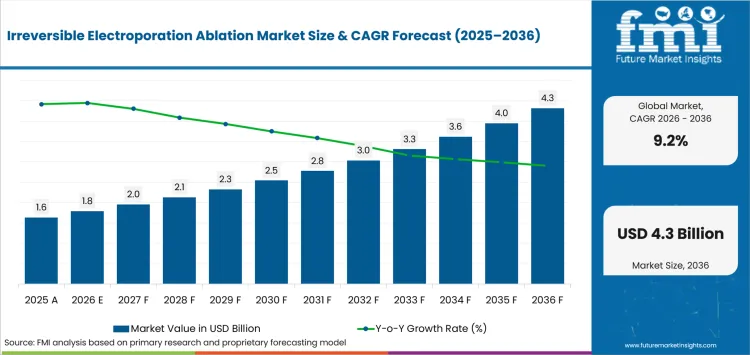
Key Takeaways of Irreversible Electroporation Ablation Market
- Demand for irreversible electroporation ablation is shaped by the use of nonthermal tissue destruction near sensitive anatomy, with lesion selection, electrode placement, imaging accuracy, and multidisciplinary treatment planning influencing clinical use.
- By technology, NanoKnife System holds 68.5% share in 2026, while hospitals account for 53.0% share in 2026 among end users, reflecting established focal-ablation use and the multidisciplinary resources required for complex procedures.
- Tumor ablation represents 37.2% share in 2026, while percutaneous procedures account for 42.5% share in 2026, reflecting localized oncology treatment pathways and image-guided electrode placement through minimally invasive access.
- Japan records the highest country CAGR at 10.4% through 2036, followed by Germany at 9.9% and the United Kingdom at 9.4%, reflecting differences in specialist capacity, clinical evidence programs, reimbursement pathways, and focal-therapy services.
- Competition centers on AngioDynamics, Galvanize Therapeutics, and Pulse Biosciences, with differentiation spanning irreversible electroporation systems, pulsed electric field platforms, pulse delivery technologies, electrodes, and specialist procedural support.
- Specialist training, electrode availability, imaging coordination, reimbursement pathways, and multidisciplinary procedural requirements remain key considerations for wider adoption across oncology and urology services.
Analyst Perspective
"The irreversible electroporation ablation market is increasingly defined by its ability to achieve local tumor control while preserving adjacent critical structures. Clinical adoption will depend on procedure-specific evidence, predictable safety outcomes, and effective coordination across imaging, anesthesia, and specialist teams. Companies that strengthen clinical validation and physician training will be better positioned to expand use across complex ablation procedures."
—Anurag Sharma, Principal Consultant for Healthcare at Future Market Insights
Source: Future Market Insights market analysis, 2026.
How is Irreversible Electroporation Ablation Market segmented?
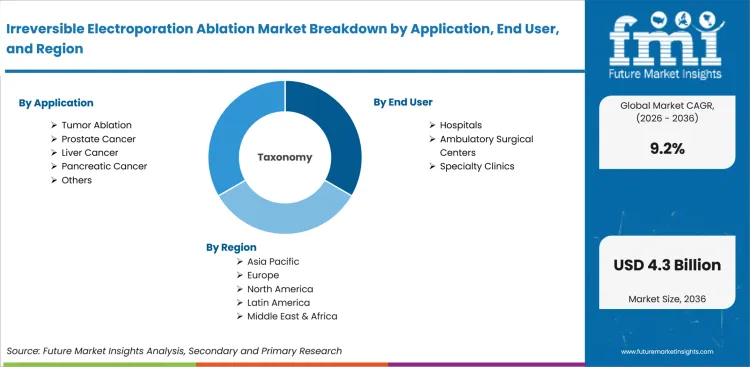
The irreversible electroporation ablation industry is segmented by application, end user, technology, procedure, and region.
The irreversible electroporation ablation industry is segmented by application, end user, technology, procedure, and region. Application coverage includes tumor ablation and organ-specific cancer treatment. End-user coverage spans hospitals and outpatient clinical settings. Technology coverage addresses NanoKnife System and other irreversible electroporation platforms. Procedure coverage includes percutaneous and surgical approaches. Regional coverage includes North America and Latin America. Western Europe and Eastern Europe form additional groups. East Asia and South Asia and Pacific complete Asian coverage. Middle East and Africa completes geographic analysis.
Why does tumor ablation shape application demand?
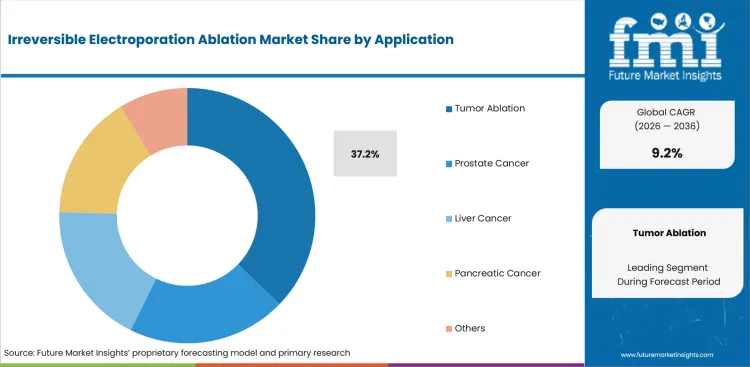
Zhang and colleagues reviewed 1,452 patients in July 2024 within focal prostate studies using irreversible electroporation as sole primary treatment. Clinical evidence places lesion definition at the centre of multidisciplinary planning for localized disease and organ-specific treatment goals. Comparable planning principles support liver treatment near major vessels without transferring prostate outcomes to every anatomical site. Pancreatic applications follow narrower eligibility criteria due to advanced disease and complex vascular anatomy affecting achievable local control.
- Tumor ablation is set to represent 37.2% share of application in 2026, driven by use within several organ-specific oncology pathways requiring nonthermal cellular destruction. Urology and hepatobiliary teams select localized treatment for carefully assessed lesions positioned near structures vulnerable to heat exposure.
- Prostate services create predictable referral cycles through imaging review and scheduled pathology assessment within established urology programs. Liver and pancreatic pathways require separate theatre preparation since organ access alters staffing requirements and recovery planning for each procedure.
Why do hospitals lead end-user demand?
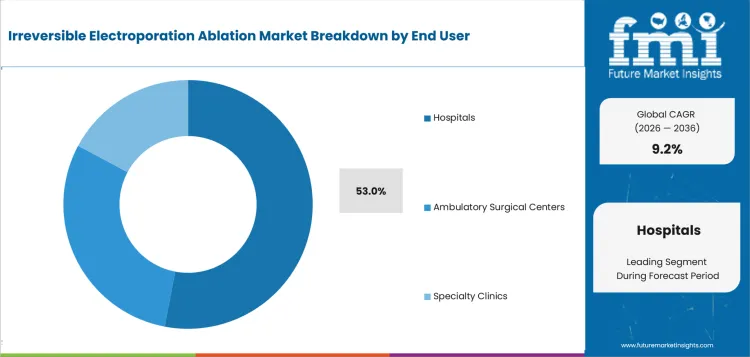
Hospital ownership concentrates accountability for anesthesia and imaging inside one coordinated interventional radiology service supporting complex ablation delivery. Zhang and colleagues reported 411 patients in January 2024 through a prospective international registry involving multiple treatment centres. Multicentre participation demonstrates institutional capacity for consistent records spanning treatment delivery and scheduled clinical surveillance. Governance protocols connect operator credentialing with complication response during recurring cases managed by trained specialist teams.
- In 2026, hospitals are likely to account for 53.0% share owing to multidisciplinary resources needed for irreversible electroporation programs. Finance teams separate capital cost from procedure economics during reviews of equipment ownership and recurring case expenditure.
- Ambulatory surgical centres use transfer agreements for patients needing unexpected inpatient support during selected prostate procedures. Specialty clinics strengthen referral continuity through consultation and surveillance services managed separately from hospital treatment schedules.
Why does nanoknife system lead technology selection?
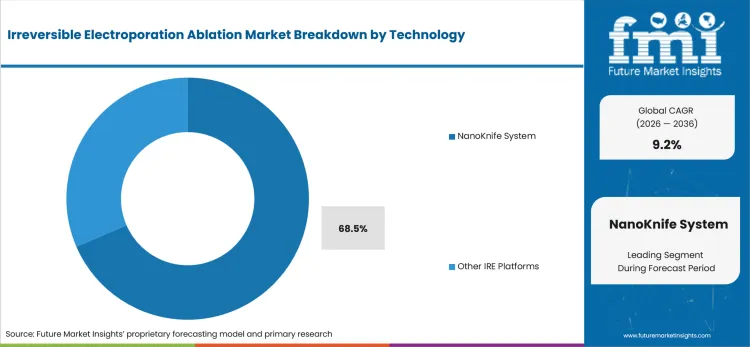
NanoKnife System integrates pulse generation with electrode controls inside a dedicated ablation technology platform for selected soft-tissue lesions. Electrocardiographic synchronization coordinates energy delivery with cardiac activity during each planned treatment sequence and reduces timing uncertainty. George and colleagues reported an 84% negative in-field biopsy result in July 2025 during PRESERVE evaluation. Pathology findings connect device performance with local treatment assessment during scheduled prostate surveillance and subsequent clinical decisions.
- Based on technology, NanoKnife system is anticipated to capture 68.5% share in 2026 since being underpinned by established use in focal ablation programs and structured specialist training. Purchasing teams examine service response and electrode availability during continuity planning for booked procedures at trained clinical centres.
- Alternative platforms introduce distinct pulse durations and probe configurations suited to soft-tissue applications requiring different cellular effects and delivery routes. Regulatory status influences distributor preparation since each configuration requires indication-specific education and technical documentation during clinical introduction.
Why do percutaneous procedures retain procedure leadership?
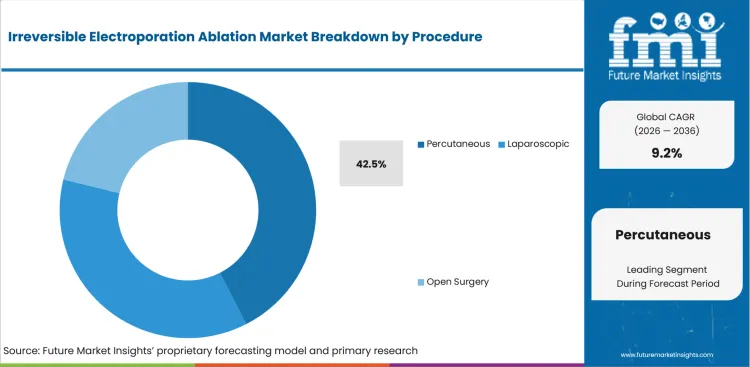
Percutaneous access uses CT-guided intervention for electrode insertion without open surgical exposure in selected liver and prostate lesions. Trajectory planning aligns probe position with lesion depth and surrounding anatomy during image-guided procedure preparation. Stable spacing supports planned target coverage during pulse delivery through difficult anatomical locations and narrow access corridors. Zhang and colleagues treated 18 liver tumors in February 2026 using a stereotactic two-needle approach near critical structures.
- By procedure, percutaneous procedures expected to garner 42.5% share in 2026 as it is helped by minimally invasive access and established image-guided planning practices. Scheduling teams reserve imaging suites and anesthesia resources according to documented case duration and electrode requirements.
- Laparoscopic access supports direct organ inspection during selected abdominal treatment plans managed by surgical teams. Open surgery combines ablation with operative exposure during complex cases already assigned to definitive surgical management.
What are drivers, restraints, and opportunities in Irreversible Electroporation Ablation Market?
Clinical demand reflects interest in tissue-sparing ablation near sensitive anatomy. Technical complexity and uneven indication evidence may delay routine adoption across developing programs.
- Driver: Specialist teams seek nonthermal tumor ablation for lesions located near vessels and ducts. Hospital programs favor treatment pathways supported by accurate imaging and coordinated clinical follow-up.
- Restraint: Electrode placement and anesthesia requirements increase procedural complexity across newly trained centers. Variable outcomes among tumor types increase scrutiny during clinical committee review.
- Opportunity: New pulse systems and delivery routes extend evaluation across percutaneous and surgical soft-tissue procedures. Combination treatment research creates additional pathways for difficult solid tumors.
Vos and colleagues reported 11 experts and 93% consensus in July 2024 across pancreatic irreversible electroporation recommendations. Standardized patient selection reduces procedural variation across specialist centers. Clear protocol guidance influences repeatable education and safer program expansion.
Hospital committees require indication-specific benefits prior to approving equipment and recurring procedure costs. Timmer and colleagues enrolled 68 patients in March 2024 and found no overall-survival difference across compared local treatments. Comparative findings increase caution around unrestricted pancreatic use.
Mariussi and colleagues assessed 310 patients in April 2026 across irreversible electroporation studies with or without immunotherapy. Combined treatment evidence expands research options for locally advanced pancreatic cancer. Company and hospital partnerships are anticipated to develop protocols linking local ablation with systemic oncology services.
How are country CAGRs aligned in Irreversible Electroporation Ablation Market?
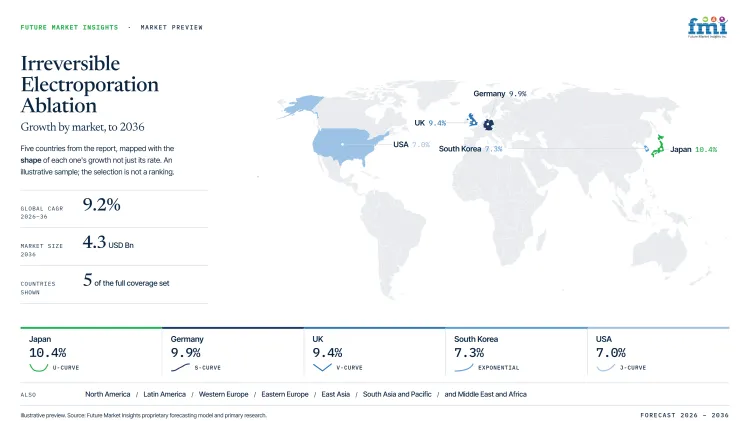
| Country or Market | CAGR |
|---|---|
| Japan | 10.4% |
| Germany | 9.9% |
| UK | 9.4% |
| South Korea | 7.3% |
| USA | 7.0% |
Source: Future Market Insights country analysis, 2026.
How do country-level CAGRs compare in Irreversible Electroporation Ablation Market?
The country comparison reflects a gradual step-down in growth across the markets covered. Japan sits at the upper end of the range, followed closely by Germany and the United Kingdom. South Korea and the United States form the lower growth tier. The United States remains at the lower end of the comparison. The 3.4-point spread shows that these markets share a positive growth outlook, although their relative positions indicate different levels of market momentum.
- Japan leads the comparison and establishes East Asia as the notable growth cluster among the markets shown.
- Germany and the United Kingdom follow closely, indicating that neither market falls far behind Japan.
- South Korea and the United States form the next growth band and maintain a moderate gap from the European markets.
- The United States records the slowest growth among the listed markets, yet its forecast remains positive within the wider market context.
- The pattern resembles a gradual downward slope rather than a sharp separation between high-growth and low-growth markets.
Markets with broadly similar CAGRs can present different entry conditions due to specialist capacity, clinical evidence, and reimbursement readiness. The full report provides country-level analysis across North America, Latin America, Western Europe, Eastern Europe, East Asia, South Asia and Pacific, and the Middle East and Africa.
Country-wise Analysis
- Irreversible electroporation ablation sales in Japan are anticipated to rise at 10.4% CAGR between 2026 and 2036, guided by specialist liver-treatment research and structured clinical evaluation. Multicenter study settings support careful patient selection for lesions unsuitable for resection or radiofrequency ablation. Japan Registry of Clinical Trials listed 45 planned participants in June 2026, creating a national evidence pathway for hepatocellular carcinoma treatment.
- Collettini and colleagues reported 30 patients in August 2024, supporting German review of image-guided irreversible electroporation for localized prostate cancer. Specialist radiology and urology teams create controlled pathways for treatment planning and follow-up. Industry in Germany is projected to expand at 9.9% CAGR over forecast period, aided by clinical experience across university hospital programs.
- Sector in the United Kingdom is estimated to record 9.4% CAGR from 2026 to 2036, reflecting focal-therapy services and organized urology pathways. University hospitals provide specialist settings for ultrasound-guided electrode placement and same-day recovery. University College London Hospitals reported three to five needles in September 2025 during prostate NanoKnife procedures, illustrating technical requirements guiding training and service design.
- Kwon and colleagues reported 13 patients in January 2026 during prospective South Korean evaluation using clustered electrodes for locally advanced pancreatic cancer. Tertiary hospitals support careful assessment of new electrode configurations and palliative protocols. The market in South Korea is predicted to progress 7.3% CAGR during the study period, influenced by specialist research and advanced imaging capacity.
- Demand in the United States is forecast to increase at 7.0% CAGR from 2026 to 2036, supported by established NanoKnife access and evolving reimbursement pathways. Clinical centers continue to compare focal prostate ablation with radiation and other treatment options. ClinicalTrials.gov listed planned enrollment of 224 participants in April 2026 for a phase three prostate study, strengthening comparative evidence development.
Who are notable companies in Irreversible Electroporation Ablation Market?
AngioDynamics participates using NanoKnife irreversible electroporation programs. Galvanize Therapeutics develops pulsed electric field systems for soft-tissue ablation. Pulse Biosciences develops nanosecond pulsed-field technology for percutaneous treatment. Surgnova Healthcare Technologies supplies an electroporation platform for surgical soft-tissue ablation.
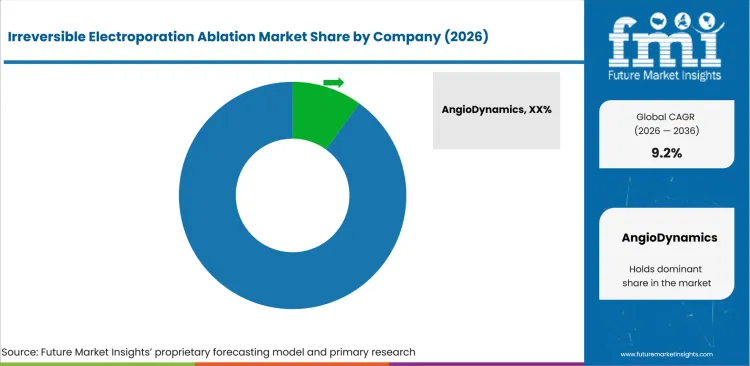
Competition in irreversible electroporation ablation is anticipated to center on pulse delivery and electrode control. Hospital teams are likely to compare companies using clinical support and procedural education. AngioDynamics is expected to receive attention from established focal-ablation experience. Galvanize Therapeutics is projected to support review across percutaneous and surgical soft-tissue applications. Pulse Biosciences is estimated to receive specialist interest from nanosecond pulse delivery. Surgnova Healthcare Technologies is anticipated to compete using generator and electrode configurations for hospital use.
- AngioDynamics and Galvanize Therapeutics receive hospital review through soft-tissue ablation platforms and specialist support. Clinical teams compare procedural education with indication evidence across complete care pathways.
- Pulse Biosciences competes through nanosecond pulsed-field delivery for percutaneous soft-tissue procedures. Specialist programs assess electrode control alongside tissue preservation during clinical evaluation.
- Surgnova Healthcare Technologies participates in electroporation review through generator and probe options. Hospital committees examine regulatory alignment together with service availability across selected regions.
- Regional developers participate through localized distribution and clinical partnerships. Direct market participation requires a platform or delivery component used for irreversible electroporation ablation.
Competitive Benchmarking: Irreversible Electroporation Ablation Market
| Company | Portfolio Depth | Clinical Match | Service Support | Service Reach |
|---|---|---|---|---|
| AngioDynamics, Inc. | High | High | High | United States and selected global markets |
| Galvanize Therapeutics, Inc. | High | High | Medium | United States and selected clinical markets |
| Pulse Biosciences, Inc. | Medium | Medium | Medium | United States |
| Surgnova Healthcare Technologies (Zhejiang) Co., Ltd. | Medium | High | Medium | China and selected international markets |
Source: Future Market Insights competitive analysis, 2026.
Key Developments in Irreversible Electroporation Ablation Market
- In December 2025, Pulse Biosciences announced a research collaboration with MD Anderson Cancer Center involving nPulse Vybrance for benign and malignant thyroid tumors. Planned clinical work extends nanosecond pulsed-field evaluation into percutaneous tumor ablation near sensitive structures.
- In May 2026, Galvanize Therapeutics received United States clearance for Aliya EX Generator supporting surgical ablation of soft tissue. Product expansion adds a surgical delivery route to its pulsed electric field portfolio and improves multi-setting clinical evaluation.
- In May 2026, AngioDynamics announced Medicare coverage guidance for NanoKnife irreversible electroporation across qualifying prostate and liver indications. Coverage development improves billing clarity for eligible hospitals and strengthens patient-access planning across covered jurisdictions.
Key Players in Irreversible Electroporation Ablation Market
Established irreversible electroporation company
- AngioDynamics, Inc.
Pulsed electric field soft-tissue ablation companies
- Galvanize Therapeutics, Inc.
- Pulse Biosciences, Inc.
Electroporation platform company
- Surgnova Healthcare Technologies (Zhejiang) Co., Ltd.
Irreversible Electroporation Ablation Market Report Scope
| Coverage field | Report scope |
|---|---|
| Market breakdown | Irreversible Electroporation Ablation Market breakdown by application, end user, technology, procedure, and region |
| Market Definition | Irreversible electroporation ablation includes nonthermal systems and electrodes delivering electrical pulses for permanent membrane disruption across selected soft-tissue procedures. |
| Regions Covered | North America, Latin America, Western Europe, Eastern Europe, East Asia, South Asia and Pacific, and Middle East and Africa |
| Countries Covered | Japan, Germany, UK, South Korea, and USA |
| Key Companies Profiled | AngioDynamics, Galvanize Therapeutics, Pulse Biosciences, and Surgnova Healthcare Technologies |
| Forecast Period | 2026 to 2036 |
| Approach | Hybrid bottom-up and top-down methodology using segment shares, country CAGRs, procedural activity, clinical evidence, and company participation |
Source: Future Market Insights scope analysis, 2026.
Irreversible Electroporation Ablation Market - Research Methodology
| Method | Approach |
|---|---|
| Primary Research | FMI analysts gathered input from manufacturers, service providers, technology developers, distributors, end users, procurement teams, and subject-matter experts. Interviews examined purchasing decisions, product or service evaluation, adoption barriers, approval requirements, pricing considerations, and expectations for technical or commercial support. Respondents were also asked what evidence is required before a trial, pilot, or initial order develops into regular purchasing. |
| Desk Research | Desk research covered government statistics, regulatory publications, trade data, industry associations, technical literature, standards, company filings, product information, and official corporate announcements. Sources were reviewed for relevance, publication date, geographic coverage, and consistency with the defined market scope. Claims relating to performance, applications, approvals, capacity, investment, and commercial activity were retained only when supported by credible public evidence. |
| Market Sizing and Forecasting | The market model combined the baseline value with historical performance, segment structure, pricing and volume indicators, adoption levels, company participation, and country-level demand conditions. Forecast assumptions considered economic activity, investment trends, regulatory developments, technology adoption, purchasing cycles, supply availability, and barriers to wider market use. Segment and regional estimates were reconciled before the final market total was calculated. |
| Data Validation | Estimates were checked against multiple independent indicators, including public data, company activity, trade patterns, industry developments, and findings from primary interviews. Validation also tested whether products, services, applications, and company revenues fell within the defined market boundaries. Adjacent categories, unsupported claims, overlapping revenues, and activities without direct market relevance were excluded to reduce double counting and maintain consistency across segments and countries. |
Source: Future Market Insights methodology analysis, 2026.
Irreversible Electroporation Ablation Market by Segments
Irreversible Electroporation Ablation Market segmented by Application:
- Tumor Ablation
- Prostate Cancer
- Liver Cancer
- Pancreatic Cancer
- Others
Irreversible Electroporation Ablation Market segmented by End User:
- Hospitals
- Ambulatory Surgical Centers
- Specialty Clinics
Irreversible Electroporation Ablation Market segmented by Technology:
- NanoKnife System
- Other IRE Platforms
Irreversible Electroporation Ablation Market segmented by Procedure:
- Percutaneous
- Laparoscopic
- Open Surgery
Irreversible Electroporation Ablation Market segmented by Region:
- North America
- United States
- Canada
- Latin America
- Brazil
- Mexico
- Argentina
- Chile
- Western Europe
- Germany
- France
- United Kingdom
- Italy
- Spain
- Benelux
- Nordics
- Eastern Europe
- Poland
- Czech Republic
- Romania
- Hungary
- East Asia
- China
- Japan
- South Korea
- South Asia and Pacific
- India
- ASEAN
- Australia and New Zealand
- Middle East and Africa
- GCC Countries
- South Africa
- Türkiye
- Israel
Research Sources and Bibliography
- Martin, R. C. G., White, R. R., Bilimoria, M. M., Kluger, M. D., Iannitti, D. A., Polanco, P. M., Hammil, C. W., Cleary, S. P., Heithaus, R. E., Welling, T., & Chan, C. H. F. (2024, November 21). Effectiveness and safety of irreversible electroporation when used for the ablation of stage 3 pancreatic adenocarcinoma: Initial results from the DIRECT Registry study. Cancers, 16(23), 3894.
- AngioDynamics, Inc. (2024, December 9). AngioDynamics receives FDA clearance for the NanoKnife System for prostate tissue ablation.
- Zhang, K., Teoh, J., Zhu, G., Ng, C.-F., Suberville, M., Laguna, P., & de la Rosette, J. (2024, July 3). Irreversible electroporation for the focal treatment of prostate cancer: A systematic review. World Journal of Men’s Health, 43(2), 321-332.
- Zhang, K., Stricker, P., Löhr, M., Stehling, M., Suberville, M., Cussenot, O., Lunelli, L., Ng, C.-F., Teoh, J., Laguna, P., & de la Rosette, J. (2024, January 9). A multi-center international study to evaluate the safety, functional and oncological outcomes of irreversible electroporation for the ablation of prostate cancer. Prostate Cancer and Prostatic Diseases, 27(3), 525-530.
- George, A. K., Miocinovic, R., Patel, A. R., Lomas, D. J., Correa, A. F., Chen, D. Y. T., Rastinehad, A. R., Schwartz, M. J., Sidana, A., Stensland, K. D., Helfand, B. T., Gahan, J. C., Meng, X., Yu, A., Brisbane, W. G., Vourganti, S., Barqawi, A. B., Uchio, E. M., Wysock, J. S., Polascik, T. J., McClure, T. D., Fainberg, J., & Coleman, J. A. (2025, July 19). Irreversible electroporation for prostate tissue ablation in patients with intermediate-risk prostate cancer: Results from the PRESERVE trial. European Urology, 89(1), 57-68.
- Zhang, L., Mayr, V., Luerken, L., Strotzer, Q., Brandenstein, M., Kupke, L., Ngu, A., Stroszczynski, C., & Einspieler, I. (2026, February 23). Stereotactic two-needle irreversible electroporation of liver tumors near critical structures: A proof-of-concept study. European Radiology Experimental, 10(1), 14.
- Vos, D. J. W., Ruarus, A. H., Timmer, F. E. F., Geboers, B., Bagla, S., Belfiore, G., Besselink, M. G., Leen, E., Martin, R. C. G., Narayanan, G., Nilsson, A., Paiella, S., Weintraub, J. L., Wiggermann, P., Scheffer, H. J., & Meijerink, M. R. (2024, July 10). Consensus guidelines of irreversible electroporation for pancreatic tumors: Protocol standardization using the modified Delphi technique. Seminars in Interventional Radiology, 41(2), 176-219.
- Timmer, F. E. F., Geboers, B., Ruarus, A. H., Vroomen, L. G. P. H., Schouten, E. A. C., van der Lei, S., Vos, D. J. W., Dijkstra, M., Schulz, H. H., Bakker, J., van den Bemd, B. A. T., van den Tol, P. M., Puijk, R. S., Lissenberg-Witte, B. I., de Gruijl, T. D., de Vries, J. J. J., Lagerwaard, F. J., Scheffer, H. J., Bruynzeel, A. M. E., & Meijerink, M. R. (2024, March 19). MRI-guided stereotactic ablative body radiotherapy versus CT-guided percutaneous irreversible electroporation for locally advanced pancreatic cancer: A single-centre, open-label, randomised phase 2 trial. The Lancet Gastroenterology & Hepatology, 9(5), 448-459.
- Mariussi, M., Costa de Oliveira Lima, L., Gallo Ruelas, M., Ohannesian, V. A., Murad, B., Strieder de Oliveira, G., Giuliani Schmitt, L., Brondani Torri, G., Altmayer, S., Mina Falsarella, P., Serrano Usón Junior, P. L., & Gobbo Garcia, R. (2026, April 27). Irreversible electroporation combined with immunotherapy versus irreversible electroporation alone for locally advanced pancreatic cancer: A systematic review and meta-analysis. Einstein, 24, eRW1656.
- Japan Registry of Clinical Trials. (2026, June 12). Efficacy of irreversible electroporation on patients with hepatocellular carcinoma who are not eligible for liver resection and radiofrequency ablation: A multicenter trial.
- Collettini, F., Stephan, C., Fischer, T., Maxeiner, A., Auer, T. A., & Gebauer, B. (2024, August 7). Long-term oncologic outcomes of image-guided irreversible electroporation for localized prostate cancer. Cardiovascular and Interventional Radiology, 47(10), 1425-1427.
- University College London Hospitals NHS Foundation Trust. (2025, September 4). Nanoknife™ for prostate cancer.
- Kwon, J. H., Kim, M.-D., Alanazi, M. S., Suk, J., Jeong, S., Bang, S., Chung, M. J., Hwang, H. K., Hong, S. S., Han, K., Kim, G. M., Won, J. Y., Park, J., Cho, J., Jeong, S. M., & Choi, T. Y. (2026, January 26). Prospective evaluation of irreversible electroporation with clustered electrodes as a novel palliative approach for locally advanced pancreatic cancer. Korean Journal of Radiology, 27(2), 152-160.
- ClinicalTrials.gov. (2026, April 23). Alternative Boost Approaches in Radiation Therapy IRreversible Electroporation Versus RADIAtioN BoosT for Intermediate Risk Prostate Cancer (IRRADIANT).
- Pulse Biosciences, Inc. (2025, December 9). Pulse Biosciences, Inc. announces initiation of research collaboration for the treatment of benign and malignant thyroid tumors with nPulse technology.
- Galvanize Therapeutics, Inc. (2026, May 18). Galvanize Therapeutics receives FDA clearance for Aliya EX Generator, expanding its Aliya pulsed electric field portfolio for surgical ablation of soft tissue.
- AngioDynamics, Inc. (2026, May 28). AngioDynamics expands patient access to NanoKnife IRE for prostate and liver cancer as Medicare coverage framework takes effect.
This bibliography is provided for reader reference and is not exhaustive. The full report contains the complete reference list and detailed citations.
This Report Answers
- What segments influence demand across application and end user with technology and procedure?
- How do specialist teams evaluate irreversible electroporation ablation prior to recurring clinical use?
- How do country CAGRs differ across profiled markets with distinct clinical capacity and reimbursement conditions?
- What companies compete using platform depth and clinical support with regional service availability?
- How are forecasts validated using bottom-up and top-down analysis with independent indicators?
- What evidence do hospital committees examine prior to program expansion across clinical services?
- How do electrode placement and imaging quality influence system selection across oncology pathways?
- What limits return on investment for hospitals adding irreversible electroporation ablation?
- How do training records and specialist guidance influence hospital approval across multidisciplinary teams?
- What company capabilities improve long-term clinical confidence and continuing system utilization?
Frequently Asked Questions
How big is the Irreversible Electroporation Ablation Market in 2026?
The irreversible electroporation ablation market is valued at USD 1.8 billion in 2026 and is forecast to reach USD 4.3 billion by 2036.
What is the CAGR of the Irreversible Electroporation Ablation Market from 2026 to 2036?
The irreversible electroporation ablation market is projected to grow at a CAGR of 9.2% between 2026 and 2036, supported by specialist teams increasingly favoring nonthermal ablation techniques to safely treat tumors positioned near delicate blood vessels and ducts.
Which technology segment leads the Irreversible Electroporation Ablation Market?
The NanoKnife System accounts for 68.5% of the irreversible electroporation ablation market by technology in 2026, driven by established use in focal ablation programs, structured specialist training, and electrocardiographic synchronization that coordinates energy delivery with cardiac activity during planned treatment sequences.
Which country is growing fastest in the Irreversible Electroporation Ablation Market?
Japan is the fastest-growing country in the irreversible electroporation ablation market, expanding at a 10.4% CAGR through 2036, ahead of the market average of 9.2%, supported by specialist liver-treatment research, structured multicenter clinical evaluation, and a national evidence pathway for hepatocellular carcinoma treatment.
Who are the leading companies in the Irreversible Electroporation Ablation Market?
Leading companies in the irreversible electroporation ablation market include AngioDynamics, Galvanize Therapeutics, Pulse Biosciences, and Surgnova Healthcare Technologies, spanning established irreversible electroporation systems, pulsed electric field platforms, nanosecond pulse delivery technologies, and electroporation generators for hospital use.
Preview the report firsthand - request a free sample
Get SampleGet the brochure for pricing and purchase details.
Get PDFTable of Content
- Key Takeaways
- Market Size and CAGR
- Top Growth Driver
- Fastest Growing Segment
- Leading Region
- Key Companies
- Emerging Opportunities
- Executive Summary
- Global Market Outlook
- Demand-side Trends
- Supply-side Trends
- Technology Roadmap Analysis
- Analysis and Recommendations
- Analyst Perspective (What is happening? Why now? What should investors know?)
- Key Questions Answered
- How large is the market?
- What is the CAGR?
- What are key trends?
- Which region dominates?
- Who are the leaders?
- Market Overview
- Market Coverage / Taxonomy
- Market Definition / Scope / Limitations
- Research Methodology
- Chapter Orientation
- Analytical Lens and Working Hypotheses
- Market Structure, Signals, and Trend Drivers
- Benchmarking and Cross-market Comparability
- Market Sizing, Forecasting, and Opportunity Mapping
- Research Design and Evidence Framework
- Desk Research Programme (Secondary Evidence)
- Expert Input and Fieldwork (Primary Evidence)
- Tooling, Models, and Reference Databases
- Data Engineering and Model Build
- Quality Assurance and Audit Trail
- Market Background
- Market Dynamics (Drivers, Restraints, Opportunity, Trends)
- Scenario Forecast (Optimistic, Likely, Conservative)
- Impact Analysis
- AI Impact
- Sustainability Impact
- Regulatory Impact
- Technology Impact
- Consumer / Buyer Analysis
- Purchase Drivers
- Adoption Barriers
- Buyer Journey
- Opportunity Map Analysis
- Product Life Cycle Analysis
- Supply Chain Analysis
- Investment Feasibility Matrix
- Value Chain Analysis
- PESTLE and Porter's Analysis
- Regulatory Landscape
- Regional Parent Market Outlook
- Production and Consumption Statistics
- Import and Export Statistics
- Global Market Analysis and Forecast, 2021 to 2036
- Historical Market Size Value (USD Billion) Analysis, 2021 to 2025
- Current and Future Market Size Value (USD Billion) Projections, 2026 to 2036
- Y-o-Y Growth Trend Analysis
- Absolute $ Opportunity Analysis
- Global Market Pricing Analysis, 2021 to 2036
- Global Market Analysis and Forecast, By Application, 2021 to 2036
- Introduction / Key Findings
- Historical Market Size Value (USD Billion) Analysis By Application, 2021 to 2025
- Current and Future Market Size Value (USD Billion) Analysis and Forecast By Application, 2026 to 2036
- Tumor Ablation
- Prostate Cancer
- Liver Cancer
- Pancreatic Cancer
- Others
- Tumor Ablation
- Y-o-Y Growth Trend Analysis By Application, 2021 to 2025
- Absolute $ Opportunity Analysis By Application, 2026 to 2036
- Global Market Analysis and Forecast, By End User, 2021 to 2036
- Introduction / Key Findings
- Historical Market Size Value (USD Billion) Analysis By End User, 2021 to 2025
- Current and Future Market Size Value (USD Billion) Analysis and Forecast By End User, 2026 to 2036
- Hospitals
- Ambulatory Surgical Centers
- Specialty Clinics
- Hospitals
- Y-o-Y Growth Trend Analysis By End User, 2021 to 2025
- Absolute $ Opportunity Analysis By End User, 2026 to 2036
- Global Market Analysis and Forecast, By Technology, 2021 to 2036
- Introduction / Key Findings
- Historical Market Size Value (USD Billion) Analysis By Technology, 2021 to 2025
- Current and Future Market Size Value (USD Billion) Analysis and Forecast By Technology, 2026 to 2036
- NanoKnife System
- Other IRE Platforms
- NanoKnife System
- Y-o-Y Growth Trend Analysis By Technology, 2021 to 2025
- Absolute $ Opportunity Analysis By Technology, 2026 to 2036
- Global Market Analysis and Forecast, By Procedure, 2021 to 2036
- Introduction / Key Findings
- Historical Market Size Value (USD Billion) Analysis By Procedure, 2021 to 2025
- Current and Future Market Size Value (USD Billion) Analysis and Forecast By Procedure, 2026 to 2036
- Percutaneous
- Laparoscopic
- Open Surgery
- Percutaneous
- Y-o-Y Growth Trend Analysis By Procedure, 2021 to 2025
- Absolute $ Opportunity Analysis By Procedure, 2026 to 2036
- Global Market Analysis and Forecast, By Region, 2021 to 2036
- Introduction
- Historical Market Size Value (USD Billion) Analysis By Region, 2021 to 2025
- Current Market Size Value (USD Billion) Analysis and Forecast By Region, 2026 to 2036
- North America
- Latin America
- Western Europe
- Eastern Europe
- East Asia
- South Asia and Pacific
- Middle East & Africa
- Market Attractiveness Analysis By Region
- North America Market Analysis and Forecast, By Country, 2021 to 2036
- Historical Market Size Value (USD Billion) Trend Analysis By Market Taxonomy, 2021 to 2025
- Market Size Value (USD Billion) Forecast By Market Taxonomy, 2026 to 2036
- By Country
- USA
- Canada
- By Application
- By End User
- By Technology
- By Procedure
- By Country
- Market Attractiveness Analysis
- By Country
- By Application
- By End User
- By Technology
- By Procedure
- Key Takeaways
- Latin America Market Analysis and Forecast, By Country
- Historical Market Size Value (USD Billion) Trend Analysis By Market Taxonomy, 2021 to 2025
- Market Size Value (USD Billion) Forecast By Market Taxonomy, 2026 to 2036
- By Country
- Brazil
- Mexico
- Chile
- Rest of Latin America
- By Application
- By End User
- By Technology
- By Procedure
- By Country
- Market Attractiveness Analysis
- By Country
- By Application
- By End User
- By Technology
- By Procedure
- Key Takeaways
- Western Europe Market Analysis and Forecast, By Country
- Historical Market Size Value (USD Billion) Trend Analysis By Market Taxonomy, 2021 to 2025
- Market Size Value (USD Billion) Forecast By Market Taxonomy, 2026 to 2036
- By Country
- Germany
- UK
- Italy
- Spain
- France
- Nordic
- BENELUX
- Rest of Western Europe
- By Application
- By End User
- By Technology
- By Procedure
- By Country
- Market Attractiveness Analysis
- By Country
- By Application
- By End User
- By Technology
- By Procedure
- Key Takeaways
- Eastern Europe Market Analysis and Forecast, By Country
- Historical Market Size Value (USD Billion) Trend Analysis By Market Taxonomy, 2021 to 2025
- Market Size Value (USD Billion) Forecast By Market Taxonomy, 2026 to 2036
- By Country
- Russia
- Poland
- Hungary
- Balkan & Baltic
- Rest of Eastern Europe
- By Application
- By End User
- By Technology
- By Procedure
- By Country
- Market Attractiveness Analysis
- By Country
- By Application
- By End User
- By Technology
- By Procedure
- Key Takeaways
- East Asia Market Analysis and Forecast, By Country
- Historical Market Size Value (USD Billion) Trend Analysis By Market Taxonomy, 2021 to 2025
- Market Size Value (USD Billion) Forecast By Market Taxonomy, 2026 to 2036
- By Country
- China
- Japan
- South Korea
- By Application
- By End User
- By Technology
- By Procedure
- By Country
- Market Attractiveness Analysis
- By Country
- By Application
- By End User
- By Technology
- By Procedure
- Key Takeaways
- South Asia and Pacific Market Analysis and Forecast, By Country
- Historical Market Size Value (USD Billion) Trend Analysis By Market Taxonomy, 2021 to 2025
- Market Size Value (USD Billion) Forecast By Market Taxonomy, 2026 to 2036
- By Country
- India
- ASEAN
- Australia & New Zealand
- Rest of South Asia and Pacific
- By Application
- By End User
- By Technology
- By Procedure
- By Country
- Market Attractiveness Analysis
- By Country
- By Application
- By End User
- By Technology
- By Procedure
- Key Takeaways
- Middle East & Africa Market Analysis and Forecast, By Country
- Historical Market Size Value (USD Billion) Trend Analysis By Market Taxonomy, 2021 to 2025
- Market Size Value (USD Billion) Forecast By Market Taxonomy, 2026 to 2036
- By Country
- Kingdom of Saudi Arabia
- Other GCC Countries
- Türkiye
- South Africa
- Other African Union
- Rest of Middle East & Africa
- By Application
- By End User
- By Technology
- By Procedure
- By Country
- Market Attractiveness Analysis
- By Country
- By Application
- By End User
- By Technology
- By Procedure
- Key Takeaways
- Key Countries Market Analysis
- USA
- Pricing Analysis
- Market Share Analysis, 2025
- By Application
- By End User
- By Technology
- By Procedure
- Canada
- Pricing Analysis
- Market Share Analysis, 2025
- By Application
- By End User
- By Technology
- By Procedure
- Mexico
- Pricing Analysis
- Market Share Analysis, 2025
- By Application
- By End User
- By Technology
- By Procedure
- Brazil
- Pricing Analysis
- Market Share Analysis, 2025
- By Application
- By End User
- By Technology
- By Procedure
- Chile
- Pricing Analysis
- Market Share Analysis, 2025
- By Application
- By End User
- By Technology
- By Procedure
- Germany
- Pricing Analysis
- Market Share Analysis, 2025
- By Application
- By End User
- By Technology
- By Procedure
- UK
- Pricing Analysis
- Market Share Analysis, 2025
- By Application
- By End User
- By Technology
- By Procedure
- Italy
- Pricing Analysis
- Market Share Analysis, 2025
- By Application
- By End User
- By Technology
- By Procedure
- Spain
- Pricing Analysis
- Market Share Analysis, 2025
- By Application
- By End User
- By Technology
- By Procedure
- France
- Pricing Analysis
- Market Share Analysis, 2025
- By Application
- By End User
- By Technology
- By Procedure
- India
- Pricing Analysis
- Market Share Analysis, 2025
- By Application
- By End User
- By Technology
- By Procedure
- ASEAN
- Pricing Analysis
- Market Share Analysis, 2025
- By Application
- By End User
- By Technology
- By Procedure
- Australia & New Zealand
- Pricing Analysis
- Market Share Analysis, 2025
- By Application
- By End User
- By Technology
- By Procedure
- China
- Pricing Analysis
- Market Share Analysis, 2025
- By Application
- By End User
- By Technology
- By Procedure
- Japan
- Pricing Analysis
- Market Share Analysis, 2025
- By Application
- By End User
- By Technology
- By Procedure
- South Korea
- Pricing Analysis
- Market Share Analysis, 2025
- By Application
- By End User
- By Technology
- By Procedure
- Russia
- Pricing Analysis
- Market Share Analysis, 2025
- By Application
- By End User
- By Technology
- By Procedure
- Poland
- Pricing Analysis
- Market Share Analysis, 2025
- By Application
- By End User
- By Technology
- By Procedure
- Hungary
- Pricing Analysis
- Market Share Analysis, 2025
- By Application
- By End User
- By Technology
- By Procedure
- Kingdom of Saudi Arabia
- Pricing Analysis
- Market Share Analysis, 2025
- By Application
- By End User
- By Technology
- By Procedure
- Türkiye
- Pricing Analysis
- Market Share Analysis, 2025
- By Application
- By End User
- By Technology
- By Procedure
- South Africa
- Pricing Analysis
- Market Share Analysis, 2025
- By Application
- By End User
- By Technology
- By Procedure
- USA
- Market Structure Analysis
- Competition Dashboard
- Competition Benchmarking
- Market Share Analysis of Top Players
- By Regional
- By Application
- By End User
- By Technology
- By Procedure
- Emerging Startups
- Innovation Benchmarking
- Competition Analysis
- Competition Deep Dive
- AngioDynamics
- Overview
- Product Portfolio
- Profitability by Market Segments
- Sales Footprint
- Strategy Overview
- Marketing Strategy
- Product Strategy
- Channel Strategy
- Medtronic
- Boston Scientific
- Olympus
- AtriCure
- Merit Medical
- AngioDynamics
- Case Studies
- Success Stories
- Recent Developments
- Competition Deep Dive
- Assumptions & Acronyms Used


