

- Industry Size (2026)
- USD 138.0 Mn
- Forecast (2036)
- USD 208.4 Mn
- CAGR (2026 to 2036)
- 4.2%
Demand for Acrylate Oligomer in Japan 2026 to 2036
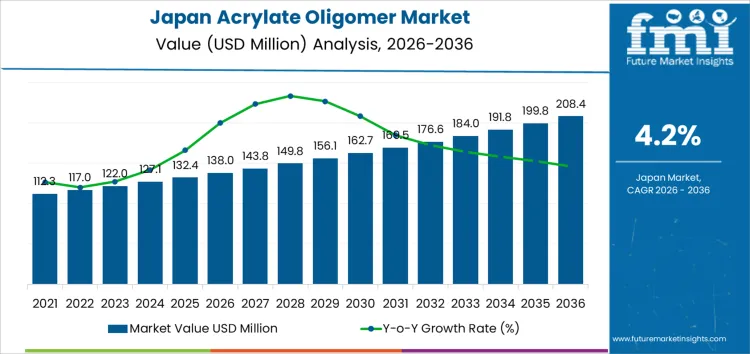
Demand for acrylate oligomer in Japan is valued at USD 138.0 million in 2026 and is forecasted to reach USD 208.4 million by 2036, reflecting a CAGR of 4.2%. Demand advances through steady adoption of UV-curable coatings, inks, and adhesives across electronics, automotive components, and industrial finishing applications. Preference for low-VOC, energy-efficient curing technologies supports continued use of acrylate oligomers in high-precision manufacturing environments.
Quick Stats for Demand for Acrylate Oligomer in Japan
- Japan Acrylate Oligomer Sales Value (2026): USD 138.0 million
- Japan Acrylate Oligomer Forecast Value (2036): USD 208.4 million
- Japan Acrylate Oligomer Forecast CAGR (2026 to 2036): 4.2%
- Leading Type Segment in Japan: Urethane Acrylate Oligomers
- Key Growth Regions in Japan: Kyushu & Okinawa, Kanto, Kansai, Chubu, Tohoku
- Top Players in Japan: Sartomer, Arkema, Allnex, Covestro, BASF
Urethane acrylate oligomers lead type-segment usage because these materials provide balanced flexibility, abrasion resistance, and strong adhesion to metals, plastics, and composite substrates. Japanese formulators rely on urethane acrylates for conformal coatings, protective layers, and functional surfaces requiring durability and controlled mechanical performance. Improvements in molecular design and cure efficiency enhance reliability in automated coating lines.
Kyushu & Okinawa, Kanto, Kansai, Chubu, and Tohoku represent key growth regions due to concentration of electronics manufacturing, automotive supply chains, and industrial coatings production. Sartomer, Arkema, Allnex, Covestro, and BASF anchor competitive activity through localized technical support, application-specific oligomer grades, and supply models aligned with Japan’s stringent quality and process-control standards.
Japan Acrylate Oligomer Key Takeaways
| Metric | Value |
|---|---|
| Japan Acrylate Oligomer Sales Value (2026) | USD 138.0 million |
| Japan Acrylate Oligomer Forecast Value (2036) | USD 208.4 million |
| Japan Acrylate Oligomer Forecast CAGR (2026-2036) | 4.2% |
Why is the Demand for Acrylate Oligomer in Japan Growing?
Demand for acrylate oligomer in Japan grows due to steady expansion across coatings, adhesives, inks, and electronic material applications. Manufacturing sectors prioritize materials that deliver rapid curing, surface durability, and controlled viscosity within precision driven production environments. Automotive and electronics industries apply acrylate oligomers in UV curable coatings to support scratch resistance, chemical stability, and uniform film formation on compact components. Growth in semiconductor packaging and printed circuit board fabrication increases use in conformal coatings and protective layers.
Packaging converters rely on acrylate based inks and varnishes to achieve high clarity and adhesion on films and paper substrates used in retail distribution. Construction and industrial maintenance activities adopt oligomer systems in sealants and specialty coatings due to performance under humidity and temperature variation. Domestic producers emphasize energy efficient curing technologies, which strengthens adoption of UV and electron beam curable formulations. Continuous upgrades in printing and coating equipment favor materials with predictable flow and fast set characteristics. Regulatory focus on low solvent emissions supports transition toward oligomer based systems compatible with reduced VOC formulations.
How Are the Segments Classified in the Demand for Acrylate Oligomers in Japan?
Demand for acrylate oligomers in Japan is shaped by advanced coating technologies, precision manufacturing standards, and emphasis on surface performance reliability. Buyers assess curing efficiency, mechanical durability, adhesion strength, and compatibility with UV and radiation-curing systems. Adoption patterns reflect strong integration within high-quality coatings and adhesive formulations, aligned with Japan’s focus on material consistency, production accuracy, and long-term performance across industrial applications.
Which Type Accounts for the Largest Share in Japan?
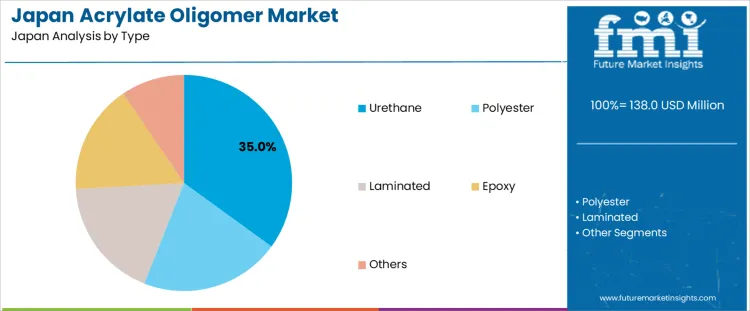
Urethane acrylate oligomers hold 35.0%, making them the leading type segment in Japan. These oligomers offer balanced flexibility, toughness, and abrasion resistance required for high-performance coatings and adhesives. Usage is prominent in applications demanding surface durability and controlled elasticity. Polyester, laminated, epoxy, and other acrylate oligomers support applications requiring hardness, chemical resistance, or cost-performance optimization. Type distribution reflects preference for urethane systems due to their adaptability across diverse formulation requirements under Japan’s quality-driven manufacturing environment.
Key Points:
- Urethane oligomers dominate due to flexibility and durability balance.
- Abrasion resistance supports long-life surface applications.
- Other types address specific hardness or chemical resistance needs.
Which End Use Industry Represents the Largest Share in Japan?
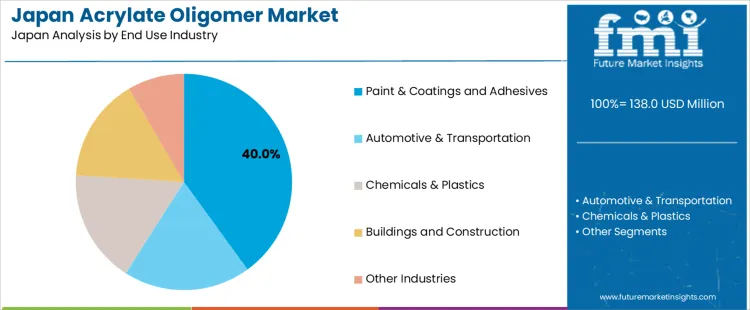
Paint and coatings and adhesives hold 40.0%, making them the leading end-use industry segment in Japan. Acrylate oligomers are widely used in UV-curable coatings, industrial finishes, and adhesive systems requiring fast curing and surface uniformity. Automotive and transportation applications use oligomers for protective and decorative coatings. Chemicals and plastics industries apply them in specialty resin formulations. Building and construction uses include sealants and protective coatings. End-use distribution reflects concentration of demand within surface treatment and bonding applications central to Japan’s manufacturing base.
Key Points:
- Paints and coatings lead due to curing efficiency needs.
- Adhesives rely on strong bonding and surface consistency.
- Automotive and construction provide steady secondary demand.
What are the Key Dynamics in the Acrylate Oligomer Industry in Japan?
Demand remains stable as Japan applies acrylate oligomers across electronics, coatings, inks, adhesives, and precision manufacturing. Usage aligns with UV-curable systems supporting high-speed production, low VOC emissions, and dimensional accuracy. Consumption concentrates within advanced manufacturing clusters serving semiconductors, display panels, automotive components, and specialty printing. Quality consistency, formulation precision, and regulatory compliance shape procurement across domestic producers and downstream users.
How do advanced manufacturing needs and UV-curable process adoption drive demand in Japan?
Japan’s electronics and precision industries rely on acrylate oligomers for UV-curable coatings and adhesives used in circuit boards, optical films, and display components. High-speed curing supports productivity while maintaining tight tolerances required for miniaturized devices. Printing and packaging sectors use oligomer-based inks to achieve sharp image quality and abrasion resistance. Automotive interior and component coatings apply tailored oligomers to balance flexibility and durability. Environmental regulations favor low-emission curing technologies, reinforcing UV systems over solvent-based alternatives. Domestic chemical firms emphasize formulation control and purity to meet strict downstream specifications within Japan’s quality-focused manufacturing ecosystem.
How do raw material costs, safety standards, and formulation complexity influence demand stability?
Japan imports key acrylic feedstocks, creating sensitivity to global price movements and currency fluctuations. Workplace safety standards require controls addressing skin sensitization and exposure, increasing compliance costs. Custom formulation demands extend development timelines for niche applications. Compatibility with curing equipment and substrates limits rapid substitution. Competition from alternative resin chemistries affects price-sensitive uses. Regulatory oversight on chemical handling and emissions influences production planning. Demand remains stable within performance-critical applications, while growth depends on continued electronics investment, cost management, and incremental innovation in UV-curable technologies across Japan’s industrial sectors.
How Is Demand for Acrylate Oligomer in Japan Evolving by Region?
Demand for acrylate oligomers in Japan is rising due to wider adoption of UV-curable coatings, industrial inks, adhesives, and functional surface treatments. Kyushu and Okinawa lead with a 5.3% CAGR, supported by electronics-related coatings and export-oriented manufacturing. Kanto follows at 4.8%, driven by printing inks, specialty coatings, and technology-focused formulation activity. Kansai records a 4.2% CAGR, shaped by industrial coatings and packaging applications. Chubu posts 3.7%, reflecting automotive and machinery manufacturing demand. Tohoku shows 3.3%, supported by regional industrial coatings. Rest of Japan records 3.1%, reflecting stable replacement-driven consumption. Regional variation reflects end-use mix, curing technology adoption, and formulation complexity across Japan.
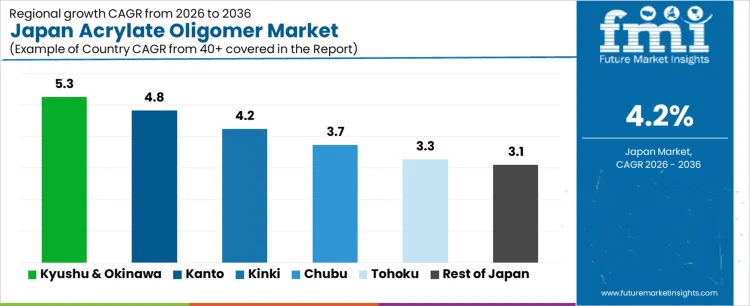
| Region | CAGR (2026 to 2036) |
|---|---|
| Kyushu & Okinawa | 5.3% |
| Kanto | 4.8% |
| Kansai | 4.2% |
| Chubu | 3.7% |
| Tohoku | 3.3% |
| Rest of Japan | 3.1% |
How is Kyushu and Okinawa driving demand for Acrylate Oligomers in Japan?
Kyushu and Okinawa drive demand through strong electronics manufacturing, export-oriented production, and industrial coating usage. Region’s CAGR of 5.3% reflects rising application of acrylate oligomers in UV-curable coatings for electronic components, precision housings, and protective surface layers. Manufacturers prioritize fast curing speeds, low solvent content, and consistent surface performance. Industrial users apply acrylate oligomers in adhesives and functional coatings requiring controlled viscosity and mechanical strength. Port access supports efficient import of raw materials and export of finished goods. Demand favors urethane acrylates and epoxy acrylates with stable molecular weight distribution. Growth remains application-led and efficiency-focused.
- Electronics and precision component coatings
- UV-curable industrial and adhesive applications
- Port-linked import and export logistics
- Preference for high-performance oligomer chemistries
How is Kanto driving demand for Acrylate Oligomers in Japan?
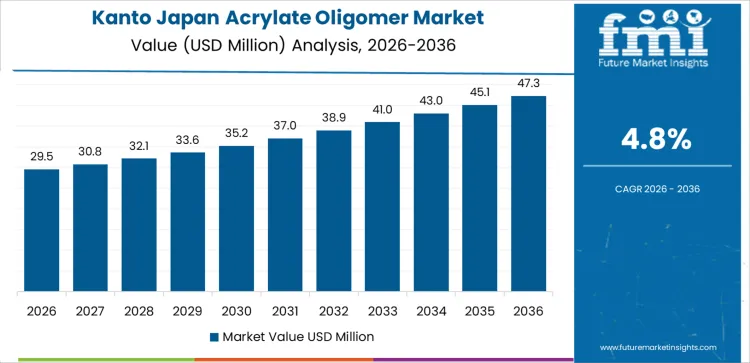
Kanto demand is shaped by concentration of printing, packaging, and specialty materials manufacturers. Region’s CAGR of 4.8% reflects extensive use of acrylate oligomers in inks, labels, and coatings requiring rapid curing and high print definition. Manufacturers emphasize formulation accuracy, regulatory compliance, and low VOC emissions. Adoption of UV and electron-beam curing improves productivity and surface consistency. Demand favors customized oligomer blends tailored to specific substrates and end-use requirements. Growth aligns with packaging innovation, recycling-compatible inks, and gradual upgrading of curing technologies rather than volume-driven expansion.
- Printing ink and specialty packaging usage
- Focus on formulation precision and compliance
- UV and EB curing technology adoption
- Customized oligomer blend demand
How is Kansai driving demand for Acrylate Oligomers in Japan?
Kansai demand reflects diversified industrial activity across coatings, adhesives, and packaging segments. Region’s CAGR of 4.2% is supported by use of acrylate oligomers in wood coatings, industrial finishes, protective layers, and flexible packaging inks. Manufacturers value abrasion resistance, surface durability, and compatibility with existing curing equipment. Procurement decisions emphasize cost efficiency, supplier reliability, and stable performance. Demand remains steady due to ongoing industrial maintenance and packaging production. Growth is incremental and replacement-driven, aligned with established manufacturing output rather than new capacity additions.
- Industrial and wood coating applications
- Packaging ink and adhesive usage
- Cost-controlled and reliability-focused procurement
- Replacement-driven demand stability
How is Chubu driving demand for Acrylate Oligomers in Japan?
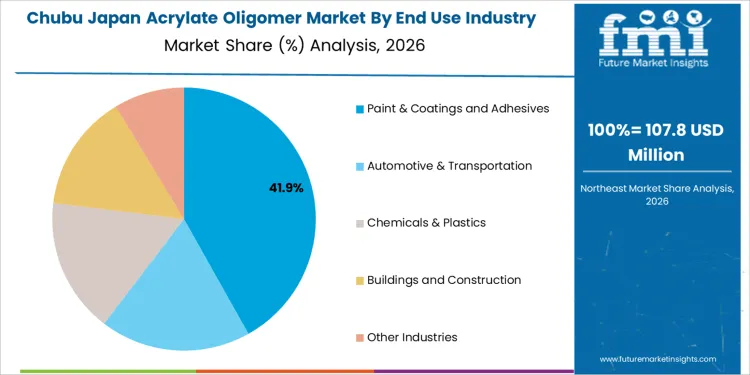
Chubu demand is anchored in automotive manufacturing, machinery production, and industrial assembly operations. Region’s CAGR of 3.7% reflects application of acrylate oligomers in automotive coatings, protective finishes, and structural adhesives. Manufacturers prioritize chemical resistance, surface uniformity, and process stability during high-volume production. Adoption of UV-curable systems progresses gradually, influenced by capital investment planning. Demand remains closely tied to automotive production cycles, maintenance coatings, and incremental efficiency improvements. Growth stays moderate due to mature industrial infrastructure and limited expansion in coating capacity.
- Automotive coating and adhesive usage
- Focus on durability and process consistency
- Gradual UV-curing system adoption
- Production-cycle-linked consumption
How is Tohoku driving demand for Acrylate Oligomers in Japan?
Tohoku demand is influenced by regional manufacturing activity and industrial maintenance requirements. Region’s CAGR of 3.3% reflects use of acrylate oligomers in protective coatings, industrial inks, and equipment maintenance applications. Facilities prioritize reliable curing behavior, ease of processing, and consistent performance under variable conditions. Demand favors standardized oligomer grades suitable for multiple applications. Procurement remains conservative, focusing on long-term supplier relationships. Growth remains cautious and efficiency-led, supported by continuity of regional industrial operations rather than expansion projects.
- Industrial maintenance and protective coating usage
- Standardized oligomer grade preference
- Conservative procurement behavior
- Stability-focused consumption patterns
How is Rest of Japan driving demand for Acrylate Oligomers in Japan?
Rest of Japan shows stable demand driven by small-scale manufacturing, localized coating operations, and replacement requirements. Region’s CAGR of 3.1% reflects use of acrylate oligomers in niche ink, coating, and adhesive applications. Buyers prioritize cost efficiency, formulation compatibility, and reliable supply. Demand remains limited and maintenance-oriented, aligned with continuation of existing production processes rather than development of new applications. Growth stays modest and predictable.
- Localized coating and ink applications
- Replacement-driven consumption behavior
- Cost-sensitive procurement focus
- Stable demand without expansion drivers
What is the competitive landscape of demand for acrylate oligomers in Japan?
Demand for acrylate oligomers in Japan is driven by use in UV-curable coatings, inks, adhesives, sealants, and advanced electronics applications. Performance expectations focus on controlled molecular weight, reactivity balance, viscosity tuning, and compatibility with photoinitiator systems used across automotive, industrial, and graphic segments. Buyers evaluate cure rate, hardness flexibility balance, yellowing resistance, and adhesion to substrates such as plastics, metals, and printed materials. Procurement teams prioritize suppliers with a strong Japan footprint, technical formulation support, and compliance with domestic chemical safety and environmental regulations. Trend in the Japan market reflects sustained adoption of energy-efficient UV curing systems, growth in electronics manufacturing, and substitution of solvent-based systems with low-VOC alternatives to meet regulatory and sustainability goals.
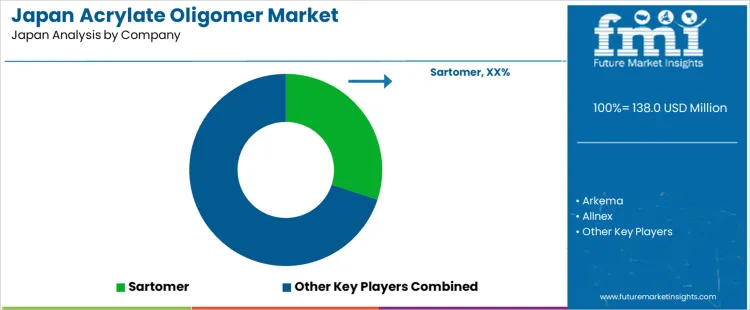
Sartomer Japan holds a leading position in the Japan acrylate oligomer market supported by domestic operations and integration within its global specialty materials network, enabling tailored oligomer solutions for coatings and adhesive formulators. Arkema, through its local presence and technical service centers, participates with a portfolio of radiation-curable oligomers for industrial and automotive coatings. Allnex operates in Japan, supplying specialty oligomers and monomers with formulation expertise for electronics and industrial markets. Covestro Japan contributes UV-curable raw materials used in high-performance coatings and inks. BASF Japan supports demand with specialty acrylate intermediates integrated into broader resin systems used by formulators requiring consistent performance. Competitive positioning in Japan reflects formulation breadth, local technical support, supply reliability, and alignment with evolving application requirements.
Key Players in Japan Acrylate Oligomer Demand
- Sartomer
- Arkema
- Allnex
- Covestro
- BASF
Scope of the Report
| Items | Values |
|---|---|
| Quantitative Units | USD million |
| Type | Urethane; Polyester; Laminated; Epoxy; Others |
| End Use Industry | Paint & Coatings and Adhesives; Automotive & Transportation; Chemicals & Plastics; Buildings and Construction; Other Industries |
| Regions Covered | Kyushu & Okinawa; Kanto; Kansai; Chubu; Tohoku; Rest of Japan |
| Key Companies Profiled | Sartomer; Arkema; Allnex; Covestro; BASF |
| Additional Attributes | Dollar sales by acrylate oligomer type and end-use industry; regional CAGR trends across Kansai and Chubu manufacturing clusters; demand trends in UV-curable coatings and adhesive formulations; increasing adoption in automotive coatings; influence of VOC regulations and sustainability-driven resin innovation in Japan. |
Japan Acrylate Oligomer Demand by Segments
Type:
- Urethane
- Polyester
- Laminated
- Epoxy
- Others
End Use Industry:
- Paint & Coatings and Adhesives
- Automotive & Transportation
- Chemicals & Plastics
- Buildings and Construction
- Other Industries
Region:
- Kyushu & Okinawa
- Kanto
- Kansai
- Chubu
- Tohoku
- Rest of Japan
Frequently Asked Questions
How big is the demand for acrylate oligomer in Japan in 2026?
The demand for acrylate oligomer in Japan is estimated to be valued at USD 138.0 million in 2026.
What will be the size of acrylate oligomer in Japan in 2036?
The market size for the acrylate oligomer in Japan is projected to reach USD 208.4 million by 2036.
How much will be the demand for acrylate oligomer in Japan growth between 2026 and 2036?
The demand for acrylate oligomer in Japan is expected to grow at a 4.2% CAGR between 2026 and 2036.
What are the key end use industry types in the acrylate oligomer in Japan?
The key end use industry types in acrylate oligomer in Japan are paint & coatings and adhesives, automotive & transportation, chemicals & plastics, buildings and construction, and other industries.
Which end use industry segment is expected to contribute significant share in the acrylate oligomer in Japan in 2026?
In terms of end use industry, paint & coatings and adhesives segment is expected to command 40.0% share in the acrylate oligomer in Japan in 2026.
Preview the report firsthand - request a free sample
Get SampleGet the brochure for pricing and purchase details.
Get PDFTable of Content
- Executive Summary
- Japan Market Outlook
- Demand-side Trends
- Supply-side Trends
- Technology Roadmap Analysis
- Analysis and Recommendations
- Market Overview
- Market Coverage / Taxonomy
- Market Definition / Scope / Limitations
- Market Background
- Market Dynamics
- Drivers
- Restraints
- Opportunity
- Trends
- Scenario Forecast
- Demand in Optimistic Scenario
- Demand in Likely Scenario
- Demand in Conservative Scenario
- Opportunity Map Analysis
- Product Life Cycle Analysis
- Supply Chain Analysis
- Investment Feasibility Matrix
- Value Chain Analysis
- PESTLE and Porter’s Analysis
- Regulatory Landscape
- Regional Parent Market Outlook
- Production and Consumption Statistics
- Import and Export Statistics
- Market Dynamics
- Japan Market Analysis 2021 to 2025 and Forecast, 2026 to 2036
- Historical Market Size Value (USD Million) Analysis, 2021 to 2025
- Current and Future Market Size Value (USD Million) Projections, 2026 to 2036
- Y-o-Y Growth Trend Analysis
- Absolute $ Opportunity Analysis
- Japan Market Pricing Analysis 2021 to 2025 and Forecast 2026 to 2036
- Japan Market Analysis 2021 to 2025 and Forecast 2026 to 2036, By Type
- Introduction / Key Findings
- Historical Market Size Value (USD Million) Analysis By Type , 2021 to 2025
- Current and Future Market Size Value (USD Million) Analysis and Forecast By Type , 2026 to 2036
- Urethane
- Polyester
- Laminated
- Epoxy
- Others
- Urethane
- Y-o-Y Growth Trend Analysis By Type , 2021 to 2025
- Absolute $ Opportunity Analysis By Type , 2026 to 2036
- Japan Market Analysis 2021 to 2025 and Forecast 2026 to 2036, By End Use Industry
- Introduction / Key Findings
- Historical Market Size Value (USD Million) Analysis By End Use Industry, 2021 to 2025
- Current and Future Market Size Value (USD Million) Analysis and Forecast By End Use Industry, 2026 to 2036
- Paint & Coatings and Adhesives
- Automotive & Transportation
- Chemicals & Plastics
- Buildings and Construction
- Other Industries
- Paint & Coatings and Adhesives
- Y-o-Y Growth Trend Analysis By End Use Industry, 2021 to 2025
- Absolute $ Opportunity Analysis By End Use Industry, 2026 to 2036
- Market Structure Analysis
- Competition Dashboard
- Competition Benchmarking
- Market Share Analysis of Top Players
- By Regional
- By Type
- By End Use Industry
- Competition Analysis
- Competition Deep Dive
- Sartomer
- Overview
- Product Portfolio
- Profitability by Market Segments (Product/Age /Sales Channel/Region)
- Sales Footprint
- Strategy Overview
- Marketing Strategy
- Product Strategy
- Channel Strategy
- Arkema
- Allnex
- Covestro
- BASF
- Sartomer
- Competition Deep Dive
- Assumptions & Acronyms Used
- Research Methodology


