

- Industry Size (2026)
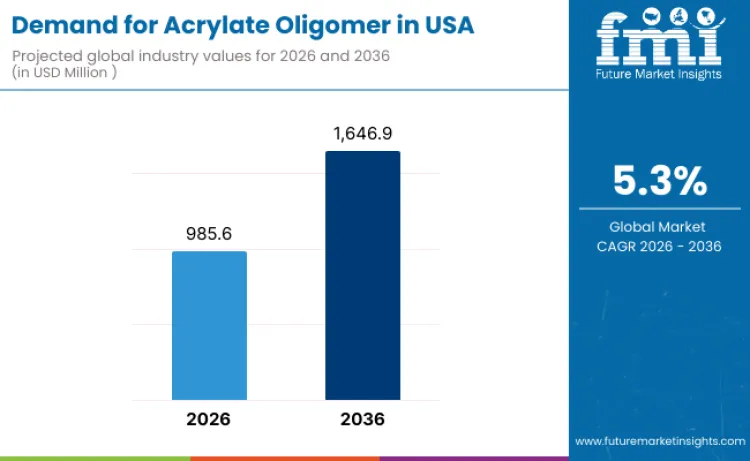
- USD 985.6 Mn
- Forecast (2036)
- USD 1646.9 Mn
- CAGR (2026 to 2036)
- 5.3%
Demand for Acrylate Oligomer in USA 2026 to 2036
Demand for acrylate oligomer in USA is valued at USD 985.6 million in 2026 and is forecasted to reach USD 1,646.9 million by 2036, reflecting a CAGR of 5.3%. Demand expands due to rising use of radiation-curable coatings, inks, adhesives, and sealants across packaging, automotive, electronics, and construction applications. Shift toward fast-curing, low-VOC, and energy-efficient coating technologies supports sustained consumption of acrylate oligomers in industrial formulations.
Urethane acrylate oligomers lead type usage because these materials deliver superior flexibility, abrasion resistance, and adhesion compared with other acrylate systems. Formulators prefer urethane acrylates for high-performance UV-curable coatings used in wood finishes, automotive clearcoats, and protective industrial surfaces. Balanced hardness, chemical resistance, and durability strengthen suitability across demanding end-use environments.
Quick Stats for Demand for Acrylate Oligomer in USA
- USA Acrylate Oligomer Sales Value (2026): USD 985.6 million
- USA Acrylate Oligomer Forecast Value (2036): USD 1,646.9 million
- USA Acrylate Oligomer Forecast CAGR (2026 to 2036): 5.3%
- Leading Type in USA Demand: Urethane acrylate oligomers
- Key Growth Regions in USA Demand: West USA, South USA, Northeast USA, Midwest USA
- Top Players in USA Demand: Allnex, Arkema (Sartomer), Covestro, IGM Resins, BASF
West USA, South USA, Northeast USA, and Midwest USA represent key growth regions supported by strong coatings manufacturing bases, printing and packaging activity, and advanced materials production. Allnex, Arkema (Sartomer), Covestro, IGM Resins, and BASF anchor competitive activity through broad oligomer portfolios, application-specific product development, and technical support aligned with evolving performance and sustainability requirements across USA coatings and adhesives industries.
USA Acrylate Oligomer Key Takeaways
| Metric | Value |
|---|---|
| USA Acrylate Oligomer Sales Value (2026) | USD 985.6 million |
| USA Acrylate Oligomer Forecast Value (2036) | USD 1,646.9 million |
| USA Acrylate Oligomer Forecast CAGR (2026-2036) | 5.3% |
How Are the Segments Classified in the Demand for Acrylate Oligomers in the USA?
Demand for acrylate oligomers in the USA is shaped by coating performance requirements, curing efficiency expectations, and compatibility with high-throughput manufacturing processes. Buyers evaluate flexibility, adhesion strength, chemical resistance, and UV-curing behavior across end-use formulations. Adoption patterns reflect strong usage in transportation-related coatings, industrial finishes, and specialty polymer systems where durability, surface performance, and process reliability are operational priorities within USA production environments.
Which Type Accounts for the Largest Share of Demand in the USA?
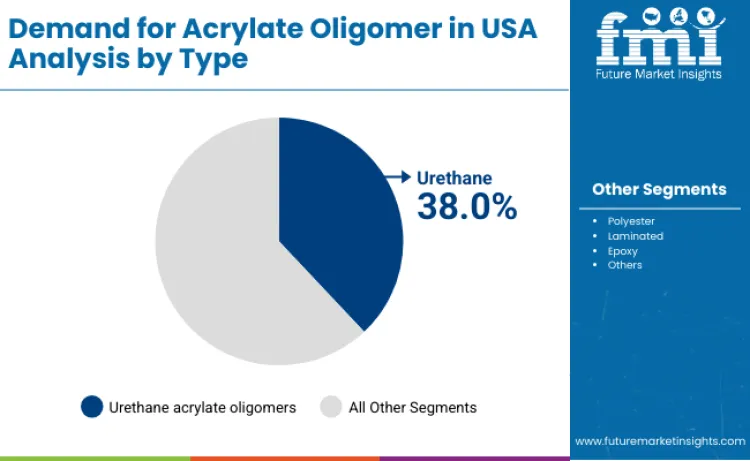
Urethane acrylate oligomers hold 38.0%, making them the leading type segment in the USA. These oligomers provide a balanced combination of flexibility, toughness, and abrasion resistance required in demanding coating and adhesive applications. Performance characteristics support use in automotive clearcoats, protective industrial finishes, and high-performance inks. Polyester, laminated, epoxy, and other acrylate oligomers serve applications requiring specific hardness, chemical resistance, or cost-performance alignment. Type distribution reflects preference for urethane systems due to their adaptability across multiple formulation requirements in USA industrial use.
Key Points:
- Urethane oligomers lead due to flexibility and durability balance.
- Strong abrasion resistance supports demanding surface applications.
- Other types address niche performance or cost needs.
Which End-Use Industry Accounts for the Largest Share of Demand in the USA?
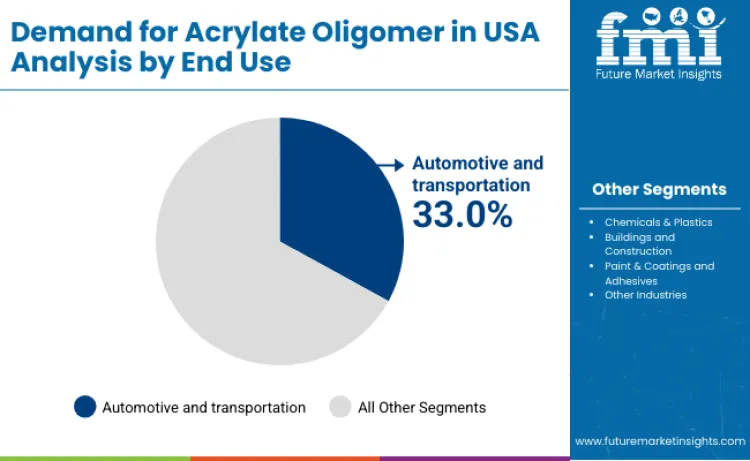
Automotive and transportation hold 33.0%, making them the leading end-use industry segment in the USA. Acrylate oligomers are used in coatings and adhesives to enhance scratch resistance, gloss retention, and curing speed for vehicle components. Chemicals and plastics industries apply oligomers in specialty resins and intermediates. Building and construction uses include protective coatings and sealants. Paint, coatings, and adhesives sectors rely on oligomers for UV-curable and fast-setting systems. End-use distribution reflects concentration of demand in transportation manufacturing with strict performance standards.
Key Points:
- Automotive applications drive primary oligomer consumption.
- Surface durability and curing speed are critical requirements.
- Construction and coatings provide steady secondary demand.
What are the Key Dynamics in the Acrylate Oligomer Industry in USA?
Demand increases as coatings, inks, adhesives, and composite manufacturers in USA expand use of acrylate oligomers for UV-curable and high-performance formulations. These materials support fast curing, surface durability, and formulation flexibility across industrial and consumer applications. Consumption aligns with domestic manufacturing output, adoption of radiation-curing technologies, and regulatory pressure to reduce volatile organic compound emissions.
How do UV-curable technologies and performance-driven formulations drive demand in USA?
USA coatings and inks producers rely on acrylate oligomers to achieve rapid curing, hardness control, and chemical resistance in UV and EB systems. Packaging and label printers adopt oligomer-based inks to improve line speed and print quality. Wood coatings and industrial finishes use tailored oligomers for abrasion resistance and gloss retention. Electronics and optical component manufacturers apply UV-curable adhesives for precision bonding. Automotive refinish and composite producers use oligomers to balance flexibility and strength. Regulatory focus on low-VOC systems accelerates shift from solvent-based chemistries. Strong presence of domestic formulators and equipment suppliers supports consistent adoption across industrial regions.
How do raw material costs, formulation complexity, and regulatory oversight influence demand stability?
Acrylate oligomer pricing reflects volatility in acrylic monomers and petrochemical feedstocks, affecting formulation economics. Customization requirements increase development time and technical cost for formulators serving niche applications. Health and safety controls addressing skin sensitization and workplace exposure add compliance obligations. End users require compatibility with curing equipment and substrates, limiting substitution flexibility. Competition from alternative resin systems influences selection in cost-sensitive segments. Environmental regulations governing chemical handling and emissions affect production planning. Demand remains stable in performance-critical applications, while growth depends on continued expansion of UV-curing infrastructure and cost management across USA manufacturing sectors.
How Is Demand for Acrylate Oligomer in USA Evolving by Region?
Demand for acrylate oligomers in the USA is increasing due to expanding use in UV-curable coatings, inks, adhesives, and advanced composite formulations. West USA leads with a 6.1% CAGR, supported by electronics manufacturing, advanced materials development, and specialty coatings adoption. South USA follows at 5.5%, driven by packaging inks, industrial coatings, and construction-related applications. Northeast USA records a 4.9% CAGR, shaped by printing inks, medical device coatings, and regulated specialty formulations. Midwest USA posts a 4.3% CAGR, reflecting steady demand from automotive coatings, industrial finishes, and manufacturing adhesives. Regional variation reflects end-use concentration, curing-technology adoption, and formulation complexity across the USA.
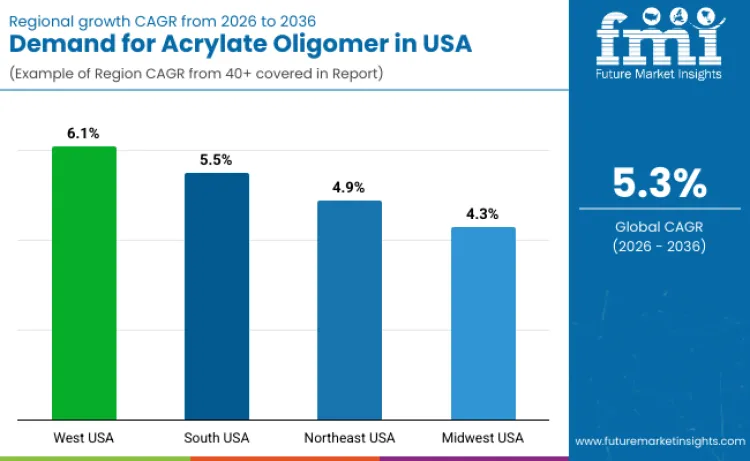
| Region | CAGR (2026-2036) |
|---|---|
| West USA | 6.1% |
| South USA | 5.5% |
| Northeast USA | 4.9% |
| Midwest USA | 4.3% |
How is West USA driving demand for Acrylate Oligomers?
West USA demand is driven by advanced manufacturing, electronics-related coatings, and high-performance material requirements. The region’s CAGR of 6.1% reflects strong use of acrylate oligomers in UV-curable coatings for electronics housings, optical components, and precision assemblies. Manufacturers value fast curing, low VOC emissions, and formulation flexibility. Demand extends to 3D printing resins, composite matrices, and specialty adhesives requiring controlled molecular weight distribution. Environmental compliance and performance differentiation influence selection of urethane acrylates and epoxy acrylates. Packaging formats favor controlled-volume containers to support formulation accuracy and contamination control.
- Electronics and precision-component coating applications
- Growth in UV-curable and low-VOC formulations
- Use in 3D printing and advanced composites
- Preference for high-specification oligomer chemistries
How is South USA driving demand for Acrylate Oligomers?
South USA demand is volume-oriented and linked to industrial production and construction activity. The region’s CAGR of 5.5% reflects extensive use of acrylate oligomers in packaging inks, wood coatings, industrial flooring, and protective finishes. Manufacturers adopt UV and electron-beam curing to improve line speed and energy efficiency. Construction-related coatings utilize acrylate oligomers for abrasion resistance and durability. Procurement emphasizes cost efficiency, supply continuity, and compatibility with high-throughput application systems. Demand favors multifunctional oligomers supporting broad formulation requirements.
- Packaging ink and industrial coating usage
- Construction and flooring protective applications
- Adoption of UV and EB curing technologies
- Cost-efficient, high-volume procurement patterns
How is Northeast USA driving demand for Acrylate Oligomers?
Northeast USA demand reflects specialty formulations, regulatory sensitivity, and precision applications. The region’s CAGR of 4.9% is supported by use of acrylate oligomers in printing inks, medical device coatings, and specialty adhesives. Manufacturers prioritize consistent curing behavior, biocompatibility compliance, and low extractables. Printing and labeling industries apply acrylate oligomers for high-resolution graphics and fast turnaround. Smaller batch sizes and customized formulations influence purchasing decisions. Demand growth aligns with specialty manufacturing rather than bulk industrial expansion.
- Medical and specialty coating formulations
- High-resolution printing and labeling applications
- Emphasis on regulatory and quality compliance
- Customized oligomer selection for niche uses
How is Midwest USA driving demand for Acrylate Oligomers?
Midwest USA demand is stable and manufacturing-driven, reflecting automotive, machinery, and industrial production activity. The region’s CAGR of 4.3% reflects use of acrylate oligomers in automotive clearcoats, metal coatings, pressure-sensitive adhesives, and industrial sealants. Manufacturers focus on durability, chemical resistance, and consistent curing under varied operating conditions. Adoption of UV-curable systems grows gradually, influenced by capital investment cycles. Procurement emphasizes reliability, supplier relationships, and compatibility with existing coating lines. Growth remains moderate, supported by replacement demand and incremental technology upgrades.
- Automotive and industrial coating applications
- Adhesives and sealants for manufacturing use
- Gradual UV-curing technology adoption
- Stable demand tied to established production lines
What is the competitive landscape of demand for acrylate oligomers in the USA?
Demand for acrylate oligomers in the USA is driven by use in UV-curable coatings, inks, adhesives, sealants, and advanced composites serving industrial, automotive, electronics, and packaging applications. Performance requirements focus on controlled molecular weight, reactivity balance, viscosity tuning, and compatibility with photoinitiator systems. Buyers evaluate cure speed, hardness flexibility balance, yellowing resistance, and adhesion to substrates such as plastics, metals, paper, and composites. Procurement teams prioritize suppliers with domestic production, formulation support, and compliance with USA chemical safety and environmental regulations. Trend in the USA market reflects rising adoption of energy-efficient UV curing, growth in electronics manufacturing, and continued replacement of solvent-based systems with low-VOC alternatives.
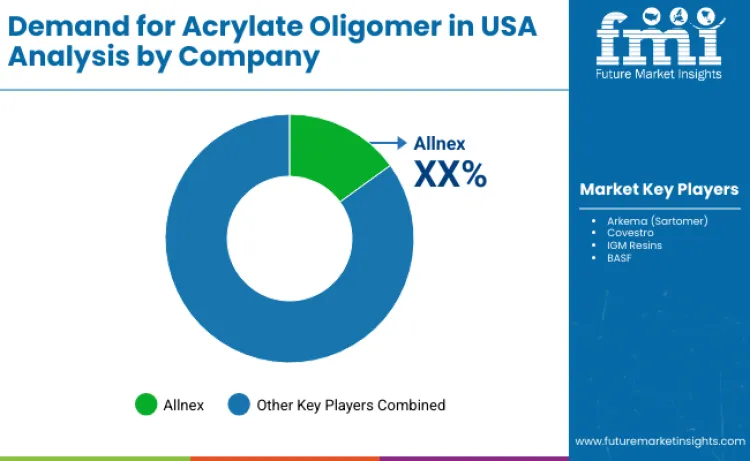
Allnex maintains a strong position through USA manufacturing of specialty acrylate oligomers used in high-performance UV and EB curing systems. Arkema supplies acrylate oligomers through its Sartomer business, supporting coatings, inks, and additive manufacturing customers across the USA. Covestro participates with radiation-curable raw materials designed for industrial coatings and electronic encapsulation applications. IGM Resins operates USA facilities supplying a broad portfolio of oligomers and monomers tailored for printing inks and wood coatings. BASF supports demand through specialty acrylate intermediates integrated into coating and adhesive formulations used by USA manufacturers. Competitive positioning in the USA reflects formulation breadth, technical service depth, supply reliability, and alignment with evolving UV-curing and sustainability requirements.
Key Players in USA Acrylate Oligomer Demand
- Allnex
- Arkema (Sartomer)
- Covestro
- IGM Resins
- BASF
Scope of the Report
| Items | Values |
|---|---|
| Quantitative Units | USD million |
| Type | Urethane; Polyester; Laminated; Epoxy; Others |
| End Use Industry | Automotive & Transportation; Chemicals & Plastics; Buildings and Construction; Paint & Coatings and Adhesives; Other Industries |
| Regions Covered | West USA; South USA; Northeast USA; Midwest USA |
| Key Companies Profiled | Allnex; Arkema (Sartomer); Covestro; IGM Resins; BASF |
| Additional Attributes | Dollar sales by oligomer type and end-use industry; regional adoption patterns across coatings, adhesives, and construction uses; demand linked to UV-curable and low-VOC formulation trends; performance-driven selection based on flexibility, adhesion, and chemical resistance; procurement influenced by industrial output cycles. |
USA Acrylate Oligomer Demand by Segments
Type:
- Urethane
- Polyester
- Laminated
- Epoxy
- Others
By End Use Industry:
- Automotive & Transportation
- Chemicals & Plastics
- Buildings and Construction
- Paint & Coatings and Adhesives
- Other Industries
Region:
- West USA
- South USA
- Northeast USA
- Midwest USA
Bibliography
- American Chemical Society. (2023). Acrylate oligomer chemistry and polymer formulation principles. ACS Publications and Technical Reports.
- Society of Plastics Engineers. (2023). Oligomer additives, performance characteristics, and application guidelines in coatings and adhesives. SPE Technical Papers.
- United States Environmental Protection Agency. (2023). Regulatory framework and compliance guidance for acrylate oligomers and related polymer materials. EPA Regulatory and Guidance Documents.
- International Organization for Standardization. (2023). Standards for polymer materials, testing methods, and performance evaluation relevant to oligomer components. ISO Standards Publications.
Frequently Asked Questions
How big is the demand for acrylate oligomer in USA in 2026?
The demand for acrylate oligomer in USA is estimated to be valued at USD 985.6 million in 2026.
What will be the size of acrylate oligomer demand in USA in 2036?
The demand size for acrylate oligomer in USA is projected to reach USD 1,646.9 million by 2036.
How much will the demand for acrylate oligomer in USA grow between 2026 and 2036?
The demand for acrylate oligomer in USA is expected to grow at a 5.3% CAGR between 2026 and 2036.
What are the key types in the acrylate oligomer demand in USA?
The key types in acrylate oligomer demand in USA include urethane acrylates, epoxy acrylates, polyester acrylates, and polyether acrylates.
Which end-use industry segment is expected to contribute a significant share in the acrylate oligomer demand in USA in 2026?
In terms of end-use industry, automotive and transportation segment is expected to command 33.0% share in the acrylate oligomer demand in USA in 2026.
Preview the report firsthand - request a free sample
Get SampleGet the brochure for pricing and purchase details.
Get PDFTable of Content
- Executive Summary
- USA Market Outlook
- Demand-side Trends
- Supply-side Trends
- Technology Roadmap Analysis
- Analysis and Recommendations
- Market Overview
- Market Coverage / Taxonomy
- Market Definition / Scope / Limitations
- Market Background
- Market Dynamics
- Drivers
- Restraints
- Opportunity
- Trends
- Scenario Forecast
- Demand in Optimistic Scenario
- Demand in Likely Scenario
- Demand in Conservative Scenario
- Opportunity Map Analysis
- Product Life Cycle Analysis
- Supply Chain Analysis
- Investment Feasibility Matrix
- Value Chain Analysis
- PESTLE and Porter’s Analysis
- Regulatory Landscape
- Regional Parent Market Outlook
- Production and Consumption Statistics
- Import and Export Statistics
- USA Acrylate Oligomer Demand Analysis 2020 to 2024 and Forecast, 2025 to 2035
- Historical Market Size Value (USD Million) Analysis, 2020 to 2024
- Current and Future Market Size Value (USD Million) Projections, 2025 to 2035
- Y-o-Y Growth Trend Analysis
- Absolute $ Opportunity Analysis
- USA Acrylate Oligomer Demand Pricing Analysis 2020 to 2024 and Forecast 2025 to 2035
- USA Acrylate Oligomer Demand Analysis 2020 to 2024 and Forecast 2025 to 2035, By Type
- Introduction / Key Findings
- Historical Market Size Value (USD Million) Analysis By Type, 2020 to 2024
- Current and Future Market Size Value (USD Million) Analysis and Forecast By Type, 2025 to 2035
- Urethane
- Polyester
- Laminated
- Epoxy
- Others
- Y-o-Y Growth Trend Analysis By Type, 2020 to 2024
- Absolute $ Opportunity Analysis By Type, 2025 to 2035
- USA Acrylate Oligomer Demand Analysis 2020 to 2024 and Forecast 2025 to 2035, By End Use Industry
- Introduction / Key Findings
- Historical Market Size Value (USD Million) Analysis By End Use Industry, 2020 to 2024
- Current and Future Market Size Value (USD Million) Analysis and Forecast By End Use Industry, 2025 to 2035
- Automotive and Transportation
- Chemicals and Plastics
- Buildings and Construction
- Paint and Coatings and Adhesives
- Other Industries
- Y-o-Y Growth Trend Analysis By End Use Industry, 2020 to 2024
- Absolute $ Opportunity Analysis By End Use Industry, 2025 to 2035
- Market Structure Analysis
- Competition Dashboard
- Competition Benchmarking
- Market Share Analysis of Top Players
- By Regional
- By Type
- By End Use Industry
- Competition Analysis
- Competition Deep Dive
- Allnex
- Overview
- Product Portfolio
- Profitability by Market Segments (Product / Sales Channel / Region)
- Sales Footprint
- Strategy Overview
- Marketing Strategy
- Product Strategy
- Channel Strategy
- Arkema (Sartomer)
- Covestro
- IGM Resins
- BASF
- Allnex
- Assumptions & Acronyms Used
- Research Methodology


