

- Industry Size (2026)
- USD 125.8 Mn
- Forecast (2036)
- USD 153.4 Mn
- CAGR (2026 to 2036)
- 2.0%
Demand for Aluminum Fluoride in Japan 2026 to 2036
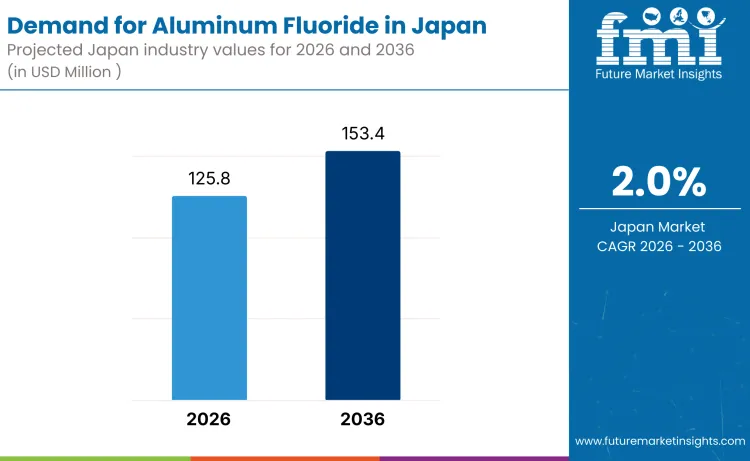
Demand for aluminum fluoride in Japan is valued at USD 125.8 million in 2026 and is forecasted to reach USD 153.4 million by 2036, representing a CAGR of 2.0%. Demand remains closely linked to aluminum smelting and downstream aluminum processing, where aluminum fluoride functions as a critical flux material. Stable domestic aluminum output and efficiency-driven process optimization support steady consumption rather than rapid expansion.
Metallurgical grade aluminum fluoride leads grade usage because it enhances electrolyte conductivity, lowers melting temperature, and improves current efficiency in electrolytic aluminum production. Japanese producers emphasize tight impurity control, consistent particle characteristics, and predictable performance to maintain operational stability. Long production cycles and high energy-cost sensitivity reinforce reliance on proven metallurgical-grade inputs.
Quick Stats for Market for Aluminum Fluoride in Japan
- Japan Aluminum Fluoride Sales Value (2026): USD 125.8 million
- Japan Aluminum Fluoride Forecast Value (2036): USD 153.4 million
- Japan Aluminum Fluoride Forecast CAGR (2026 to 2036): 2.0%
- Leading Grade in Japan Market: Metallurgical Grade Aluminum Fluoride
- Key Growth Regions in Japan Market: Kyushu & Okinawa, Kanto, Kansai, Chubu, Tohoku
- Top Players in Japan Market: Nippon Light Metal Company, Tokuyama Corporation, Tosoh Corporation, Kanto Chemical Co., Inc., Showa Denko K.K.
Kyushu & Okinawa, Kanto, Kansai, Chubu, and Tohoku represent key growth regions due to concentration of aluminum smelters, rolled product manufacturers, and industrial materials clusters. Nippon Light Metal Company, Tokuyama Corporation, Tosoh Corporation, Kanto Chemical Co., Inc., and Showa Denko K.K. anchor competitive activity through domestic manufacturing capability, quality-focused supply models, and long-term customer relationships aligned with Japan’s stringent industrial and process reliability standards.
Japan Aluminum Fluoride Key Takeaways
| Metric | Value |
|---|---|
| Japan Aluminum Fluoride Sales Value (2026) | USD 125.8 million |
| Japan Aluminum Fluoride Forecast Value (2036) | USD 153.4 million |
| Japan Aluminum Fluoride Forecast CAGR (2026-2036) | 2.0% |
How Are the Segments Classified in the Demand for Aluminum Fluoride in Japan?
Demand for aluminum fluoride in Japan is shaped by domestic aluminum processing requirements, materials efficiency standards, and controlled chemical usage regulations. Buyers assess grade purity, thermal stability, and consistency in electrolytic and specialty applications. Adoption patterns reflect concentration of demand within aluminum production, supported by downstream use in fluorochemicals, ceramics, and intermediates aligned with Japan’s precision manufacturing and quality compliance environment.
By Grade, Which Grade Represents Largest Share of Demand in Japan?
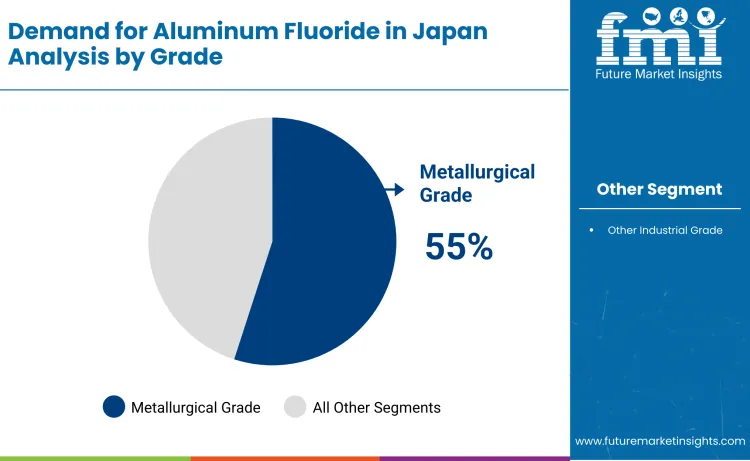
Metallurgical grade aluminum fluoride holds 55%, making it the leading grade segment in Japan. This grade is primarily used in aluminum smelting operations to reduce electrolyte melting temperature and stabilize bath chemistry. Consistent impurity control supports predictable current efficiency and operational reliability in electrolytic cells. Other industrial grades are applied in ceramics processing, fluorochemical synthesis, and chemical intermediate production, where purity requirements differ by application. Grade distribution reflects concentration of demand within aluminum production, where performance consistency and process control remain critical under Japan’s manufacturing standards.
Key Points:
- Metallurgical grade dominates due to aluminum smelting requirements.
- Electrolytic stability drives preference for controlled impurity levels.
- Other grades support ceramics and chemical intermediate uses.
By Application, Which Application Represent the Largest Share of Demand in Japan?
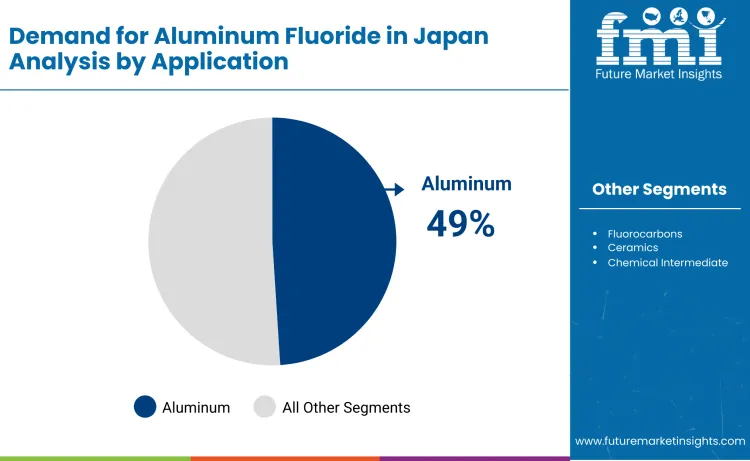
Aluminum applications hold 49.0%, making them the leading application segment in Japan. Aluminum fluoride is used to improve conductivity and reduce energy consumption during electrolytic aluminum production. Usage supports stable smelting operations aligned with efficiency and emissions control objectives. Fluorocarbon applications use aluminum fluoride as a processing agent in controlled chemical synthesis. Ceramics manufacturing applies aluminum fluoride to modify flux behavior and firing characteristics. Chemical intermediate applications rely on aluminum fluoride for specific reaction pathways. Application distribution reflects dominant demand from aluminum production, supported by steady secondary industrial usage.
Key Points:
- Aluminum production drives primary consumption in Japan.
- Energy efficiency influences application-level demand concentration.
- Secondary demand arises from fluorochemical and ceramics processing.
What are the Key Dynamics in the Aluminum Fluoride Industry in Japan?
Demand remains stable as Japan relies on aluminum fluoride for primary and secondary aluminum processing despite limited domestic smelting capacity. Usage concentrates in specialty aluminum production, alloy processing, and downstream metallurgical applications. Consumption aligns with Japan’s advanced manufacturing base, including automotive, electronics, and precision components. Import dependence, energy considerations, and process efficiency requirements shape procurement patterns across established industrial regions.
How do specialty aluminum processing and manufacturing quality requirements drive demand in Japan?
Japan uses aluminum fluoride primarily in controlled metallurgical processes supporting high-purity aluminum alloys rather than large-scale primary smelting. Specialty producers apply aluminum fluoride to stabilize electrolytic baths and improve yield consistency in niche aluminum operations. Automotive and electronics supply chains depend on aluminum materials with strict performance tolerances, reinforcing use of reliable fluxing agents. Recycling-oriented aluminum processors use aluminum fluoride to support process efficiency and impurity control. Advanced manufacturing clusters in Chubu and Kansai regions sustain steady downstream demand. Long-term supplier relationships and quality assurance standards guide procurement within Japan’s precision-focused industrial structure.
How do import reliance, environmental regulation, and cost sensitivity influence demand stability?
Japan depends heavily on imported aluminum fluoride due to limited domestic raw material availability. Import price volatility and logistics costs influence purchasing strategies. Environmental regulations governing fluoride emissions and waste handling impose compliance requirements on processors. Energy costs affect aluminum processing volumes, indirectly shaping consumption levels. Recycling initiatives reduce reliance on primary aluminum, moderating growth potential. Limited substitution options maintain baseline demand, while efficiency improvements constrain volume expansion. Demand remains stable within specialized applications, shaped by import economics, environmental oversight, and Japan’s emphasis on high-value aluminum manufacturing rather than bulk smelting activity.
How Is Demand for Aluminum Fluoride in Japan Evolving by Region?
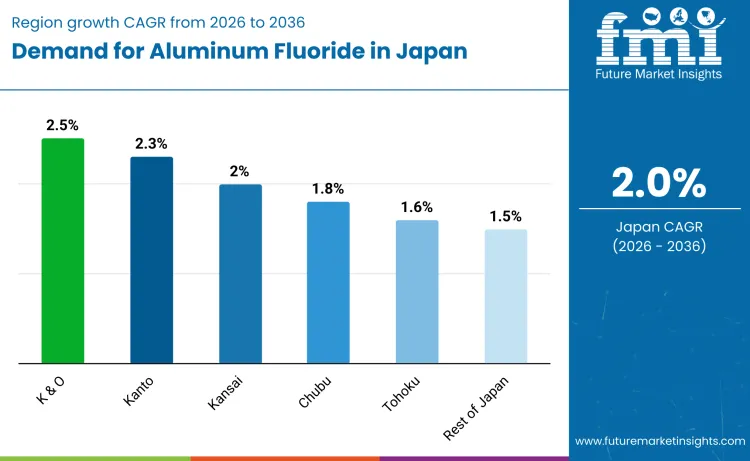
Demand for aluminum fluoride in Japan is growing at a measured pace due to its continued use in aluminum smelting, secondary refining, and specialty metallurgical processes. Kyushu and Okinawa lead with a 2.5% CAGR, supported by non-ferrous metal processing and port-linked industrial activity. Kanto follows at 2.3%, driven by secondary aluminum refining and specialty materials manufacturing. Kansai records a 2.0% CAGR, shaped by industrial alloys and fabrication demand. Chubu posts 1.8%, reflecting automotive aluminum usage. Tohoku shows 1.6%, supported by recycling and regional processing. Rest of Japan records 1.5%, reflecting stable replacement-driven consumption. Regional variation reflects smelting presence, industrial mix, and energy-cost sensitivity across Japan.
| Region | CAGR (2026 to 2036) |
|---|---|
| Kyushu & Okinawa | 2.5% |
| Kanto | 2.3% |
| Kansai | 2.0% |
| Chubu | 1.8% |
| Tohoku | 1.6% |
| Rest of Japan | 1.5% |
How is Kyushu and Okinawa driving demand for Aluminum Fluoride in Japan?
Kyushu and Okinawa drive demand due to concentration of non-ferrous metal processing facilities and proximity to major import ports. Region’s CAGR of 2.5% reflects consistent use of aluminum fluoride as a fluxing agent in primary smelting and secondary aluminum refining. Operators focus on maintaining electrolytic bath stability, reducing energy losses, and improving current efficiency. Port-linked logistics support reliable sourcing of raw materials and bulk handling efficiency. Demand favors low-impurity and granular grades suitable for continuous smelting operations. Growth remains efficiency-led, aligned with stable aluminum output rather than new capacity development.
- Primary and secondary aluminum refining usage
- Electrolytic bath stabilization applications
- Port-based logistics and bulk handling
- Focus on efficiency rather than capacity expansion
How is Kanto driving demand for Aluminum Fluoride in Japan?
Kanto demand is shaped by secondary aluminum processing, recycling activity, and specialty metallurgy. Region’s CAGR of 2.3% reflects application of aluminum fluoride in refining operations requiring precise chemical control. Producers emphasize consistent flux performance to support high-quality alloy output for industrial and electronic applications. Regulatory oversight encourages sourcing from certified suppliers with traceable material quality. Demand remains batch-oriented, favoring mid-size bulk packaging compatible with controlled production environments. Growth is driven by gradual process optimization and recycling efficiency improvements rather than expansion of smelting capacity.
- Secondary aluminum refining and recycling
- Specialty alloy production requirements
- Strong regulatory and quality oversight
- Batch-focused procurement patterns
How is Kansai driving demand for Aluminum Fluoride in Japan?
Kansai demand reflects diversified industrial fabrication and alloy production activity. Region’s CAGR of 2.0% is supported by use of aluminum fluoride in melt treatment and alloy preparation for machinery, construction, and industrial components. Fabricators rely on aluminum fluoride to maintain melt consistency and reduce variability during processing. Limited presence of primary smelting constrains overall volume growth. Procurement decisions emphasize reliability, cost efficiency, and compatibility with existing furnace systems. Demand growth remains steady and replacement-driven, aligned with ongoing industrial activity.
- Industrial alloy and fabrication applications
- Melt consistency and quality control usage
- Cost-focused and reliable procurement
- Replacement-driven demand patterns
How is Chubu driving demand for Aluminum Fluoride in Japan?
Chubu demand is anchored in automotive manufacturing and downstream aluminum casting operations. Region’s CAGR of 1.8% reflects use of aluminum fluoride in secondary refining supporting production of automotive components and machinery parts. Manufacturers prioritize defect reduction, process consistency, and material performance. Demand remains linked to automotive production cycles and incremental efficiency improvements. Packaging preference centers on standardized bulk formats aligned with predictable consumption schedules. Growth remains modest due to mature manufacturing infrastructure and limited expansion in smelting capacity.
- Automotive aluminum casting support
- Secondary refining and melt conditioning
- Production-cycle-linked consumption
- Standardized bulk procurement formats
How is Tohoku driving demand for Aluminum Fluoride in Japan?
Tohoku demand is influenced by aluminum recycling operations, regional processing facilities, and public-sector supported industrial activity. Region’s CAGR of 1.6% reflects controlled use of aluminum fluoride in secondary aluminum recovery and impurity management. Facilities focus on improving recycling yields and maintaining consistent melt quality. Geographic dispersion of plants supports low-volume, stable procurement rather than large-scale purchasing. Demand growth remains cautious and efficiency-driven, aligned with regional industrial sustainability initiatives.
- Secondary aluminum recovery usage
- Recycling efficiency and impurity control
- Low-volume and stable procurement
- Efficiency-led consumption patterns
How is Rest of Japan driving demand for Aluminum Fluoride in Japan?
Rest of Japan shows stable demand driven by small-scale metal processing and maintenance of existing operations. Region’s CAGR of 1.5% reflects use of aluminum fluoride in localized refining, fabrication, and alloy treatment activities. Buyers prioritize cost efficiency, supplier reliability, and compatibility with established processing systems. Demand remains limited and replacement-driven, with minimal exposure to new industrial capacity. Consumption aligns with operational continuity rather than growth-oriented investment.
- Localized metal processing applications
- Replacement-driven consumption behavior
- Cost-sensitive procurement focus
- Stable demand without expansion drivers
What is the competitive landscape of demand for aluminum fluoride in Japan?
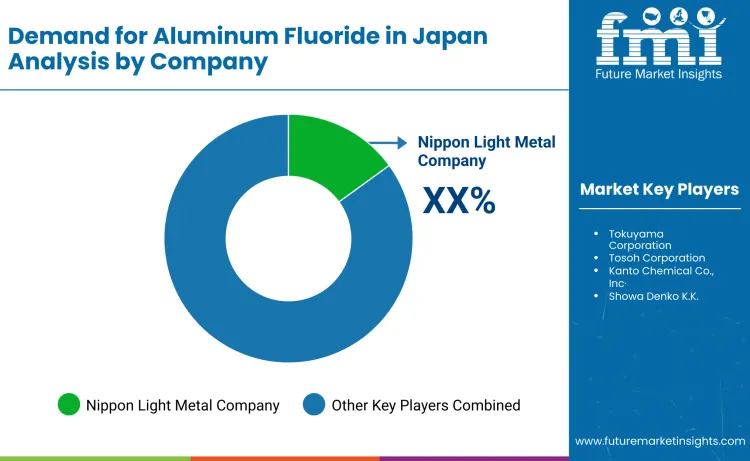
Demand for aluminum fluoride in Japan is primarily driven by aluminum smelting activity, specialty ceramics, glass manufacturing, and select industrial chemical processes requiring fluxing performance. Usage centers on controlled fluoride content, consistent chemical purity, and secure handling practices aligned with Japan’s industrial and environmental standards. Buyers evaluate product stability, moisture control, packaging safety, and compliance with domestic hazardous substance regulations. Procurement teams prioritize suppliers with certified quality systems, technical understanding of smelting chemistry, and reliable logistics for fluoride-based inorganic compounds. Trend in the Japan market reflects stable aluminum production, ongoing investment in materials engineering, and sustained reliance on aluminum fluoride as a critical additive in electrolytic reduction processes.
Nippon Light Metal Company supports domestic primary and secondary aluminum operations with aluminum fluoride grades tailored to local smelter requirements and quality specifications. Tokuyama Corporation participates through specialty fluorochemical products, including aluminum fluoride intermediates aligned with Japanese industrial demands. Tosoh Corporation maintains visibility via inorganic chemical divisions supplying fluoride compounds and related materials used in ceramics and glass sectors. Kanto Chemical Co., Inc. contributes through chemical supply operations offering aluminum fluoride for industrial processing within Japan. Showa Denko K.K. supports demand through fluorochemical products and engineered materials provided to metal and materials manufacturers. Competitive positioning in Japan reflects domestic production capability, quality control, regulatory compliance, and technical support tailored to Japanese industry needs.
Key Players in Japan Aluminum Fluoride Demand
- Nippon Light Metal Company
- Tokuyama Corporation
- Tosoh Corporation
- Kanto Chemical Co., Inc.
- Showa Denko K.K.
Scope of the Report
| Items | Values |
|---|---|
| Quantitative Units | USD million |
| Grade | Metallurgical Grade; Other Industrial Grade |
| Application | Aluminum; Fluorocarbons; Ceramics; Chemical Intermediate |
| Regions Covered | Kyushu & Okinawa; Kanto; Kansai; Chubu; Tohoku; Rest of Japan |
| Key Companies Profiled | Nippon Light Metal Company; Tokuyama Corporation; Tosoh Corporation; Kanto Chemical Co., Inc.; Showa Denko K.K. |
| Additional Attributes | Dollar sales by grade and application segments; regional CAGR trends across aluminum smelting and chemical manufacturing clusters; demand patterns linked to domestic aluminum production cycles; adoption trends for high-purity metallurgical grades; regulatory and environmental compliance impact on fluorine-based chemical processing in Japan. |
Japan Aluminum Fluoride Demand by Segments
Grade:
- Metallurgical Grade
- Other Industrial Grade
Application:
- Aluminum
- Fluorocarbons
- Ceramics
- Chemical Intermediate
Region:
- Kyushu & Okinawa
- Kanto
- Kansai
- Chubu
- Tohoku
- Rest of Japan
Frequently Asked Questions
How big is the demand for aluminum fluoride in Japan in 2026?
The demand for aluminum fluoride in Japan is estimated to be valued at USD 125.8 million in 2026.
What will be the size of aluminum fluoride demand in Japan in 2036?
The demand size for aluminum fluoride in Japan is projected to reach USD 153.4 million by 2036.
How much will the demand for aluminum fluoride in Japan grow between 2026 and 2036?
The demand for aluminum fluoride in Japan is expected to grow at a 2.0% CAGR between 2026 and 2036.
What are the key grades in the aluminum fluoride demand in Japan?
The key grades in aluminum fluoride demand in Japan include metallurgical grade and other industrial-grade variants.
Which application segment is expected to contribute a significant share in the aluminum fluoride demand in Japan in 2026?
In terms of application, aluminum production is expected to command 49.0% share in the aluminum fluoride demand in Japan in 2026.
Preview the report firsthand - request a free sample
Get SampleGet the brochure for pricing and purchase details.
Get PDFTable of Content
- Executive Summary
- Japan Market Outlook
- Demand Side Trends
- Supply Side Trends
- Industrial and Regulatory Landscape
- Analysis and Recommendations
- Market Overview
- Market Coverage and Taxonomy
- Market Definition Scope and Limitations
- Market Background
- Market Dynamics
- Drivers
- Restraints
- Opportunities
- Trends
- Scenario Forecast
- Demand in Optimistic Scenario
- Demand in Likely Scenario
- Demand in Conservative Scenario
- Opportunity Map Analysis
- Product and Chemical Life Cycle Analysis
- Aluminum and Fluorochemicals Value Chain Analysis
- Investment Feasibility Matrix
- PESTLE and Porter Analysis
- Environmental and Chemical Compliance Framework
- Regional Parent Market Outlook
- Import Dependency and Supply Security Analysis
- Japan Aluminum Fluoride Demand Analysis 2020 to 2024 and Forecast 2025 to 2035
- Historical Demand Value USD Million Analysis 2020 to 2024
- Current and Future Demand Value USD Million Projections 2025 to 2035
- Year on Year Growth Trend Analysis
- Absolute Dollar Opportunity Analysis
- Japan Aluminum Fluoride Pricing Analysis 2020 to 2024 and Forecast 2025 to 2035
- Japan Aluminum Fluoride Demand Analysis 2020 to 2024 and Forecast 2025 to 2035 By Grade
- Introduction and Key Findings
- Historical Demand Value USD Million Analysis by Grade 2020 to 2024
- Current and Future Demand Value USD Million Analysis and Forecast by Grade 2025 to 2035
- Metallurgical Grade
- Other Industrial Grade
- Year on Year Growth Trend Analysis by Grade
- Absolute Dollar Opportunity Analysis by Grade
- Japan Aluminum Fluoride Demand Analysis 2020 to 2024 and Forecast 2025 to 2035 By Application
- Introduction and Key Findings
- Historical Demand Value USD Million Analysis by Application 2020 to 2024
- Current and Future Demand Value USD Million Analysis and Forecast by Application 2025 to 2035
- Aluminum Production
- Fluorocarbons
- Ceramics
- Chemical Intermediates
- Year on Year Growth Trend Analysis by Application
- Absolute Dollar Opportunity Analysis by Application
- Japan Aluminum Fluoride Demand Analysis 2020 to 2024 and Forecast 2025 to 2035 By Region
- Kyushu and Okinawa
- Kanto
- Kansai
- Chubu
- Tohoku
- Rest of Japan
- Market Structure Analysis
- Competition Dashboard
- Competition Benchmarking
- Market Share Analysis of Key Players
- By Grade
- By Application
- By Region
- Competition Analysis
- Competition Deep Dive
- Nippon Light Metal Company
- Tokuyama Corporation
- Tosoh Corporation
- Kanto Chemical Co., Inc.
- Showa Denko K.K.
- Assumptions and Acronyms Used
- Research Methodology


