

- Industry Size (2025)
- USD 16.3 Mn
- Forecast (2035)
- USD 25.9 Mn
- CAGR (2025 to 2035)
- 4.7%
Demand for Boron Trifluoride and Complexes in Japan Forecast and Outlook 2025 to 2035
The demand for boron trifluoride and complexes in Japan is expected to grow from USD 16.3 million in 2025 to USD 25.9 million by 2035, reflecting a compound annual growth rate (CAGR) of 4.7%. Boron trifluoride and its complexes are crucial in various industrial applications, including as catalysts in organic synthesis, in petroleum refining, and as reagents in chemical manufacturing. The steady demand for these compounds is driven by their importance in the chemical, pharmaceutical, and materials industries, where they support processes requiring precise chemical control and high reactivity.
The market will experience steady growth, starting at USD 16.3 million in 2025 and increasing to USD 17.1 million in 2026, and USD 17.9 million in 2027. As demand for these compounds grows, the market will expand further, reaching USD 19.7 million by 2029 and USD 20.6 million by 2030. By 2035, the demand for boron trifluoride and its complexes is expected to reach USD 25.9 million, reflecting consistent growth in key sectors such as chemical manufacturing and pharmaceuticals.
Quick Stats of the Demand for Boron Trifluoride and Complexes in Japan
- Demand for Boron Trifluoride and Complexes in Japan Value (2025): USD 16.3 million
- Demand for Boron Trifluoride and Complexes in Japan Forecast Value (2035): USD 25.9 million
- Demand for Boron Trifluoride and Complexes in Japan Forecast CAGR (2025-2035): 4.7%
- Demand for Boron Trifluoride and Complexes in Japan Product Type: 40% BF3 (Gas)
- Demand for Boron Trifluoride and Complexes in Japan Key Growth Regions: Kyushu & Okinawa, Kanto, Kinki, Chubu, Tohoku, Rest of Japan
- Demand for Boron Trifluoride and Complexes in Japan Key Players: Stella Chemifa Corporation, Morita Chemical Industries Co., Ltd, Kishida Chemical Co. Ltd.

What is the Growth Forecast for the Boron Trifluoride and Complexes Industry in Japan through 2035?
The boron trifluoride and complexes market in Japan is expected to experience gradual growth over the forecast period. From USD 16.3 million in 2025, the market will rise to USD 17.1 million in 2026, and USD 17.9 million in 2027. The growth will continue steadily each year, reaching USD 18.8 million by 2028, and USD 19.7 million by 2029. By 2035, the market will expand to USD 25.9 million, driven by continued demand in the chemical, pharmaceutical, and industrial sectors.
The early vs. late growth curve comparison reveals that growth in the early years of the forecast period (2025–2029) will be more gradual, with incremental increases year-over-year. However, from 2029 onward, the growth rate will accelerate slightly, driven by increasing applications of boron trifluoride in newer chemical processes and expanding demand in high-tech industries. The comparison highlights a shift toward faster growth as adoption of advanced technologies in chemical manufacturing and related sectors pushes the demand for boron trifluoride and its complexes. This late-stage growth acceleration underscores the evolving role of these compounds in cutting-edge industrial applications.
Key Takeaways of Boron Trifluoride and Complexes Industry in Japan
| Metric | Value |
|---|---|
| Industry Sales Value (2025) | USD 16.3 million |
| Industry Forecast Value (2035) | USD 25.9 million |
| Industry Forecast CAGR (2025-2035) | 4.7% |
Why is the Demand for Boron Trifluoride (and its Complexes) in Japan Growing?
The demand for Boron Trifluoride (BF₃) and its complexes in Japan is rising as its role as a catalyst and chemical intermediate becomes increasingly important across multiple industries. BF₃ is widely used in polymerization, alkylation, esterification, condensation and other organic synthesis reactions. In polymer and petrochemical sectors it helps produce high performance plastics, resins, specialty polymers and synthetic rubbers. These materials are used in automobiles, electronics, industrial goods and other value added products. Growth in these downstream industries in Japan supports rising consumption of BF₃ as a foundational catalyst. In addition, BF₃ and its complexes are valued in pharmaceuticals and fine chemical synthesis because of their strong Lewis acid properties, which enable high selectivity reactions for active pharmaceutical ingredients, agrochemicals and specialty chemicals. The demand from these sectors strengthens as Japanese chemical and pharmaceutical manufacturers emphasize quality, yield and production efficiency.
Concurrently, demand is driven by expansion of the electronics and high tech manufacturing sector in Japan. BF₃ complexes contribute in the synthesis of specialized polymers and chemical intermediates used in semiconductors, electronic components and related advanced materials. High purity BF₃ grades are often required in such applications to meet stringent purity, performance and safety standards. Domestic producers of BF₃ and its complexes supply material tailored for these demanding uses. As Japanese companies invest in semiconductor fabrication, advanced materials and fine chemicals, reliance on catalysts like BF₃ and its complexes grows. Given the broad base of end use industries, ongoing industrial innovation and the importance of advanced materials in Japan’s manufacturing economy, demand for BF₃ and its complexes is expected to increase steadily in coming years.
What Is the Current State of the Demand for Boron Trifluoride and Complexes in Japan in Terms of Product Type and End-Use?
The demand for boron trifluoride (BF3) and its complexes in Japan is primarily driven by product type and end-use. The leading product type is BF3 (gas), accounting for 40% of the market share, while polymer and petrochemicals is the dominant end-use sector, capturing 35% of the demand. Boron trifluoride is widely used as a catalyst and reagent in various chemical processes, and its complexes find applications in sectors such as pharmaceuticals, electronics, and agrochemicals, where they play a key role in facilitating reactions and improving process efficiencies.
How Is BF3 (Gas) Leading the Demand for Boron Trifluoride and Complexes in Japan?
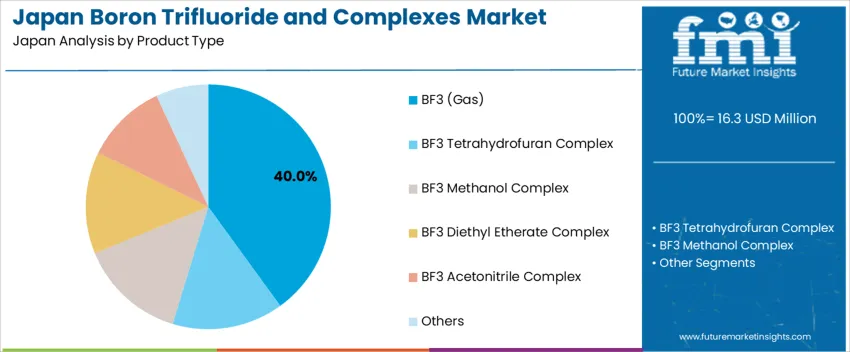
BF3 (gas) leads the demand for boron trifluoride and complexes in Japan, holding 40% of the market share. Boron trifluoride in its gaseous form is commonly used as a catalyst in a wide range of chemical reactions, including polymerization and hydrocracking processes. Its ability to activate various substrates and accelerate reactions makes it a critical component in several industries, including petroleum refining, polymer production, and agrochemicals.
The demand for BF3 (gas) is driven by its versatility, efficiency, and effectiveness in catalyzing reactions in the polymer and petrochemical industries, where speed and efficiency are crucial. Additionally, its role in the synthesis of specialty chemicals and the production of synthetic materials enhances its value in industrial processes. As Japan continues to advance its chemical manufacturing and refining capabilities, the demand for BF3 (gas) in key sectors like petrochemicals and polymers is expected to remain strong, ensuring its dominant position in the market.
How Is Polymer and Petrochemicals Leading the End-Use Demand for Boron Trifluoride and Complexes in Japan?
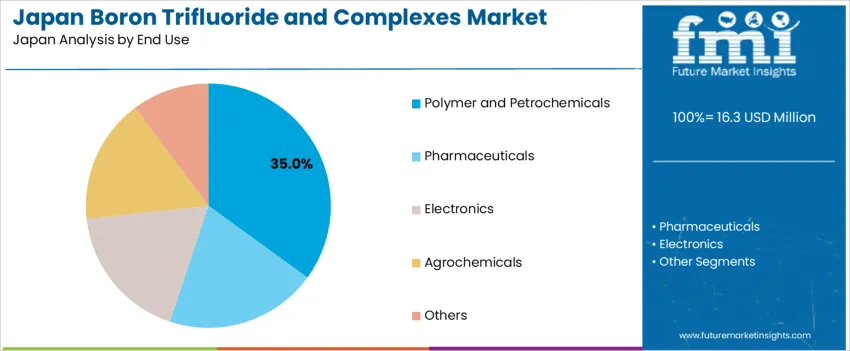
Polymer and petrochemicals is the leading end-use sector for boron trifluoride and its complexes in Japan, capturing 35% of the demand. Boron trifluoride is crucial in the production of various polymers, such as polyolefins and styrenes, as it is used to catalyze polymerization reactions. Additionally, it plays a significant role in petrochemical processes, particularly in the refinement of crude oil and the production of specialty chemicals used in diverse applications.
The demand for boron trifluoride in the polymer and petrochemical sectors is driven by its efficiency in accelerating chemical reactions, its ability to produce high-quality products, and its role in reducing production costs. As the demand for advanced polymers and petrochemical products continues to rise in Japan, driven by industries like automotive, electronics, and packaging, the use of boron trifluoride as a catalyst is expected to grow. This continued reliance on boron trifluoride in polymer and petrochemical applications ensures that this end-use sector remains the largest driver of demand in Japan.
What is the Summary of Demand for Boron Trifluoride and Its Complexes in Japan?
Demand for boron trifluoride (BF₃) and its complexes in Japan is supported by usage in chemical synthesis, polymer production, semiconductors, and specialty chemicals manufacturing. The market for high purity BF₃ in Japan is modest but growing. As global demand for BF₃ and its complexes rises, increasing applications in electronics, pharmaceuticals, and industrial chemicals drive interest in Japan as well. Continued demand is expected where high precision chemical processes or materials are required, especially in sectors such as semiconductors, pharmaceuticals, and specialty chemicals.
What are the Drivers of Demand for Boron Trifluoride and Its Complexes in Japan?
Boron trifluoride is important as it serves as a strong catalyst and reagent in many chemical synthesis processes. It is widely used for polymerization, alkylation, isomerization, esterification, and other reactions needed in plastics, resins, specialty chemicals, and fine chemicals manufacturing. The electronics and semiconductor sectors also drive demand in Japan since high purity chemicals, including BF₃, are often required in semiconductor fabrication or specialty materials production. Additionally, the use of BF₃ complexes in pharmaceuticals and agrochemicals for the synthesis of intermediates or specialty compounds supports steady demand. The general growth of Japan’s chemical and high tech manufacturing industries underpins the baseline demand for BF₃ and its complexes for advanced applications.
What are the Restraints on Demand for Boron Trifluoride and Its Complexes in Japan?
Despite its utility, demand for BF₃ in Japan faces constraints. Handling BF₃ and its complexes requires strict safety protocols because BF₃ is reactive and hazardous. The need for specialized storage and handling raises costs and restricts adoption, especially for smaller firms. Production cost volatility and supply chain sensitivity, particularly regarding raw material availability and energy costs, can make BF₃ procurement expensive, which may deter use. Regulatory and environmental compliance pressures, especially relating to chemical safety and emissions, may limit certain applications or lead to preference for alternative reagents in some sectors. Finally, demand depends heavily on end use industries; if sectors such as polymer manufacturing or semiconductors contract or shift toward alternate chemistries, BF₃ demand may stagnate.
What are the Key Trends Influencing Demand for Boron Trifluoride and Its Complexes in Japan?
A notable trend is growing demand for high purity BF₃ and specialty complexes tailored for advanced industries such as semiconductors, pharmaceuticals, and specialty chemicals. As Japan maintains a strong electronics manufacturing base, demand for high precision reagents is increasing. Another trend is the increased use of BF₃ and its complexes in polymerization and specialty polymer/resin production, supporting plastics, coatings, adhesives, and advanced materials industries. Additionally, globalization of chemical supply chains and growth in Asia Pacific demand encourage Japanese firms to maintain or expand BF₃ usage to stay competitive. Finally, as regulatory frameworks tighten globally and locally, there is increasing focus on safe handling, quality control, and compliance. This drives demand for certified high purity BF₃ and validated supply chain standards rather than lower grade alternatives.
What is the Regional Demand Outlook for Boron Trifluoride and Complexes in Japan?
The demand for boron trifluoride and its complexes in Japan shows steady growth across regions, with Kyushu & Okinawa leading at a CAGR of 5.9%. Kanto follows with a CAGR of 5.4%, supported by its industrial activities and chemical production. The Kinki region shows moderate growth at 4.8%, while Chubu, Tohoku, and the Rest of Japan exhibit slower growth, with respective CAGRs of 4.2%, 3.7%, and 3.5%. These regional differences reflect varying levels of industrial demand, chemical production capabilities, and market requirements for boron trifluoride and its complexes in various applications.

| Region | CAGR (%) |
|---|---|
| Kyushu & Okinawa | 5.9 |
| Kanto | 5.4 |
| Kinki | 4.8 |
| Chubu | 4.2 |
| Tohoku | 3.7 |
| Rest of Japan | 3.5 |
What factors are driving the demand for boron trifluoride and complexes in Kyushu & Okinawa?
The demand for boron trifluoride and complexes in Kyushu & Okinawa is projected to grow at a CAGR of 5.9%, driven by the region’s strong chemical and manufacturing sectors. Kyushu & Okinawa are home to significant chemical production facilities, including those involved in the manufacturing of specialty chemicals, petrochemicals, and polymers, where boron trifluoride is used as a catalyst and reactant in various chemical processes. Additionally, the region's increasing focus on sustainable chemical production methods and the adoption of advanced technologies for industrial applications is further boosting demand for boron trifluoride and its complexes. The rising demand for boron-based compounds in electronics, agriculture, and pharmaceuticals also contributes to the growing need for these chemicals in Kyushu & Okinawa.
Why is the demand for boron trifluoride and complexes increasing in Kanto?

In Kanto, the demand for boron trifluoride and its complexes is expected to grow at a CAGR of 5.4%, supported by the region’s significant industrial and chemical production activities. Kanto, home to Tokyo and several major industrial hubs, has a well-established chemical industry, including those involved in high-tech applications such as electronics, pharmaceuticals, and materials science, where boron trifluoride is used in the synthesis of various compounds. The growing demand for advanced materials and high-performance chemicals in industries such as semiconductors and electronics is contributing to the increasing use of boron trifluoride and its complexes. Additionally, Kanto’s focus on sustainable industrial practices and regulatory pressure to reduce environmental impact is driving the adoption of these chemicals in eco-friendlier processes.
What influences the demand for boron trifluoride and complexes in Kinki?
The demand for boron trifluoride and its complexes in the Kinki region is projected to grow at a CAGR of 4.8%, reflecting steady growth driven by the region’s industrial and chemical sectors. Kinki, including Osaka and Kyoto, is a major hub for manufacturing, including specialty chemicals, pharmaceuticals, and automotive industries, all of which utilize boron trifluoride in their production processes. The region’s strong focus on innovation in materials science, coupled with the growing demand for high-performance chemicals in electronics and agriculture, is driving the increased use of boron trifluoride and complexes. While the growth rate is slower compared to Kyushu & Okinawa and Kanto, Kinki’s industrial base ensures continued demand for these chemicals in various applications, particularly in industrial catalysts and chemical synthesis.
How is the demand for boron trifluoride and complexes growing in Chubu?
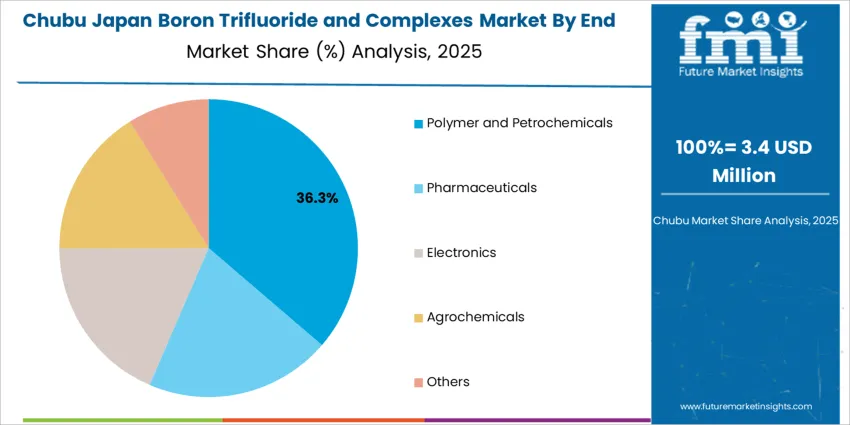
The demand for boron trifluoride and complexes in Chubu is expected to grow at a CAGR of 4.2%, driven by the region’s manufacturing and industrial activities. Chubu, home to Nagoya and several industrial centers, has a strong presence in automotive, electronics, and chemical manufacturing, where boron trifluoride is used in various processes such as polymer production, refining, and as a catalyst in chemical reactions. The region’s strong focus on advancing chemical production technologies and materials science is driving the demand for these chemicals. As Chubu continues to prioritize industrial modernization and energy efficiency, the use of boron trifluoride and complexes in high-performance materials and sustainable production methods will continue to grow, contributing to steady demand in the region.
What factors are influencing the demand for boron trifluoride and complexes in Tohoku?
In Tohoku, the demand for boron trifluoride and complexes is projected to grow at a CAGR of 3.7%, reflecting slower growth compared to more industrialized regions. Tohoku, which is more rural and less industrialized, has a smaller chemical production base. However, the demand for boron trifluoride is gradually increasing due to its applications in agriculture, pharmaceuticals, and materials science. The region’s growing interest in sustainable agricultural practices and the need for high-quality chemicals in industrial and environmental applications are contributing to the steady rise in demand for boron-based compounds. While the growth rate is slower, Tohoku’s increasing focus on industrial and agricultural modernization will continue to drive the demand for boron trifluoride and complexes over time.
How is the demand for boron trifluoride and complexes evolving in the Rest of Japan?
In the Rest of Japan, the demand for boron trifluoride and complexes is expected to grow at a CAGR of 3.5%, reflecting steady but modest growth in less industrialized regions. This region, which includes rural areas and smaller prefectures, has a more limited chemical production base. However, as industries in the Rest of Japan continue to modernize and adopt sustainable practices, the demand for specialty chemicals like boron trifluoride is gradually increasing. The agricultural sector, in particular, is driving some demand for boron-based compounds in pest control and soil treatments. As Japan continues to emphasize sustainability and efficient chemical production, the demand for boron trifluoride and complexes in the Rest of Japan will rise, though at a slower pace compared to more industrialized regions.
How Are Companies Competing in the Boron Trifluoride and Complexes Industry in Japan

Demand for boron trifluoride (BF₃) and its complexes in Japan is driven by applications in sectors like polymer production, pharmaceuticals, fine chemicals, and electronics. Key players in the market include Stella Chemifa Corporation (holding approximately 28.6% share), Morita Chemical Industries Co., Ltd., and Kishida Chemical Co. Ltd. These companies provide BF₃ in its gas form or as complexes (such as ether or solvent adducts), which are used in chemical synthesis, resin production, and catalysis for a wide range of industrial applications.
Competition in this market focuses on several factors: product purity, safety, and reliable supply. Suppliers emphasize the need for high purity BF₃ suitable for sensitive processes like polymerization and chemical synthesis, with quality control being crucial. Given the reactive and corrosive nature of BF₃, firms that provide secure packaging and safe handling instructions, along with technical support, are preferred by industrial users. Additionally, companies that offer customization in complex formulations, technical expertise, and consistent delivery tend to gain a competitive advantage. By aligning their offerings with Japan’s industrial standards and needs for reliable, high quality products, these companies aim to secure and expand their share in the BF₃ and complexes market.
Key Players of the Boron Trifluoride and Complexes in Industry
- Stella Chemifa Corporation
- Morita Chemical Industries Co., Ltd
- Kishida Chemical Co. Ltd.
Scope of the Report
| Items | Details |
|---|---|
| Quantitative Units | USD Million |
| Regions Covered | Japan |
| Product Type | BF3 (Gas), BF3 Tetrahydrofuran Complex, BF3 Methanol Complex, BF3 Diethyl Etherate Complex, BF3 Acetonitrile Complex, Others |
| End Use | Polymer and Petrochemicals, Pharmaceuticals, Electronics, Agrochemicals, Others |
| Key Companies Profiled | Stella Chemifa Corporation, Morita Chemical Industries Co., Ltd, Kishida Chemical Co. Ltd. |
| Additional Attributes | The market analysis includes dollar sales by product type, end use, and company categories. It also covers regional demand trends in Japan, driven by the increasing use of Boron Trifluoride and its complexes in polymer and petrochemical production, pharmaceuticals, electronics, and agrochemical applications. The competitive landscape highlights key manufacturers focusing on innovations in Boron Trifluoride formulations and their applications in various industrial processes. Trends in the growing demand for Boron Trifluoride as a catalyst and chemical reagent are explored, along with advancements in the production and usage of its complexes for specialized industrial applications. |
Key Segments of the Demand for Boron Trifluoride and Complexes in Japan
Product Type:
- BF3 (Gas)
- BF3 Tetrahydrofuran Complex
- BF3 Methanol Complex
- BF3 Diethyl Etherate Complex
- BF3 Acetonitrile Complex
- Others
End Use:
- Polymer and Petrochemicals
- Pharmaceuticals
- Electronics
- Agrochemicals
- Others
Region:
- Kyushu & Okinawa
- Kanto
- Kinki
- Chubu
- Tohoku
- Rest of Japan
Frequently Asked Questions
How big is the demand for boron trifluoride and complexes in Japan in 2025?
The demand for boron trifluoride and complexes in Japan is estimated to be valued at USD 16.3 million in 2025.
What will be the size of boron trifluoride and complexes in Japan in 2035?
The market size for the boron trifluoride and complexes in Japan is projected to reach USD 25.9 million by 2035.
How much will be the demand for boron trifluoride and complexes in Japan growth between 2025 and 2035?
The demand for boron trifluoride and complexes in Japan is expected to grow at a 4.7% CAGR between 2025 and 2035.
What are the key product types in the boron trifluoride and complexes in Japan?
The key product types in boron trifluoride and complexes in Japan are BF3 (gas), BF3 tetrahydrofuran complex, BF3 methanol complex, BF3 diethyl etherate complex, BF3 acetonitrile complex and others.
Which end use segment is expected to contribute significant share in the boron trifluoride and complexes in Japan in 2025?
In terms of end use, polymer and petrochemicals segment is expected to command 35.0% share in the boron trifluoride and complexes in Japan in 2025.
Preview the report firsthand - request a free sample
Get SampleGet the brochure for pricing and purchase details.
Get PDFTable of Content
- Executive Summary
- Japan Market Outlook
- Demand-side Trends
- Supply-side Trends
- Technology Roadmap Analysis
- Analysis and Recommendations
- Market Overview
- Market Coverage / Taxonomy
- Market Definition / Scope / Limitations
- Market Background
- Market Dynamics
- Drivers
- Restraints
- Opportunity
- Trends
- Scenario Forecast
- Demand in Optimistic Scenario
- Demand in Likely Scenario
- Demand in Conservative Scenario
- Opportunity Map Analysis
- Product Life Cycle Analysis
- Supply Chain Analysis
- Investment Feasibility Matrix
- Value Chain Analysis
- PESTLE and Porter’s Analysis
- Regulatory Landscape
- Regional Parent Market Outlook
- Production and Consumption Statistics
- Import and Export Statistics
- Market Dynamics
- Japan Market Analysis 2020 to 2024 and Forecast, 2025 to 2035
- Historical Market Size Value (USD Million) Analysis, 2020 to 2024
- Current and Future Market Size Value (USD Million) Projections, 2025 to 2035
- Y-o-Y Growth Trend Analysis
- Absolute $ Opportunity Analysis
- Japan Market Pricing Analysis 2020 to 2024 and Forecast 2025 to 2035
- Japan Market Analysis 2020 to 2024 and Forecast 2025 to 2035, By Product Type
- Introduction / Key Findings
- Historical Market Size Value (USD Million) Analysis By Product Type , 2020 to 2024
- Current and Future Market Size Value (USD Million) Analysis and Forecast By Product Type , 2025 to 2035
- BF3 (Gas)
- BF3 Tetrahydrofuran Complex
- BF3 Methanol Complex
- BF3 Diethyl Etherate Complex
- BF3 Acetonitrile Complex
- Others
- Y-o-Y Growth Trend Analysis By Product Type , 2020 to 2024
- Absolute $ Opportunity Analysis By Product Type , 2025 to 2035
- Japan Market Analysis 2020 to 2024 and Forecast 2025 to 2035, By End Use
- Introduction / Key Findings
- Historical Market Size Value (USD Million) Analysis By End Use, 2020 to 2024
- Current and Future Market Size Value (USD Million) Analysis and Forecast By End Use, 2025 to 2035
- Polymer and Petrochemicals
- Pharmaceuticals
- Electronics
- Agrochemicals
- Others
- Y-o-Y Growth Trend Analysis By End Use, 2020 to 2024
- Absolute $ Opportunity Analysis By End Use, 2025 to 2035
- Market Structure Analysis
- Competition Dashboard
- Competition Benchmarking
- Market Share Analysis of Top Players
- By Regional
- By Product Type
- By End Use
- Competition Analysis
- Competition Deep Dive
- Stella Chemifa Corporation
- Overview
- Product Portfolio
- Profitability by Market Segments (Product/Age /Sales Channel/Region)
- Sales Footprint
- Strategy Overview
- Marketing Strategy
- Product Strategy
- Channel Strategy
- Morita Chemical Industries Co., Ltd
- Kishida Chemical Co. Ltd.
- Stella Chemifa Corporation
- Competition Deep Dive
- Assumptions & Acronyms Used
- Research Methodology


