

- Industry Size (2026)
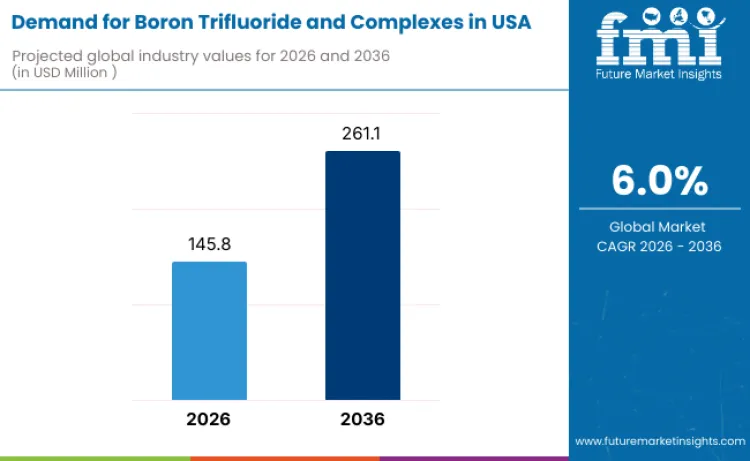
- USD 145.8 Mn
- Forecast (2036)
- USD 261.1 Mn
- CAGR (2026 to 2036)
- 6.0%
Demand for Boron Trifluoride and Complexes in USA 2026 to 2036
Demand for boron trifluoride and complexes in USA is valued at USD 145.8 million in 2026 and is projected to reach USD 261.1 million by 2036, reflecting a CAGR of 6.0%. Demand increases due to expanding use of boron trifluoride as a Lewis acid catalyst in petrochemical processing, polymerization reactions, and specialty chemical synthesis. Semiconductor fabrication and pharmaceutical intermediate production also contribute through requirements for high-purity catalytic reagents with consistent performance.
BF₃ (gas) leads product-type usage because gaseous form enables precise dosing, high reactivity, and efficient integration into continuous reaction systems. Chemical producers rely on BF₃ gas for alkylation, isomerization, and resin modification processes where reaction control and yield optimization are critical. Improvements in gas handling, containment systems, and purity assurance strengthen adoption across industrial-scale operations.
Quick Stats for Demand for Boron Trifluoride and Complexes in USA
- USA Boron Trifluoride and Complexes Sales Value (2026): USD 145.8 million
- USA Boron Trifluoride and Complexes Forecast Value (2036): USD 261.1 million
- USA Boron Trifluoride and Complexes Forecast CAGR (2026 to 2036): 6.0%
- Leading Product Type in USA Demand: BF₃ (Gas)
- Key Growth Regions in USA Demand: West USA, South USA, Northeast USA, Midwest USA
- Top Players in USA Demand: Honeywell, BASF, Solvay, Arkema, Stella Chemifa
West USA, South USA, Northeast USA, and Midwest USA represent key growth regions supported by concentrated petrochemical complexes, specialty chemical manufacturing, and electronics production clusters. Honeywell, BASF, Solvay, Arkema, and Stella Chemifa anchor competitive activity through high-purity production, robust supply chains, and application-specific formulations designed to meet stringent safety and performance requirements across chemical processing and advanced manufacturing environments.
USA Boron Trifluoride and Complexes Key Takeaways
| Metric | Value |
|---|---|
| USA Boron Trifluoride and Complexes Sales Value (2026) | USD 145.8 million |
| USA Boron Trifluoride and Complexes Forecast Value (2036) | USD 261.1 million |
| USA Boron Trifluoride and Complexes Forecast CAGR (2026 to 2036) | 6.0% |
How Are the Segments Classified in the Demand for Boron Trifluoride and Complexes in the USA?
Demand for boron trifluoride and its complexes in the USA is shaped by specialty chemical synthesis needs, controlled reactivity requirements, and use in regulated industrial processes. Buyers evaluate handling safety, coordination stability, solvent compatibility, and suitability for catalytic and intermediate applications. Adoption patterns reflect usage across polymer processing, pharmaceutical synthesis, electronics-grade reactions, and agrochemical manufacturing within controlled USA production environments.
Which Product Type Accounts for the Largest Share of Demand in the USA?
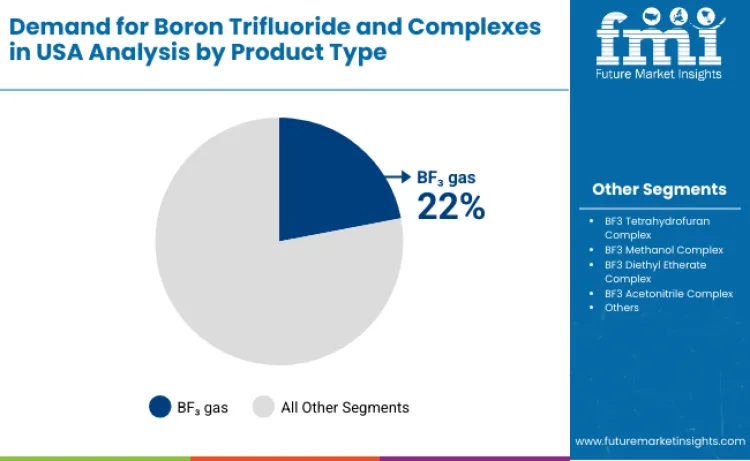
BF₃ gas holds 22%, making it the leading product-type segment in USA demand. Direct gas usage supports controlled Lewis acid catalysis in polymerization and petrochemical reactions requiring high reactivity and purity. BF₃ tetrahydrofuran, methanol, diethyl etherate, and acetonitrile complexes provide stabilized coordination forms suited for laboratory-scale and specialty synthesis. These complexes enable safer handling, controlled release, and solvent-specific reaction control. Other complex forms support niche catalytic and intermediate roles. Product-type distribution reflects preference for direct BF₃ gas in high-volume industrial applications requiring precise catalytic strength.
Key Points:
- BF₃ gas leads due to direct catalytic efficiency.
- Complexes improve handling safety and reaction control.
- Solvent-specific complexes support specialty synthesis.
- Distribution reflects industrial-scale catalytic requirements.
Which End-Use Segment Accounts for the Largest Share of Demand in the USA?
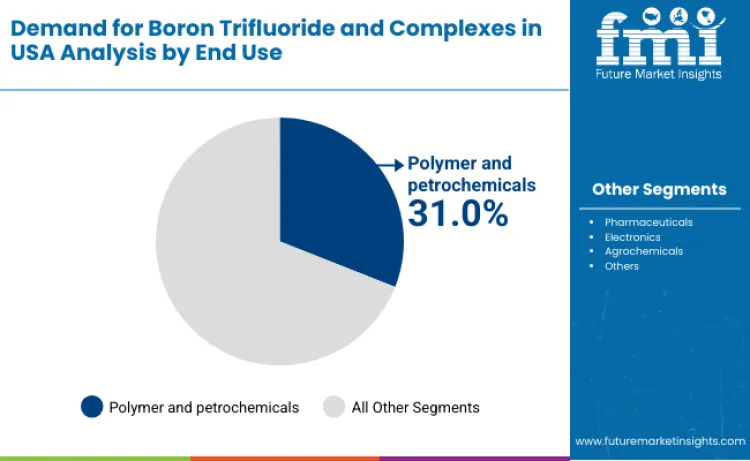
Polymer and petrochemicals hold 31.0%, making them the leading end-use segment in the USA. This segment relies on boron trifluoride for polymerization catalysis, alkylation reactions, and specialty resin production. Pharmaceuticals use BF₃ complexes for controlled intermediate synthesis and reaction selectivity. Electronics applications depend on high-purity complexes for specialty material processing. Agrochemicals apply BF₃-based catalysis in active-ingredient synthesis. Other end uses support laboratory research and niche chemical transformations. End-use distribution reflects concentration of BF₃ demand within large-scale polymer and petrochemical operations.
Key Points:
- Polymer and petrochemical processing drives primary demand.
- Pharmaceuticals require controlled catalytic intermediates.
- Electronics depend on high-purity reaction systems.
- Agrochemicals use BF₃ in specialty synthesis pathways.
What are the Key Dynamics in the Boron Trifluoride and Complexes Industry in USA?
Demand increases as USA chemical, pharmaceutical, and polymer industries rely on boron trifluoride and its complexes for catalytic, alkylation, and polymerization processes. Applications span specialty chemicals, fuel additives, and pharmaceutical intermediates. Usage remains concentrated within regulated industrial environments due to handling requirements. Domestic production, established downstream industries, and consistent R and D activity support stable consumption across chemical manufacturing hubs in the Gulf Coast and Midwest regions.
How does industrial catalysis need and specialty chemical production drive demand in USA?
The USA petrochemical and specialty chemical producers use boron trifluoride complexes as Lewis acid catalysts in alkylation, esterification, and polymer modification reactions. Refineries apply boron trifluoride based systems in fuel additive synthesis and octane enhancement processes. Pharmaceutical manufacturers rely on controlled catalytic properties for intermediate synthesis requiring high selectivity. Polymer producers use complexes in niche applications involving fluoropolymers and specialty resins. Domestic chemical clusters support demand through integrated supply chains and established safety protocols. Contract manufacturing organizations adopt boron trifluoride complexes for custom synthesis projects requiring precise reaction control. R and D laboratories within US firms sustain steady consumption for process optimization and formulation development.
How do safety regulations, handling complexity, and substitution trends affect demand stability?
Boron trifluoride requires strict handling due to toxicity and corrosive behaviour, increasing compliance costs for US operators. OSHA standards, EPA reporting requirements, and hazardous material transport rules limit adoption to facilities with advanced safety infrastructure. Smaller manufacturers avoid usage due to training and containment requirements. Alternative catalysts gain evaluation when processes permit substitution without yield loss. Price sensitivity arises from specialized storage and distribution needs. Waste neutralization and emissions control add operational burden. Regulatory scrutiny influences procurement cycles and limits expansion into less controlled environments. Demand remains stable within established industrial users while expansion faces constraints tied to safety management and regulatory oversight.
How Is Demand for Boron Trifluoride and Complexes in the USA Evolving by Region?
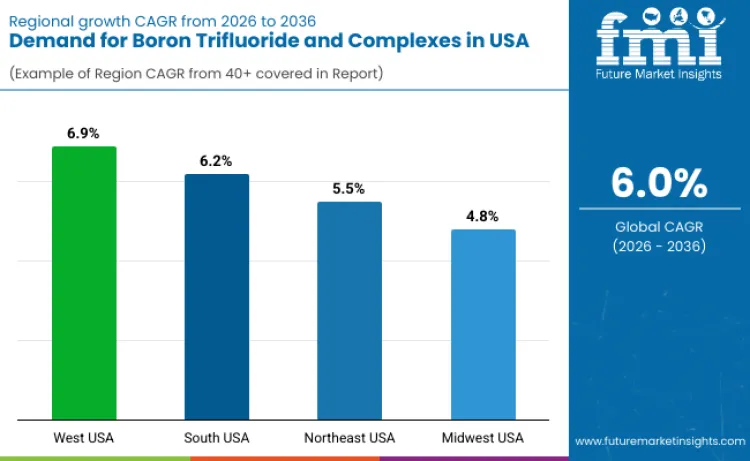
Demand for boron trifluoride and complexes in the USA is expanding steadily due to continued reliance on Lewis acid catalysts across refining, pharmaceuticals, polymers, agrochemicals, and specialty synthesis. West USA leads with a 6.9% CAGR, supported by high-purity chemical synthesis linked to electronics, advanced materials, and specialty polymers. South USA follows at 6.2%, anchored by refinery alkylation, fluorochemical production, and integrated petrochemical operations. Northeast USA records a 5.5% CAGR, shaped by pharmaceutical intermediates, research-driven synthesis, and regulated fine-chemical production. Midwest USA posts a 4.8% CAGR, reflecting stable polymer, resin, and agrochemical applications. Regional growth differences reflect reaction complexity, purity standards, packaging formats, and industrial concentration across the USA.
| Region | CAGR (2026 to 2036) |
|---|---|
| West USA | 6.9% |
| South USA | 6.2% |
| Northeast USA | 5.5% |
| Midwest USA | 4.8% |
How is West USA driving demand for Boron Trifluoride and Complexes?
West USA demand is shaped by high-value chemistry requiring precise reaction control and strict impurity limits. The region’s CAGR of 6.9% reflects rising use of boron trifluoride etherates in cationic polymerization, Friedel-Crafts acylation, and fluorinated intermediate synthesis supporting electronics, aerospace, and advanced materials. Semiconductor-adjacent chemical manufacturing requires ultra-low moisture and trace-metal specifications to maintain reaction selectivity. Contract development and manufacturing organizations increase procurement of premium-grade BF₃-diethyl etherate and BF₃-tetrahydrofuran complexes for small-batch, high-margin synthesis. Packaging preference centers on small-volume pressure cylinders, lined containers, and sealed stainless-steel vessels to minimize contamination. Demand growth remains value-driven rather than volume-driven, supported by innovation-focused chemical clusters and compliance-ready infrastructure.
- High-purity etherate complexes for controlled synthesis
- Electronics and advanced-material reaction demand
- Growth in contract and specialty chemical manufacturing
- Preference for contamination-controlled packaging formats
How is South USA driving demand for Boron Trifluoride and Complexes?
South USA demand is volume-intensive and closely linked to energy and petrochemical economics. The region’s CAGR of 6.2% reflects sustained use of boron trifluoride as a Lewis acid catalyst in gasoline alkylation, olefin isomerization, and large-scale fluorochemical synthesis. Integrated refinery and chemical complexes support continuous catalyst consumption under long operating cycles. Purity requirements emphasize industrial-grade stability and resistance to degradation during extended processing. BF₃ gas and stabilized complexes are supplied through bulk ISO tanks, rail-mounted pressure vessels, and large cylinders. Established hazardous-material handling expertise and logistics networks reinforce long-term supply contracts. Regional demand remains resilient due to limited substitution options in high-throughput alkylation chemistry.
- Refinery alkylation and olefin-processing reactions
- Industrial-grade purity with continuous-feed stability
- Bulk transport via ISO tanks and pressure vessels
- Long-term demand anchored by petrochemical hubs
How is Northeast USA driving demand for Boron Trifluoride and Complexes?
Northeast USA demand is driven by precision chemistry, regulatory oversight, and research-oriented production. The region’s CAGR of 5.5% reflects use of boron trifluoride complexes in stereoselective synthesis, glycosylation, and protecting-group chemistry for pharmaceutical intermediates and APIs. Volumes remain moderate, while purity requirements remain stringent due to reproducibility and compliance expectations. Academic institutions, contract research organizations, and clinical-stage manufacturers rely on low-water-content BF₃ complexes for reaction consistency. Packaging formats favor laboratory-scale cylinders, glass-lined containers, and specialty ampoules supporting controlled dosing. Demand growth aligns with pharmaceutical pipeline activity rather than bulk chemical throughput.
- API and fine-chemical reaction pathways
- High-purity, low-moisture specifications
- Laboratory-scale and controlled packaging formats
- Research-driven and clinical manufacturing dependence
How is Midwest USA driving demand for Boron Trifluoride and Complexes?
Midwest USA demand reflects stable, process-driven industrial chemistry. The region’s CAGR of 4.8% is supported by use of boron trifluoride complexes in resin curing, polymer modification, and agrochemical intermediate synthesis. Applications prioritize consistency, cost efficiency, and compatibility with established production lines. Technical-grade BF₃ complexes dominate procurement, with limited demand for ultra-high-purity variants. Packaging commonly includes mid-size pressure cylinders and reusable industrial containers aligned with predictable production cycles. Agricultural chemical producers maintain steady usage linked to seasonal formulation schedules. Growth remains moderate due to lower refinery concentration and limited specialty synthesis intensity.
- Polymer and resin modification applications
- Agrochemical intermediate and formulation usage
- Technical-grade purity preference
- Predictable demand from mature manufacturing bases
What is the competitive landscape of demand for boron trifluoride and complexes in the USA?
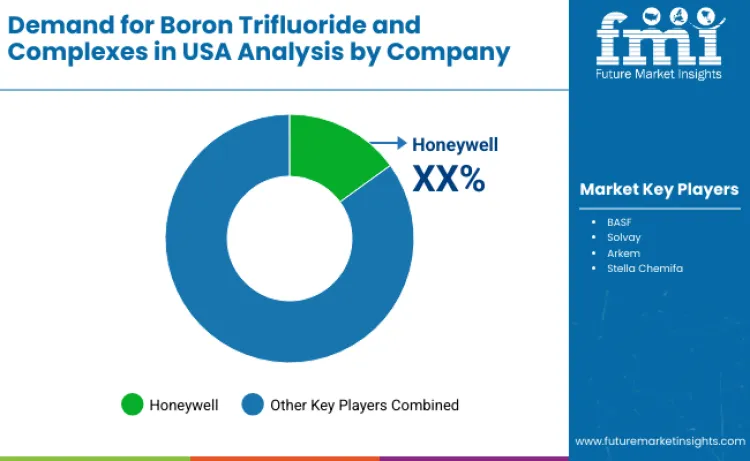
Demand for boron trifluoride and its complexes in the USA is driven by usage across petrochemical catalysis, pharmaceutical synthesis, polymerization, and specialty organic reactions. Applications require controlled Lewis acidity, consistent purity, and reliable supply under strict hazardous-material handling protocols. Buyers evaluate gas quality, complex stability, packaging formats, and compliance with USA safety and transportation regulations. Procurement teams prioritize suppliers with domestic production, technical support capability, and experience managing reactive fluorine-containing intermediates. Trend in the USA market reflects steady consumption in refining catalysts, increasing use in fine chemical synthesis, and continued reliance within electronics-grade and specialty polymer applications.
Honeywell maintains a strong position through USA-based production of boron trifluoride gas and stabilized complexes supplied to refining and chemical synthesis customers. BASF operates USA facilities supplying boron trifluoride complexes used in polymerization and pharmaceutical manufacturing. Solvay participates through specialty fluorochemicals operations supporting catalyst and intermediate demand within the United States. Arkema maintains a presence via specialty chemical portfolios supplying boron-based intermediates and complexed forms for industrial synthesis. Stella Chemifa supports niche requirements with high-purity boron trifluoride products used in electronics, laboratory, and specialty chemical applications. Competitive positioning in the USA reflects domestic manufacturing footprint, regulatory compliance, technical handling expertise, and long-term supply reliability for hazardous specialty chemicals.
Key Players in USA Boron Trifluoride and Complexes Demand
- Honeywell
- BASF
- Solvay
- Arkema
- Stella Chemifa
Scope of the Report
| Items | Values |
|---|---|
| Quantitative Units | USD million |
| Product Type | BF₃ (Gas); BF₃ Tetrahydrofuran Complex; BF₃ Methanol Complex; BF₃ Diethyl Etherate Complex; BF₃ Acetonitrile Complex; Other BF₃ Coordination Complexes |
| End Use | Polymer and Petrochemicals; Pharmaceuticals; Electronics; Agrochemicals; Other Specialty Chemical Applications |
| Regions Covered | West USA; South USA; Northeast USA; Midwest USA |
| Key Companies Profiled | Honeywell; BASF; Solvay; Arkema; Stella Chemifa |
| Additional Attributes | Dollar sales by BF₃ gas and complex type across West USA, South USA, Northeast USA, and Midwest USA; application-wise utilization trends in polymerization catalysis, pharmaceutical synthesis, and electronic-grade chemical processes; regional purity-grade demand variations driven by electronics and specialty polymer clusters; regulatory and safety compliance influence on regional logistics and storage infrastructure; supplier differentiation based on complex stability, packaging formats, and technical service support within USA chemical manufacturing hubs. |
USA Boron Trifluoride and Complexes Demand by Segments
Product Type:
- BF3 (Gas)
- BF3 Tetrahydrofuran Complex
- BF3 Methanol Complex
- BF3 Diethyl Etherate Complex
- BF3 Acetonitrile Complex
- Others
End Use:
- Polymer and Petrochemicals
- Pharmaceuticals
- Electronics
- Agrochemicals
- Others
Region:
- West USA
- South USA
- Northeast USA
- Midwest USA
Frequently Asked Questions
How big is the demand for boron trifluoride and complexes in USA in 2026?
The demand for boron trifluoride and complexes in USA is estimated to be valued at USD 145.8 million in 2026.
What will be the size of boron trifluoride and complexes demand in USA in 2036?
The demand size for boron trifluoride and complexes in USA is projected to reach USD 261.1 million by 2036.
How much will the demand for boron trifluoride and complexes in USA grow between 2026 and 2036?
The demand for boron trifluoride and complexes in USA is expected to grow at a 6.0% CAGR between 2026 and 2036.
What are the key product types in the boron trifluoride and complexes demand in USA?
The key product types in boron trifluoride and complexes demand in USA include BF₃ gas and boron trifluoride complexes.
Which end-use segment is expected to contribute a significant share in the boron trifluoride and complexes demand in USA in 2026?
In terms of end use, polymer and petrochemicals segment is expected to command 31.0% share in the boron trifluoride and complexes demand in USA in 2026.
Preview the report firsthand - request a free sample
Get SampleGet the brochure for pricing and purchase details.
Get PDFTable of Content
- Executive Summary
- USA Market Outlook
- Demand Side Trends
- Supply Side Trends
- Technology Roadmap Analysis
- Analysis and Recommendations
- Market Overview
- Market Coverage and Taxonomy
- Market Definition, Scope, and Limitations
- Market Background
- Market Dynamics
- Drivers
- Restraints
- Opportunities
- Trends
- Scenario Forecast
- Demand in Optimistic Scenario
- Demand in Likely Scenario
- Demand in Conservative Scenario
- Opportunity Map Analysis
- Product Life Cycle Analysis
- Supply Chain Analysis
- Investment Feasibility Matrix
- Value Chain Analysis
- PESTLE and Porter Analysis
- Regulatory Landscape
- Regional Parent Market Outlook
- Production and Consumption Statistics
- Import and Export Statistics
- USA Boron Trifluoride and Complexes Demand Analysis 2020 to 2024 and Forecast 2025 to 2035
- Historical Market Size Value (USD Million) Analysis 2020 to 2024
- Current and Future Market Size Value (USD Million) Projections 2025 to 2035
- Year to Year Growth Trend Analysis
- Absolute Dollar Opportunity Analysis
- USA Boron Trifluoride and Complexes Pricing Analysis 2020 to 2024 and Forecast 2025 to 2035
- USA Boron Trifluoride and Complexes Demand Analysis 2020 to 2024 and Forecast 2025 to 2035, By Product Type
- Introduction and Key Findings
- Historical Market Size Value (USD Million) Analysis By Product Type 2020 to 2024
- Current and Future Market Size Value (USD Million) Analysis and Forecast By Product Type 2025 to 2035
- BF3 Gas
- BF3 Tetrahydrofuran Complex
- BF3 Methanol Complex
- BF3 Diethyl Etherate Complex
- BF3 Acetonitrile Complex
- Other BF3 Coordination Complexes
- Year to Year Growth Trend Analysis By Product Type 2020 to 2024
- Absolute Dollar Opportunity Analysis By Product Type 2025 to 2035
- USA Boron Trifluoride and Complexes Demand Analysis 2020 to 2024 and Forecast 2025 to 2035, By End Use
- Introduction and Key Findings
- Historical Market Size Value (USD Million) Analysis By End Use 2020 to 2024
- Current and Future Market Size Value (USD Million) Analysis and Forecast By End Use 2025 to 2035
- Polymer and Petrochemicals
- Pharmaceuticals
- Electronics
- Agrochemicals
- Other Specialty Chemical Applications
- Year to Year Growth Trend Analysis By End Use 2020 to 2024
- Absolute Dollar Opportunity Analysis By End Use 2025 to 2035
- Market Structure Analysis
- Competition Dashboard
- Competition Benchmarking
- Market Share Analysis of Key Players
- By Product Type
- By End Use
- By Region
- Competition Analysis
- Competition Deep Dive
- Honeywell
- BASF
- Solvay
- Arkema
- Stella Chemifa
- Assumptions and Acronyms Used
- Research Methodology


