

- Industry Size (2025)
- USD 74.9 Mn
- Forecast (2035)
- USD 117.1 Mn
- CAGR (2025 to 2035)
- 4.6%
Demand for Diffuser Membrane in Japan Forecast and Outlook 2025 to 2035
The demand for diffuser membrane in Japan is expected to grow steadily from USD 74.9 million in 2025 to USD 117.1 million by 2035, representing a 4.6% CAGR. Over the next decade, the demand for diffuser membranes is expected to grow gradually, with an average annual increase of approximately USD 3 million. From 2025 to 2026, the industry grows by USD 2.7 million, driven by expanding applications across water treatment, HVAC systems, and environmental management. As Japan continues to prioritize environmental sustainability and efficient resource management, the need for effective diffusion technologies, particularly in wastewater treatment and air purification, is expected to boost demand. The industry sees consistent, moderate growth each year, with annual increases continuing to hover around USD 2.7–3.0 million through the first half of the forecast period.
Quick Stats of the Demand for Diffuser Membrane in Japan
- Demand for Diffuser Membrane in Japan Value (2025): USD 74.9 million
- Demand for Diffuser Membrane in Japan Forecast Value (2035): USD 117.1 million
- Demand for Diffuser Membrane in Japan Forecast CAGR (2025-2035): 4.6%
- Demand for Diffuser Membrane in Japan Leading Material Type: EPDM (Ethylene Propylene Diene Monomer)
- Demand for Diffuser Membrane in Japan Key Growth Regions: Kyushu & Okinawa, Kanto, Kansai, Chubu, Tohoku, Rest of Japan
- Demand for Diffuser Membrane in Japan Top Players: Pentair (AquaVation), Aquasource, SSI, Koch Membrane Systems, Xylem (Sanitaire)
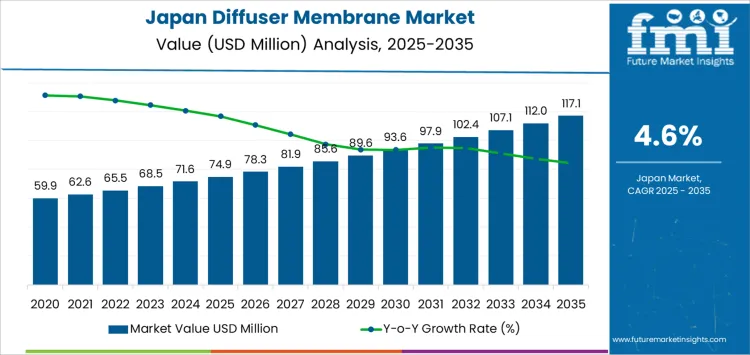
By 2030, the demand is forecasted to reach USD 85.6 million, continuing the steady upward trajectory. During this period, the growth rate slightly accelerates as more industries adopt advanced diffuser membrane technologies, particularly in areas like industrial air filtration, medical device applications, and advanced water treatment solutions. As the demand increases, 2029 to 2030 sees a noticeable jump, contributing USD 4.2 million to the total demand. By 2035, the industry is expected to reach USD 117.1 million, driven by technological advancements and an increased focus on energy-efficient and eco-friendly systems. The steady rise reflects growing industrial reliance on membrane technology for process optimization and environmental sustainability, positioning diffuser membranes as a key component in Japan’s advancing industrial and ecological landscapes.
Demand for Diffuser Membrane in Japan Key Takeaways
| Metric | Value |
|---|---|
| Demand for Diffuser Membrane in Japan Value (2025) | USD 74.9 million |
| Demand for Diffuser Membrane in Japan Forecast Value (2035) | USD 117.1 million |
| Demand for Diffuser Membrane in Japan Forecast CAGR (2025-2035) | 4.6% |
Why is the Demand for Diffuser Membrane in Japan Growing?
The demand for diffuser membranes in Japan is growing as industries that require advanced filtration and aeration technologies continue to expand. Diffuser membranes are essential components in water treatment systems, particularly in municipal and industrial wastewater treatment, as they are used to distribute air evenly for the purpose of oxygenation and improving the efficiency of biological treatment processes. As Japan focuses on enhancing water quality management and sustainability, the need for efficient and reliable diffuser membranes is on the rise.
A key driver behind the growth of diffuser membranes is the increasing focus on environmental sustainability and water conservation. Japan has long been committed to maintaining high standards in environmental protection and wastewater treatment. As urban populations grow and industrial activities expand, efficient wastewater treatment solutions become more important. Diffuser membranes improve the aeration process in wastewater treatment plants, reducing energy consumption while increasing treatment efficiency. This makes them an attractive solution for municipalities and industries aiming to meet stricter environmental regulations.
The growing demand for aquaculture and industrial applications is contributing to the rise of diffuser membranes. These membranes are also used in applications such as fish farming, where oxygen is required to sustain aquatic life. As Japan continues to invest in sustainable aquaculture practices and industrial efficiency, the demand for high-quality diffuser membranes is expected to grow steadily through 2035. As technology improves and the demand for efficient water and air treatment solutions increases, the industry for diffuser membranes in Japan is projected to continue its upward trajectory.
What is the Segment-Wise Analysis of Demand for Diffuser Membranes in Japan?
Demand for diffuser membranes in Japan is segmented by material type, flow rate (air handling capacity), end users, configuration, and region. By material type, demand is divided into EPDM (Ethylene Propylene Diene Monomer), silicone, polyurethane, and other materials. The flow rate is segmented into high capacity (>50 m³/h), medium capacity (5 to 50 m³/h), and low capacity (<5 m³/h). End users include municipal wastewater treatment (44%), industrial wastewater treatment, aquaculture, fish farms, and shellfish cultivation. The configuration types include disc diffuser membranes, tube diffuser membranes, panel diffuser membranes, and other specialized designs. Regionally, demand spans across Kyushu & Okinawa, Kanto, Kansai, Chubu, Tohoku, and the rest of Japan.
How Does EPDM Lead the Demand for Diffuser Membranes in Japan?
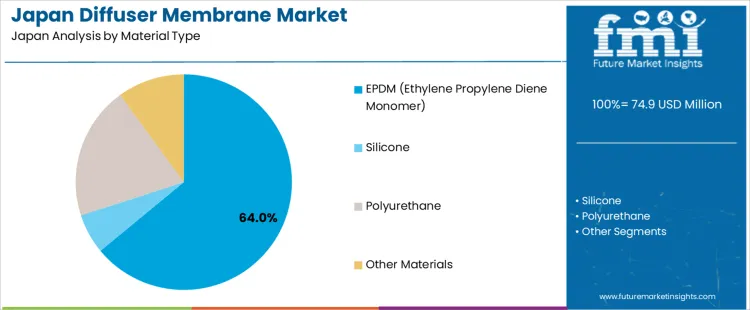
EPDM (ethylene propylene diene monomer) accounts for 64% of the demand for diffuser membranes in Japan, driven by its excellent durability, resistance to weathering, and chemical stability. EPDM is widely used in diffuser membranes for applications in wastewater treatment and aquaculture due to its ability to withstand harsh environmental conditions, including exposure to UV radiation, extreme temperatures, and chemical exposure. The material's resistance to ozone, oxygen, and water makes it ideal for long-lasting, high-performance applications. EPDM is cost-effective and offers good elasticity, ensuring that diffuser membranes retain their functionality over time. As the demand for reliable and durable systems in municipal and industrial wastewater treatment grows, EPDM remains the material of choice in the diffuser membrane industry in Japan, providing high reliability and performance.
Why Does Municipal Wastewater Treatment Lead the Demand for Diffuser Membranes in Japan?
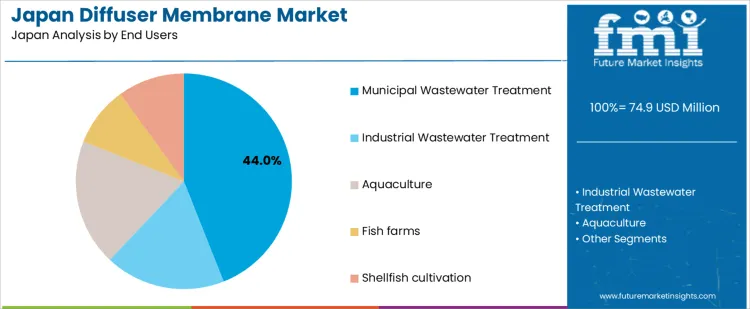
Municipal wastewater treatment accounts for 44% of the demand for diffuser membranes in Japan, driven by the country's emphasis on advanced water treatment technologies and environmental sustainability. Diffuser membranes play a critical role in aeration systems used in municipal wastewater treatment, facilitating the efficient transfer of oxygen to the water to support biological processes that remove contaminants. With Japan’s focus on maintaining high standards of water quality and managing its extensive urban infrastructure, there is significant demand for reliable, high-capacity diffuser membranes. As municipalities invest in wastewater treatment infrastructure to handle growing populations and environmental regulations, the need for efficient and durable diffuser membranes continues to rise. The growing importance of environmental sustainability and the increasing focus on water reuse and recycling further contribute to the dominance of municipal wastewater treatment in the demand for diffuser membranes.
What are the Key Trends, Drivers, and Restraints in Demand for Diffuser Membranes in Japan?
Demand for diffuser membranes in Japan is growing due to increased investment in wastewater treatment, water reuse, and environmental infrastructure. As municipalities and industries upgrade aging wastewater treatment plants and meet stricter effluent quality standards, the need for efficient aeration systems rises, with diffuser membranes playing a key role. These membranes, often used in fine-bubble aeration systems, deliver efficient oxygen transfer, enhancing biological treatment performance. There are challenges. Implementing these systems requires significant capital investment, and the high-performance membranes come with higher costs and maintenance requirements, which may be burdensome for smaller or rural facilities.
Why is Demand for Diffuser Membranes Growing in Japan?
The demand for diffuser membranes in Japan is increasing due to several key factors. Strict environmental regulations and heightened awareness around water pollution and wastewater quality are pushing industries and municipalities to upgrade their aeration systems. With the expanding water and wastewater treatment sector, the need for efficient, high-performing membranes grows, particularly in dense urban and industrial areas where wastewater treatment demands are high. Membrane-based diffusers are preferred due to their superior oxygen transfer rates, energy savings, and reliability compared to conventional systems. These advantages make them especially attractive for both municipal plants and industries with high wastewater treatment needs, such as food production or manufacturing, helping them meet sustainability goals and operational efficiency.
How are Technological & Industry Innovations Driving Diffuser Membrane Demand in Japan?
Technological innovations in membrane materials and diffuser design are driving increased demand for these systems in Japan. New materials such as EPDM, silicone, and advanced polymers enhance membrane durability, resistance to fouling, and consistency in oxygen transfer. These improvements lead to higher efficiency and lower energy consumption in aeration systems, making them more cost-effective over the long term. The integration of these advanced membranes into fine-bubble and membrane disc diffusers ensures higher oxygen transfer rates and greater energy savings compared to older technologies. As municipalities and industries focus on reducing operational costs, improving energy efficiency, and complying with environmental standards, these innovations make membrane-based diffusers more appealing, especially in areas where infrastructure upgrades are needed.
What are the Key Challenges and Risks That Could Limit Diffuser Membrane Demand in Japan?
The high initial costs of upgrading or installing membrane-based aeration systems may be prohibitive for smaller facilities or those with limited budgets. The need for regular maintenance, including cleaning and membrane replacement, contributes to ongoing operational costs. In facilities with lower wastewater volume or fewer financial resources, traditional aeration methods may remain more cost-effective. industrial wastewater with heavy solids or abrasive contaminants can cause membranes to wear out more quickly, limiting their effectiveness and increasing maintenance costs. Supply chain constraints or fluctuations in material costs could also affect the availability and pricing of membranes, which could hinder their widespread adoption.
What is the Regional Demand Outlook for Diffuser Membrane in Japan?
| Region | CAGR (%) |
|---|---|
| Kyushu & Okinawa | 5.7% |
| Kanto | 5.3% |
| Kansai | 4.6% |
| Chubu | 4.1% |
| Tohoku | 3.6% |
| Rest of Japan | 3.4% |
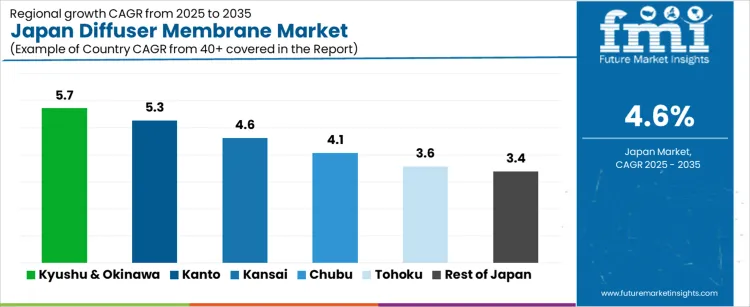
Demand for diffuser membranes in Japan is growing steadily across all regions, with Kyushu & Okinawa leading at a 5.7% CAGR, driven by the region’s expanding wastewater treatment and aquaculture industries. Kanto follows with a 5.3% CAGR, supported by the region’s large industrial base and high demand for wastewater treatment solutions in urban areas. Kansai shows a 4.6% CAGR, fueled by its strong industrial sectors and increased focus on sustainable water management. Chubu experiences a 4.1% CAGR, with steady demand driven by the growing need for water treatment technologies in manufacturing and agriculture. Tohoku and the Rest of Japan see moderate growth at 3.6% and 3.4%, respectively.
How is Demand for Diffuser Membrane Growing in Kyushu & Okinawa?
Kyushu & Okinawa leads the demand for diffuser membranes, growing at a 5.7% CAGR. The region’s expanding wastewater treatment and aquaculture industries are the primary drivers of this growth. Okinawa, with its growing tourism sector, requires effective water treatment solutions to manage the increase in wastewater generated by hotels, resorts, and other establishments. Kyushu’s agriculture and aquaculture industries rely on diffuser membranes for efficient water aeration in fish farming and other operations. As the region continues to focus on improving water treatment infrastructure and adopting more sustainable practices, demand for diffuser membranes is expected to remain strong. The growing awareness of environmental sustainability and the need for efficient water management in both urban and rural areas further supports steady growth in the demand for diffuser membranes in Kyushu & Okinawa.
Why is Demand for Diffuser Membrane Rising in Kanto?
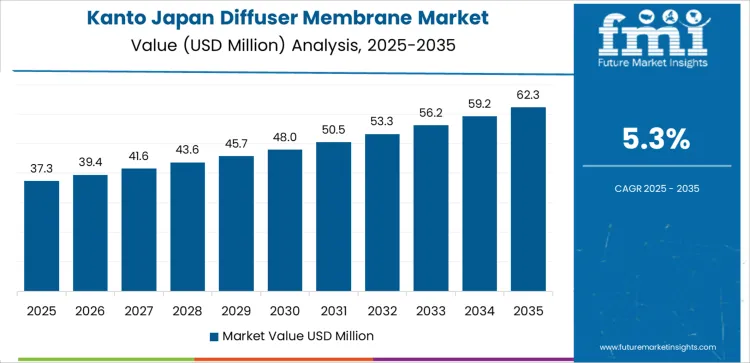
In Kanto, demand for diffuser membranes is rising at a 5.3% CAGR. The region’s large industrial base, particularly in Tokyo and its surrounding areas, creates significant demand for wastewater treatment solutions. Kanto is home to numerous industries that require efficient water management, including manufacturing, electronics, and food processing. The growing emphasis on sustainable production processes, as well as the increasing population in urban areas, has led to a higher demand for water purification and wastewater treatment technologies. Kanto’s focus on improving environmental quality and reducing water pollution further contributes to the demand for diffuser membranes. As urbanization and industrial growth continue, Kanto will likely remain a key region for the adoption of advanced water treatment solutions, including the use of diffuser membranes in large-scale wastewater treatment facilities and industrial applications.
How is Demand for Diffuser Membrane Expanding in Kansai?
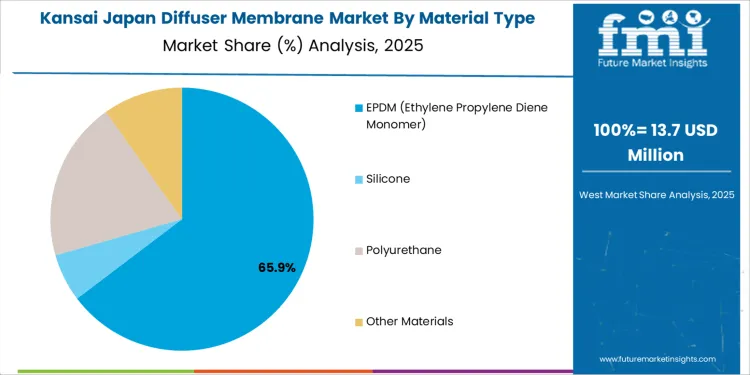
Kansai shows steady demand for diffuser membranes, growing at a 4.6% CAGR. The region’s industrial base, particularly in Osaka and Kobe, is contributing to the demand for efficient water treatment solutions. As the region's industrial activities increase, the need for wastewater treatment in sectors such as manufacturing, food production, and chemical processing rises. Kansai's focus on environmental sustainability and water purification is driving the adoption of advanced technologies, including diffuser membranes, for more effective and energy-efficient wastewater treatment. The region's increasing commitment to reducing environmental impact and improving water management practices further strengthens the demand for diffuser membranes. As industries in Kansai continue to grow, the demand for high-performance water treatment solutions will increase, driving the continued expansion of the diffuser membrane industry in the region.
Why is Demand for Diffuser Membrane Growing in Chubu?
.webp "Japan Diffuser Membrane Market Chubu Market Share Analysis By Flow Rate (air Handling Capacity)")
Chubu is experiencing steady demand for diffuser membranes, growing at a 4.1% CAGR. The region’s strong industrial and manufacturing base, particularly in Nagoya, is a significant driver of demand for wastewater treatment technologies. As the region's manufacturing sector continues to expand, there is a growing need for water purification and wastewater treatment systems to meet environmental regulations. Chubu’s agricultural sector increasingly relies on diffuser membranes for aeration in irrigation and water management systems. As the region embraces more sustainable practices and modernizes its water treatment infrastructure, the demand for diffuser membranes will likely continue to grow. Chubu’s focus on improving water quality, coupled with the rise of environmental awareness, will support steady demand for diffuser membranes in both industrial and agricultural applications.
How is Demand for Diffuser Membrane Expanding in Tohoku?
Tohoku is seeing moderate growth in diffuser membrane demand, with a 3.6% CAGR. Although the region’s demand is smaller compared to major urban centers, there is steady interest driven by the growing need for water treatment solutions in both rural and urban sectors. Tohoku’s agricultural industry is increasingly adopting efficient water management practices, including the use of diffuser membranes for aeration and irrigation. Tohoku’s focus on rebuilding infrastructure and improving environmental sustainability after past natural disasters has contributed to the rising demand for wastewater treatment technologies. As awareness of water treatment solutions continues to grow, the adoption of diffuser membranes is expected to increase. Over time, as the region continues to modernize its infrastructure and embrace more sustainable practices, the demand for diffuser membranes in Tohoku will continue to rise steadily.
Why is Demand for Diffuser Membrane Steady in the Rest of Japan?
The Rest of Japan is experiencing steady demand for diffuser membranes, with a 3.4% CAGR. While adoption is slower compared to major urban regions, there is growing interest in water treatment solutions for both agricultural and small-scale industrial applications. As rural areas modernize and adopt more sustainable water management practices, the demand for efficient wastewater treatment solutions, including diffuser membranes, is rising. The growing awareness of environmental sustainability and the need for efficient water treatment technologies in smaller municipalities and agricultural communities is contributing to this trend. As infrastructure improves and the benefits of diffuser membranes become more widely recognized, the demand for these technologies will continue to grow gradually in the Rest of Japan.
What is Driving the Demand for Diffuser Membranes in Japan and Who Are the Key Players Supplying Them?
Demand for diffuser membranes in Japan is rising as water treatment and wastewater management systems are upgraded in municipal, industrial, and aquaculture sectors. Diffuser membranes flexible or porous membranes used to pass air or oxygen into liquids help in efficient aeration and oxygen transfer, which are essential for wastewater treatment, sewage processing, aquaculture, and various industrial processes. As Japan’s regulatory and environmental standards become more stringent and its infrastructure ages, there is increased pressure to improve water-processing efficiency and ecological safety. This drives the adoption of advanced diffuser membrane systems that offer higher oxygen transfer efficiency, lower energy consumption, and reliable performance.
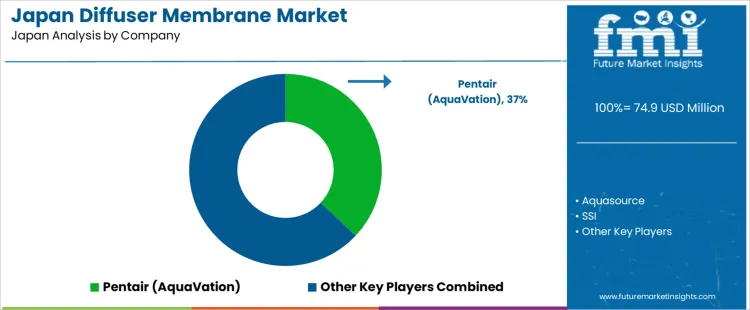
Leading providers of diffuser membranes globally (and influencing supply to Japan) include Pentair (AquaVation), Aquasource, SSI Aeration, Koch Membrane Systems, and Xylem (Sanitaire). Pentair (AquaVation) leads the pack with around 37.0% share, offering a wide range of fine-bubble diffuser membranes suited for wastewater and industrial aeration needs in Japan and globally. Other suppliers like Aquasource, SSI, Koch and Xylem compete by offering alternative membrane materials (rubber, EPDM, silicone), disc or tubular diffuser formats, and customized solutions for different end-use sectors.
Technological advances in membrane materials and design are boosting uptake of diffuser membranes in Japan. Membranes made from EPDM, silicone, or other polymers deliver durable performance, high oxygen-transfer efficiency, and resistance to fouling or clogging, which reduces maintenance costs and downtime. Growing demand is particularly noted in wastewater treatment plants undergoing upgrades, industrial facilities seeking energy-efficient aeration, and aquaculture systems that need stable oxygenation sectors where precise oxygen transfer and environmental compliance are increasingly important.
Key Players in Japan Diffuser Membrane Demand
- Pentair (AquaVation)
- Aquasource
- SSI
- Koch Membrane Systems
- Xylem (Sanitaire)
Scope of Report
| Items | Values |
|---|---|
| Quantitative Units (2025) | USD million |
| Material Type | EPDM (Ethylene Propylene Diene Monomer), Silicone, Polyurethane, Other Materials |
| Flow Rate (Air Handling Capacity) | High Capacity (>50 m³/h), Medium Capacity (5 to 50 m³/h), Low Capacity (<5 m³/h) |
| Configuration | Disc Diffuser Membranes, Tube Diffuser Membranes, Panel Diffuser Membranes, Other Specialized Designs |
| End Users | Municipal Wastewater Treatment, Industrial Wastewater Treatment, Aquaculture, Fish Farms, Shellfish Cultivation |
| Region | Kyushu & Okinawa, Kanto, Kansai, Chubu, Tohoku, Rest of Japan |
| Countries Covered | Japan |
| Key Companies Profiled | Pentair (AquaVation), Aquasource, SSI, Koch Membrane Systems, Xylem (Sanitaire) |
| Additional Attributes | Dollar sales by material type, flow rate, and configuration; regional CAGR and growth trends; increasing adoption in municipal and industrial wastewater treatment; innovations in diffuser membrane designs and materials. |
Japan Diffuser Membrane Demand by Key Segments
Material Type
- EPDM (Ethylene Propylene Diene Monomer)
- Silicone
- Polyurethane
- Other Materials
Flow Rate (Air Handling Capacity)
- High Capacity (>50 m³/h)
- Medium Capacity (5 to 50 m³/h)
- Low Capacity (<5 m³/h)
Configuration
- Disc Diffuser Membranes
- Tube Diffuser Membranes
- Panel Diffuser Membranes
- Other Specialized Designs
End Users
- Municipal Wastewater Treatment
- Industrial Wastewater Treatment
- Aquaculture
- Fish farms
- Shellfish cultivation
Region
- Kyushu & Okinawa
- Kanto
- Kansai
- Chubu
- Tohoku
- Rest of Japan
Frequently Asked Questions
How big is the demand for diffuser membrane in Japan in 2025?
The demand for diffuser membrane in Japan is estimated to be valued at USD 74.9 million in 2025.
What will be the size of diffuser membrane in Japan in 2035?
The market size for the diffuser membrane in Japan is projected to reach USD 117.1 million by 2035.
How much will be the demand for diffuser membrane in Japan growth between 2025 and 2035?
The demand for diffuser membrane in Japan is expected to grow at a 4.6% CAGR between 2025 and 2035.
What are the key product types in the diffuser membrane in Japan?
The key product types in diffuser membrane in Japan are epdm (ethylene propylene diene monomer), silicone, polyurethane and other materials.
Which flow rate (air handling capacity) segment is expected to contribute significant share in the diffuser membrane in Japan in 2025?
In terms of flow rate (air handling capacity), high capacity (>50 m³/h) segment is expected to command 45.0% share in the diffuser membrane in Japan in 2025.
Preview the report firsthand - request a free sample
Get SampleGet the brochure for pricing and purchase details.
Get PDFTable of Content
- Executive Summary
- Japan Market Outlook
- Demand-side Trends
- Supply-side Trends
- Technology Roadmap Analysis
- Analysis and Recommendations
- Market Overview
- Market Coverage / Taxonomy
- Market Definition / Scope / Limitations
- Market Background
- Market Dynamics
- Drivers
- Restraints
- Opportunity
- Trends
- Scenario Forecast
- Demand in Optimistic Scenario
- Demand in Likely Scenario
- Demand in Conservative Scenario
- Opportunity Map Analysis
- Product Life Cycle Analysis
- Supply Chain Analysis
- Investment Feasibility Matrix
- Value Chain Analysis
- PESTLE and Porter’s Analysis
- Regulatory Landscape
- Regional Parent Market Outlook
- Production and Consumption Statistics
- Import and Export Statistics
- Market Dynamics
- Japan Market Analysis 2020 to 2024 and Forecast, 2025 to 2035
- Historical Market Size Value (USD Million) Analysis, 2020 to 2024
- Current and Future Market Size Value (USD Million) Projections, 2025 to 2035
- Y-o-Y Growth Trend Analysis
- Absolute $ Opportunity Analysis
- Japan Market Pricing Analysis 2020 to 2024 and Forecast 2025 to 2035
- Japan Market Analysis 2020 to 2024 and Forecast 2025 to 2035, By Material Type
- Introduction / Key Findings
- Historical Market Size Value (USD Million) Analysis By Material Type , 2020 to 2024
- Current and Future Market Size Value (USD Million) Analysis and Forecast By Material Type , 2025 to 2035
- EPDM (Ethylene Propylene Diene Monomer)
- Silicone
- Polyurethane
- Other Materials
- Y-o-Y Growth Trend Analysis By Material Type , 2020 to 2024
- Absolute $ Opportunity Analysis By Material Type , 2025 to 2035
- Japan Market Analysis 2020 to 2024 and Forecast 2025 to 2035, By Flow Rate (Air Handling Capacity)
- Introduction / Key Findings
- Historical Market Size Value (USD Million) Analysis By Flow Rate (Air Handling Capacity), 2020 to 2024
- Current and Future Market Size Value (USD Million) Analysis and Forecast By Flow Rate (Air Handling Capacity), 2025 to 2035
- High Capacity (>50 m³/h)
- Medium Capacity (5 to 50 m³/h)
- Low Capacity (<5 m³/h)
- Y-o-Y Growth Trend Analysis By Flow Rate (Air Handling Capacity), 2020 to 2024
- Absolute $ Opportunity Analysis By Flow Rate (Air Handling Capacity), 2025 to 2035
- Japan Market Analysis 2020 to 2024 and Forecast 2025 to 2035, By Configuration
- Introduction / Key Findings
- Historical Market Size Value (USD Million) Analysis By Configuration, 2020 to 2024
- Current and Future Market Size Value (USD Million) Analysis and Forecast By Configuration, 2025 to 2035
- Disc Diffuser Membranes
- Tube Diffuser Membranes
- Panel Diffuser Membranes
- Other Specialized Designs
- Y-o-Y Growth Trend Analysis By Configuration, 2020 to 2024
- Absolute $ Opportunity Analysis By Configuration, 2025 to 2035
- Japan Market Analysis 2020 to 2024 and Forecast 2025 to 2035, By End Users
- Introduction / Key Findings
- Historical Market Size Value (USD Million) Analysis By End Users, 2020 to 2024
- Current and Future Market Size Value (USD Million) Analysis and Forecast By End Users, 2025 to 2035
- Municipal Wastewater Treatment
- Industrial Wastewater Treatment
- Aquaculture
- Fish farms
- Shellfish cultivation
- Y-o-Y Growth Trend Analysis By End Users, 2020 to 2024
- Absolute $ Opportunity Analysis By End Users, 2025 to 2035
- Market Structure Analysis
- Competition Dashboard
- Competition Benchmarking
- Market Share Analysis of Top Players
- By Regional
- By Material Type
- By Flow Rate (Air Handling Capacity)
- By Configuration
- By End Users
- Competition Analysis
- Competition Deep Dive
- Pentair (AquaVation)
- Overview
- Product Portfolio
- Profitability by Market Segments (Product/Age /Sales Channel/Region)
- Sales Footprint
- Strategy Overview
- Marketing Strategy
- Product Strategy
- Channel Strategy
- Aquasource
- SSI
- Koch Membrane Systems
- Xylem (Sanitaire)
- Pentair (AquaVation)
- Competition Deep Dive
- Assumptions & Acronyms Used
- Research Methodology


