

- Industry Size (2025)
- USD 491.1 Mn
- Forecast (2035)
- USD 862.6 Mn
- CAGR (2025 to 2035)
- 5.8%
Demand for Diffuser Membrane in USA 2025 to 2035
The demand for diffuser membrane in the USA is valued at USD 491.1 million in 2025 and is forecasted to reach USD 862.6 million by 2035. The CAGR between 2025 and 2035 is projected at 5.8%. Demand is driven by the modernization of wastewater treatment facilities and rising expectations for high-efficiency aeration performance within municipal and industrial plants. Treatment operators focus on reducing energy intensity in biological processes, and diffuser membranes enable fine-bubble aeration with lower power consumption than coarse-bubble systems. Improved oxygen-transfer efficiency also supports stricter effluent requirements, which continue to expand as national and regional environmental regulations evolve.
EPDM represents the leading material type due to its mechanical strength, chemical resistance, and endurance under continuous operating cycles. Membranes manufactured with EPDM maintain airflow consistency for long durations, limiting maintenance frequency. This supports cost-control objectives in large-scale installations and retrofit programs for existing activated-sludge systems. Demand strengthens in the West, South, and Northeast. These regions contain dense urban networks, expanding reuse projects, and industrial activity requiring advanced biological treatment. Aging infrastructure in older cities further contributes to replacement and refurbishment activity. Key suppliers include Pentair (AquaVation), Aquasource, SSI, Koch Membrane Systems, and Xylem (Sanitaire). Supplier development priorities center on longer service life, resistance to fouling, and enhanced diffuser configurations that improve overall aeration efficiency and system reliability.
Quick Stats for USA Diffuser Membrane Demand
- USA Diffuser Membrane Sales Value (2025): USD 491.1 million
- USA Diffuser Membrane Forecast Value (2035): USD 862.6 million
- USA Diffuser Membrane Forecast CAGR (2025 to 2035): 5.8%
- Leading Material Type in USA Diffuser Membrane Demand: EPDM
- Key Growth Regions in USA Diffuser Membrane Demand: West USA, South USA, Northeast USA
- Top Players in USA Diffuser Membrane Demand: Pentair (AquaVation), Aquasource, SSI, Koch Membrane Systems, Xylem (Sanitaire)
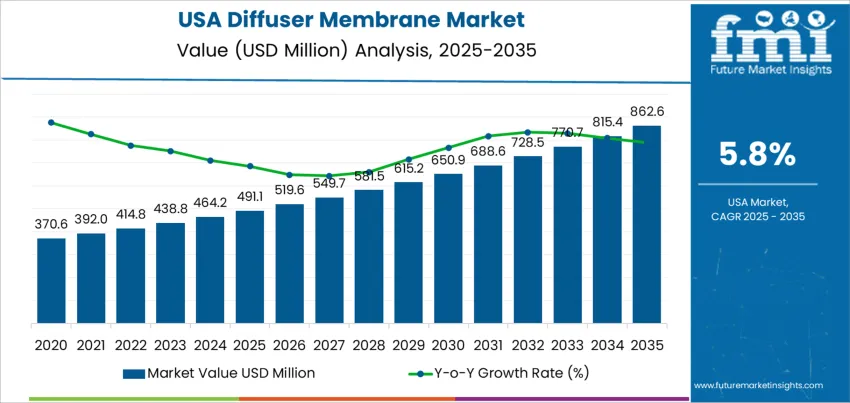
What is the Growth Forecast for Diffuser Membrane Industry in USA through 2035?
Demand for diffuser membranes in the United States follows an early growth curve shaped by stronger adoption in municipal wastewater treatment and industrial effluent systems. Early-phase gains reflect compliance with updated discharge requirements, modernization of aging aeration infrastructure, and emphasis on improving energy efficiency in treatment plants. Projects funded at the state and local levels contribute to consistent procurement cycles, giving the early curve a steady incline supported by capital-improvement programs.
As the curve progresses into the later phase, growth remains positive but becomes more dependent on replacement demand rather than new installation peaks. Membrane lifespan and performance degradation create predictable refurbishment schedules, which support ongoing activity without dramatic surges. Late-phase expansion also emerges in niche applications such as aquaculture, but these segments add incremental volume rather than shifting the trajectory sharply upward.
Competition from alternative aeration technologies introduces mild flattening during later years, particularly where lifecycle cost analysis favors existing infrastructure. Manufacturers respond with durability enhancements and fine-bubble efficiency upgrades that help sustain adoption. The comparison shows the early curve driven by regulatory modernization and plant expansion, while the late curve relies more on maintenance-driven procurement and gradual diversification across industrial users.
USA Diffuser Membrane Key Takeaways
| Metric | Value |
|---|---|
| USA Diffuser Membrane Sales Value (2025) | USD 491.1 million |
| USA Diffuser Membrane Forecast Value (2035) | USD 862.6 million |
| USA Diffuser Membrane Forecast CAGR (2025 to 2035) | 5.8% |
Why is the Demand for Diffuser Membranes in the USA Growing?
Demand for diffuser membranes in the USA is increasing because wastewater treatment plants, industrial facilities and aquaculture operations require efficient and reliable aeration systems to maintain water quality and meet environmental regulations. Diffuser membranes typically made of materials like EPDM, silicone or polyurethane are central to fine-bubble aeration, which allows oxygen transfer into wastewater at higher efficiency than older coarse-bubble systems. Municipalities investing in wastewater infrastructure upgrades and industrial sites handling process effluent drive demand for replacement or new diffuser membrane installations. Gains in industrial throughput from sectors such as food processing, chemical manufacturing and pharmaceuticals further support ongoing USAge.
Aquaculture and fish-farming operations also adopt diffuser membranes as part of recirculating aquaculture systems (RAS), using bubbles to maintain dissolved oxygen levels in water tanks. This adds a non-municipal dimension to the demand base. Advancements in membrane technology such as coatings to resist fouling and durable elastomer formulations reduce maintenance frequency and improve lifespan, which encourages facility managers to prefer membrane diffusers over older ceramic or plate-type alternatives.
Which Material Types, Flow Capacities, and End-User Segments Lead Demand for Diffuser Membranes in the USA?
Demand for diffuser membranes in the United States is supported by ongoing upgrades in wastewater treatment infrastructure and stricter environmental compliance requirements for oxygen transfer efficiency. USA facilities prioritize durable, chemical-resistant, and energy-efficient aeration components. Growth aligns with municipal treatment capacity expansion, industrial effluent reduction standards, and rising adoption within recirculating aquaculture systems. Performance selection depends on membrane elasticity, fouling resistance, diffusivity, and cost-efficient lifecycle operations across diverse aeration environments.
By Material Type, EPDM Dominates Adoption
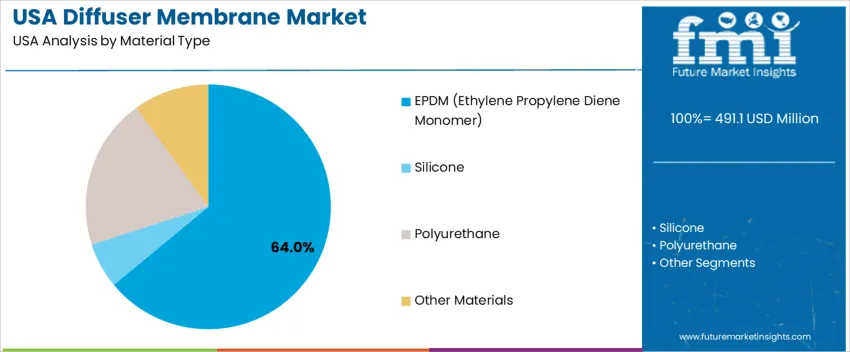
EPDM accounts for 64.0%, driven by its long-term elasticity, tear resistance, and cost-effectiveness in large wastewater treatment operations. These membranes withstand harsh biological and chemical environments, supporting stable oxygen diffusion in activated sludge systems. Polyurethane holds 20.0%, used where abrasion resistance and enhanced durability are required for industrial aeration tanks. Silicone represents 6.0%, deployed in niche systems requiring high-temperature stability and reduced fouling. Other materials contribute 10.0%, serving case-specific aeration conditions. Material decisions in the USA reflect maintenance optimization, lower blower energy consumption, and compliance with clean water regulatory frameworks demanding sustained aeration performance.
Key Points:
- EPDM dominates due to durability and favorable cost lifecycle
- Polyurethane supports demanding industrial USAge
- Silicone enables heat-resistant and low-fouling operations
By Flow Rate, High-Capacity Diffuser Membranes Lead
.webp "Usa Diffuser Membrane Market Analysis By Flow Rate (air Handling Capacity)")
High-capacity (>50 m³/h) systems represent 45.0%, supporting major USA municipal treatment plants focused on high-volume oxygenation and process aeration efficiency. These systems reduce blower load requirements, improving operational energy savings. Low-capacity (<5 m³/h) diffusers account for 38.0%, widely used in decentralized plants, small-scale industries, and modular aquaculture settings. Medium-capacity solutions hold 17.0%, supporting balancing tanks, equalization basins, and compact industrial vessels. Flow capacity selection depends on tank geometry, sludge characteristics, and dissolved oxygen targets. Adoption patterns reflect the United States’ distribution of both large municipalities and growing clusters of smaller treatment facilities serving expanding industrial and residential zones.
Key Points:
- High-capacity units address large-scale municipal aeration needs
- Low-capacity units support compact and decentralized systems
- Medium-capacity units integrate into mixed-treatment configurations
By End-User, Municipal Wastewater Leads
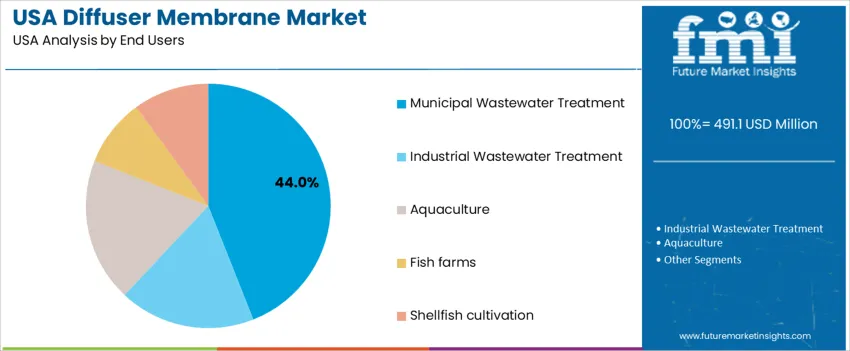
Municipal wastewater treatment accounts for 44.0%, driven by federal and state mandates improving water discharge quality and aeration efficiency across activated sludge facilities. Aquaculture contributes 19.0%, supporting aerated ponds and recirculating systems as domestic aquaculture production expands. Industrial wastewater treatment represents 18.0%, with facilities seeking better biological degradation of high-strength effluent. Fish farms hold 9.0%, while shellfish cultivation contributes 10.0%, both requiring controlled dissolved oxygen to maintain healthy growth cycles. USA end-use adoption reflects broad infrastructure modernization and increased reliance on biological treatment systems across public and private sectors.
Key Points:
- Public facility upgrades are primary demand drivers
- Aquaculture use is rising with controlled-environment farming
- Industrial operators invest in biological compliance and oxygenation control
What are the Drivers, Restraints, and Key Trends of the Demand for Diffuser Membranes in the USA?
Growth of wastewater treatment capacity expansion, stricter discharge regulations and increased adoption of advanced aeration technologies drive demand.
In the United States, municipal wastewater treatment plants and industrial effluent systems increasingly require high-efficiency diffuser membranes to meet stricter environmental regulations and discharge standards for biological oxygen demand (BOD), nitrogen levels and effluent clarity. Expansion and upgrades of aging treatment infrastructure in states such as California, Florida and Pennsylvania prompt procurement of diffuser membranes for activated-sludge, aerated lagoon and tertiary-treatment systems. Industrial facilities including food processing, pharmaceuticals and chemical manufacturers also install diffuser-based aeration systems to control wastewater outflow before discharge or recycling. These regulatory and environmental drivers support ongoing demand across public and private sectors involved in water and wastewater management.
Capital cost pressures, maintenance complexity and competition from alternative treatment solutions restrain demand.
Upgrading or expanding aeration systems with diffuser membranes requires significant capital investment, which municipal budgets and small industrial plants may find difficult to prioritize. Membranes require periodic inspection and replacement due to fouling, clogging or degradation under harsh wastewater chemistry, increasing lifecycle maintenance costs. Alternative technologies such as fine-bubble diffused aeration rings, mechanical aerators or membrane bioreactors (MBRs) may compete for adoption when space constraints or effluent requirements differ. These cost and maintenance drawbacks slow widespread upgrade across all treatment sites.
Shift toward energy-efficient fine-bubble diffusers, increased integration with monitoring sensors and rising demand in decentralized and small-community treatment setups define key trends.
Suppliers increasingly provide fine-bubble diffuser membranes that reduce energy consumption per volume of oxygen delivered, offering long-term cost savings for treatment plants under utility rate pressure. Integration with dissolved-oxygen sensors and automated control systems enables optimized aeration cycles, reducing carbon footprint and improving process reliability. Smaller or rural communities adopt compact, modular treatment units using diffuser membranes for decentralized wastewater management, expanding demand beyond large municipal systems. Industrial water reuse and zero-liquid discharge (ZLD) strategies also incorporate membrane-based aeration to meet sustainability goals. These trends indicate sustained, regulation-driven demand for diffuser membranes across U.S. water treatment and environmental infrastructure sectors.
Analysis of the Demand for Diffuser Membranes in the USA by Region
Demand for diffuser membranes in the United States is rising as municipalities and industries modernize aeration systems to improve wastewater-treatment efficiency, reduce energy consumption, and comply with tightening discharge regulations. Growth is also linked to upgrades in food-processing facilities, aquaculture systems, and decentralized treatment plants that rely on oxygen-transfer optimization. West USA leads at 6.7% CAGR, followed by South USA at 6.0%, reflecting infrastructure investment and large-scale industrial wastewater operations. Northeast USA records 5.3%, driven by regulatory compliance priorities, while Midwest USA grows at 4.6%, with USAge tied to manufacturing and municipal plant rehabilitation programs.
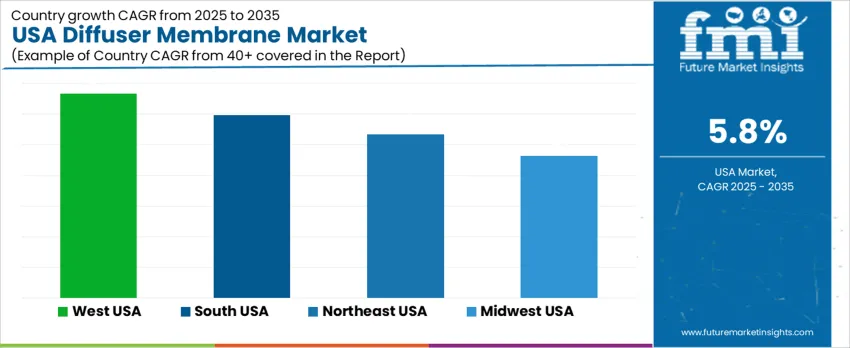
| Region | CAGR (2025-2035) |
|---|---|
| West USA | 6.7% |
| South USA | 6.0% |
| Northeast USA | 5.3% |
| Midwest USA | 4.6% |
How is the West USA driving demand for diffuser membranes?
West USA expands at 6.7% CAGR, supported by major wastewater-treatment upgrades in California, Washington, and Oregon aimed at sustainability compliance, biogas recovery improvements, and reducing aeration energy loads. Utilities prioritize membrane diffusers that deliver higher oxygen-transfer efficiency and lower long-term operational costs. Industrial processors in coastal metros use EPDM and PTFE membrane formats to handle variable effluent characteristics. Aquaculture facilities and decentralized treatment units in rural communities add incremental adoption. Procurement teams require membranes with fouling resistance, durability against chemicals, and strong manufacturer service support for maintenance and replacement cycles under regulatory scrutiny.
- Wastewater-treatment modernization improving oxygen efficiency
- Industrial facilities using durable membranes for varied effluents
- Rural water systems adding decentralized aeration units
- Performance warranties influencing procurement decisions
How is the South USA shaping adoption?
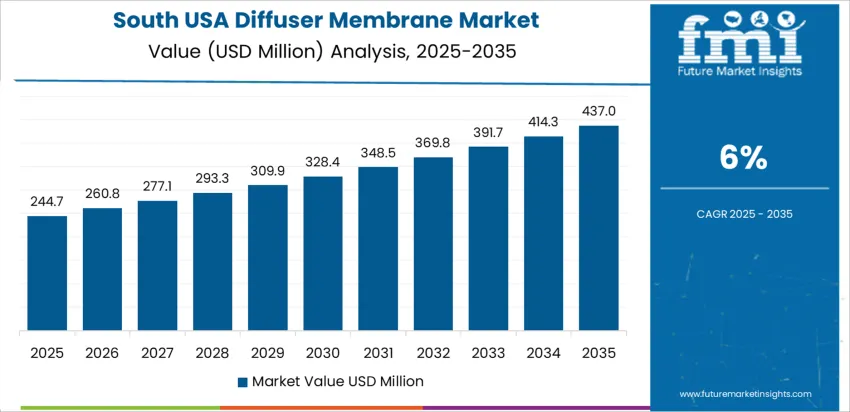
South USA grows at 6.0% CAGR, driven by significant industrial wastewater-management requirements across Texas, Louisiana, Georgia, and Florida. Diffuser systems support refineries, chemical plants, and large food-processing operations where aeration energy accounts for major operational costs. Municipal expansion in fast-growing urban zones drives investment into upgraded biological-treatment infrastructure. Warm-climate aquatic environments amplify oxygen-demand variation, leading to demand for high-efficiency fine-bubble diffusers. Buyers evaluate resilience to scaling and chemical deterioration in high-load treatment basins. Vendor partnerships provide on-site maintenance, extending membrane service life in continuous-operation facilities.
- Industrial effluent loads driving aeration upgrades
- Rapid population growth increasing municipal demand
- Warm climates intensifying oxygen-transfer needs
- Maintenance partnerships supporting lifecycle reliability
How is the Northeast USA contributing to system modernization?
Northeast USA reports 5.3% CAGR, influenced by aging infrastructure replacement and strict water-quality regulations in New York, New Jersey, and Massachusetts. Municipal operators adopt PTFE-coated membranes to reduce fouling and keep aeration performance consistent in older basins. Advanced treatment initiatives for nutrient removal improve compatibility requirements for diffuser materials. Industrial parks with environmental-compliance obligations upgrade equipment to meet permit thresholds. Procurement requires documented efficiency validation and material traceability. Adoption of real-time aeration control technology improves integration of membrane diffusers within automated biological-treatment systems.
- Regulatory enforcement accelerating adoption
- Older facilities requiring aeration efficiency improvements
- Industrial compliance driving membrane-type selection
- Automation integration guiding equipment procurement
How is the Midwest USA supporting wastewater-treatment growth?
Midwest USA achieves 4.6% CAGR, driven by municipal rehabilitation programs and industrial processing facilities across Ohio, Michigan, Illinois, and Wisconsin. Food-and-beverage manufacturers adopt fine-bubble diffuser membranes to lower energy expenditure and enhance biological stability in aeration tanks. Medium-sized municipalities replace coarse-bubble systems as part of long-term performance upgrades. Cold-climate treatment plants demand membranes with mechanical flexibility and freeze-thaw tolerance. Supply chains leverage regional manufacturing to ensure predictable shipping and spare-part readiness. Procurement teams focus on durability in high-solids environments and compatibility with incremental plant expansions.
- Food-processing wastewater supporting continuous demand
- Municipal rehabilitation replacing outdated aeration systems
- Climate robustness influencing membrane material selection
- Regional supply reliability shaping purchasing decisions
How is competitive positioning defined among diffuser-membrane suppliers in the United States?
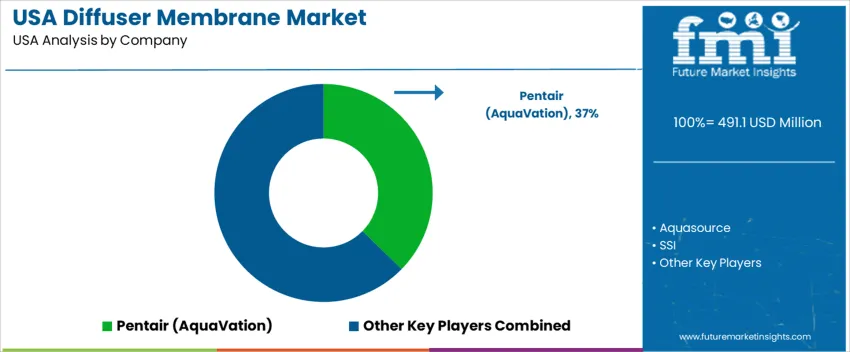
Competitive structure in the United States diffuser-membrane field reflects the ability to deliver stable aeration performance, maintain membrane flexibility over long operating cycles, and support wastewater plants through field services and stocked distribution. Pentair (AquaVation) holds an estimated 37.3%, supported by extended use in municipal activated-sludge systems where operators rely on predictable oxygen-transfer efficiency and well-established installation standards. Its advantage links to a broad product line that fits both fine-bubble and retrofit requirements.
Aquasource focuses on diffuser configurations designed to control fouling and maintain airflow consistency in variable-load facilities. Its involvement strengthens where energy optimization targets are high and mechanical simplicity influences selection. SSI maintains a technical presence through material options aimed at improved chemical resistance and longevity. Participation is reinforced by active engagement with engineering consultants specifying aeration for mid-scale plants.
Koch Membrane Systems competes by integrating diffuser solutions with its broader water-treatment technologies. Adoption is higher where utilities seek packaged system familiarity and consolidated support across filtration and aeration. Xylem (Sanitaire) offers aeration grids and membranes positioned for new-build wastewater infrastructure, with design guidance targeted toward efficiency improvements in secondary treatment. Competitive strength increasingly depends on documented life-cycle performance, assurance of spare-part availability within the United States, and service response that limits downtime during diffuser changeouts or cleaning cycles.
Key Players in USA Diffuser Membrane Demand
- Pentair (AquaVation)
- Aquasource
- SSI
- Koch Membrane Systems
- Xylem (Sanitaire)
Scope of the Report
| Items | Values |
|---|---|
| Quantitative Units | USD million |
| Material Type | EPDM (Ethylene Propylene Diene Monomer), Silicone, Polyurethane, Other Materials |
| Flow Rate (Air Handling Capacity) | High Capacity (>50 m³/h), Low Capacity (<5 m³/h), Medium Capacity (5 to 50 m³/h) |
| End Users | Municipal Wastewater Treatment, Industrial Wastewater Treatment, Aquaculture, Fish Farms, Shellfish Cultivation |
| Regions Covered | West USA, South USA, Northeast USA, Midwest USA |
| Key Companies Profiled | Pentair (AquaVation), Aquasource, SSI, Koch Membrane Systems, Xylem (Sanitaire) |
| Additional Attributes | Dollar sales by material type, air flow capacity, and end-user applications; regional adoption across major U.S. wastewater and aquaculture facilities; performance attributes including oxygen transfer efficiency, fouling resistance, and lifecycle costs; competitive landscape across membrane retrofit and new aeration system installations; integration with energy-efficient wastewater operations, EPA compliance upgrades, and sustainable aquaculture systems. |
USA Diffuser Membrane Demand by Segments
Material Type:
- EPDM (Ethylene Propylene Diene Monomer)
- Silicone
- Polyurethane
- Other Materials
Flow Rate (Air Handling Capacity):
High Capacity (>50 m³/h)
Low Capacity (<5 m³/h)
Medium Capacity (5 to 50 m³/h)
End Users:
- Municipal Wastewater Treatment
- Industrial Wastewater Treatment
- Aquaculture
- Fish farms
- Shellfish cultivation
Region:
- West USA
- South USA
- Northeast USA
- Midwest USA
Frequently Asked Questions
How big is the demand for diffuser membrane in USA in 2025?
The demand for diffuser membrane in USA is estimated to be valued at USD 491.1 million in 2025.
What will be the size of diffuser membrane in USA in 2035?
The market size for the diffuser membrane in USA is projected to reach USD 862.6 million by 2035.
How much will be the demand for diffuser membrane in USA growth between 2025 and 2035?
The demand for diffuser membrane in USA is expected to grow at a 5.8% CAGR between 2025 and 2035.
What are the key product types in the diffuser membrane in USA?
The key product types in diffuser membrane in USA are epdm (ethylene propylene diene monomer), silicone, polyurethane and other materials.
Which flow rate (air handling capacity) segment is expected to contribute significant share in the diffuser membrane in USA in 2025?
In terms of flow rate (air handling capacity), high capacity (>50 m³/h) segment is expected to command 45.0% share in the diffuser membrane in USA in 2025.
Preview the report firsthand - request a free sample
Get SampleGet the brochure for pricing and purchase details.
Get PDFTable of Content
- Executive Summary
- USA Market Outlook
- Demand-side Trends
- Supply-side Trends
- Technology Roadmap Analysis
- Analysis and Recommendations
- Market Overview
- Market Coverage / Taxonomy
- Market Definition / Scope / Limitations
- Market Background
- Market Dynamics
- Drivers
- Restraints
- Opportunity
- Trends
- Scenario Forecast
- Demand in Optimistic Scenario
- Demand in Likely Scenario
- Demand in Conservative Scenario
- Opportunity Map Analysis
- Product Life Cycle Analysis
- Supply Chain Analysis
- Investment Feasibility Matrix
- Value Chain Analysis
- PESTLE and Porter’s Analysis
- Regulatory Landscape
- Regional Parent Market Outlook
- Production and Consumption Statistics
- Import and Export Statistics
- Market Dynamics
- USA Market Analysis 2020 to 2024 and Forecast, 2025 to 2035
- Historical Market Size Value (USD Million) Analysis, 2020 to 2024
- Current and Future Market Size Value (USD Million) Projections, 2025 to 2035
- Y-o-Y Growth Trend Analysis
- Absolute $ Opportunity Analysis
- USA Market Pricing Analysis 2020 to 2024 and Forecast 2025 to 2035
- USA Market Analysis 2020 to 2024 and Forecast 2025 to 2035, By Material Type
- Introduction / Key Findings
- Historical Market Size Value (USD Million) Analysis By Material Type , 2020 to 2024
- Current and Future Market Size Value (USD Million) Analysis and Forecast By Material Type , 2025 to 2035
- EPDM (Ethylene Propylene Diene Monomer)
- Silicone
- Polyurethane
- Other Materials
- Y-o-Y Growth Trend Analysis By Material Type , 2020 to 2024
- Absolute $ Opportunity Analysis By Material Type , 2025 to 2035
- USA Market Analysis 2020 to 2024 and Forecast 2025 to 2035, By Flow Rate (Air Handling Capacity)
- Introduction / Key Findings
- Historical Market Size Value (USD Million) Analysis By Flow Rate (Air Handling Capacity), 2020 to 2024
- Current and Future Market Size Value (USD Million) Analysis and Forecast By Flow Rate (Air Handling Capacity), 2025 to 2035
- High Capacity (>50 m³/h)
- Low Capacity (<5 m³/h)
- Medium Capacity (5 to 50 m³/h)
- Y-o-Y Growth Trend Analysis By Flow Rate (Air Handling Capacity), 2020 to 2024
- Absolute $ Opportunity Analysis By Flow Rate (Air Handling Capacity), 2025 to 2035
- USA Market Analysis 2020 to 2024 and Forecast 2025 to 2035, By End Users
- Introduction / Key Findings
- Historical Market Size Value (USD Million) Analysis By End Users, 2020 to 2024
- Current and Future Market Size Value (USD Million) Analysis and Forecast By End Users, 2025 to 2035
- Municipal Wastewater Treatment
- Industrial Wastewater Treatment
- Aquaculture
- Fish farms
- Shellfish cultivation
- Y-o-Y Growth Trend Analysis By End Users, 2020 to 2024
- Absolute $ Opportunity Analysis By End Users, 2025 to 2035
- Market Structure Analysis
- Competition Dashboard
- Competition Benchmarking
- Market Share Analysis of Top Players
- By Regional
- By Material Type
- By Flow Rate (Air Handling Capacity)
- By End Users
- Competition Analysis
- Competition Deep Dive
- Pentair (AquaVation)
- Overview
- Product Portfolio
- Profitability by Market Segments (Product/Age /Sales Channel/Region)
- Sales Footprint
- Strategy Overview
- Marketing Strategy
- Product Strategy
- Channel Strategy
- Aquasource
- SSI
- Koch Membrane Systems
- Xylem (Sanitaire)
- Pentair (AquaVation)
- Competition Deep Dive
- Assumptions & Acronyms Used
- Research Methodology


