

- Industry Size (2026)
- USD 256.38 Mn
- Forecast (2036)
- USD 967.26 Mn
- CAGR (2026 to 2036)
- 14.2%
Demand for Hyper-Personalized Fitness in Japan Market Size, Market Forecast and Outlook By FMI
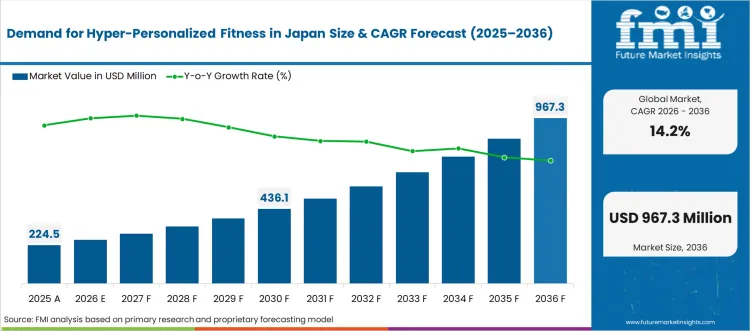
The Hyper-Personalized Fitness in Japan market was valued at USD 224.50 million in 2025, projected to reach USD 256.38 million in 2026, and is forecast to expand to USD 967.26 million by 2036 at a 14.2% CAGR. As per FMI, wearable biometric sensors and AI-coached workout platforms are replacing standardized gym routines across Japanese urban prefectures.
Summary of Demand for Hyper-Personalized Fitness in Japan Market
- Market Overview
- The Hyper-Personalized Fitness in Japan market is valued at USD 224.50 million in 2025 and is projected to reach USD 967.26 million by 2036.
- The industry is expected to grow at a 14.2% CAGR from 2026 to 2036, creating an incremental opportunity of USD 710.88 million.
- The market remains a technology-driven health optimization category where biometric personalization, wearable connectivity, and AI-coached fitness delivery define competitive positioning within Japan's aging and health-conscious consumer base.
- Demand and Growth Drivers
- Demand is accelerating as Japanese consumers shift from standardized gym routines to algorithmically curated fitness programs delivered through wearable biometric platforms.
- Corporate wellness mandates under the Industrial Safety and Health Act are channeling employer budgets toward connected fitness ecosystems that produce measurable employee health outcomes.
- Prefectural health promotion subsidies are expanding device adoption among aging populations in regions with limited access to staffed fitness facilities.
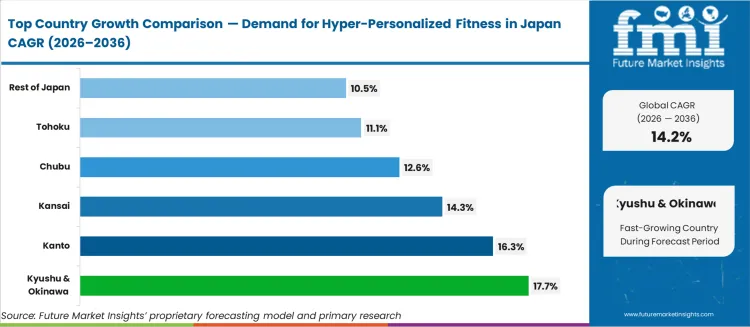
- Kyushu and Okinawa lead at 17.7% CAGR, followed by Kanto at 16.3%, Kansai at 14.3%, Chubu at 12.6%, Tohoku at 11.1%, and Rest of Japan at 10.5%.
- Product and Segment View
- The market includes product type, sales channels as primary segmentation dimensions.
- Wearables leads by Product Type with 47% share in 2026.
- Direct Sales leads by Sales Channels with 58.1% share in 2026.
- Geography and Competitive Outlook
- Kyushu & Okinawa is the fastest-growing region at 17.7% CAGR, while Kanto anchors the largest demand base.
- Competition is shaped by technical specialisation, regulatory compliance capability, and platform integration depth, with key players including Peloton Interactive, Ergotron, Inc., Curiouser Products Inc, Whoop, Tonal.
- Analyst Opinion at FMI
- Ronak Shah, Principal Consultant, opines: 'FMI's analysis reveals that the hyper-personalized fitness in japan market is entering a phase where procurement decisions are increasingly dictated by regulatory compliance timelines and measurable performance thresholds. Organisations that delay platform investment risk permanent lockout from competitive procurement tiers their counterparts are actively securing.'
- Strategic Implications / Executive Takeaways
- Solution providers must secure certified integration pathways with tier-1 enterprise systems to qualify for forthcoming institutional procurement contracts.
- Capital project directors should phase out legacy approaches and mandate native platform compatibility in all new equipment and software procurement specifications.
- Technical teams must develop specialised competencies in product type validation to demonstrate compliance parameters during the evaluation phase.
Demand for Hyper-Personalized Fitness in Japan Market Key Takeaways
| Metric | Details |
|---|---|
| Industry Size (2026) | USD 256.38 million |
| Industry Value (2036) | USD 967.26 million |
| CAGR (2026 to 2036) | 14.2% |
Source: Future Market Insights, 2026
Consumers are investing in connected fitness ecosystems that adapt exercise prescriptions to real-time physiological feedback collected through skin-contact optical and inertial sensors. FMI is of the opinion that corporate wellness mandates under the Industrial Safety and Health Act are accelerating enterprise adoption of personalized fitness platforms within large Japanese employers, converting discretionary consumer spending into structured procurement budgets.
Regional adoption patterns across Japan reflect distinct infrastructure and demographic conditions. Kyushu and Okinawa lead at 17.7% CAGR, driven by prefectural health promotion subsidies targeting aging populations with limited access to staffed fitness facilities. Kanto follows at 16.3%, anchored by dense urban consumer bases in Tokyo and Yokohama where connected home fitness demand surges among time-constrained professionals. Kansai registers 14.3% growth supported by Osaka and Kobe municipal wellness investment programs. Chubu expands at 12.6% as automotive sector employers integrate wearable fitness monitoring into occupational health protocols. Tohoku and Rest of Japan maintain steady trajectories at 11.1% and 10.5% respectively, with rural telehealth fitness programs compensating for gym facility scarcity. FMI analysts observe that prefectures with higher median age consistently show faster adoption of at-home connected fitness devices compared to gym-dense metropolitan centres.
Demand for Hyper-Personalized Fitness in Japan Market Definition
Based on FMI's report, the Hyper-Personalized Fitness in Japan market covers wearable fitness devices, AI-driven smart exercise equipment, and connected software platforms that use biometric data, behavioral analytics, and machine learning to deliver individualized training, nutrition, and recovery prescriptions specifically within the Japanese consumer and corporate wellness ecosystem.
Demand for Hyper-Personalized Fitness in Japan Market Inclusions
Future Market Insights analysis covers wearable fitness trackers with biometric monitoring capabilities, AI-powered smart gym equipment, connected fitness software platforms, and subscription-based personalized coaching services. The scope encompasses regional market sizes across Japanese prefectural groupings, forecast projections from 2026 to 2036, and segmentation by product type and sales channel.
Demand for Hyper-Personalized Fitness in Japan Market Exclusions
The scope excludes general consumer electronics without dedicated fitness algorithms, traditional gym equipment lacking connectivity or personalization features, and standalone nutrition apps without integrated biometric feedback loops. Medical-grade rehabilitation devices regulated under pharmaceutical affairs law are also omitted.
Demand for Hyper-Personalized Fitness in Japan Market Research Methodology
- Primary Research: Analysts conducted structured interviews with fitness technology product managers, corporate wellness directors at Japanese conglomerates, and prefectural health bureau officials to map procurement triggers and adoption barriers.
- Desk Research: Data collection aggregated Japan Sports Agency physical activity reports, METI digital health technology assessments, and published corporate wellness program disclosures from listed Japanese employers.
- Market-Sizing and Forecasting: Baseline values derive from a bottom-up aggregation of connected fitness device shipments and software subscription revenues within Japan, applying prefectural-level demographic and health expenditure curves to project adoption velocity.
- Data Validation and Update Cycle: Projections are cross-validated against publicly reported fitness technology revenue guidance from major device manufacturers and quarterly subscription metrics disclosed by platform operators.
Why is the Demand for Hyper-Personalized Fitness in Japan Growing?
The demand for hyper-personalized fitness in Japan is growing as consumers increasingly seek tailored workout and wellness programs that cater to their specific health goals, preferences, and lifestyles. Hyper-personalized fitness goes beyond standard fitness plans by using advanced technologies such as wearables, AI, and data analytics to create customized workout regimens, nutrition plans, and recovery strategies. As Japanese consumers become more health-conscious and tech-savvy, the need for highly individualized fitness solutions is on the rise. People are looking for more than just general fitness advice; they want programs that consider their unique body types, fitness levels, and goals.
The growth in demand is also fueled by Japan's aging population, with many individuals seeking fitness solutions to maintain health, mobility, and independence as they age. Hyper-personalized fitness programs are particularly appealing to older adults who need specific guidance on exercise routines tailored to their physical abilities and limitations. The rise of digital platforms and fitness apps has made personalized fitness services more accessible, allowing users to follow their customized plans from home or on-the-go.
Technological innovations in fitness tracking and virtual coaching are also contributing to the demand for hyper-personalized fitness. These technologies enable real-time monitoring of progress, adjustments to routines, and enhanced motivation, making it easier for individuals to stay on track with their health goals. With Japan’s focus on innovation and health, the hyper-personalized fitness sector is expected to continue expanding rapidly, driven by technological advancements and evolving consumer needs.
What is the Segment-Wise Analysis of Demand for Hyper-Personalized Fitness in Japan?
Demand for hyper-personalized fitness in Japan is segmented by product type, sales channels, and region. By product type, wearables lead at 47%, followed by smart equipment and other products. In terms of sales channels, direct sales dominate at 58.1%, with indirect sales contributing to the remainder. Regionally, demand spans across Kyushu & Okinawa, Kanto, Kansai, Chubu, Tohoku, and the rest of Japan, with varying levels of adoption based on local preferences and the growing trend toward fitness technology.
How Do Wearables Lead the Demand for Hyper-Personalized Fitness in Japan?
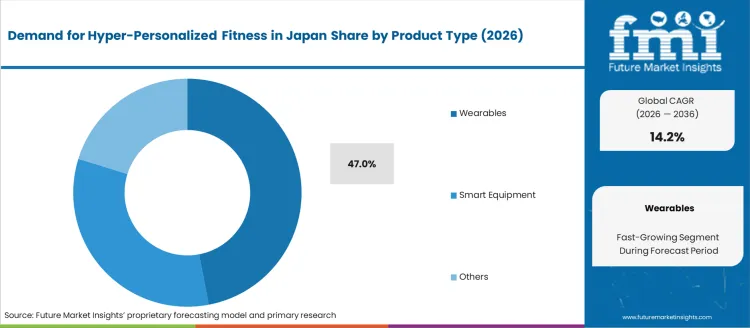
Wearables account for 47% of the demand for hyper-personalized fitness in Japan, driven by their ability to provide real-time data and insights into an individual’s fitness journey. These devices, including smartwatches and fitness trackers, allow users to monitor key health metrics such as heart rate, steps, calories burned, and sleep patterns. As Japanese consumers increasingly focus on health and wellness, wearables have become a crucial tool for fitness enthusiasts seeking personalized workout and wellness plans. The rise of fitness apps and integration with other smart devices enhances the appeal of wearables, allowing users to tailor their routines to their specific needs. With the growing trend toward fitness and wellness, particularly in urban areas like Kanto and Kansai, wearables continue to lead the industry in hyper-personalized fitness solutions in Japan.
Why Does Direct Sales Lead the Demand for Hyper-Personalized Fitness in Japan?
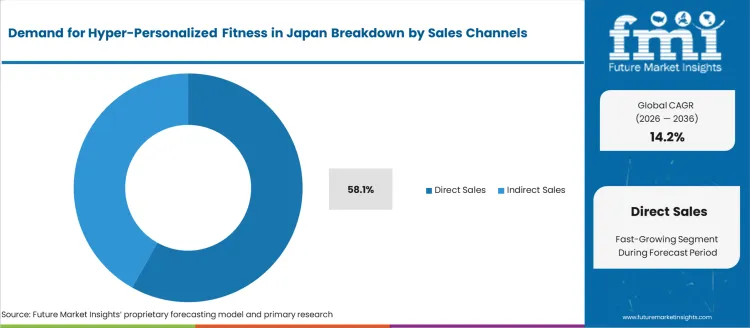
Direct sales account for 58.1% of the demand for hyper-personalized fitness in Japan, reflecting the growing preference for purchasing fitness-related products directly from brands and specialized retailers. Consumers increasingly value personalized experiences and are more likely to buy wearables and smart fitness equipment from brands that offer tailored advice, customer service, and exclusive offers. Direct sales provide consumers with the opportunity to receive expert guidance on product selection, ensuring they choose the right fitness devices for their specific goals. The direct sales channel also allows brands to build stronger relationships with customers, offering specialized services such as training programs and wellness support. This personal touch is driving the preference for direct sales in the hyper-personalized fitness sector. As the demand for personalized fitness solutions continues to grow, direct sales remain the leading channel for delivering these products to the Japanese industry.
What are the Key Trends, Drivers, and Restraints in Demand for Hyper-Personalized Fitness in Japan?
Demand for hyper-personalized fitness in Japan is rising as people increasingly seek fitness solutions tailored to their individual needs, including personalized workouts, nutrition plans, and wellness advice. This trend aligns with growing health awareness, particularly in an aging population that prioritizes preventive health. The increasing use of fitness wearables, apps, and smart devices helps enable hyper-personalized solutions. The adoption of these services may face challenges, such as high costs for premium offerings, concerns about privacy and data security, and resistance from older or less tech-savvy individuals. Compact living spaces in urban areas may limit the use of personalized fitness equipment at home. Despite these barriers, the demand for hyper-personalized fitness is expected to continue growing.
Why is Demand for Hyper-Personalized Fitness Growing in Japan?
Demand for hyper-personalized fitness in Japan is being driven by rising health consciousness and a growing desire for fitness solutions that align with individual needs. As more people look to stay fit, manage their weight, and prevent health issues, hyper-personalized fitness offers tailored programs that match their specific goals. Convenience is also a major driver, as busy lifestyles make flexible, at-home, or digital fitness options appealing. The growing adoption of wearable fitness trackers and mobile apps enables individuals to receive customized advice and track their progress with ease. Younger and middle-aged professionals, who often face tight schedules, find personalized fitness solutions more practical and accessible, further fueling growth in this segment.
How are Technological & Industry Innovations Driving Hyper-Personalized Fitness Demand in Japan?
Technological advancements are central to the growth of hyper-personalized fitness in Japan. AI-powered fitness apps, wearable sensors, and smart equipment enable users to receive real-time feedback and customized fitness programs tailored to their unique needs and goals. These innovations allow for data-driven workouts that adapt to an individual’s progress. The rising demand for fitness apps and wearables, along with the integration of digital coaching and personalization algorithms, has made personalized fitness more accessible. Hybrid models that combine virtual fitness coaching with in-person services provide flexibility, allowing users to enjoy personalized fitness experiences from home, further expanding the appeal and reach of this growing trend in Japan.
What are the Key Challenges and Risks That Could Limit Hyper-Personalized Fitness Demand in Japan?
Despite its potential, there are several challenges that could limit the adoption of hyper-personalized fitness in Japan. High costs for premium apps, wearables, and smart fitness equipment may deter cost-conscious consumers. Data privacy concerns are also a barrier, as some users may be hesitant to share their health information with digital platforms. Older generations or people less comfortable with technology may find it difficult to adopt personalized fitness solutions. Japan’s compact urban living spaces may not be suitable for home-based fitness equipment. If hyper-personalized services fail to meet user expectations or deliver promised results, it could undermine trust and hinder long-term adoption.
What is the Regional Demand Outlook for Hyper-Personalized Fitness in Japan?
Demand for hyper-personalized fitness in Japan is growing rapidly, with Kyushu & Okinawa leading at a 17.7% CAGR, driven by the region's increasing focus on health and wellness. Kanto follows with a 16.3% CAGR, supported by its large urban population and the growing demand for individualized fitness plans. Kansai shows a 14.3% CAGR, fueled by the region’s vibrant culture of fitness and wellness, along with the rise of boutique gyms and personalized training services. Chubu experiences a 12.6% CAGR, as more consumers turn to customized fitness solutions to meet their unique health goals. Tohoku and the Rest of Japan see moderate growth at 11.1% and 10.5%, respectively, as personalized fitness services gradually expand into smaller industrys.
.webp "Top Country Growth Comparison Demand For Hyper Personalized Fitness In Japan Cagr (2026 2036)")
| Region | CAGR (%) |
|---|---|
| Kyushu & Okinawa | 17.7% |
| Kanto | 16.3% |
| Kansai | 14.3% |
| Chubu | 12.6% |
| Tohoku | 11.1% |
| Rest of Japan | 10.5% |
How is Demand for Hyper-Personalized Fitness Growing in Kyushu & Okinawa?
Kyushu & Okinawa leads the demand for hyper-personalized fitness, growing at a 17.7% CAGR. The region’s strong emphasis on health and wellness, coupled with its rapidly growing fitness culture, has contributed to the increased demand for individualized fitness solutions. Okinawa, known for its longevity and health-conscious population, has seen a surge in interest in personalized fitness services that cater to the unique needs of residents and tourists alike. With more people seeking tailored fitness plans that focus on specific goals such as weight loss, muscle gain, or overall wellness, the region’s demand for personalized training and nutrition services is rising. The growing number of boutique fitness studios, fitness apps, and wellness centers in Kyushu & Okinawa is contributing to the growth of the industry. As consumers prioritize achieving their health goals with customized solutions, hyper-personalized fitness is expected to continue expanding across the region.
Why is Demand for Hyper-Personalized Fitness Rising in Kanto?
In Kanto, demand for hyper-personalized fitness is rising at a 16.3% CAGR. The region's large urban population, particularly in Tokyo, drives a strong demand for customized fitness solutions that cater to individual needs. Kanto’s busy lifestyle, with many people seeking convenience and efficiency, has led to the rapid adoption of personalized fitness services, such as one-on-one training sessions, fitness apps, and virtual coaching. As health-conscious consumers become more aware of the importance of personalized fitness for achieving specific health goals, the demand for tailored fitness plans has surged. The growing number of boutique fitness studios and wellness centers in Kanto, offering specialized fitness programs for different demographics, further supports the growth in this sector. With the increasing emphasis on overall well-being, recovery, and mental health, Kanto’s fitness industry will continue to evolve, with hyper-personalized fitness services playing a central role in meeting the diverse needs of consumers.
How is Demand for Hyper-Personalized Fitness Expanding in Kansai?
Kansai shows steady demand for hyper-personalized fitness, growing at a 14.3% CAGR. The region’s vibrant culture of fitness and wellness, particularly in cities like Osaka and Kyoto, has led to a rise in the demand for individualized fitness services. Kansai’s consumers are increasingly seeking customized fitness plans that are designed to address their specific health goals, from weight management to improving cardiovascular health. The growth of boutique gyms, fitness studios, and online platforms offering personalized fitness solutions is driving the demand for hyper-personalized fitness in the region. Kansai’s fitness enthusiasts are also turning to nutrition plans and lifestyle coaching to complement their training. As awareness of the benefits of a personalized approach to fitness continues to spread, Kansai is expected to experience steady growth in demand for hyper-personalized fitness services, making it an important player in the overall fitness industry in Japan.
Why is Demand for Hyper-Personalized Fitness Growing in Chubu?
Chubu is experiencing steady demand for hyper-personalized fitness, growing at a 12.6% CAGR. The region’s increasing focus on health and fitness, particularly in urban areas like Nagoya, is contributing to the rise of customized fitness solutions. As more consumers in Chubu become interested in personalized fitness plans that target specific goals, such as strength training, weight loss, or flexibility, the demand for tailored fitness programs has surged. Chubu’s growing health-conscious population is driving the adoption of personalized fitness services across both residential and commercial sectors. The increasing popularity of digital fitness platforms, offering personalized workout routines and nutritional advice, is further fueling growth. As fitness trends evolve and more people seek individualized services, the demand for hyper-personalized fitness in Chubu is expected to continue to rise, particularly as consumers increasingly value tailored solutions that align with their unique fitness needs and lifestyles.
How is Demand for Hyper-Personalized Fitness Expanding in Tohoku?
Tohoku is seeing moderate growth in hyper-personalized fitness demand, with an 11.1% CAGR. While the region’s fitness industry is smaller compared to urban centers, there is a growing interest in personalized fitness services as consumers become more health-conscious. As Tohoku’s population ages, there is an increasing need for customized fitness programs designed to improve mobility, strength, and overall wellness. Younger generations in Tohoku are embracing digital fitness solutions, including apps and virtual coaching, which offer personalized workout routines tailored to individual goals. As the region’s focus on health and wellness continues to grow, personalized fitness services are becoming more popular in both urban and rural areas. The rising awareness of the importance of fitness for maintaining good health is driving the adoption of hyper-personalized fitness services in Tohoku, contributing to steady growth in the region.
Why is Demand for Hyper-Personalized Fitness Steady in the Rest of Japan?
The Rest of Japan is experiencing steady demand for hyper-personalized fitness, with a 10.5% CAGR. Although the adoption of personalized fitness is slower compared to urban areas, there is growing interest in customized fitness services as consumers across rural regions become more health-conscious. As the fitness culture expands beyond major metropolitan areas, personalized fitness programs designed for specific health goals are increasingly sought after. In rural and smaller cities, there is a rising demand for individualized solutions, including fitness coaching, nutrition plans, and rehabilitation programs tailored to the local population. The increasing availability of online fitness platforms and apps, which offer personalized fitness solutions, is driving adoption in the Rest of Japan. As more consumers prioritize health and well-being, the demand for hyper-personalized fitness services will continue to grow, albeit at a more gradual pace compared to larger urban regions.
What Is Driving the Demand for Hyper‑Personalized Fitness in Japan and Who Are the Key Providers?
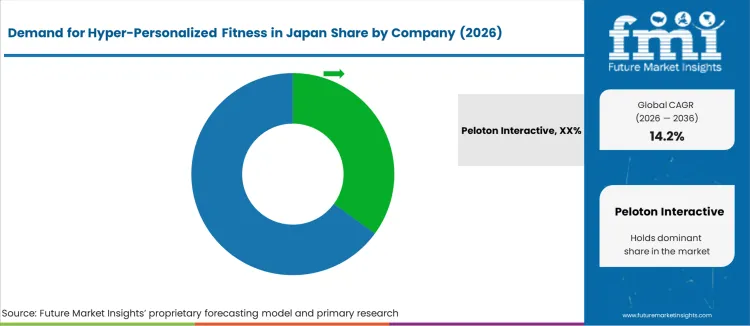
The demand for hyper‑personalized fitness in Japan is growing as consumers increasingly seek convenience, flexibility, and tailored fitness experiences that align with their unique health goals and lifestyles. Japan's busy urban environments and the rise of compact living spaces have led many individuals to prefer home‑based fitness solutions over traditional gym memberships. There is a growing awareness of the importance of health and wellness, with many people looking for personalized approaches that help improve physical and mental well‑being. Advances in technology, such as wearable devices, AI‑driven coaching, and connected home fitness equipment, make it easier to create customized workout plans, monitor performance, and track progress over time, allowing individuals to receive real‑time feedback and adjust routines as needed.
Key providers in the hyper‑personalized fitness space include Peloton Interactive, Ergotron, Inc., Curiouser Products Inc., Whoop, and Tonal. Peloton, holding a significant 35.0% industry share, leads with its interactive fitness offerings, including cycling and strength training programs that are paired with digital coaching and progress tracking. Whoop focuses on wearable health devices that track sleep, recovery, and activity, providing highly personalized fitness data. These companies, among others, are transforming the fitness landscape by offering flexible and customizable solutions that cater to individual fitness needs.
Hyper‑personalized fitness aligns well with Japan’s growing emphasis on health, wellness, and convenience. As more people adopt healthier lifestyles, the ability to access tailored fitness plans that fit into their busy lives is becoming more important. The ability to train at home and receive customized feedback appeals to those seeking privacy, comfort, and efficiency. With the integration of data from wearables and apps, fitness routines are becoming more dynamic and suited to individual needs, making hyper‑personalized fitness a popular and sustainable choice in Japan’s evolving wellness culture.
Key Players in Japan Hyper-Personalized Fitness Demand
- Peloton Interactive
- Ergotron, Inc.
- Curiouser Products Inc
- Whoop
- Tonal
Scope of the Report
| Metric | Value |
|---|---|
| Quantitative Units | USD 256.38 million to USD 967.26 million, at a CAGR of 14.2% |
| Market Definition | Based on FMI's report, the Hyper-Personalized Fitness in Japan market covers wearable fitness devices, AI-driven smart exercise equipment, and connected software platforms that use biometric data, behavioral analytics, and machine learning to deliver individualized training, nutrition, and recovery prescriptions specifically within the Japanese consumer and corporate wellness ecosystem. |
| Segmentation | Product Type: Wearables, Smart Equipment, Others; Sales Channels: Direct Sales, Indirect Sales |
| Regions Covered | Kyushu & Okinawa, Kanto, Kansai, Chubu, Tohoku, Rest of Japan |
| Key Companies Profiled | Peloton Interactive, Ergotron, Inc., Curiouser Products Inc, Whoop, Tonal |
| Forecast Period | 2026 to 2036 |
| Approach | Hybrid bottom-up methodology combining installed base metrics with regulatory compliance adoption curves and primary research validation. |
Japan Hyper-Personalized Fitness Demand by Key Segments
Product Type
- Wearables
- Smart Equipment
- Others
Sales Channels
- Direct Sales
- Indirect Sales
Region
- Kyushu & Okinawa
- Kanto
- Kansai
- Chubu
- Tohoku
- Rest of Japan
Bibliography
- 1. Ministry of Economy, Trade and Industry (METI). (2025). Digital Health and Fitness Technology Industry Report. Government of Japan.
- 2. Japan Sports Agency. (2025). Sport Basic Plan: Promotion of Health through Physical Activity. Japan Sports Agency.
- 3. World Health Organization. (2024). Global Status Report on Physical Activity 2024. WHO.
- 4. Organisation for Economic Co-operation and Development. (2025). Health at a Glance: OECD Indicators. OECD Publishing.
- 5. International Organization for Standardization. (2024). ISO 20957: Stationary Training Equipment, Safety Requirements and Test Methods. ISO.
- 6. Ministry of Health, Labour and Welfare. (2025). National Health Promotion in the 21st Century (Health Japan 21). MHLW.
This bibliography is provided for reader reference. The full Future Market Insights report contains the complete reference list with primary research documentation.
Frequently Asked Questions
How large is the Hyper-Personalized Fitness in Japan market in 2026?
The Hyper-Personalized Fitness in Japan market is estimated to be valued at USD 256.38 million in 2026.
What will be the market size of Hyper-Personalized Fitness in Japan by 2036?
Market size for Hyper-Personalized Fitness in Japan is projected to reach USD 967.26 million by 2036.
What is the expected CAGR for Hyper-Personalized Fitness in Japan between 2026 and 2036?
The Hyper-Personalized Fitness in Japan market is expected to grow at a CAGR of 14.2% between 2026 and 2036.
Which Product Type leads the Hyper-Personalized Fitness in Japan market in 2026?
Wearables accounts for 47% share in 2026 by Product Type.
Which region is projected to grow fastest?
Kyushu & Okinawa is projected to grow at a CAGR of 17.7% during 2026 to 2036.
What does this report include in its scope?
The report covers market sizing, segmentation analysis, regional forecasts, competitive landscape evaluation, and forecast projections from 2026 to 2036.
How does FMI build and validate the Hyper-Personalized Fitness in Japan forecast?
Forecasting models apply a bottom-up methodology starting with installed base metrics and cross-validate projections against quarterly revenue volumes and regulatory compliance adoption data.
Preview the report firsthand - request a free sample
Get SampleGet the brochure for pricing and purchase details.
Get PDFTable of Content
- Executive Summary
- Global Market Outlook
- Demand-side Trends
- Supply-side Trends
- Technology Roadmap Analysis
- Analysis and Recommendations
- Market Overview
- Market Coverage / Taxonomy
- Market Definition / Scope / Limitations
- Research Methodology
- Chapter Orientation
- Analytical Lens and Working Hypotheses
- Market Structure, Signals, and Trend Drivers
- Desk Research Programme (Secondary Evidence)
- Company Annual and Sustainability Reports
- Peer-reviewed Journals and Academic Literature
- Corporate Websites, Product Literature, and Technical Notes
- Earnings Decks and Investor Briefings
- Statutory Filings and Regulatory Disclosures
- Technical White Papers and Standards Notes
- Trade Journals, Industry Magazines, and Analyst Briefs
- Conference Proceedings, Webinars, and Seminar Materials
- Government Statistics Portals and Public Data Releases
- Press Releases and Reputable Media Coverage
- Specialist Newsletters and Curated Briefings
- Sector Databases and Reference Repositories
- FMI Internal Proprietary Databases and Historical Market Datasets
- Subscription Datasets and Paid Sources
- Social Channels, Communities, and Digital Listening Inputs
- Additional Desk Sources
- Expert Input and Fieldwork (Primary Evidence)
- Primary Modes
- Qualitative Interviews and Expert Elicitation
- Quantitative Surveys and Structured Data Capture
- Blended Approach
- Why Primary Evidence is Used
- Field Techniques
- Interviews
- Surveys
- Focus Groups
- Observational and In-context Research
- Social and Community Interactions
- Stakeholder Universe Engaged
- C-suite Leaders
- Board Members
- Presidents and Vice Presidents
- R&D and Innovation Heads
- Technical Specialists
- Domain Subject-matter Experts
- Scientists
- Physicians and Other Healthcare Professionals
- Governance, Ethics, and Data Stewardship
- Research Ethics
- Data Integrity and Handling
- Primary Modes
- Tooling, Models, and Reference Databases
- Data Engineering and Model Build
- Data Acquisition and Ingestion
- Cleaning, Normalisation, and Verification
- Synthesis, Triangulation, and Analysis
- Quality Assurance and Audit Trail
- Market Background
- Market Dynamics
- Drivers
- Restraints
- Opportunity
- Trends
- Scenario Forecast
- Demand in Optimistic Scenario
- Demand in Likely Scenario
- Demand in Conservative Scenario
- Opportunity Map Analysis
- Product Life Cycle Analysis
- Supply Chain Analysis
- Investment Feasibility Matrix
- Value Chain Analysis
- PESTLE and Porter’s Analysis
- Regulatory Landscape
- Regional Parent Market Outlook
- Production and Consumption Statistics
- Import and Export Statistics
- Market Dynamics
- Global Market Analysis 2021 to 2025 and Forecast, 2026 to 2036
- Historical Market Size Value (USD Million) Analysis, 2021 to 2025
- Current and Future Market Size Value (USD Million) Projections, 2026 to 2036
- Y-o-Y Growth Trend Analysis
- Absolute $ Opportunity Analysis
- Global Market Pricing Analysis 2021 to 2025 and Forecast 2026 to 2036
- Global Market Analysis 2021 to 2025 and Forecast 2026 to 2036, By Product Type
- Introduction / Key Findings
- Historical Market Size Value (USD Million) Analysis By Product Type , 2021 to 2025
- Current and Future Market Size Value (USD Million) Analysis and Forecast By Product Type , 2026 to 2036
- Wearables
- Smart Equipment
- Others
- Wearables
- Y-o-Y Growth Trend Analysis By Product Type , 2021 to 2025
- Absolute $ Opportunity Analysis By Product Type , 2026 to 2036
- Global Market Analysis 2021 to 2025 and Forecast 2026 to 2036, By Sales Channels
- Introduction / Key Findings
- Historical Market Size Value (USD Million) Analysis By Sales Channels, 2021 to 2025
- Current and Future Market Size Value (USD Million) Analysis and Forecast By Sales Channels, 2026 to 2036
- Direct Sales
- Indirect Sales
- Direct Sales
- Y-o-Y Growth Trend Analysis By Sales Channels, 2021 to 2025
- Absolute $ Opportunity Analysis By Sales Channels, 2026 to 2036
- Global Market Analysis 2021 to 2025 and Forecast 2026 to 2036, By Region
- Introduction
- Historical Market Size Value (USD Million) Analysis By Region, 2021 to 2025
- Current Market Size Value (USD Million) Analysis and Forecast By Region, 2026 to 2036
- North America
- Latin America
- Western Europe
- Eastern Europe
- East Asia
- South Asia and Pacific
- Middle East & Africa
- Market Attractiveness Analysis By Region
- North America Market Analysis 2021 to 2025 and Forecast 2026 to 2036, By Country
- Historical Market Size Value (USD Million) Trend Analysis By Market Taxonomy, 2021 to 2025
- Market Size Value (USD Million) Forecast By Market Taxonomy, 2026 to 2036
- By Country
- USA
- Canada
- Mexico
- By Product Type
- By Sales Channels
- By Country
- Market Attractiveness Analysis
- By Country
- By Product Type
- By Sales Channels
- Key Takeaways
- Latin America Market Analysis 2021 to 2025 and Forecast 2026 to 2036, By Country
- Historical Market Size Value (USD Million) Trend Analysis By Market Taxonomy, 2021 to 2025
- Market Size Value (USD Million) Forecast By Market Taxonomy, 2026 to 2036
- By Country
- Brazil
- Chile
- Rest of Latin America
- By Product Type
- By Sales Channels
- By Country
- Market Attractiveness Analysis
- By Country
- By Product Type
- By Sales Channels
- Key Takeaways
- Western Europe Market Analysis 2021 to 2025 and Forecast 2026 to 2036, By Country
- Historical Market Size Value (USD Million) Trend Analysis By Market Taxonomy, 2021 to 2025
- Market Size Value (USD Million) Forecast By Market Taxonomy, 2026 to 2036
- By Country
- Germany
- UK
- Italy
- Spain
- France
- Nordic
- BENELUX
- Rest of Western Europe
- By Product Type
- By Sales Channels
- By Country
- Market Attractiveness Analysis
- By Country
- By Product Type
- By Sales Channels
- Key Takeaways
- Eastern Europe Market Analysis 2021 to 2025 and Forecast 2026 to 2036, By Country
- Historical Market Size Value (USD Million) Trend Analysis By Market Taxonomy, 2021 to 2025
- Market Size Value (USD Million) Forecast By Market Taxonomy, 2026 to 2036
- By Country
- Russia
- Poland
- Hungary
- Balkan & Baltic
- Rest of Eastern Europe
- By Product Type
- By Sales Channels
- By Country
- Market Attractiveness Analysis
- By Country
- By Product Type
- By Sales Channels
- Key Takeaways
- East Asia Market Analysis 2021 to 2025 and Forecast 2026 to 2036, By Country
- Historical Market Size Value (USD Million) Trend Analysis By Market Taxonomy, 2021 to 2025
- Market Size Value (USD Million) Forecast By Market Taxonomy, 2026 to 2036
- By Country
- China
- Japan
- South Korea
- By Product Type
- By Sales Channels
- By Country
- Market Attractiveness Analysis
- By Country
- By Product Type
- By Sales Channels
- Key Takeaways
- South Asia and Pacific Market Analysis 2021 to 2025 and Forecast 2026 to 2036, By Country
- Historical Market Size Value (USD Million) Trend Analysis By Market Taxonomy, 2021 to 2025
- Market Size Value (USD Million) Forecast By Market Taxonomy, 2026 to 2036
- By Country
- India
- ASEAN
- Australia & New Zealand
- Rest of South Asia and Pacific
- By Product Type
- By Sales Channels
- By Country
- Market Attractiveness Analysis
- By Country
- By Product Type
- By Sales Channels
- Key Takeaways
- Middle East & Africa Market Analysis 2021 to 2025 and Forecast 2026 to 2036, By Country
- Historical Market Size Value (USD Million) Trend Analysis By Market Taxonomy, 2021 to 2025
- Market Size Value (USD Million) Forecast By Market Taxonomy, 2026 to 2036
- By Country
- Kingdom of Saudi Arabia
- Other GCC Countries
- Turkiye
- South Africa
- Other African Union
- Rest of Middle East & Africa
- By Product Type
- By Sales Channels
- By Country
- Market Attractiveness Analysis
- By Country
- By Product Type
- By Sales Channels
- Key Takeaways
- Key Countries Market Analysis
- USA
- Pricing Analysis
- Market Share Analysis, 2025
- By Product Type
- By Sales Channels
- Canada
- Pricing Analysis
- Market Share Analysis, 2025
- By Product Type
- By Sales Channels
- Mexico
- Pricing Analysis
- Market Share Analysis, 2025
- By Product Type
- By Sales Channels
- Brazil
- Pricing Analysis
- Market Share Analysis, 2025
- By Product Type
- By Sales Channels
- Chile
- Pricing Analysis
- Market Share Analysis, 2025
- By Product Type
- By Sales Channels
- Germany
- Pricing Analysis
- Market Share Analysis, 2025
- By Product Type
- By Sales Channels
- UK
- Pricing Analysis
- Market Share Analysis, 2025
- By Product Type
- By Sales Channels
- Italy
- Pricing Analysis
- Market Share Analysis, 2025
- By Product Type
- By Sales Channels
- Spain
- Pricing Analysis
- Market Share Analysis, 2025
- By Product Type
- By Sales Channels
- France
- Pricing Analysis
- Market Share Analysis, 2025
- By Product Type
- By Sales Channels
- India
- Pricing Analysis
- Market Share Analysis, 2025
- By Product Type
- By Sales Channels
- ASEAN
- Pricing Analysis
- Market Share Analysis, 2025
- By Product Type
- By Sales Channels
- Australia & New Zealand
- Pricing Analysis
- Market Share Analysis, 2025
- By Product Type
- By Sales Channels
- China
- Pricing Analysis
- Market Share Analysis, 2025
- By Product Type
- By Sales Channels
- Japan
- Pricing Analysis
- Market Share Analysis, 2025
- By Product Type
- By Sales Channels
- South Korea
- Pricing Analysis
- Market Share Analysis, 2025
- By Product Type
- By Sales Channels
- Russia
- Pricing Analysis
- Market Share Analysis, 2025
- By Product Type
- By Sales Channels
- Poland
- Pricing Analysis
- Market Share Analysis, 2025
- By Product Type
- By Sales Channels
- Hungary
- Pricing Analysis
- Market Share Analysis, 2025
- By Product Type
- By Sales Channels
- Kingdom of Saudi Arabia
- Pricing Analysis
- Market Share Analysis, 2025
- By Product Type
- By Sales Channels
- Turkiye
- Pricing Analysis
- Market Share Analysis, 2025
- By Product Type
- By Sales Channels
- South Africa
- Pricing Analysis
- Market Share Analysis, 2025
- By Product Type
- By Sales Channels
- USA
- Market Structure Analysis
- Competition Dashboard
- Competition Benchmarking
- Market Share Analysis of Top Players
- By Regional
- By Product Type
- By Sales Channels
- Competition Analysis
- Competition Deep Dive
- Peloton Interactive
- Overview
- Product Portfolio
- Profitability by Market Segments (Product/Age /Sales Channel/Region)
- Sales Footprint
- Strategy Overview
- Marketing Strategy
- Product Strategy
- Channel Strategy
- Ergotron, Inc.
- Curiouser Products Inc
- Whoop
- Tonal
- Peloton Interactive
- Competition Deep Dive
- Assumptions & Acronyms Used


