

- Industry Size (2026)
- USD 5.5 Bn
- Forecast (2036)
- USD 31.1 Bn
- CAGR (2026 to 2036)
- 18.9%
Hyper-Personalized Fitness Market Forecast and Outlook 2026 to 2036
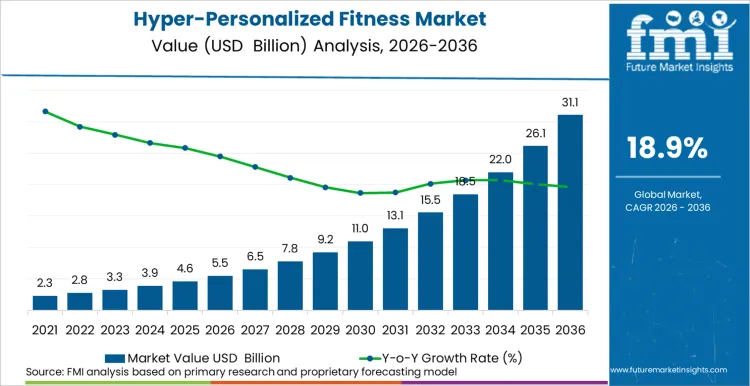
The global hyper-personalized fitness sector is on track to achieve a valuation of USD 31.1 billion by 2036, accelerating from USD 5.5 billion in 2026 at a CAGR of 18.9%. As per Future Market Insights, expansion is structurally underpinned by the rapid integration of wearable biometric data with AI coaching engines and the convergence of consumer fitness platforms with clinical health records. EGYM and Playlist announced a definitive agreement to merge in January 2026, with the transaction including USD 785 million in new equity investments, creating the largest integrated wellness technology platform globally. This scale of capital deployment compels fitness technology providers to consolidate hardware, software, and community access into unified ecosystems. Simultaneously the regulatory landscape is shifting from fragmented proprietary data silos to standardized API frameworks that bridge consumer wellness data with clinical medicine.
Phillipp Roesch-Schlanderer, CEO of EGYM, stated: 'We are uniting smart training equipment, club and studio access, management software, corporate wellness, and personalized AI training into one connected ecosystem.' This confirms that the competitive battleground has shifted from point solutions to full-stack platform integration.
FMI opines that the operational reality for fitness technology companies is defined by the race to embed clinical-grade intelligence into consumer workflows. WHOOP launched Advanced Labs in December 2025, integrating external lab results with 24/7 wearable data. Peloton launched the Pro Series in October 2025, integrating AI-powered Peloton IQ. Apple expanded Fitness+ to 28 new markets in December 2025 with AI-generated Custom Plans. iFIT acquired Reform RX in May 2025 to integrate connected Pilates into its personalized training ecosystem. As per FMI, these launches confirm that hyper-personalization has moved from niche wearable features to mass-market platform capability.
Key Takeaways
The hyper-personalized fitness market is a platform-controlled ecosystem where power concentrates among integrated technology providers such as Apple, Peloton, EGYM, and WHOOP, who own the data pipeline from biometric capture through AI processing to personalized output delivery.
Pricing asymmetry favors platform operators who monetize recurring subscriptions against near-zero marginal cost of personalized AI outputs, while hardware margins compress and gym operators face escalating software licensing fees.
Sourcing fragility centers on wearable sensor component supply chains and the dependence on a small number of AI model providers where semiconductor disruptions can disable personalization stacks.
Brand and compliance risks are intensifying as wearable health data crosses into clinical territory, raising questions about medical device classification, data privacy regulations, and liability for AI-generated health recommendations.
Geographically, North America leads in platform adoption and venture funding, Europe benefits from EGYM-led gym equipment integration, Asia Pacific is driven by smartphone fitness app proliferation in India and China, and the Middle East is emerging as a corporate wellness hub.
FMI analysts are of the opinion that the strategic reframing is the transition from isolated fitness tracking to clinically integrated wellness management where wearable-EHR bridges and AI coaching determine competitive advantage.
Summary of Hyper-Personalized Fitness Market
What Is Growth Outlook for Hyper-Personalized Fitness Market as per Future Market Insights Projection?
Future Market Insights projects the hyper-personalized fitness industry to expand at a CAGR of 18.9% from 2026 to 2036, increasing from USD 5.5 Billion in 2026 to USD 31.1 Billion by 2036.
FMI Research Approach: FMI proprietary forecasting model based on connected fitness device penetration and subscription revenue analysis.
How Do FMI Analysts Perceive Hyper-Personalized Fitness Market to Evolve?
FMI analysts perceive the market evolving toward clinically integrated wellness platforms where wearable biometrics, AI coaching, and electronic health records converge into a unified health management system.
FMI Research Approach: Wearable-EHR standardized API framework developments and EGYM/Playlist merger analysis.
Which Country Holds Largest Share in Global Hyper-Personalized Fitness Market?
The United States holds a significant share supported by the largest concentration of connected fitness platforms, venture capital funding, and early adoption of wearable-clinical integration.
FMI Research Approach: FMI country-level revenue modeling by device penetration and subscription revenue.
How Large Will Hyper-Personalized Fitness Market Be by 2036?
The global hyper-personalized fitness market is projected to reach USD 31.1 Billion by 2036.
FMI Research Approach: FMI long-term revenue forecast derived from connected device adoption curves and subscription economics.
What Is Definition of Hyper-Personalized Fitness Market?
The hyper-personalized fitness market includes AI-driven fitness platforms, wearable biometric devices, connected gym equipment, personalized coaching software, and integrated wellness management systems that use individual physiological data to customize exercise, nutrition, and recovery protocols.
FMI Research Approach: FMI market taxonomy and inclusion-exclusion framework.
What Are Globally Unique Trends Shaping Hyper-Personalized Fitness Market?
Globally unique trends include the merger of consumer fitness and clinical health data through standardized APIs, the integration of blood biomarkers with wearable metrics, and the consolidation of gym equipment, software, and community access into unified platforms.
FMI Research Approach: WHOOP Advanced Labs disclosures and EGYM/Playlist merger terms.
Hyper-Personalized Fitness Market Key Takeaways
| Metric | Details |
|---|---|
| Industry Size (2026) | USD 5.5 Billion |
| Industry Value (2036) | USD 31.1 Billion |
| CAGR (2026 to 2036) | 18.9% |
Source: Future Market Insights (FMI) analysis, based on proprietary forecasting model and primary research
Semi-annual Market Update for Hyper-Personalized Fitness Market
The table below presents the expected CAGR for the global hyper-personalized fitness market over several semi-annual periods spanning from 2025 to 2035. In the first half (H1) of the decade from 2025 to 2035, the market is predicted to grow at a CAGR of 19.0%, followed by a slightly lower growth rate of 18.4% in the second half (H2) of the same decade.
| Particular | Value CAGR |
|---|---|
| H1 | 19.0% (2025 to 2035) |
| H2 | 18.4% (2025 to 2035) |
| H1 | 19.1% (2026 to 2036) |
| H2 | 18.6% (2026 to 2036) |
Moving into the subsequent period, from H1 2026 to H2 2036, the CAGR is projected to increase slightly to 19.0% in the first half and remain relatively lower at 18.6% in the second half. In the first half (H1), the sector witnessed an increase of 192 BPS while in the second half (H2), the sector witnessed a decrease of 186 BPS.
Top Hyper-Personalized Fitness Market Dynamics and Industry Trends
Rising Demand for Personalization in Fitness Solutions
The increasing focus on individual health and wellness is a major driver of the hyper-personalized fitness market. Consumers are shifting away from one-size-fits-all fitness approaches, demanding solutions tailored to their unique physiological metrics, fitness goals, and preferences.
According to a report by the Global Wellness Institute, 73% of fitness enthusiasts in 2023 expressed a preference for personalized workout and nutrition plans, a significant increase from 58% in 2020. This demand has fueled innovations in wearables, AI-driven apps, and integrated fitness platforms.
Technological Advancements as Market Catalysts
Wearable fitness technology and digital platforms play a pivotal role in the market’s growth. Devices like Fitbit, Apple Watch, and Garmin trackers now feature advanced health-monitoring capabilities, including heart rate variability, sleep analysis, and oxygen saturation levels, driving consumer engagement.
The International Data Corporation (IDC) reported that the shipment of wearables reached 533.6 million units in 2023, with over 60% of these integrated with hyper-personalized fitness apps. Meanwhile, digital fitness platforms are leveraging AI and big data analytics to deliver increasingly customized user experiences, with Peloton and Mirror seeing a 20% increase in subscriptions year-over-year.
Increasing Adoption of Hybrid and Virtual Fitness Models
The COVID-19 pandemic accelerated the adoption of hybrid fitness models, blending in-person training with digital solutions. By 2023, over 65% of fitness enthusiasts were engaging in virtual or hybrid training sessions, as noted by a survey from the American College of Sports Medicine (ACSM). Platforms like Freeletics and MyFitnessPal have seen user engagement soar, with a 30% growth in mobile app usage during the past two years. This trend is fueled by convenience, affordability, and the ability to customize fitness routines to fit busy lifestyles.
Emerging Opportunities in Genomic and AI-Driven Fitness
Integrating genomic insights and AI has unlocked new opportunities in hyper-personalized fitness. Companies like DNAFit and 23andMe now offer fitness recommendations based on genetic markers, targeting nutrition, endurance, and recovery optimization. According to the Personalized Nutrition and Fitness Association, 35% of consumers are willing to pay a premium for fitness solutions tailored to their genetic profiles, showcasing a significant area of growth.
Comparison of Historical vs Future Outlook on Changing Consumer Trends for Hyper-Personalized Fitness Industry
The global hyper-personalized fitness market experienced a compound annual growth rate (CAGR) of 18.5% from 2021 to 2025. By 2025, the market had escalated to USD 1,978.9 million, a substantial increase from USD 3,902.1 million in 2021. The COVID-19 pandemic accelerated the adoption of digital fitness platforms and home-based personalized training programs as gym closures and social distancing measures reshaped consumer habits.
Sales surged for wearables, connected fitness equipment, and digital fitness subscriptions, with major players like Peloton, Apple, and Garmin reporting record revenues. This period also saw technological advancements in AI-driven fitness apps, further enhancing user adoption across various demographics.
The same trend extends to the forecast period ranging from 2026 to 2036 where there is an expected increase in the market size with the CAGR of 18.9% till 2036. The additional growth is expected to be driven by technological innovations like AI, IoT, and genomic-based fitness solutions. Consumer expectations for data-driven, outcome-oriented fitness plans are expected to rise, supported by increased disposable incomes and greater health awareness globally.
The integration of augmented reality (AR) and virtual reality (VR) in fitness will open new avenues for immersive and tailored workout experiences. Additionally, corporate wellness programs and senior-focused personalized fitness solutions will contribute to sustained demand, positioning the market for robust expansion during this period.
Key Hyper-Personalized Fitness Market Players and Concentration
Tier-1 players seize the largest market share of around 50% and have revenues of more than USD 1,950.0 million in 2023 in the hyper-personalized fitness market. These leading companies are recognized for their high-quality products, strong brand reputation, and significant market share.
They often lead in innovation and design. This commitment makes sure that good quality products are delivered that are appropriate for a wide range of populations. Some of the Tier-1 companies are Peloton Interactive, Garmin Ltd, Fitbit Inc., and Nike Training Club among others.
Tier-2 market players in the hyper-personalized fitness include companies that have revenues between USD 1,365.7 million, hence occupying a strategic market position in niche regional and specialty market segments. The present emphasis on specific segments and customer-oriented requirements, enables them to offer predesigned solutions to address specific recovery considerations. Some of the Tier-2 companies that can be associated with this segment include MyFitnessPal, Whoop, Tonal, and Echelon Fitness among others
Tier-3 key manufacturers are small-scale firms whose revenues are less than USD 585.3 Million; they are involved in small-scale niche markets and provide products in the target market. Such companies may target special populations or specific clientele, offering specialized equipment that is intended to meet specific recovery requirements.
They have strength because they can provide solutions that other international firms are best suited to provide depending on local consumers’ tastes and needs. The Tier-3 companies performing in the market are Ergotron Inc., Curiouser, Products Inc., Fiture, and Freeletics among others.
Analysis of Top Countries Offering, Developing, and Using Hyper-Personalized Fitness
The following section delves into the global market for hyper-personalized fitness, focusing on demand across key countries and regions, including North America, Asia Pacific, and Europe.
The United States is forecasted to dominate the North American market, holding a substantial share of 58.9% by 2034. This dominance is driven by high workplace wellness awareness and corporate adoption. Additionally, the USA market benefits from the presence of numerous leading brands and a highly developed distribution network. Meanwhile, Canada is projected to grow at a robust CAGR of 7.8% during the same period.
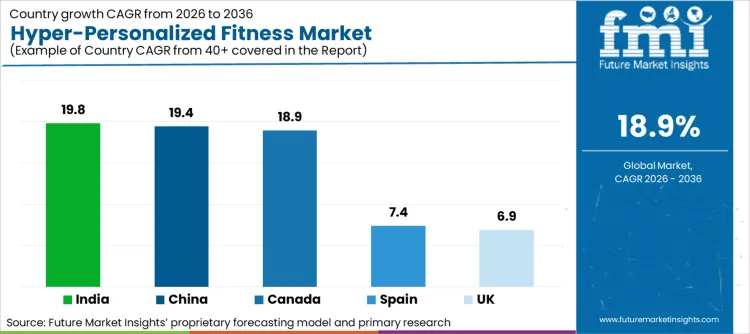
| Countries | Value CAGR (2026 to 2036) |
|---|---|
| USA | 5.7% |
| Canada | 18.9% |
| Germany | 6.6% |
| UK | 6.9% |
| Spain | 7.4% |
| China | 19.4% |
| India | 19.8% |
India's Growth Is Fueled by Increasing Disposable Incomes, Widespread Smartphone Adoption, And Rising Health Consciousness Among Its Growing Middle Class
India is expected to witness the prominent growth in the global hyper-personalized fitness market, with a projected CAGR of 19.8% during 2026 to 2036. The market is fueled by increasing disposable incomes, widespread smartphone adoption, and a growing middle class prioritizing health and wellness.
With over 700 million smartphone users in 2023, the proliferation of fitness apps like Cure.fit and HealthifyMe has soared, registering a 30% annual growth in downloads. According to the India Brand Equity Foundation (IBEF), the middle-class population in India is projected to reach 580 million by 2026, with rising discretionary spending on health-focused services. With 62% of urban consumers prioritizing fitness in their daily routines supports the increasing adoption of digital fitness platforms and wearable devices.
China's Market Is Driven by Rising Urbanization and Government Support for Health Initiatives
Canada is projected to achieve a robust CAGR of 19.4%, making it one of the fastest-growing markets for hyper-personalized fitness. This growth is attributed by rapid urbanization and strong government backing for health initiatives under programs like the Healthy China 2030 plan.
The Chinese fitness app market witnessed a ~20% growth in active users in 2023, with platforms like Keep and FitTime leading the charge. Additionally, government policies promoting physical activity and fitness infrastructure investment are key enablers, with USD 15 billion allocated for sports and fitness development in 2022. This environment supports the rise of hyper-personalized fitness offerings tailored to urban lifestyles.
The UK Market Is Boosted by High Adoption Rates of Wearable Fitness Technologies
UK’s hyper-personalized fitness market is expected to grow at a CAGR of 6.9%, reflecting a high adoption rates of wearable fitness technologies.
Over 25 million wearable devices were in use in 2023, with Fitbit, Garmin, and Apple Watch dominating the market. A survey by the Office for National Statistics (ONS) revealed that 68% of UK adults actively monitor their fitness metrics using wearables or apps.
The integration of these devices with hyper-personalized platforms, such as MyFitnessPal and Peloton, has driven consumer engagement, with the digital fitness segment growing by 18% annually. Additionally, the UK's tech-savvy population and well-established digital infrastructure have made it a lucrative market for innovation in hyper-personalized fitness solutions.
Hyper-Personalized Fitness Industry Analysis by Top Investment Segments
The section contains information about the leading segments in the industry. By product type, wearables segment is estimated to grow at a CAGR of 7.4% throughout 2035. Additionally, the direct sales in terms of sales channel segment is projected to expand at 6.9% till 2035.
Wearable Segment Claims High Demand in Hyper-Personalized Fitness Market
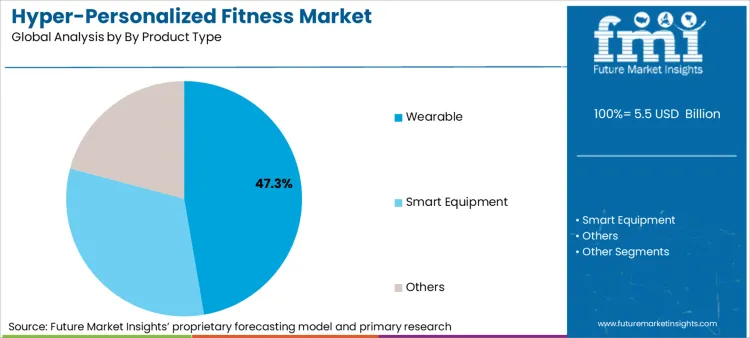
| Product Type | Wearable |
|---|---|
| Value Share (2035) | 47.3% |
The wearable segment dominates the global hyper-personalized fitness market, projected to hold a value share of 47.3% by 2035, highlighting its pivotal role in driving personalized fitness solutions.
The growth is attributed by the increasing adoption of smartwatches, fitness bands, smart fitness and other wearable devices equipped with advanced health-monitoring features like heart rate tracking, sleep analysis, and oxygen saturation monitoring.
According to the International Data Corporation (IDC), shipments of wearable devices surpassed 533.6 million units globally in 2023, with significant contributions from leading players such as Fitbit, Apple, and Garmin. These devices not only provide real-time fitness data but also seamlessly integrate with AI-powered apps, offering users hyper-personalized insights and tailored fitness routines, fueling their widespread demand.
Direct Sales Channel Excel as the Leading Sales Channel for Hyper-Personalized Fitness
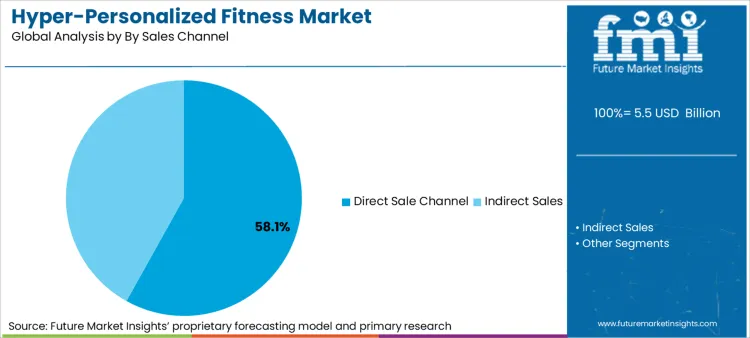
| Sales Channel | Direct Sales Channel |
|---|---|
| Value Share (2035) | 58.1% |
Direct sales channels dominate the global hyper-personalized fitness market, projected to account for a 58.1% value share by 2035. The growth is attributed to the increasing preference for direct-to-consumer (DTC) strategies employed by leading fitness brands and digital platforms. Companies like Peloton, Tonal, and Mirror excel in engaging customers through proprietary websites, exclusive apps, and in-person interactions, ensuring tailored recommendations and strong brand loyalty.
The direct sales model allows for deeper personalization, as companies collect user data to refine product offerings and deliver highly customized fitness solutions. Additionally, this channel eliminates intermediary costs, enabling competitive pricing while maintaining profitability, which resonates strongly with tech-savvy and health-conscious consumers.
Residential Segment Dominates the Hyper-Personalized Fitness Market
| Technology | Residential |
|---|---|
| Value Share (2035) | 61.3% |
The Residential Segment dominates the global Hyper-Personalized Fitness Market, accounting for a significant value share of 61.3% by 2035. The dominance is driven by the increasing consumer preference for home-based fitness solutions that offer convenience, flexibility, and the ability to customize workout routines based on individual needs and goals.
As advancements in technology, such as AI-driven personal trainers, wearable fitness devices, and virtual fitness platforms, continue to evolve, they provide users with highly tailored fitness experiences in the comfort of their homes. Additionally, the rising trend of remote work and a growing focus on health and wellness have accelerated demand for residential fitness solutions, making this segment the leading contributor to the market's growth.
Leading Suppliers of Hyper-Personalized Fitness
The hyper-personalized fitness market is rapidly evolving due to advancements in technology and increasing consumer demand for tailored experiences. The market is characterized by a blend of advanced technology, user-centric design, and a focus on delivering unique experiences that cater specifically to individual needs.
Recent Developments:
- In December 2025, Apple announced its largest expansion of Fitness+ to 28 new markets with AI-generated Custom Plans and generative AI voice dubbing technology.
- In December 2025, WHOOP introduced Advanced Labs and Healthspan metrics including WHOOP Age and Pace of Aging utilizing nine physiological markers.
- In October 2025, Peloton launched the Pro Series with AI-powered Peloton IQ software and integrated Precor support network.
Leading Hyper-Personalized Fitness Producers by Market Share
- Ergotron, Inc.
- Peloton Interactive
- Curiouser Products Inc
- Whoop
- Tonal
- Garmin Ltd
- Strava
- Fitbit Inc
- Nike Training Club
- MyFitnessPal
Market Definition
The hyper-personalized fitness market represents revenue generated from AI-driven fitness platforms, wearable biometric devices, connected gym equipment, and personalized coaching software.
Inclusions cover wearable fitness trackers, AI coaching subscriptions, connected equipment hardware and software, personalized nutrition platforms, and corporate wellness solutions.
Exclusions include generic fitness apparel, non-connected gym equipment, standard gym memberships without personalization features, and pharmaceutical wellness products.
Top Segments Studied in the Hyper-Personalized Fitness Market Report
By Product Type:
In terms of product type, the industry is divided into wearables, smart equipment, and others.
By Service:
The industry is classified by service as personal training, digital fitness platforms, wearable technology services, and others.
By Technology:
The industry is classified by technology as artificial intelligence, wearables and IoT, big data analytics, virtual reality (VR) and augmented reality (AR), and genomic-based solutions.
By End Use:
The industry is classified by end use as residential and commercial.
By Sales Channel:
In terms of sales channel, the industry is segregated into direct and indirect sales channel.
By Region:
Key countries of North America, Latin America, Europe, Asia Pacific, and Middle East and Africa (MEA) have been covered in the report.
Bibliography
- EGYM GmbH and Playlist Inc. (2026, January). Merger announcement and funding details. HPE Growth Partners.
- WHOOP Inc. (2025, December). Advanced Labs and Healthspan feature launch. WHOOP Newsroom.
- Peloton Interactive Inc. (2025, October). Pro Series and Peloton IQ launch. Peloton Investor Relations.
- Apple Inc. (2025, December). Fitness+ expansion to 28 new markets. Apple Newsroom.
Frequently Asked Questions
What is the current global market size?
The global market is valued at USD 5.5 Billion in 2026, driven by wearable-clinical integration and AI coaching adoption.
What is the projected CAGR?
The market is projected to grow at a CAGR of 18.9% from 2026 to 2036.
Which regions are experiencing fastest expansion?
North America leads with the largest platform concentration, followed by Europe with EGYM-led gym integration.
What are the primary drivers?
Wearable-clinical data convergence and platform consolidation through mergers like EGYM/Playlist are fueling adoption.
Who are the leading suppliers?
Apple, Peloton, EGYM, WHOOP, and Fitbit are key players differentiating through AI coaching depth and biometric integration.
Preview the report firsthand - request a free sample
Get SampleGet the brochure for pricing and purchase details.
Get PDFTable of Content
- Executive Summary
- Global Market Outlook
- Demand-side Trends
- Supply-side Trends
- Technology Roadmap Analysis
- Analysis and Recommendations
- Market Overview
- Market Coverage / Taxonomy
- Market Definition / Scope / Limitations
- Research Methodology
- Chapter Orientation
- Analytical Lens and Working Hypotheses
- Market Structure, Signals, and Trend Drivers
- Benchmarking and Cross-market Comparability
- Market Sizing, Forecasting, and Opportunity Mapping
- Research Design and Evidence Framework
- Desk Research Programme (Secondary Evidence)
- Company Annual and Sustainability Reports
- Peer-reviewed Journals and Academic Literature
- Corporate Websites, Product Literature, and Technical Notes
- Earnings Decks and Investor Briefings
- Statutory Filings and Regulatory Disclosures
- Technical White Papers and Standards Notes
- Trade Journals, Industry Magazines, and Analyst Briefs
- Conference Proceedings, Webinars, and Seminar Materials
- Government Statistics Portals and Public Data Releases
- Press Releases and Reputable Media Coverage
- Specialist Newsletters and Curated Briefings
- Sector Databases and Reference Repositories
- FMI Internal Proprietary Databases and Historical Market Datasets
- Subscription Datasets and Paid Sources
- Social Channels, Communities, and Digital Listening Inputs
- Additional Desk Sources
- Expert Input and Fieldwork (Primary Evidence)
- Primary Modes
- Qualitative Interviews and Expert Elicitation
- Quantitative Surveys and Structured Data Capture
- Blended Approach
- Why Primary Evidence is Used
- Field Techniques
- Interviews
- Surveys
- Focus Groups
- Observational and In-context Research
- Social and Community Interactions
- Stakeholder Universe Engaged
- C-suite Leaders
- Board Members
- Presidents and Vice Presidents
- R&D and Innovation Heads
- Technical Specialists
- Domain Subject-matter Experts
- Scientists
- Physicians and Other Healthcare Professionals
- Governance, Ethics, and Data Stewardship
- Research Ethics
- Data Integrity and Handling
- Primary Modes
- Tooling, Models, and Reference Databases
- Desk Research Programme (Secondary Evidence)
- Data Engineering and Model Build
- Data Acquisition and Ingestion
- Cleaning, Normalisation, and Verification
- Synthesis, Triangulation, and Analysis
- Quality Assurance and Audit Trail
- Market Background
- Market Dynamics
- Drivers
- Restraints
- Opportunity
- Trends
- Scenario Forecast
- Demand in Optimistic Scenario
- Demand in Likely Scenario
- Demand in Conservative Scenario
- Opportunity Map Analysis
- Product Life Cycle Analysis
- Supply Chain Analysis
- Investment Feasibility Matrix
- Value Chain Analysis
- PESTLE and Porter’s Analysis
- Regulatory Landscape
- Regional Parent Market Outlook
- Production and Consumption Statistics
- Import and Export Statistics
- Market Dynamics
- Global Market Analysis 2021 to 2025 and Forecast, 2026 to 2036
- Historical Market Size Value (USD Million) Analysis, 2021 to 2025
- Current and Future Market Size Value (USD Million) Projections, 2026 to 2036
- Y-o-Y Growth Trend Analysis
- Absolute $ Opportunity Analysis
- Global Market Pricing Analysis 2021 to 2025 and Forecast 2026 to 2036
- Global Market Analysis 2021 to 2025 and Forecast 2026 to 2036, By By Product Type
- Introduction / Key Findings
- Historical Market Size Value (USD Million) Analysis By By Product Type , 2021 to 2025
- Current and Future Market Size Value (USD Million) Analysis and Forecast By By Product Type , 2026 to 2036
- Wearable
- Smart Equipment
- Wearable
- Y-o-Y Growth Trend Analysis By By Product Type , 2021 to 2025
- Absolute $ Opportunity Analysis By By Product Type , 2026 to 2036
- Global Market Analysis 2021 to 2025 and Forecast 2026 to 2036, By By Sales Channel
- Introduction / Key Findings
- Historical Market Size Value (USD Million) Analysis By By Sales Channel, 2021 to 2025
- Current and Future Market Size Value (USD Million) Analysis and Forecast By By Sales Channel, 2026 to 2036
- Direct Sale Channel
- Indirect Sales
- Direct Sale Channel
- Y-o-Y Growth Trend Analysis By By Sales Channel, 2021 to 2025
- Absolute $ Opportunity Analysis By By Sales Channel, 2026 to 2036
- Global Market Analysis 2021 to 2025 and Forecast 2026 to 2036, By Region
- Introduction
- Historical Market Size Value (USD Million) Analysis By Region, 2021 to 2025
- Current Market Size Value (USD Million) Analysis and Forecast By Region, 2026 to 2036
- North America
- Latin America
- Western Europe
- Eastern Europe
- East Asia
- South Asia and Pacific
- Middle East & Africa
- Market Attractiveness Analysis By Region
- North America Market Analysis 2021 to 2025 and Forecast 2026 to 2036, By Country
- Historical Market Size Value (USD Million) Trend Analysis By Market Taxonomy, 2021 to 2025
- Market Size Value (USD Million) Forecast By Market Taxonomy, 2026 to 2036
- By Country
- USA
- Canada
- Mexico
- By By Product Type
- By By Sales Channel
- By Country
- Market Attractiveness Analysis
- By Country
- By By Product Type
- By By Sales Channel
- Key Takeaways
- Latin America Market Analysis 2021 to 2025 and Forecast 2026 to 2036, By Country
- Historical Market Size Value (USD Million) Trend Analysis By Market Taxonomy, 2021 to 2025
- Market Size Value (USD Million) Forecast By Market Taxonomy, 2026 to 2036
- By Country
- Brazil
- Chile
- Rest of Latin America
- By By Product Type
- By By Sales Channel
- By Country
- Market Attractiveness Analysis
- By Country
- By By Product Type
- By By Sales Channel
- Key Takeaways
- Western Europe Market Analysis 2021 to 2025 and Forecast 2026 to 2036, By Country
- Historical Market Size Value (USD Million) Trend Analysis By Market Taxonomy, 2021 to 2025
- Market Size Value (USD Million) Forecast By Market Taxonomy, 2026 to 2036
- By Country
- Germany
- UK
- Italy
- Spain
- France
- Nordic
- BENELUX
- Rest of Western Europe
- By By Product Type
- By By Sales Channel
- By Country
- Market Attractiveness Analysis
- By Country
- By By Product Type
- By By Sales Channel
- Key Takeaways
- Eastern Europe Market Analysis 2021 to 2025 and Forecast 2026 to 2036, By Country
- Historical Market Size Value (USD Million) Trend Analysis By Market Taxonomy, 2021 to 2025
- Market Size Value (USD Million) Forecast By Market Taxonomy, 2026 to 2036
- By Country
- Russia
- Poland
- Hungary
- Balkan & Baltic
- Rest of Eastern Europe
- By By Product Type
- By By Sales Channel
- By Country
- Market Attractiveness Analysis
- By Country
- By By Product Type
- By By Sales Channel
- Key Takeaways
- East Asia Market Analysis 2021 to 2025 and Forecast 2026 to 2036, By Country
- Historical Market Size Value (USD Million) Trend Analysis By Market Taxonomy, 2021 to 2025
- Market Size Value (USD Million) Forecast By Market Taxonomy, 2026 to 2036
- By Country
- China
- Japan
- South Korea
- By By Product Type
- By By Sales Channel
- By Country
- Market Attractiveness Analysis
- By Country
- By By Product Type
- By By Sales Channel
- Key Takeaways
- South Asia and Pacific Market Analysis 2021 to 2025 and Forecast 2026 to 2036, By Country
- Historical Market Size Value (USD Million) Trend Analysis By Market Taxonomy, 2021 to 2025
- Market Size Value (USD Million) Forecast By Market Taxonomy, 2026 to 2036
- By Country
- India
- ASEAN
- Australia & New Zealand
- Rest of South Asia and Pacific
- By By Product Type
- By By Sales Channel
- By Country
- Market Attractiveness Analysis
- By Country
- By By Product Type
- By By Sales Channel
- Key Takeaways
- Middle East & Africa Market Analysis 2021 to 2025 and Forecast 2026 to 2036, By Country
- Historical Market Size Value (USD Million) Trend Analysis By Market Taxonomy, 2021 to 2025
- Market Size Value (USD Million) Forecast By Market Taxonomy, 2026 to 2036
- By Country
- Kingdom of Saudi Arabia
- Other GCC Countries
- Turkiye
- South Africa
- Other African Union
- Rest of Middle East & Africa
- By By Product Type
- By By Sales Channel
- By Country
- Market Attractiveness Analysis
- By Country
- By By Product Type
- By By Sales Channel
- Key Takeaways
- Key Countries Market Analysis
- USA
- Pricing Analysis
- Market Share Analysis, 2025
- By By Product Type
- By By Sales Channel
- Canada
- Pricing Analysis
- Market Share Analysis, 2025
- By By Product Type
- By By Sales Channel
- Mexico
- Pricing Analysis
- Market Share Analysis, 2025
- By By Product Type
- By By Sales Channel
- Brazil
- Pricing Analysis
- Market Share Analysis, 2025
- By By Product Type
- By By Sales Channel
- Chile
- Pricing Analysis
- Market Share Analysis, 2025
- By By Product Type
- By By Sales Channel
- Germany
- Pricing Analysis
- Market Share Analysis, 2025
- By By Product Type
- By By Sales Channel
- UK
- Pricing Analysis
- Market Share Analysis, 2025
- By By Product Type
- By By Sales Channel
- Italy
- Pricing Analysis
- Market Share Analysis, 2025
- By By Product Type
- By By Sales Channel
- Spain
- Pricing Analysis
- Market Share Analysis, 2025
- By By Product Type
- By By Sales Channel
- France
- Pricing Analysis
- Market Share Analysis, 2025
- By By Product Type
- By By Sales Channel
- India
- Pricing Analysis
- Market Share Analysis, 2025
- By By Product Type
- By By Sales Channel
- ASEAN
- Pricing Analysis
- Market Share Analysis, 2025
- By By Product Type
- By By Sales Channel
- Australia & New Zealand
- Pricing Analysis
- Market Share Analysis, 2025
- By By Product Type
- By By Sales Channel
- China
- Pricing Analysis
- Market Share Analysis, 2025
- By By Product Type
- By By Sales Channel
- Japan
- Pricing Analysis
- Market Share Analysis, 2025
- By By Product Type
- By By Sales Channel
- South Korea
- Pricing Analysis
- Market Share Analysis, 2025
- By By Product Type
- By By Sales Channel
- Russia
- Pricing Analysis
- Market Share Analysis, 2025
- By By Product Type
- By By Sales Channel
- Poland
- Pricing Analysis
- Market Share Analysis, 2025
- By By Product Type
- By By Sales Channel
- Hungary
- Pricing Analysis
- Market Share Analysis, 2025
- By By Product Type
- By By Sales Channel
- Kingdom of Saudi Arabia
- Pricing Analysis
- Market Share Analysis, 2025
- By By Product Type
- By By Sales Channel
- Turkiye
- Pricing Analysis
- Market Share Analysis, 2025
- By By Product Type
- By By Sales Channel
- South Africa
- Pricing Analysis
- Market Share Analysis, 2025
- By By Product Type
- By By Sales Channel
- USA
- Market Structure Analysis
- Competition Dashboard
- Competition Benchmarking
- Market Share Analysis of Top Players
- By Regional
- By By Product Type
- By By Sales Channel
- Competition Analysis
- Competition Deep Dive
- Competition Deep Dive
- Assumptions & Acronyms Used


