

- Industry Size (2025)
- USD 12.5 Mn
- Forecast (2035)
- USD 17.1 Mn
- CAGR (2025 to 2035)
- 3.2%
Demand for L-Lysine Hydrochloride (HCL) in Japan Forecast and Outlook 2025 to 2035
The demand for L-Lysine Hydrochloride (HCL) in Japan is projected to grow from USD 12.5 million in 2025 to USD 17.1 million by 2035, reflecting a compound annual growth rate (CAGR) of 3.2%. L-Lysine HCL is a key amino acid used in animal feed, particularly for poultry, swine, and other livestock, to promote growth and improve feed efficiency. The demand for L-Lysine HCL is primarily driven by the need for protein-rich feed additives in the agricultural sector, which supports the growing food production needs. As Japan continues to focus on improving the productivity of its livestock industry and ensuring sustainable food production, L-Lysine HCL is expected to see steady demand over the next decade.
The market is also influenced by Japan’s emphasis on advanced agricultural practices and the adoption of functional feed ingredients. With increasing awareness of nutrition and health benefits in animal products, L-Lysine HCL plays a critical role in ensuring the quality of meat and dairy products. The continued focus on improving feed efficiency and reducing environmental impact will contribute to the market growth for L-Lysine HCL in Japan.
Quick Stats of the Demand for L-Lysine Hydrochloride (HCL) in Japan
- Demand for L-Lysine Hydrochloride (HCL) in Japan Value (2025): USD 12.5 million
- Demand for L-Lysine Hydrochloride (HCL) in Japan Forecast Value (2035): USD 17.1 million
- Demand for L-Lysine Hydrochloride (HCL) in Japan Forecast CAGR (2025 to 2035): 3.2%
- Demand for L-Lysine Hydrochloride (HCL) in Japan Leading Source: Fruits (43%)
- Demand for L-Lysine Hydrochloride (HCL) in Japan Key Growth Regions: Kyushu & Okinawa, Kanto, Kansai, Chubu, Tohoku, Rest of Japan
- Demand for L-Lysine Hydrochloride (HCL) in Japan Key Players: Ajinomoto Co., Inc., CJ CheilJedang Corporation, Kyowa Hakko Bio Co., Ltd., Evonik Industries AG, Meihua Holdings Group Co., Ltd.
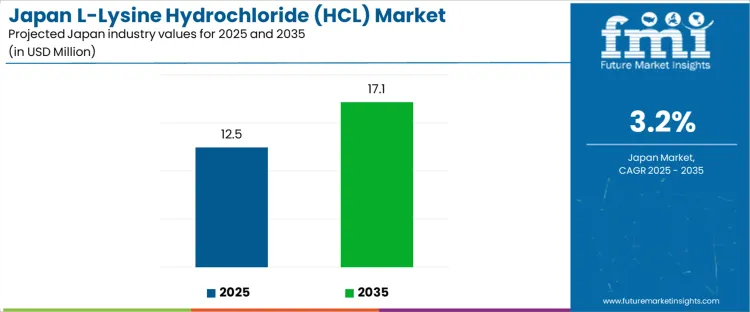
What is the Growth Forecast for the L-Lysine Hydrochloride (HCL) Market through 2035?
The early vs late growth curve comparison for the L-Lysine Hydrochloride (HCL) market in Japan shows consistent growth throughout the forecast period, with early growth gradually accelerating in the later years. Starting at USD 12.5 million in 2025, the market increases slowly to USD 12.9 million in 2026 and USD 13.3 million in 2027, reflecting moderate demand in the early phase as the agricultural sector continues to adopt L-Lysine HCL in feed formulations.
From 2027 to 2030, the growth rate remains steady, with the market reaching USD 13.7 million in 2028, USD 14.2 million in 2029, and USD 14.6 million in 2030. During this phase, the steady adoption of L-Lysine HCL as a critical ingredient in animal feed continues, driven by the growing emphasis on sustainable farming and the need for cost-effective feed solutions. By 2035, the market is projected to reach USD 17.1 million, showing a gradual acceleration in demand as livestock farming practices evolve and demand for high-quality animal products increases. The early vs late growth curve comparison reveals a predictable increase in market demand, with the latter years experiencing a slightly more pronounced acceleration as L-Lysine HCL becomes more widely adopted across the industry.
Key Takeaways of L-Lysine Hydrochloride (HCL) Industry in Japan
| Metric | Value |
|---|---|
| Industry Sales Value (2025) | USD 12.5 million |
| Industry Forecast Value (2035) | USD 17.1 million |
| Industry Forecast CAGR (2025 to 2035) | 3.2% |
What Is Driving the Demand for L Lysine Hydrochloride (HCl) in Japan?
The demand for L-Lysine HCl in Japan is driven primarily by its central role as an essential amino acid in animal nutrition. Poultry, swine, aquaculture, and pet food feed producers rely on L-Lysine HCl to balance diets, support growth, and improve feed conversion efficiency. The continued demand for meat, poultry, seafood, and other protein rich products supports consistent use of lysine as a feed additive. Domestic livestock and aquaculture operations in Japan increasingly require high quality feed inputs to meet standards of animal health, productivity, and product quality. Use of L-Lysine HCl enables formulation of nutritionally complete feeds without excessive crude protein content.
Future demand for L-Lysine HCl in Japan is expected to rise as demand for animal derived protein grows and livestock producers seek efficient, cost effective nutrition solutions. Expansion of aquaculture and poultry sectors may increase need for lysine supplementation. Demand could also grow if feed formulations shift toward more precise amino acid balancing rather than high protein feed, to reduce waste and costs. On the other hand, growth will depend on factors such as raw material availability, price volatility, and competition from alternative amino acids or protein sources.
What Are the Key Segments in L-Lysine Hydrochloride (HCL) Market in Japan?
The L-Lysine Hydrochloride (HCL) market in Japan is segmented by source and application. Fruits lead the source segment, accounting for 43% of the market share. In terms of application, processed food products dominate, holding 34.4% of the market. The demand for L-Lysine HCL is driven by its use as an essential amino acid in various food, feed, and pharmaceutical applications.
Which Source Drives L-Lysine Hydrochloride (HCL) Demand in Japan?
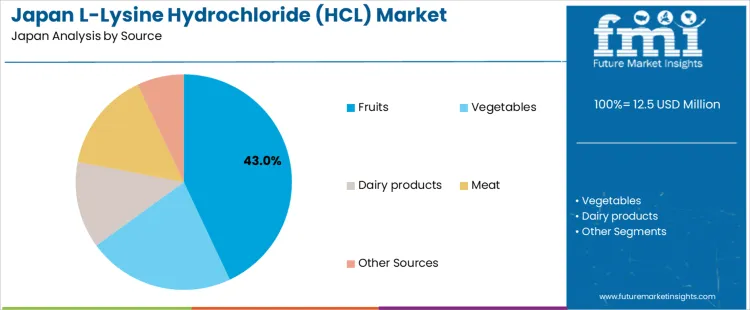
Fruits are the primary source of L-Lysine Hydrochloride (HCL) in Japan, representing 43% of the market share. L-Lysine is naturally present in various fruits, and the demand for fruit-based sources is increasing due to the growing trend toward plant-based and natural products. This source of L-Lysine HCL is widely used in dietary supplements, food fortification, and other health-related applications, as fruits offer a sustainable, vegan-friendly option. While vegetables, dairy products, meat, and other sources also contribute to the market, fruits remain the leading source due to their natural origin and alignment with current health and wellness trends in Japan.
Which Application Drives L-Lysine Hydrochloride (HCL) Demand in Japan?
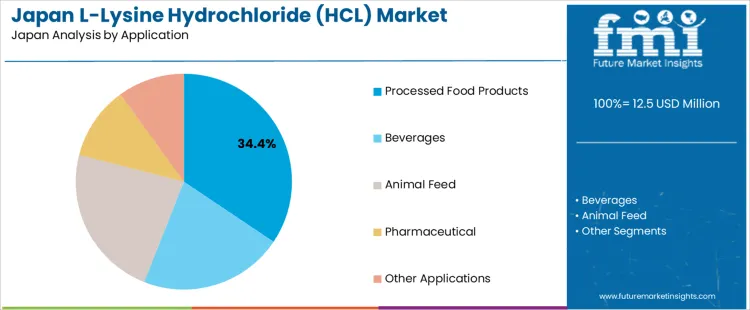
Processed food products are the largest application for L-Lysine Hydrochloride (HCL) in Japan, accounting for 34.4% of the market share. L-Lysine is used in the food industry to enhance protein content and improve the nutritional value of processed foods. It is commonly added to products like snacks, cereals, dairy products, and bakery items to ensure they meet dietary requirements, particularly for individuals with limited protein intake. The demand for L-Lysine in processed foods is driven by the increasing consumer focus on fortified and functional foods. Other applications such as beverages, animal feed, and pharmaceuticals also contribute to the market, but processed food products remain the largest driver due to their widespread use in everyday consumer products.
What is the Key Dynamics for L Lysine Hydrochloride (HCl) Demand in Japan?
Demand for L-Lysine HCl in Japan is underpinned by the growing importance of amino acids across food, feed, pharmaceutical, and nutritional supplement sectors. As protein-rich diets, dietary supplements, and functional foods gain traction among health-conscious consumers, L-Lysine HCl serves as a vital essential amino acid in formulations. In parallel, demand in animal nutrition for poultry, swine, and aquaculture feed continues to support L-Lysine HCl consumption for improved growth performance and feed efficiency. The convergence of human nutrition, animal feed, and pharmaceutical needs sustains a broad base of demand for L-Lysine HCl.
What are the Key Drivers for L-Lysine HCl Demand in Japan?
The first major driver is rising consumer interest in health, nutrition, and wellness, which fuels demand for amino-acid enriched foods, dietary supplements, and functional nutrition products containing L-Lysine. Second, the animal feed industry drives demand because L-Lysine HCl enhances feed conversion, supports growth in livestock and aquaculture, and helps meet demand for protein-rich animal products. Third, expansion of pharmaceutical and nutraceutical sectors contributes, as L-Lysine HCl is used in therapeutic nutrition and supplement formulations. Finally, technological improvements in amino-acid production make L-Lysine HCl more cost-effective and accessible, encouraging broader adoption.
What are the Restraints for L-Lysine HCl Demand in Japan?
One restraint is competition from alternative protein sources, amino acids, or feed additives, which may suppress incremental demand for L-Lysine HCl in both feed and food sectors. Another constraint is sensitivity around synthetic additives or processed amino-acid inclusion among health-conscious consumers, which may limit uptake in premium or natural-oriented segments. Cost fluctuations in raw materials or global supply-chain disruptions can affect pricing for L-Lysine HCl and impact its attractiveness. In some food or feed applications regulatory or formulation constraints may limit substitution of L-Lysine with other amino acids or proteins.
What are the Key Trends in L-Lysine HCl Demand in Japan?
A strong trend is increasing use of L-Lysine HCl in functional foods, dietary supplements, and health-oriented nutritional products as awareness of amino-acid benefits grows among consumers. In animal nutrition there is continued shift toward precision-formulated feeds optimized for growth, health, and feed efficiency, which supports sustained L-Lysine HCl demand. Use in pharmaceutical and nutraceutical applications including therapeutic, infant nutrition, and fortification segments is gaining ground. Geographic and market-segment expansion as well as integrated supply-chain sourcing are making L-Lysine HCl more accessible across sectors, promoting its adoption in emerging food and feed formulations.
What is the Regional Demand Outlook for L-Lysine Hydrochloride (HCL) in Japan?
The demand for L-Lysine Hydrochloride (HCL) in Japan is projected to grow steadily, with Kyushu & Okinawa leading the way at a projected CAGR of 4.0%. Kanto follows with a growth rate of 3.7%, while Kansai is expected to grow at 3.3%. Chubu is projected to grow at a rate of 2.9%, while Tohoku and Rest of Japan show more moderate growth, with CAGRs of 2.5% and 2.4%, respectively. The increasing demand for L-Lysine Hydrochloride in the animal feed, food and beverage, and pharmaceutical industries is driving its adoption across Japan.
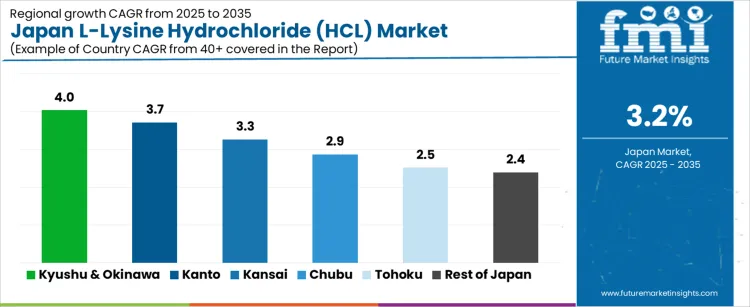
| Region | CAGR (2025-2035) |
|---|---|
| Kyushu & Okinawa | 4.0% |
| Kanto | 3.7% |
| Kansai | 3.3% |
| Chubu | 2.9% |
| Tohoku | 2.5% |
| Rest of Japan | 2.4% |
What is Driving the Growth of L-Lysine Hydrochloride in Kyushu & Okinawa?
Kyushu & Okinawa is projected to experience the highest growth in the L-Lysine Hydrochloride market, with a projected CAGR of 4.0%. The region’s strong agricultural and aquaculture sectors are significant drivers of this growth. L-Lysine Hydrochloride is widely used in animal feed to promote growth and improve feed efficiency, making it highly relevant in Kyushu & Okinawa’s agriculture-focused economy. Additionally, the rising demand for high-protein foods and supplements in the food and beverage industry is contributing to the growth of L-Lysine Hydrochloride consumption. The region's growing focus on improving livestock productivity and enhancing food security through efficient feed management further supports the adoption of L-Lysine Hydrochloride.
Why is the L-Lysine Hydrochloride Market Expanding in Kanto?
In Kanto, the demand for L-Lysine Hydrochloride is projected to grow at a CAGR of 3.7%. Kanto, which includes Tokyo, is Japan’s largest economic and industrial hub. The region’s strong presence in the food and beverage, pharmaceutical, and animal feed industries is contributing to the steady growth of L-Lysine Hydrochloride. As the demand for processed and protein-rich foods increases, the need for L-Lysine Hydrochloride in both food production and livestock feed continues to rise. The pharmaceutical sector, focusing on amino acid-based supplements, also plays a role in driving growth. Additionally, the rise in awareness about animal nutrition and health in Kanto is further supporting the demand for L-Lysine Hydrochloride.
How is the L-Lysine Hydrochloride Market Growing in Kansai?
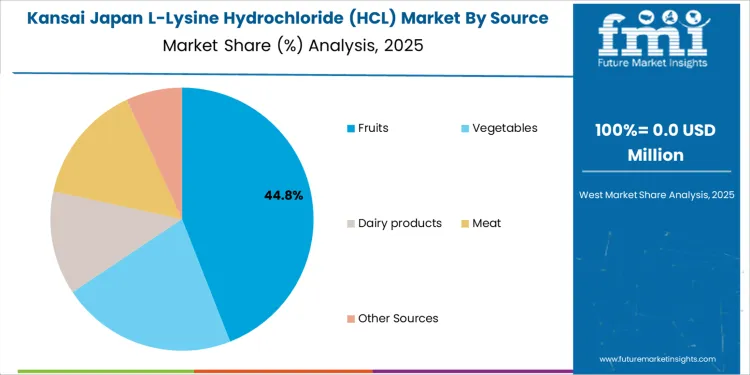
In Kansai, the L-Lysine Hydrochloride market is projected to grow at a CAGR of 3.3%. Kansai, home to major cities like Osaka and Kyoto, has a well-established food processing industry and strong agricultural sector. The increasing need for animal feed additives and supplements in Kansai is driving the demand for L-Lysine Hydrochloride, especially in livestock farming and aquaculture. As the region focuses on improving the quality of animal-based food products and enhancing livestock health, the need for high-quality feed additives like L-Lysine Hydrochloride is rising. Kansai’s growing demand for functional foods and supplements is also contributing to the expansion of the market for this essential amino acid.
What is Contributing to the Growth of L-Lysine Hydrochloride in Chubu?
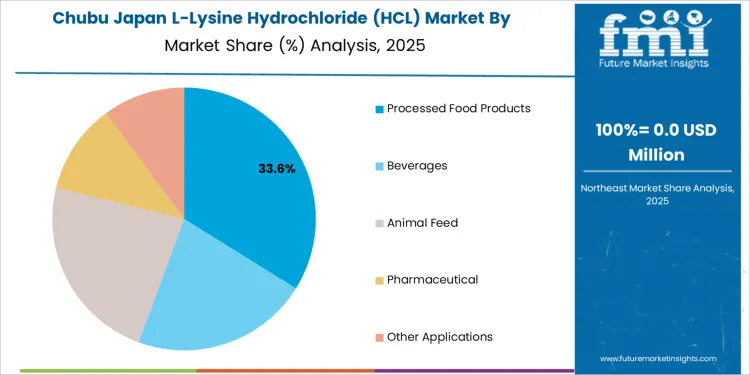
In Chubu, the L-Lysine Hydrochloride market is expected to grow at a CAGR of 2.9%. Chubu, a key industrial region, has a significant demand for L-Lysine Hydrochloride in animal feed and food production. The region’s agricultural and livestock sectors are increasingly adopting advanced nutritional solutions to boost production efficiency and meet consumer demand for high-quality food products. As Chubu’s food industry evolves to cater to health-conscious consumers, the adoption of L-Lysine Hydrochloride to improve the nutritional profile of food products is growing. The need for high-performance feed additives in animal husbandry and aquaculture is also contributing to the steady demand for L-Lysine Hydrochloride in the region.
What is Influencing the Growth of L-Lysine Hydrochloride in Tohoku?
In Tohoku, the demand for L-Lysine Hydrochloride is projected to grow at a CAGR of 2.5%. While the growth rate is slower compared to other regions, Tohoku’s agricultural industry is increasingly adopting L-Lysine Hydrochloride to improve animal nutrition and feed quality. The growing awareness of the benefits of amino acid supplementation in livestock feed is gradually influencing the adoption of L-Lysine Hydrochloride in the region. Tohoku’s focus on sustainable farming practices and improving the efficiency of its agricultural output is contributing to the gradual demand for this essential nutrient. As Tohoku continues to modernize its agricultural practices, the adoption of feed additives like L-Lysine Hydrochloride is expected to increase.
What is Contributing to the Growth of L-Lysine Hydrochloride in Rest of Japan?
In Rest of Japan, the L-Lysine Hydrochloride market is expected to grow at a more moderate rate of 2.4%. While the demand is lower compared to more industrialized regions, the steady adoption of animal feed additives and functional food ingredients is contributing to the growth of this market. As businesses in rural and less urbanized areas look for ways to improve livestock productivity and food quality, the need for efficient feed additives like L-Lysine Hydrochloride is gradually increasing. Rest of Japan’s growing interest in improving food security and nutritional efficiency in agriculture is further supporting the demand for L-Lysine Hydrochloride in the region.
What is the Competitive Landscape for Demand for L Lysine Hydrochloride (HCl) in Japan?
Demand for L-Lysine HCl in Japan has been rising, largely driven by the growing need for high-quality animal feed in livestock and aquaculture sectors. L-Lysine HCl is an essential amino acid supplement commonly added to poultry, swine and fish feed to optimize protein balance, improve growth rates and enhance feed-conversion efficiency. As demand for meat, eggs and seafood rises among Japanese consumers, feed producers increasingly rely on lysine supplementation to ensure consistent livestock performance while maintaining nutritional and environmental standards.
Other relevant suppliers include CJ CheilJedang Corporation, Kyowa Hakko Bio Co., Ltd., Evonik Industries AG, and Meihua Holdings Group Co., Ltd. These firms supply feed-grade L-Lysine HCl to Japanese feed manufacturers and integrators for livestock, aquaculture, and other applications. The competition among them centers on product purity and quality, consistency of supply, compliance with Japanese feed- and food-safety regulations, cost-effectiveness, and ability to deliver large-volume orders. Firms that can combine reliable supply chains, strong quality control, regulatory compliance, and competitive pricing are best positioned to capture growth as the Japanese demand for animal protein and sustainable feed solutions continues to increase.
Key Players of the L-Lysine Hydrochloride (HCL) Industry in Japan
- Ajinomoto Co., Inc.
- CJ CheilJedang Corporation
- Kyowa Hakko Bio Co., Ltd.
- Evonik Industries AG
- Meihua Holdings Group Co., Ltd.
Scope of the Report
| Items | Values |
|---|---|
| Quantitative Units (2025) | USD Million |
| Source | Fruits, Vegetables, Dairy Products, Meat, Other Sources |
| Application | Processed Food Products, Beverages, Animal Feed, Pharmaceutical, Other Applications |
| Companies | Ajinomoto Co., Inc., CJ CheilJedang Corporation, Kyowa Hakko Bio Co., Ltd., Evonik Industries AG, Meihua Holdings Group Co., Ltd. |
| Regions Covered | Kyushu & Okinawa, Kanto, Kansai, Chubu, Tohoku, Rest of Japan |
| Additional Attributes | Dollar by sales by source, application, and region. Includes performance in food and beverage fortification, nutritional benefits, cost-effectiveness in production, market demand trends in animal feed, regulatory compliance in pharmaceuticals, market share and competitive positioning of key companies, sustainability practices in sourcing and production, quality and purity standards, and the role of L-Lysine HCL in supporting growth in various sectors such as animal nutrition, food processing, and pharmaceutical applications. |
Key Segments in the Demand for L-Lysine Hydrochloride (HCL) in Japan
Source:
- Fruits
- Vegetables
- Dairy Products
- Meat
- Other Sources
Application:
- Processed Food Products
- Beverages
- Animal Feed
- Pharmaceutical
- Other Applications
Region:
- Kyushu & Okinawa
- Kanto
- Kansai
- Chubu
- Tohoku
- Rest of Japan
Frequently Asked Questions
How big is the demand for l-lysine hydrochloride (HCL) in Japan in 2025?
The demand for l-lysine hydrochloride (HCL) in Japan is estimated to be valued at USD 12.5 million in 2025.
What will be the size of l-lysine hydrochloride (HCL) in Japan in 2035?
The market size for the l-lysine hydrochloride (HCL) in Japan is projected to reach USD 17.1 million by 2035.
How much will be the demand for l-lysine hydrochloride (HCL) in Japan growth between 2025 and 2035?
The demand for l-lysine hydrochloride (HCL) in Japan is expected to grow at a 3.2% CAGR between 2025 and 2035.
What are the key product types in the l-lysine hydrochloride (HCL) in Japan?
The key product types in l-lysine hydrochloride (HCL) in Japan are fruits, vegetables, dairy products, meat and other sources.
Which application segment is expected to contribute significant share in the l-lysine hydrochloride (HCL) in Japan in 2025?
In terms of application, processed food products segment is expected to command 34.4% share in the l-lysine hydrochloride (HCL) in Japan in 2025.
Preview the report firsthand - request a free sample
Get SampleGet the brochure for pricing and purchase details.
Get PDFTable of Content
- Executive Summary
- Japan Market Outlook
- Demand-side Trends
- Supply-side Trends
- Technology Roadmap Analysis
- Analysis and Recommendations
- Market Overview
- Market Coverage / Taxonomy
- Market Definition / Scope / Limitations
- Market Background
- Market Dynamics
- Drivers
- Restraints
- Opportunity
- Trends
- Scenario Forecast
- Demand in Optimistic Scenario
- Demand in Likely Scenario
- Demand in Conservative Scenario
- Opportunity Map Analysis
- Product Life Cycle Analysis
- Supply Chain Analysis
- Investment Feasibility Matrix
- Value Chain Analysis
- PESTLE and Porter’s Analysis
- Regulatory Landscape
- Regional Parent Market Outlook
- Production and Consumption Statistics
- Import and Export Statistics
- Market Dynamics
- Japan Market Analysis 2020 to 2024 and Forecast, 2025 to 2035
- Historical Market Size Value (USD Million) Analysis, 2020 to 2024
- Current and Future Market Size Value (USD Million) Projections, 2025 to 2035
- Y-o-Y Growth Trend Analysis
- Absolute $ Opportunity Analysis
- Japan Market Pricing Analysis 2020 to 2024 and Forecast 2025 to 2035
- Japan Market Analysis 2020 to 2024 and Forecast 2025 to 2035, By Source
- Introduction / Key Findings
- Historical Market Size Value (USD Million) Analysis By Source , 2020 to 2024
- Current and Future Market Size Value (USD Million) Analysis and Forecast By Source , 2025 to 2035
- Fruits
- Vegetables
- Dairy products
- Meat
- Other Sources
- Y-o-Y Growth Trend Analysis By Source , 2020 to 2024
- Absolute $ Opportunity Analysis By Source , 2025 to 2035
- Japan Market Analysis 2020 to 2024 and Forecast 2025 to 2035, By Application
- Introduction / Key Findings
- Historical Market Size Value (USD Million) Analysis By Application, 2020 to 2024
- Current and Future Market Size Value (USD Million) Analysis and Forecast By Application, 2025 to 2035
- Processed Food Products
- Beverages
- Animal Feed
- Pharmaceutical
- Other Applications
- Y-o-Y Growth Trend Analysis By Application, 2020 to 2024
- Absolute $ Opportunity Analysis By Application, 2025 to 2035
- Market Structure Analysis
- Competition Dashboard
- Competition Benchmarking
- Market Share Analysis of Top Players
- By Regional
- By Source
- By Application
- Competition Analysis
- Competition Deep Dive
- Ajinomoto Co., Inc.
- Overview
- Product Portfolio
- Profitability by Market Segments (Product/Age /Sales Channel/Region)
- Sales Footprint
- Strategy Overview
- Marketing Strategy
- Product Strategy
- Channel Strategy
- CJ CheilJedang Corporation
- Kyowa Hakko Bio Co., Ltd.
- Evonik Industries AG
- Meihua Holdings Group Co., Ltd.
- Ajinomoto Co., Inc.
- Competition Deep Dive
- Assumptions & Acronyms Used
- Research Methodology


