

- Industry Size (2025)
- USD 26.2 Mn
- Forecast (2035)
- USD 37.3 Mn
- CAGR (2025 to 2035)
- 3.6%
Demand for Rail Gangway in Japan Forecast and Outlook 2025 to 2035
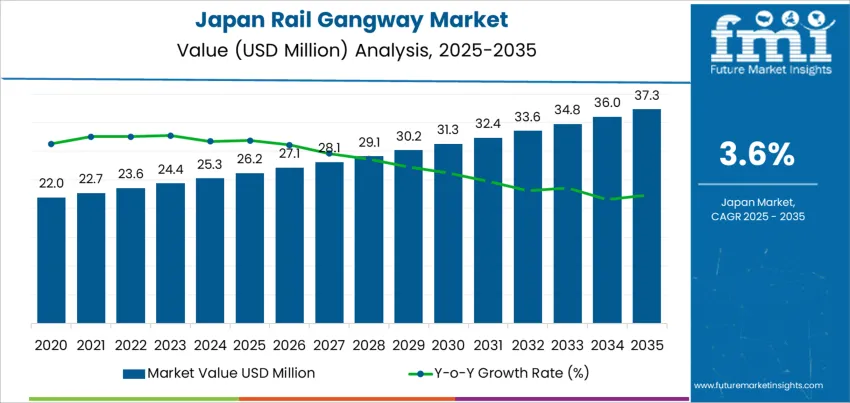
The demand for rail gangways in Japan is expected to grow from USD 26.2 million in 2025 to USD 37.3 million by 2035, reflecting a compound annual growth rate (CAGR) of 3.6%. Rail gangways, which provide safe and efficient access between train cars, are a critical component of the transportation infrastructure. As Japan continues to modernize and expand its extensive rail network, the demand for high-quality, durable, and reliable gangways will continue to rise.
The focus on improving passenger safety, accessibility, and operational efficiency in the rail transport sector will support the industry’s growth. Innovations in gangway design to accommodate the evolving needs of passengers, including accessibility for individuals with disabilities, will further drive demand.
Quick Stats of the Demand for Rail Gangway in Japan
- Demand for Rail Gangway in Japan Value (2025): USD 26.2 million
- Demand for Rail Gangway in Japan Forecast Value (2035): USD 37.3 million
- Demand for Rail Gangway in Japan Forecast CAGR (2025-2035): 3.6%
- Demand for Rail Gangway in Japan Leading Product Type: Two Piece Gangways
- Demand for Rail Gangway in Japan Key Growth Regions: Kyushu & Okinawa, Kanto, Kansai, Chubu, Tohoku, Rest of Japan
- Demand for Rail Gangway in Japan Top Players: HÜBNER GmbH & Co. KG, Dellner Couplers, Narita Mfg. Co, Jai Dadi Group, KTK Group
What is the Growth Forecast for the Demand for Rail Gangway in Japan through 2035?
The continued growth of the rail gangway industry will also benefit from ongoing advancements in materials and manufacturing technologies. Innovations in lightweight, weather-resistant, and easy-to-maintain materials will make gangways more efficient and cost-effective. As the rail industry in Japan continues to prioritize sustainability, the use of environmentally friendly materials in the construction of rail gangways will become increasingly important.
The integration of smart technologies, such as sensor-based systems for monitoring and optimizing gangway usage, will further enhance their functionality and efficiency. These technological advancements, coupled with the expanding rail infrastructure, will ensure steady growth in the demand for rail gangways throughout the forecast period.
From 2025 to 2030, demand for rail gangways is expected to increase from USD 26.2 million to USD 31.3 million, adding USD 5.1 million in value. This growth will be fueled by ongoing upgrades and investments in Japan’s rail system, particularly in major urban areas where passenger volume is highest. With a growing emphasis on making public transportation more efficient and secure, rail gangways are becoming a vital part of ensuring smooth and safe transitions for passengers between train cars. The rising need for accessible transportation for elderly and disabled passengers will also contribute to this growth, as rail gangways are increasingly designed to meet these specific needs.
From 2030 to 2035, demand for rail gangways will continue to rise from USD 31.3 million to USD 37.3 million, contributing USD 6.0 million in value. During this phase, demand will be primarily driven by the expansion of the rail network and the continued modernization of Japan’s transport infrastructure. With the growing interconnectivity of rail lines, especially high-speed rail systems, the need for efficient, well-designed rail gangways that can support a higher volume of passengers will continue to rise. The trend toward improving the overall passenger experience, including ensuring faster boarding and better connectivity between train cars, will sustain the demand for high-quality gangways.
Demand for Rail Gangway in Japan Key Takeaways
| Metric | Value |
|---|---|
| Demand for Rail Gangway in Japan Value (2025) | USD 26.2 million |
| Demand for Rail Gangway in Japan Forecast Value (2035) | USD 37.3 million |
| Demand for Rail Gangway in Japan Forecast CAGR (2025-2035) | 3.6% |
Why is the Demand for Rail Gangway in Japan Growing?
The demand for rail gangways in Japan is growing as the country’s transportation infrastructure continues to modernize and expand. Rail gangways, used to connect train carriages, are essential for ensuring smooth and safe movement of passengers and crew. With the increasing focus on improving rail network efficiency, comfort, and safety, rail gangways are becoming a critical component in the design and maintenance of new and existing trains.
A major driver behind the growth of rail gangways is the rising demand for high-speed and commuter rail services across Japan. The country’s commitment to expanding its rail networks, particularly through the introduction of new high-speed lines and upgrading of existing systems, is driving the need for modern and efficient rail carriages that incorporate advanced gangway systems. These systems improve train connectivity, ensuring better passenger flow and safety during travel.
The focus on passenger experience and comfort is influencing the adoption of more advanced rail gangway systems. Innovations in rail design are leading to more comfortable and accessible travel environments, where passengers can move freely between carriages. As Japan continues to invest in rail infrastructure and technology, the demand for rail gangways is expected to grow steadily through 2035, supporting the expansion of the country’s extensive rail network.
What is the Segment-Wise Analysis of Demand for Rail Gangway in Japan?
Demand for rail gangways in Japan is segmented by product type, material type, train type, and region. By product type, demand is divided into two-piece gangways and single-piece gangways, with two-piece gangways leading at 78%. The demand is also segmented by material type, including aluminum, alloys, steel, and composites, with aluminum leading at 54.3%. In terms of train type, demand is spread across passenger trains, metro/subway trains, high-speed trains, and special trains, with passenger trains being the most common. Regionally, demand is distributed across Kyushu & Okinawa, Kanto, Kansai, Chubu, Tohoku, and the rest of Japan.
Why Do Two-Piece Gangways Lead the Demand for Rail Gangways in Japan?
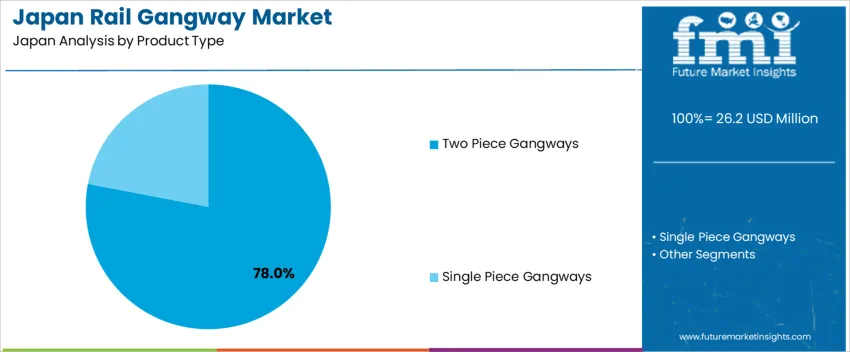
Two-piece gangways account for 78% of the demand for rail gangways in Japan due to their flexibility, modular design, and efficiency in installation and maintenance. The two-piece design allows for easier transportation, assembly, and replacement, making them an ideal choice for connecting rail cars, especially where space and weight constraints are important. This design also enhances passenger safety and mobility by allowing smoother transitions between carriages, particularly in busy metro or train stations.
Two-piece gangways are adaptable to various train types, including passenger, high-speed, and metro trains. As Japan continues to invest in expanding its rail infrastructure, the demand for two-piece gangways remains strong, particularly in the fast-growing metro and commuter rail systems. Their versatility, ease of use, and safety features make two-piece gangways the preferred option for efficient train connectivity.
Why Does Aluminum Lead the Demand for Rail Gangways in Japan?
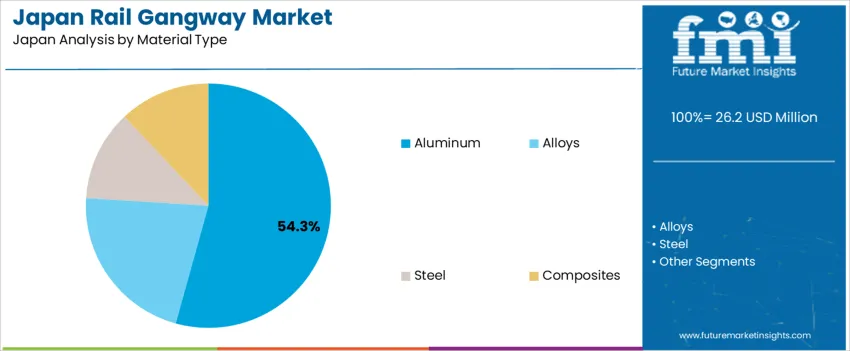
Aluminum accounts for 54.3% of the demand for rail gangways in Japan, driven by its lightweight, corrosion-resistant, and durable characteristics. Aluminum provides the necessary strength for rail gangways while ensuring they remain light, which is crucial for easy handling and installation, particularly in high-traffic areas like metro stations. Its resistance to corrosion ensures long-term durability, even in the harshest weather conditions, reducing maintenance needs. Aluminum’s lightweight nature also minimizes the overall strain on the train structure, which is particularly important in high-speed and metro trains.
As rail systems modernize and expand in Japan, aluminum continues to be the preferred material due to its combination of strength, durability, and low maintenance costs. Given the demand for efficient, cost-effective, and sustainable materials in rail infrastructure, aluminum gangways will continue to lead the industry in Japan for the foreseeable future.
What are the Key Trends, Drivers, and Restraints in Demand for Rail Gangway in Japan?
Demand for rail gangway systems in Japan is increasing as rail operators intensify efforts to improve passenger safety, comfort, and connectivity across long and connected trains. Gangways are the passageways that allow passengers to walk between rail cars without leaving the train.
As rail infrastructure expands and urban transit continues to form a core of mobility in large metropolitan areas, need for reliable gangway systems, especially in commuter trains, metro, and intercity services, has grown. Modern rail gangs feature flexible articulation, secure sealing, integrated safety measures, and durability under heavy use. Efficiency in operations and rising demand for seamless, accessible travel during crowded commutes contribute to increasing demand. On the downside, high upfront cost of advanced gangway systems and stringent safety and quality standards pose limitations.
Why is Demand for Rail Gangway Growing in Japan?
Demand is growing because Japanese rail transport remains a major mode of mass transit for both urban commuters and intercity travelers. As trains become longer and more frequent to handle high passenger volumes, safe and comfortable passage between carriages becomes essential. Gangways enable smooth movement, convenience for boarding/alighting, and emergency evacuation, attributes highly valued in dense urban networks. The push for better passenger experience, accessibility for elderly and disabled users, and compliance with safety regulations further support gangway adoption. Continuous investment in rail infrastructure, fleet renewal and expansion of metro and suburban lines encourage incorporation of gangways even in new rolling stock.
How are Technological & Industry Innovations Driving Rail Gangway Demand in Japan?
Technological improvements in gangway design and materials help meet the evolving needs of efficiency, safety, and comfort. Contemporary gangways use more durable, wear‑resistant materials, improved articulation systems, and better sealing to protect against weather and noise. Designs now focus on lighter-weight constructions, easier installation, and lower maintenance, attractive features for operators upgrading or expanding fleets.
Some gangways integrate advanced safety systems and better accessibility features, such as wider passages and stable floors, making them more suitable for modern passenger expectations. The trend toward metro and commuter rail modernization, including increased attention to passenger flow, comfort, and operational reliability, fuels adoption of upgraded gangway systems across train types in Japan.
What are the Key Challenges and Risks That Could Limit Rail Gangway Demand in Japan?
Despite clear benefits, adoption of rail gangway systems faces hurdles. High capital cost for equipping or retrofitting trains with gangways can be a burden, especially for older fleets or smaller operators. Strict regulatory and safety standards for railway components demand rigorous testing and certification, which adds to development cost and time. Compatibility issues with older rolling stock or different train configurations may render retrofitting difficult or cost‑ineffective. For some lines, lower passenger volumes or operational constraints may not justify the investment. These factors can slow down or limit the broad deployment of gangway systems, particularly in rural or less‑trafficked routes.
What is the Regional Demand Outlook for Rail Gangway in Japan?
| Region | CAGR (%) |
|---|---|
| Kyushu & Okinawa | 4.5% |
| Kanto | 4.1% |
| Kansai | 3.6% |
| Chubu | 3.2% |
| Tohoku | 2.8% |
| Rest of Japan | 2.7% |
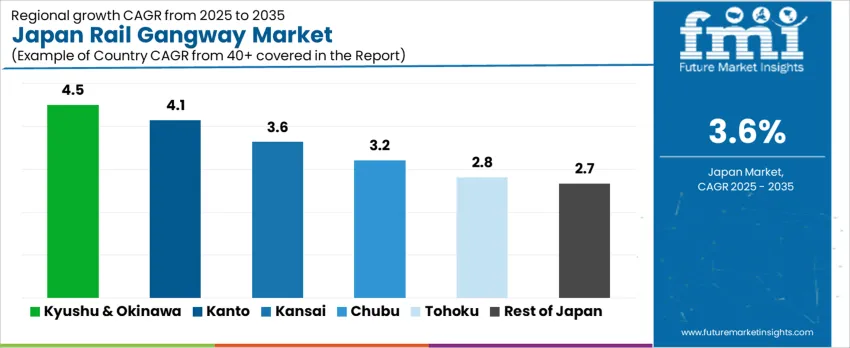
Demand for rail gangways in Japan is growing steadily, with Kyushu & Okinawa leading at a 4.5% CAGR, supported by expanding rail infrastructure. Kanto follows with a 4.1% CAGR, driven by the region’s large rail network and high passenger volumes. Kansai shows a 3.6% CAGR, fueled by its focus on modernizing public transportation. Chubu experiences a 3.2% CAGR, with steady demand driven by infrastructure development. Tohoku and the Rest of Japan see moderate growth at 2.8% and 2.7%, respectively, reflecting gradual improvements in regional transport infrastructure. As Japan’s rail system modernizes and passenger numbers increase, demand for rail gangways is expected to continue growing.
How is Demand for Rail Gangways Growing in Kyushu & Okinawa?
Kyushu & Okinawa shows strong demand for rail gangways, growing at a 4.5% CAGR. The region's expanding rail infrastructure and the push toward upgrading and modernizing train stations contribute to the rising need for rail gangways. With ongoing investment in the region's railway systems to improve passenger experience and safety, rail gangways are crucial for efficient, safe boarding and disembarking, especially at busy transportation hubs.
As the population and tourism sectors in Okinawa and Kyushu grow, there is an increased focus on improving accessibility and ensuring smooth transitions between platforms and trains. The region’s commitment to sustainable transport solutions further promotes the adoption of rail gangways as part of its public transit infrastructure upgrades. As passenger traffic rises and transportation infrastructure modernizes, demand for rail gangways in Kyushu & Okinawa is expected to remain strong.
Why is Demand for Rail Gangways Rising in Kanto?
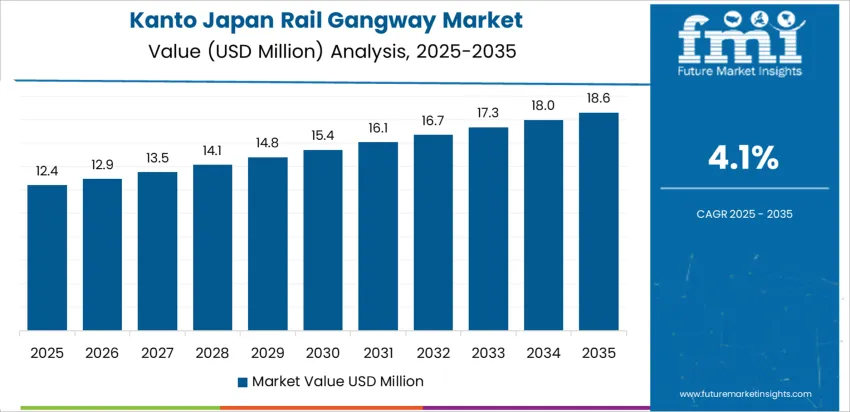
Kanto is experiencing steady demand for rail gangways, with a 4.1% CAGR. The region’s extensive rail network, particularly in Tokyo, is a major driver of this demand. With high passenger traffic and a focus on improving the efficiency and safety of public transportation systems, Kanto’s railway stations require reliable, high-quality rail gangways. These gangways play a vital role in ensuring smooth and safe transitions for passengers, particularly in crowded urban areas.
The continued expansion of the 5G network, smart stations, and automated systems in Kanto also requires upgrading rail infrastructure, including gangways. As Kanto's railway network continues to grow with new lines, stations, and transit-oriented developments, the demand for rail gangways will rise steadily. This growth is further supported by the region's commitment to providing accessible and seamless public transportation for commuters and tourists.
How is Demand for Rail Gangways Expanding in Kansai?
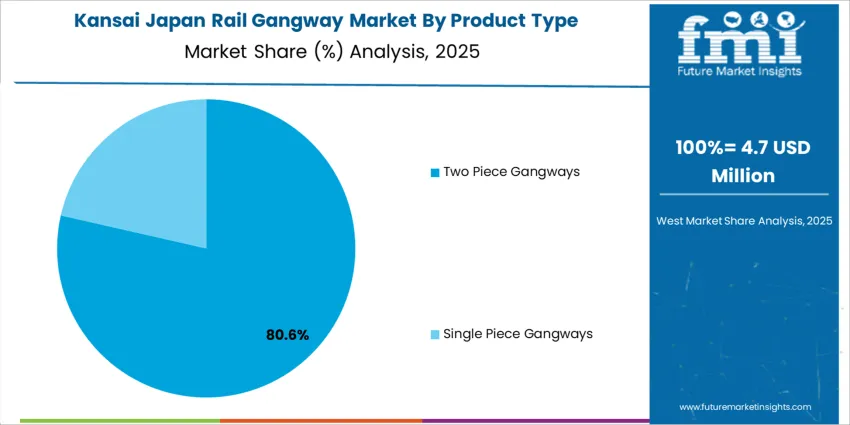
Kansai is seeing steady demand for rail gangways, with a 3.6% CAGR. The region’s focus on upgrading public transportation infrastructure, including train stations and platforms, drives the demand for rail gangways. As the demand for more efficient and accessible rail systems rises, particularly in urban centers like Osaka and Kyoto, the need for rail gangways to accommodate passengers smoothly and safely is becoming increasingly important.
Kansai’s investment in transportation upgrades, including high-speed rail and station modernization, supports this growth. The region’s growing tourism sector and large commuter population further increase the demand for high-quality, durable rail gangways to ensure safe boarding and disembarking. As Kansai continues to improve its rail network and passenger experiences, demand for rail gangways is expected to grow steadily.
Why is Demand for Rail Gangways Growing in Chubu?
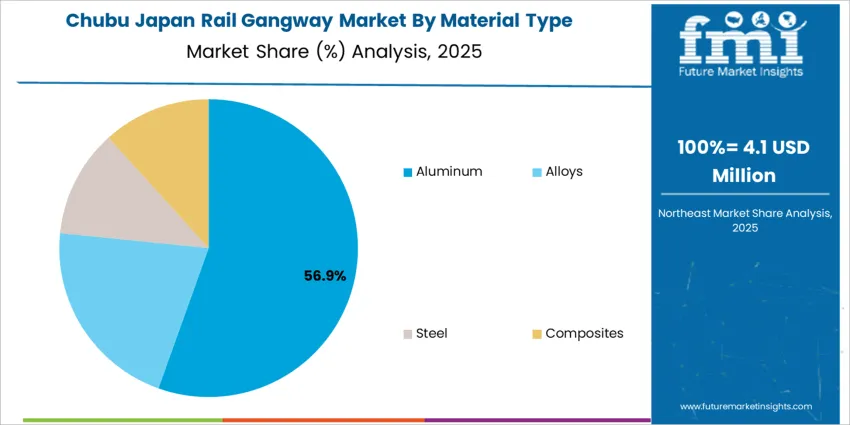
Chubu is experiencing steady demand for rail gangways, growing at a 3.2% CAGR. The region’s ongoing expansion in rail infrastructure, particularly in cities like Nagoya, supports the growing need for modern, efficient, and accessible rail gangways. With more rail services connecting suburban and urban areas, Chubu requires robust gangways for smooth transitions between platforms and trains. The region’s emphasis on expanding and upgrading railway stations to accommodate increasing passenger traffic further drives demand for high-quality rail gangways. As the region continues to prioritize the safety, accessibility, and efficiency of public transportation, the demand for rail gangways will continue to rise steadily, supported by both infrastructure development and growing passenger numbers.
How is Demand for Rail Gangways Expanding in Tohoku?
Tohoku is seeing moderate demand for rail gangways, growing at a 2.8% CAGR. Although the region’s rail infrastructure is less developed than in other areas, there is steady growth due to ongoing modernization efforts. Tohoku’s railway stations are gradually upgrading to accommodate rising passenger numbers and improve accessibility, especially in the wake of recovery from natural disasters. Rail gangways play an important role in ensuring smooth access between platforms and trains, particularly in areas where regional connectivity is improving. With the focus on improving transport infrastructure, the demand for rail gangways in Tohoku is expected to continue rising steadily as more stations are modernized and the region focuses on better rail services for both locals and tourists.
Why is Demand for Rail Gangways Steady in the Rest of Japan?
The Rest of Japan is experiencing steady demand for rail gangways, growing at a 2.7% CAGR. Although demand is smaller compared to major metropolitan regions, rural and suburban areas are gradually upgrading their railway systems, which boosts the demand for rail gangways. As local rail networks improve and modernization efforts expand to smaller stations, there is an increasing need for safe, efficient gangways to facilitate passenger movement. The rise in local tourism and public interest in improved transport services supports the steady demand for rail gangways in these regions. While the growth rate is slower than in urban centers, the steady adoption of rail gangways reflects the country’s broader focus on improving accessibility and efficiency in transportation.
What Is Driving the Demand for Rail Gangways in Japan and Who Are the Key Players Shaping the Industry?
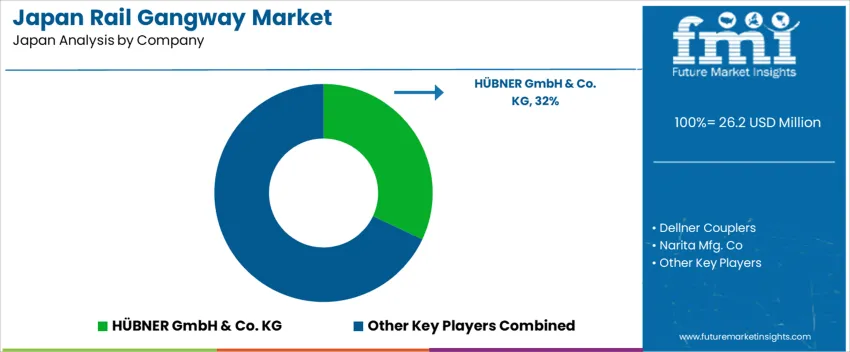
The demand for rail gangways in Japan is growing due to the expansion of rail networks, modernization of passenger trains, and increasing focus on passenger comfort and safety. Rail gangways, which connect passenger carriages and allow for safe movement between them, are essential for enhancing passenger convenience, especially in long-distance and high-speed rail services. As Japan’s rail industry continues to upgrade its infrastructure with newer and more advanced train systems, there is an increasing need for high-quality, durable, and efficient rail gangways that meet safety standards and improve the overall passenger experience. The growth of commuter and intercity rail travel, coupled with the push for sustainability and improved public transport options, further drives the demand for these components
Key players shaping the rail gangway industry in Japan include HÜBNER GmbH & Co. KG, Dellner Couplers, Narita Mfg. Co., Jai Dadi Group, and KTK Group. HÜBNER GmbH & Co. KG leads the industry with a significant share of 32.0%, known for its high-quality and innovative rail gangway solutions that enhance the safety and comfort of passengers. These companies play a crucial role in supplying gangways that are designed to withstand the demands of modern rail transport systems, ensuring they are both durable and functional. Their products cater to both local and international rail operators who require reliable solutions to meet the increasing demand for efficient rail transport systems.
The growth of the rail gangway industry in Japan is also supported by continuous technological advancements and the focus on improving the efficiency of rail transport. With Japan’s reputation for cutting-edge rail technology, the demand for high-performance rail gangways will likely continue to grow. As the rail industry expands, particularly with the introduction of more advanced trains and longer routes, the need for well-designed and reliable gangways will remain essential, driving continued industry growth.
Key Players in Japan Rail Gangway Demand
- HÜBNER GmbH & Co. KG
- Dellner Couplers
- Narita Mfg. Co
- Jai Dadi Group
- KTK Group
Scope of Report
| Items | Values |
|---|---|
| Quantitative Units (2025) | USD million |
| Product Type | Two Piece Gangways, Single Piece Gangways |
| Material Type | Aluminum, Alloys, Steel, Composites |
| Train Type | Passenger Train, Metro/Subway Train, High-speed Train, Special Train |
| Region | Kyushu & Okinawa, Kanto, Kansai, Chubu, Tohoku, Rest of Japan |
| Countries Covered | Japan |
| Key Companies Profiled | HÜBNER GmbH & Co. KG, Dellner Couplers, Narita Mfg. Co, Jai Dadi Group, KTK Group |
| Additional Attributes | Dollar sales by product type and material; regional CAGR and growth outlook; trends in high-speed train demand; material preferences in different train types; supply chain and manufacturing trends. |
Japan Rail Gangway Demand by Key Segments
Product Type
- Two Piece Gangways
- Single Piece Gangways
Material Type
- Aluminum
- Alloys
- Steel
- Composites
Train Type
- Passenger Train
- Metro/Subway Train
- High-speed Train
- Special Train
Region
- Kyushu & Okinawa
- Kanto
- Kansai
- Chubu
- Tohoku
- Rest of Japan
Frequently Asked Questions
How big is the demand for rail gangway in Japan in 2025?
The demand for rail gangway in Japan is estimated to be valued at USD 26.2 million in 2025.
What will be the size of rail gangway in Japan in 2035?
The market size for the rail gangway in Japan is projected to reach USD 37.3 million by 2035.
How much will be the demand for rail gangway in Japan growth between 2025 and 2035?
The demand for rail gangway in Japan is expected to grow at a 3.6% CAGR between 2025 and 2035.
What are the key product types in the rail gangway in Japan?
The key product types in rail gangway in Japan are two piece gangways and single piece gangways.
Which material type segment is expected to contribute significant share in the rail gangway in Japan in 2025?
In terms of material type, aluminum segment is expected to command 54.3% share in the rail gangway in Japan in 2025.
Preview the report firsthand - request a free sample
Get SampleGet the brochure for pricing and purchase details.
Get PDFTable of Content
- Executive Summary
- Japan Market Outlook
- Demand-side Trends
- Supply-side Trends
- Technology Roadmap Analysis
- Analysis and Recommendations
- Market Overview
- Market Coverage / Taxonomy
- Market Definition / Scope / Limitations
- Market Background
- Market Dynamics
- Drivers
- Restraints
- Opportunity
- Trends
- Scenario Forecast
- Demand in Optimistic Scenario
- Demand in Likely Scenario
- Demand in Conservative Scenario
- Opportunity Map Analysis
- Product Life Cycle Analysis
- Supply Chain Analysis
- Investment Feasibility Matrix
- Value Chain Analysis
- PESTLE and Porter’s Analysis
- Regulatory Landscape
- Regional Parent Market Outlook
- Production and Consumption Statistics
- Import and Export Statistics
- Market Dynamics
- Japan Market Analysis 2020 to 2024 and Forecast, 2025 to 2035
- Historical Market Size Value (USD Million) Analysis, 2020 to 2024
- Current and Future Market Size Value (USD Million) Projections, 2025 to 2035
- Y-o-Y Growth Trend Analysis
- Absolute $ Opportunity Analysis
- Japan Market Pricing Analysis 2020 to 2024 and Forecast 2025 to 2035
- Japan Market Analysis 2020 to 2024 and Forecast 2025 to 2035, By Product Type
- Introduction / Key Findings
- Historical Market Size Value (USD Million) Analysis By Product Type , 2020 to 2024
- Current and Future Market Size Value (USD Million) Analysis and Forecast By Product Type , 2025 to 2035
- Two Piece Gangways
- Single Piece Gangways
- Y-o-Y Growth Trend Analysis By Product Type , 2020 to 2024
- Absolute $ Opportunity Analysis By Product Type , 2025 to 2035
- Japan Market Analysis 2020 to 2024 and Forecast 2025 to 2035, By Material Type
- Introduction / Key Findings
- Historical Market Size Value (USD Million) Analysis By Material Type, 2020 to 2024
- Current and Future Market Size Value (USD Million) Analysis and Forecast By Material Type, 2025 to 2035
- Aluminum
- Alloys
- Steel
- Composites
- Y-o-Y Growth Trend Analysis By Material Type, 2020 to 2024
- Absolute $ Opportunity Analysis By Material Type, 2025 to 2035
- Japan Market Analysis 2020 to 2024 and Forecast 2025 to 2035, By Train Type
- Introduction / Key Findings
- Historical Market Size Value (USD Million) Analysis By Train Type, 2020 to 2024
- Current and Future Market Size Value (USD Million) Analysis and Forecast By Train Type, 2025 to 2035
- Passenger Train
- Metro/Subway Train
- High-speed Train
- Special Train
- Y-o-Y Growth Trend Analysis By Train Type, 2020 to 2024
- Absolute $ Opportunity Analysis By Train Type, 2025 to 2035
- Market Structure Analysis
- Competition Dashboard
- Competition Benchmarking
- Market Share Analysis of Top Players
- By Regional
- By Product Type
- By Material Type
- By Train Type
- Competition Analysis
- Competition Deep Dive
- HÜBNER GmbH & Co. KG
- Overview
- Product Portfolio
- Profitability by Market Segments (Product/Age /Sales Channel/Region)
- Sales Footprint
- Strategy Overview
- Marketing Strategy
- Product Strategy
- Channel Strategy
- Dellner Couplers
- Narita Mfg. Co
- Jai Dadi Group
- KTK Group
- HÜBNER GmbH & Co. KG
- Competition Deep Dive
- Assumptions & Acronyms Used
- Research Methodology


