

- Industry Size (2025)
- USD 202.6 Mn
- Forecast (2035)
- USD 316.4 Mn
- CAGR (2025 to 2035)
- 4.6%
Demand for Rail Gangway in USA 2025 to 2035
The demand for rail gangway in the USA is valued at USD 202.6 million in 2025 and is forecasted to reach USD 316.4 million by 2035, recording a CAGR of 4.6%. Demand is supported by continued upgrades of passenger rolling stock, accessibility requirements, and the need to ensure controlled passenger flow within multi-car configurations. Rail operators prioritize platform safety, fire resistance, vibration durability, and lifecycle performance when selecting gangway systems for refurbishment and new fleet procurement. Two-piece gangways represent the leading type due to their structural flexibility and suitability for high-frequency passenger services. These systems maintain protected passage between cars during vehicle articulation and alignment changes. Material choices emphasize reduced weight, improved thermal insulation, and acoustic suppression to support comfort standards in commuter and intercity operations.
Demand is strongest in the West, South, and Northeast regions, where transit expansions, intercity rail upgrades, and improved fleet utilization are underway. Replacement of ageing gangways in existing fleets supports steady procurement cycles linked to periodic maintenance programmes. Key suppliers include HÜBNER GmbH & Co. KG, Dellner Couplers, Narita Manufacturing Co., Jai Dadi Group, and KTK Group. Their priorities include compliance with technical safety standards, component modularity to simplify installation, and durable sealing solutions suited to diverse climatic conditions across rail operators in the United States.
Quick Stats for USA Rail Gangway Demand
- USA Rail Gangway Sales Value (2025): USD 202.6 million
- USA Rail Gangway Forecast Value (2035): USD 316.4 million
- USA Rail Gangway Forecast CAGR (2025–2035): 4.6%
- Leading Type in USA Rail Gangway Demand: Two-Piece Gangways
- Key Growth Regions in USA Rail Gangway Demand: West USA, South USA, Northeast USA
- Top Players in USA Rail Gangway Demand: HÜBNER GmbH & Co. KG, Dellner Couplers, Narita Manufacturing Co., Jai Dadi Group, KTK Group
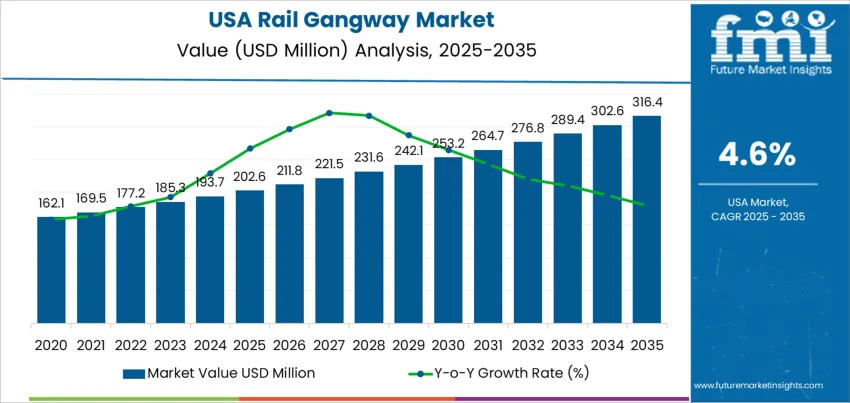
What is the Growth Forecast for Rail Gangway Industry in USA through 2035?
Demand for Rail Gangway in the United States is expanding steadily, driven by investments in urban and regional passenger transport systems. Growth contribution remains anchored in fleet upgrades for metro and subway networks, which represent the largest share of rolling stock deployments. Replacement of aging gangway systems contributes a predictable baseline of incremental gains. This contribution is strengthened by safety compliance requirements, including fire-resistance and structural-performance standards, which support the adoption of advanced gangway materials.
High-speed and special-purpose rail programs add a selective but rising contribution due to operational modernization and the need for enhanced interoperability. Procurement cycles remain multi-year, resulting in consistent but moderated annual growth. Suppliers benefit from the preference for lightweight aluminum and alloy gangways, which reduce energy consumption. The growth contribution index reflects balanced input from both new installations and retrofit projects, without reliance on rapid network expansion. Local production capacity and technical partnerships enhance contribution efficiency by aligning product design with USA transit specifications.
USA Rail Gangway Key Takeaways
| Metric | Value |
|---|---|
| USA Rail Gangway Sales Value (2025) | USD 202.6 million |
| USA Rail Gangway Forecast Value (2035) | USD 316.4 million |
| USA Rail Gangway Forecast CAGR (2025-2035) | 4.6% |
Why is the Demand for Rail Gangways in the USA Growing?
Demand for rail gangways in the USA is increasing because public transit agencies and passenger rail operators invest in modernization programs to improve safety, comfort and accessibility. Rail gangways connect adjacent cars with a sealed walkway that allows passengers to move freely, which supports better use of interior space during peak hours. Fleet expansion in commuter rail, rapid transit and intercity services strengthens the need for new equipment that meets updated transportation standards.
Open gangway arrangements help increase passenger capacity without requiring additional rail cars, which appeals to urban networks managing congestion. New rolling stock procurement projects in major metro areas often include gangway-equipped trains to support continuous passenger flow and reduce bottlenecks at high demand stations. Manufacturers provide gangways with improved fire resistance, noise control and durability that align with regulatory and operational requirements. Integrated components such as handrails and anti-slip flooring enhance accessibility for individuals with mobility needs. Constraints include high installation cost if operators attempt to retrofit older fleets. Structural differences in legacy rail cars limit compatibility with continuous gangway configurations, which can delay upgrades until full fleet replacement cycles.
Which Product Types, Materials, and Train Categories Lead Demand for Rail Gangways in the United States?
Demand for rail gangways in the United States is shaped by continued investments in mass transit modernization, intercity connectivity, and passenger comfort. Rail operators seek gangway systems that improve passenger safety, reduce noise transmission, and meet interoperability standards across rolling stock fleets. Procurement expansions in metro and commuter systems support strong consumption volumes, while fleet refurbishment programs maintain recurring replacement demand. Lightweight designs, durability, and compliance with USA regulatory frameworks guide specifications among transport authorities and OEMs.
By Product Type, Two-Piece Gangways Dominate USA Demand
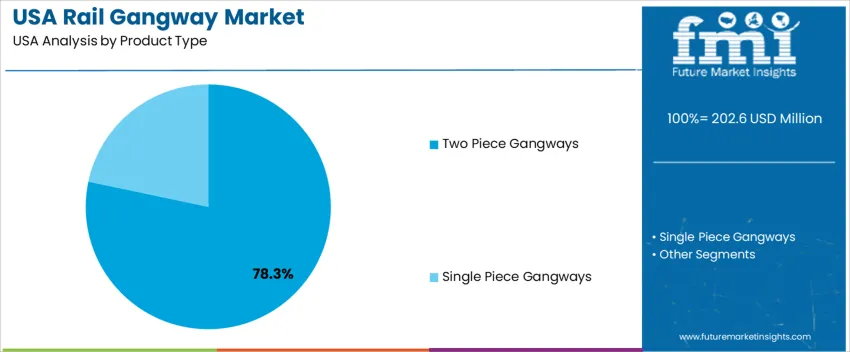
Two-piece gangways account for 78.3%, reflecting their compatibility with articulated trains, enhanced flexibility between cars, and superior vibration absorption suited to frequent stops in metro operations. Urban rail network upgrades in major USA cities prioritize modular gangway structures that enable high-capacity passenger flow and optimized platform boarding. Single-piece gangways represent 21.7%, used in select mainline fleets where rigid structural continuity remains appropriate. Procurement decisions consider long-term maintenance, interchangeability during fleet expansion, and safety requirements under dynamic passenger movement. Two-piece configurations align with urban service growth, standardized fleet purchases, and goals to improve accessibility and comfort across USA transit corridors.
Key Points:
- Two-piece gangways are essential for articulated metro and commuter trains
- Adoption aligns with high-frequency, high-passenger-density operations
- Single-piece systems retain selective use in specific intercity fleets
By Material Type, Aluminum Leads Usage in USA Rail Gangways
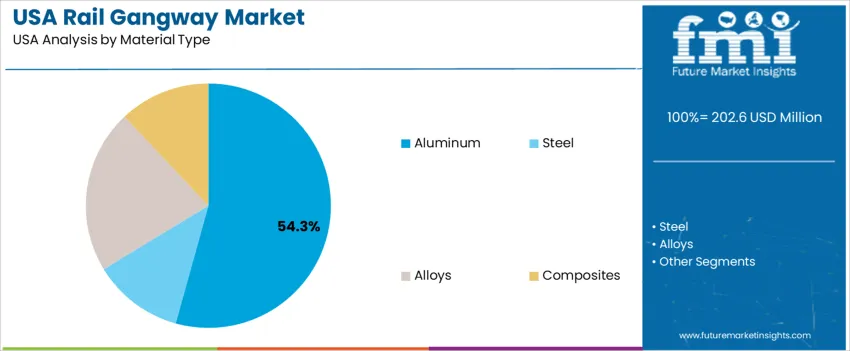
Aluminum holds the largest share at 54.3%, reflecting its low weight, corrosion resistance, and lifecycle cost advantages that support energy efficiency across electrified and diesel fleets. Demand is reinforced by USA sustainability objectives and the need to reduce axle load and improve acceleration in transit fleets. Alloys account for 21.7%, serving demanding operating environments requiring structural rigidity and mechanical durability. Steel represents 12.0%, retained in applications emphasizing impact resistance. Composites hold 12.0%, growing in acceptance for their lightweight properties and sound-damping capabilities in modern urban fleets. Material choices enable operators to balance durability, safety compliance, and reduced wear-and-tear across a variety of USA rail systems.
Key Points:
- Aluminum supports light weighting to cut energy and maintenance costs
- Alloy structures improve robustness for high-stress operating conditions
- Composites gain traction for noise reduction and safety performance
By Train Type, Metro/Subway Systems Drive the Largest Share
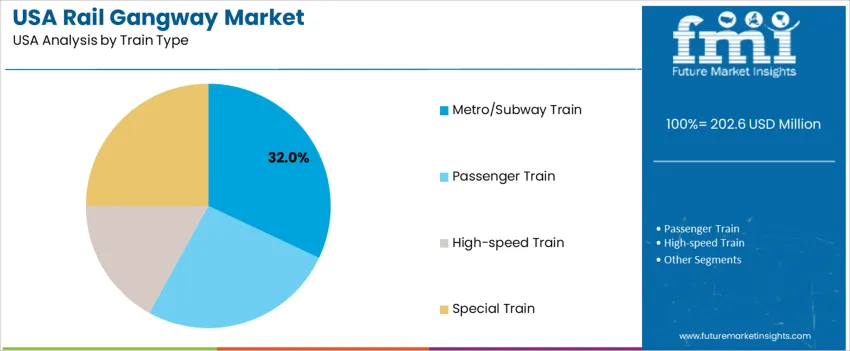
Metro and subway trains account for 32.0%, driven by expansion and refurbishment of rapid-transit networks serving dense urban areas. Passenger trains represent 26.0%, supported by corridor upgrades improving comfort and high-frequency ridership. Special trains, including airport connectors and tourist shuttles, contribute 25.0%, reflecting broader use of gangways beyond traditional rail services. High-speed trains hold 17.0%, where demand increases in line with planned future corridors and pilot developments. Train-type segmentation reflects reliance on public transit use across major cities and continuous investment in safe, interconnected rail operations across the USA transportation landscape.
Key Points:
- Metro fleet projects provide the strongest gangway consumption base
- Passenger services support replacement cycles and comfort upgrades
- High-speed adoption depends on corridor expansion initiatives
What are the Drivers, Restraints, and Key Trends of the Demand for Rail Gangways in USA?
Growth of commuter rail expansion, increased intercity passenger services and modernisation of existing fleets drive demand.
In the United States, rail operators upgrading rolling stock for commuter and intercity services require gangways to enable safe, flexible passage between cars. Expansion projects in heavily travelled corridors, especially in the Northeast, California and Pacific Northwest, encourage procurement of modern gangway systems to improve train capacity and accessibility. Transit agencies emphasize rider comfort, safety and compliance with Americans with Disabilities Act (ADA) standards, supporting demand for gangways offering stable articulation, wide passage and vibration control. Replacement of aging equipment in legacy fleets, including regional and long-distance passenger trains, generates recurring demand as older gangways reach end-of-service life.
High regulatory and safety compliance costs, compatibility challenges with legacy cars and slow replacement cycles restrain demand.
Gangway systems must meet rigorous federal standards for crashworthiness, fire safety, and structural integrity under dynamic rail loads. Retrofitting older rail cars can involve costly modifications to door frames, vestibules and undercarriage support, which delays adoption. Freight-passenger hybrid routes and mixed-fleet operations complicate uniform gangway specification across diverse rolling stock. Budget constraints at smaller transit agencies and long vehicle life cycles slow replacement speed despite growing maintenance needs.
Shift toward modular, interoperable gangways, increased adoption in light-rail and commuter fleets, and rising use of gangway-equipped sleeper and long-haul trains define key trends.
Manufacturers are developing modular gangway units that can retrofit a variety of car types, reducing customization time and installation cost for USA operators. Light-rail and commuter rail systems expanding in suburban areas are adding gangway-equipped cars to improve passenger flow and capacity during peak hours. Long-distance operators are ordering gangway-equipped sleeper and coach cars to enhance onboard mobility and improve passenger experience on cross-country services. Transit agencies increasingly include gangway performance metrics, such as noise isolation, joint smoothness and maintenance intervals in procurement specifications. These trends suggest stable but selective demand for rail gangways within the evolving USA passenger rail landscape.
Analysis of the Demand for Rail Gangways in the USA by Region
Demand for rail gangways in the United States reflects ongoing investment in passenger rolling stock, fleet renewal, and safety compliance. Gangways support safe movement between cars on intercity trains, commuter rail, metro fleets, and some regional services. West USA leads growth at 5.2% CAGR from 2025 to 2035, followed by South USA at 4.7%, supported by corridor expansions and new EMU and DMU procurements. Northeast USA grows at 4.2%, mainly through replacement cycles for legacy commuter and intercity fleets. Midwest USA progresses more gradually at 3.6% CAGR, with demand linked to incremental network upgrades and selective fleet modernization.
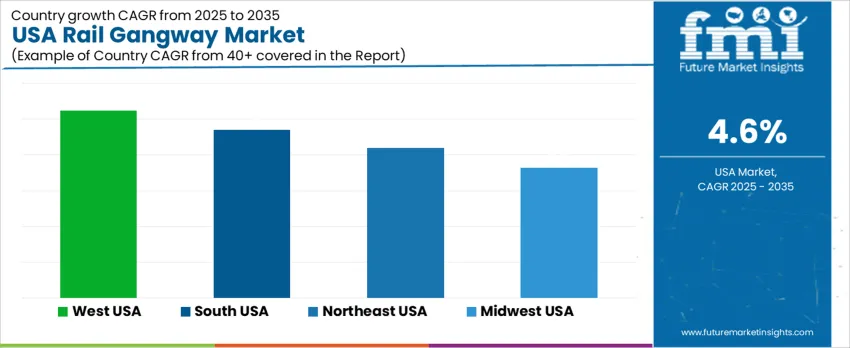
| Region | CAGR (2025-2035) |
|---|---|
| West USA | 5.2% |
| South USA | 4.7% |
| Northeast USA | 4.2% |
| Midwest USA | 3.6% |
How is the West USA shaping demand for rail gangways?
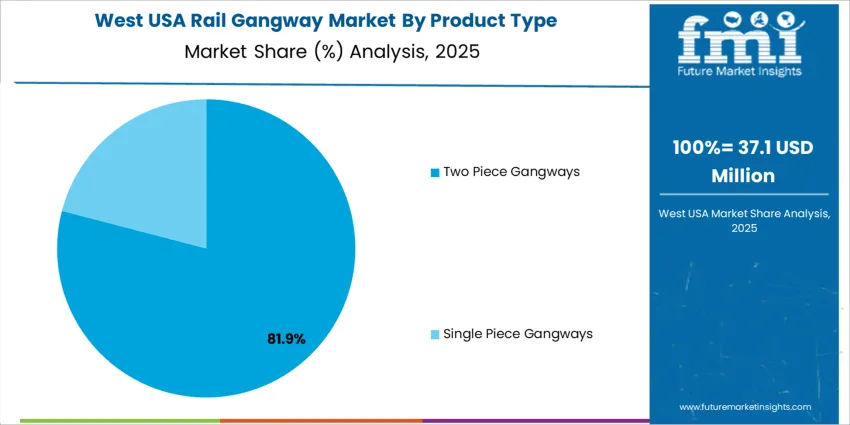
West USA posts the highest regional growth, with demand for rail gangways rising at about 5.2% CAGR through 2035. Fleet requirements stem from expansions across suburban commuter corridors, regional intercity links, and urban light-rail and metro projects anchored in California, Washington, Colorado, and Arizona. Agencies specifying new trains emphasize wide, enclosed gangways that support passenger circulation, accessibility compliance, and on-board security visibility. Procurement documents increasingly reference lifecycle performance, sealing quality, and resistance to dust and temperature swings. Aftermarket activity grows as operators refurbish existing fleets to extend service life under rising ridership. OEMs and component suppliers respond with modular gangway platforms that simplify installation and maintenance.
- New commuter and regional fleets driving first-fit gangway volumes
- Light-rail and metro extensions adding multi-car articulated sets
- Environmental sealing and durability influencing specification choices
- Refurbishment programs supporting recurring aftermarket demand
How is the South USA influencing demand for rail gangways?
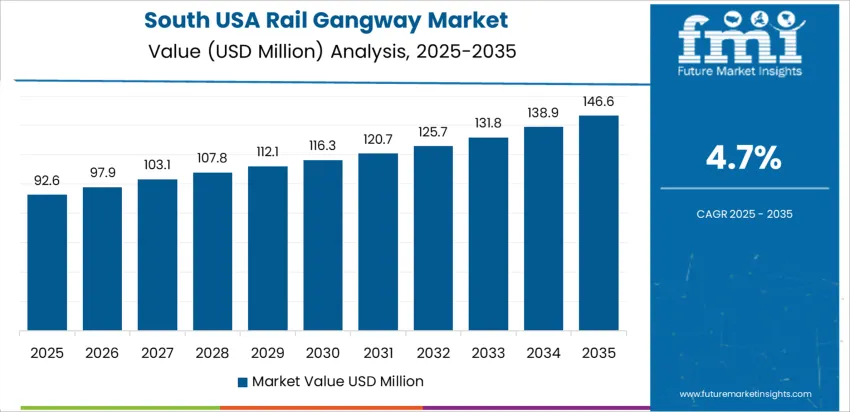
South USA records solid expansion, with rail gangway demand increasing at roughly 4.7% CAGR over the forecast period. Growth links to population gains in Texas, Florida, Georgia, North Carolina, and surrounding states, where congestion concerns support commuter and regional rail development. New rolling stock orders for corridor services favor gangways that enable open inter-car layouts, improving perceived safety and passenger distribution. Climate conditions require attention to heat, humidity, and corrosion behavior of bellows materials and mechanical joints. Freight-dominant corridors transitioning selected rights-of-way to passenger operations introduce new gangway requirements. Maintenance depots prioritize parts commonality and ease of inspection when evaluating supplier proposals.
- Population-driven rail projects supporting new passenger fleets
- Open-gangway interiors improving passenger circulation and security oversight
- Climate resilience shaping material and sealing specifications
- Depot operators favoring standardized designs for maintenance efficiency
How is the Northeast USA contributing to rail gangway procurement?
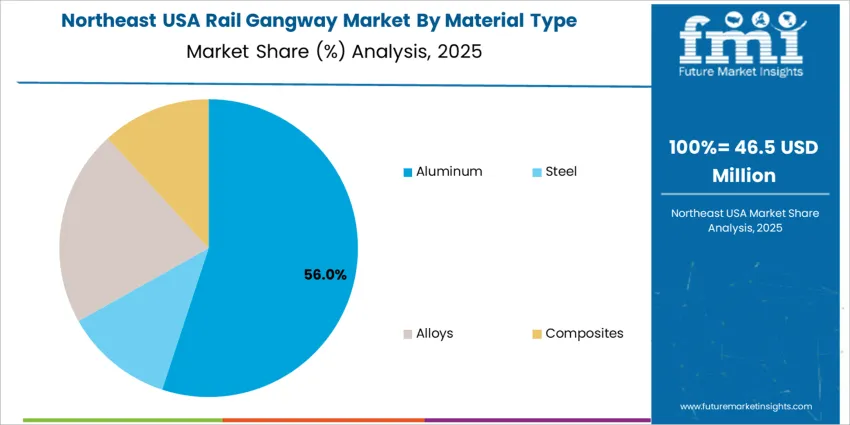
Northeast USA shows steady growth, with demand for rail gangways advancing at around 4.2% CAGR between 2025 and 2035. Activity centers on dense commuter and intercity corridors spanning New England, New York, New Jersey, and adjoining states, where operators manage aging fleets under high-utilization regimes. Replacement programs for EMUs, push–pull coaches, and corridor trainsets require gangways meeting stringent crashworthiness, fire safety, and accessibility standards. Agencies place emphasis on ride comfort and noise reduction in inter-car transitions due to long daily travel times. Tunnel, coastal, and winter conditions require robust sealing and resistance to water ingress, ice, and de-icing agents. Joint procurement frameworks sometimes align specifications across multiple authorities.
- High-frequency commuter networks driving structured renewal cycles
- Safety and fire standards heavily shaping design and testing needs
- Harsh-weather exposure influencing sealing and material durability
- Multi-agency coordination guiding common gangway specifications
How is the Midwest USA affecting demand for rail gangways?
Midwest USA posts comparatively moderate growth, with rail gangway demand rising at about 3.6% CAGR through 2035. Fleets serve commuter lines and intercity corridors across Illinois, Michigan, Wisconsin, Minnesota, Missouri, and neighboring states, where incremental service improvements dominate planning. Many operators focus on life-extension projects, replacing worn gangway components while deferring complete vehicle renewal. New procurements emphasize compatibility with existing platform heights and mixed consist operations. Weather exposure creates requirements for reliable performance under snow, ice, and sustained low temperatures, making mechanical robustness and bellows flexibility key evaluation points. Funding patterns tied to multi-year capital programs create staggered order schedules for OEM and aftermarket supply.
- Life-extension strategies sustaining steady aftermarket gangway needs
- Intercity and commuter services driving selective new-train orders
- Cold-weather performance a critical factor in design assessment
- Staggered funding cycles leading to phased procurement volumes
What does the competitive structure for rail gangway demand in the United States show?
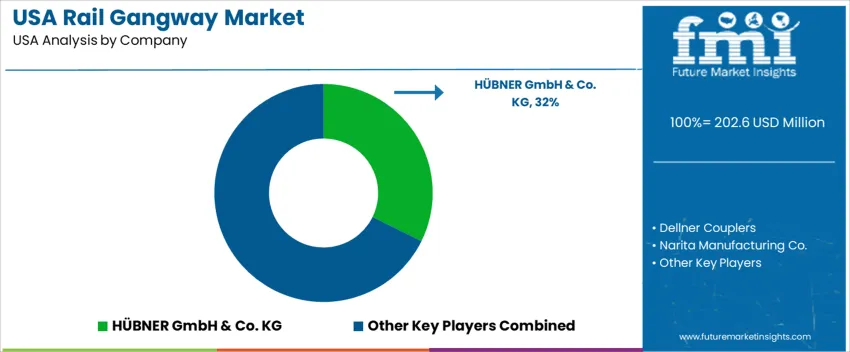
Rail gangway demand in the United States reflects replacement and fleet-modernisation cycles across commuter rail, metro, and inter-city passenger systems. Procurement decisions emphasise fire-resistant elastomers, vibration-control compatibility, and lifecycle reliability under varied climate exposure. USA transit authorities require suppliers to document compliance with ASTM material standards and interoperability with rolling-stock produced by established North American manufacturers. Lead times and integration engineering directly influence supplier selection.
HÜBNER GmbH & Co. KG holds about 32.3% share in the United States. Its position reflects extensive installation history in regional and urban fleets, backed by technical service coverage and validated durability in harsh-weather corridors. Dellner competes in new-build and mid-life refurbishment programs where coupling-system integration and modular gangway assemblies shape cost predictability. Narita Manufacturing participates in targeted transit routes requiring compact configurations and weight-controlled designs.
Jai Dadi Group focuses on value-driven solutions in procurement environments prioritizing lower acquisition cost where compliance requirements remain achievable. KTK Group retains presence through partnerships supporting imported rolling-stock and specified gangway interface geometries. Future competitive outcomes depend on documentation depth for flame, smoke, and toxicity performance, mechanical-fatigue validation for high-frequency use profiles, and service availability that supports transit-agency uptime expectations.
Key Players in USA Rail Gangway Demand
- HÜBNER GmbH & Co. KG
- Dellner Couplers
- Narita Manufacturing Co.
- Jai Dadi Group
- KTK Group
Scope of the Report
| Items | Values |
|---|---|
| Quantitative Units | USD million |
| Product Type | Single Piece Gangways, Two Piece Gangways |
| Material Type | Steel, Aluminum, Alloys, Composites |
| Train Type | Passenger Train, Metro/Subway Train, High-speed Train, Special Train |
| Regions Covered | West USA, South USA, Northeast USA, Midwest USA |
| Key Companies Profiled | HÜBNER GmbH & Co. KG, Dellner Couplers, Narita Manufacturing Co., Jai Dadi Group, KTK Group |
| Additional Attributes | Dollar sales by product type, material type, and train segments; regional procurement and replacement cycles across West, South, Northeast, and Midwest USA; modernization programs in metro and high-speed transit; demand driven by refurbishment of existing rail fleets and expansion of intercity transportation; supplier competition focused on lightweight alloys, safety compliance, crashworthiness, and extended lifecycle performance. |
USA Rail Gangway Demand by Segments
Product Type:
- Single Piece Gangways
- Two Piece Gangways
Material Type:
- Steel
- Aluminum
- Alloys
- Composites
Train Type:
- Passenger Train
- Metro/Subway Train
- High-speed Train
- Special Train
Region:
- West USA
- South USA
- Northeast USA
- Midwest USA
Frequently Asked Questions
How big is the demand for rail gangway in USA in 2025?
The demand for rail gangway in USA is estimated to be valued at USD 202.6 million in 2025.
What will be the size of rail gangway in USA in 2035?
The market size for the rail gangway in USA is projected to reach USD 316.4 million by 2035.
How much will be the demand for rail gangway in USA growth between 2025 and 2035?
The demand for rail gangway in USA is expected to grow at a 4.6% CAGR between 2025 and 2035.
What are the key product types in the rail gangway in USA?
The key product types in rail gangway in USA are two piece gangways and single piece gangways.
Which material type segment is expected to contribute significant share in the rail gangway in USA in 2025?
In terms of material type, aluminum segment is expected to command 54.3% share in the rail gangway in USA in 2025.
Preview the report firsthand - request a free sample
Get SampleGet the brochure for pricing and purchase details.
Get PDFTable of Content
- Executive Summary
- USA Market Outlook
- Demand-side Trends
- Supply-side Trends
- Technology Roadmap Analysis
- Analysis and Recommendations
- Market Overview
- Market Coverage / Taxonomy
- Market Definition / Scope / Limitations
- Market Background
- Market Dynamics
- Drivers
- Restraints
- Opportunity
- Trends
- Scenario Forecast
- Demand in Optimistic Scenario
- Demand in Likely Scenario
- Demand in Conservative Scenario
- Opportunity Map Analysis
- Product Life Cycle Analysis
- Supply Chain Analysis
- Investment Feasibility Matrix
- Value Chain Analysis
- PESTLE and Porter’s Analysis
- Regulatory Landscape
- Regional Parent Market Outlook
- Production and Consumption Statistics
- Import and Export Statistics
- Market Dynamics
- USA Market Analysis 2020 to 2024 and Forecast, 2025 to 2035
- Historical Market Size Value (USD Million) Analysis, 2020 to 2024
- Current and Future Market Size Value (USD Million) Projections, 2025 to 2035
- Y-o-Y Growth Trend Analysis
- Absolute $ Opportunity Analysis
- USA Market Pricing Analysis 2020 to 2024 and Forecast 2025 to 2035
- USA Market Analysis 2020 to 2024 and Forecast 2025 to 2035, By Product Type
- Introduction / Key Findings
- Historical Market Size Value (USD Million) Analysis By Product Type , 2020 to 2024
- Current and Future Market Size Value (USD Million) Analysis and Forecast By Product Type , 2025 to 2035
- Two Piece Gangways
- Single Piece Gangways
- Y-o-Y Growth Trend Analysis By Product Type , 2020 to 2024
- Absolute $ Opportunity Analysis By Product Type , 2025 to 2035
- USA Market Analysis 2020 to 2024 and Forecast 2025 to 2035, By Material Type
- Introduction / Key Findings
- Historical Market Size Value (USD Million) Analysis By Material Type, 2020 to 2024
- Current and Future Market Size Value (USD Million) Analysis and Forecast By Material Type, 2025 to 2035
- Aluminum
- Steel
- Alloys
- Composites
- Y-o-Y Growth Trend Analysis By Material Type, 2020 to 2024
- Absolute $ Opportunity Analysis By Material Type, 2025 to 2035
- USA Market Analysis 2020 to 2024 and Forecast 2025 to 2035, By Train Type
- Introduction / Key Findings
- Historical Market Size Value (USD Million) Analysis By Train Type, 2020 to 2024
- Current and Future Market Size Value (USD Million) Analysis and Forecast By Train Type, 2025 to 2035
- Metro/Subway Train
- Passenger Train
- High-speed Train
- Special Train
- Y-o-Y Growth Trend Analysis By Train Type, 2020 to 2024
- Absolute $ Opportunity Analysis By Train Type, 2025 to 2035
- Market Structure Analysis
- Competition Dashboard
- Competition Benchmarking
- Market Share Analysis of Top Players
- By Regional
- By Product Type
- By Material Type
- By Train Type
- Competition Analysis
- Competition Deep Dive
- HÜBNER GmbH & Co. KG
- Overview
- Product Portfolio
- Profitability by Market Segments (Product/Age /Sales Channel/Region)
- Sales Footprint
- Strategy Overview
- Marketing Strategy
- Product Strategy
- Channel Strategy
- Dellner Couplers
- Narita Manufacturing Co.
- Jai Dadi Group
- KTK Group
- HÜBNER GmbH & Co. KG
- Competition Deep Dive
- Assumptions & Acronyms Used
- Research Methodology


