

- Industry Size (2025)
- USD 55.3 Mn
- Forecast (2035)
- USD 78.8 Mn
- CAGR (2025 to 2035)
- 3.6%
Demand for Screw Conveyor in Japan Forecast and Outlook 2025 to 2035
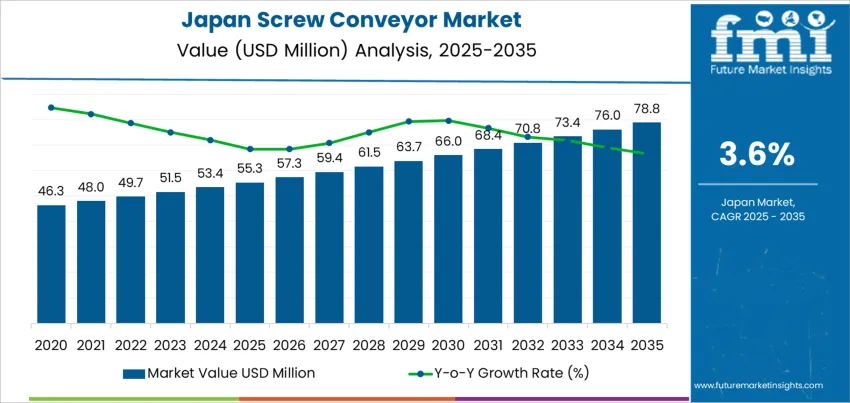
The demand for screw conveyors in Japan is expected to grow from USD 55.3 million in 2025 to USD 78.8 million by 2035, reflecting a compound annual growth rate (CAGR) of 3.6%. Screw conveyors, widely used in industries such as food processing, pharmaceuticals, construction, and mining, are essential for transporting bulk materials in a controlled and efficient manner.
The increasing need for automation in material handling processes and the growing focus on improving operational efficiency in industrial applications will continue to drive demand for screw conveyors. The trend towards custom-built solutions that meet specific material handling requirements is expected to further fuel the industry.
The overall growth in demand for screw conveyors will also be supported by technological innovations, such as advancements in sensor integration, IoT-enabled monitoring systems, and the development of more flexible designs. These innovations will increase the efficiency and reliability of screw conveyors, making them even more attractive to industries seeking optimized material handling solutions. As industries in Japan continue to invest in automation and smarter production lines, screw conveyors will remain a key solution for efficient material transportation, driving sustained growth throughout the forecast period.
Quick Stats of the Demand for Screw Conveyor in Japan
- Demand for Screw Conveyor in Japan Value (2025): USD 55.3 million
- Demand for Screw Conveyor in Japan Forecast Value (2035): USD 78.8 million
- Demand for Screw Conveyor in Japan Forecast CAGR (2025-2035): 3.6%
- Demand for Screw Conveyor in Japan Leading Product Type: Horizontal Screw Conveyor
- Demand for Screw Conveyor in Japan Key Growth Regions: Kyushu & Okinawa, Kanto, Kansai, Chubu, Tohoku, Rest of Japan
- Demand for Screw Conveyor in Japan Top Players: Vac-U-Max, Inc., Anders Pedersen Maskin- & Specialfabrik A/S, Industrial Screw Conveyors Inc., Wamgroup Spa, DEMECH India
What is the Growth Forecast for the Demand for Screw Conveyor in Japan through 2035?
From 2025 to 2030, the demand for screw conveyors is expected to grow from USD 55.3 million to USD 66.0 million, adding USD 10.7 million in value. This period will be characterized by the continued expansion of Japan’s industrial sectors, particularly manufacturing, construction, and food processing. As businesses focus on improving material handling systems and reducing labor costs, screw conveyors will continue to be an essential component in automated production lines. The increased adoption of modular and customizable screw conveyor systems, designed to fit various space and production requirements, will further contribute to industry growth. The development of energy-efficient and durable screw conveyors will meet the rising demand for sustainable and cost-effective material handling solutions.
From 2030 to 2035, demand will continue to rise from USD 66.0 million to USD 78.8 million, contributing USD 12.8 million in value. This growth will be driven by the ongoing expansion and modernization of Japan’s manufacturing and logistics infrastructure. As industries continue to adopt automation and advanced material handling technologies, screw conveyors will remain integral to various sectors, including mining, food processing, and chemical production. The trend towards more sophisticated conveyor systems that offer enhanced reliability, increased throughput, and reduced downtime will further fuel demand.
Demand for Screw Conveyor in Japan Key Takeaways
| Metric | Value |
|---|---|
| Demand for Screw Conveyor in Japan Value (2025) | USD 55.3 million |
| Demand for Screw Conveyor in Japan Forecast Value (2035) | USD 78.8 million |
| Demand for Screw Conveyor in Japan Forecast CAGR (2025-2035) | 3.6% |
Why is the Demand for Screw Conveyor in Japan Growing?
The demand for screw conveyors in Japan is growing due to the increasing need for efficient material handling systems across industries such as manufacturing, agriculture, and food processing. Screw conveyors, known for their ability to transport bulk materials over long distances with minimal effort, are becoming essential in a variety of sectors. Their ability to handle both dry and wet materials, as well as their durability and cost-effectiveness, make them a preferred choice for automating material handling processes.
A key factor driving the growth of screw conveyors is the expansion of industries that rely on bulk material handling. As manufacturing and processing sectors continue to evolve, the need for more efficient systems to move raw materials, products, and waste has risen. Screw conveyors help streamline these operations, improving productivity and reducing the need for manual labor. This is particularly important in sectors such as food processing and construction, where the movement of large quantities of materials is essential for maintaining efficiency.
The focus on automation and technological advancements in industrial processes is contributing to the growing demand for screw conveyors. As companies invest in smarter, more efficient systems, screw conveyors are being integrated with automated processes, making them more versatile and adaptable to modern manufacturing and processing environments. With continued industry growth and the push for efficiency, the demand for screw conveyors in Japan is expected to rise steadily through 2035.
What is the Segment-Wise Analysis of Demand for Screw Conveyors in Japan?
Demand for screw conveyors in Japan is segmented by product type, end-use, rotation capacity, and region. By product type, demand is divided into horizontal screw conveyors, inclined screw conveyors, vertical screw conveyors, shafted screw conveyors, and shaft-less screw conveyors. The demand is also segmented by end-use, including mining and metallurgy, agriculture, food and beverage, chemical, pharmaceutical, and others. In terms of rotation capacity, demand is spread across less than 45 RPM, 45-105 RPM, 105-165 RPM, and greater than 165 RPM. Regionally, demand is distributed across Kyushu & Okinawa, Kanto, Kansai, Chubu, Tohoku, and the rest of Japan.
Why Do Horizontal Screw Conveyors Lead the Demand in Japan?

Horizontal screw conveyors account for 42% of the demand for screw conveyors in Japan due to their efficiency and versatility in a wide range of industrial applications. Horizontal screw conveyors are commonly used for transporting bulk materials such as powders, grains, and other solids, making them ideal for industries like agriculture, food and beverage, and chemicals. Their simple design, ease of installation, and ability to handle a variety of materials make them a preferred choice across many sectors.
The widespread use of horizontal screw conveyors in Japan's manufacturing and processing industries, coupled with their ability to operate smoothly in horizontal transport settings, ensures their dominance in the industry. As Japan continues to focus on industrial automation and material handling efficiency, horizontal screw conveyors will remain the most popular product type.
Why Does Mining and Metallurgy Lead the Demand for Screw Conveyors in Japan?
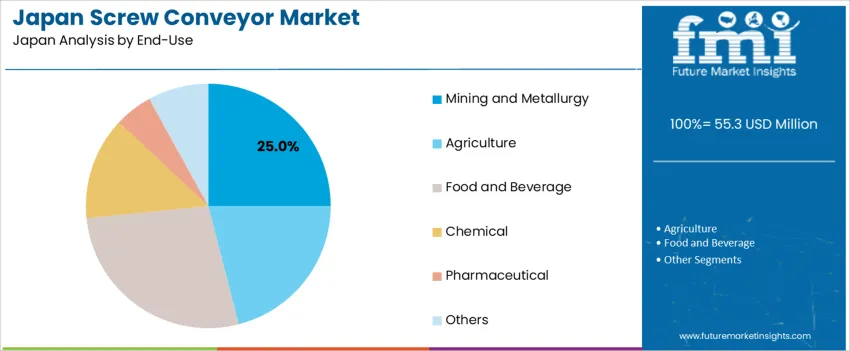
Mining and metallurgy account for 25% of the demand for screw conveyors in Japan, driven by the need for reliable and efficient bulk material handling systems in these industries. Mining and metallurgy operations often involve the transportation of heavy, abrasive materials such as ore, minerals, and coal, which require robust and durable equipment like screw conveyors. Screw conveyors provide a practical solution for moving such materials over short distances within processing plants, smelting facilities, and mining sites.
Their ability to handle dense, granular, or particulate materials with minimal risk of spillage and contamination makes them indispensable in these sectors. As Japan continues to invest in its mining and metallurgy industries, especially in the context of resource management and sustainability, the demand for screw conveyors is expected to remain strong.
What are the Key Trends, Drivers, and Restraints in Demand for Screw Conveyor Systems in Japan?
Screw conveyors, using a rotating helical screw blade inside a tube or trough to move material, are used across sectors such as food processing, pharmaceuticals, chemicals, agriculture, waste management, and construction. The push toward industrial automation and modernization of processing plants boosts adoption. As manufacturers and processors emphasize efficiency, hygiene, and continuous flow, screw conveyors offer consistent throughput, reduced manual handling, and contamination resistant transport. These features drive their growing demand. Factors such as fluctuating steel and material costs, maintenance requirements, and the need for customization to handle varied materials sometimes limit their broader adoption.
Why is Demand for Screw Conveyor Systems Growing in Japan?
Demand is growing because Japanese industries, including food and beverage processing, pharmaceuticals, chemical manufacturing, agriculture, and waste handling, increasingly rely on automated material handling systems for bulk solids. As production volumes grow and regulations on hygiene and safety tighten, screw conveyors offer a reliable solution for transporting powders, granules, wet or dry bulk, sludge, or semi solid materials. The shift toward automation and optimized workflows makes screw conveyors attractive to processors needing continuous, controlled conveyance. As older facilities modernize and new plants are built, investments in efficient conveyors rise. The need for compact, enclosed systems that minimize spillage, contamination, and manual labour is a major driver of adoption.
How are Technological & Industry Innovations Driving Screw Conveyor Demand in Japan?
Technological innovations are enhancing the functionality, durability, and adaptability of screw conveyor systems. Manufacturers increasingly use materials like stainless steel and corrosion resistant coatings to meet hygiene requirements for food, chemicals, and pharmaceutical industries. Flexible designs, including horizontal, inclined, vertical, shaft less, and flexible screw conveyors, allow handling of a variety of materials and fit into constrained plant layouts. Advanced customization, such as variable pitch screw blades, specific trough geometries, and tailored capacities, helps handle sticky, abrasive, or high moisture materials, expanding use cases. Growing interest globally in automation, predictive maintenance, and energy efficient material handling also promotes adoption of modern screw conveyor systems.
What are the Key Challenges and Risks That Could Limit Screw Conveyor Demand in Japan?
High initial cost for installation, particularly for custom or specialized conveyors, may deter smaller processors or firms with limited budgets. Regular maintenance and potential wear and tear when handling abrasive or corrosive materials increase operating costs and downtime. For certain materials, such as highly viscous slurries or very large bulky materials, screw conveyors may not be optimal, prompting users to consider alternative conveying methods. Sensitivity to raw material prices, such as steel, can raise costs for manufacturers and end users, squeezing margins. Regulatory and hygiene compliance requirements, especially in food, pharmaceutical, and waste management sectors, demand higher grade materials and frequent cleaning, which can increase costs and complexity.
What is the Regional Demand Outlook for Screw Conveyor in Japan?
| Region | CAGR (%) |
|---|---|
| Kyushu & Okinawa | 4.5% |
| Kanto | 4.1% |
| Kansai | 3.6% |
| Chubu | 3.2% |
| Tohoku | 2.8% |
| Rest of Japan | 2.7% |
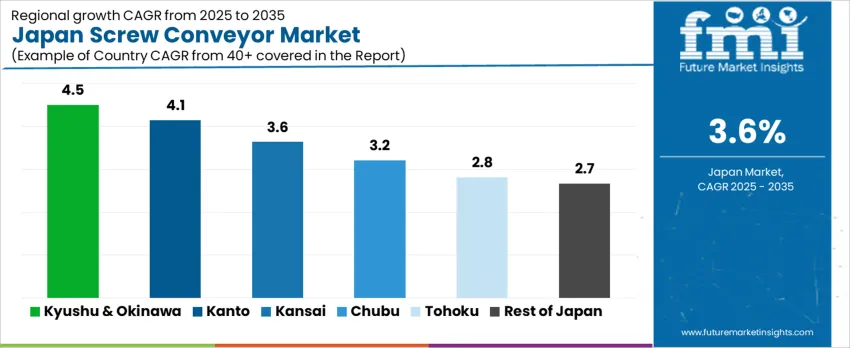
Demand for screw conveyors in Japan is growing steadily, with Kyushu & Okinawa leading at a 4.5% CAGR, driven by industrial and manufacturing growth. Kanto follows at 4.1%, supported by its large industrial base. Kansai shows steady demand at 3.6% CAGR, driven by a focus on food processing and logistics. Chubu experiences a 3.2% CAGR, fueled by industrial modernization. Tohoku and the Rest of Japan see moderate growth at 2.8% and 2.7%, respectively, as local industries continue to modernize and embrace automation. This trend reflects Japan’s ongoing industrial upgrades and the adoption of efficient material handling solutions.
How is Demand for Screw Conveyors Growing in Kyushu & Okinawa?
Kyushu & Okinawa is leading in demand for screw conveyors, growing at a 4.5% CAGR. The region’s expanding industrial and manufacturing sectors, especially in food processing, agriculture, and logistics, are key drivers of growth. Screw conveyors play an essential role in transporting bulk materials such as grains, food products, and raw materials, making them vital for automating production processes. The rise of small and medium-sized businesses in the region has further fueled the demand for efficient, space-saving equipment. The region’s focus on modernizing manufacturing and embracing automation strengthens the need for such equipment. As Kyushu & Okinawa continues to develop its industrial capabilities, the demand for screw conveyors is expected to remain strong, particularly in food processing and logistics sectors.
Why is Demand for Screw Conveyors Rising in Kanto?
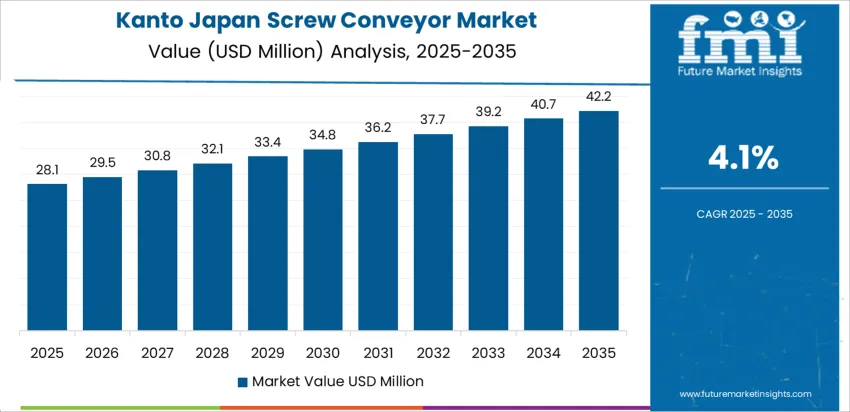
Kanto is experiencing steady demand for screw conveyors, growing at a 4.1% CAGR. The region’s large industrial base, particularly in manufacturing and logistics, is a significant driver of growth. In industries like food processing, chemicals, and pharmaceuticals, screw conveyors are crucial for transporting powders, liquids, and granular materials. The high population density in Kanto also adds to the demand for efficient and reliable material handling systems.
Furthermore, the region’s strong focus on advanced manufacturing techniques and automation increases the adoption of screw conveyors. As Kanto continues to modernize its industrial and manufacturing sectors, the demand for these systems is expected to grow, supported by their versatility and compact design, which makes them ideal for space-efficient and energy-saving applications.
How is Demand for Screw Conveyors Expanding in Kansai?
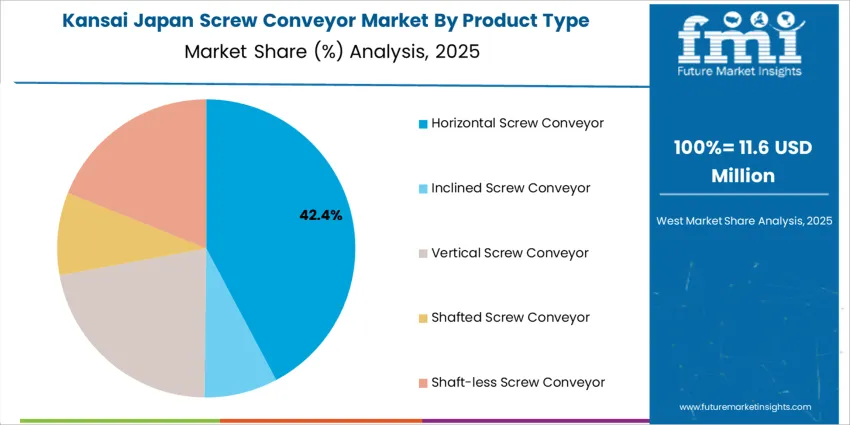
Kansai is seeing steady demand for screw conveyors, growing at a 3.6% CAGR. The region’s industrial focus, particularly in food and beverage, chemicals, and metalworking, drives the increasing adoption of screw conveyors. With major cities like Osaka and Kobe acting as industrial hubs, efficient material handling becomes crucial, and screw conveyors are essential for automating production processes. The versatile nature of screw conveyors, which can handle a wide range of materials, supports their growing use in Kansai’s industries.
As businesses in the region modernize their operations and move towards automation and sustainable production practices, the demand for screw conveyors continues to rise steadily. The region’s industrial infrastructure and ongoing efficiency improvements ensure that demand for these systems will remain steady in the long term.
Why is Demand for Screw Conveyors Growing in Chubu?
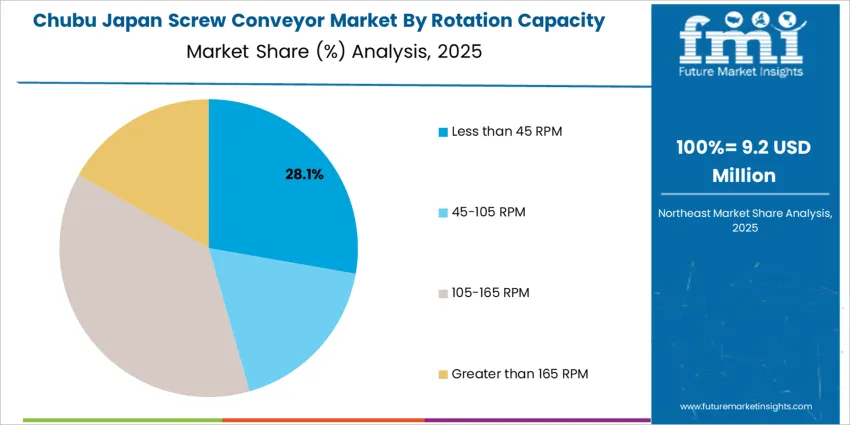
Chubu is experiencing steady demand for screw conveyors, with a 3.2% CAGR. The region’s strong industrial sector, particularly in cities like Nagoya, is a major driver. As the region focuses on increasing manufacturing capacity and automating production processes, industries such as automotive, food processing, and chemicals are adopting screw conveyors. These systems are especially valued for their space-saving, reliable transport of bulk materials.
With Chubu’s continued emphasis on modernizing industrial operations and increasing efficiency, the demand for screw conveyors is expected to rise steadily. Industries in the region are looking to adopt more sustainable and energy-efficient equipment, which supports the growth of screw conveyors. As the region’s manufacturing industries continue to expand, the demand for screw conveyors will continue to follow suit, driven by automation and production efficiency.
How is Demand for Screw Conveyors Expanding in Tohoku?
Tohoku is seeing moderate demand for screw conveyors, growing at a 2.8% CAGR. While the region’s demand is smaller compared to urban areas, there is steady growth as local industries, particularly in food production, agriculture, and manufacturing, modernize their operations. As Tohoku continues to expand its industrial capabilities, businesses increasingly adopt screw conveyors for more efficient material handling.
The region’s growing emphasis on automation and cost reduction further supports this trend, as companies look for ways to optimize production processes. Small and medium-sized enterprises in Tohoku are turning to reliable systems like screw conveyors to improve their operations. As the region’s industrial infrastructure improves, demand for screw conveyors will continue to increase, although at a more moderate pace compared to major urban centers.
Why is Demand for Screw Conveyors Steady in the Rest of Japan?
The Rest of Japan is experiencing steady demand for screw conveyors, with a 2.7% CAGR. While the demand is lower in rural and suburban areas compared to major urban centers, local industries in agriculture and small-scale manufacturing are increasingly adopting efficient material handling solutions. As businesses in these regions modernize their operations and move toward automation, the need for space-efficient and reliable systems like screw conveyors rises. The growing interest in energy-efficient technologies and modern production methods further contributes to the steady increase in demand. As the Rest of Japan’s industries improve and access to advanced equipment grows, screw conveyors will continue to be adopted, driving steady demand in these regions.
What is Driving the Demand for Screw Conveyors in Japan and Who Are the Key Players Shaping the Industry?

The demand for screw conveyors in Japan is growing due to their essential role in material handling across industries such as agriculture, chemicals, pharmaceuticals, and manufacturing. Screw conveyors are highly valued for their efficiency in transporting granular, powdery, or liquid materials through confined spaces, making them ideal for applications that require continuous and reliable movement of bulk materials. The increasing need for automation in production and manufacturing processes, along with a rising focus on improving operational efficiency and reducing manual labor, is driving the demand for screw conveyors. Japan’s strong industrial sector and the country’s emphasis on innovation and technology further support the adoption of advanced screw conveyor systems in a variety of industries.
Key players shaping the screw conveyor industry in Japan include Vac-U-Max, Inc., Anders Pedersen Maskin- & Specialfabrik A/S, Industrial Screw Conveyors Inc., Wamgroup Spa, and DEMECH India. Vac-U-Max, Inc. leads the industry with a substantial share of 23.5%, offering highly efficient and reliable screw conveyor solutions tailored to the specific needs of various industries. These companies are critical in providing tailored solutions for material handling, ensuring that their systems meet the demands of Japan’s high-tech industries. Their focus on durability, energy efficiency, and customizability allows them to maintain a strong presence in the competitive screw conveyor industry.
The growth of the screw conveyor industry in Japan is also supported by the continued expansion of the industrial and manufacturing sectors. As industries look for ways to improve efficiency, minimize downtime, and ensure smooth operations, screw conveyors continue to be integral in material handling systems. The need for increasingly sophisticated and automated solutions in Japan’s industrial landscape ensures continued demand for advanced screw conveyor systems.
Key Players in Japan Small Satellites Demand
- Vac-U-Max, Inc
- Anders Pedersen Maskin- & Specialfabrik A/S
- Industrial Screw Conveyors Inc
- Wamgroup Spa
- DEMECH India
Scope of Report
| Items | Values |
|---|---|
| Quantitative Units (2025) | USD million |
| Product Type | Horizontal Screw Conveyor, Inclined Screw Conveyor, Vertical Screw Conveyor, Shafted Screw Conveyor, Shaft-less Screw Conveyor |
| Rotation Capacity | Less than 45 RPM, 45-105 RPM, 105-165 RPM, Greater than 165 RPM |
| End-Use | Mining and Metallurgy, Agriculture, Food and Beverage, Chemical, Pharmaceutical, Others |
| Region | Kyushu & Okinawa, Kanto, Kansai, Chubu, Tohoku, Rest of Japan |
| Countries Covered | Japan |
| Key Companies Profiled | Vac-U-Max, Inc, Anders Pedersen Maskin- & Specialfabrik A/S, Industrial Screw Conveyors Inc, Wamgroup Spa, DEMECH India |
| Additional Attributes | Dollar sales by product type and rotation capacity; regional CAGR and growth outlook; adoption of energy-efficient screw conveyors; technological innovations in material handling; demand by end-use industry including mining, agriculture, and food & beverage. |
Japan Screw Conveyor Demand by Key Segments
Product Type
- Horizontal Screw Conveyor
- Inclined Screw Conveyor
- Vertical Screw Conveyor
- Shafted Screw Conveyor
- Shaft-less Screw Conveyor
Rotation Capacity
- Less than 45 RPM
- 45-105 RPM
- 105-165 RPM
- Greater than 165 RPM
End-Use
- Mining and Metallurgy
- Agriculture
- Food and Beverage
- Chemical
- Pharmaceutical
- Others
Region
- Kyushu & Okinawa
- Kanto
- Kansai
- Chubu
- Tohoku
- Rest of Japan
Frequently Asked Questions
How big is the demand for screw conveyor in Japan in 2025?
The demand for screw conveyor in Japan is estimated to be valued at USD 55.3 million in 2025.
What will be the size of screw conveyor in Japan in 2035?
The market size for the screw conveyor in Japan is projected to reach USD 78.8 million by 2035.
How much will be the demand for screw conveyor in Japan growth between 2025 and 2035?
The demand for screw conveyor in Japan is expected to grow at a 3.6% CAGR between 2025 and 2035.
What are the key product types in the screw conveyor in Japan?
The key product types in screw conveyor in Japan are horizontal screw conveyor, inclined screw conveyor, vertical screw conveyor, shafted screw conveyor and shaft-less screw conveyor.
Which rotation capacity segment is expected to contribute significant share in the screw conveyor in Japan in 2025?
In terms of rotation capacity, less than 45 rpm segment is expected to command 27.0% share in the screw conveyor in Japan in 2025.
Preview the report firsthand - request a free sample
Get SampleGet the brochure for pricing and purchase details.
Get PDFTable of Content
- Executive Summary
- Japan Market Outlook
- Demand-side Trends
- Supply-side Trends
- Technology Roadmap Analysis
- Analysis and Recommendations
- Market Overview
- Market Coverage / Taxonomy
- Market Definition / Scope / Limitations
- Market Background
- Market Dynamics
- Drivers
- Restraints
- Opportunity
- Trends
- Scenario Forecast
- Demand in Optimistic Scenario
- Demand in Likely Scenario
- Demand in Conservative Scenario
- Opportunity Map Analysis
- Product Life Cycle Analysis
- Supply Chain Analysis
- Investment Feasibility Matrix
- Value Chain Analysis
- PESTLE and Porter’s Analysis
- Regulatory Landscape
- Regional Parent Market Outlook
- Production and Consumption Statistics
- Import and Export Statistics
- Market Dynamics
- Japan Market Analysis 2020 to 2024 and Forecast, 2025 to 2035
- Historical Market Size Value (USD Million) Analysis, 2020 to 2024
- Current and Future Market Size Value (USD Million) Projections, 2025 to 2035
- Y-o-Y Growth Trend Analysis
- Absolute $ Opportunity Analysis
- Japan Market Pricing Analysis 2020 to 2024 and Forecast 2025 to 2035
- Japan Market Analysis 2020 to 2024 and Forecast 2025 to 2035, By Product Type
- Introduction / Key Findings
- Historical Market Size Value (USD Million) Analysis By Product Type , 2020 to 2024
- Current and Future Market Size Value (USD Million) Analysis and Forecast By Product Type , 2025 to 2035
- Horizontal Screw Conveyor
- Inclined Screw Conveyor
- Vertical Screw Conveyor
- Shafted Screw Conveyor
- Shaft-less Screw Conveyor
- Y-o-Y Growth Trend Analysis By Product Type , 2020 to 2024
- Absolute $ Opportunity Analysis By Product Type , 2025 to 2035
- Japan Market Analysis 2020 to 2024 and Forecast 2025 to 2035, By Rotation Capacity
- Introduction / Key Findings
- Historical Market Size Value (USD Million) Analysis By Rotation Capacity, 2020 to 2024
- Current and Future Market Size Value (USD Million) Analysis and Forecast By Rotation Capacity, 2025 to 2035
- Less than 45 RPM
- 45-105 RPM
- 105-165 RPM
- Greater than 165 RPM
- Y-o-Y Growth Trend Analysis By Rotation Capacity, 2020 to 2024
- Absolute $ Opportunity Analysis By Rotation Capacity, 2025 to 2035
- Japan Market Analysis 2020 to 2024 and Forecast 2025 to 2035, By End-Use
- Introduction / Key Findings
- Historical Market Size Value (USD Million) Analysis By End-Use, 2020 to 2024
- Current and Future Market Size Value (USD Million) Analysis and Forecast By End-Use, 2025 to 2035
- Mining and Metallurgy
- Agriculture
- Food and Beverage
- Chemical
- Pharmaceutical
- Others
- Y-o-Y Growth Trend Analysis By End-Use, 2020 to 2024
- Absolute $ Opportunity Analysis By End-Use, 2025 to 2035
- Market Structure Analysis
- Competition Dashboard
- Competition Benchmarking
- Market Share Analysis of Top Players
- By Regional
- By Product Type
- By Rotation Capacity
- By End-Use
- Competition Analysis
- Competition Deep Dive
- Vac-U-Max, Inc
- Overview
- Product Portfolio
- Profitability by Market Segments (Product/Age /Sales Channel/Region)
- Sales Footprint
- Strategy Overview
- Marketing Strategy
- Product Strategy
- Channel Strategy
- Anders Pedersen Maskin- & Specialfabrik A/S
- Industrial Screw Conveyors Inc
- Wamgroup Spa
- DEMECH India
- Vac-U-Max, Inc
- Competition Deep Dive
- Assumptions & Acronyms Used
- Research Methodology


