

- Industry Size (2025)
- USD 1.2 Bn
- Forecast (2035)
- USD 5.2 Bn
- CAGR (2025 to 2035)
- 15.8%
Demand for Streaming Analytics in Japan Forecast and Outlook 2025 to 2035
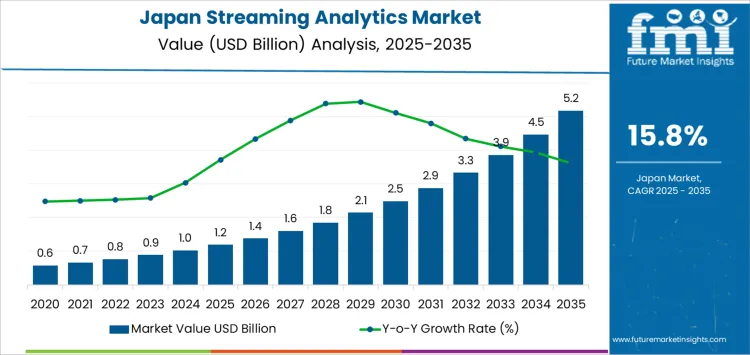
Demand for streaming analytics in Japan is valued at USD 1.2 billion in 2025 and is projected to reach USD 5.2 billion by 2035, reflecting a CAGR of 15.8%. The historical rise from USD 0.6 billion in 2020 to USD 1.2 billion in 2025 shows accelerating adoption across data intensive operations. IT and telecom firms form the largest early users as real time traffic monitoring and network optimization require continuous data processing. Advertising and marketing applications hold the largest share of applications due to campaign tracking and audience behavior measurement. Large enterprises account for most deployments because of their higher data-throughput needs and established cloud-integration budgets. Platform-based solutions dominate early usage due to scalability and standardized deployment. Early demand reflects operational analytics and real-time reporting rather than advanced predictive workloads.
From 2026, spending increases from USD 1.4 billion to USD 2.9 billion by 2031, then rises to USD 5.2 billion by 2035 through widening annual increments. Financial analytics and fraud intelligence gain share as banks and payment platforms expand real-time monitoring requirements. Retail and supply chain use grows with broader sensor-driven inventory tracking and demand sensing. Media and entertainment adoption remains strong as live content performance tracking expands. Small and medium enterprises increase participation through managed services and hybrid deployments that lower upfront system costs. Consulting and integration services expand as workflows grow more complex. After 2030, value growth reflects rising data volumes per user rather than basic user expansion alone. Annual additions widen steadily, indicating increasing spending intensity across existing enterprise customers.
Quick Stats of the Demand for Streaming Analytics in Japan
- Demand for Streaming Analytics in Japan Value (2025): USD 1.2 billion
- Demand for Streaming Analytics in Japan Forecast Value (2035): USD 5.2 billion
- Demand for Streaming Analytics in Japan Forecast CAGR (2025-2035): 15.8%
- Demand for Streaming Analytics in Japan Leading Solution: Platform (30%)
- Demand for Streaming Analytics in Japan Key Growth Regions: Kyushu & Okinawa, Kanto, Kansai
- Demand for Streaming Analytics in Japan Top Players: Microsoft Azure Stream Analytics, Google Cloud Dataflow, IBM Streams, AWS Kinesis, SAS Streaming Analytics
What is the Growth Forecast for Streaming Analytics in Japan through 2035?
Between 2025 and 2030, demand for streaming analytics in Japan is projected to rise from USD 1.2 billion to USD 2.5 billion, creating an absolute increase of USD 1.3 billion and representing about 32.5% of total decade growth. This phase reflects expanding adoption across telecommunications, financial services, and digital commerce platforms requiring real-time data processing. Enterprise migration from batch analytics supports baseline demand. Historical growth relied on pilot deployments and limited scale implementations, while near-term performance is shaped by wider operational rollout, integration with transaction systems, and rising use in fraud detection, network monitoring, and consumer behavior analysis environments.
From 2030 to 2035, demand is forecast to expand from USD 2.5 billion to USD 5.2 billion, adding USD 2.7 billion and accounting for nearly 67.5% of the total ten-year expansion. This period reflects deeper penetration across industrial automation, connected mobility systems, and large-scale public infrastructure monitoring. Integration with artificial intelligence pipelines and edge analytics strengthens processing intensity. Earlier growth depended on enterprise experimentation and digital channel growth, while future expansion is guided by national data-utilization policies, broader sensor-network deployment, and sustained investment in real-time decision-support platforms for regulated and commercial users.
Streaming Analytics Industry in Japan Key Takeaways
| Metric | Value |
|---|---|
| Industry Value (2025) | USD 1.2 billion |
| Forecast Value (2035) | USD 5.2 billion |
| Forecast CAGR (2025-2035) | 15.8% |
What Is Driving the Demand for Streaming Analytics in Japan Across Historical and Future Growth Cycles?
Demand for streaming analytics in Japan developed as enterprises digitized operations across manufacturing, telecom, finance, and transportation. Early adoption followed growth in machine data, network traffic monitoring, and automated production lines. Real time processing supported operational visibility across factories, payment systems, and communications networks. Historical demand relied on on premises data platforms and tightly controlled enterprise deployments. Procurement focused on stability, data integrity, and integration with legacy systems. Growth aligned with expansion of industrial automation, rising mobile data usage, and enterprise software upgrades. Japanese firms favored long deployment cycles and vendor continuity. Staff training and system reliability shaped purchasing decisions. Historical growth followed steady enterprise digitization rather than rapid platform experimentation across most industrial and commercial users.
Future demand for streaming analytics in Japan is expected to follow wider cloud adoption, real time decision systems, and expansion of connected devices. Data streams from smart factories, logistics platforms, and digital services raise demand for continuous analytics. Enterprises seek faster response to operational signals across supply chains, network security, and financial monitoring. Historical growth relied on infrastructure expansion and internal data flows. Future growth centers on distributed processing, scalable cloud architectures, and integration with automated decision engines. Public sector modernization supports wider use across transport management and emergency response systems. Investment priorities reflect data governance, cybersecurity requirements, and system interoperability. Growth will depend on workforce skills, cloud vendor alignment, and long term platform standardization across industrial and service sectors nationwide.
What Is the Demand for Streaming Analytics in Japan by Solution and Application?
Demand for streaming analytics in Japan is shaped by high frequency data generation, smart infrastructure deployment, and real time decision support across digital services. Platform-based solutions lead by solution due to their role in continuous data ingestion, processing, and visualization. Advertising and marketing leads by application as brands rely on live audience behavior tracking and campaign optimization. Procurement is driven by enterprise IT buyers, digital platforms, and system integrators supporting cloud and edge deployments. Import reliance remains present for stream processing engines and high-speed data connectors. Substitution pressure arises from batch analytics in delayed-reporting environments. Demand for stability is supported by sustained growth in digital transactions, sensor networks, and online media activity.
Why do platforms account for 30% of the demand for streaming analytics in Japan by solution?
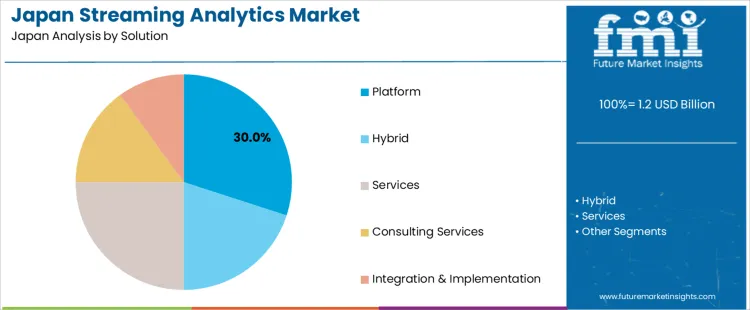
Platforms account for 30% of the demand for streaming analytics in Japan by solution, reflecting their role as the core layer for real time data processing. Consumption intensity is driven by financial trading systems, smart manufacturing lines, and customer interaction monitoring across digital services. Usage remains stable because real time insights depend on continuous stream ingestion and low latency computation. Procurement is led by large enterprises, cloud service users, and data intensive service operators. Price sensitivity remains moderate because platform reliability directly affects operational visibility. Specification control emphasizes throughput scalability, event processing latency, fault tolerance, and integration with data lakes and enterprise middleware.
Platform deployments also generate consistent repeat demand through capacity scaling, version upgrades, and expansion into new business units. Repeat utilization remains predictable as data velocity rises across sectors. Buyers favor modular architectures that support incremental node addition without service disruption. Margin structure remains controlled under competition from global platform vendors and open-source-based alternatives. Regulatory exposure centers on data privacy governance and system audit traceability. Import reliance persists for licensed processing engines and distributed messaging frameworks. Substitution pressure from edge only analytics exists in selected manufacturing environments where central aggregation is limited.
Why does advertising and marketing represent 28% of the demand for streaming analytics in Japan by application?
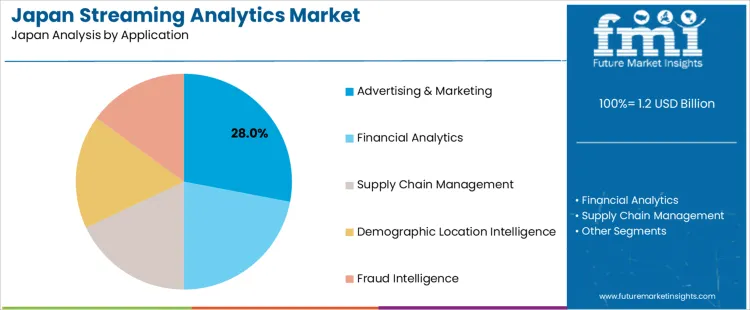
Advertising and marketing account for 28% of streaming analytics demand in Japan by application, reflecting reliance on live consumer behavior tracking across digital channels. Consumption intensity is driven by campaign performance monitoring, real-time bidding, and location-based audience targeting. Usage remains stable because brand engagement and conversion tracking rely on immediate feedback loops. Procurement is dominated by media agencies, digital platform operators, and large consumer brands managing multichannel campaigns. Price sensitivity remains moderate because analytics spend aligns with media budget efficiency goals. Specification control emphasizes millisecond-level event capture, attribution accuracy, and audience segmentation refresh rates.
Advertising and marketing analytics also generate steady repeat demand through continuous campaign cycles and seasonal promotion peaks. Repeat utilization remains predictable as brands rotate creative assets and targeting strategies throughout the year. Buyers favor platforms that support high concurrency and rapid dashboard updates. Margin structure remains controlled under agency pricing models and competitive software licensing. Regulatory exposure centers on consumer data protection and consent management. Import reliance persists for ad tech integrations and identity resolution engines. Substitution pressure from delayed reporting tools remains limited because campaign optimization relies on immediate performance signals.
What Is Driving the Demand for Streaming Analytics in Japan Real Time Data Operations and Service Reliability?
Demand for streaming analytics in Japan is shaped by dense digital transactions, continuous transport data flows, and fault sensitive industrial operations. Financial trading platforms analyze tick data with millisecond tolerance. Rail operators process sensor feeds for congestion, safety, and timetable accuracy. Retail chains track live purchasing behavior across stores for inventory balance. Online gaming and media platforms monitor user activity to stabilize service quality. Earthquake and weather monitoring systems rely on continuous signal ingestion for early alerts. Buyers focus on low latency processing, durable pipelines, and exact data ordering. Demand follows operational dependency on live insight rather than batch reporting.
How Are Transport, Utilities, and Public Safety Systems Using Streaming Analytics in Japan?
Japan transport networks generate continuous telemetry from trains, switches, and passenger gates that requires instant evaluation. Streaming analytics engines flag abnormal speed variance, braking patterns, and platform congestion in real time. Utility providers monitor grid load, transformer vibration, and voltage drift to avoid cascading failure. Emergency services ingest sound, motion, and traffic feeds to guide dispatch routing during incidents. These systems operate under strict uptime rules with no tolerance for data backlog. Continuous ingestion allows rapid intervention that protects commuter flow, grid stability, and response timing. Demand links directly to public infrastructure digitization rather than enterprise software experimentation projects cycles.
Why Are Financial Services and Digital Platforms Expanding Streaming Analytics Use in Japan?
Japan financial institutions process high volume transactions that require uninterrupted fraud scoring and risk monitoring. Streaming analytics evaluates card usage, transfer behavior, and account activity as each event occurs. Digital payment platforms apply similar pipelines to detect misuse and service faults before customer impact spreads. Media streaming, online gaming, and advertising exchanges track session quality and pricing signals through live data feeds. These platforms depend on immediate feedback to adjust load balancing and content delivery. Demand grows from revenue protection needs and service continuity pressure that leave no margin for delayed detection inside high velocity transaction environments today across platforms.
How Do Cost Control, Talent Availability, and Integration Effort Limit Streaming Analytics Expansion in Japan?
Streaming analytics adoption in Japan faces limits tied to platform complexity, system integration cost, and skilled engineer availability. Many enterprises operate layered legacy systems that require custom connectors for real time ingestion. Operational teams carry responsibility for round the clock pipeline management, which raises staffing pressure. Data governance rules enforce strict control over movement of personal and financial information. High power consumption from continuous compute loads also enters budget planning. Small enterprises favor batch analysis due to lower operating burden. These structural constraints slow uniform adoption despite strong demand for live operational visibility across digital and physical processes nationwide environments.
What is the Demand for Streaming Analytics in Japan by Region?
| Region | CAGR (%) |
|---|---|
| Kyushu & Okinawa | 19.8% |
| Kanto | 18.2% |
| Kansai | 16.0% |
| Chubu | 14.1% |
| Tohoku | 12.3% |
| Rest of Japan | 11.7% |
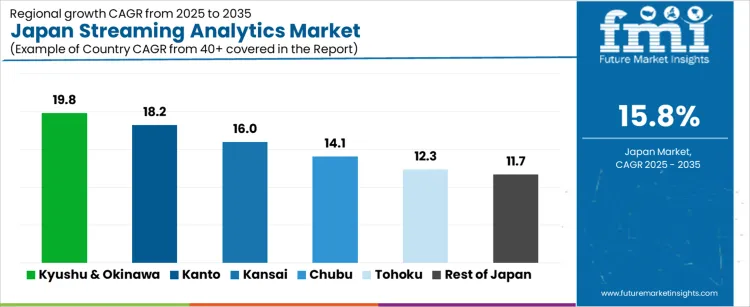
The demand for streaming analytics in Japan is expanding rapidly across digital infrastructure and enterprise technology regions, led by Kyushu and Okinawa at a 19.8% CAGR. Growth in this region is supported by smart manufacturing projects, real time logistics tracking, and rising deployment of IoT data platforms. Kanto follows at 18.2%, driven by large scale data center activity, financial services analytics, and widespread use of real time customer intelligence systems. Kansai records 16.0% growth, reflecting adoption across media, retail analytics, and industrial monitoring. Chubu at 14.1% shows strong uptake linked to automotive manufacturing data streams and factory automation. Tohoku and the Rest of Japan, at 12.3% and 11.7%, reflect slower but consistent growth shaped by gradual enterprise digitization and expanding regional cloud infrastructure adoption.
How Is Smart Tourism Infrastructure Driving Streaming Analytics Demand in Kyushu and Okinawa?
Demand for streaming analytics in Kyushu and Okinawa is advancing at a CAGR of 19.8% through 2035, supported by smart tourism platforms, airport traffic monitoring systems, and real time hospitality data management. Resorts and transport hubs rely on continuous data streams for crowd movement analysis, dynamic pricing, and energy optimization. Coastal logistics operations also apply streaming tools for shipment tracking and port activity monitoring. Growth reflects strong digital investment tied to tourism recovery, expansion of smart resort facilities, and rising integration of real time analytics in municipal monitoring platforms.
- Smart resorts rely on live customer behavior tracking
- Airport traffic systems drive continuous data ingestion
- Port logistics adopt real time shipment visibility tools
- Municipal monitoring platforms expand streaming workloads
Why Is Financial and Media Data Intensity Sustaining Streaming Analytics Growth in Kanto?
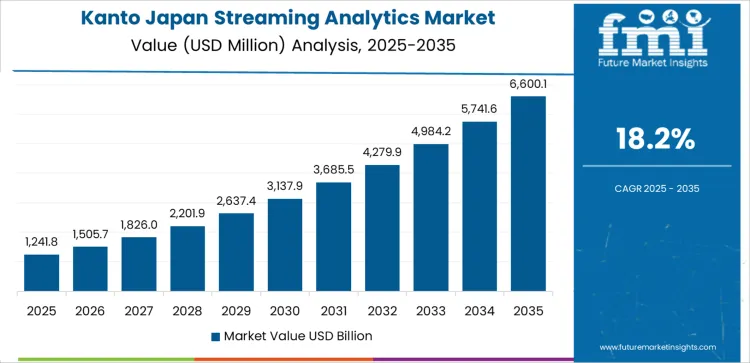
Demand for streaming analytics in Kanto is rising at a CAGR of 18.2% through 2035, driven by dense concentration of financial institutions, digital media platforms, and large scale e commerce operations. Kanto records the highest volume of real time transaction monitoring, fraud detection, and user engagement analytics. Media firms rely on live audience measurement and ad performance tracking. Growth reflects expanding fintech usage, strong cloud platform investment, and continuous growth of data driven operations across capital market infrastructure.
- Financial transaction monitoring anchors large scale deployments
- Digital media firms rely on real time audience metrics
- Cloud native platforms drive streaming workload expansion
- Fraud detection systems sustain continuous data processing demand
What Is Supporting Enterprise Streaming Analytics Expansion Across Kansai?
Demand for streaming analytics in Kansai is progressing at a CAGR of 16.0% through 2035, supported by manufacturing digitization, logistics network optimization, and regional retail chain analytics programs. Kansai applies streaming tools for production line monitoring, warehouse automation, and live inventory visibility. Retail operators use real time demand tracking for store level replenishment decisions. Growth reflects steady adoption of industrial IoT platforms, expanding regional cloud usage, and rising use of event driven architectures across mid scale enterprises.
- Production line sensors drive continuous data flow adoption
- Warehouse automation supports real time performance tracking
- Retail chains apply live inventory analytics
- Industrial IoT platforms expand event driven workloads
How Is Automotive and Factory Automation Shaping Streaming Analytics Demand in Chubu?
Demand for streaming analytics in Chubu is advancing at a CAGR of 14.1% through 2035, supported by automotive manufacturing telemetry, robotics driven production systems, and real time quality monitoring platforms. Factories stream machine data for fault prediction, throughput optimization, and anomaly detection. Supply chain visibility tools also depend on live freight and component movement tracking. Growth reflects strong digital factory programs, steady robotics investment, and rising use of edge analytics for operational decision support in large manufacturing clusters.
- Automotive telemetry drives continuous machine data streams
- Robotics systems rely on real time performance feedback
- Quality inspection platforms apply live anomaly detection
- Edge analytics supports localized processing architectures
Why Is Public Safety Digitalization Driving Streaming Analytics Growth in Tohoku?
Demand for streaming analytics in Tohoku is advancing at a CAGR of 12.3% through 2035, supported by disaster prevention systems, transportation safety monitoring, and selective industrial sensor networks. Tohoku applies live data processing for weather alerts, seismic activity monitoring, and rail safety control centers. Industrial use remains focused on utilities and small processing plants. Growth reflects public infrastructure modernization, smart disaster response planning, and rising application of real time analytics in regional safety management systems.
- Disaster monitoring systems depend on continuous sensor streams
- Rail safety platforms rely on live control data
- Utility networks apply real time operational analytics
- Public infrastructure upgrades sustain steady adoption
How Is Digital Retail and Small Enterprise Analytics Shaping Growth in Rest of Japan?
Demand for streaming analytics in Rest of Japan is advancing at a CAGR of 11.7% through 2035, supported by digital retail adoption, small enterprise cloud analytics usage, and gradual rollout of smart utility networks. These areas apply streaming tools for live payment tracking, customer behavior monitoring, and energy consumption analysis. Deployment remains focused on cloud based platforms with limited on site infrastructure. Growth remains steady and guided by local business digitization, rising digital payment volumes, and gradual expansion of smart town initiatives.
- Cloud based analytics platforms dominate deployment models
- Digital payments drive continuous transaction tracking
- Small retailers adopt live customer behavior analysis
- Smart utility projects support gradual data stream expansion
What Is Driving the Demand for Streaming Analytics in Japan and Which Platforms Shape Enterprise Data Processing?
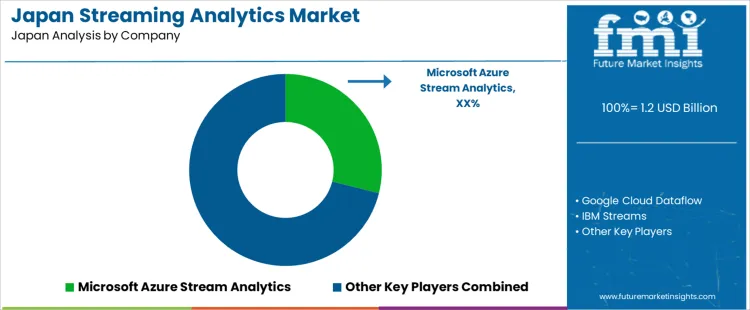
The demand for streaming analytics in Japan is shaped by real time monitoring needs across manufacturing automation, financial trading, transport operations, and telecom network management. NTT Data holds a central domestic role through large scale data integration platforms used in public sector systems, rail control rooms, and carrier traffic analysis. Fujitsu supports demand through real time processing frameworks embedded in factory automation, cybersecurity monitoring, and logistics optimization. NEC contributes through streaming platforms used in biometric security, video analytics, and disaster prevention systems. AWS Kinesis maintains strong enterprise adoption through cloud native streaming used by digital commerce firms, online gaming platforms, and fintech operators. Microsoft Azure Stream Analytics supports IoT driven analytics through industrial cloud deployments used by automotive and electronics manufacturers.
Google Cloud Dataflow participates in media analytics, digital advertising measurement, and large scale data engineering used by internet focused enterprises. IBM Streams supports regulated industries through low latency analytics used in financial risk monitoring and infrastructure operations. SAS Streaming Analytics remains active in fraud detection, energy demand modeling, and predictive maintenance across utilities and transport fleets. Platform selection in Japan is governed by latency stability, integration with on premises systems, domestic data residency alignment, and long term vendor support. Buyer preference favors suppliers with Japanese language technical support, proven uptime in continuous operations, and strong partner ecosystems. Demand visibility tracks smart factory expansion, cashless payment growth, autonomous mobility testing, and steady investment in urban infrastructure digitization across major metropolitan regions.
Key Players in the Streaming Analytics Industry in Japan
- Microsoft Azure Stream Analytics
- Google Cloud Dataflow
- IBM Streams
- AWS Kinesis
- SAS Streaming Analytics
Scope of the Report
| Items | Values |
|---|---|
| Quantitative Units (2025) | USD billion |
| Type | Platform, Hybrid, Services, Consulting Services, Integration and Implementation |
| Application | Advertising and Marketing, Financial Analytics, Supply Chain Management, Demographic Location Intelligence, Fraud Intelligence |
| End User | Large Enterprises, Small and Medium Enterprises across IT and Telecom, Media and Entertainment, Retail and E commerce, Manufacturing, Banking Financial Services and Insurance |
| Regions Covered | Kyushu and Okinawa, Kanto, Kansai, Chubu, Tohoku, Rest of Japan |
| Countries Covered | Japan |
| Key Companies Profiled | NTT Data, Fujitsu, NEC, Microsoft Azure Stream Analytics, Google Cloud Dataflow, IBM Streams, AWS Kinesis, SAS Streaming Analytics |
| Additional Attributes | Dollar sales by solution and application categories, regional adoption across digital infrastructure clusters, deployment patterns across cloud native and hybrid environments, integration with AI and edge analytics pipelines, demand from real time transaction, network, and operational monitoring use cases, compliance with data governance and residency requirements in regulated industries |
Streaming Analytics Industry in Japan Segmentation
Solution:
- Platform
- Hybrid
- Services
- Consulting Services
- Integration & Implementation
Application:
- Advertising & Marketing
- Financial Analytics
- Supply Chain Management
- Demographic Location Intelligence
- Fraud Intelligence
Enterprise Size:
- Large Enterprises
- Small & Medium Enterprises (SMEs)
Industry:
- IT & Telecom
- Media and Entertainment
- Retail & E-commerce
- Manufacturing
- Banking, Financial Services, and Insurance (BFSI)
Region:
- Kyushu & Okinawa
- Kanto
- Kansai
- Chubu
- Tohoku
- Rest of Japan
Frequently Asked Questions
How big is the demand for streaming analytics in Japan in 2025?
The demand for streaming analytics in Japan is estimated to be valued at USD 1.2 billion in 2025.
What will be the size of streaming analytics in Japan in 2035?
The market size for the streaming analytics in Japan is projected to reach USD 5.2 billion by 2035.
How much will be the demand for streaming analytics in Japan growth between 2025 and 2035?
The demand for streaming analytics in Japan is expected to grow at a 15.8% CAGR between 2025 and 2035.
What are the key product types in the streaming analytics in Japan?
The key product types in streaming analytics in Japan are platform, hybrid, services, consulting services and integration & implementation.
Which application segment is expected to contribute significant share in the streaming analytics in Japan in 2025?
In terms of application, advertising & marketing segment is expected to command 28.0% share in the streaming analytics in Japan in 2025.
Preview the report firsthand - request a free sample
Get SampleGet the brochure for pricing and purchase details.
Get PDFTable of Content
- Executive Summary
- Japan Market Outlook
- Demand-side Trends
- Supply-side Trends
- Technology Roadmap Analysis
- Analysis and Recommendations
- Market Overview
- Market Coverage / Taxonomy
- Market Definition / Scope / Limitations
- Market Background
- Market Dynamics
- Drivers
- Restraints
- Opportunity
- Trends
- Scenario Forecast
- Demand in Optimistic Scenario
- Demand in Likely Scenario
- Demand in Conservative Scenario
- Opportunity Map Analysis
- Product Life Cycle Analysis
- Supply Chain Analysis
- Investment Feasibility Matrix
- Value Chain Analysis
- PESTLE and Porter’s Analysis
- Regulatory Landscape
- Regional Parent Market Outlook
- Production and Consumption Statistics
- Import and Export Statistics
- Market Dynamics
- Japan Market Analysis 2020 to 2024 and Forecast, 2025 to 2035
- Historical Market Size Value (USD Million) Analysis, 2020 to 2024
- Current and Future Market Size Value (USD Million) Projections, 2025 to 2035
- Y-o-Y Growth Trend Analysis
- Absolute $ Opportunity Analysis
- Japan Market Pricing Analysis 2020 to 2024 and Forecast 2025 to 2035
- Japan Market Analysis 2020 to 2024 and Forecast 2025 to 2035, By Solution
- Introduction / Key Findings
- Historical Market Size Value (USD Million) Analysis By Solution , 2020 to 2024
- Current and Future Market Size Value (USD Million) Analysis and Forecast By Solution , 2025 to 2035
- Platform
- Hybrid
- Services
- Consulting Services
- Integration & Implementation
- Y-o-Y Growth Trend Analysis By Solution , 2020 to 2024
- Absolute $ Opportunity Analysis By Solution , 2025 to 2035
- Japan Market Analysis 2020 to 2024 and Forecast 2025 to 2035, By Application
- Introduction / Key Findings
- Historical Market Size Value (USD Million) Analysis By Application, 2020 to 2024
- Current and Future Market Size Value (USD Million) Analysis and Forecast By Application, 2025 to 2035
- Advertising & Marketing
- Financial Analytics
- Supply Chain Management
- Demographic Location Intelligence
- Fraud Intelligence
- Y-o-Y Growth Trend Analysis By Application, 2020 to 2024
- Absolute $ Opportunity Analysis By Application, 2025 to 2035
- Japan Market Analysis 2020 to 2024 and Forecast 2025 to 2035, By Enterprise Size
- Introduction / Key Findings
- Historical Market Size Value (USD Million) Analysis By Enterprise Size, 2020 to 2024
- Current and Future Market Size Value (USD Million) Analysis and Forecast By Enterprise Size, 2025 to 2035
- Large Enterprises
- Small & Medium Enterprises (SMEs)
- Y-o-Y Growth Trend Analysis By Enterprise Size, 2020 to 2024
- Absolute $ Opportunity Analysis By Enterprise Size, 2025 to 2035
- Japan Market Analysis 2020 to 2024 and Forecast 2025 to 2035, By Industry
- Introduction / Key Findings
- Historical Market Size Value (USD Million) Analysis By Industry, 2020 to 2024
- Current and Future Market Size Value (USD Million) Analysis and Forecast By Industry, 2025 to 2035
- IT & Telecom
- Media and Entertainment
- Retail & E-commerce
- Manufacturing
- Banking, Financial Services, and Insurance (BFSI)
- Y-o-Y Growth Trend Analysis By Industry, 2020 to 2024
- Absolute $ Opportunity Analysis By Industry, 2025 to 2035
- Market Structure Analysis
- Competition Dashboard
- Competition Benchmarking
- Market Share Analysis of Top Players
- By Regional
- By Solution
- By Application
- By Enterprise Size
- By Industry
- Competition Analysis
- Competition Deep Dive
- Microsoft Azure Stream Analytics
- Overview
- Product Portfolio
- Profitability by Market Segments (Product/Age /Sales Channel/Region)
- Sales Footprint
- Strategy Overview
- Marketing Strategy
- Product Strategy
- Channel Strategy
- Google Cloud Dataflow
- IBM Streams
- AWS Kinesis
- SAS Streaming Analytics
- Microsoft Azure Stream Analytics
- Competition Deep Dive
- Assumptions & Acronyms Used
- Research Methodology


