

- Industry Size (2025)
- USD 8.1 Bn
- Forecast (2035)
- USD 50.4 Bn
- CAGR (2025 to 2035)
- 20.0%
Demand for Streaming Analytics in USA 2025 to 2035
The USA streaming analytics demand is valued at USD 8.1 billion in 2025 and is forecasted to reach USD 50.4 billion by 2035, reflecting a CAGR of 20.0%. Growth is supported by rapid expansion of real-time data processing across financial services, telecommunications, industrial automation, and e-commerce operations. Organizations rely on continuous analytics to enhance fraud detection, personalize digital experiences, and optimize IoT-driven asset monitoring.
Platforms represent the leading solution category because they provide scalable real-time data ingestion, seamless integration with cloud services, and event-driven decision automation. Enterprises prioritize systems that support advanced analytics models, reduced latency, and high throughput to manage unpredictable streaming workloads. Unified platforms strengthen operational efficiency through centralized analytics governance and improved data observability.
Quick Stats for USA Streaming Analytics Demand
- USA Streaming Analytics Sales Value (2025): USD 8.1 billion
- USA Streaming Analytics Forecast Value (2035): USD 50.4 billion
- USA Streaming Analytics Forecast CAGR (2025 to 2035): 20.0%
- Leading Solution in USA Streaming Analytics Demand: Platforms
- Key Growth Regions in USA Streaming Analytics Demand: West USA, South USA, Northeast USA
- Top Players in USA Streaming Analytics Demand: Microsoft Azure Stream Analytics, Google Cloud Dataflow, IBM Streams, AWS Kinesis, SAS Streaming Analytics
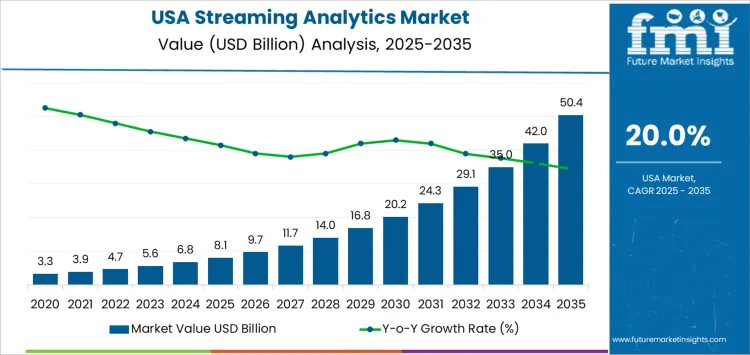
What is the Growth Forecast for Streaming Analytics Industry in USA through 2035?
The West, South, and Northeast regions lead adoption based on strong technology ecosystems, large enterprise presence, and high penetration of digital services. Key suppliers include Microsoft Azure Stream Analytics, Google Cloud Dataflow, IBM Streams, AWS Kinesis, and SAS Streaming Analytics. Their strategies emphasize AI-enabled automation, stronger edge-to-cloud connectivity, and security enhancements that enable real-time intelligence across critical business operations.
Demand for streaming analytics in the United States benefits from strong contribution effects driven by digital transformation priorities in data-intensive industries. Financial services, telecommunications, healthcare networks, and retail platforms deploy real-time analytics engines to enhance decision accuracy and operational monitoring. These enterprise sectors contribute a large share of incremental revenue growth due to their continuous scaling of event-driven data pipelines. Adoption also increases as smart devices and sensor networks expand the volume of continuous data flows.
Cloud platforms support cost-efficient deployment, which broadens participation among mid-sized organizations. This structural expansion distributes growth across a wider base rather than concentrating it in early adopters alone. Artificial intelligence integration into real-time systems raises the value proposition and increases contract size and renewal rates. Product upgrades and performance enhancements contribute recurring revenue streams, improving cumulative impact on the total growth index.
Regulatory compliance and cybersecurity oversight add sustained demand where milliseconds influence risk exposure. The result is a balanced contribution structure combining essential infrastructure spending with innovation-driven scaling. Continuous real-time data reliance positions streaming analytics as a high-impact growth driver within the broader analytics and data-management ecosystem in the United States.
USA Streaming Analytics Key Takeaways
| Metric | Value |
|---|---|
| USA Streaming Analytics Sales Value (2025) | USD 8.1 billion |
| USA Streaming Analytics Forecast Value (2035) | USD 50.4 billion |
| USA Streaming Analytics Forecast CAGR (2025-2035) | 20.0% |
Why is the Demand for Streaming Analytics in the USA Growing?
Demand for streaming analytics in the USA is increasing because organizations rely on real time decision making in finance, telecommunications, e commerce and logistics. Continuous data flows come from online transactions, connected devices and digital customer interactions. Streaming analytics tools allow companies to monitor system performance, detect anomalies and protect operational continuity without waiting for batch processing. Financial institutions use streaming analytics to monitor fraud signals and risk patterns that require immediate action. Retailers study purchasing behaviour as users browse and buy through digital channels. Operational teams in transportation and supply chains track vehicle locations and shipment conditions to maintain delivery accuracy.
Growth in artificial intelligence and automation supports wider use of real time data pipelines for machine learning models. Enterprises value the ability to adjust pricing, update inventory and support customer engagement as conditions change. Constraints include the need for specialized data engineering skills and investment in cloud or on premise infrastructure. Smaller businesses may adopt streaming analytics gradually as data volumes grow and commercial benefits become clearer.
Which Solutions and Applications Lead Demand for Streaming Analytics in the United States?
Demand for streaming analytics in the United States aligns with real-time decision environments across retail, BFSI, telecom, and digital media sectors. Organizations apply continuous data processing to improve customer engagement, risk visibility, and operational efficiency while reducing downtime and response delays. Growth follows cloud migration, IoT endpoint expansion, and broad use of behavioral data from online interactions. USA enterprises prioritize accurate insight delivery from fast data streams.
By Solution, Platforms Hold the Largest Share
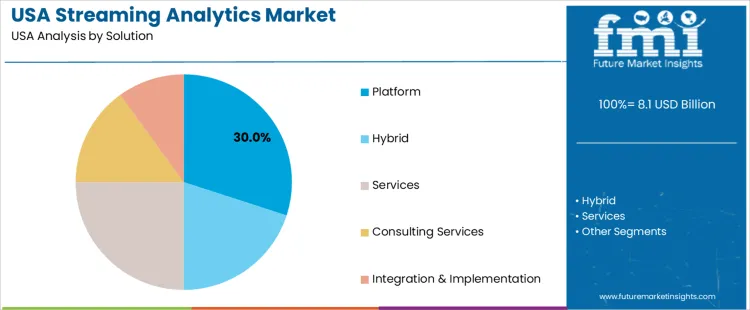
Streaming analytics platforms account for 30.0%. These systems unify ingestion, processing, and actioning of continuous data in operational environments across marketing, customer service, and fraud detection. Hybrid deployment holds 20.0% and reflects mixed resource models inside USA enterprises retaining sensitive data on secure servers while extending external workloads to cloud platforms. Services hold 25.0%. Consulting represents 15.0% and includes architecture assessment and workflow planning. Integration and implementation services contribute 10.0% with configuration support inside distributed data infrastructure. Demand aligns with simplified pipeline management and resilient execution inside live workloads.
Key Points:
- Platforms secure unified processing and workflow consistency
- Hybrid models support governance and flexible resource control
- Service components maintain performance and operational fit
By Application, Advertising and Marketing Hold the Largest Share
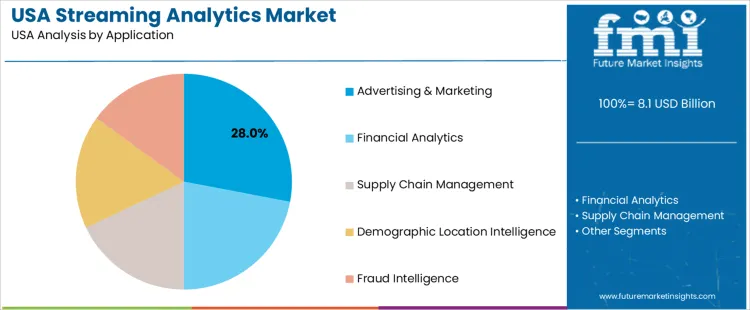
Advertising and marketing lead at 28.0%. Real-time segmentation and dynamic engagement drive adoption across retail media networks and online platforms. Financial analytics holds 22.0% where live risk scoring and trading operations depend on immediate insights. Supply chain management accounts for 18.0% as logistics providers monitor routing efficiency, shipment tracking, and inventory conditions. Demographic location intelligence holds 17.0% and supports mobility analysis across cities, retail districts, and transportation hubs. Fraud intelligence accounts for 15.0%. USA organizations rely on continuous detection of suspicious activities inside payment and account ecosystems.
Key Points:
- Marketing teams utilize streaming analytics for live personalization
- Financial workflows depend on real-time exposure visibility
- Operational routing uses constant tracking to avoid delays
What are the Key Dynamics in the Streaming Analytics Industry?
Growth of real-time data processing needs, increased adoption across banking and retail sectors and rising focus on operational intelligence drive demand.
In the United States, organizations manage growing data volumes generated by mobile apps, online transactions, connected machinery and smart devices. Banks apply streaming analytics for fraud detection and instant risk scoring linked to payment authorization. Retailers analyze purchase behavior and inventory data during active customer sessions to improve promotions and reduce stockouts. Telecommunications providers use real-time analytics to monitor network performance and support continuous service uptime. Emergency response centers and logistics companies rely on dynamic alerts drawn from sensors, geolocation data and dispatch systems. These operational requirements sustain investment in platforms that process data streams with low latency.
High implementation cost, shortage of advanced analytics talent and data integration complexity restrain demand.
Deployment involves specialized cloud or edge infrastructure along with configuration for high-availability performance, which increases spending for mid-size firms. Many companies lack data engineers or architects trained to work with streaming frameworks. Integrating siloed enterprise systems into unified real-time pipelines presents substantial design and maintenance work. Decision-makers evaluate cost justification carefully when slower batch analytics still support certain reporting needs. These factors slow adoption in sectors with limited technical readiness.
Shift toward cloud-native architectures, increased use in cybersecurity monitoring and rising interest in edge analytics define key trends.
Cloud providers expand fully managed streaming services that reduce hardware burden and accelerate deployment. Security teams apply behavioral analytics to detect breaches, insider threats and bot activity while events remain active. Manufacturers and utilities evaluate edge-processed analytics near equipment to reduce bandwidth use and improve response times. Subscription pricing models improve accessibility for scaling up during high-traffic events such as seasonal shopping peaks. Data visualization tools enhance situational awareness for business users working with live dashboards. These patterns indicate continued demand for streaming analytics across the United States aligned with automation, digital commerce and always-active operational models.
Analysis of the Demand for Streaming Analytics in the USA by Region
Demand for streaming analytics in the United States expands in line with real-time data processing, smart-device connectivity, and operational intelligence initiatives. Industries deploy event-driven data architecture to accelerate decision cycles in financial trading, cybersecurity, retail, transportation, and healthcare analytics. Organizations prioritize system visibility that supports anomaly detection, service personalization, and asset monitoring at scale. Cloud-native data pipelines sustain rapid ingestion from edge devices and enterprise platforms. Growth rates reflect the geographic distribution of technology ecosystems, digital investments, and advanced data-governance maturity. West USA leads with 23.1%, South USA follows with 20.6%, Northeast USA observes 18.4%, and Midwest USA records 16.0% expansion through 2035.
| Region | CAGR (2025-2035) |
|---|---|
| West USA | 23.1% |
| South USA | 20.6% |
| Northeast USA | 18.4% |
| Midwest USA | 16.0% |
How is the West USA driving demand for streaming analytics?
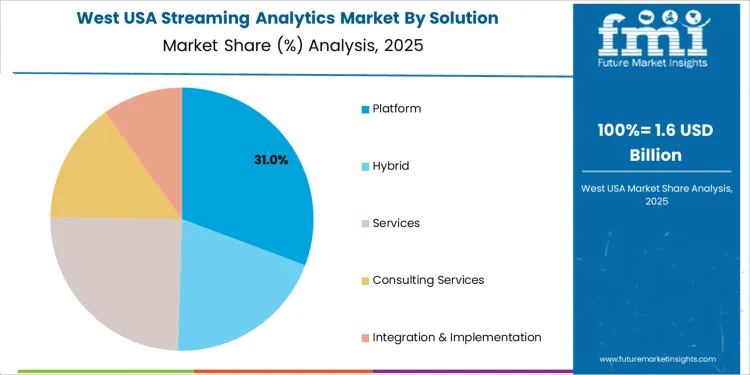
West USA achieves 23.1% CAGR, supported by high-density innovation clusters, cloud service providers, and artificial-intelligence development across California and Washington. Technology and media companies manage continuous data feeds for content personalization and reliability monitoring. Mobility platforms rely on real-time location analytics to manage urban routing decisions. Semiconductor and advanced manufacturing facilities use streaming systems to detect process deviations that impact yield. Financial technology operations evaluate event-stream platforms optimized for latency-sensitive transactions. Procurement teams emphasize scalability, data-encryption capabilities, and direct integration with container workloads to manage complex digital-service environments.
- Cloud and AI ecosystems accelerating feature deployment
- Media and mobility services sustaining continuous data flow
- Chip and industrial operations requiring predictive intervention
- Security and throughput benchmarks guiding platform selection
How is the South USA shaping adoption?
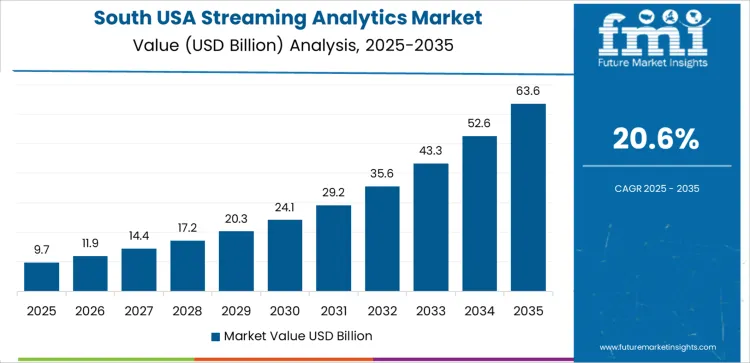
South USA records 20.6% CAGR, driven by expanding enterprise campuses in Texas, Georgia, and Florida. Utilities integrate streaming analytics for grid performance and outage prediction. Retailers use real-time consumer insights to improve supply movement and store replenishment. Ports and logistics providers rely on continuous data visibility for cargo tracking and operational planning. Healthcare networks evaluate clinical-data streams to support workflow improvements and emergency-response coordination. Buyers assess cost-efficiency, operational uptime, and vendor support as implementations increase across multi-state campuses.
- Energy and utilities reinforcing predictive grid analytics
- Retail supply chains improving replenishment timing
- Logistics hubs prioritizing location intelligence
- Healthcare systems using data streams for operational clarity
How is the Northeast USA influencing growth?
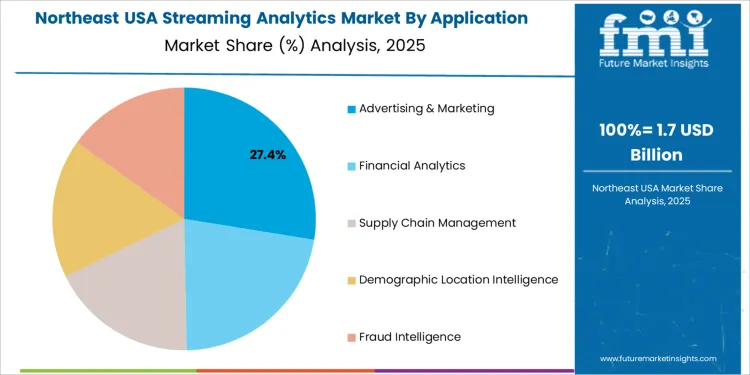
Northeast USA shows 18.4% CAGR, sustained by financial services, cybersecurity firms, and research organizations in New York, New Jersey, and Massachusetts. Data-intensive capital-market operations depend on sub-second analytics to monitor volatility, detect fraud, and ensure compliance. Cyber defense centers track network telemetry in real time to mitigate strengthened risks. Hospitals analyze continuous patient-monitoring signals to inform treatment decisions. Public transit networks incorporate live sensor data for fleet performance oversight. Procurement activities emphasize proven reliability under sustained throughput conditions.
- Capital-market demand shaping ultra-fast analytics
- Cyber defense strengthening continuous threat detection
- Healthcare monitoring generating persistent data flow
- Transit agencies prioritizing operational visibility
How is the Midwest USA contributing to streaming-analytics deployment?
Midwest USA grows at 16.0% CAGR, influenced by smart-manufacturing and agricultural-technology expansions across Illinois, Ohio, and Michigan. Factories adopt machine-data streaming for predictive maintenance, scrap control, and cycle-time improvement. Autonomous machinery programs depend on real-time analytics to stabilize equipment behavior in field operations. Regional insurers evaluate risk-event monitoring for claims-management efficiency. University research networks create steady technical workloads for pilot deployments. Buyers look for simplified integration with legacy systems that dominate industrial environments.
- Manufacturing analytics improving equipment reliability
- Ag-tech platforms using live conditions for adaptive operation
- Insurance risk analysis enhancing loss-mitigation strategies
- Integration needs guiding software compatibility choices
What is the competitive landscape of demand for streaming analytics platforms in the United States?
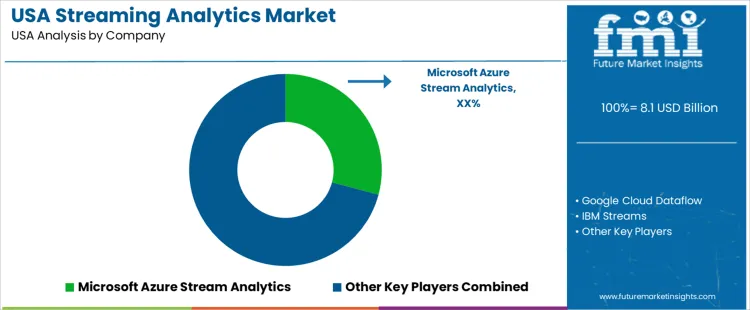
Demand for streaming-analytics platforms in the United States is driven by real-time data processing requirements in sectors such as finance, e-commerce, logistics, and IoT-driven industries. Buyers value low-latency ingestion, scalability under unpredictable load, integration with existing cloud infrastructure, and robust security and compliance support. Preference tends toward platforms that offer unified data pipelines, managed services, and simplified operational overhead for developers and data teams.
Google Cloud Dataflow competes through batch+stream unified APIs, flexible pricing, and support for Apache Beam services well-received by tech-savvy firms and those building hybrid cloud pipelines.
IBM Streams maintains relevance within legacy-heavy industries requiring on-premises or hybrid deployments, high throughput, and robust compliance options. AWS Kinesis supports demand where enterprises already leverage AWS for compute and storage; its scalability and integration with Lambda, Redshift, and S3 pipelines make it popular for real-time analytics at scale. SAS Streaming Analytics serves sectors prioritizing advanced statistical models and regulated data workflows (healthcare analytics, finance), attracting users who require packaged analytic rigor rather than self-built pipelines.
Key Players in USA Streaming Analytics Demand
- Microsoft Azure Stream Analytics
- Google Cloud Dataflow
- IBM Streams
- AWS Kinesis
- SAS Streaming Analytics
Scope of the Report
| Items | Values |
|---|---|
| Quantitative Units | USD billion |
| Solution | Platform, Hybrid, Services, Consulting Services, Integration & Implementation |
| Application | Advertising & Marketing, Financial Analytics, Supply Chain Management, Demographic Location Intelligence, Fraud Intelligence |
| Enterprise Size | Large Enterprises, Small & Medium Enterprises (SMEs) |
| Industry | IT & Telecom, Media and Entertainment, Retail & E-commerce, Manufacturing, Banking, Financial Services, and Insurance (BFSI) |
| Regions Covered | West USA, South USA, Northeast USA, Midwest USA |
| Key Companies Profiled | Microsoft Azure Stream Analytics, Google Cloud Dataflow, IBM Streams, AWS Kinesis, SAS Streaming Analytics |
| Additional Attributes | Dollar sales by solution type, application, and enterprise size; deployment of real-time streaming analytics tools across BFSI, retail, manufacturing, and telecom; increased use of cloud-native architectures and event-driven data pipelines; adoption driven by fraud prevention, operational monitoring, customer sentiment analysis, and anomaly detection in USA enterprises. |
USA Streaming Analytics Demand by Segments
Solution:
- Platform
- Hybrid
- Services
- Consulting Services
- Integration & Implementation
Application:
- Advertising & Marketing
- Financial Analytics
- Supply Chain Management
- Demographic Location Intelligence
- Fraud Intelligence
Enterprise Size:
- Large Enterprises
- Small & Medium Enterprises (SMEs)
Industry:
- IT & Telecom
- Media and Entertainment
- Retail & E-commerce
- Manufacturing
- Banking, Financial Services, and Insurance (BFSI)
Region:
- West USA
- South USA
- Northeast USA
- Midwest USA
Frequently Asked Questions
How big is the demand for streaming analytics in USA in 2025?
The demand for streaming analytics in USA is estimated to be valued at USD 8.1 billion in 2025.
What will be the size of streaming analytics in USA in 2035?
The market size for the streaming analytics in USA is projected to reach USD 50.4 billion by 2035.
How much will be the demand for streaming analytics in USA growth between 2025 and 2035?
The demand for streaming analytics in USA is expected to grow at a 20.0% CAGR between 2025 and 2035.
What are the key product types in the streaming analytics in USA?
The key product types in streaming analytics in USA are platform, hybrid, services, consulting services and integration & implementation.
Which application segment is expected to contribute significant share in the streaming analytics in USA in 2025?
In terms of application, advertising & marketing segment is expected to command 28.0% share in the streaming analytics in USA in 2025.
Preview the report firsthand - request a free sample
Get SampleGet the brochure for pricing and purchase details.
Get PDFTable of Content
- Executive Summary
- USA Market Outlook
- Demand-side Trends
- Supply-side Trends
- Technology Roadmap Analysis
- Analysis and Recommendations
- Market Overview
- Market Coverage / Taxonomy
- Market Definition / Scope / Limitations
- Market Background
- Market Dynamics
- Drivers
- Restraints
- Opportunity
- Trends
- Scenario Forecast
- Demand in Optimistic Scenario
- Demand in Likely Scenario
- Demand in Conservative Scenario
- Opportunity Map Analysis
- Product Life Cycle Analysis
- Supply Chain Analysis
- Investment Feasibility Matrix
- Value Chain Analysis
- PESTLE and Porter’s Analysis
- Regulatory Landscape
- Regional Parent Market Outlook
- Production and Consumption Statistics
- Import and Export Statistics
- Market Dynamics
- USA Market Analysis 2020 to 2024 and Forecast, 2025 to 2035
- Historical Market Size Value (USD Million) Analysis, 2020 to 2024
- Current and Future Market Size Value (USD Million) Projections, 2025 to 2035
- Y-o-Y Growth Trend Analysis
- Absolute $ Opportunity Analysis
- USA Market Pricing Analysis 2020 to 2024 and Forecast 2025 to 2035
- USA Market Analysis 2020 to 2024 and Forecast 2025 to 2035, By Solution
- Introduction / Key Findings
- Historical Market Size Value (USD Million) Analysis By Solution , 2020 to 2024
- Current and Future Market Size Value (USD Million) Analysis and Forecast By Solution , 2025 to 2035
- Platform
- Hybrid
- Services
- Consulting Services
- Integration & Implementation
- Y-o-Y Growth Trend Analysis By Solution , 2020 to 2024
- Absolute $ Opportunity Analysis By Solution , 2025 to 2035
- USA Market Analysis 2020 to 2024 and Forecast 2025 to 2035, By Application
- Introduction / Key Findings
- Historical Market Size Value (USD Million) Analysis By Application, 2020 to 2024
- Current and Future Market Size Value (USD Million) Analysis and Forecast By Application, 2025 to 2035
- Advertising & Marketing
- Financial Analytics
- Supply Chain Management
- Demographic Location Intelligence
- Fraud Intelligence
- Y-o-Y Growth Trend Analysis By Application, 2020 to 2024
- Absolute $ Opportunity Analysis By Application, 2025 to 2035
- USA Market Analysis 2020 to 2024 and Forecast 2025 to 2035, By Enterprise Size
- Introduction / Key Findings
- Historical Market Size Value (USD Million) Analysis By Enterprise Size, 2020 to 2024
- Current and Future Market Size Value (USD Million) Analysis and Forecast By Enterprise Size, 2025 to 2035
- Large Enterprises
- Small & Medium Enterprises (SMEs)
- Y-o-Y Growth Trend Analysis By Enterprise Size, 2020 to 2024
- Absolute $ Opportunity Analysis By Enterprise Size, 2025 to 2035
- USA Market Analysis 2020 to 2024 and Forecast 2025 to 2035, By Industry
- Introduction / Key Findings
- Historical Market Size Value (USD Million) Analysis By Industry, 2020 to 2024
- Current and Future Market Size Value (USD Million) Analysis and Forecast By Industry, 2025 to 2035
- IT & Telecom
- Media and Entertainment
- Retail & E-commerce
- Manufacturing
- Banking, Financial Services, and Insurance (BFSI)
- Y-o-Y Growth Trend Analysis By Industry, 2020 to 2024
- Absolute $ Opportunity Analysis By Industry, 2025 to 2035
- Market Structure Analysis
- Competition Dashboard
- Competition Benchmarking
- Market Share Analysis of Top Players
- By Regional
- By Solution
- By Application
- By Enterprise Size
- By Industry
- Competition Analysis
- Competition Deep Dive
- Microsoft Azure Stream Analytics
- Overview
- Product Portfolio
- Profitability by Market Segments (Product/Age /Sales Channel/Region)
- Sales Footprint
- Strategy Overview
- Marketing Strategy
- Product Strategy
- Channel Strategy
- Google Cloud Dataflow
- IBM Streams
- AWS Kinesis
- SAS Streaming Analytics
- Microsoft Azure Stream Analytics
- Competition Deep Dive
- Assumptions & Acronyms Used
- Research Methodology


