

- Industry Size (2026)
- USD 797.0 Mn
- Forecast (2036)
- USD 1017.9 Mn
- CAGR (2026 to 2036)
- 2.5%
Demand for Stretch Film Packs in Japan Forecast and Outlook 2026 to 2036
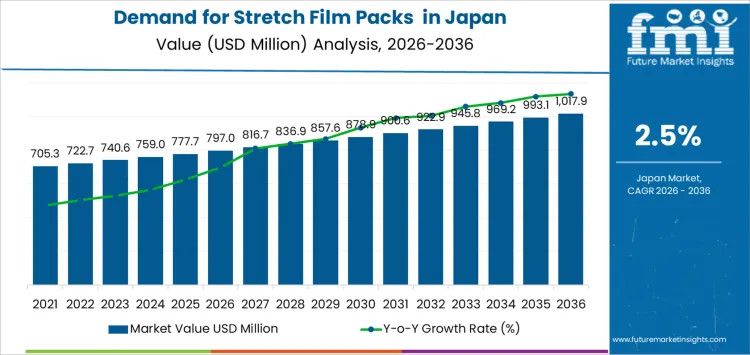
The demand for stretch film packs in Japan is valued at USD 797.0 million in 2026 and is projected to reach USD 1,017.9 million by 2036, reflecting a CAGR of 2.5%. Growth from 2020 to 2026 shows a steady rise supported by food and beverage logistics, pharmaceutical handling, and consumer goods distribution. LLDPE remains the primary material due to reliable stretch properties, while sleeves, labels, wraps, and hoods meet varied protective requirements across domestic shipments.
From 2027 onward, values move from USD 816.7 million to USD 900.6 million by 2031, then reach USD 1,017.9 million by 2036 through stable annual additions. Demand is shaped by routine packaging use rather than major shifts in shipping practices. Food and beverage applications continue to anchor consumption, while pharmaceutical and consumer goods sectors maintain predictable wrapping needs. Growth reflects packaging density and replacement frequency across Japan’s distribution networks.
Quick Stats of the Demand for Stretch Film Packs in Japan:
- Demand for Stretch Film Packs in Japan Value (2026): USD 797.0 million
- Demand for Stretch Film Packs in Japan Forecast Value (2036): USD 1,017.9 million
- Demand for Stretch Film Packs in Japan Forecast CAGR (2026–2036): 2.5%
- Demand for Stretch Film Packs in Japan Leading Material Type: LLDPE (44%)
- Demand for Stretch Film Packs in Japan Key Growth Regions: Kyushu & Okinawa, Kanto, Kansai
- Demand for Stretch Film Packs in Japan Top Players: Eltech K-Laser S.r.l., Kurz, Unifoil, Light Logics Holography & Optics, Lasersec Technologies Pvt. Ltd.
What is the Growth Forecast for Stretch Film Packs in Japan through 2036?
Between 2026 and 2031, demand for stretch film packs in Japan increases from USD 797.0 million to USD 878.9 million, reflecting an expansion of USD 81.9 million across five years. Annual value addition remains steady as logistics operators, consumer goods manufacturers, and distribution centers reinforce pallet protection practices. Earlier growth was tied to steady freight movement, while near term progression reflects higher packaged shipment volumes, tighter wrapping consistency requirements, and continued reliance on pallet unitization across domestic supply chains.
From 2031 to 2036, demand rises from USD 878.9 million to USD 1,017.9 million, adding USD 139.0 million through the period. Yearly value creation increases as automated wrapping lines expand across fulfillment hubs, and bulk shippers adopt higher performance film grades for stability during longer transport routes. Earlier growth was supported by operational packaging needs, while later expansion reflects broader warehouse modernization, rising export shipment preparation, and structured load protection protocols adopted by manufacturers and third party logistics providers.
Stretch Film Packs Industry in Japan Key Takeaways
| Metric | Value |
|---|---|
| Industry Value (2026) | USD 797.0 million |
| Forecast Value (2036) | USD 1,017.9 million |
| Forecast CAGR (2026–2036) | 2.5% |
What Is Driving the Demand for Stretch Film Packs in Japan from 2026 to 2036?
Demand for stretch film packs in Japan grew through expansion of logistics networks, warehousing, and manufacturing operations that depend on stable palletised loads. Companies in automotive, electronics, food distribution, and retail used films to secure mixed shipments and reduce handling damage. Historical demand followed growth in mechanised palletising, standard pallet formats, and steady distribution volume. Procurement focused on tensile strength, puncture resistance, and wrap consistency. Buyers selected films that balanced protection with predictable cost and compatibility with existing wrapping equipment.
From 2026 to 2036 demand is expected to align with automation, e commerce expansion, and material reduction goals. Fulfilment centres adopt high performance films that support consistent tension and lower material use. Companies prioritise recyclable and downgauged films to meet waste reduction targets. Automated application equipment influences film specifications for compatibility and throughput. Demand also reflects performance needs in refrigerated logistics, export shipping, and dense urban distribution networks. Buyers evaluate durability, recyclability, and overall load stability across varied shipping conditions.
What Is the Demand for Stretch Film Packs in Japan by Material Type and Product for 2026 to 2036?
The demand for stretch film packs in Japan from 2026 to 2036 is shaped by retail distribution growth, pallet load stabilization needs, and rising use of automated wrapping equipment. LLDPE leads by material type because of its balance of stretchability, puncture strength, and cost efficiency across pallet applications. Sleeves and labels lead by product as they support secure bundling and identification within logistics networks. Procurement is driven by packaging converters, distribution centers, and consumer goods manufacturers. Import reliance remains present for premium resin grades. Substitution pressure exists from recyclable paper wraps in limited segments. Demand stability is supported by e commerce expansion and manufacturing shipment volumes.
Why does LLDPE account for 44% of the demand for stretch film packs in Japan by material type from 2026 to 2036?
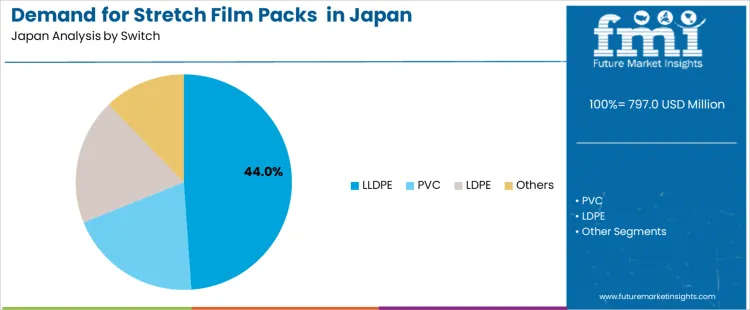
LLDPE accounts for 44% of the demand for stretch film packs in Japan by material type due to its tensile strength, controlled elasticity, and ability to conform tightly around pallet loads. Consumption intensity is driven by beverage distribution, electronics packaging, and fast moving consumer goods where predictable load retention is critical. Usage remains stable because LLDPE performs reliably across automated and manual wrapping systems. Procurement is led by packaging plants and logistics operators that require consistent film gauge and mechanical behavior. Price sensitivity remains moderate because resin cost influences wrapping cost per pallet.
LLDPE driven demand remains predictable across 2026 to 2036 due to continuous pallet movement within domestic supply chains. Repeat utilization remains consistent because stretch film is a single use packaging material. Buyers favor high yield formulations that reduce film consumption per unit. Margin structure remains steady under competition between domestic polymer converters. Regulatory exposure centers on recycling targets and material reduction policies. Import reliance persists for high performance metallocene LLDPE grades. Substitution pressure from PVC and LDPE remains limited in high load containment scenarios where controlled stretch profiles are required.
Why do sleeves and labels represent 45.0% of the demand for stretch film packs in Japan by product?
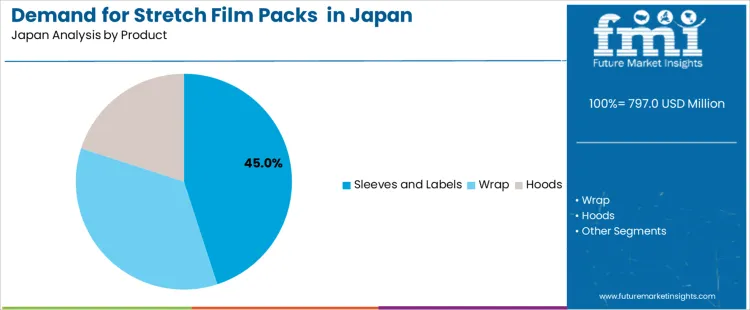
Sleeves and labels represent 45.0% of the demand for stretch film packs in Japan by product, reflecting their essential role in bundling, tamper indication, and SKU identification across warehousing and retail distribution. Consumption intensity is driven by beverage multipacks, personal care products, and electronics accessories where sleeve packaging supports unit grouping. Usage remains stable because sleeves integrate visual branding and protective wrapping in a single format. Procurement is dominated by consumer goods manufacturers and packaging converters.
Sleeves and labels maintain consistent demand from 2026 to 2036 due to high turnover products and continuous production cycles. Repeat utilization remains predictable as each retail unit requires new sleeve packaging. Buyers favor formats that run efficiently on high speed application lines. Margin structure remains controlled under competitive converting operations. Regulatory exposure centers on packaging waste guidelines and labeling accuracy standards. Import reliance persists for specialty shrink films and high clarity label substrates. Substitution pressure from paper based wraps remains limited where optical clarity and tight conforming shrink are required for retail presentation.
What Is Driving the Demand for Stretch Film Packs in Japan Load Security Needs Across Tight Logistics Networks?
Demand for stretch film packs in Japan grows through dense logistics flows, compact warehouse layouts, and strict pallet stability expectations across retail and manufacturing supply chains. Daily replenishment cycles for convenience stores and supermarkets require consistent pallet wrapping that protects cartons during frequent restacking and truck transfers. Food, beverage, and pharmaceutical shippers rely on film tension reliability during humidity shifts that weaken outer packaging. Exporters use higher-grade films to meet overseas stability norms. Demand aligns with load security discipline, automation compatibility, and the need to minimize product damage within short-cycle distribution paths rather than global packaging trends alone.
How Are Urban Warehouses and High-Frequency Replenishment Shaping Film Consumption in Japan?
Urban warehouses in Japan operate with limited floor space, narrow aisles, and rapid pallet turnover. Mixed-SKU pallets require stable wrapping to prevent leaning during tight turns made by compact forklifts and automated guided vehicles. Stretch film packs support repeated handling as products move through cross-docking points toward convenience stores and specialty retailers. Frequent night-time deliveries intensify wrapping cycles tied to route schedules. Operators focus on pre-cut rolls for consistent application speed among rotating staff. Demand follows repeated micro-distribution movements and tight delivery windows built into Japan’s retail supply chains, rather than long-duration international transport patterns.
Why Is Packaging Downgauging Increasing Dependence on High-Performance Stretch Film in Japan?
Manufacturers in Japan continue reducing carton thickness and switching to lighter trays to cut material cost and storage footprint. Thinner packaging increases vulnerability to corner crush and shifting during pallet movement. High-performance stretch films compensate by providing controlled elongation and uniform containment force even under humid or temperature-variable warehouse conditions. Beverage, dairy, and frozen food sectors rely on film integrity to secure vertical stacking on tight timelines. Film choice becomes a stability tool rather than a secondary packaging detail. Demand rises through structural packaging changes, humidity sensitivity, and retailer pressure to maintain delivery precision without added pallet components.
What is the Demand for Stretch Film Packs in Japan by Region?
| Region | CAGR (%) |
|---|---|
| Kyushu & Okinawa | 3.1% |
| Kanto | 2.8% |
| Kansai | 2.5% |
| Chubu | 2.2% |
| Tohoku | 1.9% |
| Rest of Japan | 1.8% |
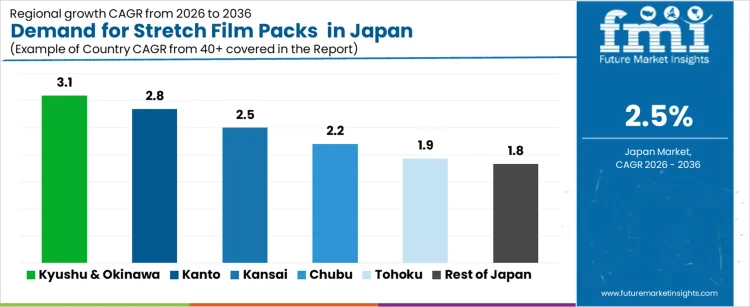
The demand for stretch film packs in Japan is rising gradually across logistics, manufacturing, and retail distribution chains, led by Kyushu and Okinawa at a 3.1% CAGR. Growth in this region is supported by active port logistics, regional food processing, and strong shipments from manufacturing clusters requiring pallet unitization. Kanto follows at 2.8%, driven by dense warehousing networks, e commerce shipments, and consistent demand from consumer goods distribution. Kansai records 2.5% growth, reflecting stable use among regional logistics firms, packaged goods manufacturers, and third party warehousing operators. Chubu at 2.2% shows moderate uptake linked to automotive parts shipments and industrial packaging needs. Tohoku and the Rest of Japan, at 1.9% and 1.8%, reflect slower growth shaped by lower freight densities, smaller warehouse footprints, and limited adoption of upgraded pallet wrapping solutions.
How Are Packaging Workflows Shaping Stretch Film Pack Use in Kyushu and Okinawa?
Demand for stretch film packs in Kyushu and Okinawa is increasing at a CAGR of 3.1% from 2026 to 2036, supported by food distribution hubs, retail consolidation centers, and warehousing sites that rely on stable pallet wrapping routines. Stretch film plays a role in unit load stability, carton protection, and shipment readiness for regional supply chains. Facilities maintain consistent consumption as wrapped pallets move frequently across island logistics networks. Replacement cycles reflect steady throughput, variable load configurations, and routine packaging shifts. Industrial areas continue to rely on stretch film for practical load security, manageable usage patterns, and predictable performance in daily operations.
- Retail centers use film for pallet stability
- Food shipments require protective wrapping
- Warehouses maintain continuous film consumption
- Routine handling shapes film application levels
Why Is High Volume Distribution Influencing Stretch Film Demand in Kanto?
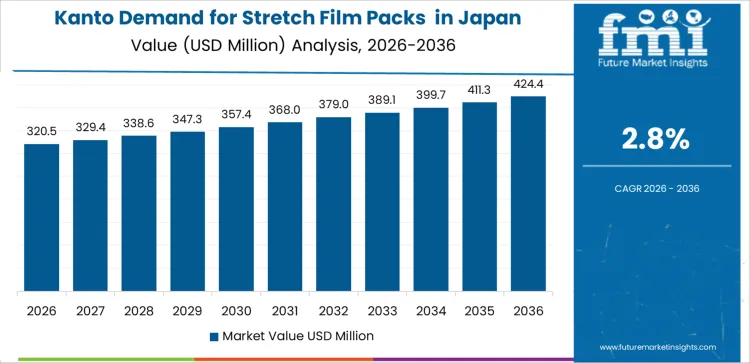
Demand for stretch film packs in Kanto is moving at a CAGR of 2.8% from 2026 to 2036, guided by large distribution complexes, e commerce fulfillment centers, and consumer goods warehouses that process extensive pallet volumes. Stretch film supports consistent wrapping across varied load shapes and product categories. Facilities rely on standardized film rolls for efficient handling, predictable break strength, and controlled stretch performance. Replacement cycles reflect high shipment turnover and structured packing workflows. Extensive regional logistics networks maintain stable requirements for stretch film as part of daily pallet preparation across densely operated storage and distribution environments.
- Fulfillment centers apply film in high volume operations
- Consumer goods warehouses use film for load protection
- Varied pallet mixes shape ongoing film needs
- Fast throughput maintains steady replenishment cycles
How Are Manufacturing and Retail Flows Supporting Stretch Film Use in Kansai?
Demand for stretch film packs in Kansai is rising at a CAGR of 2.5% from 2026 to 2036, supported by mixed manufacturing clusters, beverage distribution routes, and regional retail supply chains. Stretch film remains part of pallet load securing practices where stability, ease of application, and consistent performance guide material selection. Facilities manage regular replenishment as pallet wrapping occurs across inbound and outbound handling zones. Moderate production levels and steady goods circulation shape consumption patterns. Kansai operations continue to rely on film roles for routine packing where mechanical stability and simple integration into existing workflows support consistent usage across storage and distribution settings.
- Beverage distributors rely on film for load integrity
- Manufacturing units apply film for shipment preparation
- Retail chains maintain ongoing wrapping activity
- Regular warehouse flows sustain film turnover
What Factors Shape Stretch Film Pack Consumption Across Chubu Facilities?
Demand for stretch film packs in Chubu is expanding at a CAGR of 2.2% from 2026 to 2036, guided by automotive component logistics, precision machinery shipments, and general manufacturing storage operations. Stretch film supports secure wrapping around sensitive parts, reducing movement during transport. Warehouses use film for pallet consolidation and space efficient stacking. Replacement patterns follow planned dispatch cycles, machinery output rhythms, and inventory turnover. Chubu facilities maintain steady film consumption where wrapping reliability, controlled stretch, and predictable load containment remain important in protecting goods moving through regional industrial distribution routes and manufacturing supply channels.
- Component logistics depend on stable pallet wrapping
- Machinery shipments require protective film layers
- Warehouses use film for pallet consolidation
- Inventory cycles influence film replacement rates
How Are Regional Storage Patterns Guiding Stretch Film Needs in Tohoku?
Demand for stretch film packs in Tohoku is growing at a CAGR of 1.9% from 2026 to 2036, supported by agricultural goods handling, food processing shipments, and community level warehousing sites. Stretch film is applied to maintain pallet stability during regional transport and seasonal product distribution. Facilities consume film in line with crop cycles, packaged food schedules, and routine order consolidation. Wrapping practices remain steady in environments where simple protective layers help reduce carton movement. Demand aligns with the region’s mixed pace logistics activity and practical material handling needs where stretch film provides consistent performance across varying pallet profiles.
- Agricultural shipments rely on pallet wrapping
- Food processors apply film in distribution cycles
- Community warehouses use film for secure handling
- Seasonal demand influences film consumption
What Is Sustaining Stretch Film Pack Usage in Rest of Japan?
Demand for stretch film packs in Rest of Japan is advancing at a CAGR of 1.8% from 2026 to 2036, supported by small warehouses, local distribution centers, and compact retail supply operations. Stretch film remains part of pallet preparation routines where straightforward application and predictable containment guide use. Many facilities operate at moderate throughput levels, creating steady but controlled consumption patterns. Replacement aligns with ongoing shipping activity and varied product mixes. Operators rely on standard film rolls that support practical load stability across limited scale logistics networks, maintaining consistent usage without rapid fluctuations driven by large industrial or metropolitan distribution cycles.
- Small warehouses maintain film for basic pallet loads
- Local distribution sites use film for stability
- Retail supply chains apply film for routine wrapping
- Product mix changes shape film replenishment needs
What Is Driving the Demand for Stretch Film Packs in Japan and Which Companies Shape Protective Packaging Supply?
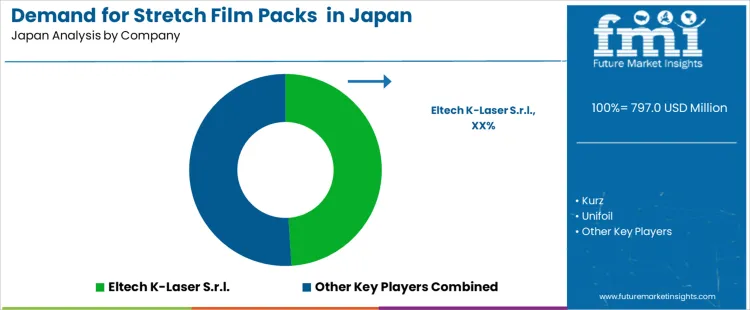
The demand for stretch film packs in Japan is shaped by e commerce logistics, cold chain distribution, and strict load stability needs in automated warehouses. Japanese converters and film producers supply most local demand through polyethylene based films optimized for pallet wrapping in narrow warehouse aisles. Domestic logistics operators favor high clarity, puncture resistant, and low gauge materials suited to robotic palletizing. Eltech K Laser, Kurz, Unifoil, Light Logics, and Lasersec Technologies participate mainly through decorative and security films used in specialty packaging rather than pallet stretch applications.
Stretch film selection in Japan is governed by load retention, cling stability under humidity, and compatibility with high speed wrapping machines. Buyers emphasize quiet unwind, consistent roll quality, and lightweight films that reduce material usage without compromising strength. Adoption increases during retail peak seasons, export shipments, and temperature controlled distribution of food and pharmaceuticals. Demand visibility tracks expansion of automated fulfillment centers, growth in convenience store logistics, and continued replacement of rigid packaging with flexible protective wraps across industrial supply chains.
Key Players in the Stretch Film Packs Industry in Japan
- Eltech K-Laser S.r.l.
- Kurz
- Unifoil
- Light Logics Holography & Optics
- Lasersec Technologies Pvt. Ltd.
Scope of the Report
| Items | Values |
|---|---|
| Quantitative Units (2026) | USD million |
| Material Type | LLDPE, PVC, LDPE, Others |
| Product | Sleeves and Labels, Wrap, Hoods |
| Application | Wine Packaging, Glassware Packaging, Crockery Packaging |
| Industry | Food and Beverage, Pharmaceutical, Consumer Goods |
| Regions Covered | Kyushu and Okinawa, Kanto, Kansai, Chubu, Tohoku, Rest of Japan |
| Countries Covered | Japan |
| Key Companies Profiled | Eltech K-Laser S.r.l., Kurz, Unifoil, Light Logics Holography and Optics, Lasersec Technologies Pvt. Ltd. |
| Additional Attributes | Dollar sales by material and product type; replacement versus single-use wrapping demand; LLDPE share at 44%; sleeves and labels share at 45%; load retention and puncture resistance parameters; packaging density and pallet stability requirements across retail and logistics chains; integration with automated wrapping lines; moisture and temperature considerations in cold chain distribution; regulatory factors tied to material reduction and recyclability; import reliance for high-performance metallocene LLDPE grades |
Stretch Film Packs Industry in Japan Segmentation
Switch (Material) :
- LLDPE
- PVC
- LDPE
- Others
Product :
- Sleeves and Labels
- Wrap
- Hoods
Application :
- Wine Packaging
- Glassware Packaging
- Crockery Packaging
Industry :
- Food & Beverage
- Pharmaceutical
- Consumer Goods
Region :
- Kyushu & Okinawa
- Kanto
- Kansai
- Chubu
- Tohoku
- Rest of Japan
Frequently Asked Questions
How big is the demand for stretch film packs in Japan in 2026?
The demand for stretch film packs in Japan is estimated to be valued at USD 797.0 million in 2026.
What will be the size of stretch film packs in Japan in 2036?
The market size for the stretch film packs in Japan is projected to reach USD 1,017.9 million by 2036.
How much will be the demand for stretch film packs in Japan growth between 2026 and 2036?
The demand for stretch film packs in Japan is expected to grow at a 2.5% CAGR between 2026 and 2036.
What are the key product types in the stretch film packs in Japan?
The key product types in stretch film packs in Japan are lldpe, pvc, ldpe and others.
Which product segment is expected to contribute significant share in the stretch film packs in Japan in 2026?
In terms of product, sleeves and labels segment is expected to command 45.0% share in the stretch film packs in Japan in 2026.
Preview the report firsthand - request a free sample
Get SampleGet the brochure for pricing and purchase details.
Get PDFTable of Content
- Executive Summary
- Japan Market Outlook
- Demand-side Trends
- Supply-side Trends
- Technology Roadmap Analysis
- Analysis and Recommendations
- Market Overview
- Market Coverage / Taxonomy
- Market Definition / Scope / Limitations
- Market Background
- Market Dynamics
- Drivers
- Restraints
- Opportunity
- Trends
- Scenario Forecast
- Demand in Optimistic Scenario
- Demand in Likely Scenario
- Demand in Conservative Scenario
- Opportunity Map Analysis
- Product Life Cycle Analysis
- Supply Chain Analysis
- Investment Feasibility Matrix
- Value Chain Analysis
- PESTLE and Porter’s Analysis
- Regulatory Landscape
- Regional Parent Market Outlook
- Production and Consumption Statistics
- Import and Export Statistics
- Market Dynamics
- Japan Market Analysis 2020 to 2024 and Forecast, 2025 to 2035
- Historical Market Size Value (USD Million) Analysis, 2020 to 2024
- Current and Future Market Size Value (USD Million) Projections, 2025 to 2035
- Y-o-Y Growth Trend Analysis
- Absolute $ Opportunity Analysis
- Japan Market Pricing Analysis 2020 to 2024 and Forecast 2025 to 2035
- Japan Market Analysis 2020 to 2024 and Forecast 2025 to 2035, By Switch
- Introduction / Key Findings
- Historical Market Size Value (USD Million) Analysis By Switch , 2020 to 2024
- Current and Future Market Size Value (USD Million) Analysis and Forecast By Switch , 2025 to 2035
- LLDPE
- PVC
- LDPE
- Others
- Y-o-Y Growth Trend Analysis By Switch , 2020 to 2024
- Absolute $ Opportunity Analysis By Switch , 2025 to 2035
- Japan Market Analysis 2020 to 2024 and Forecast 2025 to 2035, By Product
- Introduction / Key Findings
- Historical Market Size Value (USD Million) Analysis By Product, 2020 to 2024
- Current and Future Market Size Value (USD Million) Analysis and Forecast By Product, 2025 to 2035
- Sleeves and Labels
- Wrap
- Hoods
- Y-o-Y Growth Trend Analysis By Product, 2020 to 2024
- Absolute $ Opportunity Analysis By Product, 2025 to 2035
- Japan Market Analysis 2020 to 2024 and Forecast 2025 to 2035, By Application
- Introduction / Key Findings
- Historical Market Size Value (USD Million) Analysis By Application, 2020 to 2024
- Current and Future Market Size Value (USD Million) Analysis and Forecast By Application, 2025 to 2035
- Wine Packaging
- Glassware Packaging
- Crockery Packaging
- Y-o-Y Growth Trend Analysis By Application, 2020 to 2024
- Absolute $ Opportunity Analysis By Application, 2025 to 2035
- Japan Market Analysis 2020 to 2024 and Forecast 2025 to 2035, By Industry
- Introduction / Key Findings
- Historical Market Size Value (USD Million) Analysis By Industry, 2020 to 2024
- Current and Future Market Size Value (USD Million) Analysis and Forecast By Industry, 2025 to 2035
- Food & Beverage
- Pharmaceutical
- Consumer Goods
- Y-o-Y Growth Trend Analysis By Industry, 2020 to 2024
- Absolute $ Opportunity Analysis By Industry, 2025 to 2035
- Market Structure Analysis
- Competition Dashboard
- Competition Benchmarking
- Market Share Analysis of Top Players
- By Regional
- By Switch
- By Product
- By Application
- By Industry
- Competition Analysis
- Competition Deep Dive
- Eltech K-Laser S.r.l.
- Overview
- Product Portfolio
- Profitability by Market Segments (Product/Age /Sales Channel/Region)
- Sales Footprint
- Strategy Overview
- Marketing Strategy
- Product Strategy
- Channel Strategy
- Kurz
- Unifoil
- Light Logics Holography & Optics
- Lasersec Technologies Pvt. Ltd.
- Eltech K-Laser S.r.l.
- Competition Deep Dive
- Assumptions & Acronyms Used
- Research Methodology


