

- Industry Size (2026)
- USD 368 Mn
- Forecast (2036)
- USD 550.0 Mn
- CAGR (2026 to 2036)
- 4.1%
Lingonberry Powder Market Forecast and Outlook 2026 to 2036
The lingonberry powder market is set to observe around USD 368 million in sales in 2026, with branded and private label programs lifting volume to USD 550.0 million by 2036 at a CAGR of 4.1%. Demand comes from supplement blends, functional foods, and beverage premixes where color, acidity, and polyphenol content define use. Product managers specify mesh size, moisture limits, and carrier choices during formulation work. Once sensory panels and stability tests close, ingredient changes trigger reformulation and label updates. Buyers evaluate suppliers on lot traceability, pesticide screens, and microbiology results. Harvest variability shapes contracting windows. Drying method, milling profile, and packaging atmosphere govern life expectations.
Sourcing teams work through approved grower lists, drying partners, and milling sites to manage crop risk. Inventory policy balances frozen berries against powder to protect continuity. Quality teams run identity, anthocyanin, and moisture tests before release. Brand owners negotiate pack sizes and blends after specification lock. Distribution favors drums and lined bags for co packers. Margin depends on yield, freight density, and repack labor rather than list prices and overhead absorption at contracted facilities.
Quick Stats for Lingonberry Powder Market
- Lingonberry Powder Market Value (2026): USD 368 million
- Lingonberry Powder Market Forecast Value (2036): USD 550.0 million
- Lingonberry Powder Market Forecast CAGR 2026 to 2036: 4.1%
- Leading Processing Type in Lingonberry Powder Market: Vacuum drying lingonberry powder
- Leading Application in Lingonberry Powder Market: Baking products
- Key Growth Regions in Lingonberry Powder Market: Asia Pacific, Europe, North America
- Top Players in Lingonberry Powder Market: Biokia, Artemis, Loov Food, Eevia Health, Arctic Power Berries
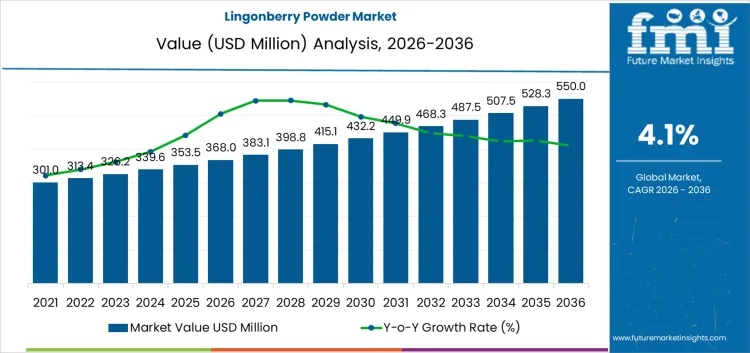
What Is the Growth Forecast for the Lingonberry Powder Market through 2036?
Crop availability, processing yield, and buyer formulation habits shape the lingonberry powder market more than headline retail demand. In 2026, at about USD 368 million, volume is tied to stable supply from Nordic and Baltic growing regions and to contracted processing runs rather than to spot harvest swings. Ingredient teams select lingonberry powder for defined color, acidity, and polyphenol profiles, which fixes usage levels inside beverages, supplements, and functional foods across long product cycles. Adoption rises through incremental line extensions and regional rollouts rather than broad category shifts. The upward path reflects wider use inside existing product families and steady growth in private label nutrition ranges, with purchasing schedules aligned to crop contracts and processing capacity rather than promotional calendars.
Processing economics and specification discipline guide the upper half of the forecast for the lingonberry powder market. As value approaches roughly USD 550 million by 2036, attention centers on drying efficiency, powder consistency, and lot to lot stability. Buyers place weight on color range control, moisture limits, and traceable origin documentation. Production planning favors longer campaigns of standardized grades that reduce waste and simplify quality release. The move from the high three hundred into the five hundred million range comes from cumulative placements across food, beverage, and supplement portfolios rather than from a single demand surge. Suppliers that maintain dependable supply chains, predictable sensory profiles, and stable delivery schedules tend to secure repeat contracts across multi-year programs.
Lingonberry Powder Market Key Takeaways
| Metric | Value |
|---|---|
| Market Value (2026) | USD 368 million |
| Forecast Value (2036) | USD 550.0 million |
| Forecast CAGR 2026 to 2036 | 4.1% |
How Is the Lingonberry Powder Market Being Used in Shelf Stable Formulations?
Lingonberry powder is produced by drying and milling whole berries or press cake into a shelf stable ingredient for food and supplement use. Earlier supply chains focused on frozen berries, concentrates, and preserves, which limited shipping range and forced processors to manage seasonal inventory risk. Powder changes that model by extending storage life and allowing precise dosing in dry mixes, capsules, and beverage bases. Buyers assess color stability, polyphenol retention, moisture control, and microbiological limits rather than fruit size or fresh grade. Initial demand came from small nutraceutical brands and specialty bakeries. Current usage spreads into functional drinks, snack coatings, and dairy alternatives because the format fits standard blending and packaging lines. Sourcing depends on Nordic harvest variability, drying yield, and documentation that supports label and audit requirements.
Manufacturers treat lingonberry powder as a controlled input whose value is tied to batch consistency and rehydration behavior, not to novelty. Early contracts were short term because volumes were limited and yield predictability remained uneven. Present procurement favors multi-year supply agreements with defined limits for particle size, water activity, and marker compounds. Processors invest in gentle drying profiles, screening, and metal control to meet audit expectations from food and supplement customers. Cost models compare finished dose cost rather than ingredient price per kilogram, which shifts attention toward solids recovery and rework rates. Distributors add value through blending and premix services that reduce handling steps for brand owners. Over time, qualification cycles and documentation discipline decide which suppliers remain on approved lists.
Which Segment Leads the Lingonberry Powder Market by Processing Type and Application?
Spending patterns in Lingonberry Powder Market are set by how processors manage yield loss, flavor retention, and microbiological stability rather than by short term retail trends. Once a drying route is selected, it defines equipment layout, energy use, and quality documentation for years. Ingredient buyers evaluate powders as functional inputs with fixed behavior in doughs, liquids, or blends, not as interchangeable fruit derivatives. This makes demand follow capacity decisions and contract farming arrangements more than promotional cycles. Segment structure reflects which processing methods preserve target compounds and which applications tolerate variation. Supplier selection rests on batch consistency, residue control, and predictable rehydration behavior rather than on branding or packaging format.
How Does Processing Type Choice Shape Cost Structure and Quality Positioning in the Lingonberry Powder Market?
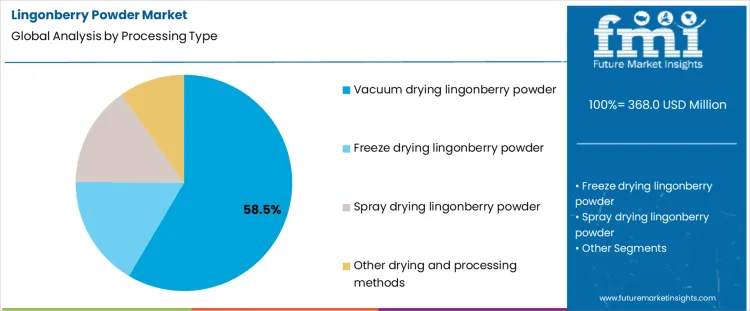
Vacuum drying lingonberry powder accounts for about 58.5% of demand in the Lingonberry Powder Market because it offers a workable balance between retention of color and flavor and manageable operating cost. This method supports stable output volumes and predictable moisture control, which suits long production campaigns. Freeze drying serves buyers who prioritize structure and sensitive compound preservation, though it carries higher energy use and longer cycle times. Spray drying supports large throughput and fine particle control, which fits beverage premix applications, yet it requires carriers and careful inlet temperature management. Other methods fill niche roles where cost ceilings or equipment constraints dominate. Each route defines different capital intensity, yield loss exposure, and quality inspection regimes.
From a supplier perspective, processing choice fixes the economic profile of the product more firmly than downstream pricing does. Vacuum dried material benefits from stable yield and moderate utility cost, which supports long term contracts. Freeze dried output carries higher unit cost and lower throughput, making it suitable for smaller, specification driven orders. Spray dried powder depends on continuous operation economics, where downtime and feed variability affect margins more than raw berry price. Switching between methods is uncommon because each requires different qualification data and customer reapproval. Demand by processing type therefore follows installed capacity and contract structure rather than seasonal shifts in end product marketing.
Why Does Application Mix Determine Volume Stability and Specification Rigor in the Lingonberry Powder Market?
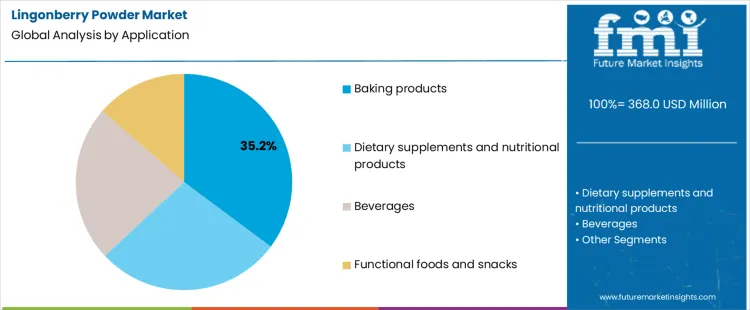
Baking products represent about 35.2% of demand in the Lingonberry Powder Market because this channel consumes consistent volumes and tolerates limited variation once recipes are fixed. Bakers value predictable color contribution, moisture behavior, and flavor release during heating. Dietary supplements and nutritional products focus on labeled content and traceability, which raises documentation and testing requirements while keeping volumes smaller. Beverage applications require fine dispersion and stable suspension behavior, placing weight on particle size control and carrier systems. Functional foods and snacks combine texture, shelf life, and labeling constraints, which fragments demand across many smaller programs. These differences explain why some suppliers build scale in bakery grades while others focus on specification driven niches.
Application mix also shapes contract length and inventory practices. Baking customers favor steady deliveries tied to production schedules, which supports forecast based manufacturing. Supplement producers place smaller orders but require lot traceability and longer retention of records. Beverage formulators test frequently and may change blends, which increases sampling and approval cycles. Snack and functional food producers often run limited campaigns, creating irregular demand peaks. The overall balance across these uses determines how producers divide capacity between high volume, standardized powder and smaller batch, tightly specified material. Segment shares move with product portfolio decisions by food manufacturers rather than with raw berry harvest size alone.
How Is the Lingonberry Powder Market Being Shaped by Functional Ingredient Positioning and Supply Discipline?
The lingonberry powder market is being shaped by its role as a functional ingredient rather than as a simple fruit derivative. Food, beverage, and nutraceutical producers use lingonberry powder for color, antioxidant positioning, and formulation differentiation, which places quality consistency and supply reliability above spot pricing. Buyers focus on standardization of active compounds, moisture control, and batch-to-batch uniformity because these factors affect labeling claims and product stability. Sourcing decisions increasingly involve quality and regulatory teams alongside procurement. This makes supplier credibility, processing discipline, and documentation capability central to long-term contracts, especially for brands that depend on repeatable taste, color, and nutritional positioning across multiple product lines.
How Is Ingredient Standardization Changing Product Development in The Lingonberry Powder Market?
Product developers increasingly design recipes around stable, predictable ingredient profiles rather than around variable seasonal inputs. This pushes demand toward standardized lingonberry powder specifications with controlled color strength, particle size, and active content. In beverage mixes, supplements, and functional foods, formulation repeatability reduces reformulation work and quality deviations. As a result, lingonberry powder market demand is shifting toward suppliers that can offer process-controlled drying, consistent blending, and specification management. There is also rising interest in pre-validated ingredient lots for regulated categories. The buying decision is becoming less about raw fruit origin and more about how reliably the powder performs inside scaled production environments.
Where Does Long-Term Volume Growth Come from in The Lingonberry Powder Market Beyond Niche Products?
Growth increasingly comes from wider use in everyday food and nutrition formats rather than only in premium or specialty products. Drink mixes, snack coatings, nutrition bars, and wellness supplements provide repeat-volume applications where small inclusion rates still create steady demand. Brand owners also look for ingredients that support clean label positioning and recognizable fruit sourcing, which strengthens lingonberry powder relevance. There is further opportunity in private label and contract manufacturing, where standardized ingredients simplify portfolio expansion. Suppliers that support application testing, stability data, and formulation guidance can become embedded partners, securing recurring business as customers expand product ranges using the same ingredient base.
Why Do Agricultural Dependence and Cost Sensitivity Limit Faster Scaling in The Lingonberry Powder Market?
Lingonberry powder market supply depends on agricultural harvesting and regional sourcing, which introduces variability in raw material availability and pricing. Weather conditions, crop yields, and logistics affect cost structures in ways that downstream buyers cannot always absorb. At the same time, many food and supplement categories remain price sensitive, making it difficult to pass higher ingredient costs through finished product pricing. Quality-driven buyers also hesitate to switch suppliers due to taste and color consistency risks, which reduces sourcing flexibility. This combination of supply variability, margin pressure, and formulation lock-in slows aggressive volume expansion outside applications where functional value clearly justifies the cost.
What is the Demand Prediction for Lingonberry Powder by Country?
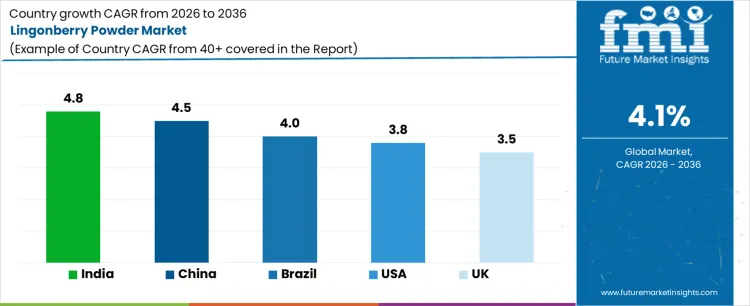
| Country | CAGR |
|---|---|
| USA | 3.8% |
| UK | 3.5% |
| China | 4.5% |
| India | 4.8% |
| Brazil | 4.0% |
Demand for lingonberry powder is rising as food, beverage, and nutraceutical producers look for concentrated fruit ingredients that offer shelf stability, standardized dosing, and easy formulation. India leads with a 4.8% CAGR, supported by rapid growth in functional foods, dietary supplements, and clean label beverage mixes where berry based ingredients are positioned for everyday use. China follows at 4.5%, driven by expanding health food manufacturing and e commerce led distribution of imported berry ingredients. Brazil records 4.0%, shaped by use in sports nutrition and flavored drink powders. The USA grows at 3.8% with steady adoption in supplements and bakery applications. The UK, at 3.5%, reflects a mature but stable ingredient demand profile.
How Do Formulation Standards and Sourcing Discipline Shape Demand in The United States?
Quality driven product formulation keeps the lingonberry powder market in the United States on a 3.8% CAGR path. Demand comes from dietary supplements, functional foods, and personal care products where traceability and consistency matter more than novelty. Procurement teams focus on batch documentation, contaminant testing, and stable supply contracts. Ingredient buyers prefer long term relationships with processors that can guarantee uniform particle size and color stability. Imports account for a large share of volume due to limited domestic berry cultivation. Inventory planning follows product launch schedules rather than seasonal consumption cycles. Private label brands influence specification thresholds. Commercial position depends on audit performance and supply reliability rather than price competition for small spot orders.
Why Do Retail Compliance and Labeling Controls Influence Purchasing in The United Kingdom?
Regulatory and retailer standards place the lingonberry powder market in the United Kingdom on a 3.5% CAGR trajectory. Food, beverage, and supplement brands operate under strict labeling and ingredient verification rules. Buyers require documented origin, allergen control, and consistent nutritional profiles. Volumes move through centralized purchasing systems serving multiple product lines. Repackers and contract manufacturers shape a large part of demand. Shelf reset schedules and product reformulations drive ordering cycles. Imports dominate supply due to limited local raw material availability. Stock policies reflect retail promotion calendars. Commercial access depends on meeting compliance checks and retail approval lists rather than competing for fragmented single brand contracts.
What Role Do Industrial Nutrition and Export Processing Play in China?
Processing scale and export oriented manufacturing place the lingonberry powder market in China on a 4.5% growth track. Demand concentrates in functional foods, beverage mixes, and supplement formulations produced for both domestic and overseas brands. Large ingredient processors control blending, standardization, and packaging. Raw material sourcing relies on imports combined with contract processing. Buyers emphasize throughput capacity and batch consistency. Orders follow factory production schedules rather than retail sales patterns. Quality control systems focus on moisture, color, and active compound stability. Price structure reflects processing efficiency and logistics control. Commercial success depends on placement within large manufacturing supply chains rather than sales to small independent brands.
How Do Brand Expansion and Product Fortification Programs Drive Volumes in India?
Rising use in supplements and fortified foods keeps the lingonberry powder market in India aligned with a 4.8% CAGR. Demand comes from contract manufacturers producing capsules, drink mixes, and nutrition blends for regional and export brands. Procurement decisions center on import reliability, documentation, and stable specifications. Most raw material enters through trading companies and ingredient distributors. Production planning follows brand launch pipelines and export order schedules. Heat and storage conditions place focus on packaging integrity and moisture control. Quality audits influence supplier continuity. Commercial results depend on distributor networks and formulation partnerships rather than direct competition for isolated brand supply contracts.
How Do Import Dependence and Blended Product Portfolios Shape Spending in Brazil?
Product diversification strategies keep the lingonberry powder market in Brazil near a 4.0% CAGR. Usage appears in supplements, dairy blends, beverage powders, and personal care formulations. Nearly all raw material arrives through imports, which places emphasis on customs clearance and documentation accuracy. Distributors play a central role in inventory positioning and customer access. Buyers prefer mixed ingredient sourcing from a limited set of approved partners. Order volumes follow promotional calendars and contract manufacturing schedules. Shelf life management influences stock turnover policies. Commercial access depends on distribution reach and regulatory compliance rather than competition for small, single product supply deals.
How Do Producers Compete for Position in the Lingonberry Powder Market?
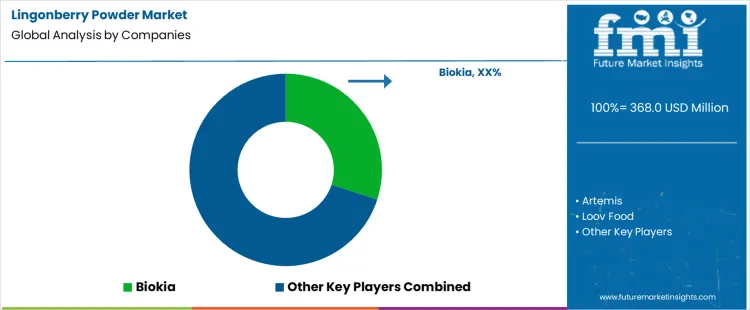
Lingonberry powder procurement centers on origin control, drying method, bioactive retention, and contaminant testing. Biokia, Artemis, Loov Food, Eevia Health, Arctic Power Berries compete through raw berry access and processing discipline. Buyers specify anthocyanin ranges, moisture limits, particle size, and carrier systems during qualification. Formulation teams lock specifications early inside supplement and functional food programs. Once stability files close, supplier changes trigger new validation work. Biokia and Arctic Power Berries draw on Nordic sourcing networks and batch traceability. Eevia Health focuses on standardized materials and documentation packages. Loov Food emphasizes ingredient simplicity and origin labeling. Artemis positions products for industrial blends. Seasonal harvest cycles, storage logistics, and yield variability shape availability planning and contract timing across accounts.
Competition reflects supply assurance, documentation depth, and consistency rather than short term price moves. Purchasing groups review pesticide screens, heavy metal limits, microbiology results, and lot to lot variance. Capacity planning matters where multi-year programs require predictable call off schedules. Smaller brands value minimum order flexibility and short lead times. Large buyers value audit histories and change control procedures. Biokia relies on long term grower relationships and controlled processing lines. Eevia Health supports customers through standardized specifications and stability data. Loov Food supplies programs that favor simple formulations and traceable origin stories. Artemis serves blending operations that need predictable physical properties. Arctic Power Berries secures positions through regional sourcing and cold chain handling. Market positions vary by application, customer scale, and regulatory review depth.
Key Players in the Lingonberry Powder Market
- Biokia
- Artemis
- Loov Food
- Eevia Health
- Arctic Power Berries
Scope of the Report
| Items | Values |
|---|---|
| Quantitative Units (2026) | USD million |
| Processing Type | Vacuum drying lingonberry powder, Freeze drying lingonberry powder, Spray drying lingonberry powder, Other drying and processing methods |
| Application | Baking products, Dietary supplements and nutritional products, Beverages, Functional foods and snacks |
| Region | Asia Pacific, Europe, North America, Latin America, Middle East & Africa |
| Countries Covered | China, Japan, South Korea, India, Australia & New Zealand, ASEAN, Germany, United Kingdom, France, Italy, Spain, Nordic, BENELUX, United States, Canada, Mexico, Brazil, Chile, Saudi Arabia, Turkey, South Africa, and other regional markets |
| Key Companies Profiled | Biokia, Artemis, Loov Food, Eevia Health, Arctic Power Berries |
| Additional Attributes | Dollar by sales by processing type and application; demand driven by functional food, supplement, and beverage formulations; growth supported by private label and nutrition blends; purchasing shaped by crop contracts, drying yield, batch consistency, residue and microbiology testing, traceable origin, moisture control, and specification lock-in rather than spot pricing. |
Lingonberry Powder Market Segmentation
Processing Type:
- Vacuum drying lingonberry powder
- Freeze drying lingonberry powder
- Spray drying lingonberry powder
- Other drying and processing methods
Application:
- Baking products
- Dietary supplements and nutritional products
- Beverages
- Functional foods and snacks
Region:
- Asia Pacific
- China
- Japan
- South Korea
- India
- Australia & New Zealand
- ASEAN
- Rest of Asia Pacific
- Europe
- Germany
- United Kingdom
- France
- Italy
- Spain
- Nordic
- BENELUX
- Rest of Europe
- North America
- United States
- Canada
- Mexico
- Latin America
- Brazil
- Chile
- Rest of Latin America
- Middle East & Africa
- Kingdom of Saudi Arabia
- Other GCC Countries
- Turkey
- South Africa
- Other African Union
- Rest of Middle East & Africa
Bibliography
- Food and Agriculture Organization of the United Nations. (2023). Code of practice for the prevention and reduction of mycotoxin contamination in dried fruits (CXC 65-2008, latest revision). FAO.
- U.S. Food and Drug Administration. (2023). Guidance for industry: Control of microbiological hazards in dried foods. U.S. Department of Health and Human Services.
- U.S. Department of Agriculture, Agricultural Marketing Service. (2024). United States standards for grades of dried fruits. USDA.
- European Commission. (2023). Commission Regulation (EU) No 1881/2006 setting maximum levels for certain contaminants in foodstuffs (consolidated version). Official Journal of the European Union.
- Nordic Council of Ministers. (2023). Nordic berries as food ingredients: Composition, processing and quality. Nordic Council of Ministers.
Frequently Asked Questions
How big is the lingonberry powder market in 2026?
The global lingonberry powder market is estimated to be valued at USD 368.0 million in 2026.
What will be the size of lingonberry powder market in 2036?
The market size for the lingonberry powder market is projected to reach USD 550.0 million by 2036.
How much will be the lingonberry powder market growth between 2026 and 2036?
The lingonberry powder market is expected to grow at a 4.1% CAGR between 2026 and 2036.
What are the key product types in the lingonberry powder market?
The key product types in lingonberry powder market are vacuum drying lingonberry powder , freeze drying lingonberry powder, spray drying lingonberry powder and other drying and processing methods.
Which application segment to contribute significant share in the lingonberry powder market in 2026?
In terms of application, baking products segment to command 35.2% share in the lingonberry powder market in 2026.
Preview the report firsthand - request a free sample
Get SampleGet the brochure for pricing and purchase details.
Get PDFTable of Content
- Executive Summary
- Global Market Outlook
- Demand-side Trends
- Supply-side Trends
- Technology Roadmap Analysis
- Analysis and Recommendations
- Market Overview
- Market Coverage / Taxonomy
- Market Definition / Scope / Limitations
- Market Background
- Market Dynamics
- Drivers
- Restraints
- Opportunity
- Trends
- Scenario Forecast
- Demand in Optimistic Scenario
- Demand in Likely Scenario
- Demand in Conservative Scenario
- Opportunity Map Analysis
- Product Life Cycle Analysis
- Supply Chain Analysis
- Investment Feasibility Matrix
- Value Chain Analysis
- PESTLE and Porter’s Analysis
- Regulatory Landscape
- Regional Parent Market Outlook
- Production and Consumption Statistics
- Import and Export Statistics
- Market Dynamics
- Global Market Analysis 2021 to 2025 and Forecast, 2026 to 2036
- Historical Market Size Value (USD Million) Analysis, 2021 to 2025
- Current and Future Market Size Value (USD Million) Projections, 2026 to 2036
- Y-o-Y Growth Trend Analysis
- Absolute $ Opportunity Analysis
- Global Market Pricing Analysis 2021 to 2025 and Forecast 2026 to 2036
- Global Market Analysis 2021 to 2025 and Forecast 2026 to 2036, By Processing Type
- Introduction / Key Findings
- Historical Market Size Value (USD Million) Analysis By Processing Type , 2021 to 2025
- Current and Future Market Size Value (USD Million) Analysis and Forecast By Processing Type , 2026 to 2036
- Vacuum drying lingonberry powder
- Freeze drying lingonberry powder
- Spray drying lingonberry powder
- Other drying and processing methods
- Vacuum drying lingonberry powder
- Y-o-Y Growth Trend Analysis By Processing Type , 2021 to 2025
- Absolute $ Opportunity Analysis By Processing Type , 2026 to 2036
- Global Market Analysis 2021 to 2025 and Forecast 2026 to 2036, By Application
- Introduction / Key Findings
- Historical Market Size Value (USD Million) Analysis By Application, 2021 to 2025
- Current and Future Market Size Value (USD Million) Analysis and Forecast By Application, 2026 to 2036
- Baking products
- Dietary supplements and nutritional products
- Beverages
- Functional foods and snacks
- Baking products
- Y-o-Y Growth Trend Analysis By Application, 2021 to 2025
- Absolute $ Opportunity Analysis By Application, 2026 to 2036
- Global Market Analysis 2021 to 2025 and Forecast 2026 to 2036, By Region
- Introduction
- Historical Market Size Value (USD Million) Analysis By Region, 2021 to 2025
- Current Market Size Value (USD Million) Analysis and Forecast By Region, 2026 to 2036
- North America
- Latin America
- Western Europe
- Eastern Europe
- East Asia
- South Asia and Pacific
- Middle East & Africa
- Market Attractiveness Analysis By Region
- North America Market Analysis 2021 to 2025 and Forecast 2026 to 2036, By Country
- Historical Market Size Value (USD Million) Trend Analysis By Market Taxonomy, 2021 to 2025
- Market Size Value (USD Million) Forecast By Market Taxonomy, 2026 to 2036
- By Country
- USA
- Canada
- Mexico
- By Processing Type
- By Application
- By Country
- Market Attractiveness Analysis
- By Country
- By Processing Type
- By Application
- Key Takeaways
- Latin America Market Analysis 2021 to 2025 and Forecast 2026 to 2036, By Country
- Historical Market Size Value (USD Million) Trend Analysis By Market Taxonomy, 2021 to 2025
- Market Size Value (USD Million) Forecast By Market Taxonomy, 2026 to 2036
- By Country
- Brazil
- Chile
- Rest of Latin America
- By Processing Type
- By Application
- By Country
- Market Attractiveness Analysis
- By Country
- By Processing Type
- By Application
- Key Takeaways
- Western Europe Market Analysis 2021 to 2025 and Forecast 2026 to 2036, By Country
- Historical Market Size Value (USD Million) Trend Analysis By Market Taxonomy, 2021 to 2025
- Market Size Value (USD Million) Forecast By Market Taxonomy, 2026 to 2036
- By Country
- Germany
- UK
- Italy
- Spain
- France
- Nordic
- BENELUX
- Rest of Western Europe
- By Processing Type
- By Application
- By Country
- Market Attractiveness Analysis
- By Country
- By Processing Type
- By Application
- Key Takeaways
- Eastern Europe Market Analysis 2021 to 2025 and Forecast 2026 to 2036, By Country
- Historical Market Size Value (USD Million) Trend Analysis By Market Taxonomy, 2021 to 2025
- Market Size Value (USD Million) Forecast By Market Taxonomy, 2026 to 2036
- By Country
- Russia
- Poland
- Hungary
- Balkan & Baltic
- Rest of Eastern Europe
- By Processing Type
- By Application
- By Country
- Market Attractiveness Analysis
- By Country
- By Processing Type
- By Application
- Key Takeaways
- East Asia Market Analysis 2021 to 2025 and Forecast 2026 to 2036, By Country
- Historical Market Size Value (USD Million) Trend Analysis By Market Taxonomy, 2021 to 2025
- Market Size Value (USD Million) Forecast By Market Taxonomy, 2026 to 2036
- By Country
- China
- Japan
- South Korea
- By Processing Type
- By Application
- By Country
- Market Attractiveness Analysis
- By Country
- By Processing Type
- By Application
- Key Takeaways
- South Asia and Pacific Market Analysis 2021 to 2025 and Forecast 2026 to 2036, By Country
- Historical Market Size Value (USD Million) Trend Analysis By Market Taxonomy, 2021 to 2025
- Market Size Value (USD Million) Forecast By Market Taxonomy, 2026 to 2036
- By Country
- India
- ASEAN
- Australia & New Zealand
- Rest of South Asia and Pacific
- By Processing Type
- By Application
- By Country
- Market Attractiveness Analysis
- By Country
- By Processing Type
- By Application
- Key Takeaways
- Middle East & Africa Market Analysis 2021 to 2025 and Forecast 2026 to 2036, By Country
- Historical Market Size Value (USD Million) Trend Analysis By Market Taxonomy, 2021 to 2025
- Market Size Value (USD Million) Forecast By Market Taxonomy, 2026 to 2036
- By Country
- Kingdom of Saudi Arabia
- Other GCC Countries
- Turkiye
- South Africa
- Other African Union
- Rest of Middle East & Africa
- By Processing Type
- By Application
- By Country
- Market Attractiveness Analysis
- By Country
- By Processing Type
- By Application
- Key Takeaways
- Key Countries Market Analysis
- USA
- Pricing Analysis
- Market Share Analysis, 2025
- By Processing Type
- By Application
- Canada
- Pricing Analysis
- Market Share Analysis, 2025
- By Processing Type
- By Application
- Mexico
- Pricing Analysis
- Market Share Analysis, 2025
- By Processing Type
- By Application
- Brazil
- Pricing Analysis
- Market Share Analysis, 2025
- By Processing Type
- By Application
- Chile
- Pricing Analysis
- Market Share Analysis, 2025
- By Processing Type
- By Application
- Germany
- Pricing Analysis
- Market Share Analysis, 2025
- By Processing Type
- By Application
- UK
- Pricing Analysis
- Market Share Analysis, 2025
- By Processing Type
- By Application
- Italy
- Pricing Analysis
- Market Share Analysis, 2025
- By Processing Type
- By Application
- Spain
- Pricing Analysis
- Market Share Analysis, 2025
- By Processing Type
- By Application
- France
- Pricing Analysis
- Market Share Analysis, 2025
- By Processing Type
- By Application
- India
- Pricing Analysis
- Market Share Analysis, 2025
- By Processing Type
- By Application
- ASEAN
- Pricing Analysis
- Market Share Analysis, 2025
- By Processing Type
- By Application
- Australia & New Zealand
- Pricing Analysis
- Market Share Analysis, 2025
- By Processing Type
- By Application
- China
- Pricing Analysis
- Market Share Analysis, 2025
- By Processing Type
- By Application
- Japan
- Pricing Analysis
- Market Share Analysis, 2025
- By Processing Type
- By Application
- South Korea
- Pricing Analysis
- Market Share Analysis, 2025
- By Processing Type
- By Application
- Russia
- Pricing Analysis
- Market Share Analysis, 2025
- By Processing Type
- By Application
- Poland
- Pricing Analysis
- Market Share Analysis, 2025
- By Processing Type
- By Application
- Hungary
- Pricing Analysis
- Market Share Analysis, 2025
- By Processing Type
- By Application
- Kingdom of Saudi Arabia
- Pricing Analysis
- Market Share Analysis, 2025
- By Processing Type
- By Application
- Turkiye
- Pricing Analysis
- Market Share Analysis, 2025
- By Processing Type
- By Application
- South Africa
- Pricing Analysis
- Market Share Analysis, 2025
- By Processing Type
- By Application
- USA
- Market Structure Analysis
- Competition Dashboard
- Competition Benchmarking
- Market Share Analysis of Top Players
- By Regional
- By Processing Type
- By Application
- Competition Analysis
- Competition Deep Dive
- Biokia
- Overview
- Product Portfolio
- Profitability by Market Segments (Product/Age /Sales Channel/Region)
- Sales Footprint
- Strategy Overview
- Marketing Strategy
- Product Strategy
- Channel Strategy
- Artemis
- Loov Food
- Eevia Health
- Arctic Power Berries
- Biokia
- Competition Deep Dive
- Assumptions & Acronyms Used
- Research Methodology


