

- Industry Size (2026)
- USD 1680.0 Mn
- Forecast (2036)
- USD 3304.8 Mn
- CAGR (2026 to 2036)
- 7.0%
Lip And Face Primer Market Forecast and Outlook 2026 to 2036
In 2026, revenue from lip and face primers is expected to total USD 1,680.0 million, rising to USD 3,304.8 million by 2036, which implies a 7.0% CAGR through the period. Value behavior is shaped by the increasing demand for long-lasting makeup solutions and surface smoothness in consumer routines. Primer products help improve makeup adhesion, extend wear time, and enhance the overall finish, contributing to their growing demand. The market growth is driven by consumer preference for products that provide pore blurring, texture refinement, and oil control. Increasing awareness through social media, influencer marketing, and professional makeup artists further accelerates adoption.
Growth in hybrid skincare-cosmetic products contributes to market expansion, as consumers seek products that combine makeup performance with skin benefits, such as hydration and barrier support. Retailers are allocating more space to specialized primers for different skin types, including those for dryness, oiliness, or uneven skin tone. Additionally, the rise of e-commerce platforms facilitates access to niche brands offering primers for specific skin concerns, which drives further market growth.
The scalability of the market is affected by raw material costs and the availability of silicone alternatives, which drive formulation innovations. Price competition, particularly with synthetic and natural alternatives, and increasing consumer demand for vegan and fragrance-free products, create cost and regulatory challenges. Manufacturers must balance consumer preferences with compliance and performance expectations, making the ability to deliver long-lasting, high-performance primers a key differentiator in the market.
Quick Stats for Lip and Face Primer Market
- Lip and Face Primer Market Value (2026): USD 1,680.0 million
- Lip and Face Primer Market Forecast Value (2036): USD 3,304.8 million
- Lip and Face Primer Market Forecast CAGR 2026 to 2036: 7.0%
- Leading Product Type by Demand Share: Face Primer
- Fastest-Growing Countries: India, China, USA, South Korea, Japan
- Top Players in Global Demand: L’Oréal, Estée Lauder, Shiseido, Unilever, Coty
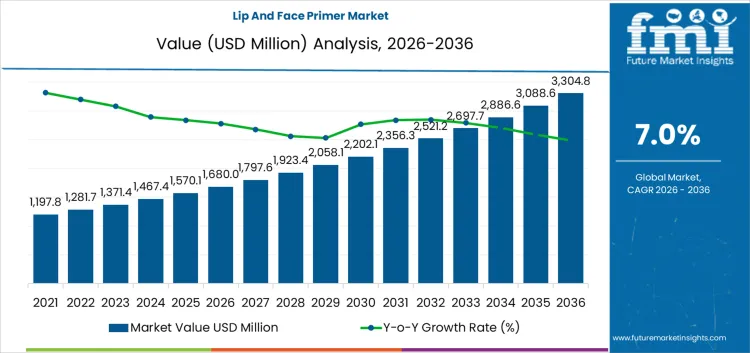
Lip And Face Primer Market Key Takeaways
| Metric | Value |
|---|---|
| Market Value (2026) | USD 1,680.0 million |
| Market Forecast Value (2036) | USD 3,304.8 million |
| Forecast CAGR 2026 to 2036 | 7.0% |
Why is the Demand for Lip And Face Primer Market Growing?
Demand for lip and face primers is increasing as color cosmetics users expect longer lasting makeup in wear. Brands design primers that improve adhesion and smoothness, helping color products resist smudging and fading across the day. Makeup artists and content creators influence routines by demonstrating preparation that relies on primers for pore blurring, texture refinement, and sebum control. Growth in hybrid makeup skin care concepts encourages formulators to add hydrating and barrier supporting ingredients within primer formats. Retailers allocate shelf space to specialized primers targeted at dryness, oiliness, or uneven tone.
Rising participation in social and professional activities, offline and on camera, sustains demand for products that maintain appearance throughout the day. Ecommerce platforms broaden access to niche brands with finish focused primers tailored to diverse skin types. Manufacturers invest in silicone alternatives and lightweight sensorial profiles to address comfort expectations and regulatory scrutiny of certain ingredients. Expansion of vegan, fragrance free, and sensitive skin suitable primer lines attracts consumers with ingredient awareness and dermatological considerations across age groups.
How Are the Segments Classified in the Lip And Face Primer Market?
Demand for lip and face primer products increases due to emphasis on makeup longevity, surface smoothness, and professional finish expectations. Consumers seek products that improve wear performance under varied environmental and skin conditions. Formulation innovation supports compatibility with diverse cosmetic routines and skin types. Distribution expansion across physical and digital channels improves accessibility and product trial across usage occasions.
Which product type represents the largest share of demand?
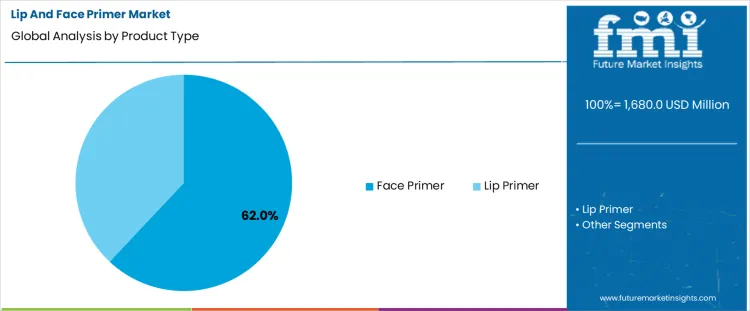
Face primer accounts for a 62.0% share, reflecting broader usage across full face makeup routines and daily cosmetic application. Face primer products address pore visibility, texture irregularities, and foundation adherence requirements. Higher consumption frequency supports volume concentration within this category. Compatibility with multiple complexion products sustains repeated use across consumer segments. Product versatility across skin types strengthens adoption. Professional makeup practices also reinforce reliance on face primers for base preparation consistency.
Key Points:
- Used routinely across full face makeup applications
- Improves texture uniformity and foundation performance
- Supports repeat usage across diverse consumer profiles
Which formulation accounts for the highest share of demand?
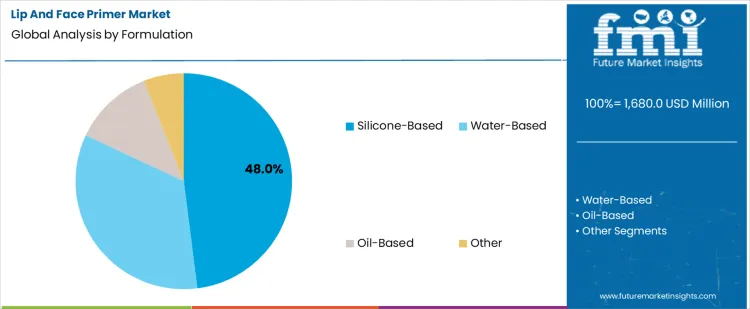
Silicone based formulations hold a 48.0% share due to smoothing performance and wear enhancement characteristics. These formulations create uniform surface layers that reduce friction during makeup application. Resistance to humidity and perspiration improves durability across extended wear periods. Lightweight feel supports comfort without compromising coverage stability. Broad compatibility with pigments and actives reinforces formulation preference among manufacturers and users.
Key Points:
- Delivers surface smoothing and glide control
- Enhances durability under variable wear conditions
- Maintains compatibility with diverse cosmetic systems
Which distribution channel accounts for the highest share of demand?
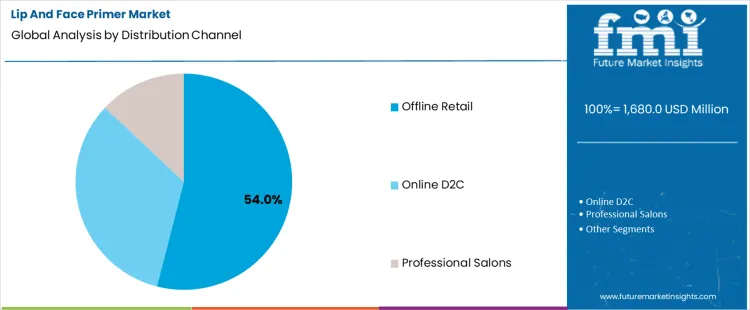
Offline retail represents a 54.0% share, supported by product testing and assisted purchasing behavior. Consumers value in store sampling to assess texture, finish, and shade interaction. Retail staff guidance supports formulation selection aligned with skin needs. Immediate product availability encourages impulse and replenishment purchases. Physical presence also strengthens brand trust and visibility across competitive cosmetic assortments.
Key Points:
- Enables tactile evaluation prior to purchase
- Supports assisted product selection experiences
- Encourages immediate acquisition and repeat buying
What are the Key Dynamics in the lip and face primer market?
Demand dynamics in the lip and face primer market reflect formulation performance requirements across color cosmetics and professional makeup applications. Global activity centers on wear longevity, surface smoothing, and compatibility with diverse cosmetic textures. Value formation depends on polymer film formation behavior, oil control capability, and sensory attributes. Purchasing decisions align with skin compatibility criteria, regulatory compliance, and stability across varying climatic conditions.
How do performance enhancement and formulation compatibility requirements shape adoption?
Adoption increases as cosmetic manufacturers seek reliable base-layer technologies that improve adhesion, pigment distribution, and product longevity. Demand strengthens where primers enable uniform application across varied skin conditions, including dryness, oiliness, and texture irregularities. Film-forming agents, volatile carriers, and elastomeric materials support smooth finish requirements. Compatibility with liquid, cream, and powder products influences formulation strategies for both mass and prestige segments. Rising interest in hybrid skincare–cosmetic products drives usage of primers incorporating hydration management or barrier-support features. Regional regulatory frameworks guide permissible ingredient classes, influencing polymer and silicone selection. Consistency during high-temperature transport and high-humidity usage conditions further shapes product development choices.
How do raw material cost exposure and stability limitations influence market scalability?
Market scalability faces constraints from volatility in silicone, polymer, and specialty emollient pricing. Demand encounters resistance where high-cost ingredients elevate per-unit formulation expense in price-sensitive product lines. Sensory and stability requirements restrict substitution flexibility for certain film formers and texture modifiers. Oxidation, phase separation, and viscosity drift during storage create quality assurance challenges, requiring additional testing and packaging controls. Compliance variations across cosmetic regulations increase documentation and reformulation workload for global distribution. Shelf-life expectations for long-wear cosmetic products impose strict preservation and packaging performance needs. Limited differentiation in functional benefits across competing primer products heightens pressure to maintain margin without compromising raw material quality.
How Is Demand for the Lip And Face Primer Market Evolving Globally?
Global demand for lip and face primers is expanding as cosmetic formulations emphasize durability, skin finish enhancement, and compatibility with advanced makeup textures. Growth reflects rising beauty consumption, hybrid skincare-cosmetics convergence, and preference for high-performance base products supporting long wear results. Demand acceleration aligns with urban lifestyle factors, premiumization trends, and digital retail influence. India records 8.6% CAGR, China records 8.1% CAGR, USA records 6.5% CAGR, South Korea records 6.2% CAGR, and Japan records 5.8% CAGR. Adoption remains linked to makeup routine sophistication, climate-related performance needs, and technology-driven ingredient innovation globally.
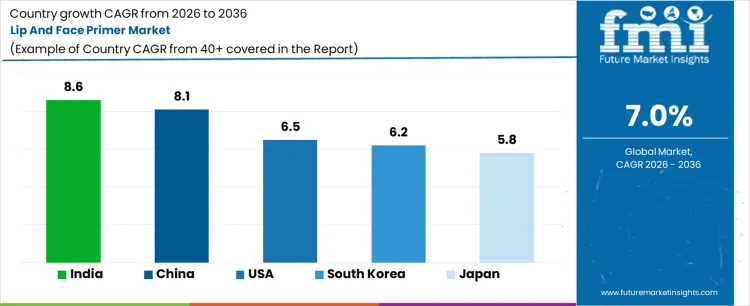
| Country | CAGR (%) |
|---|---|
| India | 8.6% |
| China | 8.1% |
| USA | 6.5% |
| South Korea | 6.2% |
| Japan | 5.8% |
What is driving growth of lip and face primer demand in India?
Demand for lip and face primers in India is increasing as makeup usage expands across urban and tier-two markets. Growth at 8.6% CAGR reflects rising interest in long wear formulations suited to warm and humid climatic conditions. Manufacturers introduce primers supporting oil control, pore blurring, and extended color retention. Digital beauty channels influence consumer awareness and routine adoption. Domestic brands scale mass-premium segments, making primers more accessible. Demand strengthens within bridal, event, and daily wear categories. Retail expansion and influencer-led education improve product penetration. Climate specific performance expectations drive continuous formulation upgrades.
- High humidity driven performance needs
- Growth of mass-premium beauty brands
- Expansion of digital beauty retail
- Rising everyday makeup usage
Why is China seeing expansion in lip and face primer adoption?
Lip and face primer demand in China is expanding as beauty routines become multilayered and skincare-makeup hybrid products gain popularity. Growth at 8.1% CAGR aligns with strong cosmetic consumption among young urban consumers. Primers supporting brightening, smoothing, and pollution resistance features attract premium positioning. Domestic manufacturers scale R&D efforts to meet texture and finish expectations. Cross-border e-commerce increases exposure to international brands. Demand concentrates in major cities with high makeup adoption rates. Stable utilization emerges from long work-hour lifestyles requiring durable makeup performance.
- Strong urban cosmetic consumption
- Rising demand for hybrid skincare benefits
- Expansion of cross-border beauty retail
- Growth of domestic product innovation
How is the USA supporting growth of lip and face primer demand?
Sales of lip and face primers in the USA are increasing as consumers seek performance enhancement across diverse makeup styles. Growth of 6.5% CAGR reflects steady adoption within both mass and prestige beauty segments. Primers support matte, dewy, and transfer-resistant finishes required across digital content creation and professional settings. Manufacturers emphasize silicone-based smoothing, hydration balancing, and color grip properties. Clean beauty standards influence ingredient selection and transparency. Retail remains omnichannel, expanding consumer access to customized primer options. Demand aligns with long wear foundation and lipstick trends.
- Growth of performance driven makeup
- Influence of clean beauty standards
- Expansion of omnichannel retail
- Increased demand for long wear finishes
What factors are shaping lip and face primer sales in South Korea?
Lip and face primer demand in South Korea is shaped by advanced beauty routines emphasizing smooth finish and skin clarity. Growth at 6.2% CAGR reflects integration of primers within multi-step makeup and skincare regimens. Consumers prioritize lightweight, breathable textures compatible with humid conditions. Manufacturers lead innovation in pore blurring, tone correction, and sebum control technologies. K-beauty exports reinforce domestic product development intensity. Adoption strengthens among younger demographics using primers for natural yet refined looks. Retailers promote primers as essential base products for consistent makeup adhesion.
- Multi-step beauty routine prevalence
- High innovation in texture technologies
- Strong K-beauty product development
- Humidity influenced performance needs
How is Japan supporting growth of lip and face primer demand?
Lip and face primer market demand in Japan is advancing through preference for refined, natural finish makeup. Growth at 5.8% CAGR reflects emphasis on smooth texture, oil balance, and UV adapted formulations. Consumers value subtle, skin-perfecting primers enhancing minimal makeup looks. Manufacturers focus on micro-fine powder dispersion, hydration stability, and compatibility with lightweight foundations. Seasonal climate variation increases reliance on primers for durability. Retail strategies position primers as skincare-linked products supporting complexion uniformity. Adoption remains steady due to disciplined consumer routines and high product quality expectations.
- Preference for natural finish formulations
- Seasonal durability requirements
- Emphasis on micro-fine cosmetic technology
- Strong consumer routine consistency
What is the competitive landscape of demand for the lip and face primer market globally?
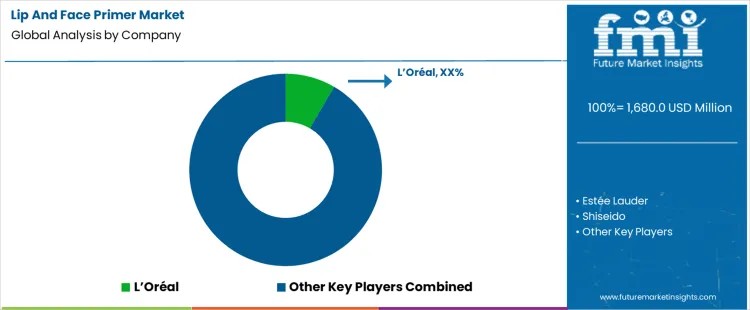
Demand for lip and face primers is driven by makeup longevity needs and social media influenced routines. Buyers evaluate texture compatibility, skin finish control, ingredient safety, shade neutrality, and performance across climates. Procurement behavior emphasizes brand reliability, consistent formulation quality, global regulatory compliance, and dependable contract manufacturing scale. Purchasing teams prioritize margin stability, launch speed, packaging integration, and alignment with portfolio positioning strategies. Trend in the lip and face primer market reflects hybrid skincare makeup formats and demand for multifunctional products. Retail channel expansion and influencer driven discovery accelerate adoption across mass, prestige, and professional segments.
L’Oréal leads competitive positioning through extensive brand portfolios, formulation expertise, and global distribution scale. Estée Lauder supports demand with prestige primer lines emphasizing skin finish refinement and long wear performance. Shiseido competes through technology driven textures, sensory performance control, and strong credibility within Asian beauty markets. Unilever maintains relevance via mass channel reach, rapid trend translation, and efficient product lifecycle management. Coty participates by leveraging celebrity brands, flexible formulations, and marketing driven shelf visibility. Competitive differentiation depends on formulation feel, wear longevity, brand equity, channel execution, and innovation cadence. Portfolio breadth and consistent quality underpin supplier selection across global retailers and private label programs.
Key Players in the Lip And Face Primer Market
- L’Oréal
- Estée Lauder
- Shiseido
- Unilever
- Coty
Scope of the Report
| Items | Values |
|---|---|
| Quantitative Units | USD million |
| Product Type | Face Primer; Lip Primer |
| Formulation | Silicone-Based; Water-Based; Oil-Based; Other |
| Distribution Channel | Offline Retail; Online D2C; Professional Salons |
| Regions Covered | Asia Pacific, Europe, North America, Latin America, Middle East & Africa |
| Countries Covered | India, China, USA, South Korea, Japan, and 40+ countries |
| Key Companies Profiled | L’Oréal; Estée Lauder; Shiseido; Unilever; Coty |
| Additional Attributes | Dollar sales by product type, formulation, and distribution channel; texture uniformity and spreadability influencing makeup adherence and wear duration; ingredient compatibility with sensitive skin and long-wear cosmetics; oil control, hydration balance, and pore-blurring performance across formulations; regulatory compliance for cosmetic ingredients; channel dynamics reflecting mass retail scale, premium brand positioning, and professional salon sourcing patterns. |
Lip And Face Primer Market by Segment
By Product Type:
- Face Primer
- Lip Primer
By Formulation:
- Silicone-Based
- Water-Based
- Oil-Based
- Other
By Distribution Channel:
- Offline Retail
- Online D2C
- Professional Salons
By Region:
- Asia Pacific
- China
- Japan
- South Korea
- India
- Australia & New Zealand
- ASEAN
- Rest of Asia Pacific
- Europe
- Germany
- United Kingdom
- France
- Italy
- Spain
- Nordic
- BENELUX
- Rest of Europe
- North America
- United States
- Canada
- Mexico
- Latin America
- Brazil
- Chile
- Rest of Latin America
- Middle East & Africa
- Kingdom of Saudi Arabia
- Other GCC Countries
- Turkey
- South Africa
- Other African Union
- Rest of Middle East & Africa
Bibliography
- Scientific Committee on Consumer Safety. (2023). The SCCS notes of guidance for the testing of cosmetic ingredients and their safety evaluation (12th revision; adopted 15 May 2023; corrigendum 1 adopted 26 October 2023; corrigendum 2 adopted 21 December 2023) (SCCS/1647/22). European Commission.
- European Parliament, & Council of the European Union. (2009). Regulation (EC) No 1223/2009 of 30 November 2009 on cosmetic products. Official Journal of the European Union.
- International Organization for Standardization. (2007). Cosmetics—Good manufacturing practices (GMP)—Guidelines (ISO 22716:2007). International Organization for Standardization.
Frequently Asked Questions
How big is the lip and face primer market in 2026?
The global lip and face primer market is estimated to be valued at USD 1,680.0 million in 2026.
What will be the size of lip and face primer market in 2036?
The market size for the lip and face primer market is projected to reach USD 3,304.8 million by 2036.
How much will be the lip and face primer market growth between 2026 and 2036?
The lip and face primer market is expected to grow at a 7.0% CAGR between 2026 and 2036.
What are the key product types in the lip and face primer market?
The key product types in lip and face primer market are face primer and lip primer.
Which formulation segment to contribute significant share in the lip and face primer market in 2026?
In terms of formulation, silicone-based segment to command 48.0% share in the lip and face primer market in 2026.
Preview the report firsthand - request a free sample
Get SampleGet the brochure for pricing and purchase details.
Get PDFTable of Content
- Executive Summary
- Global Market Outlook
- Demand-side Trends
- Supply-side Trends
- Technology Roadmap Analysis
- Analysis and Recommendations
- Market Overview
- Market Coverage / Taxonomy
- Market Definition / Scope / Limitations
- Market Background
- Market Dynamics
- Drivers
- Restraints
- Opportunity
- Trends
- Scenario Forecast
- Demand in Optimistic Scenario
- Demand in Likely Scenario
- Demand in Conservative Scenario
- Opportunity Map Analysis
- Product Life Cycle Analysis
- Supply Chain Analysis
- Investment Feasibility Matrix
- Value Chain Analysis
- PESTLE and Porter’s Analysis
- Regulatory Landscape
- Regional Parent Market Outlook
- Production and Consumption Statistics
- Import and Export Statistics
- Market Dynamics
- Global Market Analysis 2021 to 2025 and Forecast, 2026 to 2036
- Historical Market Size Value (USD Million) Analysis, 2021 to 2025
- Current and Future Market Size Value (USD Million) Projections, 2026 to 2036
- Y-o-Y Growth Trend Analysis
- Absolute $ Opportunity Analysis
- Global Market Pricing Analysis 2021 to 2025 and Forecast 2026 to 2036
- Global Market Analysis 2021 to 2025 and Forecast 2026 to 2036, By Product Type
- Introduction / Key Findings
- Historical Market Size Value (USD Million) Analysis By Product Type, 2021 to 2025
- Current and Future Market Size Value (USD Million) Analysis and Forecast By Product Type, 2026 to 2036
- Face Primer
- Lip Primer
- Face Primer
- Y-o-Y Growth Trend Analysis By Product Type, 2021 to 2025
- Absolute $ Opportunity Analysis By Product Type, 2026 to 2036
- Global Market Analysis 2021 to 2025 and Forecast 2026 to 2036, By Formulation
- Introduction / Key Findings
- Historical Market Size Value (USD Million) Analysis By Formulation, 2021 to 2025
- Current and Future Market Size Value (USD Million) Analysis and Forecast By Formulation, 2026 to 2036
- Silicone-Based
- Water-Based
- Oil-Based
- Other
- Silicone-Based
- Y-o-Y Growth Trend Analysis By Formulation, 2021 to 2025
- Absolute $ Opportunity Analysis By Formulation, 2026 to 2036
- Global Market Analysis 2021 to 2025 and Forecast 2026 to 2036, By Distribution Channel
- Introduction / Key Findings
- Historical Market Size Value (USD Million) Analysis By Distribution Channel, 2021 to 2025
- Current and Future Market Size Value (USD Million) Analysis and Forecast By Distribution Channel, 2026 to 2036
- Offline Retail
- Online D2C
- Professional Salons
- Offline Retail
- Y-o-Y Growth Trend Analysis By Distribution Channel, 2021 to 2025
- Absolute $ Opportunity Analysis By Distribution Channel, 2026 to 2036
- Global Market Analysis 2021 to 2025 and Forecast 2026 to 2036, By Region
- Introduction
- Historical Market Size Value (USD Million) Analysis By Region, 2021 to 2025
- Current Market Size Value (USD Million) Analysis and Forecast By Region, 2026 to 2036
- North America
- Latin America
- Western Europe
- Eastern Europe
- East Asia
- South Asia and Pacific
- Middle East & Africa
- Market Attractiveness Analysis By Region
- North America Market Analysis 2021 to 2025 and Forecast 2026 to 2036, By Country
- Historical Market Size Value (USD Million) Trend Analysis By Market Taxonomy, 2021 to 2025
- Market Size Value (USD Million) Forecast By Market Taxonomy, 2026 to 2036
- By Country
- USA
- Canada
- Mexico
- By Product Type
- By Formulation
- By Distribution Channel
- By Country
- Market Attractiveness Analysis
- By Country
- By Product Type
- By Formulation
- By Distribution Channel
- Key Takeaways
- Latin America Market Analysis 2021 to 2025 and Forecast 2026 to 2036, By Country
- Historical Market Size Value (USD Million) Trend Analysis By Market Taxonomy, 2021 to 2025
- Market Size Value (USD Million) Forecast By Market Taxonomy, 2026 to 2036
- By Country
- Brazil
- Chile
- Rest of Latin America
- By Product Type
- By Formulation
- By Distribution Channel
- By Country
- Market Attractiveness Analysis
- By Country
- By Product Type
- By Formulation
- By Distribution Channel
- Key Takeaways
- Western Europe Market Analysis 2021 to 2025 and Forecast 2026 to 2036, By Country
- Historical Market Size Value (USD Million) Trend Analysis By Market Taxonomy, 2021 to 2025
- Market Size Value (USD Million) Forecast By Market Taxonomy, 2026 to 2036
- By Country
- Germany
- UK
- Italy
- Spain
- France
- Nordic
- BENELUX
- Rest of Western Europe
- By Product Type
- By Formulation
- By Distribution Channel
- By Country
- Market Attractiveness Analysis
- By Country
- By Product Type
- By Formulation
- By Distribution Channel
- Key Takeaways
- Eastern Europe Market Analysis 2021 to 2025 and Forecast 2026 to 2036, By Country
- Historical Market Size Value (USD Million) Trend Analysis By Market Taxonomy, 2021 to 2025
- Market Size Value (USD Million) Forecast By Market Taxonomy, 2026 to 2036
- By Country
- Russia
- Poland
- Hungary
- Balkan & Baltic
- Rest of Eastern Europe
- By Product Type
- By Formulation
- By Distribution Channel
- By Country
- Market Attractiveness Analysis
- By Country
- By Product Type
- By Formulation
- By Distribution Channel
- Key Takeaways
- East Asia Market Analysis 2021 to 2025 and Forecast 2026 to 2036, By Country
- Historical Market Size Value (USD Million) Trend Analysis By Market Taxonomy, 2021 to 2025
- Market Size Value (USD Million) Forecast By Market Taxonomy, 2026 to 2036
- By Country
- China
- Japan
- South Korea
- By Product Type
- By Formulation
- By Distribution Channel
- By Country
- Market Attractiveness Analysis
- By Country
- By Product Type
- By Formulation
- By Distribution Channel
- Key Takeaways
- South Asia and Pacific Market Analysis 2021 to 2025 and Forecast 2026 to 2036, By Country
- Historical Market Size Value (USD Million) Trend Analysis By Market Taxonomy, 2021 to 2025
- Market Size Value (USD Million) Forecast By Market Taxonomy, 2026 to 2036
- By Country
- India
- ASEAN
- Australia & New Zealand
- Rest of South Asia and Pacific
- By Product Type
- By Formulation
- By Distribution Channel
- By Country
- Market Attractiveness Analysis
- By Country
- By Product Type
- By Formulation
- By Distribution Channel
- Key Takeaways
- Middle East & Africa Market Analysis 2021 to 2025 and Forecast 2026 to 2036, By Country
- Historical Market Size Value (USD Million) Trend Analysis By Market Taxonomy, 2021 to 2025
- Market Size Value (USD Million) Forecast By Market Taxonomy, 2026 to 2036
- By Country
- Kingdom of Saudi Arabia
- Other GCC Countries
- Turkiye
- South Africa
- Other African Union
- Rest of Middle East & Africa
- By Product Type
- By Formulation
- By Distribution Channel
- By Country
- Market Attractiveness Analysis
- By Country
- By Product Type
- By Formulation
- By Distribution Channel
- Key Takeaways
- Key Countries Market Analysis
- USA
- Pricing Analysis
- Market Share Analysis, 2025
- By Product Type
- By Formulation
- By Distribution Channel
- Canada
- Pricing Analysis
- Market Share Analysis, 2025
- By Product Type
- By Formulation
- By Distribution Channel
- Mexico
- Pricing Analysis
- Market Share Analysis, 2025
- By Product Type
- By Formulation
- By Distribution Channel
- Brazil
- Pricing Analysis
- Market Share Analysis, 2025
- By Product Type
- By Formulation
- By Distribution Channel
- Chile
- Pricing Analysis
- Market Share Analysis, 2025
- By Product Type
- By Formulation
- By Distribution Channel
- Germany
- Pricing Analysis
- Market Share Analysis, 2025
- By Product Type
- By Formulation
- By Distribution Channel
- UK
- Pricing Analysis
- Market Share Analysis, 2025
- By Product Type
- By Formulation
- By Distribution Channel
- Italy
- Pricing Analysis
- Market Share Analysis, 2025
- By Product Type
- By Formulation
- By Distribution Channel
- Spain
- Pricing Analysis
- Market Share Analysis, 2025
- By Product Type
- By Formulation
- By Distribution Channel
- France
- Pricing Analysis
- Market Share Analysis, 2025
- By Product Type
- By Formulation
- By Distribution Channel
- India
- Pricing Analysis
- Market Share Analysis, 2025
- By Product Type
- By Formulation
- By Distribution Channel
- ASEAN
- Pricing Analysis
- Market Share Analysis, 2025
- By Product Type
- By Formulation
- By Distribution Channel
- Australia & New Zealand
- Pricing Analysis
- Market Share Analysis, 2025
- By Product Type
- By Formulation
- By Distribution Channel
- China
- Pricing Analysis
- Market Share Analysis, 2025
- By Product Type
- By Formulation
- By Distribution Channel
- Japan
- Pricing Analysis
- Market Share Analysis, 2025
- By Product Type
- By Formulation
- By Distribution Channel
- South Korea
- Pricing Analysis
- Market Share Analysis, 2025
- By Product Type
- By Formulation
- By Distribution Channel
- Russia
- Pricing Analysis
- Market Share Analysis, 2025
- By Product Type
- By Formulation
- By Distribution Channel
- Poland
- Pricing Analysis
- Market Share Analysis, 2025
- By Product Type
- By Formulation
- By Distribution Channel
- Hungary
- Pricing Analysis
- Market Share Analysis, 2025
- By Product Type
- By Formulation
- By Distribution Channel
- Kingdom of Saudi Arabia
- Pricing Analysis
- Market Share Analysis, 2025
- By Product Type
- By Formulation
- By Distribution Channel
- Turkiye
- Pricing Analysis
- Market Share Analysis, 2025
- By Product Type
- By Formulation
- By Distribution Channel
- South Africa
- Pricing Analysis
- Market Share Analysis, 2025
- By Product Type
- By Formulation
- By Distribution Channel
- USA
- Market Structure Analysis
- Competition Dashboard
- Competition Benchmarking
- Market Share Analysis of Top Players
- By Regional
- By Product Type
- By Formulation
- By Distribution Channel
- Competition Analysis
- Competition Deep Dive
- L’Oréal
- Overview
- Product Portfolio
- Profitability by Market Segments (Product/Age /Sales Channel/Region)
- Sales Footprint
- Strategy Overview
- Marketing Strategy
- Product Strategy
- Channel Strategy
- Estée Lauder
- Shiseido
- Unilever
- Coty
- L’Oréal
- Competition Deep Dive
- Assumptions & Acronyms Used
- Research Methodology


