

- Market Size (2026)
- USD 909.5 Mn
- Forecast (2036)
- USD 2113.8 Mn
- CAGR (2026 to 2036)
- 8.8%
How big is Lower Limb Arterial Disease Management Market size?
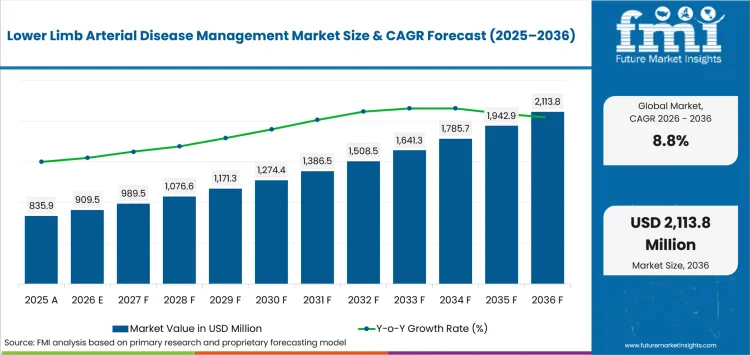
USD 909.5 million in 2026 and USD 2113.8 million by 2036 at an 8.8% CAGR.
Lower limb arterial disease management is projected to expand at 8.8% CAGR between 2026 and 2036, increasing valuation from USD 909.5 million to USD 2113.8 million. Treating circulatory issues in the legs requires comprehensive care plans combining cardiovascular risk control with exercise and revascularization. A major health report highlights how widespread this condition is among older populations. In May 2024, the American Heart Association and American College of Cardiology joint guideline reported that 10 million to 12 million United States adults aged 40 years or older live with peripheral artery disease. This persistent patient volume keeps diagnosis and long-term follow-up consistently active across primary and vascular care services.
International healthcare networks vary significantly in referral speed and the overall capacity of their vascular teams. Hospitals in the United States and Germany place greater weight on clinical records on evaluating and review new medical devices. South Korea and Japan referral centers focus heavily on training for endovascular therapy devices and expanding their procedural reach to treat complex arterial lesions. According to its November 2025 report, the National Vascular Registry recorded 16,618 lower-limb revascularization procedures in United Kingdom hospitals during 2024. Detailed surgical registries illustrate the high demand for these specialized interventions.
Key Takeaways of Lower Limb Arterial Disease Management Market
- Demand for lower limb arterial disease management is shaped by earlier diagnosis, disease-stage assessment, and coordinated vascular care spanning medical therapy, revascularization, exercise, and wound management.
- By disease type, peripheral artery disease holds 36.3% share in 2026, while pharmacological therapy accounts for 38.8% share in 2026 within management type, reflecting the broad patient base requiring cardiovascular-risk management and continuing medical treatment.
- Drug-coated balloons lead the device and procedure category with 44.0% share in 2026, while hospitals represent 37.8% share in 2026 among end users, reflecting localized drug delivery during vascular intervention and the concentration of imaging, revascularization, and wound-care capabilities within hospitals.
- South Korea records the highest country CAGR at 10.6% through 2036, followed by the United Kingdom at 10.3% and Germany at 9.0%, reflecting differences in vascular referral networks, endovascular capacity, and specialist care infrastructure.
- Competition centers on Abbott, Medtronic, Boston Scientific, BD, Johnson & Johnson MedTech, and Penumbra, with competitive positioning spanning peripheral balloons, stents, atherectomy systems, thrombectomy technologies, and other limb-preservation solutions.
- Referral delays, lesion complexity, specialist capacity, cardiovascular-risk management, and coordination between imaging, intervention, and wound-care services remain key considerations across lower limb arterial disease management.
Analyst Perspective
"The lower limb arterial disease management market is increasingly shaped by continuity of care rather than initial intervention alone. Clinical adoption depends on accurate disease staging, measurable limb outcomes, and coordinated follow-up across medical and interventional pathways. Companies that demonstrate durable patient outcomes, support repeat procedures, and strengthen imaging and vascular-team coordination will be better positioned to expand adoption."
— Anurag Sharma, Principal Consultant for Healthcare at Future Market Insights
Source: Future Market Insights analysis, 2026.
How is Lower Limb Arterial Disease Management Market segmented?
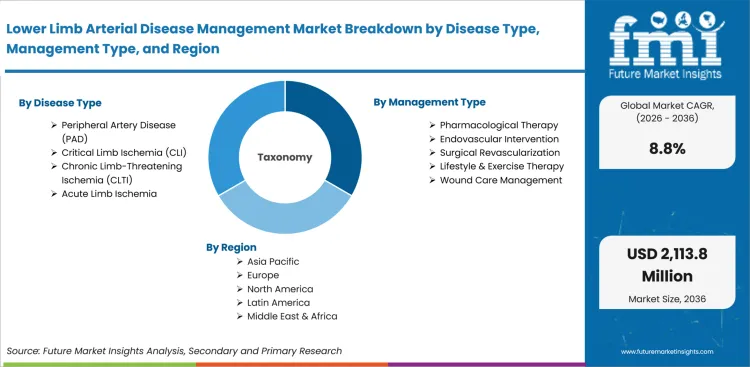
The lower limb arterial disease management industry is segmented by disease type, management type, end user, device/procedure, and region.
The lower limb arterial disease management market is segmented by disease type, management type, end user, device/procedure, and region. Disease Type covers Peripheral Artery Disease (symptomatic and asymptomatic), Chronic Limb-Threatening Ischemia, and Acute Limb Ischemia. Management Type addresses Pharmacological Therapy, Endovascular Intervention, Surgical Revascularization, Lifestyle and Exercise Therapy, and Wound Care Management. End User spans Hospitals, Vascular Surgery Centers, Cardiology Clinics, and Ambulatory Surgical Centers. Device/Procedure lists Drug-Coated Balloons, Drug-Eluting Stents, Atherectomy Systems, Bypass Grafts, and Thrombectomy Devices. Regional analysis examines North America, Latin America, Western Europe, Eastern Europe, East Asia, South Asia and Pacific, and Middle East and Africa.
Why does peripheral artery disease shape disease-type selection?
The 2024 ACC/AHA guideline by Gornik and colleagues, published in May 2024, estimated that at least 113 million and potentially as many as 236 million people worldwide live with peripheral artery disease. Such global burden supports routine vascular surveillance and disease-stage treatment planning across national care systems.
Early disease commonly appears as exertional leg discomfort requiring vascular testing and continuing cardiovascular-risk management. Progressive disease introduces rest pain and tissue loss, creating greater need for revascularization and limb-preservation planning. Such clinical breadth positions Peripheral artery disease as the entry diagnosis connecting routine surveillance with advanced treatment decisions.
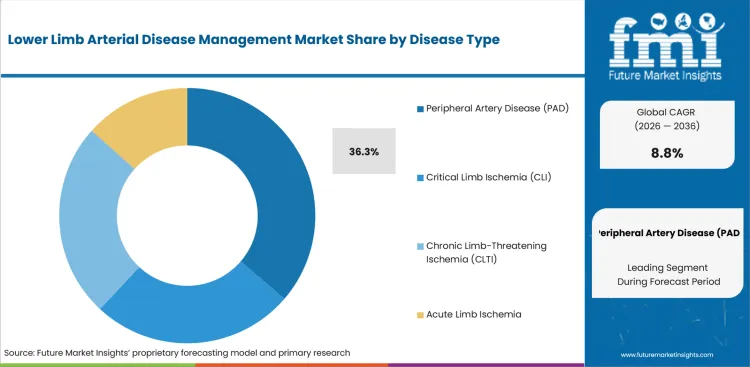
- Peripheral artery disease is estimated to represent 36.3% share in 2026, backed by substantial prevalence and continuing care needs across several symptom stages. Hospital teams examine walking impairment and perfusion findings before selecting medical management or procedural assessment.
- Chronic limb-threatening ischemia (formerly called critical limb ischemia) involves severe perfusion loss presenting with rest pain or non-healing tissue damage. Acute Limb Ischemia creates an emergency pathway requiring rapid diagnosis and immediate blood-flow restoration.
How does pharmacological therapy shape management-type selection?
Medical therapy forms the initial treatment approach for many patients entering lower-limb arterial care. Antithrombotic medicines and lipid management reduce cardiovascular risk during surveillance or post-procedure follow-up. XATOA Registry analysis published in July 2024 included 2,820 lower-extremity peripheral artery disease patients, documenting routine dual-pathway inhibition among patients with and without previous revascularization. Endovascular and surgical procedures enter treatment planning as symptom severity or limb risk exceeds medical management alone.
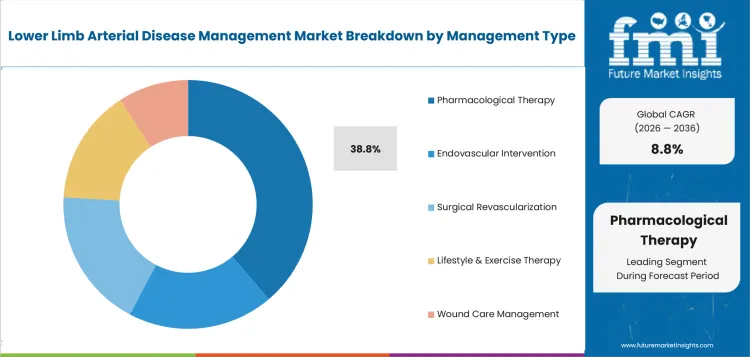
- Based on management type, pharmacological therapy is projected to secure 38.8% share in 2026 as it reflects continuous medicine use from diagnosis into long-term follow-up. Clinicians review bleeding risk and cardiovascular history before selecting an appropriate antithrombotic regimen.
- Endovascular intervention and surgical revascularization restore blood flow among patients presenting with function-limiting or limb-threatening disease. Lifestyle and exercise therapy improves walking capacity, and wound care management addresses tissue protection during ischemic ulcer treatment.
Why do hospitals lead end-user selection?
Hospitals combine vascular surgery and interventional radiology with imaging and wound-care services within one treatment setting. Complex arterial cases require coordinated assessment before teams select catheter intervention or open revascularization. Vascular surgery centers manage planned procedures, whereas cardiology clinics provide cardiovascular surveillance and medicine adjustment.THRILLER registry findings published in September 2024 examined the first 1,000 interventions completed at 7 hospitals in the Netherlands, illustrating multicenter delivery for popliteal and infrapopliteal revascularization.
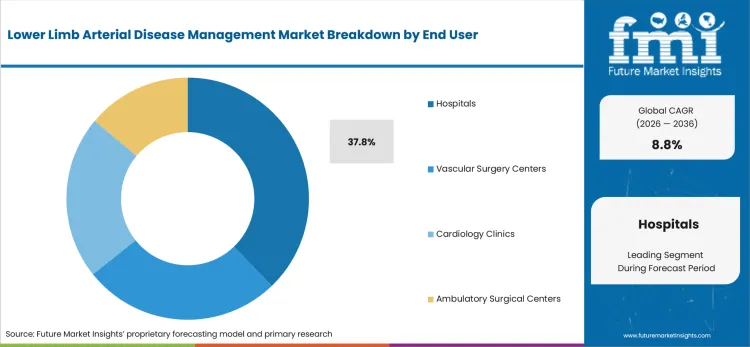
- Hospitals are anticipated to account for 37.8% share of end user in 2026, guided by access to multidisciplinary expertise and advanced procedural facilities. Clinical committees assess imaging capacity and emergency coverage during service planning for complex arterial cases.
- Vascular surgery centers concentrate scheduled revascularization and structured follow-up among patients referred from community services. Cardiology clinics and ambulatory surgical centers manage medical surveillance or selected procedures carrying limited recovery requirements.
Why do drug-coated balloons shape device and procedure selection?
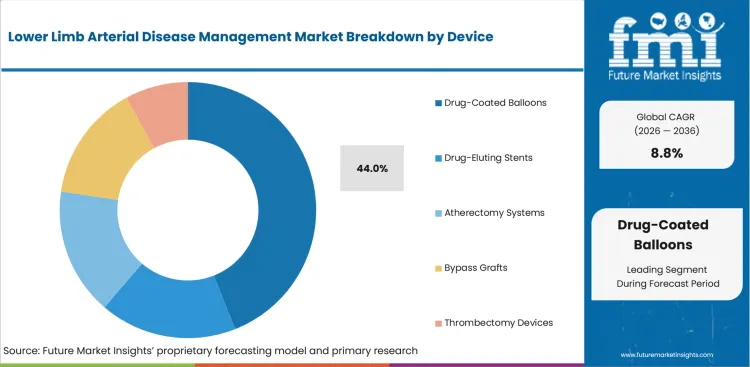
Drug-coated balloons deliver antiproliferative medicine during vessel expansion without leaving permanent metallic scaffolding inside the treated artery. Medicines and healthcare products issued by regulatory agency guidance in February 2024 permitted paclitaxel-coated device consideration for intermittent claudication and critical limb ischemia. Localized drug delivery addresses restenosis risk and preserves later treatment choices among patients requiring repeat intervention. Drug-eluting stents and atherectomy systems serve different lesion characteristics, and bypass grafts and thrombectomy devices address surgical reconstruction or acute clot removal.
- By procedure, drug-coated balloons are forecast to hold 44.0% share in 2026 since being guided by extensive use during femoropopliteal and below-knee intervention. Procedure teams evaluate lesion length and vessel diameter before selecting balloon size and inflation strategy.
- Drug-eluting stents provide arterial scaffolding following recoil or vessel dissection during catheter treatment. Atherectomy systems prepare calcified lesions with bypass grafts and thrombectomy devices serving reconstruction or urgent thrombus-removal requirements.
What are drivers, restraints, and opportunities in Lower Limb Arterial Disease Management Market?
Earlier disease recognition and coordinated referral increase treatment activity. Delayed assessment and uneven vascular capacity restrict timely limb-preservation care.
- Driver: Walking impairment and non-healing wounds prompt vascular assessment in primary and specialist services. Clear clinical staging directs medicine use and revascularization review.
- Restraint: Fragmented referral procedures postpone imaging and specialist assessment during progressive ischemia. Longer waiting periods increase treatment complexity and emergency admissions.
- Opportunity: New below-the-knee devices expand treatment choices for difficult lesions. Clinical records from defined patient groups improve hospital evaluation.
Functional improvement guides continued medicine review among symptomatic patients receiving treatment for intermittent claudication. Ramacciotti and colleagues reported in August 2024 an absolute 68-meter walking-distance advantage for rivaroxaban combined with aspirin. Measured mobility gains clarify treatment discussions and provide a direct outcome for scheduled claudication review. Routine walking assessments allow clinicians to compare symptom change between consecutive visits. Clear mobility records identify patients needing exercise adjustment or procedural assessment.
Referral delay restricts care for patients entering treatment with chronic limb-threatening ischemia and tissue loss. Unclear triage procedures prolong transfer from community assessment to vascular review. Named transfer responsibility reduces avoidable pauses between initial examination and hospital admission. Birmpili and colleagues found a 3% increase in adjusted odds of one-year death for every one-day delay during December 2024 analysis of tissue-loss cases. Longer waiting periods expose affected limbs to clinical deterioration and reduce time available for revascularization.
Below-the-knee scaffolds create another treatment option for lesions with restenosis risk following angioplasty. United States Food and Drug Administration reported in April 2024 effective treatment in 74% of Esprit BTK recipients compared with 44% following angioplasty. Hospital teams compare bioabsorbable drug-eluting stents (such as the Esprit BTK scaffold) with standard balloon treatment during infrapopliteal case review and follow-up planning. Local outcome records clarify lesion profiles receiving durable vessel patency and fewer repeat procedures. Structured surveillance provides committees with a consistent basis for evaluating newer infrapopliteal devices.
How are country CAGRs aligned in Lower Limb Arterial Disease Management Market?
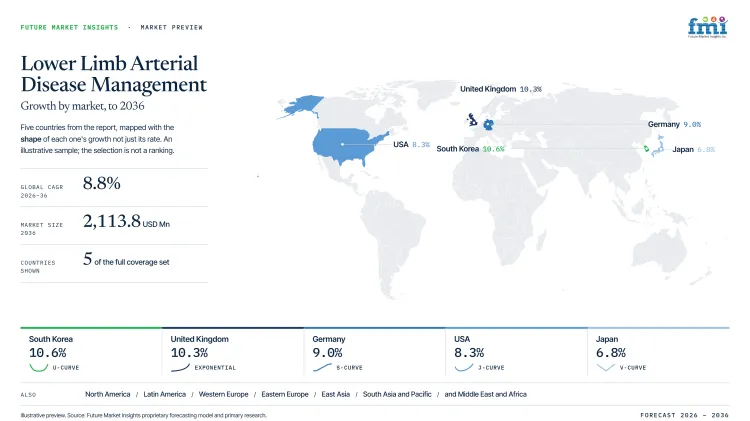
| Country | CAGR |
|---|---|
| South Korea | 10.6% |
| United Kingdom | 10.3% |
| Germany | 9.0% |
| USA | 8.3% |
| Japan | 6.8% |
Source: Future Market Insights country forecast, 2026.
How do country-level CAGRs compare in Lower Limb Arterial Disease Management Market?
Country comparison shows a gradual step-down among five profiled markets. South Korea leads the disclosed group and United Kingdom follows at a narrow distance. Germany forms the middle rate band under established vascular services. The United States and Japan complete comparison under different coverage structures. The 3.8-point spread indicates measured separation from first position to fifth position. Profiled rates describe the selected group and do not form a universal ranking.
- South Korea leads the five-country forecast with concentrated endovascular practice and established tertiary referral networks.
- United Kingdom follows at a narrow rate gap under national pathway review and organized transfer planning.
- Germany occupies the middle position with established angiology services and hospital intervention capacity.
- USA combines extensive medicine access with established peripheral intervention services across varied provider structures.
- Japan completes the disclosed group with measured procedure planning and concentrated vascular expertise.
Similar CAGRs present different entry conditions under reimbursement design and clinician training. Full report coverage extends across North America, Latin America, Western Europe, Eastern Europe, East Asia, South Asia and Pacific, and Middle East and Africa.
Country-wise Analysis
- Sales in South Korea are expected to record 10.6% CAGR during the study period, driven by concentrated referral centers and established drug-coated balloon experience. Choi and colleagues enrolled 200 patients at 8 institutions in research published during May 2024 on infrainguinal revascularization. Multicenter findings inform device selection and post-procedure surveillance for lesions below the groin. Close referral links shorten the interval between diagnostic imaging and catheter treatment within tertiary hospitals.
- Atkins and colleagues mapped referral processes at 12 vascular units using 45 interviews in January 2024. Recorded differences covered triage procedures and transfer decisions among English vascular services. Sector in the United Kingdom are predicted to expand at 10.3% CAGR from 2026 to 2036, aided by national pathway review and coordinated transfer planning. Clear transfer protocols improve continuity from community assessment to vascular intervention and post-procedure follow-up.
- German angiology services maintain defined paths for lesion assessment and surgical referral. Industry in Germany is estimated to register 9.0% CAGR between 2026 and 2036, led by established hospital capacity and registry-led procedural review. Korosoglou and colleagues reported debulking in approximately 12% of infrainguinal procedures during June 2024 research. Registry comparisons clarify debulking selection and bailout-stent decisions for complex infrainguinal lesions.
- Girotra and colleagues created a registry of 103,748 newly diagnosed patients in March 2025. Demand in the United States is forecast to increase at 8.3% CAGR during the assessment period, backed by integrated records and extensive peripheral intervention access. Longitudinal records track cardiovascular events and repeat procedures over extended follow-up periods. National evidence informs medicine review and revascularization planning for newly diagnosed patients entering vascular care.
- Referral centers in Japan use national procedure records for device assessment and clinician training. Japan Surgical Society reported 59,899 endovascular treatments for extremity arteries during 2024 in its April 2026 publication. Recorded activity informs balloon catheters inventory and peripheral-stent planning across high-volume vascular hospitals. Ther market in Japan is anticipated to scale at 6.8% CAGR by 2036, guided by measured equipment review and concentrated vascular expertise.
Who are notable companies in Lower Limb Arterial Disease Management Market?
Abbott, Medtronic plc, Boston Scientific Corporation, BD, Cook Medical, Terumo Corporation, Royal Philips, Johnson & Johnson MedTech, W. L. Gore & Associates, Inc., and Penumbra, Inc. are the prominent companies contributing to this market.
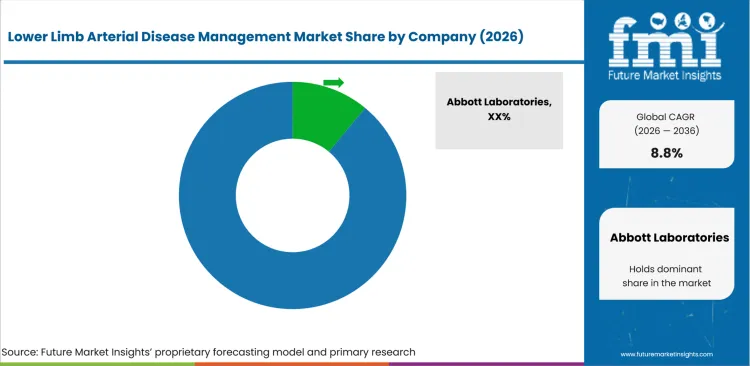
Competition in lower limb arterial disease management sector centers on lesion access and physician education. Hospital committees compare product dimensions and inventory continuity during formulary review. Balloon and scaffold companies compete for planned femoropopliteal or below-the-knee procedures. Imaging and calcium-modification suppliers address lesions requiring detailed measurement or plaque preparation. Thrombus-removal companies focus on acute arterial occlusion and urgent limb-salvage treatment.
- Abbott and Medtronic plc is likely to cover lower-limb revascularization with scaffold and guidewire portfolios. Clinical committees compare lesion indications and physician training during scheduled product assessment.
- Boston Scientific Corporation and BD are expected to provide drug-coated balloon systems for femoropopliteal artery treatment. Hospital formularies examine catheter profiles and product availability during annual review.
- Cook Medical and Terumo Corporation are anticipated to supply wires and stents for narrow vessels or difficult arterial access. Royal Philips is likely to add intravascular imaging for vessel measurement and procedural confirmation inside interventional suites.
- Johnson & Johnson MedTech is expected to provide intravascular lithotripsy for heavily calcified peripheral lesions. Penumbra, Inc. is projected to addresses acute arterial thrombus with blood clot retrieval devices, and W. L. Gore & Associates, Inc. is likely to supply covered reconstruction for selected occlusions.
Competitive Benchmarking: Lower Limb Arterial Disease Management Market
| Company | Portfolio Depth | Clinical Match | Service Support | Service Reach |
|---|---|---|---|---|
| Abbott | High | High | High | Global |
| Medtronic plc | High | High | High | Global |
| Boston Scientific Corporation | High | High | High | Global |
| BD | High | High | High | Global |
| Cook Medical | High | High | High | Global |
| Terumo Corporation | High | High | High | Global |
| Royal Philips | Medium | High | High | Global |
| Johnson & Johnson MedTech | High | High | High | Global |
| W. L. Gore & Associates, Inc. | Medium | High | High | Selected global markets |
| Penumbra, Inc. | Medium | High | Medium | United States and selected global markets |
Source: Future Market Insights competitive review, 2026.
Key Developments in Lower Limb Arterial Disease Management Market
- In January 2025, Penumbra announced Lightning Bolt 12 and Lightning Bolt 6X with TraX for arterial and venous thrombus management. Company bench testing recorded faster aspiration for Lightning Bolt 12 compared with its preceding generation.
- In March 2025, Johnson & Johnson MedTech launched the Shockwave Javelin Peripheral IVL Catheter in United States. Forward lithotripsy modifies calcium in severely narrowed peripheral lesions during crossing.
- In September 2025, Penumbra introduced a 150-centimeter Lightning Bolt 6X catheter for distal below-the-knee anatomy. Added catheter length extends aspiration access into smaller arteries affected by thrombus.
Key Players in Lower Limb Arterial Disease Management Market
Established peripheral intervention companies
- Abbott
- Medtronic plc
- Boston Scientific Corporation
- BD
Catheter and vascular reconstruction companies
- Cook Medical
- Terumo Corporation
- W. L. Gore & Associates, Inc.
Imaging and thrombus-management companies
- Royal Philips
- Johnson & Johnson MedTech
- Penumbra, Inc.
Lower Limb Arterial Disease Management Market Report Scope
| Coverage Field | Report Scope |
|---|---|
| Market Breakdown | Lower Limb Arterial Disease Management Market breakdown by Disease Type, Management Type, End User, Device/Procedure, and Region |
| Market Definition | Lower limb arterial disease management covers medicines, procedures, devices, exercise programs, and wound services used in lower-extremity arterial care. |
| Regions Covered | North America, Latin America, Western Europe, Eastern Europe, East Asia, South Asia and Pacific, and Middle East and Africa |
| Countries Covered | USA, UK, Germany, Japan, and South Korea |
| Key Companies Profiled | Abbott; Medtronic plc; Boston Scientific Corporation; BD; Cook Medical; Terumo Corporation; Royal Philips; Johnson & Johnson MedTech; W. L. Gore & Associates, Inc.; Penumbra, Inc. |
| Forecast Period | 2026 to 2036 |
| Approach | Hybrid bottom-up and top-down methodology using segment shares and country CAGRs with procedure activity, clinical evidence, and company participation. |
Source: Future Market Insights report model, 2026.
Lower Limb Arterial Disease Management Market - Research Methodology
| Method | Approach |
|---|---|
| Primary Research | FMI analysts gathered input from manufacturers, service providers, technology developers, distributors, end users, procurement teams, and subject-matter experts. Interviews examined purchasing decisions, product or service evaluation, adoption barriers, approval requirements, pricing considerations, and expectations for technical or commercial support. Respondents were also asked what evidence is required before a trial, pilot, or initial order develops into regular purchasing. |
| Desk Research | Desk research covered government statistics, regulatory publications, trade data, industry associations, technical literature, standards, company filings, product information, and official corporate announcements. Sources were reviewed for relevance, publication date, geographic coverage, and consistency with the defined market scope. Claims relating to performance, applications, approvals, capacity, investment, and commercial activity were retained only when supported by credible public evidence. |
| Market Sizing and Forecasting | The market model combined the baseline value with historical performance, segment structure, pricing and volume indicators, adoption levels, company participation, and country-level demand conditions. Forecast assumptions considered economic activity, investment trends, regulatory developments, technology adoption, purchasing cycles, supply availability, and barriers to wider market use. Segment and regional estimates were reconciled before the final market total was calculated. |
| Data Validation | Estimates were checked against multiple independent indicators, including public data, company activity, trade patterns, industry developments, and findings from primary interviews. Validation also tested whether products, services, applications, and company revenues fell within the defined market boundaries. Adjacent categories, unsupported claims, overlapping revenues, and activities without direct market relevance were excluded to reduce double counting and maintain consistency across segments and countries. |
Source: Future Market Insights methodology review, 2026.
Lower Limb Arterial Disease Management Market by Segments
Lower Limb Arterial Disease Management Market segmented by Disease Type:
- Peripheral Artery Disease (PAD)
- Critical Limb Ischemia (CLI)
- Chronic Limb-Threatening Ischemia (CLTI)
- Acute Limb Ischemia
Lower Limb Arterial Disease Management Market segmented by Management Type:
- Pharmacological Therapy
- Endovascular Intervention
- Surgical Revascularization
- Lifestyle and Exercise Therapy
- Wound Care Management
Lower Limb Arterial Disease Management Market segmented by End User:
- Hospitals
- Vascular Surgery Centers
- Cardiology Clinics
- Ambulatory Surgical Centers
Lower Limb Arterial Disease Management Market segmented by Device/Procedure:
- Drug-Coated Balloons
- Drug-Eluting Stents
- Atherectomy Systems
- Bypass Grafts
- Thrombectomy Devices
Lower Limb Arterial Disease Management Market segmented by Region:
- North America
- United States
- Canada
- Latin America
- Brazil
- Mexico
- Argentina
- Chile
- Western Europe
- Germany
- France
- United Kingdom
- Italy
- Spain
- Benelux
- Nordics
- Eastern Europe
- Poland
- Czech Republic
- Romania
- Hungary
- East Asia
- China
- Japan
- South Korea
- South Asia and Pacific
- India
- ASEAN
- Australia and New Zealand
- Middle East and Africa
- GCC Countries
- South Africa
- Türkiye
- Israel
Research Sources and Bibliography
- American Heart Association. (2024, May 14). New roadmap to lower the risk of amputation in peripheral artery disease.
- Atkins, E., Kellar, I., Birmpili, P., Waton, S., Li, Q., Johal, A. S., Boyle, J. R., Pherwani, A. D., Chetter, I., & Cromwell, D. A. (2024, January 24). The symptom to assessment pathway for suspected chronic limb-threatening ischaemia affects quality of care: A process mapping exercise. BMJ Open Quality, 13(1), e002605.
- Birmpili, P., Li, Q., Johal, A. S., Atkins, E., Waton, S., Pherwani, A. D., Williams, R., Chetter, I., Boyle, J. R., & Cromwell, D. A. (2024, December 24). Delays to revascularisation and outcomes of non-elective admissions for chronic limb threatening ischaemia: A UK population-based cohort study. European Journal of Vascular and Endovascular Surgery. Advance online publication.
- Choi, T. W., Won, J. H., Jae, H. J., Jeon, Y. S., Park, S. W., Ko, G. Y., Yim, N. Y., Won, J. Y., Kim, C. W., & Kim, J. (2024, May 22). Safety and effectiveness of Passeo-18 Lux drug-coated balloon catheter in infrainguinal endovascular revascularization in the Korean population: A multicenter post-market surveillance study. Korean Journal of Radiology, 25(6), 565-574.
- Debus, E. S., Aboyans, V., Bosch, J., Fox, K. A. A., Patel, M. R., Welsh, R. C., Zeymer, U., Gay, A., Vogtländer, K., & Anand, S. S. (2024, July 14). Effect of peripheral interventions in patients with peripheral artery disease receiving rivaroxaban and aspirin: Analyses from the XATOA Registry. European Journal of Vascular and Endovascular Surgery, 68(6), 784-795.
- Girotra, S., Li, Q., Vaughan-Sarrazin, M., Lund, B. C., Al-Garadi, M., Beckman, J. A., Nathani, R., Hoffman, R. M., Chan, P. S., Banerjee, S., Tsai, S., Kumbhani, D. J., Minniefield-Young, N., Smolderen, K. G., Arya, S., Nguyen, C., Matheny, M. E., & Gobbel, G. T. (2025, March 21). Long-term outcomes of peripheral artery disease in veterans: Analysis of the Peripheral Artery Disease Long-Term Survival Study. Journal of the American Heart Association, 14(7), e038403.
- Gornik, H. L., Aronow, H. D., Goodney, P. P., Arya, S., Brewster, L. P., Byrd, L., Chandra, V., Drachman, D. E., Eaves, J. M., Ehrman, J. K., Evans, J. N., Getchius, T. S. D., Gutiérrez, J. A., Hawkins, B. M., Hess, C. N., Ho, K. J., Jones, W. S., Kim, E. S. H., Kinlay, S., ... Wilkins, L. R. (2024, May 14). 2024 ACC/AHA/AACVPR/APMA/ABC/SCAI/SVM/SVN/SVS/SIR/VESS guideline for the management of lower extremity peripheral artery disease. Circulation, 149(24), e1313-e1410.
- Johnson & Johnson MedTech. (2025, March 4). Shockwave Medical launches novel forward intravascular lithotripsy platform in U.S. to transform treatment of difficult-to-cross calcified lesions.
- Korosoglou, G., Feld, J., Langhoff, R., Lichtenberg, M., Stausberg, J., Hoffmann, U., Rammos, C., & Malyar, N. (2024, June 21). Safety and effectiveness of debulking for the treatment of infrainguinal peripheral artery disease: Data from the Recording Courses of Vascular Diseases Registry in 2,910 patients. Angiology. Advance online publication.
- Nugteren, M. J., Hazenberg, C. E. V. B., Bakker, O. J., Dinkelman, M. K., Fioole, B., Hinnen, J. W., Pierie, M., de Borst, G. J., Ünlü, Ç., Akkersdijk, G. P., Bekken, J. A., Bosma, J., Buwalda, M., Cuijpers-Patist, B., Feenstra, I., de Fijter, W. M., van den Haak, R. F. F., van Hattum, E. S., van Hees, C. P. H., ... Vriens, P. W. H. E. (2025, February). Short-term outcomes of a prospective registry of popliteal and infrapopliteal endovascular interventions for chronic limb threatening ischaemia. European Journal of Vascular and Endovascular Surgery, 69(2), 304-312.
- Penumbra, Inc. (2025, January 22). Announcing Lightning Bolt 12 and Lightning Bolt 6X with TraX - Newest additions to Penumbra's CAVT platform for the management of arterial and venous thrombus.
- Penumbra, Inc. (2025, September 8). Lightning Bolt 6X with TraX now available in 150 cm, bringing the power of CAVT to more distal anatomy below the knee.
- Ramacciotti, E., Volpiani, G. G., Britto, K. F., Agati, L. B., Ribeiro, C. M., Aguiar, V. C. R., Paganotti, A., Pereira, F. M., Caffaro, R. A., Krakauer, R., Rached, H. R. S., Fareed, J., Wolosker, N., Anand, S. S., Eikelboom, J. W., Chang, C., & Lopes, R. D. (2024, August 26). Rivaroxaban for patients with intermittent claudication. NEJM Evidence, 3(9), EVIDoa2400021.
- Thanigaimani, S., Sun, D., Ahmad, U., Anning, N., Tian, K., & Golledge, J. (2024). Network meta-analysis of randomised controlled trials comparing outcomes of different endovascular revascularisation treatments for infra-inguinal peripheral arterial disease causing chronic limb threatening ischaemia. European Journal of Vascular and Endovascular Surgery, 68(2), 246-254.
- United States Food and Drug Administration. (2024, April 26). Esprit BTK Everolimus Eluting Resorbable Scaffold System - P230036.
- Waton, S., Johal, A., Li, Q., Sheehan, F., Birmpili, P., Cromwell, D. A., Williams, R., Harding, J., Pherwani, A. D., & Bicknell, C. D. (2025, November). National Vascular Registry: 2025 State of the Nation Report. Healthcare Quality Improvement Partnership.
- Yamamoto, T., Takahashi, A., Yoshizumi, T., Ishihara, S., Inomata, M., Imoto, S., Eguchi, H., Ebata, T., Otsuka, M., Okuyama, H., Kakeji, Y., Kato, T., Kamei, T., Saiki, Y., Saito, A., Shimizu, H., Soga, Y., Tajiri, T., Nogi, H., & Taketomi, A. (2026, April 7). 2024 National Clinical Database annual report by the Japan Surgical Society. Surgery Today, 56, 833-867.
This bibliography is provided for reader reference and is not exhaustive. The full report contains the complete reference list and detailed citations.
This Report Answers
- What segments influence demand across disease type and management type with end user and device or procedure?
- How do vascular teams evaluate lower limb arterial disease management options before routine use across hospital services?
- How do country CAGRs differ across profiled markets with distinct treatment capacity and specialist access?
- What companies compete through portfolio depth and clinical evidence and dependable regional service support across vascular networks?
- What evidence do hospital committees examine before expanding lower limb arterial disease management programs across participating departments?
- How do lesion characteristics and treatment outcomes influence device selection across vascular intervention programs and hospital networks?
- What limits return on investment for hospitals expanding lower limb arterial disease management services across specialist departments?
- How do clinical education records and specialist guidance influence hospital approval across multidisciplinary vascular teams?
- What company capabilities improve long-term clinical confidence and continuing treatment utilization across hospital networks and vascular services?
Frequently Asked Questions
How big is the Lower Limb Arterial Disease Management Market in 2026?
The lower limb arterial disease management market is valued at USD 909.5 million in 2026 and is forecast to reach USD 2,113.8 million by 2036.
What is the CAGR of the Lower Limb Arterial Disease Management Market from 2026 to 2036?
The lower limb arterial disease management market is projected to grow at a CAGR of 8.8% between 2026 and 2036, supported by earlier disease recognition and coordinated vascular referral driving sustained demand for pharmacological therapy and endovascular intervention across primary and specialist care services.
Which device/procedure segment leads the Lower Limb Arterial Disease Management Market?
Drug-coated balloons account for 44.0% of the lower limb arterial disease management market by device/procedure in 2026, driven by their localized antiproliferative drug delivery during vessel expansion without leaving permanent metallic scaffolding across femoropopliteal and below-knee interventions.
Which country is growing fastest in the Lower Limb Arterial Disease Management Market?
South Korea is the fastest-growing country in the lower limb arterial disease management market, expanding at a 10.6% CAGR through 2036, ahead of the market average of 8.8%, supported by concentrated endovascular practice, established tertiary referral networks, and close referral links that shorten the interval between diagnostic imaging and catheter treatment.
Who are the leading companies in the Lower Limb Arterial Disease Management Market?
Leading companies in the lower limb arterial disease management market include Abbott, Medtronic, Boston Scientific, BD, Cook Medical, Terumo Corporation, Royal Philips, Johnson & Johnson MedTech, W. L. Gore & Associates, and Penumbra, spanning peripheral balloon and stent portfolios, drug-coated balloon systems, intravascular imaging, calcium modification, and thrombus retrieval devices.
Preview the report firsthand - request a free sample
Get SampleGet the brochure for pricing and purchase details.
Get PDFTable of Content
- Key Takeaways
- Market Size and CAGR
- Top Growth Driver
- Fastest Growing Segment
- Leading Region
- Key Companies
- Emerging Opportunities
- Executive Summary
- Global Market Outlook
- Demand-side Trends
- Supply-side Trends
- Technology Roadmap Analysis
- Analysis and Recommendations
- Analyst Perspective (What is happening? Why now? What should investors know?)
- Key Questions Answered
- How large is the market?
- What is the CAGR?
- What are key trends?
- Which region dominates?
- Who are the leaders?
- Market Overview
- Market Coverage / Taxonomy
- Market Definition / Scope / Limitations
- Research Methodology
- Chapter Orientation
- Analytical Lens and Working Hypotheses
- Market Structure, Signals, and Trend Drivers
- Benchmarking and Cross-market Comparability
- Market Sizing, Forecasting, and Opportunity Mapping
- Research Design and Evidence Framework
- Desk Research Programme (Secondary Evidence)
- Expert Input and Fieldwork (Primary Evidence)
- Tooling, Models, and Reference Databases
- Data Engineering and Model Build
- Quality Assurance and Audit Trail
- Market Background
- Market Dynamics (Drivers, Restraints, Opportunity, Trends)
- Scenario Forecast (Optimistic, Likely, Conservative)
- Impact Analysis
- AI Impact
- Sustainability Impact
- Regulatory Impact
- Technology Impact
- Consumer / Buyer Analysis
- Purchase Drivers
- Adoption Barriers
- Buyer Journey
- Opportunity Map Analysis
- Product Life Cycle Analysis
- Supply Chain Analysis
- Investment Feasibility Matrix
- Value Chain Analysis
- PESTLE and Porter's Analysis
- Regulatory Landscape
- Regional Parent Market Outlook
- Production and Consumption Statistics
- Import and Export Statistics
- Global Market Analysis and Forecast, 2021 to 2036
- Historical Market Size Value (USD Million) Analysis, 2021 to 2025
- Current and Future Market Size Value (USD Million) Projections, 2026 to 2036
- Y-o-Y Growth Trend Analysis
- Absolute $ Opportunity Analysis
- Global Market Pricing Analysis, 2021 to 2036
- Global Market Analysis and Forecast, By Disease Type, 2021 to 2036
- Introduction / Key Findings
- Historical Market Size Value (USD Million) Analysis By Disease Type, 2021 to 2025
- Current and Future Market Size Value (USD Million) Analysis and Forecast By Disease Type, 2026 to 2036
- Peripheral Artery Disease (PAD)
- Critical Limb Ischemia (CLI)
- Chronic Limb-Threatening Ischemia (CLTI)
- Acute Limb Ischemia
- Peripheral Artery Disease (PAD)
- Y-o-Y Growth Trend Analysis By Disease Type, 2021 to 2025
- Absolute $ Opportunity Analysis By Disease Type, 2026 to 2036
- Global Market Analysis and Forecast, By Management Type, 2021 to 2036
- Introduction / Key Findings
- Historical Market Size Value (USD Million) Analysis By Management Type, 2021 to 2025
- Current and Future Market Size Value (USD Million) Analysis and Forecast By Management Type, 2026 to 2036
- Pharmacological Therapy
- Endovascular Intervention
- Surgical Revascularization
- Lifestyle & Exercise Therapy
- Wound Care Management
- Pharmacological Therapy
- Y-o-Y Growth Trend Analysis By Management Type, 2021 to 2025
- Absolute $ Opportunity Analysis By Management Type, 2026 to 2036
- Global Market Analysis and Forecast, By End User, 2021 to 2036
- Introduction / Key Findings
- Historical Market Size Value (USD Million) Analysis By End User, 2021 to 2025
- Current and Future Market Size Value (USD Million) Analysis and Forecast By End User, 2026 to 2036
- Hospitals
- Vascular Surgery Centers
- Cardiology Clinics
- Ambulatory Surgical Centers
- Hospitals
- Y-o-Y Growth Trend Analysis By End User, 2021 to 2025
- Absolute $ Opportunity Analysis By End User, 2026 to 2036
- Global Market Analysis and Forecast, By Device/Procedure, 2021 to 2036
- Introduction / Key Findings
- Historical Market Size Value (USD Million) Analysis By Device/Procedure, 2021 to 2025
- Current and Future Market Size Value (USD Million) Analysis and Forecast By Device/Procedure, 2026 to 2036
- Drug-Coated Balloons
- Drug-Eluting Stents
- Atherectomy Systems
- Bypass Grafts
- Thrombectomy Devices
- Drug-Coated Balloons
- Y-o-Y Growth Trend Analysis By Device/Procedure, 2021 to 2025
- Absolute $ Opportunity Analysis By Device/Procedure, 2026 to 2036
- Global Market Analysis and Forecast, By Region, 2021 to 2036
- Introduction
- Historical Market Size Value (USD Million) Analysis By Region, 2021 to 2025
- Current Market Size Value (USD Million) Analysis and Forecast By Region, 2026 to 2036
- North America
- Latin America
- Western Europe
- Eastern Europe
- East Asia
- South Asia and Pacific
- Middle East & Africa
- Market Attractiveness Analysis By Region
- North America Market Analysis and Forecast, By Country, 2021 to 2036
- Historical Market Size Value (USD Million) Trend Analysis By Market Taxonomy, 2021 to 2025
- Market Size Value (USD Million) Forecast By Market Taxonomy, 2026 to 2036
- By Country
- USA
- Canada
- By Disease Type
- By Management Type
- By End User
- By Device/Procedure
- By Country
- Market Attractiveness Analysis
- By Country
- By Disease Type
- By Management Type
- By End User
- By Device/Procedure
- Key Takeaways
- Latin America Market Analysis and Forecast, By Country
- Historical Market Size Value (USD Million) Trend Analysis By Market Taxonomy, 2021 to 2025
- Market Size Value (USD Million) Forecast By Market Taxonomy, 2026 to 2036
- By Country
- Brazil
- Mexico
- Chile
- Rest of Latin America
- By Disease Type
- By Management Type
- By End User
- By Device/Procedure
- By Country
- Market Attractiveness Analysis
- By Country
- By Disease Type
- By Management Type
- By End User
- By Device/Procedure
- Key Takeaways
- Western Europe Market Analysis and Forecast, By Country
- Historical Market Size Value (USD Million) Trend Analysis By Market Taxonomy, 2021 to 2025
- Market Size Value (USD Million) Forecast By Market Taxonomy, 2026 to 2036
- By Country
- Germany
- UK
- Italy
- Spain
- France
- Nordic
- BENELUX
- Rest of Western Europe
- By Disease Type
- By Management Type
- By End User
- By Device/Procedure
- By Country
- Market Attractiveness Analysis
- By Country
- By Disease Type
- By Management Type
- By End User
- By Device/Procedure
- Key Takeaways
- Eastern Europe Market Analysis and Forecast, By Country
- Historical Market Size Value (USD Million) Trend Analysis By Market Taxonomy, 2021 to 2025
- Market Size Value (USD Million) Forecast By Market Taxonomy, 2026 to 2036
- By Country
- Russia
- Poland
- Hungary
- Balkan & Baltic
- Rest of Eastern Europe
- By Disease Type
- By Management Type
- By End User
- By Device/Procedure
- By Country
- Market Attractiveness Analysis
- By Country
- By Disease Type
- By Management Type
- By End User
- By Device/Procedure
- Key Takeaways
- East Asia Market Analysis and Forecast, By Country
- Historical Market Size Value (USD Million) Trend Analysis By Market Taxonomy, 2021 to 2025
- Market Size Value (USD Million) Forecast By Market Taxonomy, 2026 to 2036
- By Country
- China
- Japan
- South Korea
- By Disease Type
- By Management Type
- By End User
- By Device/Procedure
- By Country
- Market Attractiveness Analysis
- By Country
- By Disease Type
- By Management Type
- By End User
- By Device/Procedure
- Key Takeaways
- South Asia and Pacific Market Analysis and Forecast, By Country
- Historical Market Size Value (USD Million) Trend Analysis By Market Taxonomy, 2021 to 2025
- Market Size Value (USD Million) Forecast By Market Taxonomy, 2026 to 2036
- By Country
- India
- ASEAN
- Australia & New Zealand
- Rest of South Asia and Pacific
- By Disease Type
- By Management Type
- By End User
- By Device/Procedure
- By Country
- Market Attractiveness Analysis
- By Country
- By Disease Type
- By Management Type
- By End User
- By Device/Procedure
- Key Takeaways
- Middle East & Africa Market Analysis and Forecast, By Country
- Historical Market Size Value (USD Million) Trend Analysis By Market Taxonomy, 2021 to 2025
- Market Size Value (USD Million) Forecast By Market Taxonomy, 2026 to 2036
- By Country
- Kingdom of Saudi Arabia
- Other GCC Countries
- Türkiye
- South Africa
- Other African Union
- Rest of Middle East & Africa
- By Disease Type
- By Management Type
- By End User
- By Device/Procedure
- By Country
- Market Attractiveness Analysis
- By Country
- By Disease Type
- By Management Type
- By End User
- By Device/Procedure
- Key Takeaways
- Key Countries Market Analysis
- USA
- Pricing Analysis
- Market Share Analysis, 2025
- By Disease Type
- By Management Type
- By End User
- By Device/Procedure
- Canada
- Pricing Analysis
- Market Share Analysis, 2025
- By Disease Type
- By Management Type
- By End User
- By Device/Procedure
- Mexico
- Pricing Analysis
- Market Share Analysis, 2025
- By Disease Type
- By Management Type
- By End User
- By Device/Procedure
- Brazil
- Pricing Analysis
- Market Share Analysis, 2025
- By Disease Type
- By Management Type
- By End User
- By Device/Procedure
- Chile
- Pricing Analysis
- Market Share Analysis, 2025
- By Disease Type
- By Management Type
- By End User
- By Device/Procedure
- Germany
- Pricing Analysis
- Market Share Analysis, 2025
- By Disease Type
- By Management Type
- By End User
- By Device/Procedure
- UK
- Pricing Analysis
- Market Share Analysis, 2025
- By Disease Type
- By Management Type
- By End User
- By Device/Procedure
- Italy
- Pricing Analysis
- Market Share Analysis, 2025
- By Disease Type
- By Management Type
- By End User
- By Device/Procedure
- Spain
- Pricing Analysis
- Market Share Analysis, 2025
- By Disease Type
- By Management Type
- By End User
- By Device/Procedure
- France
- Pricing Analysis
- Market Share Analysis, 2025
- By Disease Type
- By Management Type
- By End User
- By Device/Procedure
- India
- Pricing Analysis
- Market Share Analysis, 2025
- By Disease Type
- By Management Type
- By End User
- By Device/Procedure
- ASEAN
- Pricing Analysis
- Market Share Analysis, 2025
- By Disease Type
- By Management Type
- By End User
- By Device/Procedure
- Australia & New Zealand
- Pricing Analysis
- Market Share Analysis, 2025
- By Disease Type
- By Management Type
- By End User
- By Device/Procedure
- China
- Pricing Analysis
- Market Share Analysis, 2025
- By Disease Type
- By Management Type
- By End User
- By Device/Procedure
- Japan
- Pricing Analysis
- Market Share Analysis, 2025
- By Disease Type
- By Management Type
- By End User
- By Device/Procedure
- South Korea
- Pricing Analysis
- Market Share Analysis, 2025
- By Disease Type
- By Management Type
- By End User
- By Device/Procedure
- Russia
- Pricing Analysis
- Market Share Analysis, 2025
- By Disease Type
- By Management Type
- By End User
- By Device/Procedure
- Poland
- Pricing Analysis
- Market Share Analysis, 2025
- By Disease Type
- By Management Type
- By End User
- By Device/Procedure
- Hungary
- Pricing Analysis
- Market Share Analysis, 2025
- By Disease Type
- By Management Type
- By End User
- By Device/Procedure
- Kingdom of Saudi Arabia
- Pricing Analysis
- Market Share Analysis, 2025
- By Disease Type
- By Management Type
- By End User
- By Device/Procedure
- Türkiye
- Pricing Analysis
- Market Share Analysis, 2025
- By Disease Type
- By Management Type
- By End User
- By Device/Procedure
- South Africa
- Pricing Analysis
- Market Share Analysis, 2025
- By Disease Type
- By Management Type
- By End User
- By Device/Procedure
- USA
- Market Structure Analysis
- Competition Dashboard
- Competition Benchmarking
- Market Share Analysis of Top Players
- By Regional
- By Disease Type
- By Management Type
- By End User
- By Device/Procedure
- Emerging Startups
- Innovation Benchmarking
- Competition Analysis
- Competition Deep Dive
- Abbott Laboratories
- Overview
- Product Portfolio
- Profitability by Market Segments
- Sales Footprint
- Strategy Overview
- Marketing Strategy
- Product Strategy
- Channel Strategy
- Medtronic plc
- Boston Scientific Corporation
- Cook Medical LLC
- Terumo Corporation
- Becton, Dickinson and Company
- Philips Healthcare
- Getinge AB
- W. L. Gore & Associates, Inc.
- B. Braun SE
- Abbott Laboratories
- Case Studies
- Success Stories
- Recent Developments
- Competition Deep Dive
- Assumptions & Acronyms Used


