

- Industry Size (2025)
- USD 24647.3 Mn
- Forecast (2035)
- USD 48940.0 Mn
- CAGR (2025 to 2035)
- 7.1%
Microfluidics Market Size, Market Forecast and Outlook By FMI
Summary of the Microfluidics Market
- Demand and Growth Drivers
- Point of care diagnostics expansion is sustaining demand for microfluidic chip platforms that enable rapid, portable testing across clinical, field, and home health settings.
- Pharmaceutical drug development is driving procurement of microfluidic systems for high throughput compound screening, organ on chip models, and single cell analysis applications.
- Polymer fabrication cost reductions and manufacturing scalability improvements are lowering barriers to commercialization of disposable microfluidic devices for mass market diagnostic applications.
- Product and Segment View
- Polymer is expected to account for 46.2% of the material segment in 2026, led by PDMS and thermoplastic substrates used in disposable diagnostic chip and assay platform production.
- Point of Care Testing holds 37.0% of the application segment, reflecting demand for rapid, miniaturized diagnostic platforms deployed outside centralized laboratory settings.
- Pharmaceuticals account for 25.0% of the industry segment, supported by investment in microfluidic drug screening, droplet based assays, and organ on chip research platforms.
- Geography and Competitive Outlook
- The USA is expected to register a CAGR of 12.1% through 2036, driven by diagnostic innovation investment, pharmaceutical R and D adoption, and strong venture capital funding for microfluidics startups.
- The European Union at 11.6% reflects demand from centralized diagnostic networks, pharmaceutical research institutions, and government funded precision medicine programs.
- Danaher Corporation and Thermo Fisher Scientific lead through established diagnostic and life sciences platforms incorporating microfluidic technology across multiple product lines.
- Analyst Opinion
- 'Microfluidics is reaching a commercial inflection point where manufacturing scalability and cost reduction are enabling mass market deployment of disposable diagnostic devices. Companies that can bridge the gap between laboratory innovation and high volume manufacturing are positioned to capture significant market share during the forecast period,' says Sabyasachi Ghosh, Managing Director at FMI.
- The market is transitioning from research focused applications toward commercial diagnostic and pharmaceutical production platforms as fabrication costs decline and regulatory pathways mature.
- Adoption is increasing due to the growing demand for rapid, decentralized diagnostic testing that microfluidic platforms can deliver with smaller sample volumes, faster turnaround times, and lower per test costs than centralized laboratory alternatives.
- Demand is further shaped by the pharmaceutical industry's increasing use of organ on chip models and microfluidic screening platforms that reduce drug development timelines and improve preclinical prediction accuracy.
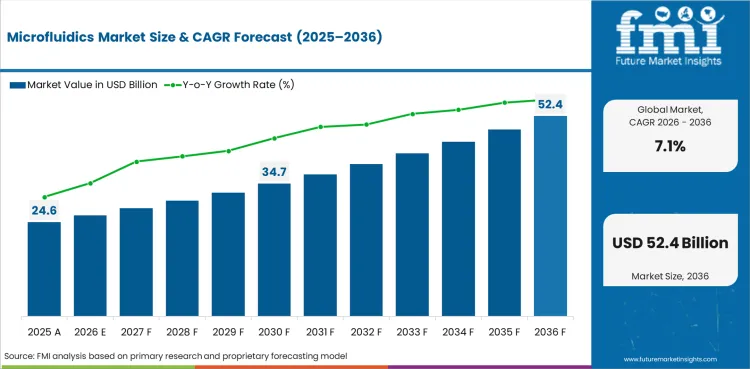
Key Takeaways, Market Size, and Forecast
- The microfluidics market was valued at USD 24.6 billion in 2025.
- The market is set to reach USD 26.4 billion by 2026-end and grow at a CAGR of 7.1% between 2026-2036 to reach USD 52.4 billion by 2036.
- Polymer will dominate with a 46.2% share, driven by cost-effective fabrication, compatibility with rapid prototyping methods, and suitability for disposable diagnostic chip production.
- Point of care testing will lead with a 37.0% share.
- By 2036, the microfluidics market is expected to be worth USD 52.40 billion.
- From 2026 to 2036, the market is projected to expand at a CAGR of 7.1%.
- The market is projected to create an incremental opportunity of USD 26.01 billion between 2026 and 2036.
- USA (12.1%) and European Union (11.6%) are two of the fastest growing markets in the world.
Microfluidics Market Definition
The Microfluidics Market covers devices, systems, and components that manipulate small volumes of fluids through microscale channels for diagnostic, pharmaceutical, clinical, and research applications. Products include microfluidic chips, lab on chip devices, organ on chip platforms, droplet generators, and integrated microfluidic analysis systems.
Microfluidics Market Inclusions
Market scope includes all commercially traded microfluidic products classified by material (polymer, glass, silicon, metal, ceramics), application (point of care testing, clinical diagnostics, drug delivery, analytical testing), industry (pharmaceuticals, in vitro diagnostics, environmental research, life science research, clinical diagnostics), and technology (droplet based microfluidics, continuous flow microfluidics, digital microfluidics, paper based microfluidics). Revenue coverage spans 2026 to 2036.
Microfluidics Market Exclusions
The scope does not include conventional macro scale fluid handling systems, standard microplate based assay platforms without microfluidic integration, or microelectromechanical systems (MEMS) used in non fluid applications.
Microfluidics Market Research Methodology
- Primary Research: FMI analysts conducted interviews with industry participants, technology providers, procurement specialists, and end users across key markets.
- Desk Research: Combined data from industry associations, regulatory filings, manufacturer disclosures, and published technical standards.
- Market Sizing and Forecasting: Bottom up aggregation across segments and regions with top down validation against industry benchmarks.
- Data Validation: Cross checked quarterly against industry production data, procurement records, and manufacturer financial disclosures.
Why is the Microfluidics Market Growing?
- Point of care diagnostic demand is accelerating as healthcare systems prioritize rapid, decentralized testing platforms that reduce dependence on centralized laboratory infrastructure and improve time to clinical decision.
- Organ on chip adoption in pharmaceutical R and D is growing as drug developers seek predictive preclinical models that reduce animal testing requirements and improve translation between in vitro and in vivo results.
Demand for microfluidics reflects the convergence of healthcare decentralization, pharmaceutical innovation, and manufacturing technology maturation. Healthcare systems globally are investing in point of care diagnostic platforms that can deliver laboratory quality results at the bedside, in primary care settings, and in resource limited environments. Microfluidic technology enables this by miniaturizing sample preparation, reaction chemistry, and detection into disposable chip formats that require minimal operator training and infrastructure. The commercial viability of these platforms has improved as polymer fabrication costs have declined and manufacturing processes have scaled to support high volume production.
The pharmaceutical industry represents a growing demand category as drug developers adopt microfluidic platforms for high throughput compound screening, organ on chip models, and single cell analysis. These applications leverage the precise fluid control and miniaturization capabilities of microfluidic systems to enable experiments that are impractical or prohibitively expensive using conventional laboratory methods. Organ on chip platforms in particular are gaining regulatory recognition as preclinical tools that can supplement or replace animal testing in specific drug development contexts.
Manufacturing scalability remains the primary commercial challenge for the microfluidics industry. While laboratory prototyping of microfluidic devices is well established, transitioning to high volume manufacturing that delivers consistent quality at commercially viable price points requires specialized fabrication infrastructure, quality control systems, and supply chain management capabilities. Companies that successfully bridge this manufacturing gap are positioned to capture significant share in the growing disposable diagnostic device market.
Market Segmentation Analysis
- Polymer accounts for 46.2% of the material segment, reflecting the cost and manufacturing advantages of thermoplastic and PDMS substrates for high volume disposable device production.
- Point of Care Testing holds 37.0% of the application segment, driven by demand for rapid, portable diagnostic platforms across clinical, field, and home health testing scenarios.
The Microfluidics Market is segmented by material, application, industry, and technology. Polymer dominates material demand, reflecting the manufacturing scalability and cost advantages of thermoplastic substrates. Point of Care Testing leads the application segment as healthcare systems invest in decentralized diagnostic platforms.
Insights into the Polymer Material Segment
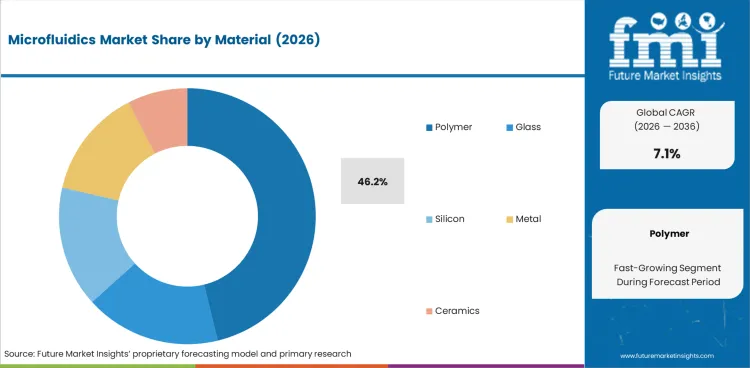
In 2026, Polymer is expected to represent 46.2% of the material segment. This category includes PDMS (polydimethylsiloxane), PMMA, COC, and other thermoplastic substrates used in microfluidic device fabrication. Polymer materials dominate due to their compatibility with injection molding, hot embossing, and soft lithography manufacturing processes that support high volume production.
The shift toward disposable, single use microfluidic devices for diagnostic applications is reinforcing polymer material dominance, as the cost per device must be low enough to support point of care deployment models where chips are used once and discarded.
Insights into the Point of Care Testing Application Segment
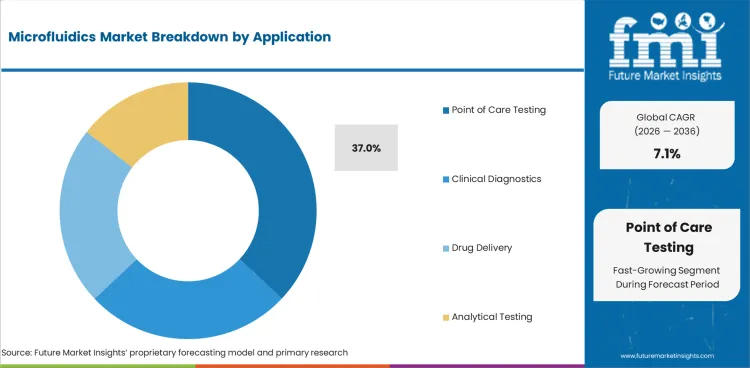
Point of Care Testing accounts for 37.0% of the application segment in 2026. This category covers microfluidic diagnostic devices deployed at or near the patient, including bedside testing in hospitals, primary care office testing, field testing in public health settings, and home based diagnostic platforms.
Growth in this segment reflects the expanding menu of clinical assays available on microfluidic platforms, which now include molecular diagnostics (PCR based), immunoassays, clinical chemistry panels, and hematology analysis that were previously available only through centralized laboratory testing.
Microfluidics Market Drivers, Restraints, and Opportunities
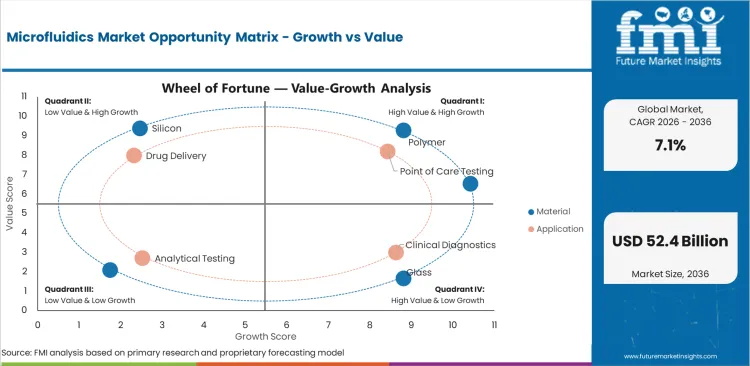
- Healthcare decentralization and diagnostic innovation are sustaining demand for microfluidic platforms that enable rapid, portable testing across diverse clinical settings.
- Manufacturing scalability and cost challenges constrain commercial deployment of microfluidic devices beyond established diagnostic applications.
- Pharmaceutical industry adoption of organ on chip and microfluidic screening platforms is creating new high value application categories with significant growth potential.
The Microfluidics Market is shaped by diagnostic innovation, pharmaceutical R and D adoption, and manufacturing technology maturation. Growth is supported by point of care testing demand, while adoption barriers include fabrication scalability challenges and regulatory pathway development for new diagnostic applications.
Point of Care Diagnostic Expansion
Demand is shaped by the global trend toward decentralized healthcare delivery, where diagnostic testing is performed at or near the patient rather than in centralized laboratories. Microfluidic platforms enable rapid, portable testing with minimal sample volumes and operator requirements, making them well suited for point of care deployment across clinical, field, and home health settings.
Manufacturing Scalability Constraints
Adoption is constrained by the technical and economic challenges of transitioning microfluidic devices from laboratory prototypes to high volume commercial products. Fabrication consistency, quality control at scale, and supply chain management for specialized materials and components remain barriers for companies seeking to commercialize microfluidic diagnostic devices.
Pharmaceutical R and D Platform Adoption
Growth reflects increasing pharmaceutical industry investment in microfluidic platforms for drug screening, organ on chip modeling, and single cell analysis. These applications leverage precise fluid control and miniaturization to enable experiments at scales and throughput levels not achievable with conventional laboratory methods.
Analysis of Microfluidics Market By Key Countries
.webp "Top Country Growth Comparison Microfluidics Market Cagr (2026 2036)")
| Country | CAGR |
|---|---|
| USA | 12.1% |
| European Union | 11.6% |
| South Korea | 11.5% |
| Japan | 11.2% |
| UK | 11.2% |
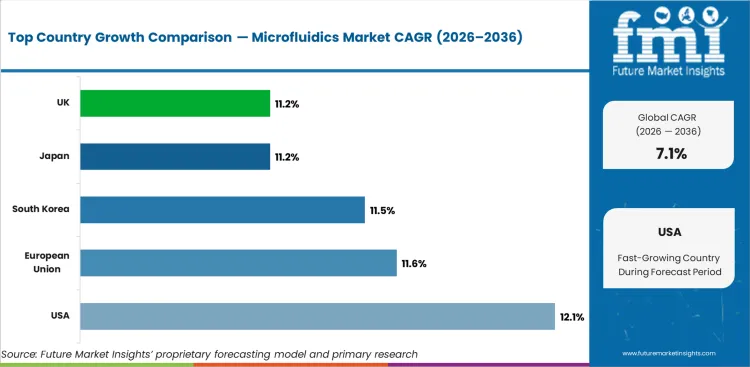
- The USA leads with a 12.1% CAGR through 2036, driven by diagnostic innovation investment, pharmaceutical R and D adoption, and venture capital funding for microfluidics startups.
- The European Union at 11.6% reflects demand from centralized diagnostic networks, pharmaceutical research, and government funded precision medicine programs.
- South Korea (11.5%) and Japan (11.2%) are expanding on account of advanced electronics manufacturing infrastructure, government investment in diagnostics, and growing pharmaceutical R and D adoption.
The global Microfluidics Market is projected to grow at a CAGR of 7.1% from 2026 to 2036. The analysis covers more than 30 countries, with the primary markets listed below.
Demand Outlook for Microfluidics Market in the United States
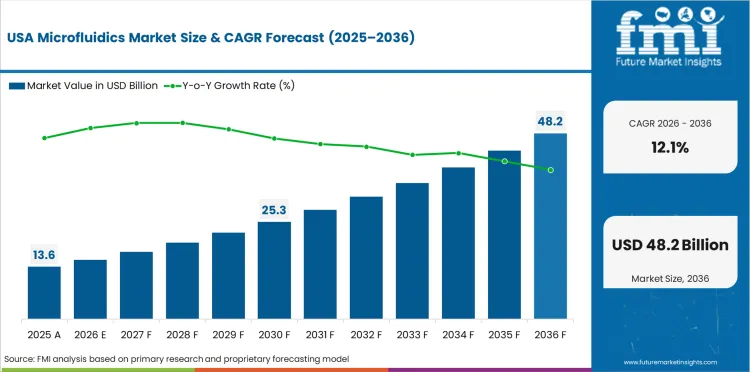
The USA is expected to grow at 12.1% through 2036. Growth is anchored in diagnostic innovation, pharmaceutical R and D investment, and a strong startup ecosystem supported by venture capital and NIH funding for microfluidics technology development.
- Point of care diagnostic innovation is driving development and commercialization of new microfluidic testing platforms.
- Pharmaceutical R and D adoption of organ on chip and microfluidic screening platforms is expanding across major drug companies.
- Venture capital investment supports a pipeline of microfluidics startups targeting diagnostic and life sciences applications.
Future Outlook for Microfluidics Market in the European Union
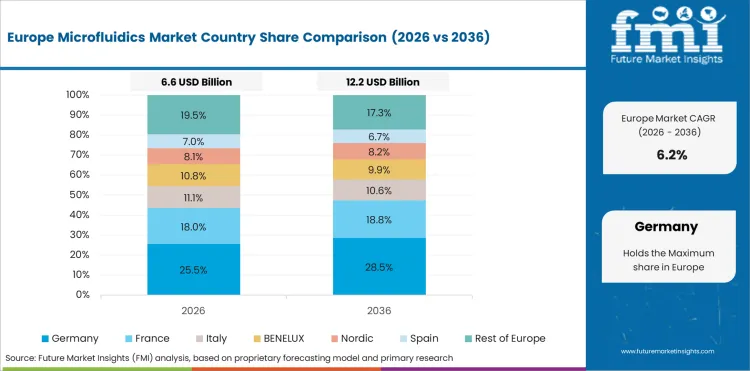
The European Union is expected to grow at 11.6% through 2036. Demand is shaped by centralized diagnostic laboratory modernization, pharmaceutical research institution investment, and EU funded precision medicine and diagnostics programs.
- Centralized diagnostic networks are adopting microfluidic platforms for high throughput molecular and immunoassay testing.
- EU funded precision medicine programs are supporting microfluidic technology development for companion diagnostics applications.
- Pharmaceutical research institutions are investing in organ on chip and microfluidic drug screening capabilities.
Opportunity Analysis of Microfluidics Market in South Korea
South Korea is expected to grow at 11.5% through 2036. Growth reflects advanced electronics manufacturing capabilities applicable to microfluidic device fabrication, government diagnostic technology investment, and growing pharmaceutical R and D adoption.
- Electronics manufacturing expertise supports cost effective microfluidic device fabrication and commercialization.
- Government investment in diagnostic technology development is accelerating microfluidic platform adoption.
- Pharmaceutical and biotechnology R and D growth is expanding the addressable market for research grade microfluidic systems.
In-depth Analysis of Microfluidics Market in Japan
Japan is expected to grow at 11.2% through 2036. Demand reflects precision manufacturing capabilities, pharmaceutical industry investment in microfluidic screening platforms, and aging population driven diagnostic demand.
- Precision manufacturing infrastructure supports high quality microfluidic device development and production.
- Pharmaceutical industry investment in microfluidic drug screening and organ on chip technology is expanding.
- Aging population diagnostic requirements are driving demand for rapid, point of care microfluidic testing platforms.
Sales Analysis of Microfluidics Market in the United Kingdom
The UK is expected to grow at 11.2% through 2036. Growth is supported by NHS diagnostic modernization, university research infrastructure investment, and pharmaceutical industry adoption of microfluidic R and D platforms.
- NHS diagnostic modernization is creating demand for microfluidic point of care testing platforms.
- University research infrastructure investment supports microfluidics technology development and commercialization.
- Pharmaceutical R and D adoption of microfluidic screening and analysis platforms is expanding across UK based drug companies.
Competitive Landscape and Strategic Positioning
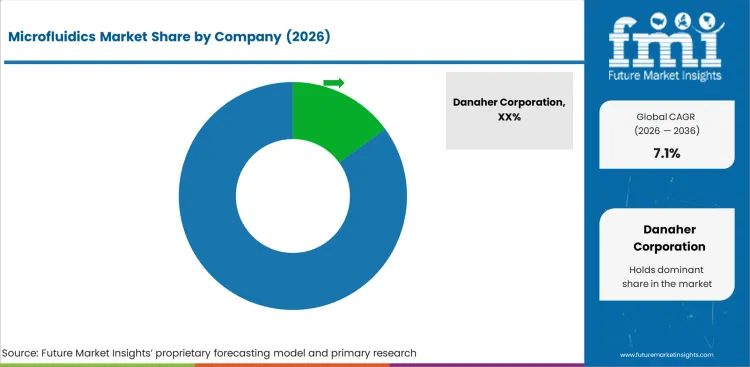
- Danaher Corporation leads through established diagnostic and life sciences platforms incorporating microfluidic technology across multiple commercial product lines.
- Thermo Fisher Scientific, Roche, and Abbott maintain strong positions through integrated diagnostic systems that leverage microfluidic sample preparation and analysis capabilities.
- Emerging players are targeting specialized applications including digital microfluidics, organ on chip platforms, and paper based diagnostic devices for resource limited settings.
Danaher Corporation maintains a leading position through its portfolio of diagnostic and life sciences platforms that incorporate microfluidic technology. Thermo Fisher Scientific provides integrated sample preparation and analysis systems with microfluidic capabilities for pharmaceutical and clinical laboratory customers.
F. Hoffmann La Roche delivers point of care and clinical diagnostic platforms with microfluidic sample handling and detection systems. Abbott Laboratories provides rapid diagnostic devices incorporating microfluidic technology for clinical and field testing applications.
Bio Rad Laboratories offers microfluidic droplet based systems for genomics and proteomics research. Qiagen NV provides sample preparation and molecular testing platforms with microfluidic integration. Agilent Technologies delivers microfluidic analytical instruments for life sciences and pharmaceutical research.
Barriers to entry include the technical complexity of microfluidic device design and manufacturing, regulatory approval requirements for diagnostic devices, established distribution relationships with clinical and research customers, and the capital requirements for scaling from prototype to commercial production. Strategic priorities include expanding point of care diagnostic applications, developing organ on chip platforms for pharmaceutical customers, and achieving manufacturing scale for disposable device production.
Key Companies in the Microfluidics Market
Key global companies leading the microfluidics market include:
- Danaher Corporation (USA), Thermo Fisher Scientific Inc. (USA), F. Hoffmann La Roche Ltd (Switzerland), Abbott Laboratories (USA) maintain leadership positions through established market presence, broad product portfolios, and global service and distribution networks.
- Bio Rad Laboratories (USA), Qiagen NV (Netherlands), Agilent Technologies (USA) have established regional strength through specialized capabilities and focused customer relationships.
- PerkinElmer Inc., Fluidigm Corporation, SCHOTT, Hologic are among the startups and emerging players gaining traction through specialized technology, niche applications, and focused innovation strategies.
Competitive Benchmarking: Microfluidics Market
| Company | Diagnostic Platform Integration | Manufacturing Scale | Pharma Customer Access | Geographic Coverage |
|---|---|---|---|---|
| Danaher Corporation | High | High | Strong | Global |
| Thermo Fisher Scientific | High | High | Strong | Global |
| F. Hoffmann La Roche | High | High | Strong | Global |
| Abbott Laboratories | High | High | Strong | Global |
| Bio Rad Laboratories | Medium | Medium | Strong | Global |
| Qiagen NV | Medium | Medium | Moderate | Global |
| Agilent Technologies | Medium | Medium | Strong | Global |
| PerkinElmer Inc. | Medium | Medium | Moderate | Global |
| Fluidigm Corporation | Medium | Low | Moderate | North America |
| SCHOTT | Low | High | Low | Europe |
Source: Future Market Insights competitive analysis, 2026.
Key Players in the Microfluidics Market
Major Global Players
- Danaher Corporation
- Thermo Fisher Scientific Inc.
- F. Hoffmann La Roche Ltd
- Abbott Laboratories
- Bio Rad Laboratories
- Qiagen NV
- Agilent Technologies
Emerging Players/Startups
- PerkinElmer Inc.
- Fluidigm Corporation
- SCHOTT
- Hologic
- Standard BioTools
Report Scope and Coverage
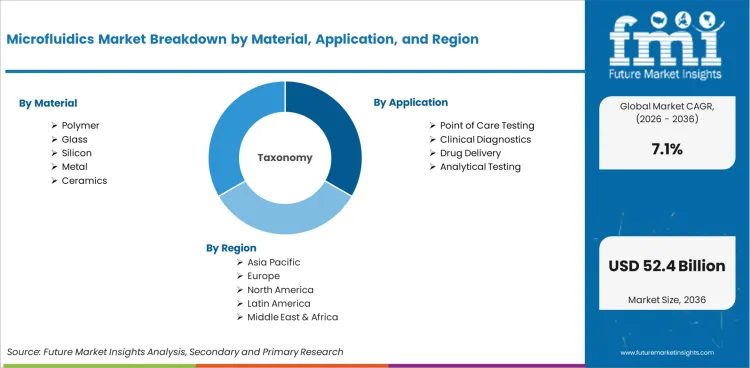
| Metric | Value |
|---|---|
| Quantitative Units | USD 26.39 billion to USD 52.40 billion, at a CAGR of 7.1% |
| Market Definition | The Microfluidics Market covers devices, systems, and components that manipulate small fluid volumes through microscale channels for diagnostic, pharmaceutical, clinical, and research applications. |
| Regions Covered | North America, Latin America, Europe, East Asia, South Asia and Pacific, Middle East and Africa |
| Countries Covered | USA, UK, France, Germany, Italy, South Korea, Japan, China, India, 30 plus countries |
| Key Companies Profiled | Danaher Corporation, Thermo Fisher Scientific Inc., F. Hoffmann La Roche Ltd, Abbott Laboratories, Bio Rad Laboratories, Qiagen NV, Agilent Technologies, PerkinElmer Inc., Fluidigm Corporation, SCHOTT, Hologic |
| Forecast Period | 2026 to 2036 |
| Approach | Hybrid bottom up and top down methodology starting with verified transaction data, projecting adoption velocity across segments and regions. |
Segmentation
Microfluidics Market Segmented by Material:
- Polymer
- Glass
- Silicon
- Metal
- Ceramics
Microfluidics Market Segmented by Application:
- Point of Care Testing
- Clinical Diagnostics
- Drug Delivery
- Analytical Testing
Microfluidics Market Segmented by Industry:
- Pharmaceuticals
- In-Vitro Diagnostics
- Environmental Research
- Life Science Research
- Clinical Diagnostics
Microfluidics Market Segmented by Technology:
- Droplet-Based Microfluidics
- Continuous-Flow Microfluidics
- Digital Microfluidics
- Paper-Based Microfluidics
- Other
Microfluidics Market by Region:
- North America
- USA
- Canada
- Mexico
- Latin America
- Brazil
- Chile
- Rest of Latin America
- Western Europe
- Germany
- UK
- Italy
- Spain
- France
- Nordic
- BENELUX
- Rest of Western Europe
- Eastern Europe
- Russia
- Poland
- Hungary
- Balkan & Baltic
- Rest of Eastern Europe
- East Asia
- China
- Japan
- South Korea
- South Asia and Pacific
- India
- ASEAN
- Australia & New Zealand
- Rest of South Asia and Pacific
- Middle East & Africa
- Kingdom of Saudi Arabia
- Other GCC Countries
- Turkiye
- South Africa
- Other African Union
- Rest of Middle East & Africa
Research Sources and Bibliography
- 1. USA Food and Drug Administration. (2025). FDA Guidance on Microfluidic Based Diagnostic Devices. FDA.
- 2. European Commission. (2024). EU In Vitro Diagnostic Regulation Implementation Report. EC.
- 3. World Health Organization. (2025). WHO Essential Diagnostics List and Technology Assessment. WHO.
- 4. National Institutes of Health. (2025). NIH Point of Care Technologies Research Network Report. NIH.
- 5. International Organization for Standardization. (2025). ISO 22916 Microfluidic Devices Standard. ISO.
This bibliography is provided for reader reference. The full Future Market Insights report contains the complete reference list with publication dates, URLs, and supporting data for all cited works.
This Report Answers
- Estimating the market size and revenue projections from 2026 to 2036.
- Segmentation by material, application, industry, and technology.
- Regional insights covering more than 30 markets.
- Analysis of microfluidic technology platforms including droplet, continuous flow, and digital approaches.
- Competitive landscape assessment including manufacturing and diagnostic platform benchmarking.
- Identification of growth opportunities in point of care diagnostics, organ on chip, and pharmaceutical screening.
- Supply chain and materials sourcing evaluation.
- Data delivery in PDF and Excel formats.
Frequently Asked Questions
What is the global market demand for Microfluidics in 2026?
In 2026, the global Microfluidics Market is expected to be worth USD 26.39 billion.
How big will the Microfluidics Market be in 2036?
By 2036, the Microfluidics Market is expected to be worth USD 52.40 billion.
How much is demand for Microfluidics expected to grow between 2026 and 2036?
Between 2026 and 2036, demand for Microfluidics is expected to grow at a CAGR of 7.1%.
Which material segment is expected to lead in 2026?
Polymer is expected to account for 46.2% of the material segment in 2026, reflecting cost effective fabrication and suitability for high volume disposable diagnostic device production.
What is driving demand in the USA?
The USA is expected to grow at 12.1% through 2036, driven by diagnostic innovation investment, pharmaceutical R and D adoption, and strong venture capital funding for microfluidics startups.
What is driving demand in the European Union?
The European Union is expected to grow at 11.6% through 2036, shaped by centralized diagnostic network modernization, pharmaceutical research investment, and EU funded precision medicine programs.
What does this report mean by Microfluidics Market definition?
The Microfluidics Market covers devices, systems, and components that manipulate small fluid volumes through microscale channels for diagnostic, pharmaceutical, clinical, and research applications.
How does FMI make the Microfluidics forecast and validate it?
Forecasting models use a hybrid bottom up and top down approach, starting with verified device procurement data and validating against global diagnostic device market statistics and manufacturer disclosures.
Preview the report firsthand - request a free sample
Get SampleGet the brochure for pricing and purchase details.
Get PDFTable of Content
- Executive Summary
- Global Market Outlook
- Demand-side Trends
- Supply-side Trends
- Technology Roadmap Analysis
- Analysis and Recommendations
- Market Overview
- Market Coverage / Taxonomy
- Market Definition / Scope / Limitations
- Research Methodology
- Chapter Orientation
- Analytical Lens and Working Hypotheses
- Market Structure, Signals, and Trend Drivers
- Benchmarking and Cross-market Comparability
- Market Sizing, Forecasting, and Opportunity Mapping
- Research Design and Evidence Framework
- Desk Research Programme (Secondary Evidence)
- Company Annual and Sustainability Reports
- Peer-reviewed Journals and Academic Literature
- Corporate Websites, Product Literature, and Technical Notes
- Earnings Decks and Investor Briefings
- Statutory Filings and Regulatory Disclosures
- Technical White Papers and Standards Notes
- Trade Journals, Industry Magazines, and Analyst Briefs
- Conference Proceedings, Webinars, and Seminar Materials
- Government Statistics Portals and Public Data Releases
- Press Releases and Reputable Media Coverage
- Specialist Newsletters and Curated Briefings
- Sector Databases and Reference Repositories
- FMI Internal Proprietary Databases and Historical Market Datasets
- Subscription Datasets and Paid Sources
- Social Channels, Communities, and Digital Listening Inputs
- Additional Desk Sources
- Expert Input and Fieldwork (Primary Evidence)
- Primary Modes
- Qualitative Interviews and Expert Elicitation
- Quantitative Surveys and Structured Data Capture
- Blended Approach
- Why Primary Evidence is Used
- Field Techniques
- Interviews
- Surveys
- Focus Groups
- Observational and In-context Research
- Social and Community Interactions
- Stakeholder Universe Engaged
- C-suite Leaders
- Board Members
- Presidents and Vice Presidents
- R&D and Innovation Heads
- Technical Specialists
- Domain Subject-matter Experts
- Scientists
- Physicians and Other Healthcare Professionals
- Governance, Ethics, and Data Stewardship
- Research Ethics
- Data Integrity and Handling
- Primary Modes
- Tooling, Models, and Reference Databases
- Desk Research Programme (Secondary Evidence)
- Data Engineering and Model Build
- Data Acquisition and Ingestion
- Cleaning, Normalisation, and Verification
- Synthesis, Triangulation, and Analysis
- Quality Assurance and Audit Trail
- Market Background
- Market Dynamics
- Drivers
- Restraints
- Opportunity
- Trends
- Scenario Forecast
- Demand in Optimistic Scenario
- Demand in Likely Scenario
- Demand in Conservative Scenario
- Opportunity Map Analysis
- Product Life Cycle Analysis
- Supply Chain Analysis
- Investment Feasibility Matrix
- Value Chain Analysis
- PESTLE and Porter’s Analysis
- Regulatory Landscape
- Regional Parent Market Outlook
- Production and Consumption Statistics
- Import and Export Statistics
- Market Dynamics
- Global Market Analysis 2021 to 2025 and Forecast, 2026 to 2036
- Historical Market Size Value (USD Million) Analysis, 2021 to 2025
- Current and Future Market Size Value (USD Million) Projections, 2026 to 2036
- Y-o-Y Growth Trend Analysis
- Absolute $ Opportunity Analysis
- Global Market Pricing Analysis 2021 to 2025 and Forecast 2026 to 2036
- Global Market Analysis 2021 to 2025 and Forecast 2026 to 2036, By Material
- Introduction / Key Findings
- Historical Market Size Value (USD Million) Analysis By Material, 2021 to 2025
- Current and Future Market Size Value (USD Million) Analysis and Forecast By Material, 2026 to 2036
- Polymer
- Glass
- Silicon
- Metal
- Ceramics
- Polymer
- Y-o-Y Growth Trend Analysis By Material, 2021 to 2025
- Absolute $ Opportunity Analysis By Material, 2026 to 2036
- Global Market Analysis 2021 to 2025 and Forecast 2026 to 2036, By Application
- Introduction / Key Findings
- Historical Market Size Value (USD Million) Analysis By Application, 2021 to 2025
- Current and Future Market Size Value (USD Million) Analysis and Forecast By Application, 2026 to 2036
- Point of Care Testing
- Clinical Diagnostics
- Drug Delivery
- Analytical Testing
- Point of Care Testing
- Y-o-Y Growth Trend Analysis By Application, 2021 to 2025
- Absolute $ Opportunity Analysis By Application, 2026 to 2036
- Global Market Analysis 2021 to 2025 and Forecast 2026 to 2036, By Industry
- Introduction / Key Findings
- Historical Market Size Value (USD Million) Analysis By Industry, 2021 to 2025
- Current and Future Market Size Value (USD Million) Analysis and Forecast By Industry, 2026 to 2036
- Pharmaceuticals
- In-Vitro Diagnostics
- Environmental Research
- Life Science Research
- Clinical Diagnostics
- Pharmaceuticals
- Y-o-Y Growth Trend Analysis By Industry, 2021 to 2025
- Absolute $ Opportunity Analysis By Industry, 2026 to 2036
- Global Market Analysis 2021 to 2025 and Forecast 2026 to 2036, By Technology
- Introduction / Key Findings
- Historical Market Size Value (USD Million) Analysis By Technology, 2021 to 2025
- Current and Future Market Size Value (USD Million) Analysis and Forecast By Technology, 2026 to 2036
- Droplet-Based Microfluidics
- Continuous-Flow Microfluidics
- Digital Microfluidics
- Paper-Based Microfluidics
- Other
- Droplet-Based Microfluidics
- Y-o-Y Growth Trend Analysis By Technology, 2021 to 2025
- Absolute $ Opportunity Analysis By Technology, 2026 to 2036
- Global Market Analysis 2021 to 2025 and Forecast 2026 to 2036, By Region
- Introduction
- Historical Market Size Value (USD Million) Analysis By Region, 2021 to 2025
- Current Market Size Value (USD Million) Analysis and Forecast By Region, 2026 to 2036
- North America
- Latin America
- Western Europe
- Eastern Europe
- East Asia
- South Asia and Pacific
- Middle East & Africa
- Market Attractiveness Analysis By Region
- North America Market Analysis 2021 to 2025 and Forecast 2026 to 2036, By Country
- Historical Market Size Value (USD Million) Trend Analysis By Market Taxonomy, 2021 to 2025
- Market Size Value (USD Million) Forecast By Market Taxonomy, 2026 to 2036
- By Country
- USA
- Canada
- Mexico
- By Material
- By Application
- By Industry
- By Technology
- By Country
- Market Attractiveness Analysis
- By Country
- By Material
- By Application
- By Industry
- By Technology
- Key Takeaways
- Latin America Market Analysis 2021 to 2025 and Forecast 2026 to 2036, By Country
- Historical Market Size Value (USD Million) Trend Analysis By Market Taxonomy, 2021 to 2025
- Market Size Value (USD Million) Forecast By Market Taxonomy, 2026 to 2036
- By Country
- Brazil
- Chile
- Rest of Latin America
- By Material
- By Application
- By Industry
- By Technology
- By Country
- Market Attractiveness Analysis
- By Country
- By Material
- By Application
- By Industry
- By Technology
- Key Takeaways
- Western Europe Market Analysis 2021 to 2025 and Forecast 2026 to 2036, By Country
- Historical Market Size Value (USD Million) Trend Analysis By Market Taxonomy, 2021 to 2025
- Market Size Value (USD Million) Forecast By Market Taxonomy, 2026 to 2036
- By Country
- Germany
- UK
- Italy
- Spain
- France
- Nordic
- BENELUX
- Rest of Western Europe
- By Material
- By Application
- By Industry
- By Technology
- By Country
- Market Attractiveness Analysis
- By Country
- By Material
- By Application
- By Industry
- By Technology
- Key Takeaways
- Eastern Europe Market Analysis 2021 to 2025 and Forecast 2026 to 2036, By Country
- Historical Market Size Value (USD Million) Trend Analysis By Market Taxonomy, 2021 to 2025
- Market Size Value (USD Million) Forecast By Market Taxonomy, 2026 to 2036
- By Country
- Russia
- Poland
- Hungary
- Balkan & Baltic
- Rest of Eastern Europe
- By Material
- By Application
- By Industry
- By Technology
- By Country
- Market Attractiveness Analysis
- By Country
- By Material
- By Application
- By Industry
- By Technology
- Key Takeaways
- East Asia Market Analysis 2021 to 2025 and Forecast 2026 to 2036, By Country
- Historical Market Size Value (USD Million) Trend Analysis By Market Taxonomy, 2021 to 2025
- Market Size Value (USD Million) Forecast By Market Taxonomy, 2026 to 2036
- By Country
- China
- Japan
- South Korea
- By Material
- By Application
- By Industry
- By Technology
- By Country
- Market Attractiveness Analysis
- By Country
- By Material
- By Application
- By Industry
- By Technology
- Key Takeaways
- South Asia and Pacific Market Analysis 2021 to 2025 and Forecast 2026 to 2036, By Country
- Historical Market Size Value (USD Million) Trend Analysis By Market Taxonomy, 2021 to 2025
- Market Size Value (USD Million) Forecast By Market Taxonomy, 2026 to 2036
- By Country
- India
- ASEAN
- Australia & New Zealand
- Rest of South Asia and Pacific
- By Material
- By Application
- By Industry
- By Technology
- By Country
- Market Attractiveness Analysis
- By Country
- By Material
- By Application
- By Industry
- By Technology
- Key Takeaways
- Middle East & Africa Market Analysis 2021 to 2025 and Forecast 2026 to 2036, By Country
- Historical Market Size Value (USD Million) Trend Analysis By Market Taxonomy, 2021 to 2025
- Market Size Value (USD Million) Forecast By Market Taxonomy, 2026 to 2036
- By Country
- Kingdom of Saudi Arabia
- Other GCC Countries
- Turkiye
- South Africa
- Other African Union
- Rest of Middle East & Africa
- By Material
- By Application
- By Industry
- By Technology
- By Country
- Market Attractiveness Analysis
- By Country
- By Material
- By Application
- By Industry
- By Technology
- Key Takeaways
- Key Countries Market Analysis
- USA
- Pricing Analysis
- Market Share Analysis, 2025
- By Material
- By Application
- By Industry
- By Technology
- Canada
- Pricing Analysis
- Market Share Analysis, 2025
- By Material
- By Application
- By Industry
- By Technology
- Mexico
- Pricing Analysis
- Market Share Analysis, 2025
- By Material
- By Application
- By Industry
- By Technology
- Brazil
- Pricing Analysis
- Market Share Analysis, 2025
- By Material
- By Application
- By Industry
- By Technology
- Chile
- Pricing Analysis
- Market Share Analysis, 2025
- By Material
- By Application
- By Industry
- By Technology
- Germany
- Pricing Analysis
- Market Share Analysis, 2025
- By Material
- By Application
- By Industry
- By Technology
- UK
- Pricing Analysis
- Market Share Analysis, 2025
- By Material
- By Application
- By Industry
- By Technology
- Italy
- Pricing Analysis
- Market Share Analysis, 2025
- By Material
- By Application
- By Industry
- By Technology
- Spain
- Pricing Analysis
- Market Share Analysis, 2025
- By Material
- By Application
- By Industry
- By Technology
- France
- Pricing Analysis
- Market Share Analysis, 2025
- By Material
- By Application
- By Industry
- By Technology
- India
- Pricing Analysis
- Market Share Analysis, 2025
- By Material
- By Application
- By Industry
- By Technology
- ASEAN
- Pricing Analysis
- Market Share Analysis, 2025
- By Material
- By Application
- By Industry
- By Technology
- Australia & New Zealand
- Pricing Analysis
- Market Share Analysis, 2025
- By Material
- By Application
- By Industry
- By Technology
- China
- Pricing Analysis
- Market Share Analysis, 2025
- By Material
- By Application
- By Industry
- By Technology
- Japan
- Pricing Analysis
- Market Share Analysis, 2025
- By Material
- By Application
- By Industry
- By Technology
- South Korea
- Pricing Analysis
- Market Share Analysis, 2025
- By Material
- By Application
- By Industry
- By Technology
- Russia
- Pricing Analysis
- Market Share Analysis, 2025
- By Material
- By Application
- By Industry
- By Technology
- Poland
- Pricing Analysis
- Market Share Analysis, 2025
- By Material
- By Application
- By Industry
- By Technology
- Hungary
- Pricing Analysis
- Market Share Analysis, 2025
- By Material
- By Application
- By Industry
- By Technology
- Kingdom of Saudi Arabia
- Pricing Analysis
- Market Share Analysis, 2025
- By Material
- By Application
- By Industry
- By Technology
- Turkiye
- Pricing Analysis
- Market Share Analysis, 2025
- By Material
- By Application
- By Industry
- By Technology
- South Africa
- Pricing Analysis
- Market Share Analysis, 2025
- By Material
- By Application
- By Industry
- By Technology
- USA
- Market Structure Analysis
- Competition Dashboard
- Competition Benchmarking
- Market Share Analysis of Top Players
- By Regional
- By Material
- By Application
- By Industry
- By Technology
- Competition Analysis
- Competition Deep Dive
- Danaher Corporation
- Overview
- Product Portfolio
- Profitability by Market Segments (Product/Age /Sales Channel/Region)
- Sales Footprint
- Strategy Overview
- Marketing Strategy
- Product Strategy
- Channel Strategy
- Thermo Fisher Scientific Inc.
- F. Hoffmann-La Roche Ltd
- Abbott Laboratories
- Bio-Rad Laboratories
- Qiagen NV
- Agilent Technologies
- PerkinElmer Inc.
- Fluidigm Corporation
- SCHOTT
- Hologic
- Danaher Corporation
- Competition Deep Dive
- Assumptions & Acronyms Used


