

- Industry Size (2026)
- USD 2 Bn
- Forecast (2036)
- USD 4.2 Bn
- CAGR (2026 to 2036)
- 7.9%
Mobile Diagnostic Sealed MRI Magnets Market Forecast and Outlook 2026 to 2036
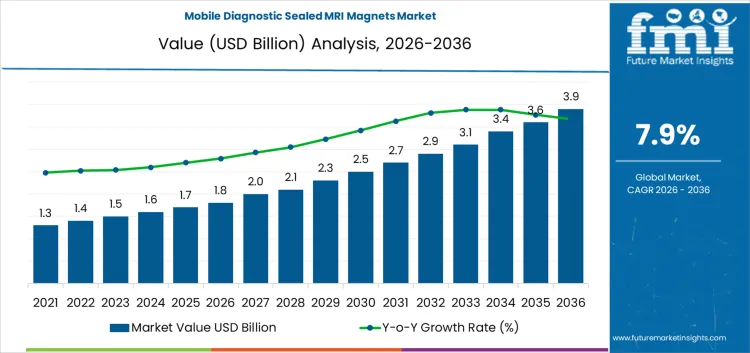
The mobile diagnostic sealed MRI magnets market is projected to grow from USD 2 billion in 2026 to USD 3.9 billion by 2036, reflecting a compound annual growth rate (CAGR) of 7.9%. This growth is driven by the increasing demand for mobile and portable MRI systems, which offer flexibility and cost efficiency in medical diagnostics, particularly in underserved or remote areas. Sealed MRI magnets are a key component of these mobile systems, providing high-quality imaging while maintaining portability and durability. As healthcare providers seek to expand access to diagnostic services, mobile MRI systems are becoming an increasingly important tool.
Quick Stats for the Mobile Diagnostic Sealed MRI Magnets Market
- Mobile Diagnostic Sealed MRI Magnets Market Value (2026): USD 2 billion
- Mobile Diagnostic Sealed MRI Magnets Market Forecast Value (2036): USD 3.9 billion
- Mobile Diagnostic Sealed MRI Magnets Market Global Forecast CAGR (2026-2035): 7.9%
- Mobile Diagnostic Sealed MRI Magnets Market Leading Segment: Superconducting Sealed Magnets (52%)
- Key Growth Regions in Mobile Diagnostic Sealed MRI Magnets Market: India
- Top Players in Mobile Diagnostic Sealed MRI Magnets Market: Siemens Healthineers, GE Healthcare, Philips Healthcare, Canon Medical Systems, Hitachi Medical Systems
What is the Year-on-Year (YoY) Growth Analysis for the Mobile Diagnostic Sealed MRI Magnets Market through 2036?
The year-on-year growth analysis of the mobile diagnostic sealed MRI magnets market shows steady and incremental growth throughout the forecast period. From USD 2 billion in 2026, the market will grow by USD 0.1 billion each year, reaching USD 2.1 billion in 2027 and USD 2.3 billion in 2028. This early growth phase reflects the gradual adoption of mobile MRI systems as healthcare providers seek to expand their diagnostic capabilities in various settings.
Mobile Diagnostic Sealed MRI Magnets Market Key Takeaways
| Metric | Value |
|---|---|
| Industry Sales Value (2026) | USD 2 billion |
| Industry Forecast Value (2036) | USD 3.9 billion |
| Industry Forecast CAGR (2026-2036) | 7.9% |
What Is Driving the Mobile Diagnostic Sealed MRI Magnets Market?
Historically, the mobile diagnostic sealed MRI magnets market evolved from the limitations of conventional stationary MRI systems that dominated medical imaging. Traditional MRI units relied on large superconducting magnets requiring complex cryogenic infrastructure with onsite liquid helium handling, restricting installation to hospitals and imaging centers with specialized facilities. This constraint limited accessibility in remote or underserved regions. Early innovation introduced portable and mobile MRI solutions with sealed magnet technology that required minimal cryogen maintenance and simplified siting requirements.
Sealed magnets used advanced superconductors and closed loop cooling that reduced dependence on external service infrastructure, enabling deployment in mobile units, diagnostic vans, and temporary clinical sites. Adoption in initial phases was concentrated where fixed MRI access was limited, such as community health outreach programs and field hospitals. Providers that trialed mobile MRI services gained operational insights into setup flexibility, patient throughput, and lower facility overheads compared with fixed installations. These early deployments established the value proposition of mobile sealed MRI magnets in expanding imaging access while maintaining diagnostic quality.
Future demand for mobile diagnostic sealed MRI magnets is expected to be shaped by broader healthcare access goals, increased imaging demand, and growth in point of care diagnostics. Healthcare systems are projected to integrate mobile MRI services to support screening and diagnosis in rural communities, outpatient clinics, and temporary care facilities where fixed MRI infrastructure is not economically justified. Growth factors will include advances in magnet design that improve field homogeneity, reduce power consumption, and enhance image resolution for a wider range of clinical applications. Expansion of value based care models that emphasize convenience and preventive diagnostics will drive adoption as providers seek to reduce wait times and facilitate early detection of neurological and musculoskeletal conditions.
Technological improvements in lightweight, sealed magnet assemblies and mobile platform integration will lower total cost of ownership and expand operational flexibility. Barriers include regulatory clearance pathways, reimbursement frameworks that vary by region, and competition from emerging imaging modalities. Long term market expansion will depend on demonstrated clinical performance, alignment with healthcare delivery models prioritizing accessibility, and cost efficiencies that make mobile MRI economically viable across diverse care settings.
What are the Key Segments in the Mobile Diagnostic Sealed MRI Magnets Market?
The Mobile Diagnostic Sealed MRI Magnets market is segmented into magnet types and applications. Magnet types include superconducting sealed magnets, permanent sealed magnets, hybrid sealed magnets, and other magnet technologies, with superconducting sealed magnets holding the largest market share at 52%. Applications in this market include neurology & brain imaging, orthopedics & musculoskeletal, cardiology & vascular, and oncology diagnostics, with neurology & brain imaging accounting for 43% of the market share. The market growth is driven by the increasing demand for mobile MRI solutions, which offer flexibility and efficiency in diagnostics, particularly in remote or underserved areas. Superconducting sealed magnets are preferred for their superior performance, while applications across a range of medical fields are fueling growth. Key regions driving this market include North America, Europe, and Asia Pacific, where healthcare infrastructure improvements and mobile healthcare solutions are expanding.
What is Driving Growth in the Superconducting Sealed Magnets Segment?
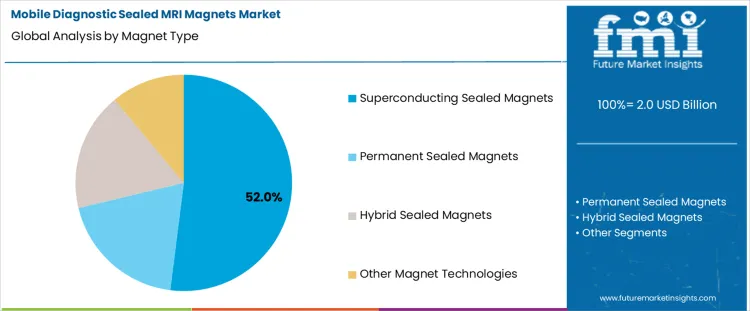
Superconducting sealed magnets lead the magnet type segment in the Mobile Diagnostic Sealed MRI Magnets market, holding 52% of the market share. This dominance is driven by the high performance and superior magnetic field strength offered by superconducting magnets, which are critical for providing high-resolution imaging in MRI systems. Superconducting magnets are particularly well-suited for mobile diagnostic units due to their ability to generate stronger and more stable magnetic fields, allowing for clearer and more detailed images, which is essential for accurate diagnosis. The portability and compact nature of mobile MRI units equipped with superconducting sealed magnets are crucial in expanding access to advanced diagnostic imaging, particularly in rural and remote areas.
Additionally, superconducting magnets, when paired with cryogenic systems, provide efficient, reliable performance over extended periods, making them ideal for mobile applications where frequent use and minimal downtime are required. The growing focus on improving healthcare accessibility, coupled with technological advancements in superconducting magnet systems, is expected to drive continued growth in this segment, particularly in regions such as North America and Europe, where mobile health initiatives are increasingly supported by healthcare policies.
What is Driving the Demand for Neurology & Brain Imaging in the Mobile Diagnostic Sealed MRI Magnets Market?
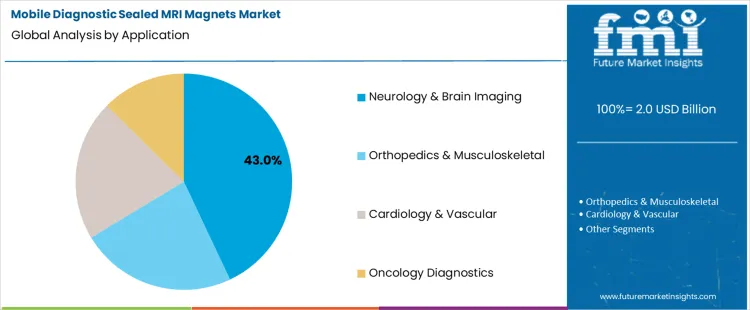
Neurology & brain imaging is the largest application segment in the Mobile Diagnostic Sealed MRI Magnets market, accounting for 43% of the market share. This is primarily driven by the increasing prevalence of neurological conditions, such as stroke, epilepsy, and neurodegenerative diseases, which require advanced imaging techniques for accurate diagnosis and treatment planning. Mobile MRI systems equipped with sealed magnets are particularly valuable in neurology & brain imaging because they provide high-resolution scans in a portable format, enabling healthcare providers to reach patients in underserved or remote locations.
The ability to conduct detailed brain scans without the need for patients to travel to specialized imaging centers is a significant advantage of mobile MRI units, particularly in rural areas or regions with limited healthcare infrastructure. Additionally, the growing awareness of neurological diseases and the demand for timely diagnoses are further driving the adoption of mobile MRI systems in neurology. As the demand for brain imaging continues to rise, particularly with the aging global population and the increasing incidence of neurological disorders, the market for mobile diagnostic MRI systems equipped with superconducting sealed magnets is expected to expand, particularly in North America, Europe, and parts of Asia Pacific.
What are the Key Dynamics in the Mobile Diagnostic Sealed MRI Magnets Market?
The mobile diagnostic sealed MRI magnets market is evolving due to the growing demand for portable medical imaging solutions, particularly for on-site diagnostic services. Sealed MRI magnets are essential components in mobile MRI systems, which provide flexibility and accessibility for medical facilities that cannot afford or do not have space for a traditional, stationary MRI scanner. These mobile MRI units are increasingly being used in emergency services, rural areas, and developing countries where access to healthcare is limited.
The market is driven by advancements in magnet technology, allowing for more compact, lightweight, and energy-efficient MRI systems. These innovations, along with the need for rapid diagnosis in diverse healthcare settings, contribute to the growth of mobile diagnostic sealed MRI magnets. Furthermore, regulatory pressures for quicker and more accurate diagnostics in emergency care and imaging centers are also contributing to the adoption of mobile MRI solutions.
What are the Key Drivers of Growth in the Mobile Diagnostic Sealed MRI Magnets Market?
Key drivers of growth in the mobile diagnostic sealed MRI magnets market include the increasing demand for accessible healthcare and the need for rapid, on-site diagnostic services. Mobile MRI systems enable healthcare providers to perform MRI scans in a variety of locations, such as remote areas, during medical emergencies, and at mobile clinics, thus expanding the reach of diagnostic services. Advances in sealed MRI magnet technology have made mobile MRI units more efficient, with improved image quality, reduced operational costs, and smaller footprints, allowing for easier transportation and setup.
The growing demand for non-invasive diagnostic procedures, particularly in the diagnosis of neurological, musculoskeletal, and cardiovascular conditions, is also boosting market growth. Furthermore, rising healthcare expenditure, along with an aging population and increasing prevalence of chronic diseases, drives the need for expanded diagnostic capabilities and the adoption of mobile MRI units. Government initiatives promoting the expansion of healthcare infrastructure, especially in rural and underserved regions, are also contributing to the growth of the market.
What are the Key Restraints in the Mobile Diagnostic Sealed MRI Magnets Market?
The mobile diagnostic sealed MRI magnets market faces several challenges. One of the primary restraints is the high initial cost of mobile MRI systems, including the sealed MRI magnets and the necessary infrastructure for transportation and setup. These costs can be prohibitive, especially for smaller healthcare providers or those in developing regions. Additionally, the operational complexity of mobile MRI units, including the need for trained personnel to transport, set up, and operate the equipment, adds to the overall costs and logistics involved in using these systems.
Another challenge is the limited availability of sealed MRI magnets with the required performance standards for mobile units. While there have been advancements in magnet technology, the miniaturization of MRI magnets without compromising image quality and diagnostic capabilities remains a challenge. Furthermore, the need for regulatory approvals and compliance with safety standards for mobile units can delay market entry and increase the cost of deployment.
What are the Key Trends in the Mobile Diagnostic Sealed MRI Magnets Market?
Several trends are shaping the mobile diagnostic sealed MRI magnets market. One major trend is the increasing adoption of advanced MRI technologies, including higher magnetic field strengths (e.g., 3T and 7T magnets), which offer improved image quality and diagnostic accuracy. These technologies are being integrated into mobile MRI systems to meet the rising demand for precise and detailed imaging in a variety of healthcare settings. Another trend is the growing interest in hybrid mobile diagnostic units that combine MRI with other imaging technologies, such as CT or X-ray, to provide comprehensive diagnostic capabilities in a single mobile platform.
Additionally, there is a growing focus on sustainability and energy efficiency in the development of mobile MRI systems, with manufacturers striving to reduce power consumption and improve the overall environmental footprint of mobile diagnostic units. Advances in software and imaging algorithms, along with the integration of AI for enhanced image processing and diagnostic assistance, are also trends that are driving the market. As the demand for mobile healthcare services continues to rise, these innovations are helping to improve the accessibility, affordability, and quality of mobile MRI diagnostics.
What is the Country-Wise Analysis of the Mobile Diagnostic Sealed MRI Magnets Market?
The mobile diagnostic sealed MRI magnets market is growing globally as the healthcare sector increasingly adopts portable and mobile MRI systems for patient diagnostics. Mobile diagnostic MRI systems, which incorporate sealed MRI magnets, offer flexibility, accessibility, and efficiency in medical imaging, particularly in remote or underserved areas. The market is influenced by technological advancements in MRI systems, the growing need for diagnostic imaging in various regions, and the increasing demand for mobile healthcare solutions. Countries like the USA, China, Germany, Japan, and India are key players in the market, each experiencing growth driven by healthcare infrastructure improvements, rising healthcare needs, and technological innovation in diagnostic equipment.
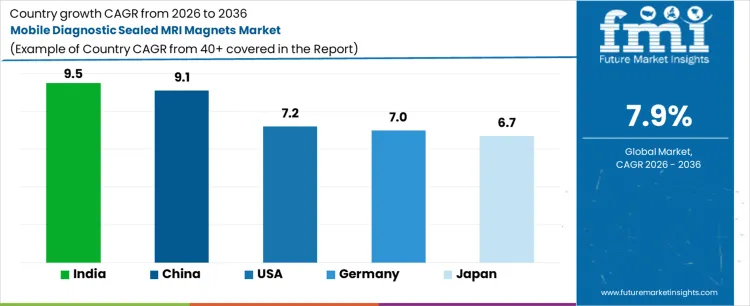
| Country | CAGR (%) |
|---|---|
| USA | 7.2 |
| China | 9.1 |
| Germany | 7 |
| Japan | 6.7 |
| India | 9.5 |
What is Driving the Growth of the Mobile Diagnostic Sealed MRI Magnets Market in the USA?
The mobile diagnostic sealed MRI magnets market in the USA is growing at a CAGR of 7.2%. The rise in demand for accessible and efficient medical imaging solutions, particularly in rural and remote areas, is a key driver. Mobile MRI systems allow for diagnostic imaging in locations where traditional stationary machines are impractical or unavailable. In the USA, there is a growing focus on increasing the availability of diagnostic services and reducing healthcare costs, making mobile MRI systems an attractive solution. Additionally, advancements in MRI technology, including sealed magnets that improve portability and reduce the risk of contamination, are contributing to the market's growth. As the healthcare industry continues to adopt more flexible and mobile diagnostic solutions, the demand for sealed MRI magnets is expected to rise.
How is the Mobile Diagnostic Sealed MRI Magnets Market Performing in China?
China’s mobile diagnostic sealed MRI magnets market is growing at a CAGR of 9.1%. China’s healthcare system is rapidly modernizing, with increasing investments in medical technologies to improve patient care and expand access to diagnostic imaging. The growing demand for mobile MRI systems, particularly in underserved regions, is driving the adoption of sealed MRI magnets. These systems allow healthcare providers in remote areas to offer diagnostic services without the need for large-scale infrastructure. Additionally, China’s focus on healthcare innovation, coupled with government support for medical technology, is fueling the demand for mobile MRI solutions. As healthcare accessibility improves across the country, the market for mobile diagnostic sealed MRI magnets is expected to continue expanding.
What Factors are Shaping the Mobile Diagnostic Sealed MRI Magnets Market in Germany?
Germany’s mobile diagnostic sealed MRI magnets market is growing at a CAGR of 7%. Germany, known for its advanced healthcare infrastructure, is increasingly adopting mobile MRI systems to improve accessibility and patient care in both urban and rural areas. The demand for portable diagnostic solutions is being driven by the need for quicker diagnostics and the ability to reach remote locations with limited medical facilities. The use of sealed MRI magnets in mobile systems is particularly appealing due to their enhanced safety, portability, and lower maintenance requirements. Germany’s commitment to healthcare innovation and reducing the burden on traditional hospital-based imaging centers is expected to further drive the growth of the mobile diagnostic MRI magnets market.
How is the Mobile Diagnostic Sealed MRI Magnets Market Evolving in Japan?
Japan’s mobile diagnostic sealed MRI magnets market is growing at a CAGR of 6.7%. Japan’s healthcare system is advanced, and there is increasing demand for mobile MRI systems as part of efforts to expand healthcare accessibility, particularly in remote and aging communities. The adoption of mobile diagnostic systems in Japan is further fueled by the country's focus on technological innovation in medical imaging. Sealed MRI magnets in mobile systems offer significant advantages, including improved portability and operational efficiency. Japan’s healthcare providers are increasingly adopting these systems to provide more flexible diagnostic services and enhance patient care. With continued healthcare system modernization, the demand for mobile MRI systems equipped with sealed MRI magnets is expected to grow steadily.
What is Contributing to the Growth of the Mobile Diagnostic Sealed MRI Magnets Market in India?
India’s mobile diagnostic sealed MRI magnets market is growing at a CAGR of 9.5%, the highest among the countries analyzed. India’s healthcare system is undergoing rapid expansion, with a focus on increasing the availability of diagnostic imaging services, particularly in underserved regions. The adoption of mobile MRI systems with sealed MRI magnets is being driven by the need to offer more accessible and affordable healthcare solutions in rural and remote areas. Sealed MRI magnets are well-suited for mobile applications due to their ability to minimize the risks of contamination and their relatively low maintenance needs. The demand for these mobile diagnostic systems is increasing as India works to improve healthcare infrastructure and expand diagnostic capabilities across the country.
What is the Competitive Landscape for the Mobile Diagnostic Sealed MRI Magnets Market?
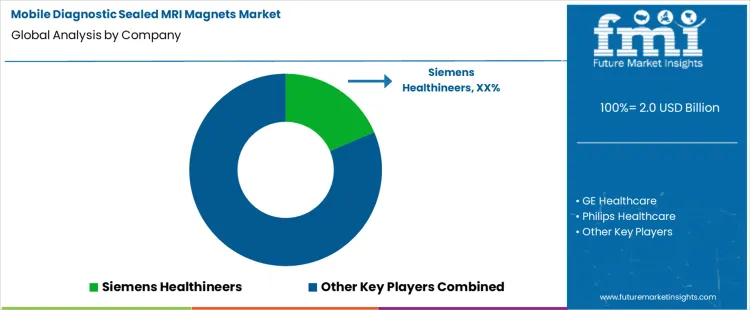
The mobile diagnostic sealed MRI magnets market is expanding, driven by the need for portable and advanced imaging solutions that offer high-quality diagnostics in remote or underserved areas. Siemens Healthineers is the market leader, offering state-of-the-art mobile MRI systems equipped with sealed magnets that provide high-resolution imaging while maintaining ease of transportation. Siemens’ advanced technology ensures reliability, performance, and efficiency in mobile diagnostics, making it the preferred choice for healthcare providers. GE Healthcare is another significant player, providing mobile MRI solutions with sealed magnets that deliver exceptional imaging capabilities, including advanced software for better diagnostic results. GE’s portfolio focuses on improving patient access to high-quality imaging, particularly in environments where traditional fixed MRI systems are not feasible.
Philips Healthcare also competes in this market, offering mobile MRI units that use sealed magnets for precise imaging while ensuring compact and flexible design for easier deployment. Canon Medical Systems brings innovative mobile diagnostic MRI systems with sealed magnets, emphasizing versatility and patient comfort. Hitachi Medical Systems provides advanced mobile MRI technology with sealed magnets that cater to specific needs in mobile diagnostics, focusing on portability and ease of use. These companies are key players in the growing mobile MRI market, contributing to the advancement of diagnostic capabilities in mobile healthcare settings.
To maintain their competitive edge, companies in the mobile diagnostic sealed MRI magnets market emphasize continuous technological innovation, product customization, and service expansion. Siemens Healthineers continues to refine its mobile MRI solutions, focusing on improving magnet efficiency and patient throughput while reducing system weight for better mobility. GE Healthcare is investing in advanced software and magnet technology to enhance the image quality and diagnostic capabilities of its mobile MRI systems.
Philips Healthcare’s strategy includes expanding its portfolio with mobile MRI units that offer ease of operation, compact design, and superior imaging performance, making them suitable for diverse healthcare settings. Canon Medical Systems is working on improving the portability and patient comfort of its mobile MRI solutions, aiming to offer greater accessibility for healthcare providers. Hitachi Medical Systems focuses on offering highly portable, easy-to-use MRI units with sealed magnets, ensuring minimal downtime and maximum uptime for mobile diagnostics. These strategies, combined with increasing demand for mobile healthcare services, position these companies as strong contenders in the growing mobile diagnostic sealed MRI magnets market.
Key Players of the Mobile Diagnostic Sealed MRI Magnets Market
- Siemens Healthineers
- GE Healthcare
- Philips Healthcare
- Canon Medical Systems
- Hitachi Medical Systems
- Others
Scope of the Report
| Items | Values |
|---|---|
| Quantitative Units (2026) | USD Billion |
| Magnet Type | Superconducting Sealed Magnets, Permanent Sealed Magnets, Hybrid Sealed Magnets, Other Magnet Technologies |
| Field Strength | <0.5T, 0.5-1.0T, 1.0-1.5T, >1.5T |
| Application | Neurology & Brain Imaging, Orthopedics & Musculoskeletal, Cardiology & Vascular, Oncology Diagnostics |
| Companies | Siemens Healthineers, GE Healthcare, Philips Healthcare, Canon Medical Systems, Hitachi Medical Systems, Others |
| Regions Covered | North America, Latin America, Western Europe, Eastern Europe, South Asia and Pacific, East Asia, Middle East & Africa |
| Countries Covered | United States, Canada, Mexico, Brazil, Argentina, Germany, France, United Kingdom, Italy, Spain, Netherlands, China, India, Japan, South Korea, ANZ, GCC Countries, South Africa |
| Additional Attributes | Dollar by sales by magnet type, field strength, application, and region. Includes market trends towards mobile diagnostic technologies, cost-effectiveness, regulatory compliance, and the role of sealed MRI magnets in enhancing medical diagnostics. |
Mobile Diagnostic Sealed MRI Magnets Market Segmentation
Magnet Type
- Superconducting Sealed Magnets
- Permanent Sealed Magnets
- Hybrid Sealed Magnets
- Other Magnet Technologies
Field Strength
- <0.5T
- 0.5-1.0T
- 1.0-1.5T
- 1.5T
Application
- Neurology & Brain Imaging
- Orthopedics & Musculoskeletal
- Cardiology & Vascular
- Oncology Diagnostics
Region
- Asia Pacific
- China
- Japan
- India
- Australia & New Zealand
- ASEAN
- Rest of Asia Pacific
- Europe
- Germany
- United Kingdom
- France
- Italy
- Spain
- Nordic
- BENELUX
- Rest of Europe
- North America
- United States
- Canada
- Mexico
- Latin America
- Brazil
- Argentina
- Rest of Latin America
- Middle East & Africa
- Kingdom of Saudi Arabia
- Other GCC Countries
- South Africa
- Rest of Middle East & Africa
Bibliography
- Siemens Healthineers. (2023). Mobile MRI Systems with Sealed Magnets: Advancing Diagnostic Imaging in Remote Healthcare. Siemens Healthineers Technical Insights.
- GE Healthcare. (2023). Innovations in Portable MRI Solutions: The Role of Sealed Magnets in Expanding Access to Diagnostic Imaging. GE Healthcare Reports.
- Philips Healthcare. (2023). Portable MRI Units: How Sealed Magnets Are Enhancing Healthcare Accessibility in Remote Regions. Philips Healthcare Perspectives.
- Canon Medical Systems. (2023). Mobile Diagnostic Imaging: The Future of Sealed MRI Magnets in On-the-Go Healthcare Solutions. Canon Medical Systems Annual Review.
- Hitachi Medical Systems. (2023). Advancing Mobile MRI Technology: The Impact of Sealed Magnets on Healthcare Delivery. Hitachi Medical Systems Insights.
Frequently Asked Questions
How big is the mobile diagnostic sealed mri magnets market in 2026?
The global mobile diagnostic sealed mri magnets market is estimated to be valued at USD 2.0 billion in 2026.
What will be the size of mobile diagnostic sealed mri magnets market in 2036?
The market size for the mobile diagnostic sealed mri magnets market is projected to reach USD 4.3 billion by 2036.
How much will be the mobile diagnostic sealed mri magnets market growth between 2026 and 2036?
The mobile diagnostic sealed mri magnets market is expected to grow at a 7.9% CAGR between 2026 and 2036.
What are the key product types in the mobile diagnostic sealed mri magnets market?
The key product types in mobile diagnostic sealed mri magnets market are superconducting sealed magnets, permanent sealed magnets, hybrid sealed magnets and other magnet technologies.
Which field strength segment to contribute significant share in the mobile diagnostic sealed mri magnets market in 2026?
In terms of field strength, 0.5–1.0t segment to command 38.0% share in the mobile diagnostic sealed mri magnets market in 2026.
Preview the report firsthand - request a free sample
Get SampleGet the brochure for pricing and purchase details.
Get PDFTable of Content
- Executive Summary
- Global Market Outlook
- Demand-side Trends
- Supply-side Trends
- Technology Roadmap Analysis
- Analysis and Recommendations
- Market Overview
- Market Coverage / Taxonomy
- Market Definition / Scope / Limitations
- Market Background
- Market Dynamics
- Drivers
- Restraints
- Opportunity
- Trends
- Scenario Forecast
- Demand in Optimistic Scenario
- Demand in Likely Scenario
- Demand in Conservative Scenario
- Opportunity Map Analysis
- Product Life Cycle Analysis
- Supply Chain Analysis
- Investment Feasibility Matrix
- Value Chain Analysis
- PESTLE and Porter’s Analysis
- Regulatory Landscape
- Regional Parent Market Outlook
- Production and Consumption Statistics
- Import and Export Statistics
- Market Dynamics
- Global Market Analysis 2021 to 2025 and Forecast, 2026 to 2036
- Historical Market Size Value (USD Million) Analysis, 2021 to 2025
- Current and Future Market Size Value (USD Million) Projections, 2026 to 2036
- Y-o-Y Growth Trend Analysis
- Absolute $ Opportunity Analysis
- Global Market Pricing Analysis 2021 to 2025 and Forecast 2026 to 2036
- Global Market Analysis 2021 to 2025 and Forecast 2026 to 2036, By Magnet Type
- Introduction / Key Findings
- Historical Market Size Value (USD Million) Analysis By Magnet Type , 2021 to 2025
- Current and Future Market Size Value (USD Million) Analysis and Forecast By Magnet Type , 2026 to 2036
- Superconducting Sealed Magnets
- Permanent Sealed Magnets
- Hybrid Sealed Magnets
- Other Magnet Technologies
- Superconducting Sealed Magnets
- Y-o-Y Growth Trend Analysis By Magnet Type , 2021 to 2025
- Absolute $ Opportunity Analysis By Magnet Type , 2026 to 2036
- Global Market Analysis 2021 to 2025 and Forecast 2026 to 2036, By Field Strength
- Introduction / Key Findings
- Historical Market Size Value (USD Million) Analysis By Field Strength, 2021 to 2025
- Current and Future Market Size Value (USD Million) Analysis and Forecast By Field Strength, 2026 to 2036
- 0.5-1.0T
- <0.5T
- 1.0-1.5T
- >1.5T
- 0.5-1.0T
- Y-o-Y Growth Trend Analysis By Field Strength, 2021 to 2025
- Absolute $ Opportunity Analysis By Field Strength, 2026 to 2036
- Global Market Analysis 2021 to 2025 and Forecast 2026 to 2036, By Application
- Introduction / Key Findings
- Historical Market Size Value (USD Million) Analysis By Application, 2021 to 2025
- Current and Future Market Size Value (USD Million) Analysis and Forecast By Application, 2026 to 2036
- Neurology & Brain Imaging
- Orthopedics & Musculoskeletal
- Cardiology & Vascular
- Oncology Diagnostics
- Neurology & Brain Imaging
- Y-o-Y Growth Trend Analysis By Application, 2021 to 2025
- Absolute $ Opportunity Analysis By Application, 2026 to 2036
- Global Market Analysis 2021 to 2025 and Forecast 2026 to 2036, By Region
- Introduction
- Historical Market Size Value (USD Million) Analysis By Region, 2021 to 2025
- Current Market Size Value (USD Million) Analysis and Forecast By Region, 2026 to 2036
- North America
- Latin America
- Western Europe
- Eastern Europe
- East Asia
- South Asia and Pacific
- Middle East & Africa
- Market Attractiveness Analysis By Region
- North America Market Analysis 2021 to 2025 and Forecast 2026 to 2036, By Country
- Historical Market Size Value (USD Million) Trend Analysis By Market Taxonomy, 2021 to 2025
- Market Size Value (USD Million) Forecast By Market Taxonomy, 2026 to 2036
- By Country
- USA
- Canada
- Mexico
- By Magnet Type
- By Field Strength
- By Application
- By Country
- Market Attractiveness Analysis
- By Country
- By Magnet Type
- By Field Strength
- By Application
- Key Takeaways
- Latin America Market Analysis 2021 to 2025 and Forecast 2026 to 2036, By Country
- Historical Market Size Value (USD Million) Trend Analysis By Market Taxonomy, 2021 to 2025
- Market Size Value (USD Million) Forecast By Market Taxonomy, 2026 to 2036
- By Country
- Brazil
- Chile
- Rest of Latin America
- By Magnet Type
- By Field Strength
- By Application
- By Country
- Market Attractiveness Analysis
- By Country
- By Magnet Type
- By Field Strength
- By Application
- Key Takeaways
- Western Europe Market Analysis 2021 to 2025 and Forecast 2026 to 2036, By Country
- Historical Market Size Value (USD Million) Trend Analysis By Market Taxonomy, 2021 to 2025
- Market Size Value (USD Million) Forecast By Market Taxonomy, 2026 to 2036
- By Country
- Germany
- UK
- Italy
- Spain
- France
- Nordic
- BENELUX
- Rest of Western Europe
- By Magnet Type
- By Field Strength
- By Application
- By Country
- Market Attractiveness Analysis
- By Country
- By Magnet Type
- By Field Strength
- By Application
- Key Takeaways
- Eastern Europe Market Analysis 2021 to 2025 and Forecast 2026 to 2036, By Country
- Historical Market Size Value (USD Million) Trend Analysis By Market Taxonomy, 2021 to 2025
- Market Size Value (USD Million) Forecast By Market Taxonomy, 2026 to 2036
- By Country
- Russia
- Poland
- Hungary
- Balkan & Baltic
- Rest of Eastern Europe
- By Magnet Type
- By Field Strength
- By Application
- By Country
- Market Attractiveness Analysis
- By Country
- By Magnet Type
- By Field Strength
- By Application
- Key Takeaways
- East Asia Market Analysis 2021 to 2025 and Forecast 2026 to 2036, By Country
- Historical Market Size Value (USD Million) Trend Analysis By Market Taxonomy, 2021 to 2025
- Market Size Value (USD Million) Forecast By Market Taxonomy, 2026 to 2036
- By Country
- China
- Japan
- South Korea
- By Magnet Type
- By Field Strength
- By Application
- By Country
- Market Attractiveness Analysis
- By Country
- By Magnet Type
- By Field Strength
- By Application
- Key Takeaways
- South Asia and Pacific Market Analysis 2021 to 2025 and Forecast 2026 to 2036, By Country
- Historical Market Size Value (USD Million) Trend Analysis By Market Taxonomy, 2021 to 2025
- Market Size Value (USD Million) Forecast By Market Taxonomy, 2026 to 2036
- By Country
- India
- ASEAN
- Australia & New Zealand
- Rest of South Asia and Pacific
- By Magnet Type
- By Field Strength
- By Application
- By Country
- Market Attractiveness Analysis
- By Country
- By Magnet Type
- By Field Strength
- By Application
- Key Takeaways
- Middle East & Africa Market Analysis 2021 to 2025 and Forecast 2026 to 2036, By Country
- Historical Market Size Value (USD Million) Trend Analysis By Market Taxonomy, 2021 to 2025
- Market Size Value (USD Million) Forecast By Market Taxonomy, 2026 to 2036
- By Country
- Kingdom of Saudi Arabia
- Other GCC Countries
- Turkiye
- South Africa
- Other African Union
- Rest of Middle East & Africa
- By Magnet Type
- By Field Strength
- By Application
- By Country
- Market Attractiveness Analysis
- By Country
- By Magnet Type
- By Field Strength
- By Application
- Key Takeaways
- Key Countries Market Analysis
- USA
- Pricing Analysis
- Market Share Analysis, 2025
- By Magnet Type
- By Field Strength
- By Application
- Canada
- Pricing Analysis
- Market Share Analysis, 2025
- By Magnet Type
- By Field Strength
- By Application
- Mexico
- Pricing Analysis
- Market Share Analysis, 2025
- By Magnet Type
- By Field Strength
- By Application
- Brazil
- Pricing Analysis
- Market Share Analysis, 2025
- By Magnet Type
- By Field Strength
- By Application
- Chile
- Pricing Analysis
- Market Share Analysis, 2025
- By Magnet Type
- By Field Strength
- By Application
- Germany
- Pricing Analysis
- Market Share Analysis, 2025
- By Magnet Type
- By Field Strength
- By Application
- UK
- Pricing Analysis
- Market Share Analysis, 2025
- By Magnet Type
- By Field Strength
- By Application
- Italy
- Pricing Analysis
- Market Share Analysis, 2025
- By Magnet Type
- By Field Strength
- By Application
- Spain
- Pricing Analysis
- Market Share Analysis, 2025
- By Magnet Type
- By Field Strength
- By Application
- France
- Pricing Analysis
- Market Share Analysis, 2025
- By Magnet Type
- By Field Strength
- By Application
- India
- Pricing Analysis
- Market Share Analysis, 2025
- By Magnet Type
- By Field Strength
- By Application
- ASEAN
- Pricing Analysis
- Market Share Analysis, 2025
- By Magnet Type
- By Field Strength
- By Application
- Australia & New Zealand
- Pricing Analysis
- Market Share Analysis, 2025
- By Magnet Type
- By Field Strength
- By Application
- China
- Pricing Analysis
- Market Share Analysis, 2025
- By Magnet Type
- By Field Strength
- By Application
- Japan
- Pricing Analysis
- Market Share Analysis, 2025
- By Magnet Type
- By Field Strength
- By Application
- South Korea
- Pricing Analysis
- Market Share Analysis, 2025
- By Magnet Type
- By Field Strength
- By Application
- Russia
- Pricing Analysis
- Market Share Analysis, 2025
- By Magnet Type
- By Field Strength
- By Application
- Poland
- Pricing Analysis
- Market Share Analysis, 2025
- By Magnet Type
- By Field Strength
- By Application
- Hungary
- Pricing Analysis
- Market Share Analysis, 2025
- By Magnet Type
- By Field Strength
- By Application
- Kingdom of Saudi Arabia
- Pricing Analysis
- Market Share Analysis, 2025
- By Magnet Type
- By Field Strength
- By Application
- Turkiye
- Pricing Analysis
- Market Share Analysis, 2025
- By Magnet Type
- By Field Strength
- By Application
- South Africa
- Pricing Analysis
- Market Share Analysis, 2025
- By Magnet Type
- By Field Strength
- By Application
- USA
- Market Structure Analysis
- Competition Dashboard
- Competition Benchmarking
- Market Share Analysis of Top Players
- By Regional
- By Magnet Type
- By Field Strength
- By Application
- Competition Analysis
- Competition Deep Dive
- Siemens Healthineers
- Overview
- Product Portfolio
- Profitability by Market Segments (Product/Age /Sales Channel/Region)
- Sales Footprint
- Strategy Overview
- Marketing Strategy
- Product Strategy
- Channel Strategy
- GE Healthcare
- Philips Healthcare
- Canon Medical Systems
- Hitachi Medical Systems
- Others
- Siemens Healthineers
- Competition Deep Dive
- Assumptions & Acronyms Used
- Research Methodology


