

- Market Size (2026)
- USD 920.6 Mn
- Forecast (2036)
- USD 1617.8 Mn
- CAGR (2026 to 2036)
- 5.8%
How big is the Mud Mixer Market size?
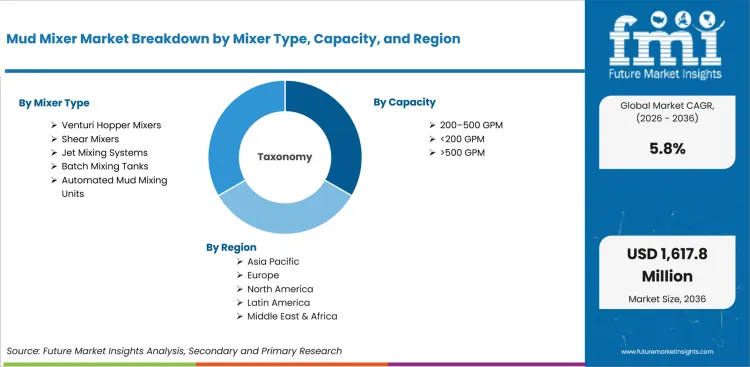
USD 920.6 million in 2026 and USD 1,617.8 million by 2036 at a 5.8% CAGR.
Demand for mud mixer is projected to expand at 5.8% CAGR between 2026 and 2036, increasing valuation from USD 920.6 million in 2026 to USD 1,617.8 million by 2036. Drilling crews rely on mud mixers to blend polymers and additives so prepared fluid flows smoothly into geotechnical or microtunneling rigs. Expanding construction activity makes dependable site-based mixing equipment essential. Highlighting this steady growth, the National Bureau of Statistics of China reported in May 2025 stating for infrastructure investment having risen 5.8% from January to April 2025. Such capital spending encourages contractors to integrate reliable fluid-preparation machinery across major excavation jobs.
Equipment priorities follow different paths based on local project environments. Contractors in India and China emphasize mobile mixing access and local service coverage. Project owners in Germany and Japan prioritize machinery with a controlled footprint for compact jobsite handling. Active field operations consistently reinforce the need for durable site equipment. Baker Hughes listed 581 USA active rigs on July 2026. This high level of drilling-service activity directly drives ongoing evaluations of fluid preparation and mud-handling equipment.
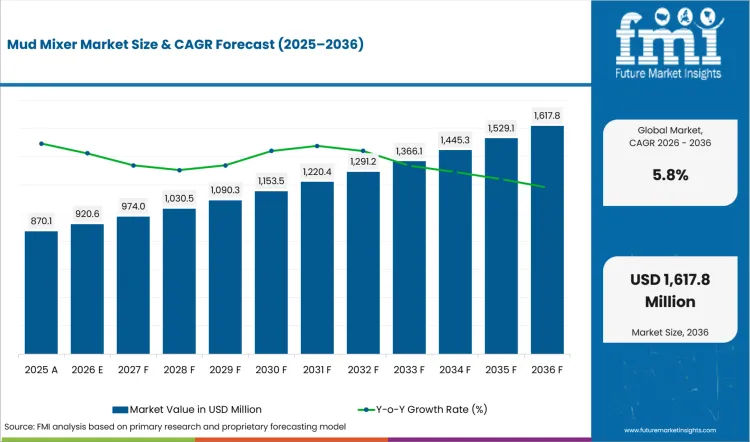
Key Takeaways of Mud Mixer Market
- Demand for mud mixers is driven by drilling teams' need for steady fluid preparation near rigs, with contractor decisions reflecting hopper access and field service depth.
- By capacity, 200-500 GPM units are expected to lead with 45.0% share in 2026, as mid-sized rigs need workable flow without oversized systems.
- HDD drilling fluids are the dominant application segment, projected to hold 36.0% share in 2026, led by repeated utility crossing and civil drilling activity.
- Drilling contractors are estimated to lead the end-user category with 34.0% share in 2026, due to direct ownership of rig-side preparation tasks.
- Tank layout, pump reliability, and solids-control compatibility remain critical to supplier evaluation, alongside compact designs that reduce setup delays across congested worksites.
- India, China, and KSA are expected to form the higher-growth country tier, advancing at 7.6%, 6.9%, and 5.7% CAGR respectively through 2036, supported by water-network work, pipeline renewal, and oilfield service activity.
- Competition centers on GN Solids Control, NOV, Vermeer, Ditch Witch, Derrick Corporation, and Aipu Solids Control, with vendors differentiating through solids-control knowledge, integrated mud-system portfolios, and contractor support networks.
Analyst Perspective
"The mud mixer market is evolving as drilling contractors seek equipment that delivers consistent fluid preparation while improving efficiency and safety at the jobsite. Buyers are evaluating systems on mixing performance, ease of operation, maintenance accessibility, and their ability to support uninterrupted drilling activities under demanding field conditions. Manufacturers that combine dependable equipment design with practical operator support, responsive service, and application expertise are likely to strengthen customer relationships and secure repeat business."
- Nikhil Kaitwade, Principal Consultant for Industrial Automation at Future Market Insights
How is Mud Mixer Market segmented?
The mud mixer industry is segmented by mixer type, capacity, mobility, application, end use and region.
Mixer type coverage includes venturi hopper mixers, shear mixers, jet mixing systems, batch mixing tanks and automated mud mixing units. Capacity coverage includes below 200 GPM, 200-500 GPM and above 500 GPM systems. Mobility coverage includes skid-mounted, trailer-mounted, truck-mounted and stationary plant configurations. Application coverage includes HDD drilling fluids, oilfield drilling mud, geotechnical slurries and microtunneling fluids. End-use coverage includes drilling contractors, oilfield service firms, utility contractors and civil contractors. Regional coverage includes North America and Latin America. Coverage also includes Western Europe, Eastern Europe, East Asia, South Asia and Pacific, plus Middle East and Africa.
How do venturi hopper mixers shape mixer type purchasing?
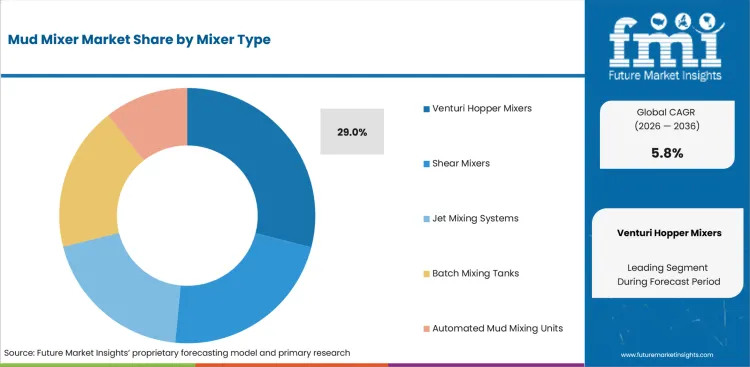
Venturi hopper mixers are estimated to guide mixer type purchasing as drilling teams need a practical way to draw dry additives into moving fluid streams. Vermeer Corporation reported in September 2024 stating the MX150 mixing system used a 7-hp engine, delivered 150 GPM maximum flow and paired with 300 gal or 500 gal tanks, supporting compact mixing packages for HDD crews.
- Based on mixer type, venturi hopper mixers are anticipated to represent 29.0% share in 2026 due to familiar hopper intake supporting field crews handling bentonite and polymer loading across utility and HDD sites. Contractors assess venturi systems through powder wet-out quality and steady fluid transfer before equipment approval.
- Shear mixers and automated mud mixing units support specialized preparation needs across heavier mud programs and repeat job sequences. Venturi hopper mixers retain selection strength as crews seek straightforward manageable training needs and dependable additive draw during changing site conditions.
How does 200-500 GPM support capacity demand?
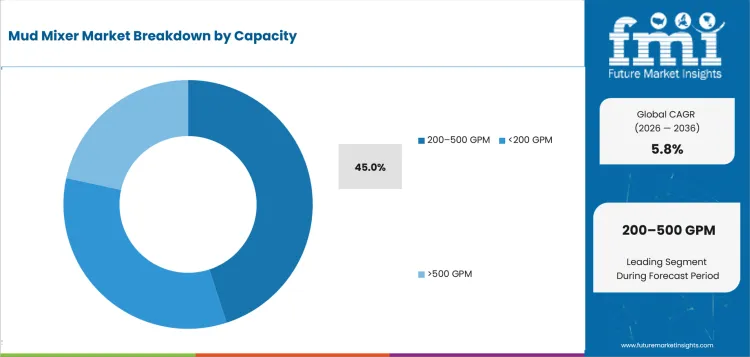
Ditch Witch announced in January 2025 noting the JT21 drill delivered 21,000 lb pullback, 20,000 lb thrust and 2,250 ft-lbs torque, reflecting rig classes needing nearby fluid preparation sized for repeat utility work. 200-500 GPM systems are expected to support capacity demand as contractors need enough flow for mid-sized HDD and civil drilling programs without moving oversized equipment.
- In 2026, 200-500 GPM capacity is projected to account for 45.0% share as many HDD and utility jobs require balanced mixing output and manageable transport requirements. Project teams evaluate this capacity band through batch timing and fluid transfer reliability before rental or purchase decisions.
- Below 200 GPM units serve compact maintenance jobs and above 500 GPM units address larger drilling or oilfield programs with heavier fluid volumes. 200-500 GPM systems keep selection depth as contractors need equipment with enough output for recurring work without adding unnecessary footprint and handling burden.
How do skid-mounted units influence mobility purchasing?
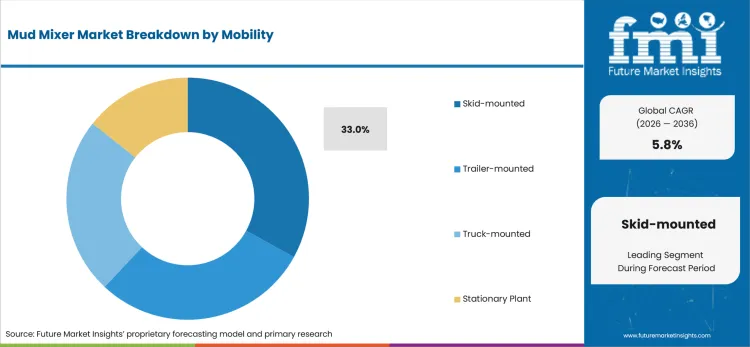
Skid-mounted units are likely to influence mobility purchasing as contractors need durable equipment bases placed near mud pits, rigs or support trucks. Vermeer reported in October 2024 that its R125 reclaimer delivered 125 GPM recycling capacity at 20.0% solids and paired with an MX300 mixer for a combined 1,600 gal fluid capacity, showing compact support packages built for utility HDD work.
- By mobility, skid-mounted units are estimated to hold 33.0% share in 2026 since contractors need stable layouts carrying hoppers and tanks across uneven jobsites. Field managers review skid packages through lifting points and pump alignment before deploying units across repeated bore programs.
- Trailer-mounted and stationary plant formats address mobility needs across heavy oilfield service and fixed preparation yards. Skid-mounted units sustain purchase consideration as drilling crews need sturdy equipment bases positioned quickly near rig operations and cleaned efficiently between assignments.
Why do HDD drilling fluids lead application demand?
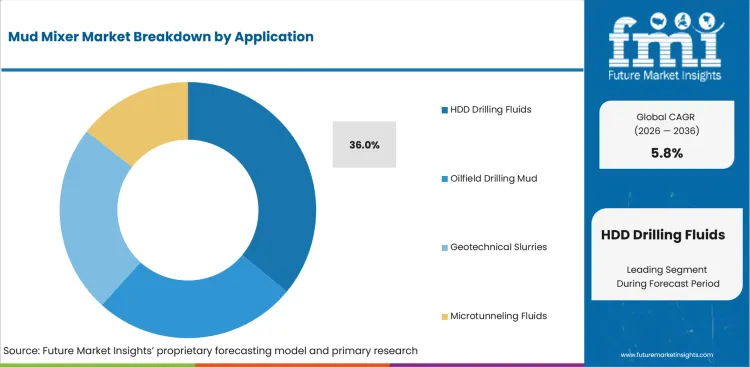
Fiber Broadband Association and Cartesian reported in January 2026 stating 49.0% of survey respondents used both aerial and underground fiber deployment methods in 2025, supporting HDD fluid needs across mixed utility construction programs. HDD drilling fluids are projected to lead application demand as utility and infrastructure bores require prepared mud for cuttings transport and tool cooling.
- HDD drilling fluids are expected to capture 36.0% share in 2026, backed by directional drilling crews repeatedly preparing bentonite and polymer batches before reaming passes and pullback work. Contractors judge application readiness through tank agitation and setup speed across utility crossings.
- Geotechnical slurries and microtunneling fluids create additional demand across soil stabilization and trenchless construction programs. HDD drilling fluids maintain application strength as short-cycle jobs require repeatable mud preparation close to rigs and underground utility corridors.
How do drilling contractors shape end-use demand?
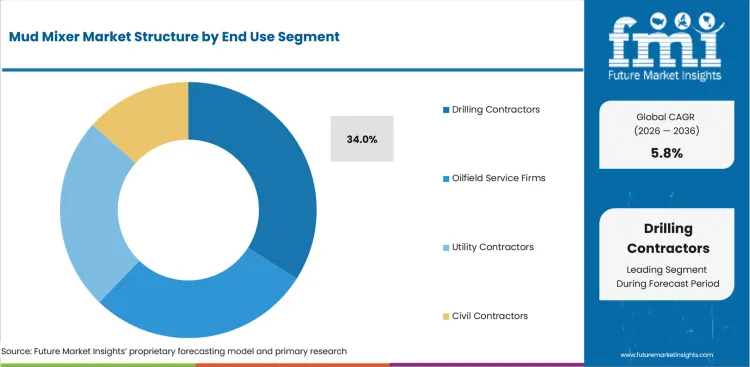
Drilling contractors are estimated to shape end-use as rig operators directly manage mud preparation timing, crew allocation and jobsite equipment placement. The US Energy Information Administration reported in November 2025 that the Lower 48 oil-directed rig count had fallen 33% since December 2022, reaching 397 rigs in October 2025. Fewer rigs delivering record output pushes contractors to protect uptime through efficient fluid preparation and equipment use.
- Drilling contractors are likely to secure 34.0% end-use share in 2026, guided by rig operators needing mixing units positioned near bore work and coordinated with pump schedules. Contractor approvals depend on consumable handling and service response during active drilling assignments.
- Oilfield service firms and civil contractors add demand based on pressure municipal installation and construction slurry needs. Drilling contractors keep end-use leadership as direct job control links equipment choice to rig productivity and daily crew planning.
What are drivers, restraints, and opportunities in Mud Mixer Market?
Adoption advances through faster fluid preparation and stronger field support. Approvals slow under hopper clogging and difficult jobsite handling.
- Driver: HDD and civil drilling teams need mixing units preparing bentonite and additives before rigs lose productive time.
- Restraint: Poor hopper intake and weak tank agitation reduce fluid consistency during active drilling work.
- Opportunity: Automated mud mixing units and higher-output packages support contractors seeking cleaner dosing control and faster batch preparation.
Underground utility projects require steady drilling-fluid supply beside active bore sites. USA Environmental Protection Agency announced in May 2024 stating EPA projected 9 million lead service lines nationwide, promoting pipe identification and replacement work requiring controlled mud preparation.
Maintaining strict safety habits and careful field handling remains essential during any underground construction work. Common Ground Alliance reported in August 2025 stating the top 10 root causes representing 85.0% of reported damages in 2024. High damage numbers inevitably force closer scrutiny of site preparation and controlled drilling practices.
New machinery packages are successfully combining compact sizes with faster fluid processing speeds on the job site. Vermeer reported in October 2024 claiming its R125 reclaimer supports 24,000 lb to 40,000 lb drill classes. Versatile equipment options provide contractors with ideal paired mixing and recycling systems for everyday utility drilling jobs.
What country CAGRs are profiled for Mud Mixer Market?
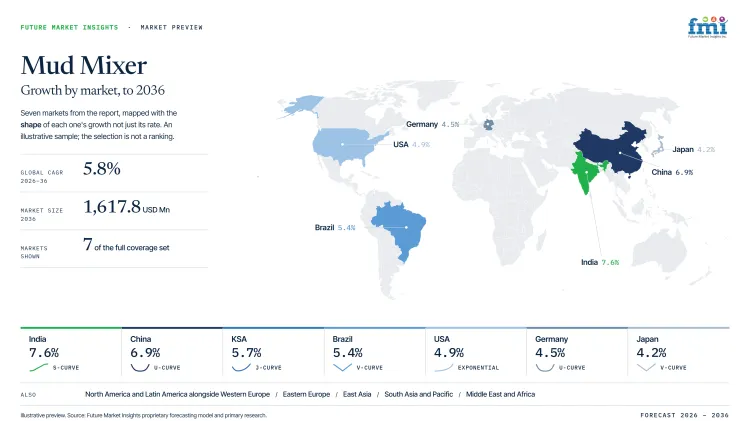
| Country | Forecast CAGR from 2026 to 2036 |
|---|---|
| India | 7.6% |
| China | 6.9% |
| KSA | 5.7% |
| Brazil | 5.4% |
| USA | 4.9% |
| Germany | 4.5% |
| Japan | 4.2% |
Source: Future Market Insights analysis, 2026.
How do country-level CAGRs compare in Mud Mixer Market?
The country comparison spans 3.4 percentage points and reveals three distinct growth tiers across the mud mixer market. India and China lead the comparison with only a 0.7-point difference between them. KSA and Brazil form a closely aligned middle group, separated by just 0.3 percentage points. The United States, Germany and Japan complete the comparison within a narrow 0.7-point range. Markets with higher drilling activity and continued investment in energy and infrastructure projects generally exhibit stronger demand for mud mixing equipment.
- India leads the comparison at 7.6% CAGR. Expansion of oil and gas exploration, geothermal drilling and infrastructure construction continues to increase the use of mud mixers for efficient preparation and handling of drilling fluids across project sites.
- Just 0.7 percentage points below India, China records a CAGR of 6.9%. Ongoing investment in domestic energy development and large-scale civil engineering projects creates favorable conditions for equipment that improves drilling fluid consistency and operational efficiency.
- KSA reaches a CAGR of 5.7%, standing 1.2 percentage points below China. Activity in upstream oil and gas operations, together with continued drilling across conventional and unconventional fields, contributes to steady demand for reliable mud mixing systems.
- Brazil posts a CAGR of 5.4%, only 0.3 percentage points behind KSA. Offshore energy development and continued investment in drilling operations reinforce the use of mud handling equipment that supports efficient wellsite operations.
- At 4.9%, the United States remains 0.5 percentage points below Brazil. Demand reflects ongoing drilling activity across shale basins and continued emphasis on equipment that improves fluid preparation, reduces downtime and supports consistent drilling performance.
- Germany records a CAGR of 4.5%, trailing the United States by 0.4 percentage points. Market opportunities are associated with specialized drilling applications, including geothermal projects and foundation engineering, where precise mud preparation is an important part of field operations.
- Japan registers the lowest CAGR at 4.2%, just 0.3 percentage points below Germany. Demand is linked to tunneling, geotechnical investigations and selected geothermal developments that require dependable drilling fluid mixing under controlled operating conditions.
Comparable CAGRs can still produce different market entry conditions. Differences in drilling activity, energy investment, infrastructure development and project requirements influence equipment adoption, deployment timelines and long-term commercial opportunities. The full report provides country-level CAGR analysis across North America, Latin America, Europe, East Asia, South Asia, Oceania and the Middle East and Africa.
Country-wise Analysis
- The market in India is projected to expand at 7.6% CAGR through 2036, guided by water-network activity and contractor demand for mobile mud preparation around HDD and civil installation sites. India Press Information Bureau reported in March 2026 stating for more than 15.82 crore rural households having tap water supply by March 2026, impacting trenchless and utility construction activity requiring dependable drilling-fluid preparation.
- Urban pipeline renewal supports China equipment needs, as mud mixer adoption anticipated to expand at 6.9% CAGR between 2026 and 2036 due to contractors managing dense underground work and municipal installation schedules. State Council Information Office reported in June 2026 noting China having planned to build or upgrade around 770,000 km of urban underground pipelines during 2026-2030, promoting demand for site-ready mixing units supporting trenchless construction.
- Baker Hughes reported in August 2025 claiming for more than 230 rigs being operated across Saudi Arabia, highlighting equipment need for drilling-fluid preparation and field maintenance support. Industry in the KSA is expected to record 5.7% CAGR by 2036, helped by oilfield service activity and drilling programs needing rugged mud preparation systems near active rigs.
- Industry in Brazil is set to rise at 5.4% CAGR during the assessment period, reflecting water security work and oilfield-linked drilling activity requiring mixing systems for contractors serving dispersed project locations. Federal Government of Brazil reported in March 2025 highlighting water security initiatives supporting over 12 million people across 390 municipalities, improving civil works visibility for contractors using mud mixers on underground installation jobs.
- The market in USA is forecast to grow at 4.9% CAGR from 2026 to 2036, led by utility oilfield service efficiency and contractor replacement of aging preparation equipment. USA Energy Information Administration reported in March 2026 stating crude oil production having reached 13.6 million b/d in 2025, sustaining drilling support demand tied to fluid preparation and solids-control operations.
- Sales in Germany are predicted to scale at 4.5% CAGR during the forecast period, driven by contractors balancing telecom trenchless activity and careful jobsite equipment planning. Bundesnetzagentur reported in June 2026 that active fiber connections increased from 5.3 million at end-2024 to 6.4 million at end-2025, supporting underground network work requiring compact drilling-fluid preparation systems.
- Compact urban works and renewal projects guide Japan, with mud mixer demand likely to rise at 4.2% CAGR between 2026 and 2036 since contractors prioritize controlled layout and dependable batch quality. Government of Japan reported in March 2026 announcing for aging water infrastructure causing about 20,000 leaks and damaging incidents every year, influencing replacement activity connected to trenchless construction tools.
Who are notable companies in Mud Mixer Market?
GN Solids Control and NOV are expected to shape mud-system competition through solids-control depth. Vermeer and Ditch Witch add HDD equipment access through contractor-facing channels. Derrick Corporation and Aipu Solids Control support drilling-fluid treatment requirements. SLB through M-I SWACO and Kem-Tron add oilfield fluid knowledge. HDD Broker supports used and rental equipment sourcing for contractors.
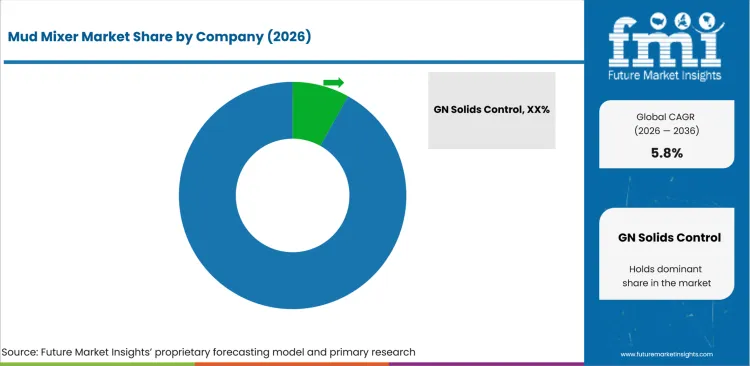
Competition in mud mixer is anticipated to center on hopper design and pump sizing. Tank layout and field service response guide final vendor review. Account teams are likely to compare vendors based on service access and fit with HDD and civil drilling workflows after first approval. GN Solids Control and NOV are expected to receive review attention due to mud-system depth. Vermeer and Ditch Witch are anticipated to compete led by HDD contractor relationships. Derrick Corporation is projected to add separation equipment strength. DC Solid Control and Aipu Solids Control are estimated to compete based on custom mud packages. SLB through M-I SWACO is likely to support oilfield service programs. HDD Broker is forecast to support access to used and rental systems.
- GN Solids Control and NOV hold established positions in solids-control equipment and mud-system engineering. Their experience with integrated packages supports projects that need storage tanks together with field-ready mixing units, which favors suppliers able to deliver the complete fluid circuit from one source.
- Vermeer and Ditch Witch compete through established HDD equipment channels and contractor support networks. Dealer relationships strengthen supplier evaluation, since crews assess drilling-fluid systems alongside the rigs they already operate.
- Derrick Corporation and Aipu Solids Control serve demand through separation equipment and custom mud-system builds. Their equipment depth allows contractors to compare fluid handling packages across drilling sites.
- SLB, through M-I SWACO, and Kem-Tron apply oilfield fluid handling expertise to HDD-scale systems. HDD Broker supports the same evaluation process by giving contractors access to used and rental units for direct comparison.
Competitive Benchmarking: Mud Mixer Market
| Company | Portfolio Depth | Equipment Match | Application Support | Service Reach |
|---|---|---|---|---|
| GN Solids Control | High | High | High | Global |
| NOV | High | High | High | Global |
| Vermeer Corporation | High | High | High | Global |
| The Charles Machine Works, Inc. through Ditch Witch | High | High | High | United States |
| SLB through M-I SWACO | High | Medium | High | Global |
| Derrick Corporation | High | Medium | High | Global |
| DC Solid Control | Medium | High | Medium | Global |
| Aipu Solids Control | Medium | High | Medium | Global |
| Kem-Tron | Medium | Medium | Medium | United States |
Source: Future Market Insights competitive analysis, 2026.
Key Developments in Mud Mixer Market
- In May 2025, GN Solids Control delivered a complete 2000HP drilling rig solids control system to an Indian drilling company. The company stated the package included two jet mud mixing hoppers. Deliveries at this rig class indicate that mixing hoppers are increasingly specified as part of an integrated solids control package rather than bought separately.
- In November 2025, GN Solids Control delivered eight jet mud mixing units to a European client. The company stated each system used an 8x6x14 centrifugal pump driven by a 90 kW electric motor. Multi-unit orders at a fixed specification point to buyers standardizing on packaged mixing units rather than configuring each site individually.
Key Players in Mud Mixer Market
Mud-system and solids-control equipment manufacturers
- GN Solids Control
- NOV
- Derrick Corporation
- DC Solid Control
- Aipu Solids Control
HDD equipment and contractor-channel developers
- Vermeer Corporation
- The Charles Machine Works, Inc. through Ditch Witch
Oilfield fluid handling and service specialists
- SLB through M-I SWACO
- Kem-Tron
Mud Mixer Market - Report Scope
| Coverage field | Report scope |
|---|---|
| Market breakdown | Mud Mixer Market breakdown by mixer type alongside capacity, mobility, application, end use and region |
| Market Definition | Mud mixer includes hopper mixers, shear mixers, jet systems, batch tanks and automated units used to prepare drilling fluids for HDD, oilfield, geotechnical and microtunneling work. |
| Regions Covered | North America and Latin America alongside Western Europe, Eastern Europe, East Asia, South Asia and Pacific, Middle East and Africa |
| Countries Covered | United States and China alongside Germany, Japan, India, KSA and Brazil |
| Key Companies Profiled | GN Solids Control and NOV alongside Vermeer Corporation, The Charles Machine Works, Inc., SLB, Derrick Corporation, DC Solid Control, Aipu Solids Control, Kem-Tron and HDD Broker |
| Forecast Period | 2026 to 2036 |
| Approach | Hybrid bottom-up and top-down methodology using segment share, country CAGR, drilling activity, utility construction, oilfield service needs, company portfolio depth and service exposure |
Source: Future Market Insights analysis, 2026.
Mud Mixer Market - Research Methodology
| Method | Approach |
|---|---|
| Primary Research | FMI analysts gathered input from manufacturers, service providers, technology developers, distributors, end users, procurement teams, and subject-matter experts. Interviews examined purchasing decisions, product or service evaluation, adoption barriers, approval requirements, pricing considerations, and expectations for technical or commercial support. Respondents were also asked what evidence is required before a trial, pilot, or initial order develops into regular purchasing. |
| Desk Research | Desk research covered government statistics, regulatory publications, trade data, industry associations, technical literature, standards, company filings, product information, and official corporate announcements. Sources were reviewed for relevance, publication date, geographic coverage, and consistency with the defined market scope. Claims relating to performance, applications, approvals, capacity, investment, and commercial activity were retained only when supported by credible public evidence. |
| Market Sizing and Forecasting | The market model combined the baseline value with historical performance, segment structure, pricing and volume indicators, adoption levels, company participation, and country-level demand conditions. Forecast assumptions considered economic activity, investment trends, regulatory developments, technology adoption, purchasing cycles, supply availability, and barriers to wider market use. Segment and regional estimates were reconciled before the final market total was calculated. |
| Data Validation | Estimates were checked against multiple independent indicators, including public data, company activity, trade patterns, industry developments, and findings from primary interviews. Validation also tested whether products, services, applications, and company revenues fell within the defined market boundaries. Adjacent categories, unsupported claims, overlapping revenues, and activities without direct market relevance were excluded to reduce double counting and maintain consistency across segments and countries. |
Mud Mixer Market by Segments
Mud Mixer Market segmented by Mixer Type:
- Venturi hopper mixers
- Shear mixers
- Jet mixing systems
- Batch mixing tanks
- Automated mud mixing units
Mud Mixer Market segmented by Capacity:
- Below 200 GPM
- 200-500 GPM
- Above 500 GPM
Mud Mixer Market segmented by Mobility:
- Skid-mounted
- Trailer-mounted
- Truck-mounted
- Stationary plant
Mud Mixer Market segmented by Application:
- HDD drilling fluids
- Oilfield drilling mud
- Geotechnical slurries
- Microtunneling fluids
Mud Mixer Market segmented by End Use:
- Drilling contractors
- Oilfield service firms
- Utility contractors
- Civil contractors
Mud Mixer Market by Region:
- North America
- United States
- Canada
- Latin America
- Brazil
- Mexico
- Argentina
- Western Europe
- Germany
- United Kingdom
- France
- Italy
- Spain
- Eastern Europe
- Russia
- Poland
- East Asia
- China
- Japan
- South Korea
- South Asia and Pacific
- India
- Thailand
- Indonesia
- Oceania
- Australia
- New Zealand
- Middle East and Africa
- GCC countries
- South Africa
- Türkiye
Research Sources and Bibliography
- Baker Hughes. (2025, August). Updated Baker Hughes Worldwide Rig Count for Saudi Arabia rig operations.
- Bundesnetzagentur. (2026, June 5). Telecoms Annual Report 2025.
- Common Ground Alliance. (2025, August 28). CGA DIRT Report highlights concerning levels of damages to buried utilities, signals need for industry-wide changes.
- Ditch Witch. (2025, January 3). New Ditch Witch JT21 drill slashes job times with best-in-class power and speed.
- Federal Government of Brazil. (2025, March 25). Federal Government advances water security projects, policies.
- Fiber Broadband Association and Cartesian. (2026, January). Fiber Deployment Cost Annual Report 2025.
- GN Solids America. (2025, May 29). 2000HP Drilling Rig Solids Control System Delivered to Indian Drilling Company.
- GN Solids Control. (2025, November 23). GN Jet Mud Mixing Hopper Unit for Europe Client.
- India Press Information Bureau. (2026, March 13). People, Panchayats and Jal Jeevan Mission.
- JapanGov. (2026, March 6). The New Face of Water: Safe, Reliable, and Drinkable for Everyone.
- National Bureau of Statistics of China. (2025, May 19). China fixed-asset investment up 4 pct in Jan-April.
- State Council Information Office of the People’s Republic of China. (2026, June 8). China to build, upgrade 770,000 km of urban underground pipelines.
- USA Energy Information Administration. (2025, November 17). USA rig counts remain low as production efficiencies improve.
- USA Energy Information Administration. (2026, March 31). USA crude oil production rose in 2025, setting new record.
- Vermeer Corporation. (2024, September 23). Vermeer introduces compact, efficient MX150 mixing system.
- Vermeer Corporation. (2024, October 1). Vermeer R125 reclaimer designed for utility horizontal directional drills.
- Vermeer Corporation. (2026, March 24). New cab for Vermeer D24 horizontal directional drill enhances operator comfort and productivity.
- Baker Hughes. (2026, July 10). Rig count overview & summary count.
- USA Environmental Protection Agency. (2024, May 2). Biden-Harris Administration announces $3 billion for lead pipe replacement to advance safe drinking water as part of Investing in America agenda.
This bibliography is provided for reader reference and is not exhaustive. The full report contains the complete reference list and detailed citations.
This Report Answers
- What segments shape demand across mixer type, capacity, mobility, application and end use?
- How do drilling contractors evaluate mud mixer systems before replacing older fluid-preparation setups?
- How do country CAGRs differ across profiled markets?
- What companies compete through hopper design and service support?
- How are forecasts validated using a hybrid bottom-up and top-down approach?
- What factors do account teams address before larger account expansion?
- How do fluid consistency and service evidence affect vendor selection?
- What limits return on investment for teams adding mud mixer systems?
- How do capacity bands and tank layouts influence account approval?
- What vendor capabilities improve long-term account confidence?
Frequently Asked Questions
What supports demand in mud mixer market?
Demand is likely to be supported by drilling teams needing prepared fluid before rigs lose productive time during HDD and civil work. Accounts are expected to favor vendors combining pump reliability and service response.
Who are key players in mud mixer market?
Key companies are anticipated to include GN Solids Control and NOV among others to support competition. Competition is likely to be based on mud-system evidence and regional contractor support coverage.
What restraint affects mud mixer market?
A major restraint is the quality burden created by worn pumps and weak tank movement during active drilling work. Accounts slow adoption if systems lack service evidence or operator access needed for field approval.
Why do executives track mud mixer market?
Executives are expected to track mud mixer as fluid preparation choices affect rig uptime and contractor productivity. Factors such as batch speed and maintenance support shape buyer reviews.
What business problem does mud mixer market address?
Mud mixer addresses the operational gap created by rigs needing prepared drilling fluid before bore activity advances. Drilling contractors and oilfield service firms need equipment supporting repeatable mixing and field-ready service evidence.
What do account teams evaluate before selecting vendors?
Account teams are likely to evaluate hopper intake and repeat-batch reliability before vendor approval. Tank design and technical documentation are expected to guide final vendor review.
What limits return on investment for purchasing teams?
Return on investment weakens if mixing performance or account acceptance is not proven before deployment. Rework and delayed batches reduce expected margin gains.
How do vendors build long-term account confidence?
Vendors build account confidence by providing consistent equipment quality and evidence specific to mud mixer operations. Installation records and responsive troubleshooting support are expected to influence repeat-order trust.
Preview the report firsthand - request a free sample
Get SampleGet the brochure for pricing and purchase details.
Get PDFTable of Content
- Key Takeaways
- Market Size and CAGR
- Top Growth Driver
- Fastest Growing Segment
- Leading Region
- Key Companies
- Emerging Opportunities
- Executive Summary
- Global Market Outlook
- Demand-side Trends
- Supply-side Trends
- Technology Roadmap Analysis
- Analysis and Recommendations
- Analyst Perspective (What is happening? Why now? What should investors know?)
- Key Questions Answered
- How large is the market?
- What is the CAGR?
- What are key trends?
- Which region dominates?
- Who are the leaders?
- Market Overview
- Market Coverage / Taxonomy
- Market Definition / Scope / Limitations
- Research Methodology
- Chapter Orientation
- Analytical Lens and Working Hypotheses
- Market Structure, Signals, and Trend Drivers
- Benchmarking and Cross-market Comparability
- Market Sizing, Forecasting, and Opportunity Mapping
- Research Design and Evidence Framework
- Desk Research Programme (Secondary Evidence)
- Expert Input and Fieldwork (Primary Evidence)
- Tooling, Models, and Reference Databases
- Data Engineering and Model Build
- Quality Assurance and Audit Trail
- Market Background
- Market Dynamics (Drivers, Restraints, Opportunity, Trends)
- Scenario Forecast (Optimistic, Likely, Conservative)
- Impact Analysis
- AI Impact
- Sustainability Impact
- Regulatory Impact
- Technology Impact
- Consumer / Buyer Analysis
- Purchase Drivers
- Adoption Barriers
- Buyer Journey
- Opportunity Map Analysis
- Product Life Cycle Analysis
- Supply Chain Analysis
- Investment Feasibility Matrix
- Value Chain Analysis
- PESTLE and Porter's Analysis
- Regulatory Landscape
- Regional Parent Market Outlook
- Production and Consumption Statistics
- Import and Export Statistics
- Global Market Analysis and Forecast, 2021 to 2036
- Historical Market Size Value (USD Million) & Volume (Unit) Analysis, 2021 to 2025
- Current and Future Market Size Value (USD Million) & Volume (Unit) Projections, 2026 to 2036
- Y-o-Y Growth Trend Analysis
- Absolute $ Opportunity Analysis
- Global Market Pricing Analysis, 2021 to 2036
- Global Market Analysis and Forecast, By Mixer Type, 2021 to 2036
- Introduction / Key Findings
- Historical Market Size Value (USD Million) & Volume (Unit) Analysis By Mixer Type, 2021 to 2025
- Current and Future Market Size Value (USD Million) & Volume (Unit) Analysis and Forecast By Mixer Type, 2026 to 2036
- Venturi Hopper Mixers
- Shear Mixers
- Jet Mixing Systems
- Batch Mixing Tanks
- Automated Mud Mixing Value (USD Million) & Volume (Unit)s
- Venturi Hopper Mixers
- Y-o-Y Growth Trend Analysis By Mixer Type, 2021 to 2025
- Absolute $ Opportunity Analysis By Mixer Type, 2026 to 2036
- Global Market Analysis and Forecast, By Capacity, 2021 to 2036
- Introduction / Key Findings
- Historical Market Size Value (USD Million) & Volume (Unit) Analysis By Capacity, 2021 to 2025
- Current and Future Market Size Value (USD Million) & Volume (Unit) Analysis and Forecast By Capacity, 2026 to 2036
- 200-500 GPM
- <200 GPM
- >500 GPM
- Y-o-Y Growth Trend Analysis By Capacity, 2021 to 2025
- Absolute $ Opportunity Analysis By Capacity, 2026 to 2036
- Global Market Analysis and Forecast, By Mobility, 2021 to 2036
- Introduction / Key Findings
- Historical Market Size Value (USD Million) & Volume (Unit) Analysis By Mobility, 2021 to 2025
- Current and Future Market Size Value (USD Million) & Volume (Unit) Analysis and Forecast By Mobility, 2026 to 2036
- Skid-mounted
- Trailer-mounted
- Truck-mounted
- Stationary Plant
- Skid-mounted
- Y-o-Y Growth Trend Analysis By Mobility, 2021 to 2025
- Absolute $ Opportunity Analysis By Mobility, 2026 to 2036
- Global Market Analysis and Forecast, By Application, 2021 to 2036
- Introduction / Key Findings
- Historical Market Size Value (USD Million) & Volume (Unit) Analysis By Application, 2021 to 2025
- Current and Future Market Size Value (USD Million) & Volume (Unit) Analysis and Forecast By Application, 2026 to 2036
- HDD Drilling Fluids
- Oilfield Drilling Mud
- Geotechnical Slurries
- Microtunneling Fluids
- HDD Drilling Fluids
- Y-o-Y Growth Trend Analysis By Application, 2021 to 2025
- Absolute $ Opportunity Analysis By Application, 2026 to 2036
- Global Market Analysis and Forecast, By End Use, 2021 to 2036
- Introduction / Key Findings
- Historical Market Size Value (USD Million) & Volume (Unit) Analysis By End Use, 2021 to 2025
- Current and Future Market Size Value (USD Million) & Volume (Unit) Analysis and Forecast By End Use, 2026 to 2036
- Drilling Contractors
- Oilfield Service Firms
- Utility Contractors
- Civil Contractors
- Drilling Contractors
- Y-o-Y Growth Trend Analysis By End Use, 2021 to 2025
- Absolute $ Opportunity Analysis By End Use, 2026 to 2036
- Global Market Analysis and Forecast, By Region, 2021 to 2036
- Introduction
- Historical Market Size Value (USD Million) & Volume (Unit) Analysis By Region, 2021 to 2025
- Current Market Size Value (USD Million) & Volume (Unit) Analysis and Forecast By Region, 2026 to 2036
- North America
- Latin America
- Western Europe
- Eastern Europe
- East Asia
- South Asia and Pacific
- Middle East & Africa
- Market Attractiveness Analysis By Region
- North America Market Analysis and Forecast, By Country, 2021 to 2036
- Historical Market Size Value (USD Million) & Volume (Unit) Trend Analysis By Market Taxonomy, 2021 to 2025
- Market Size Value (USD Million) & Volume (Unit) Forecast By Market Taxonomy, 2026 to 2036
- By Country
- USA
- Canada
- By Mixer Type
- By Capacity
- By Mobility
- By Application
- By End Use
- By Country
- Market Attractiveness Analysis
- By Country
- By Mixer Type
- By Capacity
- By Mobility
- By Application
- By End Use
- Key Takeaways
- Latin America Market Analysis and Forecast, By Country
- Historical Market Size Value (USD Million) & Volume (Unit) Trend Analysis By Market Taxonomy, 2021 to 2025
- Market Size Value (USD Million) & Volume (Unit) Forecast By Market Taxonomy, 2026 to 2036
- By Country
- Brazil
- Mexico
- Chile
- Rest of Latin America
- By Mixer Type
- By Capacity
- By Mobility
- By Application
- By End Use
- By Country
- Market Attractiveness Analysis
- By Country
- By Mixer Type
- By Capacity
- By Mobility
- By Application
- By End Use
- Key Takeaways
- Western Europe Market Analysis and Forecast, By Country
- Historical Market Size Value (USD Million) & Volume (Unit) Trend Analysis By Market Taxonomy, 2021 to 2025
- Market Size Value (USD Million) & Volume (Unit) Forecast By Market Taxonomy, 2026 to 2036
- By Country
- Germany
- UK
- Italy
- Spain
- France
- Nordic
- BENELUX
- Rest of Western Europe
- By Mixer Type
- By Capacity
- By Mobility
- By Application
- By End Use
- By Country
- Market Attractiveness Analysis
- By Country
- By Mixer Type
- By Capacity
- By Mobility
- By Application
- By End Use
- Key Takeaways
- Eastern Europe Market Analysis and Forecast, By Country
- Historical Market Size Value (USD Million) & Volume (Unit) Trend Analysis By Market Taxonomy, 2021 to 2025
- Market Size Value (USD Million) & Volume (Unit) Forecast By Market Taxonomy, 2026 to 2036
- By Country
- Russia
- Poland
- Hungary
- Balkan & Baltic
- Rest of Eastern Europe
- By Mixer Type
- By Capacity
- By Mobility
- By Application
- By End Use
- By Country
- Market Attractiveness Analysis
- By Country
- By Mixer Type
- By Capacity
- By Mobility
- By Application
- By End Use
- Key Takeaways
- East Asia Market Analysis and Forecast, By Country
- Historical Market Size Value (USD Million) & Volume (Unit) Trend Analysis By Market Taxonomy, 2021 to 2025
- Market Size Value (USD Million) & Volume (Unit) Forecast By Market Taxonomy, 2026 to 2036
- By Country
- China
- Japan
- South Korea
- By Mixer Type
- By Capacity
- By Mobility
- By Application
- By End Use
- By Country
- Market Attractiveness Analysis
- By Country
- By Mixer Type
- By Capacity
- By Mobility
- By Application
- By End Use
- Key Takeaways
- South Asia and Pacific Market Analysis and Forecast, By Country
- Historical Market Size Value (USD Million) & Volume (Unit) Trend Analysis By Market Taxonomy, 2021 to 2025
- Market Size Value (USD Million) & Volume (Unit) Forecast By Market Taxonomy, 2026 to 2036
- By Country
- India
- ASEAN
- Australia & New Zealand
- Rest of South Asia and Pacific
- By Mixer Type
- By Capacity
- By Mobility
- By Application
- By End Use
- By Country
- Market Attractiveness Analysis
- By Country
- By Mixer Type
- By Capacity
- By Mobility
- By Application
- By End Use
- Key Takeaways
- Middle East & Africa Market Analysis and Forecast, By Country
- Historical Market Size Value (USD Million) & Volume (Unit) Trend Analysis By Market Taxonomy, 2021 to 2025
- Market Size Value (USD Million) & Volume (Unit) Forecast By Market Taxonomy, 2026 to 2036
- By Country
- Kingdom of Saudi Arabia
- Other GCC Countries
- Türkiye
- South Africa
- Other African Union
- Rest of Middle East & Africa
- By Mixer Type
- By Capacity
- By Mobility
- By Application
- By End Use
- By Country
- Market Attractiveness Analysis
- By Country
- By Mixer Type
- By Capacity
- By Mobility
- By Application
- By End Use
- Key Takeaways
- Key Countries Market Analysis
- USA
- Pricing Analysis
- Market Share Analysis, 2025
- By Mixer Type
- By Capacity
- By Mobility
- By Application
- By End Use
- Canada
- Pricing Analysis
- Market Share Analysis, 2025
- By Mixer Type
- By Capacity
- By Mobility
- By Application
- By End Use
- Mexico
- Pricing Analysis
- Market Share Analysis, 2025
- By Mixer Type
- By Capacity
- By Mobility
- By Application
- By End Use
- Brazil
- Pricing Analysis
- Market Share Analysis, 2025
- By Mixer Type
- By Capacity
- By Mobility
- By Application
- By End Use
- Chile
- Pricing Analysis
- Market Share Analysis, 2025
- By Mixer Type
- By Capacity
- By Mobility
- By Application
- By End Use
- Germany
- Pricing Analysis
- Market Share Analysis, 2025
- By Mixer Type
- By Capacity
- By Mobility
- By Application
- By End Use
- UK
- Pricing Analysis
- Market Share Analysis, 2025
- By Mixer Type
- By Capacity
- By Mobility
- By Application
- By End Use
- Italy
- Pricing Analysis
- Market Share Analysis, 2025
- By Mixer Type
- By Capacity
- By Mobility
- By Application
- By End Use
- Spain
- Pricing Analysis
- Market Share Analysis, 2025
- By Mixer Type
- By Capacity
- By Mobility
- By Application
- By End Use
- France
- Pricing Analysis
- Market Share Analysis, 2025
- By Mixer Type
- By Capacity
- By Mobility
- By Application
- By End Use
- India
- Pricing Analysis
- Market Share Analysis, 2025
- By Mixer Type
- By Capacity
- By Mobility
- By Application
- By End Use
- ASEAN
- Pricing Analysis
- Market Share Analysis, 2025
- By Mixer Type
- By Capacity
- By Mobility
- By Application
- By End Use
- Australia & New Zealand
- Pricing Analysis
- Market Share Analysis, 2025
- By Mixer Type
- By Capacity
- By Mobility
- By Application
- By End Use
- China
- Pricing Analysis
- Market Share Analysis, 2025
- By Mixer Type
- By Capacity
- By Mobility
- By Application
- By End Use
- Japan
- Pricing Analysis
- Market Share Analysis, 2025
- By Mixer Type
- By Capacity
- By Mobility
- By Application
- By End Use
- South Korea
- Pricing Analysis
- Market Share Analysis, 2025
- By Mixer Type
- By Capacity
- By Mobility
- By Application
- By End Use
- Russia
- Pricing Analysis
- Market Share Analysis, 2025
- By Mixer Type
- By Capacity
- By Mobility
- By Application
- By End Use
- Poland
- Pricing Analysis
- Market Share Analysis, 2025
- By Mixer Type
- By Capacity
- By Mobility
- By Application
- By End Use
- Hungary
- Pricing Analysis
- Market Share Analysis, 2025
- By Mixer Type
- By Capacity
- By Mobility
- By Application
- By End Use
- Kingdom of Saudi Arabia
- Pricing Analysis
- Market Share Analysis, 2025
- By Mixer Type
- By Capacity
- By Mobility
- By Application
- By End Use
- Türkiye
- Pricing Analysis
- Market Share Analysis, 2025
- By Mixer Type
- By Capacity
- By Mobility
- By Application
- By End Use
- South Africa
- Pricing Analysis
- Market Share Analysis, 2025
- By Mixer Type
- By Capacity
- By Mobility
- By Application
- By End Use
- USA
- Market Structure Analysis
- Competition Dashboard
- Competition Benchmarking
- Market Share Analysis of Top Players
- By Regional
- By Mixer Type
- By Capacity
- By Mobility
- By Application
- By End Use
- Emerging Startups
- Innovation Benchmarking
- Competition Analysis
- Competition Deep Dive
- GN Solids Control
- Overview
- Product Portfolio
- Profitability by Market Segments
- Sales Footprint
- Strategy Overview
- Marketing Strategy
- Product Strategy
- Channel Strategy
- NOV
- Vermeer
- Ditch Witch
- M-I SWACO
- Kem-Tron
- Derrick Corporation
- DC Solid Control
- Aipu Solids Control
- HDD Broker
- GN Solids Control
- Case Studies
- Success Stories
- Recent Developments
- Competition Deep Dive
- Assumptions & Acronyms Used


