

- Industry Size (2026)
- USD 680 Mn
- Forecast (2036)
- USD 1720 Mn
- CAGR (2026 to 2036)
- 9.7%
Multi-Piston Viscous Filler Market Forecast and Outlook 2026 to 2036
The multi-piston viscous filler market is expected to experience steady growth from 2026 to 2036. In 2026, the market value is projected to be USD 680 million, with steady growth anticipated, reaching USD 1,720 million by 2036. The compound annual growth rate (CAGR) for this market is forecasted at 9.7%, driven by the increasing demand for precise and efficient filling solutions in industries such as food and beverage, pharmaceuticals, and chemicals. Multi-piston viscous fillers offer higher accuracy, faster production speeds, and greater flexibility, making them an attractive choice for a wide range of viscous product applications.
The market will benefit from advancements in filling technologies, as manufacturers look for solutions to enhance production efficiency and meet strict regulatory requirements. As the demand for automated and high-speed filling solutions grows, multi-piston viscous fillers will continue to be increasingly adopted across various industries. The market is expected to experience steady growth, supported by the increasing need for efficient and scalable filling solutions.
Quick Stats of the Multi-Piston Viscous Filler Market
- Multi-Piston Viscous Filler Market Value (2026): USD 680 million
- Multi-Piston Viscous Filler Market Forecast Value (2036): USD 1,720 million
- Multi-Piston Viscous Filler Market Global Forecast CAGR (2026-2036): 9.7%
- Multi-Piston Viscous Filler Market Leading Segment: Technology (CIP/SIP-ready piston filling) 55%
- Key Growth Regions in Multi-Piston Viscous Filler Market: China
- Top Players in Multi-Piston Viscous Filler Market: Tetra Pak, Krones, Newamstar, Nichrome, Local OEMs, Shibuya, JBT, Bosch Packaging
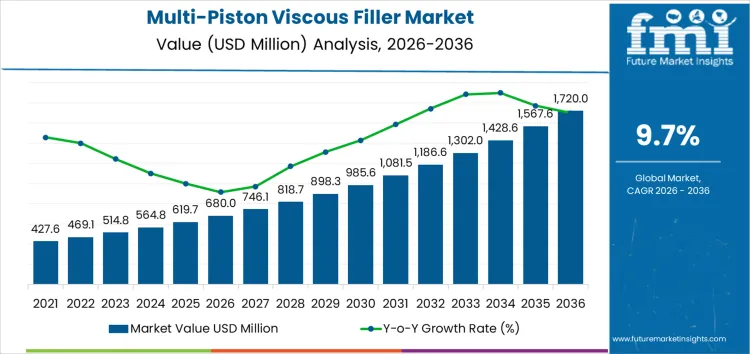
What is the Growth Forecast for the Multi-Piston Viscous Filler Market through 2036?
The growth forecast for the multi-piston viscous filler market indicates strong expansion, with a projected CAGR of 9.7%. Starting at USD 680 million in 2026, the market will experience steady year-on-year growth, reaching USD 746.8 million in 2027, USD 819.7 million in 2028, and USD 899.2 million in 2029. By 2030, the market value is projected to grow to USD 986.7 million, continuing its upward trend throughout the forecast period.
From 2031 to 2036, the market will maintain consistent growth, reaching USD 1,083.9 million in 2031, USD 1,192.5 million in 2032, and USD 1,314.8 million in 2033. The market will continue to expand, with values rising to USD 1,443.8 million in 2034, USD 1,589.1 million in 2035, and USD 1,720 million by 2036. The inflection point mapping shows a gradual acceleration in the market as demand increases for high-performance, automated filling systems, with the most significant growth expected in the middle of the forecast period.
Multi-Piston Viscous Filler Market Key Takeaways
| Metric | Value |
|---|---|
| Industry Sales Value (2026) | USD 680 million |
| Industry Forecast Value (2036) | USD 1,720 million |
| Industry Forecast CAGR (2026-2036) | 9.7% |
What Is Driving the Demand for the Multi-Piston Viscous Filler Market Globally?
The global demand for multi piston viscous fillers is being driven by expanding production of viscous and shear sensitive products in food, cosmetics, pharmaceuticals, and adhesives industries where precise dosing and gentle handling are essential. Multi piston fillers use multiple synchronized pistons to dispense thick liquids, pastes, creams, gels, and other high viscosity formulations with accuracy and repeatability. As manufacturers seek to improve throughput, reduce waste, and maintain consistent product quality, these systems offer advantages over gravity or pump based fillers, especially for products prone to aeration, texture change, or ingredient separation. Growth in convenience food formats, personal care and beauty products, specialty adhesives, and medical formulations has increased reliance on equipment capable of handling complex rheologies while delivering accurate fill volumes across a range of container sizes. Evolving food safety and pharmaceutical quality standards also reinforce investment in controlled, sanitary filling technologies that minimise contamination risk and support traceability.
Future demand for multi piston viscous fillers is expected to grow as automation, flexibility, and ease of changeover become more pressing for manufacturers adapting to shorter product lifecycles and greater SKU variety. Advances in machine design, servo drive control, and user interfaces are improving fill precision, reducing downtime, and enabling integration with vision systems and line management software, which enhances overall equipment effectiveness. Expansion of mid tier and regional manufacturing capacity, particularly in Asia Pacific and Latin America, will broaden the addressable market as more producers adopt higher performance filling solutions to meet quality expectations. Sustainability considerations, such as reducing product giveaway and energy use, will further support adoption because accurate filling reduces waste and improves resource utilisation. Integration with hygienic design and clean in place capabilities will influence uptake in food and life sciences sectors where sanitation is critical. As manufacturers balance cost pressures with demands for accuracy, flexibility, and compliance, multi piston viscous fillers are poised to expand steadily, driven by performance benefits that align with global trends in high viscosity product manufacturing.
What are the Leading Segments in the Global Multi-Piston Viscous Filler Market?
The global multi-piston viscous filler market is segmented by filler type and product viscosity range. Among filler types, servo-driven multi-piston fillers lead the market, capturing 45% of the share, followed by volumetric piston fillers, rotary piston fillers, and inline piston fillers. Servo-driven fillers are preferred for their precision, flexibility, and ability to handle high-speed, high-accuracy filling processes. On the product viscosity range side, high-viscosity & chunky products dominate the market, accounting for 50% of the share, followed by medium-high viscosity, medium viscosity, and viscous foods. The demand for fillers capable of handling thicker, chunkier products is increasing in industries like food and beverages, cosmetics, and pharmaceuticals.
What Drives the Growth of Servo-Driven Multi-Piston Fillers in the Multi-Piston Viscous Filler Market?
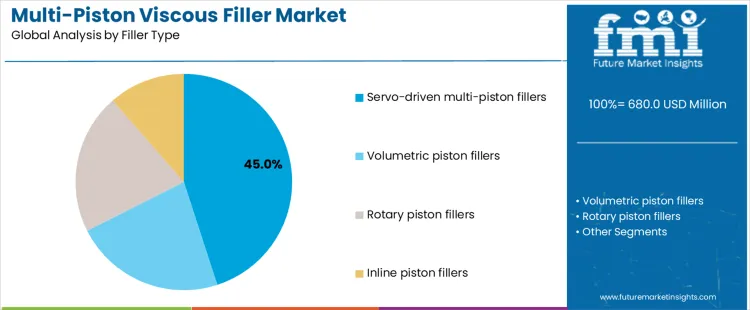
Servo-driven multi-piston fillers are the leading type in the multi-piston viscous filler market, holding 45% of the share. These fillers are preferred due to their high precision, speed, and flexibility, making them ideal for applications where exact portion control and high throughput are required. Servo-driven technology allows for better control of the filling process, ensuring consistent and accurate product delivery even for products with varying viscosities. These fillers are particularly valued in industries like food and beverage, cosmetics, and pharmaceuticals, where consistency and quality control are critical. The ability to handle complex filling tasks, adjust for changes in product viscosity, and perform efficiently at high speeds makes servo-driven multi-piston fillers highly desirable. Additionally, the increasing demand for automation in production lines and the need for flexible solutions capable of handling various viscosities further fuel the growth of this segment.
What is Driving the Demand for High-Viscosity & Chunky Products in the Multi-Piston Viscous Filler Market?
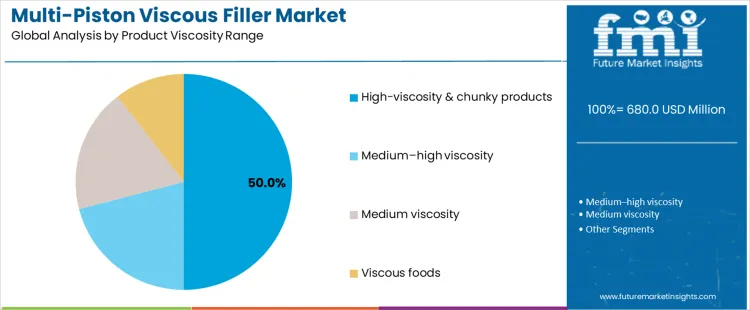
High-viscosity & chunky products are the dominant product viscosity range in the multi-piston viscous filler market, capturing 50% of the share. The demand for fillers capable of handling high-viscosity and chunky products is driven by the growing need for packaging solutions in industries such as food and beverages, cosmetics, and pharmaceuticals, where thick or chunk-filled products are common. Examples include products like sauces, jams, creams, pastes, and cosmetics with suspended particles, which require specialized equipment to ensure accurate filling without compromising product integrity. Multi-piston fillers designed for high-viscosity and chunky products are equipped to handle the challenges of filling thick or chunky substances, such as maintaining consistent flow and preventing clogging or spillage. As consumer demand for premium, textured products continues to rise, the need for specialized filling technologies that can handle these complex formulations will continue to grow, further solidifying the dominance of high-viscosity and chunky products in the market.
What is the Market Overview of the Global Multi-Piston Viscous Filler Market?
The global multi piston viscous filler market is expanding as manufacturers seek high speed, precision filling solutions for viscous products in industries such as food and beverage, cosmetics, pharmaceuticals, and industrial chemicals. Multi piston systems use coordinated pistons to deliver accurate, repeatable doses of thick liquids like sauces, creams, gels and adhesives. Growth reflects rising demand for automation, consistent fill quality and production flexibility across packaging formats. Adoption is supported by increased production volumes, focus on reducing waste and labor costs, and broader implementation of advanced filling technologies in processing facilities worldwide.
What are the Key Drivers for the Global Multi Piston Viscous Filler Market?
A key driver is the need for accurate, efficient filling of high viscosity products that traditional volumetric or gravity fillers struggle to handle reliably. Food and beverage producers, cosmetic formulators and chemical manufacturers turn to multi piston fillers to maintain consistent weight or volume, improve throughput and minimize product giveaway. Rising consumer demand for processed foods, personal care products and paints/coatings increases production pressure, encouraging investment in automated filling lines. Technology improvements in servo driven pistons and control systems support precision, fast changeovers and integration with digital process monitoring, reinforcing adoption in both high and mid volume manufacturing environments.
What are the Restraints for the Global Multi Piston Viscous Filler Market?
One restraint is the higher initial cost and complexity of multi piston filler systems compared with simpler dosing methods. Small to medium enterprises may hesitate to invest without clear short term return on investment, especially where production volumes are variable. Integration with existing packaging lines, training for operators, and maintenance of precise mechanical systems require planning and resources. Viscous materials with particulates, abrasives or extreme thixotropic behavior can challenge filler design and require customized solutions, increasing engineering and validation time. Variability in regulatory requirements for sanitary design in food and pharmaceutical applications also affects specification and rollout timelines across regions.
What is the Key Trends in the Global Multi Piston Viscous Filler Market?
A key trend is integration of Industry 4.0 capabilities such as IoT connectivity, real time diagnostics and predictive maintenance that enhance uptime and process control. Manufacturers are offering modular, easily reconfigurable multi piston fillers that support fast format changes, recipe memory and remote monitoring. Growth of flexible automation that accommodates multiple product viscosities and packaging types on a single platform increases line utility. Advances in servo technology and electronics allow smoother, more accurate piston motion and reduced cycle times. Sustainability considerations are influencing designs that minimize product waste, energy use and cleaning requirements, aligning filling performance with eco efficiency goals.
What is the Country-Wise Analysis of the Multi-Piston Viscous Filler Market?
The multi-piston viscous filler market is expected to grow steadily, driven by increasing demand for high-precision filling systems in industries such as food and beverage, pharmaceuticals, and cosmetics. Multi-piston viscous fillers provide accurate, efficient filling for thick or sticky liquids, which is crucial in many production lines. High-growth markets like China and India are seeing strong demand due to rapid industrialization, increasing manufacturing activities, and the growing focus on improving production efficiencies. Developed markets such as the USA, Germany, and Brazil are also experiencing steady growth, supported by the need for advanced filling technologies and the push for greater operational efficiency in packaging systems.
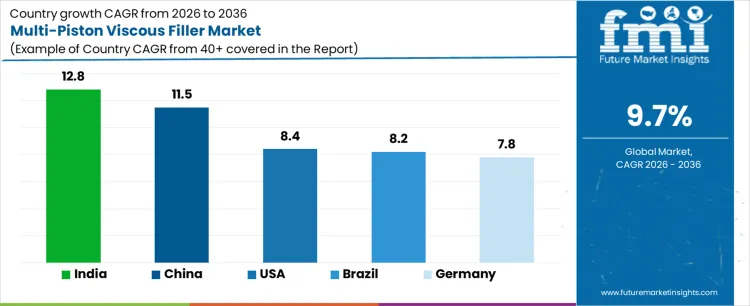
| Country | CAGR (%) |
|---|---|
| China | 11.5 |
| India | 12.8 |
| United States | 8.4 |
| Germany | 7.8 |
| Brazil | 8.2 |
What is the Growth Outlook for the Multi-Piston Viscous Filler Market in China?
The multi-piston viscous filler market in China is expected to grow at the highest rate, with a projected CAGR of 11.5%. China’s rapid industrialization and significant expansion of the food and beverage, pharmaceutical, and cosmetics sectors are driving the demand for more efficient, high-precision filling systems. As the country continues to modernize its manufacturing processes and focus on improving production capabilities, the need for advanced filling technologies, such as multi-piston viscous fillers, is increasing. The rise of automation in China’s packaging sector is further contributing to market growth, with companies seeking to optimize their filling processes for higher productivity and accuracy.
What is the Market Outlook for the Multi-Piston Viscous Filler Market in India?
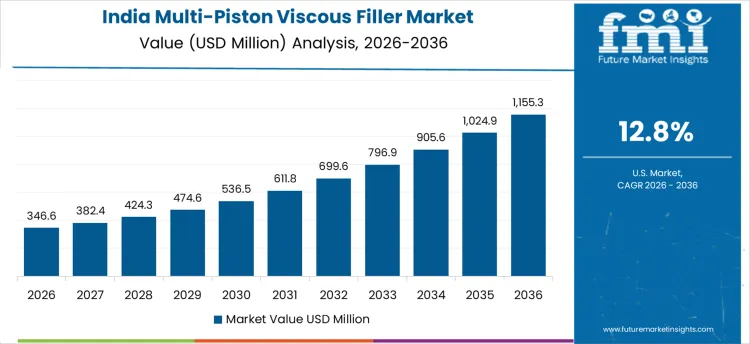
The multi-piston viscous filler market in India is projected to grow at the highest rate, with a projected CAGR of 12.8%. India’s expanding manufacturing sector, coupled with increasing demand for high-precision filling technologies in food processing, pharmaceuticals, and cosmetics, is driving significant market growth. The shift towards automation and more efficient production systems is also contributing to the adoption of advanced filling technologies. As Indian industries look to improve production capacity and reduce waste, the demand for multi-piston viscous fillers is expected to rise. Additionally, India’s growing focus on improving manufacturing standards and meeting global quality expectations will continue to support market expansion.
What is the Growth Forecast for the Multi-Piston Viscous Filler Market in the United States?
The multi-piston viscous filler market in the United States is expected to grow steadily, with a projected CAGR of 8.4%. The U.S. packaging and manufacturing industries, particularly in sectors such as food, beverages, and pharmaceuticals, are increasingly adopting advanced filling solutions to improve efficiency and precision. Multi-piston viscous fillers are essential for filling thick, sticky liquids, and as demand for these products increases, U.S. companies are investing in more efficient, automated filling systems. The market’s growth is also driven by the rising focus on reducing production costs, increasing throughput, and maintaining high-quality standards in packaging operations, making multi-piston viscous fillers an essential technology.
What is the Market Outlook for the Multi-Piston Viscous Filler Market in Germany?
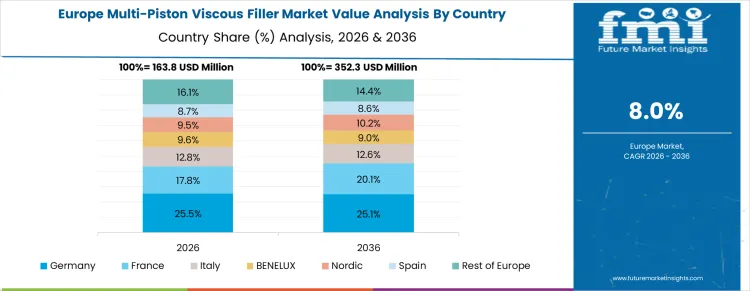
The multi-piston viscous filler market in Germany is projected to grow at a steady pace, with a projected CAGR of 7.8%. Germany’s well-established manufacturing sector, particularly in food processing, pharmaceuticals, and cosmetics, is driving demand for advanced filling systems that provide precise, high-speed filling for viscous products. German manufacturers are increasingly seeking solutions that improve efficiency and product quality, while also reducing operational costs. The market for multi-piston viscous fillers is supported by Germany’s strong commitment to automation and innovation in manufacturing technologies. As industries continue to prioritize efficiency and sustainability, demand for multi-piston viscous filling solutions is expected to remain steady.
What are the Growth Prospects for the Multi-Piston Viscous Filler Market in Brazil?
The multi-piston viscous filler market in Brazil is expected to grow at a moderate pace, with a projected CAGR of 8.2%. Brazil’s growing food and beverage, cosmetics, and pharmaceutical industries are driving demand for filling systems that offer high precision and efficiency. As the country continues to modernize its manufacturing base and invest in more automated, efficient production technologies, the need for advanced filling solutions like multi-piston viscous fillers is rising. With a focus on improving production capabilities, reducing waste, and meeting international quality standards, Brazil’s market for multi-piston viscous fillers is expected to expand steadily in the coming years.
What is the Competitive Landscape for the Multi-Piston Viscous Filler Market?
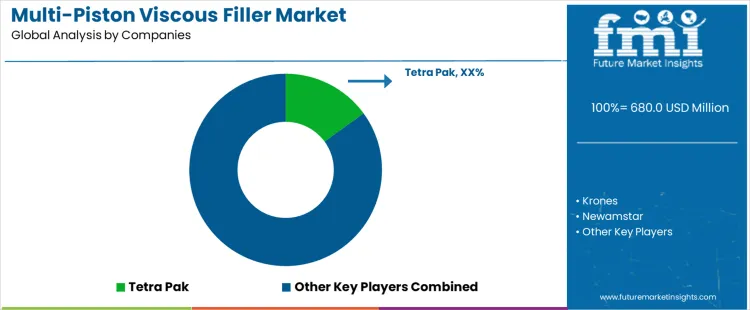
The multi-piston viscous filler market is growing as manufacturers seek efficient, high-precision filling solutions for viscous liquids in industries such as food and beverage, pharmaceuticals, and cosmetics. Tetra Pak leads the market with its advanced multi-piston viscous filling technologies, offering reliable, high-speed solutions designed to handle a wide range of viscous products. Their focus on innovation, quality, and sustainability positions them as a dominant player. Krones, Newamstar, and Nichrome are key competitors, each offering specialized filling solutions for viscous liquids. Krones provides state-of-the-art filling systems designed for high-volume production, while Newamstar and Nichrome focus on cost-effective and customizable solutions for various industries.
Local OEMs, Shibuya, JBT, and Bosch Packaging further contribute to the competitive landscape with their own advanced multi-piston viscous filling solutions. Shibuya specializes in providing flexible and reliable filling machines, while JBT and Bosch Packaging offer cutting-edge technologies for automated filling systems. These companies compete by focusing on product innovation, filling precision, and the ability to meet the diverse needs of industries requiring high-performance filling solutions for viscous liquids.
Key Players of the Multi-Piston Viscous Filler Market
- Tetra Pak
- Krones
- Newamstar
- Nichrome
- Local OEMs
- Shibuya
- JBT
- Bosch Packaging
Scope of the Report
| Items | Values |
|---|---|
| Quantitative Units (2026) | USD Million |
| Application | Sauces, Creams & Pastes, Dairy & Food Processing, FMCG Food Plants, Local Food Brands, Condiments & Sauces, Precision Filling |
| Filler Type | Servo-Driven Multi-Piston Fillers, Volumetric Piston Fillers, Rotary Piston Fillers, Inline Piston Fillers |
| Product Viscosity Range | High-Viscosity & Chunky Products, Medium–High Viscosity, Medium Viscosity, Viscous Foods |
| Technology | CIP/SIP-Ready Piston Filling, Hygienic Design & Quick Changeover, High-Speed Mechanical Drives, Cost-Efficient Piston Systems |
| Companies | Tetra Pak, Krones, Newamstar, Nichrome, Local OEMs, Shibuya, JBT, Bosch Packaging |
| Regions Covered | North America, Latin America, Western Europe, Eastern Europe, South Asia and Pacific, East Asia, Middle East & Africa |
| Countries Covered | United States, Canada, Mexico, Brazil, Argentina, Germany, France, United Kingdom, Italy, Spain, Netherlands, China, India, Japan, South Korea, ANZ, GCC Countries, South Africa |
| Additional Attributes | Dollar by sales by application, filler type, product viscosity range, technology, and region. Includes market trends in multi-piston viscous fillers, focusing on servo-driven, volumetric, rotary, and inline piston fillers. Highlights the role of hygienic design, quick changeover, and high-speed mechanical drives in food, dairy, FMCG, and condiment processing. Focus on cost-efficiency, regulatory compliance, performance, and market share of key companies in the filling equipment market. |
Multi-Piston Viscous Filler Market Segmentation
Application:
- Sauces, creams & pastes
- Dairy & food processing
- FMCG food plants
- Local food brands
- Condiments & sauces
- Precision filling
Filler Type:
- Servo-driven multi-piston fillers
- Volumetric piston fillers
- Rotary piston fillers
- Inline piston fillers
- Others
Product Viscosity Range:
- High-viscosity & chunky products
- Medium–high viscosity
- Medium viscosity
- Viscous foods
- Others
Technology:
- CIP/SIP-ready piston filling
- Hygienic design & quick changeover
- High-speed mechanical drives
- Cost-efficient piston systems
- Others
Region:
- Asia Pacific
- China
- Japan
- South Korea
- India
- Australia & New Zealand
- ASEAN
- Rest of Asia Pacific
- Europe
- Germany
- United Kingdom
- France
- Italy
- Spain
- Nordic
- BENELUX
- Rest of Europe
- North America
- United States
- Canada
- Mexico
- Latin America
- Brazil
- Chile
- Rest of Latin America
- Middle East & Africa
- Kingdom of Saudi Arabia
- Other GCC Countries
- Turkey
- South Africa
- Other African Union
- Rest of Middle East & Africa
Frequently Asked Questions
How big is the multi-piston viscous filler market in 2026?
The global multi-piston viscous filler market is valued at USD 680 million in 2026.
What will be the size of the multi-piston viscous filler market in 2036?
The market is projected to reach USD 1,720 million by 2036.
How fast will the multi-piston viscous filler market grow between 2026 and 2036?
The market will grow at a CAGR of 9.7% from 2026 to 2036.
Which technology segment leads the multi-piston viscous filler market in 2026?
CIP/SIP-ready piston filling technology leads the market with a 55% share in 2026.
Who are the major players in the multi-piston viscous filler market?
Key players include Tetra Pak, Krones, Newamstar, Nichrome, Shibuya, JBT, Bosch Packaging, and local OEMs.
Preview the report firsthand - request a free sample
Get SampleGet the brochure for pricing and purchase details.
Get PDFTable of Content
- Executive Summary
- Global Market Outlook
- Demand-side Trends
- Supply-side Trends
- Technology Roadmap Analysis
- Analysis and Recommendations
- Market Overview
- Market Coverage / Taxonomy
- Market Definition / Scope / Limitations
- Market Background
- Market Dynamics
- Drivers
- Restraints
- Opportunity
- Trends
- Scenario Forecast
- Demand in Optimistic Scenario
- Demand in Likely Scenario
- Demand in Conservative Scenario
- Opportunity Map Analysis
- Product Life Cycle Analysis
- Supply Chain Analysis
- Investment Feasibility Matrix
- Value Chain Analysis
- PESTLE and Porter’s Analysis
- Regulatory Landscape
- Regional Parent Market Outlook
- Production and Consumption Statistics
- Import and Export Statistics
- Market Dynamics
- Global Market Analysis 2021 to 2025 and Forecast, 2026 to 2036
- Historical Market Size Value (USD Million) Analysis, 2021 to 2025
- Current and Future Market Size Value (USD Million) Projections, 2026 to 2036
- Y-o-Y Growth Trend Analysis
- Absolute $ Opportunity Analysis
- Global Market Pricing Analysis 2021 to 2025 and Forecast 2026 to 2036
- Global Market Analysis 2021 to 2025 and Forecast 2026 to 2036, By Application
- Introduction / Key Findings
- Historical Market Size Value (USD Million) Analysis By Application , 2021 to 2025
- Current and Future Market Size Value (USD Million) Analysis and Forecast By Application , 2026 to 2036
- Sauces, creams & pastes
- Dairy & food processing
- FMCG food plants
- Local food brands
- Condiments & sauces
- Precision filling
- Sauces, creams & pastes
- Y-o-Y Growth Trend Analysis By Application , 2021 to 2025
- Absolute $ Opportunity Analysis By Application , 2026 to 2036
- Global Market Analysis 2021 to 2025 and Forecast 2026 to 2036, By Filler Type
- Introduction / Key Findings
- Historical Market Size Value (USD Million) Analysis By Filler Type, 2021 to 2025
- Current and Future Market Size Value (USD Million) Analysis and Forecast By Filler Type, 2026 to 2036
- Servo-driven multi-piston fillers
- Volumetric piston fillers
- Rotary piston fillers
- Inline piston fillers
- Servo-driven multi-piston fillers
- Y-o-Y Growth Trend Analysis By Filler Type, 2021 to 2025
- Absolute $ Opportunity Analysis By Filler Type, 2026 to 2036
- Global Market Analysis 2021 to 2025 and Forecast 2026 to 2036, By Product Viscosity Range
- Introduction / Key Findings
- Historical Market Size Value (USD Million) Analysis By Product Viscosity Range, 2021 to 2025
- Current and Future Market Size Value (USD Million) Analysis and Forecast By Product Viscosity Range, 2026 to 2036
- High-viscosity & chunky products
- Medium–high viscosity
- Medium viscosity
- Viscous foods
- High-viscosity & chunky products
- Y-o-Y Growth Trend Analysis By Product Viscosity Range, 2021 to 2025
- Absolute $ Opportunity Analysis By Product Viscosity Range, 2026 to 2036
- Global Market Analysis 2021 to 2025 and Forecast 2026 to 2036, By Technology
- Introduction / Key Findings
- Historical Market Size Value (USD Million) Analysis By Technology, 2021 to 2025
- Current and Future Market Size Value (USD Million) Analysis and Forecast By Technology, 2026 to 2036
- CIP/SIP-ready piston filling
- Hygienic design & quick changeover
- High-speed mechanical drives
- Cost-efficient piston systems
- CIP/SIP-ready piston filling
- Y-o-Y Growth Trend Analysis By Technology, 2021 to 2025
- Absolute $ Opportunity Analysis By Technology, 2026 to 2036
- Global Market Analysis 2021 to 2025 and Forecast 2026 to 2036, By Region
- Introduction
- Historical Market Size Value (USD Million) Analysis By Region, 2021 to 2025
- Current Market Size Value (USD Million) Analysis and Forecast By Region, 2026 to 2036
- North America
- Latin America
- Western Europe
- Eastern Europe
- East Asia
- South Asia and Pacific
- Middle East & Africa
- Market Attractiveness Analysis By Region
- North America Market Analysis 2021 to 2025 and Forecast 2026 to 2036, By Country
- Historical Market Size Value (USD Million) Trend Analysis By Market Taxonomy, 2021 to 2025
- Market Size Value (USD Million) Forecast By Market Taxonomy, 2026 to 2036
- By Country
- USA
- Canada
- Mexico
- By Application
- By Filler Type
- By Product Viscosity Range
- By Technology
- By Country
- Market Attractiveness Analysis
- By Country
- By Application
- By Filler Type
- By Product Viscosity Range
- By Technology
- Key Takeaways
- Latin America Market Analysis 2021 to 2025 and Forecast 2026 to 2036, By Country
- Historical Market Size Value (USD Million) Trend Analysis By Market Taxonomy, 2021 to 2025
- Market Size Value (USD Million) Forecast By Market Taxonomy, 2026 to 2036
- By Country
- Brazil
- Chile
- Rest of Latin America
- By Application
- By Filler Type
- By Product Viscosity Range
- By Technology
- By Country
- Market Attractiveness Analysis
- By Country
- By Application
- By Filler Type
- By Product Viscosity Range
- By Technology
- Key Takeaways
- Western Europe Market Analysis 2021 to 2025 and Forecast 2026 to 2036, By Country
- Historical Market Size Value (USD Million) Trend Analysis By Market Taxonomy, 2021 to 2025
- Market Size Value (USD Million) Forecast By Market Taxonomy, 2026 to 2036
- By Country
- Germany
- UK
- Italy
- Spain
- France
- Nordic
- BENELUX
- Rest of Western Europe
- By Application
- By Filler Type
- By Product Viscosity Range
- By Technology
- By Country
- Market Attractiveness Analysis
- By Country
- By Application
- By Filler Type
- By Product Viscosity Range
- By Technology
- Key Takeaways
- Eastern Europe Market Analysis 2021 to 2025 and Forecast 2026 to 2036, By Country
- Historical Market Size Value (USD Million) Trend Analysis By Market Taxonomy, 2021 to 2025
- Market Size Value (USD Million) Forecast By Market Taxonomy, 2026 to 2036
- By Country
- Russia
- Poland
- Hungary
- Balkan & Baltic
- Rest of Eastern Europe
- By Application
- By Filler Type
- By Product Viscosity Range
- By Technology
- By Country
- Market Attractiveness Analysis
- By Country
- By Application
- By Filler Type
- By Product Viscosity Range
- By Technology
- Key Takeaways
- East Asia Market Analysis 2021 to 2025 and Forecast 2026 to 2036, By Country
- Historical Market Size Value (USD Million) Trend Analysis By Market Taxonomy, 2021 to 2025
- Market Size Value (USD Million) Forecast By Market Taxonomy, 2026 to 2036
- By Country
- China
- Japan
- South Korea
- By Application
- By Filler Type
- By Product Viscosity Range
- By Technology
- By Country
- Market Attractiveness Analysis
- By Country
- By Application
- By Filler Type
- By Product Viscosity Range
- By Technology
- Key Takeaways
- South Asia and Pacific Market Analysis 2021 to 2025 and Forecast 2026 to 2036, By Country
- Historical Market Size Value (USD Million) Trend Analysis By Market Taxonomy, 2021 to 2025
- Market Size Value (USD Million) Forecast By Market Taxonomy, 2026 to 2036
- By Country
- India
- ASEAN
- Australia & New Zealand
- Rest of South Asia and Pacific
- By Application
- By Filler Type
- By Product Viscosity Range
- By Technology
- By Country
- Market Attractiveness Analysis
- By Country
- By Application
- By Filler Type
- By Product Viscosity Range
- By Technology
- Key Takeaways
- Middle East & Africa Market Analysis 2021 to 2025 and Forecast 2026 to 2036, By Country
- Historical Market Size Value (USD Million) Trend Analysis By Market Taxonomy, 2021 to 2025
- Market Size Value (USD Million) Forecast By Market Taxonomy, 2026 to 2036
- By Country
- Kingdom of Saudi Arabia
- Other GCC Countries
- Turkiye
- South Africa
- Other African Union
- Rest of Middle East & Africa
- By Application
- By Filler Type
- By Product Viscosity Range
- By Technology
- By Country
- Market Attractiveness Analysis
- By Country
- By Application
- By Filler Type
- By Product Viscosity Range
- By Technology
- Key Takeaways
- Key Countries Market Analysis
- USA
- Pricing Analysis
- Market Share Analysis, 2025
- By Application
- By Filler Type
- By Product Viscosity Range
- By Technology
- Canada
- Pricing Analysis
- Market Share Analysis, 2025
- By Application
- By Filler Type
- By Product Viscosity Range
- By Technology
- Mexico
- Pricing Analysis
- Market Share Analysis, 2025
- By Application
- By Filler Type
- By Product Viscosity Range
- By Technology
- Brazil
- Pricing Analysis
- Market Share Analysis, 2025
- By Application
- By Filler Type
- By Product Viscosity Range
- By Technology
- Chile
- Pricing Analysis
- Market Share Analysis, 2025
- By Application
- By Filler Type
- By Product Viscosity Range
- By Technology
- Germany
- Pricing Analysis
- Market Share Analysis, 2025
- By Application
- By Filler Type
- By Product Viscosity Range
- By Technology
- UK
- Pricing Analysis
- Market Share Analysis, 2025
- By Application
- By Filler Type
- By Product Viscosity Range
- By Technology
- Italy
- Pricing Analysis
- Market Share Analysis, 2025
- By Application
- By Filler Type
- By Product Viscosity Range
- By Technology
- Spain
- Pricing Analysis
- Market Share Analysis, 2025
- By Application
- By Filler Type
- By Product Viscosity Range
- By Technology
- France
- Pricing Analysis
- Market Share Analysis, 2025
- By Application
- By Filler Type
- By Product Viscosity Range
- By Technology
- India
- Pricing Analysis
- Market Share Analysis, 2025
- By Application
- By Filler Type
- By Product Viscosity Range
- By Technology
- ASEAN
- Pricing Analysis
- Market Share Analysis, 2025
- By Application
- By Filler Type
- By Product Viscosity Range
- By Technology
- Australia & New Zealand
- Pricing Analysis
- Market Share Analysis, 2025
- By Application
- By Filler Type
- By Product Viscosity Range
- By Technology
- China
- Pricing Analysis
- Market Share Analysis, 2025
- By Application
- By Filler Type
- By Product Viscosity Range
- By Technology
- Japan
- Pricing Analysis
- Market Share Analysis, 2025
- By Application
- By Filler Type
- By Product Viscosity Range
- By Technology
- South Korea
- Pricing Analysis
- Market Share Analysis, 2025
- By Application
- By Filler Type
- By Product Viscosity Range
- By Technology
- Russia
- Pricing Analysis
- Market Share Analysis, 2025
- By Application
- By Filler Type
- By Product Viscosity Range
- By Technology
- Poland
- Pricing Analysis
- Market Share Analysis, 2025
- By Application
- By Filler Type
- By Product Viscosity Range
- By Technology
- Hungary
- Pricing Analysis
- Market Share Analysis, 2025
- By Application
- By Filler Type
- By Product Viscosity Range
- By Technology
- Kingdom of Saudi Arabia
- Pricing Analysis
- Market Share Analysis, 2025
- By Application
- By Filler Type
- By Product Viscosity Range
- By Technology
- Turkiye
- Pricing Analysis
- Market Share Analysis, 2025
- By Application
- By Filler Type
- By Product Viscosity Range
- By Technology
- South Africa
- Pricing Analysis
- Market Share Analysis, 2025
- By Application
- By Filler Type
- By Product Viscosity Range
- By Technology
- USA
- Market Structure Analysis
- Competition Dashboard
- Competition Benchmarking
- Market Share Analysis of Top Players
- By Regional
- By Application
- By Filler Type
- By Product Viscosity Range
- By Technology
- Competition Analysis
- Competition Deep Dive
- Tetra Pak
- Overview
- Product Portfolio
- Profitability by Market Segments (Product/Age /Sales Channel/Region)
- Sales Footprint
- Strategy Overview
- Marketing Strategy
- Product Strategy
- Channel Strategy
- Krones
- Newamstar
- Nichrome
- Local OEMs
- Shibuya
- JBT
- Bosch Packaging
- Tetra Pak
- Competition Deep Dive
- Assumptions & Acronyms Used
- Research Methodology


