

- Industry Size (2026)
- USD 277.6 Mn
- Forecast (2036)
- USD 1176.4 Mn
- CAGR (2026 to 2036)
- 13.9%
Multi-Stress Resilience Focused Nutrient Blend Market Forecast and Outlook 2026 to 2036
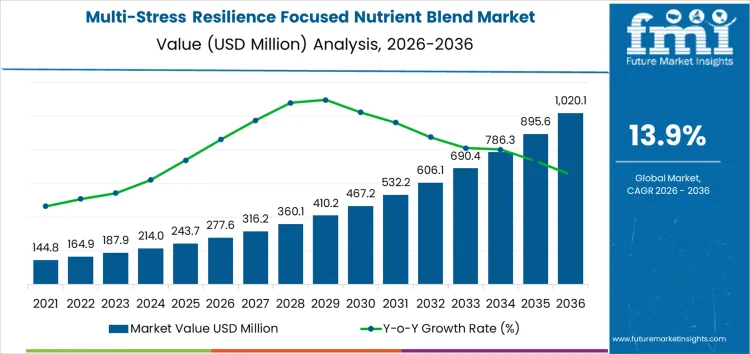
The multi-stress resilience focused nutrient blend market is projected to experience significant growth from 2026 to 2036. Starting at USD 277.6 million in 2026, the market is expected to reach USD 1,176.4 million by 2036, reflecting a compound annual growth rate (CAGR) of 13.9%. This growth is driven by the increasing demand for agricultural solutions that enhance crop resilience against various environmental stresses such as drought, extreme temperatures, and nutrient deficiencies. Multi-stress resilience nutrient blends are designed to support plant growth and improve yields in the face of multiple stressors, making them increasingly essential in regions affected by climate change.
The industry’s expansion is supported by the growing global focus on sustainable agriculture and the need to adapt to the challenges posed by changing weather patterns. As farmers seek more effective ways to boost crop resilience and optimize resource use, the demand for nutrient blends that target multiple stress factors will rise. Additionally, advancements in formulation technologies and the growing adoption of precision farming techniques will further drive market growth. Over the forecast period, the market is expected to grow steadily, driven by these trends and innovations in stress-resilient agricultural solutions.
Quick Stats of the Multi-Stress Resilience Focused Nutrient Blend Market
- Multi-Stress Resilience Focused Nutrient Blend Market Value (2026): USD 277.6 million
- Multi-Stress Resilience Focused Nutrient Blend Market Forecast Value (2036): USD 1,176.4 million
- Multi-Stress Resilience Focused Nutrient Blend Market Global Forecast CAGR (2026-2036): 13.9%
- Multi-Stress Resilience Focused Nutrient Blend Market Leading Segment: Sales Channel (Ag-Retailers) 60%
- Key Growth Regions in Multi-Stress Resilience Focused Nutrient Blend Market: India
- Top Players in Multi-Stress Resilience Focused Nutrient Blend Market: BASF, UPL, Syngenta, Nutrien, Yara International
What is the Growth Forecast for the Multi-Stress Resilience Focused Nutrient Blend Market through 2036?
The long-term value accumulation curve for the multi-stress resilience focused nutrient blend market reveals a pattern of steady growth driven by both early adoption and continued technological advancements. From 2026 to 2031, the market will experience strong growth, rising from USD 277.6 million to USD 561.4 million. This phase will be characterized by an initial surge in adoption as farmers increasingly recognize the benefits of multi-stress resilience blends, driven by the need to mitigate the risks posed by unpredictable weather patterns and environmental stressors.
In the later stages, from 2031 to 2036, the market will continue to experience steady value accumulation, reaching USD 1,176.4 million by 2036. This phase will see more predictable and sustained growth, as multi-stress resilience nutrient blends become an integral part of agricultural practices, particularly in regions facing the most significant climate challenges. The curve reflects the broadening adoption of these blends across the agricultural industry, with market expansion driven by innovation, optimization of nutrient formulations, and increased awareness of the value these solutions offer in sustaining crop productivity over the long term.
Multi-Stress Resilience Focused Nutrient Blend Market Key Takeaways
| Metric | Value |
|---|---|
| Industry Sales Value (2026) | USD 540 million |
| Industry Forecast Value (2036) | USD 1,302 million |
| Industry Forecast CAGR (2026-2036) | 9.2% |
What Is Driving the Demand for Multi Stress Resilience Focused Nutrient Blend Market?
Historical demand for nutrient blends that support plant resilience to multiple stresses grew from the need to address limitations of conventional fertilizer regimes that supply basic macro nutrients without regard to environmental challenges. Traditional fertilizer programs focused on nitrogen (N), phosphorus (P), and potassium (K) to maximize crop yields under stable conditions. Over time, research showed that plants often face complex combinations of stresses such as drought, heat, salinity, and nutrient imbalance that reduce photosynthesis, growth, and yield.
Agriculture science began linking tailored nutrient management with stress mitigation by incorporating elements such as potassium, boron, micronutrients, and bio enhancers that influence physiological responses and stress tolerance pathways. Specific nutritional strategies emerged that improve water use efficiency, osmotic balance, and antioxidant capacity in crops under abiotic stress. These developments formed the basis for nutrient blends formulated with multiple components aimed at strengthening plant resilience across varied stress conditions rather than providing only basic nutrition.
Future demand for multi stress resilience focused nutrient blends is expected to grow as climate variability and environmental pressures increase the frequency and severity of combined stresses on crops. Climate resilient agriculture seeks solutions that help plants endure drought, temperature extremes, salinity, and nutrient deficiencies simultaneously, shaping interest in nutrient programs that go beyond standard fertilizer. Drivers include adoption of advanced crop nutrition strategies that integrate essential macro and micronutrients with compounds that support physiological tolerance mechanisms, and rising use of precision nutrient delivery to optimize resilience outcomes.
Broader trends in climate resilient crop management, where varieties and agronomic practices are selected to withstand multiple abiotic stresses, are likely to influence nutrient blend design and adoption. Development of digital agronomy tools and soil to plant monitoring systems will also support use of tailored nutrients that respond to stress indicators. Challenges include formulation complexity and the need for site specific recommendations that align with diverse soils and crop types, but continued research in crop stress physiology and nutrient interactions is anticipated to shape uptake of multi stress resilience nutrition solutions.
What are the Leading Segments in the Global Multi-Stress Resilience-Focused Nutrient Blend Market?
The global multi-stress resilience-focused nutrient blend market is segmented by crop and sales channel. Among crops, cereals lead the market, capturing 50% of the share, followed by oilseeds, fruits, and vegetables. Cereals dominate due to their large-scale cultivation and the critical need for fertilizers that help crops withstand multiple stress factors, such as drought, pests, and disease. On the sales channel side, ag-retailers dominate, holding 60% of the share, followed by direct-to-farmer, online marketplaces, and cooperatives. Ag-retailers lead due to their established distribution networks and their ability to provide tailored, expert solutions for large-scale agricultural operations.
What Drives the Growth of Cereal Crops in the Multi-Stress Resilience-Focused Nutrient Blend Market?
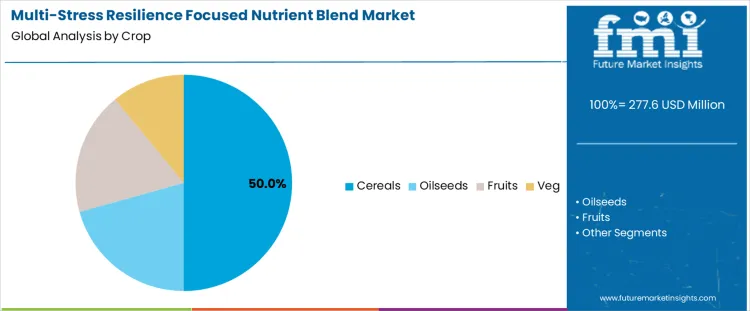
Cereal crops are the leading crop type in the multi-stress resilience-focused nutrient blend market, holding 50% of the share. This growth is driven by the large-scale cultivation of essential cereal crops, such as wheat, corn, and rice, which are staples in global food production. Cereal crops are highly vulnerable to multiple environmental stresses, including extreme weather conditions, pests, and diseases, making them a priority for farmers looking for fertilizers that enhance resilience. Multi-stress resilience-focused nutrient blends help cereal crops thrive by improving their resistance to a range of challenges, which is particularly important as climate change and unpredictable weather patterns increase the frequency and severity of these stresses. The increasing demand for higher yields, alongside the need to protect crops against a variety of stresses, drives the adoption of these specialized nutrient blends in cereal crop production. As the agricultural industry continues to focus on sustainability and adapting to changing environmental conditions, multi-stress resilience-focused fertilizers will remain critical in cereal crop management, ensuring their continued dominance in the market.
What is Driving the Demand for Ag-Retailers in the Multi-Stress Resilience-Focused Nutrient Blend Market?
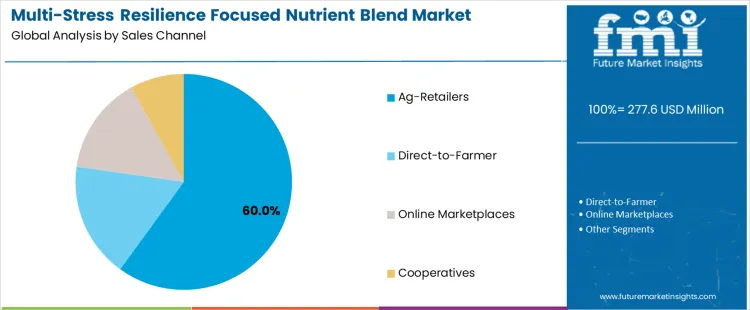
Ag-retailers are the leading sales channel in the multi-stress resilience-focused nutrient blend market, capturing 60% of the share. This demand is driven by the established role ag-retailers play in providing specialized fertilizers and expert advice to farmers. As the need for multi-stress resilience increases, ag-retailers are able to offer targeted solutions, including nutrient blends that help crops endure various environmental challenges. Their strong relationships with farmers and large-scale distribution networks make ag-retailers the preferred channel for providing these specialized products. Ag-retailers also offer technical support, helping farmers implement best practices and optimize the use of resilience-focused fertilizers for improved crop performance. With the growing emphasis on sustainable farming practices and the need for fertilizers that address multiple stresses, ag-retailers will continue to be the dominant channel in delivering these essential products to farmers. Their ability to reach a broad customer base and offer customized solutions ensures that ag-retailers will maintain their position as key players in the market for multi-stress resilience-focused nutrient blends.
What are the Key Dynamics in the Multi Stress Resilience Focused Nutrient Blend Market?
The multi stress resilience focused nutrient blend market is shaped by demand for fertilizer products that help crops withstand a range of environmental stresses, including drought, heat, salinity, and nutrient imbalance. These blends combine macro and micronutrients with compounds intended to support plant physiological resilience. Growers and agronomists evaluate products based on crop performance, stress response data, and compatibility with soil conditions. Scientific evidence on nutrient stress interactions influences product design and recommendations. Environmental standards and sustainability frameworks increasingly emphasize resilience outcomes alongside yield. Supply chain access to quality raw materials and agronomic advisory services affects how blends are developed and adopted.
What are the Main Drivers Supporting Growth in This Market?
Growth in the multi stress resilience focused nutrient blend market is driven by rising interest in soil health and crop stability under variable climatic conditions. Fluctuating weather patterns, including heat waves and erratic rainfall, increase pressure on nutrient management strategies that support stress mitigation. Research linking specific nutrient ratios and plant physiological responses to stress is guiding formulation improvements. Farmers seek products that can maintain crop vigor and reduce yield variability. Integration of soil testing and nutrient planning tools helps tailor blend use to field level conditions. Policies encouraging efficient nutrient use and reductions in crop losses contribute to demand.
What Restraints Are Limiting Market Expansion?
Market expansion is constrained by variability in soil types, crop species, and stress response outcomes, which can lead to inconsistent field results. Higher cost of specialized nutrient blends compared with conventional fertilizers may deter adoption among budget sensitive growers. Need for agronomic expertise to interpret soil tests and align blend selection with specific stress conditions limits uptake where advisory services are scarce. Differences in regional guidelines on nutrient products and resilience claims add complexity for suppliers entering multiple markets. Lack of long term performance data in diverse environments can create uncertainty for end users.
What Emerging Trends Are Shaping Future Development in This Market?
Emerging trends include increased use of precision agriculture tools that integrate soil health metrics, weather data, and plant stress indicators to guide nutrient blend recommendations. Advances in nutrient chemistry are improving targeted delivery of micronutrients and bioactive compounds that support stress physiology. Digital decision support platforms are linking resilience outcomes with profitability metrics, aiding adoption. Collaboration between research institutions, fertilizer producers, and crop advisors is generating field based evidence on blend performance under multi stress scenarios. There is growth in custom formulated blends tailored to specific crop stress profiles and regional conditions.
What is the Country-Wise Analysis of the Multi-Stress Resilience Focused Nutrient Blend Market?
The multi-stress resilience focused nutrient blend market is experiencing robust growth due to increasing demand for fertilizers and nutrient blends that improve plant resistance to various environmental stresses, such as drought, heat, and soil salinity. These nutrient blends are designed to help crops withstand multiple stress factors simultaneously, thereby improving agricultural productivity and sustainability. Developed markets like the USA and Brazil are seeing steady growth driven by the emphasis on precision agriculture and sustainability. Emerging markets like India and China are experiencing rapid adoption due to their large agricultural sectors and growing awareness of the need for resilience in the face of climate change. As climate-related stresses on crops become more prevalent globally, the market for multi-stress resilience focused nutrient blends is expected to expand significantly.
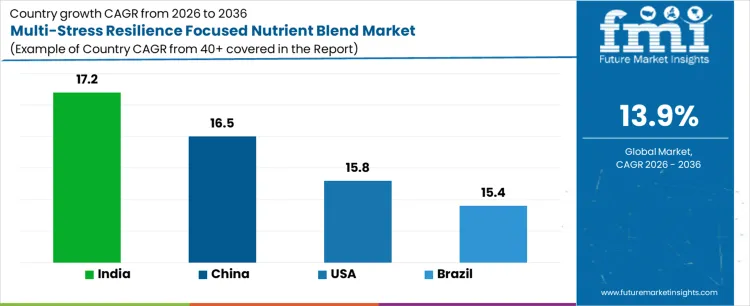
| Country | CAGR (2026-2036) |
|---|---|
| USA | 15.8% |
| China | 16.5% |
| India | 17.2% |
| Brazil | 15.4% |
What is the Growth Outlook for the Multi-Stress Resilience Focused Nutrient Blend Market in the USA?
The multi-stress resilience focused nutrient blend market in the USA is projected to grow steadily, with a projected CAGR of 15.8% from 2026 to 2036. The USA agricultural sector is increasingly adopting advanced nutrient management techniques to improve crop yields and resilience in the face of climate variability. With the growing frequency of extreme weather events, including droughts and heatwaves, USA farmers are turning to nutrient blends that enhance crop tolerance to multiple stresses. These nutrient blends offer a solution to improve soil health, enhance nutrient uptake, and support plant resilience, helping farmers cope with changing environmental conditions. Continued governmental support for sustainable farming practices and a shift towards precision agriculture are expected to drive steady growth in the market for multi-stress resilience focused nutrient blends in the USA.
What is the Market Outlook for the Multi-Stress Resilience Focused Nutrient Blend Market in China?
China is expected to experience strong growth in the multi-stress resilience focused nutrient blend market, with a projected CAGR of 16.5% from 2026 to 2036. As one of the largest agricultural producers globally, China faces numerous challenges related to climate change, including increased droughts, extreme temperatures, and soil degradation. These challenges are driving demand for innovative solutions that improve crop resilience to multiple stresses. Multi-stress resilience focused nutrient blends are gaining popularity in China as farmers seek to optimize fertilizer use and improve plant health under difficult environmental conditions. The Chinese government’s emphasis on sustainable farming practices, coupled with its efforts to address the environmental impacts of agriculture, is expected to accelerate the adoption of these nutrient blends. As China continues to modernize its agricultural sector and focuses on improving resource use efficiency, the market for these nutrient blends is expected to grow rapidly.
What is the Growth Forecast for the Multi-Stress Resilience Focused Nutrient Blend Market in India?
India is projected to experience the highest growth in the multi-stress resilience focused nutrient blend market, with a projected CAGR of 17.2% from 2026 to 2036. India’s agricultural sector is highly vulnerable to climate change, with farmers facing increasingly unpredictable weather patterns, including extreme temperatures, droughts, and floods. Multi-stress resilience focused nutrient blends offer a solution to enhance crop tolerance to these diverse stresses. As India’s agricultural practices modernize and the need for sustainable farming solutions grows, there is an increasing adoption of nutrient blends that improve soil health, boost nutrient uptake, and improve resilience against environmental stresses. The Indian government’s focus on promoting climate-resilient agriculture, coupled with rising awareness of the importance of sustainability, is expected to drive rapid growth in the market for these nutrient blends in India.
What is the Market Outlook for the Multi-Stress Resilience Focused Nutrient Blend Market in Brazil?
Brazil is expected to experience steady growth in the multi-stress resilience focused nutrient blend market, with a projected CAGR of 15.4% from 2026 to 2036. As a major agricultural producer, Brazil faces challenges related to soil health, water scarcity, and extreme weather events that affect crop yields. Multi-stress resilience focused nutrient blends are increasingly being adopted by Brazilian farmers as part of efforts to improve crop resilience, optimize fertilizer use, and enhance soil fertility. With the Brazilian government’s focus on promoting sustainable farming practices and improving agricultural productivity, the demand for innovative nutrient solutions is expected to grow steadily. As Brazil continues to prioritize sustainability and climate-resilient agriculture, the market for multi-stress resilience focused nutrient blends is expected to expand, offering valuable solutions for farmers facing diverse environmental challenges.
What is the Competitive Landscape for the Multi-Stress Resilience Focused Nutrient Blend Market?
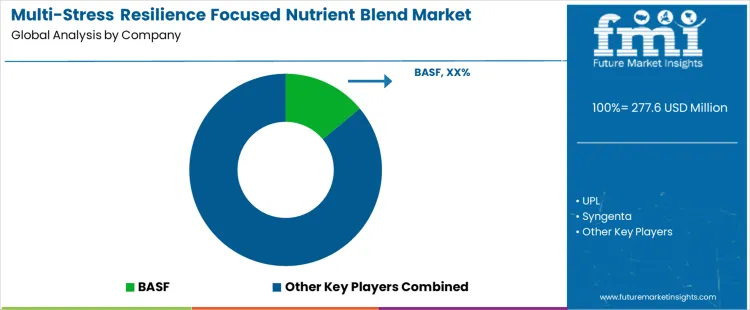
The multi-stress resilience focused nutrient blend market is expanding rapidly as the agricultural industry increasingly seeks solutions to help crops withstand multiple environmental stresses, such as drought, pests, and extreme temperatures. BASF leads the market with its innovative nutrient blends, offering high-performance solutions designed to enhance plant resilience under various stress conditions. Their focus on product efficacy, sustainability, and enhancing crop performance in challenging environments has positioned them as a dominant player. UPL, Syngenta, and Nutrien are key competitors, each providing specialized nutrient blends tailored to improving crop stress tolerance. UPL focuses on sustainable agricultural solutions, while Syngenta offers advanced technologies to protect crops from multiple stresses. Nutrien delivers comprehensive nutrient management programs aimed at improving resilience and optimizing crop yields under stress.
Yara International further strengthens the competitive landscape with its own multi-stress resilience-focused nutrient blends. Yara International emphasizes sustainable nutrient management to improve plant health and protect crops from environmental challenges. These companies compete by focusing on product innovation, sustainability, and their ability to meet the growing demand for solutions that enhance crop resilience. As environmental challenges such as climate change and water scarcity intensify, the market for multi-stress resilience focused nutrient blends is expected to continue growing, fostering further innovation and competition in the sector.
Key Players of the Multi-Stress Resilience Focused Nutrient Blend Market
- BASF
- UPL
- Syngenta
- Nutrien
- Yara International
Scope of the Report
| Items | Values |
|---|---|
| Quantitative Units (2026) | USD Million |
| Crop | Cereals, Oilseeds, Fruits, Vegetables |
| Form | Granular, Liquid, Powder, Suspension |
| Sales Channel | Ag Retailers, Direct to Farmer, Online Marketplaces, Cooperatives |
| Companies | BASF, UPL, Syngenta, Nutrien, Yara International |
| Regions Covered | North America, Latin America, Western Europe, Eastern Europe, South Asia & Pacific, East Asia, Middle East & Africa |
| Countries Covered | United States, Canada, Mexico, Brazil, Argentina, Germany, France, United Kingdom, Italy, Spain, Netherlands, China, India, Japan, South Korea, ANZ, GCC Countries, South Africa |
| Additional Attributes | Dollar by sales by crop, form, sales channel, and region. Includes analysis of market trends in multi stress resilience focused nutrient blends, performance outcomes under diverse stress conditions, formulation and delivery cost factors, regulatory and environmental considerations, adoption trends among growers facing abiotic and biotic stresses, market share and competitive positioning of key companies, innovations in resilience oriented nutrient technologies, and evaluation of impact on nutrient use efficiency, crop health, yield stability, and overall farm resilience. |
Multi-Stress Resilience Focused Nutrient Blend Market Segmentation
Crop
- Cereals
- Oilseeds
- Fruits
- Vegetables
Form
- Granular
- Liquid
- Powder
- Suspension
Sales Channel
- Ag-Retailers
- Direct-to-Farmer
- Online Marketplaces
- Cooperatives
Region
- Asia Pacific
- China
- Japan
- South Korea
- India
- Australia & New Zealand
- ASEAN
- Rest of Asia Pacific
- Europe
- Germany
- United Kingdom
- France
- Italy
- Spain
- Nordic
- BENELUX
- Rest of Europe
- North America
- United States
- Canada
- Mexico
- Latin America
- Brazil
- Chile
- Rest of Latin America
- Middle East & Africa
- Kingdom of Saudi Arabia
- Other GCC Countries
- Turkey
- South Africa
- Other African Union
- Rest of Middle East & Africa
Frequently Asked Questions
How big is the multi-stress resilience focused nutrient blend market in 2026?
The global multi-stress resilience focused nutrient blend market is estimated to be valued at USD 277.6 million in 2026.
What will be the size of multi-stress resilience focused nutrient blend market in 2036?
The market size for the multi-stress resilience focused nutrient blend market is projected to reach USD 1,020.1 million by 2036.
How much will be the multi-stress resilience focused nutrient blend market growth between 2026 and 2036?
The multi-stress resilience focused nutrient blend market is expected to grow at a 13.9% CAGR between 2026 and 2036.
What are the key product types in the multi-stress resilience focused nutrient blend market?
The key product types in multi-stress resilience focused nutrient blend market are cereals, oilseeds, fruits and veg.
Which form segment to contribute significant share in the multi-stress resilience focused nutrient blend market in 2026?
In terms of form, granular segment to command 45.0% share in the multi-stress resilience focused nutrient blend market in 2026.
Preview the report firsthand - request a free sample
Get SampleGet the brochure for pricing and purchase details.
Get PDFTable of Content
- Executive Summary
- Global Market Outlook
- Demand-side Trends
- Supply-side Trends
- Technology Roadmap Analysis
- Analysis and Recommendations
- Market Overview
- Market Coverage / Taxonomy
- Market Definition / Scope / Limitations
- Market Background
- Market Dynamics
- Drivers
- Restraints
- Opportunity
- Trends
- Scenario Forecast
- Demand in Optimistic Scenario
- Demand in Likely Scenario
- Demand in Conservative Scenario
- Opportunity Map Analysis
- Product Life Cycle Analysis
- Supply Chain Analysis
- Investment Feasibility Matrix
- Value Chain Analysis
- PESTLE and Porter’s Analysis
- Regulatory Landscape
- Regional Parent Market Outlook
- Production and Consumption Statistics
- Import and Export Statistics
- Market Dynamics
- Global Market Analysis 2021 to 2025 and Forecast, 2026 to 2036
- Historical Market Size Value (USD Million) Analysis, 2021 to 2025
- Current and Future Market Size Value (USD Million) Projections, 2026 to 2036
- Y-o-Y Growth Trend Analysis
- Absolute $ Opportunity Analysis
- Global Market Pricing Analysis 2021 to 2025 and Forecast 2026 to 2036
- Global Market Analysis 2021 to 2025 and Forecast 2026 to 2036, By Crop
- Introduction / Key Findings
- Historical Market Size Value (USD Million) Analysis By Crop , 2021 to 2025
- Current and Future Market Size Value (USD Million) Analysis and Forecast By Crop , 2026 to 2036
- Cereals
- Oilseeds
- Fruits
- Veg
- Cereals
- Y-o-Y Growth Trend Analysis By Crop , 2021 to 2025
- Absolute $ Opportunity Analysis By Crop , 2026 to 2036
- Global Market Analysis 2021 to 2025 and Forecast 2026 to 2036, By Form
- Introduction / Key Findings
- Historical Market Size Value (USD Million) Analysis By Form, 2021 to 2025
- Current and Future Market Size Value (USD Million) Analysis and Forecast By Form, 2026 to 2036
- Granular
- Liquid
- Powder
- Suspension
- Granular
- Y-o-Y Growth Trend Analysis By Form, 2021 to 2025
- Absolute $ Opportunity Analysis By Form, 2026 to 2036
- Global Market Analysis 2021 to 2025 and Forecast 2026 to 2036, By Sales Channel
- Introduction / Key Findings
- Historical Market Size Value (USD Million) Analysis By Sales Channel, 2021 to 2025
- Current and Future Market Size Value (USD Million) Analysis and Forecast By Sales Channel, 2026 to 2036
- Ag-Retailers
- Direct-to-Farmer
- Online Marketplaces
- Cooperatives
- Ag-Retailers
- Y-o-Y Growth Trend Analysis By Sales Channel, 2021 to 2025
- Absolute $ Opportunity Analysis By Sales Channel, 2026 to 2036
- Global Market Analysis 2021 to 2025 and Forecast 2026 to 2036, By Region
- Introduction
- Historical Market Size Value (USD Million) Analysis By Region, 2021 to 2025
- Current Market Size Value (USD Million) Analysis and Forecast By Region, 2026 to 2036
- North America
- Latin America
- Western Europe
- Eastern Europe
- East Asia
- South Asia and Pacific
- Middle East & Africa
- Market Attractiveness Analysis By Region
- North America Market Analysis 2021 to 2025 and Forecast 2026 to 2036, By Country
- Historical Market Size Value (USD Million) Trend Analysis By Market Taxonomy, 2021 to 2025
- Market Size Value (USD Million) Forecast By Market Taxonomy, 2026 to 2036
- By Country
- USA
- Canada
- Mexico
- By Crop
- By Form
- By Sales Channel
- By Country
- Market Attractiveness Analysis
- By Country
- By Crop
- By Form
- By Sales Channel
- Key Takeaways
- Latin America Market Analysis 2021 to 2025 and Forecast 2026 to 2036, By Country
- Historical Market Size Value (USD Million) Trend Analysis By Market Taxonomy, 2021 to 2025
- Market Size Value (USD Million) Forecast By Market Taxonomy, 2026 to 2036
- By Country
- Brazil
- Chile
- Rest of Latin America
- By Crop
- By Form
- By Sales Channel
- By Country
- Market Attractiveness Analysis
- By Country
- By Crop
- By Form
- By Sales Channel
- Key Takeaways
- Western Europe Market Analysis 2021 to 2025 and Forecast 2026 to 2036, By Country
- Historical Market Size Value (USD Million) Trend Analysis By Market Taxonomy, 2021 to 2025
- Market Size Value (USD Million) Forecast By Market Taxonomy, 2026 to 2036
- By Country
- Germany
- UK
- Italy
- Spain
- France
- Nordic
- BENELUX
- Rest of Western Europe
- By Crop
- By Form
- By Sales Channel
- By Country
- Market Attractiveness Analysis
- By Country
- By Crop
- By Form
- By Sales Channel
- Key Takeaways
- Eastern Europe Market Analysis 2021 to 2025 and Forecast 2026 to 2036, By Country
- Historical Market Size Value (USD Million) Trend Analysis By Market Taxonomy, 2021 to 2025
- Market Size Value (USD Million) Forecast By Market Taxonomy, 2026 to 2036
- By Country
- Russia
- Poland
- Hungary
- Balkan & Baltic
- Rest of Eastern Europe
- By Crop
- By Form
- By Sales Channel
- By Country
- Market Attractiveness Analysis
- By Country
- By Crop
- By Form
- By Sales Channel
- Key Takeaways
- East Asia Market Analysis 2021 to 2025 and Forecast 2026 to 2036, By Country
- Historical Market Size Value (USD Million) Trend Analysis By Market Taxonomy, 2021 to 2025
- Market Size Value (USD Million) Forecast By Market Taxonomy, 2026 to 2036
- By Country
- China
- Japan
- South Korea
- By Crop
- By Form
- By Sales Channel
- By Country
- Market Attractiveness Analysis
- By Country
- By Crop
- By Form
- By Sales Channel
- Key Takeaways
- South Asia and Pacific Market Analysis 2021 to 2025 and Forecast 2026 to 2036, By Country
- Historical Market Size Value (USD Million) Trend Analysis By Market Taxonomy, 2021 to 2025
- Market Size Value (USD Million) Forecast By Market Taxonomy, 2026 to 2036
- By Country
- India
- ASEAN
- Australia & New Zealand
- Rest of South Asia and Pacific
- By Crop
- By Form
- By Sales Channel
- By Country
- Market Attractiveness Analysis
- By Country
- By Crop
- By Form
- By Sales Channel
- Key Takeaways
- Middle East & Africa Market Analysis 2021 to 2025 and Forecast 2026 to 2036, By Country
- Historical Market Size Value (USD Million) Trend Analysis By Market Taxonomy, 2021 to 2025
- Market Size Value (USD Million) Forecast By Market Taxonomy, 2026 to 2036
- By Country
- Kingdom of Saudi Arabia
- Other GCC Countries
- Turkiye
- South Africa
- Other African Union
- Rest of Middle East & Africa
- By Crop
- By Form
- By Sales Channel
- By Country
- Market Attractiveness Analysis
- By Country
- By Crop
- By Form
- By Sales Channel
- Key Takeaways
- Key Countries Market Analysis
- USA
- Pricing Analysis
- Market Share Analysis, 2025
- By Crop
- By Form
- By Sales Channel
- Canada
- Pricing Analysis
- Market Share Analysis, 2025
- By Crop
- By Form
- By Sales Channel
- Mexico
- Pricing Analysis
- Market Share Analysis, 2025
- By Crop
- By Form
- By Sales Channel
- Brazil
- Pricing Analysis
- Market Share Analysis, 2025
- By Crop
- By Form
- By Sales Channel
- Chile
- Pricing Analysis
- Market Share Analysis, 2025
- By Crop
- By Form
- By Sales Channel
- Germany
- Pricing Analysis
- Market Share Analysis, 2025
- By Crop
- By Form
- By Sales Channel
- UK
- Pricing Analysis
- Market Share Analysis, 2025
- By Crop
- By Form
- By Sales Channel
- Italy
- Pricing Analysis
- Market Share Analysis, 2025
- By Crop
- By Form
- By Sales Channel
- Spain
- Pricing Analysis
- Market Share Analysis, 2025
- By Crop
- By Form
- By Sales Channel
- France
- Pricing Analysis
- Market Share Analysis, 2025
- By Crop
- By Form
- By Sales Channel
- India
- Pricing Analysis
- Market Share Analysis, 2025
- By Crop
- By Form
- By Sales Channel
- ASEAN
- Pricing Analysis
- Market Share Analysis, 2025
- By Crop
- By Form
- By Sales Channel
- Australia & New Zealand
- Pricing Analysis
- Market Share Analysis, 2025
- By Crop
- By Form
- By Sales Channel
- China
- Pricing Analysis
- Market Share Analysis, 2025
- By Crop
- By Form
- By Sales Channel
- Japan
- Pricing Analysis
- Market Share Analysis, 2025
- By Crop
- By Form
- By Sales Channel
- South Korea
- Pricing Analysis
- Market Share Analysis, 2025
- By Crop
- By Form
- By Sales Channel
- Russia
- Pricing Analysis
- Market Share Analysis, 2025
- By Crop
- By Form
- By Sales Channel
- Poland
- Pricing Analysis
- Market Share Analysis, 2025
- By Crop
- By Form
- By Sales Channel
- Hungary
- Pricing Analysis
- Market Share Analysis, 2025
- By Crop
- By Form
- By Sales Channel
- Kingdom of Saudi Arabia
- Pricing Analysis
- Market Share Analysis, 2025
- By Crop
- By Form
- By Sales Channel
- Turkiye
- Pricing Analysis
- Market Share Analysis, 2025
- By Crop
- By Form
- By Sales Channel
- South Africa
- Pricing Analysis
- Market Share Analysis, 2025
- By Crop
- By Form
- By Sales Channel
- USA
- Market Structure Analysis
- Competition Dashboard
- Competition Benchmarking
- Market Share Analysis of Top Players
- By Regional
- By Crop
- By Form
- By Sales Channel
- Competition Analysis
- Competition Deep Dive
- BASF
- Overview
- Product Portfolio
- Profitability by Market Segments (Product/Age /Sales Channel/Region)
- Sales Footprint
- Strategy Overview
- Marketing Strategy
- Product Strategy
- Channel Strategy
- UPL
- Syngenta
- Nutrien
- Yara International
- BASF
- Competition Deep Dive
- Assumptions & Acronyms Used
- Research Methodology


