

- Industry Size (2025)
- USD 159.0 Mn
- Forecast (2035)
- USD 284.7 Mn
- CAGR (2025 to 2035)
- 6.0%
Multichannel Reagent Reservoir Market Size and Share Forecast Outlook 2025 to 2035
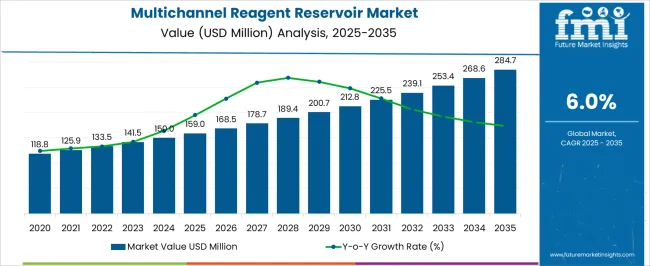
The Multichannel Reagent Reservoir Market is estimated to be valued at USD 159.0 million in 2025 and is projected to reach USD 284.7 million by 2035, registering a compound annual growth rate (CAGR) of 6.0% over the forecast period.
Quick Stats for Multichannel Reagent Reservoir Market
- Multichannel Reagent Reservoir Market Value (2025): USD 159.0 million
- Multichannel Reagent Reservoir Market Forecast Value (2035): USD 284.7 million
- Multichannel Reagent Reservoir Market Forecast CAGR: 6.0%
- Leading Segment in Multichannel Reagent Reservoir Market in 2025: Disposable Multichannel Reagent Reservoir (65.0%)
- Key Growth Regions in Multichannel Reagent Reservoir Market: North America, Asia-Pacific, Europe
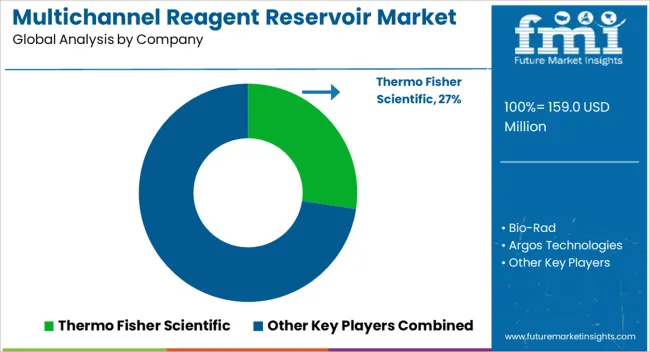
- Top Key Players in Multichannel Reagent Reservoir Market: Thermo Fisher Scientific, Bio-Rad, Argos Technologies, STEMCELL Technologies, Hirschmann Laborgeräte, INTEGRA Holding AG, Heathrow Scientific, Merck, BioCision, VISTALAB TECHNOLOGIES, EUROCLONE, Corning
Multichannel Reagent Reservoir Market Key Takeaways
| Metric | Value |
|---|---|
| Multichannel Reagent Reservoir Market Estimated Value in (2025 E) | USD 159.0 million |
| Multichannel Reagent Reservoir Market Forecast Value in (2035 F) | USD 284.7 million |
| Forecast CAGR (2025 to 2035) | 6.0% |
Why is the Multichannel Reagent Reservoir Market Growing?
The Multichannel Reagent Reservoir market is experiencing strong growth driven by the increasing demand for high-throughput laboratory automation and efficient liquid handling solutions in research and production environments. Current adoption is being propelled by the rising need for precision, reproducibility, and contamination-free reagent management in pharmaceutical, biotechnology, and academic laboratories. The market is further influenced by the rapid expansion of biopharmaceutical development pipelines, particularly in the synthesis of antibodies, vaccines, and cell and gene therapies.
Increasing investments in automated liquid handling systems and laboratory robotics have reinforced the demand for multichannel reagent reservoirs, which are integral to streamlining workflows and reducing manual errors. The future outlook is shaped by the integration of these reservoirs with advanced automated platforms, enabling improved throughput, reduced reagent wastage, and enhanced operational efficiency.
Technological innovations in material design and compatibility with diverse liquid types are expected to support market expansion As laboratories continue to prioritize operational efficiency and scalability, multichannel reagent reservoirs are positioned to play a critical role in accelerating scientific research and commercial production processes.
Segmental Analysis
The multichannel reagent reservoir market is segmented by product type, material type, end user, and geographic regions. By product type, multichannel reagent reservoir market is divided into Disposable Multichannel Reagent Reservoir and Reusable Multichannel Reagent Reservoir. In terms of material type, multichannel reagent reservoir market is classified into Polystyrene and Polypropylene. Based on end user, multichannel reagent reservoir market is segmented into Biopharmaceutical Companies, Research Centers And Laboratories, Academic Institutes, and Contract Research Organizations (CROs). Regionally, the multichannel reagent reservoir industry is classified into North America, Latin America, Western Europe, Eastern Europe, Balkan & Baltic Countries, Russia & Belarus, Central Asia, East Asia, South Asia & Pacific, and the Middle East & Africa.
Insights into the Disposable Multichannel Reagent Reservoir Segment
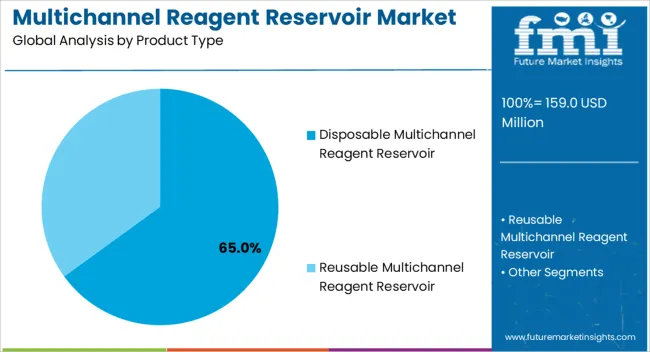
The disposable multichannel reagent reservoir segment is projected to hold 65.00% of the overall market revenue in 2025, making it the leading product type. This dominance has been attributed to its single-use design, which minimizes cross-contamination risks and enhances laboratory safety. The segment’s growth is further driven by the convenience offered in high-throughput workflows, where rapid reagent replacement and ease of handling are essential.
Adoption has been reinforced by increasing demand from biopharmaceutical companies and automated laboratories, where reproducibility and sterility are critical. The ability to integrate seamlessly with robotic pipetting systems has enhanced operational efficiency and reduced manual intervention.
Furthermore, the cost-effectiveness of disposable reservoirs in comparison to reusable alternatives for high-volume applications has contributed to their widespread adoption As laboratory processes continue to focus on automation, precision, and contamination control, the disposable multichannel reagent reservoir segment is expected to maintain its leading position and drive revenue growth in the market.
Insights into the Polystyrene Segment
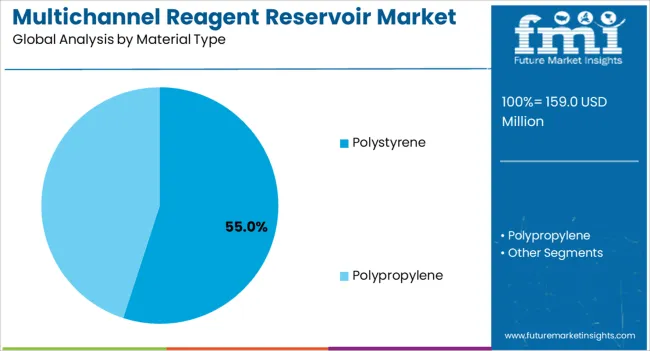
The polystyrene material type is anticipated to account for 55.00% of the market revenue in 2025, representing the most widely adopted material. This preference is being driven by its excellent chemical resistance, optical clarity, and compatibility with a wide range of reagents commonly used in research and production laboratories.
The growth of this segment has been reinforced by the material’s cost efficiency, lightweight structure, and ease of manufacturing in standardized shapes and sizes for multichannel reservoir systems. Additionally, polystyrene’s thermal stability allows it to withstand common laboratory handling and sterilization protocols, making it highly suitable for both academic and industrial environments.
Its compatibility with automated liquid handling platforms has further strengthened adoption, as laboratories increasingly implement robotic systems to enhance throughput and reduce human error The segment’s continued growth is expected to be supported by ongoing innovations in polymer formulation and manufacturing techniques, ensuring enhanced durability, reliability, and functionality for a broad range of laboratory applications.
Insights into the Biopharmaceutical Companies Segment
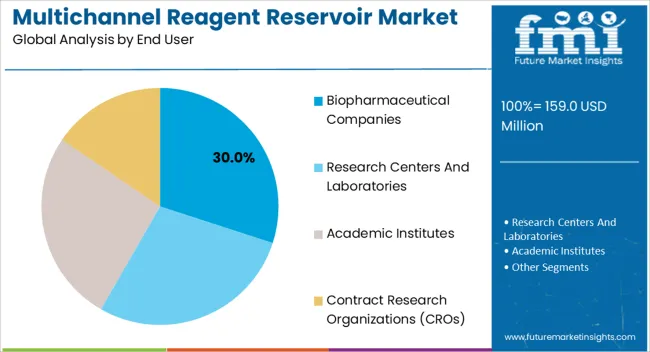
The biopharmaceutical companies end-use segment is expected to hold 30.00% of the market revenue in 2025, making it the leading consumer of multichannel reagent reservoirs. This leadership is being driven by the high demand for precise and contamination-free reagent handling in drug discovery, vaccine development, and therapeutic protein production.
The segment’s growth is further supported by the increasing adoption of automated and high-throughput screening systems, where multichannel reagent reservoirs are critical for ensuring operational efficiency and reproducibility. Biopharmaceutical laboratories prioritize disposable reservoirs to minimize cross-contamination, reduce downtime, and maintain stringent quality standards.
Additionally, ongoing expansion of research pipelines, the scaling of production processes, and the rising number of biopharmaceutical facilities globally have strengthened market demand As the focus on accelerated drug development and laboratory automation continues, the biopharmaceutical segment is expected to remain a dominant driver of revenue growth in the multichannel reagent reservoir market, with increasing investments in scalable and efficient liquid handling solutions.
Market Overview
Multichannel Reagent Reservoir Market Overview
Multichannel Reagent Reservoir are products used for dispensing reagent with multichannel pipets. The system consist of two parts the reusable bases with volume markings and disposable inserts that fits into the reusable base.
Their sloping V shaped structure makes it easy to pick up the sample to the last drop and deeper pour prevents spillage while emptying the reagents. Multichannel Reagent Reservoirs are available in 10 - 100 mL sizes. The Multichannel Reagent Reservoir are made up of polystyrene and polypropylene that are designed for use with automate and robotic systems. The products are autoclavable.
The Multichannel Reagent Reservoirs are all in one compact and stacked to reduce the storage space. Moreover Multichannel Reagent Reservoir can be washed and sterilized depending upon the application. Graduation marks on the walls of the trough allows easy identification. Also the lids are provided to prevent the contamination into the media.
Analysis of Multichannel Reagent Reservoir Market By Key Countries
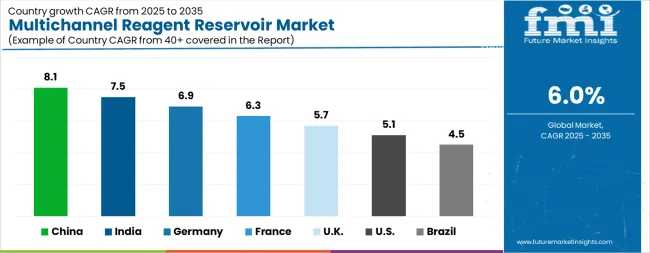
| Country | CAGR |
|---|---|
| China | 8.1% |
| India | 7.5% |
| Germany | 6.9% |
| France | 6.3% |
| UK | 5.7% |
| USA | 5.1% |
| Brazil | 4.5% |
Country-wise Analysis
The Multichannel Reagent Reservoir Market is expected to register a CAGR of 6.0% during the forecast period, exhibiting varied country level momentum. China leads with the highest CAGR of 8.1%, followed by India at 7.5%. Developed markets such as Germany, France, and the UK continue to expand steadily, while the USA is likely to grow at consistent rates. Brazil posts the lowest CAGR at 4.5%, yet still underscores a broadly positive trajectory for the global Multichannel Reagent Reservoir Market. In 2024, Germany held a dominant revenue in the Western Europe market and is expected to grow with a CAGR of 6.9%. The USA Multichannel Reagent Reservoir Market is estimated to be valued at USD 55.3 million in 2025 and is anticipated to reach a valuation of USD 90.9 million by 2035. Sales are projected to rise at a CAGR of 5.1% over the forecast period between 2025 and 2035. While Japan and South Korea markets are estimated to be valued at USD 7.9 million and USD 4.6 million respectively in 2025.
Key Players in the Multichannel Reagent Reservoir Market
- Thermo Fisher Scientific
- Bio-Rad
- Argos Technologies
- STEMCELL Technologies
- Hirschmann Laborgeräte
- INTEGRA Holding AG
- Heathrow Scientific
- Merck
- BioCision
- VISTALAB TECHNOLOGIES
- EUROCLONE
- Corning
Scope of the Report
| Item | Value |
|---|---|
| Quantitative Units | USD 159.0 Million |
| Product Type | Disposable Multichannel Reagent Reservoir and Reusable Multichannel Reagent Reservoir |
| Material Type | Polystyrene and Polypropylene |
| End User | Biopharmaceutical Companies, Research Centers And Laboratories, Academic Institutes, and Contract Research Organizations (CROs) |
| Regions Covered | North America, Europe, Asia-Pacific, Latin America, Middle East & Africa |
| Country Covered | United States, Canada, Germany, France, United Kingdom, China, Japan, India, Brazil, South Africa |
| Key Companies Profiled | Thermo Fisher Scientific, Bio-Rad, Argos Technologies, STEMCELL Technologies, Hirschmann Laborgeräte, INTEGRA Holding AG, Heathrow Scientific, Merck, BioCision, VISTALAB TECHNOLOGIES, EUROCLONE, and Corning |
Multichannel Reagent Reservoir Market by Segments
Product Type:
- Disposable Multichannel Reagent Reservoir
- Reusable Multichannel Reagent Reservoir
Material Type:
- Polystyrene
- Polypropylene
End User:
- Biopharmaceutical Companies
- Research Centers And Laboratories
- Academic Institutes
- Contract Research Organizations (CROs)
Region:
- North America
- USA
- Canada
- Mexico
- Latin America
- Brazil
- Chile
- Rest of Latin America
- Western Europe
- Germany
- UK
- Italy
- Spain
- France
- Nordic
- BENELUX
- Rest of Western Europe
- Eastern Europe
- Russia
- Poland
- Hungary
- Balkan & Baltic
- Rest of Eastern Europe
- East Asia
- China
- Japan
- South Korea
- South Asia and Pacific
- India
- ASEAN
- Australia & New Zealand
- Rest of South Asia and Pacific
- Middle East & Africa
- Kingdom of Saudi Arabia
- Other GCC Countries
- Turkiye
- South Africa
- Other African Union
- Rest of Middle East & Africa
Frequently Asked Questions
How big is the multichannel reagent reservoir market in 2025?
The global multichannel reagent reservoir market is estimated to be valued at USD 159.0 million in 2025.
What will be the size of multichannel reagent reservoir market in 2035?
The market size for the multichannel reagent reservoir market is projected to reach USD 284.7 million by 2035.
How much will be the multichannel reagent reservoir market growth between 2025 and 2035?
The multichannel reagent reservoir market is expected to grow at a 6.0% CAGR between 2025 and 2035.
What are the key product types in the multichannel reagent reservoir market?
The key product types in multichannel reagent reservoir market are disposable multichannel reagent reservoir and reusable multichannel reagent reservoir.
Which material type segment to contribute significant share in the multichannel reagent reservoir market in 2025?
In terms of material type, polystyrene segment to command 55.0% share in the multichannel reagent reservoir market in 2025.
Preview the report firsthand - request a free sample
Get SampleGet the brochure for pricing and purchase details.
Get PDFTable of Content
- Executive Summary
- Global Market Outlook
- Demand-side Trends
- Supply-side Trends
- Technology Roadmap Analysis
- Analysis and Recommendations
- Market Overview
- Market Coverage / Taxonomy
- Market Definition / Scope / Limitations
- Market Background
- Market Dynamics
- Drivers
- Restraints
- Opportunity
- Trends
- Scenario Forecast
- Demand in Optimistic Scenario
- Demand in Likely Scenario
- Demand in Conservative Scenario
- Opportunity Map Analysis
- Product Life Cycle Analysis
- Supply Chain Analysis
- Investment Feasibility Matrix
- Value Chain Analysis
- PESTLE and Porter’s Analysis
- Regulatory Landscape
- Regional Parent Market Outlook
- Production and Consumption Statistics
- Import and Export Statistics
- Market Dynamics
- Global Market Analysis 2020 to 2024 and Forecast, 2025 to 2035
- Historical Market Size Value (USD Million) Analysis, 2020 to 2024
- Current and Future Market Size Value (USD Million) Projections, 2025 to 2035
- Y-o-Y Growth Trend Analysis
- Absolute $ Opportunity Analysis
- Global Market Pricing Analysis 2020 to 2024 and Forecast 2025 to 2035
- Global Market Analysis 2020 to 2024 and Forecast 2025 to 2035, By Product Type
- Introduction / Key Findings
- Historical Market Size Value (USD Million) Analysis By Product Type , 2020 to 2024
- Current and Future Market Size Value (USD Million) Analysis and Forecast By Product Type , 2025 to 2035
- Disposable Multichannel Reagent Reservoir
- Reusable Multichannel Reagent Reservoir
- Y-o-Y Growth Trend Analysis By Product Type , 2020 to 2024
- Absolute $ Opportunity Analysis By Product Type , 2025 to 2035
- Global Market Analysis 2020 to 2024 and Forecast 2025 to 2035, By Material Type
- Introduction / Key Findings
- Historical Market Size Value (USD Million) Analysis By Material Type, 2020 to 2024
- Current and Future Market Size Value (USD Million) Analysis and Forecast By Material Type, 2025 to 2035
- Polystyrene
- Polypropylene
- Y-o-Y Growth Trend Analysis By Material Type, 2020 to 2024
- Absolute $ Opportunity Analysis By Material Type, 2025 to 2035
- Global Market Analysis 2020 to 2024 and Forecast 2025 to 2035, By End User
- Introduction / Key Findings
- Historical Market Size Value (USD Million) Analysis By End User, 2020 to 2024
- Current and Future Market Size Value (USD Million) Analysis and Forecast By End User, 2025 to 2035
- Biopharmaceutical Companies
- Research Centers And Laboratories
- Academic Institutes
- Contract Research Organizations (CROs)
- Y-o-Y Growth Trend Analysis By End User, 2020 to 2024
- Absolute $ Opportunity Analysis By End User, 2025 to 2035
- Global Market Analysis 2020 to 2024 and Forecast 2025 to 2035, By Region
- Introduction
- Historical Market Size Value (USD Million) Analysis By Region, 2020 to 2024
- Current Market Size Value (USD Million) Analysis and Forecast By Region, 2025 to 2035
- North America
- Latin America
- Western Europe
- Eastern Europe
- East Asia
- South Asia and Pacific
- Middle East & Africa
- Market Attractiveness Analysis By Region
- North America Market Analysis 2020 to 2024 and Forecast 2025 to 2035, By Country
- Historical Market Size Value (USD Million) Trend Analysis By Market Taxonomy, 2020 to 2024
- Market Size Value (USD Million) Forecast By Market Taxonomy, 2025 to 2035
- By Country
- USA
- Canada
- Mexico
- By Product Type
- By Material Type
- By End User
- By Country
- Market Attractiveness Analysis
- By Country
- By Product Type
- By Material Type
- By End User
- Key Takeaways
- Latin America Market Analysis 2020 to 2024 and Forecast 2025 to 2035, By Country
- Historical Market Size Value (USD Million) Trend Analysis By Market Taxonomy, 2020 to 2024
- Market Size Value (USD Million) Forecast By Market Taxonomy, 2025 to 2035
- By Country
- Brazil
- Chile
- Rest of Latin America
- By Product Type
- By Material Type
- By End User
- By Country
- Market Attractiveness Analysis
- By Country
- By Product Type
- By Material Type
- By End User
- Key Takeaways
- Western Europe Market Analysis 2020 to 2024 and Forecast 2025 to 2035, By Country
- Historical Market Size Value (USD Million) Trend Analysis By Market Taxonomy, 2020 to 2024
- Market Size Value (USD Million) Forecast By Market Taxonomy, 2025 to 2035
- By Country
- Germany
- UK
- Italy
- Spain
- France
- Nordic
- BENELUX
- Rest of Western Europe
- By Product Type
- By Material Type
- By End User
- By Country
- Market Attractiveness Analysis
- By Country
- By Product Type
- By Material Type
- By End User
- Key Takeaways
- Eastern Europe Market Analysis 2020 to 2024 and Forecast 2025 to 2035, By Country
- Historical Market Size Value (USD Million) Trend Analysis By Market Taxonomy, 2020 to 2024
- Market Size Value (USD Million) Forecast By Market Taxonomy, 2025 to 2035
- By Country
- Russia
- Poland
- Hungary
- Balkan & Baltic
- Rest of Eastern Europe
- By Product Type
- By Material Type
- By End User
- By Country
- Market Attractiveness Analysis
- By Country
- By Product Type
- By Material Type
- By End User
- Key Takeaways
- East Asia Market Analysis 2020 to 2024 and Forecast 2025 to 2035, By Country
- Historical Market Size Value (USD Million) Trend Analysis By Market Taxonomy, 2020 to 2024
- Market Size Value (USD Million) Forecast By Market Taxonomy, 2025 to 2035
- By Country
- China
- Japan
- South Korea
- By Product Type
- By Material Type
- By End User
- By Country
- Market Attractiveness Analysis
- By Country
- By Product Type
- By Material Type
- By End User
- Key Takeaways
- South Asia and Pacific Market Analysis 2020 to 2024 and Forecast 2025 to 2035, By Country
- Historical Market Size Value (USD Million) Trend Analysis By Market Taxonomy, 2020 to 2024
- Market Size Value (USD Million) Forecast By Market Taxonomy, 2025 to 2035
- By Country
- India
- ASEAN
- Australia & New Zealand
- Rest of South Asia and Pacific
- By Product Type
- By Material Type
- By End User
- By Country
- Market Attractiveness Analysis
- By Country
- By Product Type
- By Material Type
- By End User
- Key Takeaways
- Middle East & Africa Market Analysis 2020 to 2024 and Forecast 2025 to 2035, By Country
- Historical Market Size Value (USD Million) Trend Analysis By Market Taxonomy, 2020 to 2024
- Market Size Value (USD Million) Forecast By Market Taxonomy, 2025 to 2035
- By Country
- Kingdom of Saudi Arabia
- Other GCC Countries
- Turkiye
- South Africa
- Other African Union
- Rest of Middle East & Africa
- By Product Type
- By Material Type
- By End User
- By Country
- Market Attractiveness Analysis
- By Country
- By Product Type
- By Material Type
- By End User
- Key Takeaways
- Key Countries Market Analysis
- USA
- Pricing Analysis
- Market Share Analysis, 2024
- By Product Type
- By Material Type
- By End User
- Canada
- Pricing Analysis
- Market Share Analysis, 2024
- By Product Type
- By Material Type
- By End User
- Mexico
- Pricing Analysis
- Market Share Analysis, 2024
- By Product Type
- By Material Type
- By End User
- Brazil
- Pricing Analysis
- Market Share Analysis, 2024
- By Product Type
- By Material Type
- By End User
- Chile
- Pricing Analysis
- Market Share Analysis, 2024
- By Product Type
- By Material Type
- By End User
- Germany
- Pricing Analysis
- Market Share Analysis, 2024
- By Product Type
- By Material Type
- By End User
- UK
- Pricing Analysis
- Market Share Analysis, 2024
- By Product Type
- By Material Type
- By End User
- Italy
- Pricing Analysis
- Market Share Analysis, 2024
- By Product Type
- By Material Type
- By End User
- Spain
- Pricing Analysis
- Market Share Analysis, 2024
- By Product Type
- By Material Type
- By End User
- France
- Pricing Analysis
- Market Share Analysis, 2024
- By Product Type
- By Material Type
- By End User
- India
- Pricing Analysis
- Market Share Analysis, 2024
- By Product Type
- By Material Type
- By End User
- ASEAN
- Pricing Analysis
- Market Share Analysis, 2024
- By Product Type
- By Material Type
- By End User
- Australia & New Zealand
- Pricing Analysis
- Market Share Analysis, 2024
- By Product Type
- By Material Type
- By End User
- China
- Pricing Analysis
- Market Share Analysis, 2024
- By Product Type
- By Material Type
- By End User
- Japan
- Pricing Analysis
- Market Share Analysis, 2024
- By Product Type
- By Material Type
- By End User
- South Korea
- Pricing Analysis
- Market Share Analysis, 2024
- By Product Type
- By Material Type
- By End User
- Russia
- Pricing Analysis
- Market Share Analysis, 2024
- By Product Type
- By Material Type
- By End User
- Poland
- Pricing Analysis
- Market Share Analysis, 2024
- By Product Type
- By Material Type
- By End User
- Hungary
- Pricing Analysis
- Market Share Analysis, 2024
- By Product Type
- By Material Type
- By End User
- Kingdom of Saudi Arabia
- Pricing Analysis
- Market Share Analysis, 2024
- By Product Type
- By Material Type
- By End User
- Turkiye
- Pricing Analysis
- Market Share Analysis, 2024
- By Product Type
- By Material Type
- By End User
- South Africa
- Pricing Analysis
- Market Share Analysis, 2024
- By Product Type
- By Material Type
- By End User
- USA
- Market Structure Analysis
- Competition Dashboard
- Competition Benchmarking
- Market Share Analysis of Top Players
- By Regional
- By Product Type
- By Material Type
- By End User
- Competition Analysis
- Competition Deep Dive
- Thermo Fisher Scientific
- Overview
- Product Portfolio
- Profitability by Market Segments (Product/Age /Sales Channel/Region)
- Sales Footprint
- Strategy Overview
- Marketing Strategy
- Product Strategy
- Channel Strategy
- Bio-Rad
- Argos Technologies
- STEMCELL Technologies
- Hirschmann Laborgeräte
- INTEGRA Holding AG
- Heathrow Scientific
- Merck
- BioCision
- VISTALAB TECHNOLOGIES
- EUROCLONE
- Corning
- Thermo Fisher Scientific
- Competition Deep Dive
- Assumptions & Acronyms Used
- Research Methodology


