

- Industry Size (2026)
- USD 187.7 Mn
- Forecast (2036)
- USD 504.8 Mn
- CAGR (2026 to 2036)
- 10.4%
Mycorrhiza-Safe High-Analysis Fertilizer Blend Market Forecast and Outlook 2026 to 2036
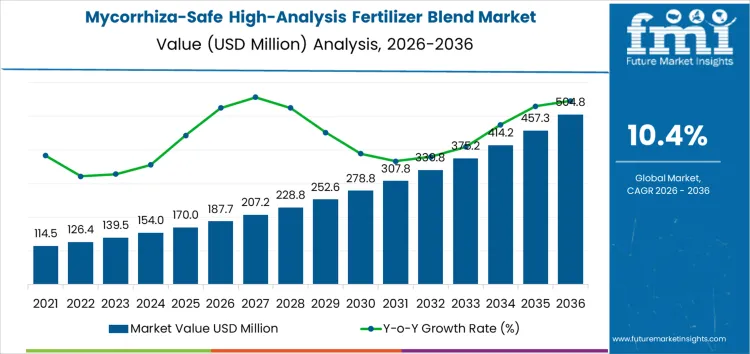
The mycorrhiza-safe high-analysis fertilizer blend market is valued at USD 187.7 million in 2026. It is projected to reach USD 504.8 million by 2036, growing at a compound annual growth rate (CAGR) of 10.4%. Dominant players in this market defend their pricing power through economies of scale, ensuring cost-efficient production and maintaining strong brand recognition. These established companies can leverage long-term supplier contracts, which help shield them from raw material price volatility.
The need for specialized production processes, certifications, and research into mycorrhiza compatibility maintains barriers to entry. Regulatory compliance plays a significant role in limiting new entrants. Despite these barriers, market fragmentation persists as demand for tailored solutions grows, with smaller companies focusing on niche applications or specific geographic regions. Fragmentation may narrow as consolidation occurs, particularly among players who can combine innovation with cost control to meet the growing demand for high-analysis, mycorrhiza-safe fertilizers.
Quick Stats of the Mycorrhiza-Safe High-Analysis Fertilizer Blend Market
- Mycorrhiza-Safe High-Analysis Fertilizer Blend Market Value (2026): USD 187.7 million
- Mycorrhiza-Safe High-Analysis Fertilizer Blend Market Forecast Value (2036): USD 504.8 million
- Mycorrhiza-Safe High-Analysis Fertilizer Blend Market Global Forecast CAGR (2026-2036): 10.4%
- Mycorrhiza-Safe High-Analysis Fertilizer Blend Market Leading Segment: Sales Channel (Ag-Retailers) 60%
- Key Growth Regions in Mycorrhiza-Safe High-Analysis Fertilizer Blend Market: India
- Top Players in Mycorrhiza-Safe High-Analysis Fertilizer Blend Market: ICL Group, Nutrien, Yara International, EuroChem, Haifa Group, UPL
What is the Growth Forecast for the Mycorrhiza-Safe High-Analysis Fertilizer Blend Market through 2036?
The 5-year growth block analysis for the mycorrhiza-safe high-analysis fertilizer blend market highlights steady and consistent growth in the first half of the forecast period. From 2026 to 2031, the market will grow from USD 187.7 million to USD 307.8 million, representing an increase of USD 120.1 million over five years. This growth will be fueled by the rising adoption of environmentally friendly and mycorrhiza-safe agricultural inputs as farmers seek to improve soil health and sustainability.
In the first few years (2026–2028), the market will see steady incremental growth, rising from USD 187.7 million in 2026 to USD 228.7 million in 2028. This period will be marked by growing awareness and adoption of mycorrhiza-safe products. From 2028 to 2031, the market will accelerate, rising by USD 79.1 million, from USD 228.7 million to USD 307.8 million. This acceleration will reflect increasing demand for fertilizers that are both high in nutrients and safe for beneficial soil fungi, as well as the growing recognition of the importance of sustainable agriculture practices. The steady rise in market value over this period indicates a strong and growing market demand for these specialized fertilizer blends.
Mycorrhiza-Safe High-Analysis Fertilizer Blend Market Key Takeaways
| Metric | Value |
|---|---|
| Industry Sales Value (2026) | USD 187.7 million |
| Industry Forecast Value (2036) | USD 504.8 million |
| Industry Forecast CAGR (2026-2036) | 10.4% |
What Is Driving the Demand for Mycorrhiza Safe High Analysis Fertilizer Blends?
Historical demand for high analysis fertilizer blends was shaped by agricultural intensification and the need to supply crops with readily available nutrients in compact, transportable forms. High analysis fertilizers concentrate key nutrients such as nitrogen, phosphorus, and potassium to support rapid nutrient uptake and consistent crop growth. Conventional high analysis blends have been widely used in modern farming systems to address productivity challenges posed by expanding global food demand throughout the late 20th century and early 21st century. During this period, fertilizer use expanded rapidly as part of high yield crop regimes and intensive cultivation practices designed to increase output per hectare.
Simultaneously, the importance of soil biology and symbiotic microbial associations with plant roots, such as mycorrhizal fungi, became better understood in agronomy research. Mycorrhizal fungi establish symbiotic relationships with plant roots that enhance nutrient and water uptake and benefit soil structure. Conventional high analysis fertilizers, especially those with high soluble phosphorus, can suppress natural mycorrhizal colonization, leading agronomists and researchers to investigate formulations that support rather than inhibit beneficial soil microbiota. This context contributed to early interest in fertilizer blends that maintain high nutrient content while being compatible with mycorrh‐friendly practices and soil health management.
Future demand for mycorrhiza safe high analysis fertilizer blends is expected to be shaped by growth in sustainable and regenerative agriculture practices that integrate nutrient management with soil biology. The broader biofertilizers market, including mycorrhiza based products that improve nutrient absorption and soil health, is projected to grow steadily, with some assessments indicating compound annual growth rates in the high single digits through 2030 and beyond. This trend reflects increasing adoption of sustainable farming methods, rising organic crop acreage, and regulatory emphasis on reducing reliance on synthetic agrochemicals.
Growth factors include rising awareness of the benefits of maintaining mycorrhizal networks for long term soil fertility, increasing interest in fertilizer products that support microbial activity, and demand for efficient nutrient delivery without compromising soil biological function. Government support for sustainable inputs and incentives for organic or reduced chemical farming practices also influence market uptake. Technical challenges include developing high analysis blends that balance nutrient availability with compatibility for mycorrhizal colonization and performance under varied soil conditions. Continued innovation in nutrient formulation and soil biology integration could shape broader adoption of mycorrhiza safe fertilizer solutions in commercial and organic farming systems.
What are the Leading Segments in the Global Mycorrhiza-Safe High-Analysis Fertilizer Blend Market?
The global mycorrhiza-safe high-analysis fertilizer blend market is segmented by crop and form. Among crop types, cereals lead the market, capturing 50% of the share, followed by oilseeds, fruits, and vegetables. Cereal crops are the most significant segment due to their extensive use in agricultural practices and the growing demand for high-efficiency fertilizers that are compatible with mycorrhiza. On the form side, granular fertilizers dominate the market, holding 45% of the share, followed by liquid, powder, and suspension forms. Granular fertilizers are preferred for their ease of use, slow-release properties, and suitability for a wide range of crops, including cereals.
What Drives the Growth of Cereal Crops in the Mycorrhiza-Safe High-Analysis Fertilizer Blend Market?
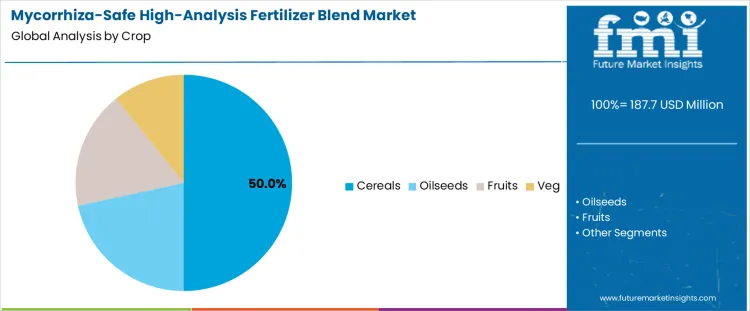
Cereal crops are the leading crop type in the mycorrhiza-safe high-analysis fertilizer blend market, holding 50% of the share. This demand is driven by the large-scale production of cereals worldwide and the need for efficient, high-performance fertilizers to boost crop yields. Cereal crops such as wheat, corn, and rice are staple food sources, and their cultivation requires fertilizers that promote healthy root development and nutrient uptake. Mycorrhiza-safe fertilizers are particularly attractive as they enhance nutrient absorption while protecting beneficial fungi, which are vital for soil health. The increasing focus on sustainable agriculture and the growing use of mycorrhiza to improve soil structure and crop productivity are key factors driving the demand for mycorrhiza-safe high-analysis fertilizers in cereal crop production.
What is Driving the Demand for Granular Fertilizers in the Mycorrhiza-Safe High-Analysis Fertilizer Blend Market?
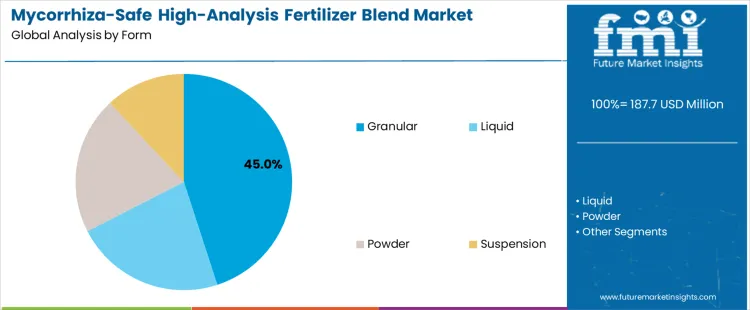
Granular fertilizers are the leading form in the mycorrhiza-safe high-analysis fertilizer blend market, capturing 45% of the share. This demand is driven by their ease of application, efficiency, and versatility across various crops, particularly cereals. Granular fertilizers provide a controlled-release mechanism, which ensures that nutrients are available to the plants over a longer period, reducing the need for frequent reapplications. Additionally, granular forms are compatible with most agricultural equipment, making them more convenient for large-scale farming operations. The mycorrhiza-safe feature of these fertilizers further boosts their adoption, as they protect and enhance the natural symbiotic relationship between plants and soil fungi, which is crucial for sustainable crop production. As the demand for efficient and eco-friendly agricultural practices continues to rise, granular fertilizers are expected to remain a dominant solution in the market.
What are the Key Dynamics in the Mycorrhiza-Safe High-Analysis Fertilizer Blend Market?
The mycorrhiza-safe high-analysis fertilizer blend market is shaped by demand for efficient nutrient delivery and soil health management. These fertilizer blends are designed to supply concentrated plant nutrients while supporting beneficial mycorrhizal fungi. Growers and agronomists evaluate performance based on nutrient content, compatibility with soil biology, and crop response. Regulations on fertilizer composition and environmental protection influence product development and use. Supply chain availability of raw materials and quality control practices also affect market activity. End users are balancing yield goals with long-term soil function in selection of fertilizer inputs.
What Factors Are Driving Growth in the Market?
Increased focus on nutrient use efficiency in crop production is a driver of market growth. Farmers seek high-analysis fertilizers to reduce application volumes and labor without compromising nutrient supply. Scientific research linking healthy soil microbial communities, including mycorrhizal fungi, to plant nutrient uptake supports interest in mycorrhiza-safe blends. Regulatory frameworks aimed at reducing nutrient runoff and protecting water quality encourage adoption of products that align with environmental guidelines. Expansion of intensive cropping systems with high nutrient demands also supports demand for concentrated, biologically compatible fertilizer blends.
What Challenges Are Restricting Adoption of These Fertilizer Blends?
Cost considerations can restrain adoption of mycorrhiza-safe high-analysis fertilizer blends, especially among smallholder and budget-constrained producers. Technical complexity in formulating fertilizers that maintain high nutrient content while avoiding ingredients that harm mycorrhizal fungi adds development hurdles for manufacturers. Variability in soil types and mycorrhizal populations can lead to inconsistent field results, which may deter some users. Differences in regional fertilizer regulations and testing standards create compliance challenges for suppliers operating across markets. End users may require additional agronomic support to integrate these products effectively into crop management plans.
What Emerging Trends Are Influencing the Future of the Market?
Advances in fertilizer formulation technology are improving the ability to combine high nutrient concentration with biological compatibility. Research into soil microbiome interactions is generating data that guides product development and application recommendations. Precision agriculture tools that monitor soil nutrient status and microbial activity are supporting targeted fertilizer use. Collaboration among fertilizer producers, soil scientists, and agricultural advisors is increasing as stakeholders seek evidence-based approaches to soil fertility. Interest in regenerative agriculture practices is contributing to demand for inputs that align nutrient supply with soil ecosystem health and long-term productivity.
What is the Country-Wise Analysis of the Mycorrhiza-Safe High-Analysis Fertilizer Blend Market?
The mycorrhiza-safe high-analysis fertilizer blend market is experiencing strong growth, driven by the increasing demand for fertilizers that promote soil health while providing essential nutrients to crops. Mycorrhizae, beneficial fungi that form symbiotic relationships with plant roots, play a critical role in nutrient absorption and soil health. As concerns about soil degradation and environmental sustainability grow, farmers and agricultural businesses are increasingly turning to fertilizers that do not harm these essential microorganisms.
Developed markets such as the USA and France are seeing steady growth in the demand for mycorrhiza-safe fertilizers due to the rising awareness of sustainable farming practices. Emerging markets like China and India are experiencing even faster growth, driven by the increasing adoption of modern farming techniques and the need to improve agricultural productivity. As the global focus on sustainable agriculture continues to rise, the market for mycorrhiza-safe high-analysis fertilizer blends is expected to expand significantly in the coming years.
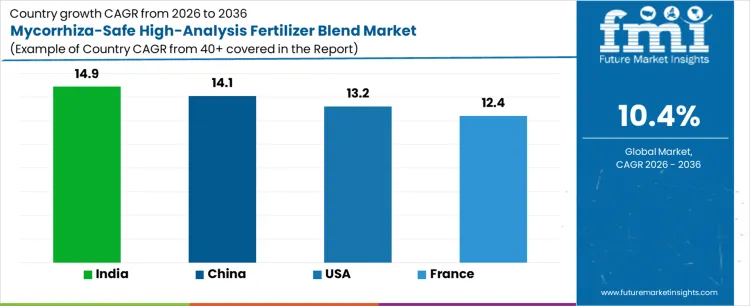
| Country | CAGR (2026-2036) |
|---|---|
| USA | 13.2% |
| China | 14.1% |
| India | 14.9% |
| France | 12.4% |
What is the Growth Outlook for the Mycorrhiza-Safe High-Analysis Fertilizer Blend Market in the USA?
The mycorrhiza-safe high-analysis fertilizer blend market in the USA is expected to grow steadily, with a projected CAGR of 13.2% from 2026 to 2036. The USA agricultural market is increasingly focused on sustainability, with farmers looking for solutions that improve crop yields while maintaining or enhancing soil health. Mycorrhizae play a vital role in promoting nutrient uptake and soil structure, and fertilizers that are safe for these microorganisms are becoming highly sought after. The growing demand for sustainable farming practices, coupled with the increased adoption of precision agriculture technologies, is expected to drive the USA market for mycorrhiza-safe high-analysis fertilizer blends. As the focus on soil health and sustainable farming solutions continues to rise, the USA market is poised for steady growth, with increasing adoption of these fertilizers by both conventional and organic farmers.
What is the Market Outlook for the Mycorrhiza-Safe High-Analysis Fertilizer Blend Market in China?
The mycorrhiza-safe high-analysis fertilizer blend market in China is projected to experience rapid growth, with a projected CAGR of 14.1% from 2026 to 2036. China’s agricultural industry is undergoing a transformation as the country increasingly focuses on sustainable farming practices and improving soil health. The growing recognition of the importance of mycorrhizae in enhancing crop yields and promoting soil health is driving the demand for mycorrhiza-safe fertilizers. The Chinese government has also introduced policies to support sustainable farming and reduce the environmental impact of conventional chemical fertilizers. As China works to modernize its agricultural sector and promote green farming solutions, the market for mycorrhiza-safe high-analysis fertilizers is expected to expand rapidly, driven by both government initiatives and growing consumer demand for sustainable agricultural practices.
What is the Growth Forecast for the Mycorrhiza-Safe High-Analysis Fertilizer Blend Market in India?
India is projected to experience the highest growth in the mycorrhiza-safe high-analysis fertilizer blend market, with a projected CAGR of 14.9% from 2026 to 2036. India’s agricultural sector is crucial to the country’s economy, and there is growing recognition of the need for sustainable farming practices to improve productivity and soil health. The increasing use of synthetic fertilizers has led to concerns about soil degradation, prompting farmers to look for alternatives that are both effective and environmentally friendly. Mycorrhiza-safe fertilizers, which support beneficial microorganisms while enhancing nutrient availability, are gaining traction in India’s agricultural landscape. The country’s rising population and the growing demand for food are driving the need for higher agricultural productivity, further contributing to the demand for these advanced fertilizers. As India continues to shift toward sustainable agricultural solutions, the mycorrhiza-safe fertilizer market is expected to grow rapidly in the coming years.
What is the Market Outlook for the Mycorrhiza-Safe High-Analysis Fertilizer Blend Market in France?
The mycorrhiza-safe high-analysis fertilizer blend market in France is expected to experience steady growth, with a projected CAGR of 12.4% from 2026 to 2036. France is a leader in promoting sustainable agricultural practices, and the demand for fertilizers that are safe for soil health and the environment is rising. French farmers are increasingly adopting practices that support the growth of beneficial microorganisms like mycorrhizae, as they are recognized for improving soil structure, nutrient absorption, and crop resilience. As the country continues to promote organic farming and sustainable agricultural practices, the market for mycorrhiza-safe high-analysis fertilizers is expected to grow steadily. France’s regulatory environment, which supports eco-friendly and sustainable farming solutions, combined with consumer demand for environmentally responsible products, will drive the growth of this market in the coming years.
What are the Growth Prospects for the Mycorrhiza-Safe High-Analysis Fertilizer Blend Market in Japan?
Japan is projected to experience steady growth in the mycorrhiza-safe high-analysis fertilizer blend market, with a projected CAGR of 8% from 2026 to 2036. Japan’s agricultural industry is highly advanced and focused on sustainability, with a growing emphasis on organic farming and soil health. As Japanese farmers seek to improve crop yields while maintaining or enhancing soil health, there is increasing demand for fertilizers that support the growth of beneficial microorganisms like mycorrhizae. The market for mycorrhiza-safe fertilizers is expected to expand as Japan continues to adopt sustainable farming practices and promotes the use of eco-friendly, natural solutions in agriculture. With Japan’s strong focus on innovation and environmentally friendly practices, the demand for mycorrhiza-safe high-analysis fertilizer blends is expected to rise steadily over the next decade.
What is the Competitive Landscape for the Mycorrhiza-Safe High-Analysis Fertilizer Blend Market?
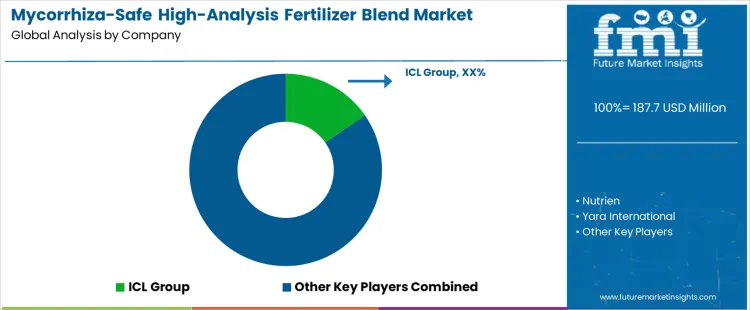
The mycorrhiza-safe high-analysis fertilizer blend market is growing as the agricultural industry increasingly focuses on sustainable practices that protect soil health and promote beneficial microbial activity. ICL Group leads the market with its innovative mycorrhiza-safe fertilizer blends, offering high-analysis solutions that enhance plant growth while being safe for mycorrhizal fungi, which play a critical role in soil health. Their focus on product performance, sustainability, and soil ecosystem preservation has positioned them as a dominant player. Nutrien, Yara International, and EuroChem are significant competitors, each providing specialized high-analysis fertilizer blends that support efficient nutrient delivery while being safe for beneficial soil microorganisms. Nutrien offers a wide range of nutrient-rich fertilizers designed to support both plant growth and soil health, while Yara International and EuroChem emphasize the importance of sustainable, high-performance fertilizers that align with ecological farming practices.
Haifa Group and UPL further contribute to the competitive landscape by offering their own mycorrhiza-safe high-analysis fertilizer blends, focusing on improving crop yield while ensuring minimal impact on beneficial soil organisms. Haifa Group specializes in producing high-quality fertilizers for a variety of crops, while UPL emphasizes sustainable agricultural solutions, including those that promote soil health. These companies compete by focusing on product innovation, sustainability, and the growing consumer demand for fertilizers that support ecological balance and long-term soil fertility. As sustainable agriculture practices continue to gain traction, the market for mycorrhiza-safe high-analysis fertilizer blends is expected to expand, fostering further innovation and competition in the sector.
Key Players of the Mycorrhiza-Safe High-Analysis Fertilizer Blend Market
- ICL Group
- Nutrien
- Yara International
- EuroChem
- Haifa Group
- UPL
Scope of the Report
| Items | Values |
|---|---|
| Quantitative Units (2026) | USD Million |
| Crop | Cereals, Oilseeds, Fruits, Vegetables |
| Form | Granular, Liquid, Powder, Suspension |
| Sales Channel | Ag Retailers, Direct to Farmer, Online Marketplaces, Cooperatives |
| Companies | ICL Group, Nutrien, Yara International, EuroChem, Haifa Group, UPL |
| Regions Covered | North America, Latin America, Western Europe, Eastern Europe, South Asia & Pacific, East Asia, Middle East & Africa |
| Countries Covered | United States, Canada, Mexico, Brazil, Argentina, Germany, France, United Kingdom, Italy, Spain, Netherlands, China, India, Japan, South Korea, ANZ, GCC Countries, South Africa |
| Additional Attributes | Dollar by sales by crop, form, and sales channel, and by region. Includes analysis of market trends in mycorrhiza safe high analysis fertilizer blends, performance outcomes on crop yield and soil health, cost and formulation factors, regulatory and safety considerations in fertilizer use, adoption patterns across farming systems, market share and competitive positioning of key companies, innovations in high analysis and mycorrhiza compatible fertilizer technologies, and evaluation of impact on agronomic performance, sustainability metrics, and farmer preferences. |
Mycorrhiza-Safe High-Analysis Fertilizer Blend Market Segmentation
Crop
- Cereals
- Oilseeds
- Fruits
- Vegetables
Form
- Granular
- Liquid
- Powder
- Suspension
Sales Channel
- Ag-Retailers
- Direct-to-Farmer
- Online Marketplaces
- Cooperatives
Region
- Asia Pacific
- China
- Japan
- South Korea
- India
- Australia & New Zealand
- ASEAN
- Rest of Asia Pacific
- Europe
- Germany
- United Kingdom
- France
- Italy
- Spain
- Nordic
- BENELUX
- Rest of Europe
- North America
- United States
- Canada
- Mexico
- Latin America
- Brazil
- Chile
- Rest of Latin America
- Middle East & Africa
- Kingdom of Saudi Arabia
- Other GCC Countries
- Turkey
- South Africa
- Other African Union
- Rest of Middle East & Africa
Frequently Asked Questions
How big is the mycorrhiza-safe high-analysis fertilizer blend market in 2026?
The global mycorrhiza-safe high-analysis fertilizer blend market is estimated to be valued at USD 187.7 million in 2026.
What will be the size of mycorrhiza-safe high-analysis fertilizer blend market in 2036?
The market size for the mycorrhiza-safe high-analysis fertilizer blend market is projected to reach USD 504.8 million by 2036.
How much will be the mycorrhiza-safe high-analysis fertilizer blend market growth between 2026 and 2036?
The mycorrhiza-safe high-analysis fertilizer blend market is expected to grow at a 10.4% CAGR between 2026 and 2036.
What are the key product types in the mycorrhiza-safe high-analysis fertilizer blend market?
The key product types in mycorrhiza-safe high-analysis fertilizer blend market are cereals, oilseeds, fruits and veg.
Which form segment to contribute significant share in the mycorrhiza-safe high-analysis fertilizer blend market in 2026?
In terms of form, granular segment to command 45.0% share in the mycorrhiza-safe high-analysis fertilizer blend market in 2026.
Preview the report firsthand - request a free sample
Get SampleGet the brochure for pricing and purchase details.
Get PDFTable of Content
- Executive Summary
- Global Market Outlook
- Demand-side Trends
- Supply-side Trends
- Technology Roadmap Analysis
- Analysis and Recommendations
- Market Overview
- Market Coverage / Taxonomy
- Market Definition / Scope / Limitations
- Market Background
- Market Dynamics
- Drivers
- Restraints
- Opportunity
- Trends
- Scenario Forecast
- Demand in Optimistic Scenario
- Demand in Likely Scenario
- Demand in Conservative Scenario
- Opportunity Map Analysis
- Product Life Cycle Analysis
- Supply Chain Analysis
- Investment Feasibility Matrix
- Value Chain Analysis
- PESTLE and Porter’s Analysis
- Regulatory Landscape
- Regional Parent Market Outlook
- Production and Consumption Statistics
- Import and Export Statistics
- Market Dynamics
- Global Market Analysis 2021 to 2025 and Forecast, 2026 to 2036
- Historical Market Size Value (USD Million) Analysis, 2021 to 2025
- Current and Future Market Size Value (USD Million) Projections, 2026 to 2036
- Y-o-Y Growth Trend Analysis
- Absolute $ Opportunity Analysis
- Global Market Pricing Analysis 2021 to 2025 and Forecast 2026 to 2036
- Global Market Analysis 2021 to 2025 and Forecast 2026 to 2036, By Crop
- Introduction / Key Findings
- Historical Market Size Value (USD Million) Analysis By Crop , 2021 to 2025
- Current and Future Market Size Value (USD Million) Analysis and Forecast By Crop , 2026 to 2036
- Cereals
- Oilseeds
- Fruits
- Veg
- Cereals
- Y-o-Y Growth Trend Analysis By Crop , 2021 to 2025
- Absolute $ Opportunity Analysis By Crop , 2026 to 2036
- Global Market Analysis 2021 to 2025 and Forecast 2026 to 2036, By Form
- Introduction / Key Findings
- Historical Market Size Value (USD Million) Analysis By Form, 2021 to 2025
- Current and Future Market Size Value (USD Million) Analysis and Forecast By Form, 2026 to 2036
- Granular
- Liquid
- Powder
- Suspension
- Granular
- Y-o-Y Growth Trend Analysis By Form, 2021 to 2025
- Absolute $ Opportunity Analysis By Form, 2026 to 2036
- Global Market Analysis 2021 to 2025 and Forecast 2026 to 2036, By Sales Channel
- Introduction / Key Findings
- Historical Market Size Value (USD Million) Analysis By Sales Channel, 2021 to 2025
- Current and Future Market Size Value (USD Million) Analysis and Forecast By Sales Channel, 2026 to 2036
- Ag-Retailers
- Direct-to-Farmer
- Online Marketplaces
- Cooperatives
- Ag-Retailers
- Y-o-Y Growth Trend Analysis By Sales Channel, 2021 to 2025
- Absolute $ Opportunity Analysis By Sales Channel, 2026 to 2036
- Global Market Analysis 2021 to 2025 and Forecast 2026 to 2036, By Region
- Introduction
- Historical Market Size Value (USD Million) Analysis By Region, 2021 to 2025
- Current Market Size Value (USD Million) Analysis and Forecast By Region, 2026 to 2036
- North America
- Latin America
- Western Europe
- Eastern Europe
- East Asia
- South Asia and Pacific
- Middle East & Africa
- Market Attractiveness Analysis By Region
- North America Market Analysis 2021 to 2025 and Forecast 2026 to 2036, By Country
- Historical Market Size Value (USD Million) Trend Analysis By Market Taxonomy, 2021 to 2025
- Market Size Value (USD Million) Forecast By Market Taxonomy, 2026 to 2036
- By Country
- USA
- Canada
- Mexico
- By Crop
- By Form
- By Sales Channel
- By Country
- Market Attractiveness Analysis
- By Country
- By Crop
- By Form
- By Sales Channel
- Key Takeaways
- Latin America Market Analysis 2021 to 2025 and Forecast 2026 to 2036, By Country
- Historical Market Size Value (USD Million) Trend Analysis By Market Taxonomy, 2021 to 2025
- Market Size Value (USD Million) Forecast By Market Taxonomy, 2026 to 2036
- By Country
- Brazil
- Chile
- Rest of Latin America
- By Crop
- By Form
- By Sales Channel
- By Country
- Market Attractiveness Analysis
- By Country
- By Crop
- By Form
- By Sales Channel
- Key Takeaways
- Western Europe Market Analysis 2021 to 2025 and Forecast 2026 to 2036, By Country
- Historical Market Size Value (USD Million) Trend Analysis By Market Taxonomy, 2021 to 2025
- Market Size Value (USD Million) Forecast By Market Taxonomy, 2026 to 2036
- By Country
- Germany
- UK
- Italy
- Spain
- France
- Nordic
- BENELUX
- Rest of Western Europe
- By Crop
- By Form
- By Sales Channel
- By Country
- Market Attractiveness Analysis
- By Country
- By Crop
- By Form
- By Sales Channel
- Key Takeaways
- Eastern Europe Market Analysis 2021 to 2025 and Forecast 2026 to 2036, By Country
- Historical Market Size Value (USD Million) Trend Analysis By Market Taxonomy, 2021 to 2025
- Market Size Value (USD Million) Forecast By Market Taxonomy, 2026 to 2036
- By Country
- Russia
- Poland
- Hungary
- Balkan & Baltic
- Rest of Eastern Europe
- By Crop
- By Form
- By Sales Channel
- By Country
- Market Attractiveness Analysis
- By Country
- By Crop
- By Form
- By Sales Channel
- Key Takeaways
- East Asia Market Analysis 2021 to 2025 and Forecast 2026 to 2036, By Country
- Historical Market Size Value (USD Million) Trend Analysis By Market Taxonomy, 2021 to 2025
- Market Size Value (USD Million) Forecast By Market Taxonomy, 2026 to 2036
- By Country
- China
- Japan
- South Korea
- By Crop
- By Form
- By Sales Channel
- By Country
- Market Attractiveness Analysis
- By Country
- By Crop
- By Form
- By Sales Channel
- Key Takeaways
- South Asia and Pacific Market Analysis 2021 to 2025 and Forecast 2026 to 2036, By Country
- Historical Market Size Value (USD Million) Trend Analysis By Market Taxonomy, 2021 to 2025
- Market Size Value (USD Million) Forecast By Market Taxonomy, 2026 to 2036
- By Country
- India
- ASEAN
- Australia & New Zealand
- Rest of South Asia and Pacific
- By Crop
- By Form
- By Sales Channel
- By Country
- Market Attractiveness Analysis
- By Country
- By Crop
- By Form
- By Sales Channel
- Key Takeaways
- Middle East & Africa Market Analysis 2021 to 2025 and Forecast 2026 to 2036, By Country
- Historical Market Size Value (USD Million) Trend Analysis By Market Taxonomy, 2021 to 2025
- Market Size Value (USD Million) Forecast By Market Taxonomy, 2026 to 2036
- By Country
- Kingdom of Saudi Arabia
- Other GCC Countries
- Turkiye
- South Africa
- Other African Union
- Rest of Middle East & Africa
- By Crop
- By Form
- By Sales Channel
- By Country
- Market Attractiveness Analysis
- By Country
- By Crop
- By Form
- By Sales Channel
- Key Takeaways
- Key Countries Market Analysis
- USA
- Pricing Analysis
- Market Share Analysis, 2025
- By Crop
- By Form
- By Sales Channel
- Canada
- Pricing Analysis
- Market Share Analysis, 2025
- By Crop
- By Form
- By Sales Channel
- Mexico
- Pricing Analysis
- Market Share Analysis, 2025
- By Crop
- By Form
- By Sales Channel
- Brazil
- Pricing Analysis
- Market Share Analysis, 2025
- By Crop
- By Form
- By Sales Channel
- Chile
- Pricing Analysis
- Market Share Analysis, 2025
- By Crop
- By Form
- By Sales Channel
- Germany
- Pricing Analysis
- Market Share Analysis, 2025
- By Crop
- By Form
- By Sales Channel
- UK
- Pricing Analysis
- Market Share Analysis, 2025
- By Crop
- By Form
- By Sales Channel
- Italy
- Pricing Analysis
- Market Share Analysis, 2025
- By Crop
- By Form
- By Sales Channel
- Spain
- Pricing Analysis
- Market Share Analysis, 2025
- By Crop
- By Form
- By Sales Channel
- France
- Pricing Analysis
- Market Share Analysis, 2025
- By Crop
- By Form
- By Sales Channel
- India
- Pricing Analysis
- Market Share Analysis, 2025
- By Crop
- By Form
- By Sales Channel
- ASEAN
- Pricing Analysis
- Market Share Analysis, 2025
- By Crop
- By Form
- By Sales Channel
- Australia & New Zealand
- Pricing Analysis
- Market Share Analysis, 2025
- By Crop
- By Form
- By Sales Channel
- China
- Pricing Analysis
- Market Share Analysis, 2025
- By Crop
- By Form
- By Sales Channel
- Japan
- Pricing Analysis
- Market Share Analysis, 2025
- By Crop
- By Form
- By Sales Channel
- South Korea
- Pricing Analysis
- Market Share Analysis, 2025
- By Crop
- By Form
- By Sales Channel
- Russia
- Pricing Analysis
- Market Share Analysis, 2025
- By Crop
- By Form
- By Sales Channel
- Poland
- Pricing Analysis
- Market Share Analysis, 2025
- By Crop
- By Form
- By Sales Channel
- Hungary
- Pricing Analysis
- Market Share Analysis, 2025
- By Crop
- By Form
- By Sales Channel
- Kingdom of Saudi Arabia
- Pricing Analysis
- Market Share Analysis, 2025
- By Crop
- By Form
- By Sales Channel
- Turkiye
- Pricing Analysis
- Market Share Analysis, 2025
- By Crop
- By Form
- By Sales Channel
- South Africa
- Pricing Analysis
- Market Share Analysis, 2025
- By Crop
- By Form
- By Sales Channel
- USA
- Market Structure Analysis
- Competition Dashboard
- Competition Benchmarking
- Market Share Analysis of Top Players
- By Regional
- By Crop
- By Form
- By Sales Channel
- Competition Analysis
- Competition Deep Dive
- ICL Group
- Overview
- Product Portfolio
- Profitability by Market Segments (Product/Age /Sales Channel/Region)
- Sales Footprint
- Strategy Overview
- Marketing Strategy
- Product Strategy
- Channel Strategy
- Nutrien
- Yara International
- EuroChem
- Haifa Group
- UPL
- ICL Group
- Competition Deep Dive
- Assumptions & Acronyms Used
- Research Methodology


