

- Industry Size (2026)
- USD 1650.0 Mn
- Forecast (2036)
- USD 3450.0 Mn
- CAGR (2026 to 2036)
- 7.7%
Nitinol Fixation Implants Market Size, Market Forecast and Outlook By FMI
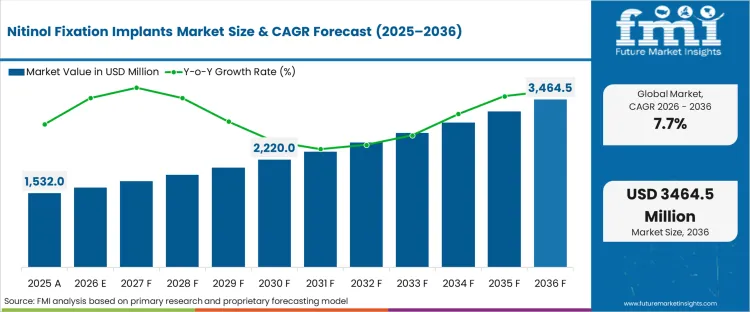
In 2026, the nitinol fixation implants market was valued at USD 1,650.0 million. Based on Future Market Insights analysis, demand for nitinol fixation implants is estimated to grow to USD 3,450.0 million by 2036. FMI projects a CAGR of 7.7% during the forecast period.
Absolute dollar growth of USD 1,800.0 million over the decade signals structural expansion rather than a routine implant refresh. As per FMI, growth is expected to be supported by rising adoption of nitinol-based compression constructs in foot and ankle and upper extremity procedures, while procurement controls, surgeon preference inertia, and reimbursement discipline are expected to pace conversion away from conventional fixation. In 2026, Smith+Nephew signed an exclusive USA distribution agreement with RMR Ortho to add the A’TOMIC™ Nitinol Fixation System to the Smith+Nephew Trauma, Foot & Ankle and Hand & Wrist portfolio. “This partnership with RMR Ortho strengthens Smith+Nephew’s fixation portfolio by adding a dynamic compression fixation solution that complements our existing technologies,” said Scott Gunn, Vice President of USA Marketing, Trauma, Extremities, and Shoulder at Smith+Nephew.
Summary of Nitinol Fixation Implants Market
- Nitinol Fixation Implants Market Definition
- The industry covers nitinol-based orthopedic fixation implants that use shape-memory and superelastic behavior to stabilize bone and soft tissue interfaces, supplied as staples, plates and screws, nails, clips, anchors, and adjunct fixation components used across multiple anatomical sites.
- Demand Drivers in The Market
- Surgeons are adopting nitinol fixation where sustained compression and reduced loosening risk support faster fusion and stable healing in small-bone procedures.
- Geriatric fracture and deformity caseloads are increasing demand for fixation options that tolerate variable bone quality and maintain apposition.
- Hospitals are standardizing fixation sets that reduce intraoperative steps and improve placement consistency across repetitive procedures.
- Key Segments Analyzed in The FMI Report
- By Implant Type: Compression Staples lead at 38.0% share in 2026, followed by plates and screws (nitinol components) at 22.0% share.
- By Application Area: Foot And Ankle leads at 30.0% share in 2026, followed by upper extremity at 18.0% share.
- Geography: India and China show the fastest growth at 9.8% and 9.2% CAGR, supported by rising orthopedic procedure volumes and expanding hospital capacity.
- Analyst Opinion at FMI
- Sabyasachi Ghosh, Principal Consultant at Future Market Insights, opines, ‘Preference is being shaped by sustained compression performance, ease of placement, and revision-risk control, since fixation failure in small-bone procedures quickly translates into re-operations and longer rehabilitation.’
- Strategic Implications and Executive Takeaways
- Protect compression staple leadership by expanding size and geometry ranges tailored to foot and ankle fusion workflows.
- Build surgeon education programs around shape-memory compression behavior to reduce technique variability and improve outcomes tracking.
- Strengthen hospital contracting with complete procedure kits, since purchasing is concentrated in hospitals and tied to service-line standardization.
- Methodology
- As per FMI, sizing and splits were triangulated using company primary disclosures, procedure mapping, and implant set procurement logic by end user.
- Segment shares were validated by linking implant type and application mix to typical surgical usage patterns and replenishment behavior.
- Sensitivity checks were run across core-feature adoption and patient-group mix to confirm revenue movement under realistic case-mix shifts.
“The A’TOMIC Nitinol Fixation System expands our ability to participate in high-frequency fracture and arthrodesis procedures while leveraging our established Extremities and Trauma sales channel to deepen surgeon engagement. This collaboration reflects our disciplined approach to portfolio expansion and our continued focus on driving sustainable growth.”.
Purchasing behaviour is being shaped by surgeon-led preference and hospital value analysis review, with buyers prioritising handling simplicity, compression reliability, and compatibility with existing instrumentation. Multi-year supply agreements are being used to stabilise pricing, while vendor selection is being influenced by tray availability, training support, and procedural standardisation in ASC settings.
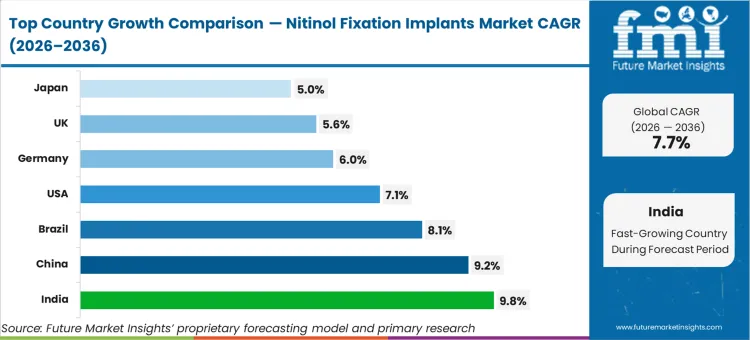
India (9.8% CAGR, supported by rising orthopedic procedure volumes and private hospital expansion) and China (9.2% CAGR, driven by increasing sports medicine and trauma caseloads) are expected to lead growth. Brazil (8.1% CAGR) is expected to expand through broader orthopedic access. The USA (7.1% CAGR) is expected to grow through high adoption in foot and ankle and outpatient orthopedic pathways. Mature markets including Germany (6.0%), the UK (5.6%), and Japan (5.0%) are expected to contribute more through replacement and incremental adoption, constrained by committee review cycles and conservative implant switching.
Nitinol Fixation Implants Market Definition
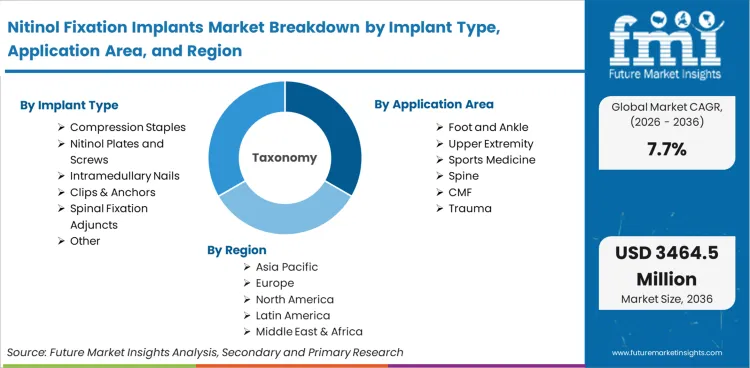
The market includes nitinol-based orthopedic fixation implants that enable compression and stabilisation via shape memory and superelastic effects. The implants include compression staples, nitinol parts for plates and screw systems, intramedullary nails, clips or anchors, and adjuncts for spinal fixation. The implants have applications in foot/ankle, upper extremity, sports medicine, spine, CMF, and trauma, and are implanted in adult, geriatric, and pediatric patients based on the application. The implants are purchased by hospitals, ambulatory surgery centers, and specialty orthopedic centers, and the market is driven by surgeon workflow, implant stability, and ambulatory surgery trends.
Nitinol Fixation Implants Market Inclusion
The report provides a global and regional market size, along with a 10-year forecast from 2026 to 2036. Segment-level data on the market size of implants by type, area of application, core feature, target group, and end user is included, along with a CAGR comparison of countries in key markets. The report also provides a detailed analysis of the procurement influencers, including value analysis review, surgeon adoption, ASC penetration, and vendor support models, in addition to the competitive landscape of key players in the industry, as per FMI analysis.
Nitinol Fixation Implants Market Exclusions
The scope excludes non-nitinol orthopedic fixation implants manufactured purely from stainless steel, titanium, or cobalt-chromium alloys without nitinol components. It also omits external fixation devices and general orthopedic instruments used for implantation. Bone graft materials, biologics, and growth factors sold as separate categories are excluded. Procedure fees and hospital service revenue are excluded. The focus remains on nitinol-based fixation implants aligned to the listed implant types, application areas, core features, patient groups, and end users.
Nitinol Fixation Implants Market Research Methodology
- Primary Research: Interviews with orthopedic surgeons, ASC administrators, hospital procurement and value analysis stakeholders, and supplier commercial teams were conducted.
- Desk Research: Public information was obtained from regulators, professional organizations, peer-reviewed articles, and primary corporate disclosures.
- Market-Sizing and Forecasting: FMI followed a hybrid approach, bottom up approach was used combining procedure volume with application area to understand the implant consumption by end-users, which were then reconciled based on estimating the segment revenue sales for implant types and core features.
- Data Validation and Update Cycle: Data was verified internally with a check for consistency between segment totals and country growth rates, with variance checks conducted before release.
Segmental Analysis
Nitinol Fixation Implants Market Analysis by Implant Type
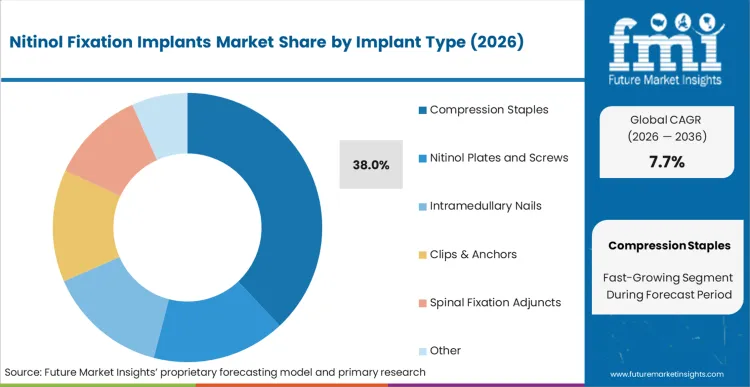
Based on FMI’s report, compression staples are estimated to hold 38.0% share in 2026, followed by plates and screws (nitinol components) at 22.0% share. Compression staples lead because they provide sustained apposition in fusion and osteotomy workflows with fewer steps than multi-screw constructs, which supports adoption in high-repetition procedures. Plates and screws follow where surgeons need load sharing across longer segments, with nitinol used to improve compliance and maintain fixation integrity.
- Simple, repeatable fixation in high-repetition foot/ankle cases: A 2024 systematic review notes nitinol compression staples are increasingly used in foot surgery due to straightforward implantation and reproducible continuous compression, with acceptable healing outcomes across common fusion and osteotomy procedures.
- Sustained compression reduces gapping under load: A 2025 Journal of Foot and Ankle Surgery article reports superelastic NiTiNOL staples can maintain stiffness while reducing permanent plantar gapping compared with static staples, aligning with staple adoption where compression maintenance matters most.
- Staple-only constructs can reduce time and invasiveness versus plates: A 2025 clinical comparative paper reports staple-only fixation advantages including smaller incisions, shorter operative time, less implant discomfort, and reduced need for removal compared with plate fixation, supporting staple preference in routine workflows.
Nitinol Fixation Implants Market Analysis by Application Area
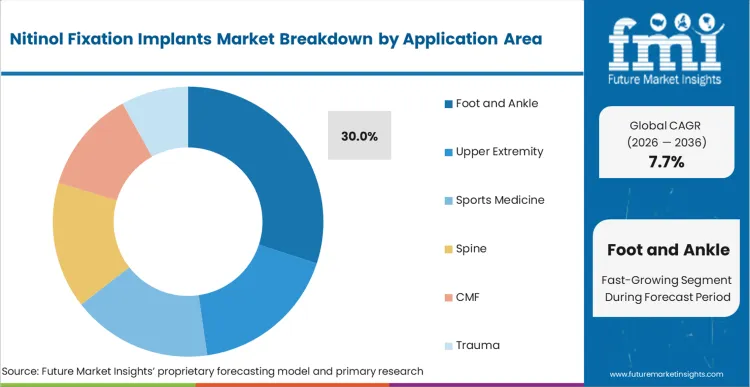
Foot and ankle accounts for 30.0% share in 2026, followed by upper extremity at 18.0%, based on FMI’s report. Foot and ankle leads due to high fusion and corrective procedure volumes where compression stability supports healing and reduces non-union risk. Upper extremity follows through hand and wrist procedures that benefit from low-profile fixation and stable apposition, though share is smaller because case volumes are lower than foot and ankle service-line throughput.
- Foot-focused implant practicality increases routine use: A 2025 clinical review notes newer superelastic nitinol staples are ready to use at room temperature with no activation steps, while maintaining dynamic compression. That practicality suits repetitive foot and ankle fusion workflows, lifting share.
- Product design and marketing focus on foot/ankle arthrodesis and osteotomy: Arthrex’s DynaNite nitinol staple product page highlights a low-profile nitinol staple designed for compressive fixation in foot & ankle indications, aligning staple use with high-frequency fusion and corrective cases.
- Service-line procedure density: Foot and ankle dominates because hospitals and ASCs run high-throughput bunion correction, Lapidus, and hindfoot or midfoot fusion lists where stable compression is routinely required. That repeat-case density keeps nitinol staples and compression implants in standard trays, driving the highest utilization share.
Nitinol Fixation Implants Market Drivers, Restraints, And Opportunities
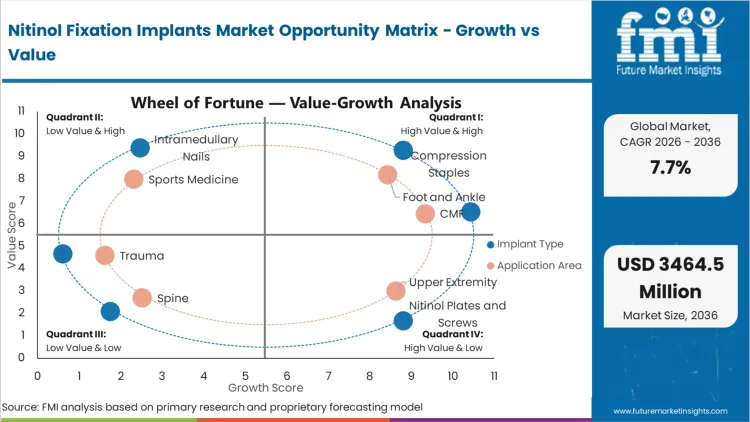
Future Market Insights analysis that historical patterns point at a procedure-driven orthopedic fixation category where demand is anchored in fusion, osteotomy, and fracture stabilization needs that benefit from sustained compression and elastic fixation behavior. Current demand is being shaped by aging-led case mix and surgeon preference for constructs that reduce loosening and improve apposition stability, as per FMI.
While growth is being restrained by surgeon preference lock-in for conventional titanium constructs, price pressure under hospital tenders, and training needs for shape-memory handling, value expansion is being supported by rising foot and ankle procedure volumes and broader adoption of compression staples in standardized workflows. Based on FMI’s report, purchasing decisions are increasingly being filtered by clinical performance consistency, ease of placement, and revision-risk outcomes rather than by implant unit price alone.
- Workflow-Led Upgrading: Growth is shifting toward fixation systems that deliver sustained compression with fewer steps and predictable placement.
- Adoption Pacing Restraint: Technique learning curves and established tray standardization slow switching from conventional constructs.
- Foot and Ankle Pull Mechanism: Demand is being sustained by fusion-heavy service lines where compression staples improve fixation stability and healing reliability.
Regional Analysis
.webp "Top Country Growth Comparison Nitinol Fixation Implants Market Cagr (2026 2036)")
Based on the regional analysis, nitinol fixation implants market is segmented into North America, Latin America, East Asia, South Asia & Pacific, Western Europe, Eastern Europe and Middle East & Africa across 40+ countries. Regional performance is interpreted through procedure volumes in foot & ankle and upper extremity, surgeon preference for shape-memory compression and superelastic fixation, and hospital versus ASC procurement of nitinol implant systems, as per FMI. The full report also offers market attractiveness analysis based on regional trends.
| Country | CAGR |
|---|---|
| United States | 7.1% |
| Germany | 6.0% |
| United Kingdom | 5.6% |
| Japan | 5.0% |
| China | 9.2% |
| India | 9.8% |
| Brazil | 8.1% |
Source: Future Market Insights (FMI) analysis, based on proprietary forecasting model and primary research
North America Nitinol Fixation Implants Market Analysis
North America has a large base of compression staples and nitinol-enabling fixation, particularly in foot/ankle and sports medicine, with hospital standardization and ASC growth as drivers for purchase decisions. Stryker has a strong base with broad portfolios and surgeon-centric solutions in extremity fixation. Zimmer Biomet has a presence through its orthopedic implants and procedural reach. Johnson & Johnson (DePuy Synthes) has a presence in areas where trauma and orthopedic fixation solutions converge with nitinol adjunct use. According to FMI analysis, hospitals remain the largest end users, with ASCs growing their share in elective extremity cases.
- United States.: In the USA, nitinol fixation implants are expected to progress at 7.1% CAGR through 2036, supported by continued shift toward minimally invasive fixation approaches and preference for shape-memory compression in foot & ankle fusion and osteotomy procedures. Compression staples remain the leading implant type where consistent compression and simple workflow are valued, while plates and screws with nitinol components see adoption in cases requiring hybrid fixation.
FMI’s report includes a detailed analysis of the growth in the North American region, along with a country-wise assessment that includes the USA, Canada and Mexico. Readers can also find regional trends, regulations, and market growth based on different segments and countries in the North America region.
East Asia Nitinol Fixation Implants Market Analysis
East Asia is driven by expanding orthopedic surgery capacity and rising adoption of advanced fixation options in high-volume hospitals, with increasing interest in superelastic fixation where bone quality or complex anatomy benefits from continuous force. Stryker and Zimmer Biomet participate through hospital channel access and extremity portfolios, while local and regional suppliers compete on pricing and availability in public systems. FMI is of the opinion that uptake remains concentrated in tertiary hospitals and specialty orthopedic centres.
- China: China has the highest growth rate with a 9.2% CAGR up to 2036, mainly due to the rising case volume for orthopedic procedures and the use of foot & ankle fixation devices in high-speed hospitals. Shape memory compression has been the most accepted core feature, especially for staples used for fusion procedures, while clips and anchors are also starting to gain acceptance for sports medicine procedures.
- Japan: Japan has a 5.0% CAGR growth rate up to 2036, mainly due to the high orthopedic case volume with a high volume of elective procedures and a conservative approach for adopting new fixation devices. Nitinol staples are also being used for foot & ankle procedures, as reliable compression is vital for the outcome, though the overall adoption is driven by conservative switching rates.
FMI’s report includes a detailed analysis of the growth in the East Asia region, along with a country-wise assessment that includes China, Japan and South Korea. Readers can also find regional trends, regulations, and market growth based on different segments and countries in the East Asia region.
South Asia & Pacific Nitinol Fixation Implants Market Analysis
South Asia & Pacific remains a high-growth region, supported by rising orthopedic procedure volumes and increasing adoption of advanced implants in private hospitals and specialty centres. Stryker and Zimmer Biomet participate through premium placements, while Arthrex has strong influence in sports medicine and soft-tissue adjacent fixation workflows that can pull nitinol-enabled options. FMI analysts note that adoption concentrates in metros where surgeon training and patient willingness to pay support premium fixation.
- India: India is forecast at 9.8% CAGR through 2036, driven by higher foot & ankle and trauma procedure volumes and growing preference for implants that simplify workflow and provide consistent compression. Compression staples remain the main entry point due to ease of use, while plates and screws with nitinol components gain adoption where hybrid constructs are required.
FMI’s report includes a detailed analysis of the growth in the South Asia & Pacific region, along with a country-wise assessment that includes India, ASEAN Countries, Australia & New Zealand and Rest of South Asia. Readers can also find regional trends, regulations, and market growth based on different segments and countries in the South Asia & Pacific region.
Latin America Nitinol Fixation Implants Market Analysis
Latin America is shaped by mixed public and private orthopedic procurement, where adoption is influenced by distributor coverage, pricing discipline, and availability of trained surgeons for advanced fixation techniques. Stryker and Zimmer Biomet hold visibility through distributor networks in larger cities. Johnson & Johnson (DePuy Synthes) participates where hospital trauma and orthopedic procurement remains consolidated. FMI opines that uptake is strongest in private hospitals and specialty centres that handle higher complexity cases.
- Brazil: The market is expected to grow by 8.1% CAGR until 2036, driven by sustained growth in foot and ankle surgery and increasing adoption of nitinol staples for fusion and deformity correction cases. Private hospitals and specialty centres are the key adoption areas where patients can afford premium cost implants, while public hospitals are limited by tender pricing constraints.
The report consists of a detailed analysis for the market in Brazil, Argentina and Rest of Latin America. Readers can find detailed information about several factors, such as the pricing analysis and regional trends, which are impacting growth in the Latin America region.
Western Europe Nitinol Fixation Implants Market Analysis
Western Europe is procurement-led and replacement-driven, where adoption depends on surgeon preference, hospital tender decisions, and evidence of improved outcomes in fusion and extremity fixation. Stryker and Zimmer Biomet remain key participants through orthopedic portfolios and established hospital access. Smith+Nephew and Arthrex influence adoption in sports medicine and extremity segments where procedural volume supports advanced fixation use. FMI is of the opinion that growth remains steady, supported by elective foot & ankle and upper extremity demand.
- Germany: Germany posts 6.0% CAGR through 2036, supported by stable elective orthopedic volumes and continued use of compression staples in foot & ankle applications. Procurement discipline and tender frameworks shape supplier share, while adoption expands where clinical preference supports shape-memory compression benefits.
- United Kingdom: The United Kingdom is projected at 5.6% CAGR through 2036, shaped by elective procedure recovery and measured uptake of advanced fixation options in foot & ankle and upper extremity surgery. Procurement is routed through structured NHS purchasing, which standardises supplier choice and slows switching.
FMI’s analysis of nitinol fixation implants market in Western Europe consists of country-wise assessment that includes Germany, UK, France, Italy, Spain, BENELUX, Nordic Countries and Rest of Western Europe. Readers can know various regulations and latest trends in the regional market.
Competitive Aligners for Market Players
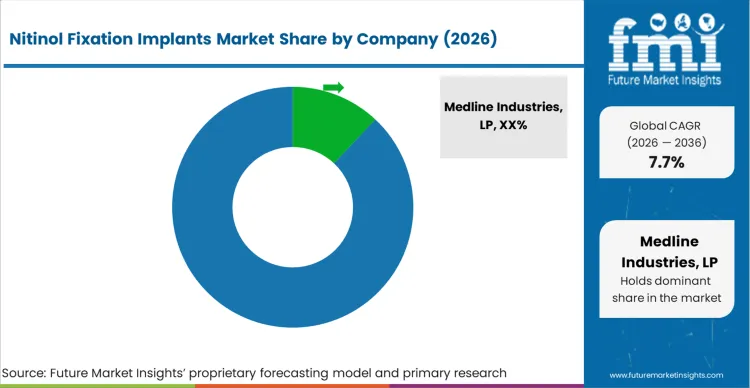
The market structure is fragmented, but the effective level of competition is limited to a few who can sustain the process of nitinol processing and fatigue, regulatory and quality documentation for implant use, and surgeon adoption through instrumentation. The level of competition is based on the confidence level and procedure requirements rather than price volatility, as the implants are chosen based on preference, evidence, and committee-standardization processes. The level of differentiation is based on fixation and handling characteristics, as compression staples and shape memory-based constructs need to demonstrate stable deployment characteristics to gain acceptance across orthopedic surgeons, as seen in the FMI report.
Companies with structural advantages typically combine broad orthopedic portfolios with established surgeon relationships and distribution coverage that supports bundled selling and contracting. Suppliers that can offer multiple nitinol fixation formats, backed by compatible instruments and clear technique support, are better positioned when hospitals standardise across service lines. Scale matters in manufacturing because nitinol heat treatment, surface finishing, and inspection discipline influence consistency and complaint rates. Firms with stronger R and D depth can expand indications into adjacent anatomies and develop porous nitinol options where fusion support is desired. Smaller players often depend on narrower segments or limited sales coverage, which can slow adoption when hospitals consolidate vendors, based on FMI’s report.
Customer concentration reinforces buyer leverage. Hospitals remain the largest purchasing centers and typically manage supplier dependency through approved alternates, competitive tenders, and value analysis reviews that weigh outcomes, ease of use, and total episode cost. ASCs apply stricter price discipline and standardise to fewer implant systems where case mix is predictable. Specialty orthopedic centers can be more preference driven, yet they still negotiate service and inventory terms to protect availability. This procurement behavior limits pricing power for routine fixation, while measured premiums are retained mainly where a device reduces operating time, improves fixation stability in challenging bone quality, or lowers the need for revision, Future Market Insights analysis.
Recent Developments
The report includes full coverage of key trends from competitive benchmarking. Some of the recent developments covered in the reports:
- In May 2025, Trax Surgical, LLC, an orthopedic product development and distribution company principally serving the needs of the orthopedic extremities market, announced that they received FDA 510(k) clearance to market the LINKT Compression Staple System. The staple system offers a range of nitinol staples for fracture repair, joint fusion, and osteotomy procedures.
- In April 2025, Medline UNITE, a leader in the foot and ankle surgery market, announced it has received 510(k) clearance from the USA Food and Drug Administration (FDA) for its latest implant family, the REFLEX HYBRID Nitinol Implant System
- In November 2025, Meduloc Receives FDA 510(k) Clearance for Novel Orthopedic Fracture Fixation System that offers surgeons a differentiated approach to fracture fixation, combining a strong, flexible nitinol implant with a deployable prong locking mechanism
Key Players in Nitinol Fixation Implants Market
- Medline Industries, LP
- Trax Surgical, LLC
- Enovis Corporation
- Smith & Nephew plc
- Meduloc
- Arthrex, Inc.
- BME, Inc
- Johnson & Johnson
- Medtronic plc
- Stryker Corporation
- Zimmer Biomet Holdings, Inc.
- MẌ Orthopedics
- Globus Medical, Inc.
- Integra LifeSciences Holdings Corporation
Scope of the Report
| Metric | Value |
|---|---|
| Quantitative Units | USD 1,650.0 Mn (2026) to USD 3,450.0 Mn (2036), at a CAGR of 7.7% |
| Market Definition | The nitinol fixation implants market comprises the global production and trade of nitinol based orthopedic and trauma fixation implants used for compression and stabilization, including staples, clips, plates, screws, and spinal adjuncts that use shape memory and superelastic behavior to maintain fixation, where demand is shaped by procedure volumes, surgeon preference for low-profile constructs, and adoption across hospital and ambulatory orthopedic settings. |
| Implant Type Segmentation | Compression Staples, Plates and Screws (nitinol components), Intramedullary Nails, Clips or Anchors, Spinal fixation Adjuncts and Other |
| Application Area Coverage | Foot and Ankle, Upper Extremity, Sports Medicine, Spine, CMF, Trauma |
| Core Feature Coverage | Shape-memory Compression, Superelastic Fixation, Porous Nitinol For Fusion, Coated or Other |
| Patient Group Coverage | Adult, Geriatric, Pediatric |
| End User Coverage | Hospitals, Ambulatory Surgical Centers, Specialty Ortho Centers |
| Regions Covered | North America, Latin America, East Asia, South Asia & Pacific, Western Europe, Eastern Europe, and Middle East & Africa. |
| Countries Covered | United States, Canada, Mexico, Brazil, Argentina, Germany, France, United Kingdom, Italy, Spain, China, India, Japan, South Korea, Indonesia, Australia and 40+ countries |
| Key Companies Profiled | Stryker Corporation, Zimmer Biomet Holdings, Inc., Johnson & Johnson, Arthrex, Inc., Smith & Nephew plc, Medtronic plc, Globus Medical, Inc., Integra LifeSciences Holdings Corporation, Enovis Corporation, Medline Industries, LP, Trax Surgical, LLC |
| Forecast Period | 2026 to 2036 |
| Approach | Hybrid top down and bottom up market modeling validated through primary interviews with orthopedic and trauma stakeholders and suppliers, supported by procedure volume triangulation and implant portfolio mapping, as per FMI. |
Nitinol Fixation Implants Market Analysis by Segments
Implant Type
- Compression Staples
- Nitinol Plates and Screws
- Intramedullary Nails
- Clips & Anchors
- Spinal Fixation Adjuncts
- Other
Application Area
- Foot and Ankle
- Upper Extremity
- Sports Medicine
- Spine
- CMF
- Trauma
Core Feature
- Shape-memory Compression
- Superelastic Fixation
- Porous Nitinol for Fusion
- Coated
Patient Group
- Adult
- Geriatric
- Pediatric
End User
- Hospitals
- Ambulatory Surgical Centers
- Specialty Ortho Centers
Region
- North America
- USA
- Canada
- Mexico
- Latin America
- Brazil
- Argentina
- Rest of Latin America
- East Asia
- China
- Japan
- South Korea
- South Asia & Pacific
- India
- ASEAN Countries
- Australia & New Zealand
- Rest of South Asia
- Western Europe
- Germany
- UK
- France
- Italy
- Spain
- BENELUX
- Nordic Countries
- Rest of Western Europe
- Eastern Europe
- Russia
- Hungary
- Poland
- Rest of Eastern Europe
- Middle East & Africa
- Saudi Arabia
- Türkiye
- South Africa
- Other African Union
- Rest of Middle East & Africa
Bibliography
- [1] Enovis Corporation (FDA). (2023). Enovis Expands Foot & Ankle Portfolio’s DynaClip® Family by Introducing Procedure-Specific Staples
- [2] PubMed Central (2024). Nitinol Compression Staples in Foot Orthopaedic Surgery: A Systematic Review
- [3] PubMed (2025). Biomechanical performance of static and NiTiNOL compression devices in first metatarsophalangeal joint arthrodesis.
- [4] PubMed (2025). Comparative effectiveness of nitinol staple-only fixation versus antiglide plate fixation for Weber type B distal fibular fractures
- [5] PubMed (2025). Continuous Compression Implants in Foot and Ankle Surgery: Tips and Tricks
- [6] Arthrex, Inc. Official Website (DynaNite Nitinol Products).
- [7] Trax Surgical, LLC, (2025), Trax Surgical Receives FDA 510(k) Clearance for Nitinol Staple System.
- [8] Medline UNITE, (2025), Medline announces FDA clearance for REFLEX® HYBRID Nitinol Implants for foot and ankle surgery.
This Report Addresses
- Market intelligence to enable structured strategic decision making across nitinol implant adoption and portfolio planning
- Market size estimation and 10-year revenue forecasts from 2026 to 2036 for nitinol fixation implant demand
- Growth opportunity mapping across implant type, application area, core feature, patient group, and end user purchasing pools
- Segment and regional revenue forecasts aligned to the stated taxonomy and covered geographies
- Competition strategy assessment including implant portfolio positioning, surgeon adoption fit, and channel coverage benchmarking
- Product and compliance tracking focused on implant material standards, device documentation needs, and quality system discipline
- Regulatory impact analysis covering orthopedic implant approval, safety and performance expectations, and procurement requirements
- Market report delivery in PDF, Excel, PPT, and interactive dashboard formats for executive and operational use
Frequently Asked Questions
How large is the demand for Nitinol Fixation Implants in the global market in 2026?
Demand for Nitinol Fixation Implants in the global market is estimated to be valued at USD 1,650.0 Mn in 2026, as per FMI.
What will be the market size of Nitinol Fixation Implants in the global market by 2036?
Market size for Nitinol Fixation Implants is projected to reach USD 3,450.0 Mn by 2036.
What is the expected demand growth for Nitinol Fixation Implants in the global market between 2026 and 2036?
Demand for Nitinol Fixation Implants in the global market is expected to grow at a CAGR of 7.7% between 2026 and 2036.
Which core feature is poised to lead demand by 2026?
Shape-memory compression is expected to be the leading core feature, capturing 54% share in 2026.
Which end user accounts for the largest share in 2026?
Hospitals are projected to account for 68% share of end user demand in 2026.
Which implant type is expected to lead the mix in 2026?
Compression staples are expected to lead implant type demand with 38% share in 2026.
Preview the report firsthand - request a free sample
Get SampleGet the brochure for pricing and purchase details.
Get PDFTable of Content
- Executive Summary
- Global Market Outlook
- Demand-side Trends
- Supply-side Trends
- Technology Roadmap Analysis
- Analysis and Recommendations
- Market Overview
- Market Coverage / Taxonomy
- Market Definition / Scope / Limitations
- Research Methodology
- Chapter Orientation
- Analytical Lens and Working Hypotheses
- Market Structure, Signals, and Trend Drivers
- Benchmarking and Cross-market Comparability
- Market Sizing, Forecasting, and Opportunity Mapping
- Research Design and Evidence Framework
- Desk Research Programme (Secondary Evidence)
- Company Annual and Sustainability Reports
- Peer-reviewed Journals and Academic Literature
- Corporate Websites, Product Literature, and Technical Notes
- Earnings Decks and Investor Briefings
- Government Statistics Portals and Public Data Releases
- Press Releases and Reputable Media Coverage
- Specialist Newsletters and Curated Briefings
- Sector Databases and Reference Repositories
- FMI Internal Proprietary Databases and Historical Market Datasets
- Subscription Datasets and Paid Sources
- Social Channels, Communities, and Digital Listening Inputs
- Additional Desk Sources
- Expert Input and Fieldwork (Primary Evidence)
- Primary Modes
- Qualitative Interviews and Expert Elicitation
- Quantitative Surveys and Structured Data Capture
- Blended Approach
- Why Primary Evidence is Used
- Field Techniques
- Interviews
- Surveys
- Focus Groups
- Observational and In-context Research
- Social and Community Interactions
- Stakeholder Universe Engaged
- C-suite Leaders
- Board Members
- Presidents and Vice Presidents
- R&D and Innovation Heads
- Technical Specialists
- Domain Subject-matter Experts
- Scientists
- Physicians and Other Healthcare Professionals
- Governance, Ethics, and Data Stewardship
- Research Ethics
- Data Integrity and Handling
- Primary Modes
- Tooling, Models, and Reference Databases
- Desk Research Programme (Secondary Evidence)
- Data Engineering and Model Build
- Data Acquisition and Ingestion
- Cleaning, Normalisation, and Verification
- Synthesis, Triangulation, and Analysis
- Quality Assurance and Audit Trail
- Market Background
- Market Dynamics
- Drivers
- Restraints
- Opportunity
- Trends
- Scenario Forecast
- Demand in Optimistic Scenario
- Demand in Likely Scenario
- Demand in Conservative Scenario
- Opportunity Map Analysis
- Product Life Cycle Analysis
- Supply Chain Analysis
- Investment Feasibility Matrix
- Value Chain Analysis
- PESTLE and Porter’s Analysis
- Regulatory Landscape
- Regional Parent Market Outlook
- Production and Consumption Statistics
- Import and Export Statistics
- Market Dynamics
- Global Market Analysis 2021 to 2025 and Forecast, 2026 to 2036
- Historical Market Size Value (USD Million) Analysis, 2021 to 2025
- Current and Future Market Size Value (USD Million) Projections, 2026 to 2036
- Y-o-Y Growth Trend Analysis
- Absolute $ Opportunity Analysis
- Global Market Pricing Analysis 2021 to 2025 and Forecast 2026 to 2036
- Global Market Analysis 2021 to 2025 and Forecast 2026 to 2036, By Implant Type
- Introduction / Key Findings
- Historical Market Size Value (USD Million) Analysis By Implant Type , 2021 to 2025
- Current and Future Market Size Value (USD Million) Analysis and Forecast By Implant Type , 2026 to 2036
- Compression Staples
- Nitinol Plates and Screws
- Intramedullary Nails
- Clips & Anchors
- Spinal Fixation Adjuncts
- Other
- Compression Staples
- Y-o-Y Growth Trend Analysis By Implant Type , 2021 to 2025
- Absolute $ Opportunity Analysis By Implant Type , 2026 to 2036
- Global Market Analysis 2021 to 2025 and Forecast 2026 to 2036, By Application Area
- Introduction / Key Findings
- Historical Market Size Value (USD Million) Analysis By Application Area, 2021 to 2025
- Current and Future Market Size Value (USD Million) Analysis and Forecast By Application Area, 2026 to 2036
- Foot and Ankle
- Upper Extremity
- Sports Medicine
- Spine
- CMF
- Trauma
- Foot and Ankle
- Y-o-Y Growth Trend Analysis By Application Area, 2021 to 2025
- Absolute $ Opportunity Analysis By Application Area, 2026 to 2036
- Global Market Analysis 2021 to 2025 and Forecast 2026 to 2036, By Region
- Introduction
- Historical Market Size Value (USD Million) Analysis By Region, 2021 to 2025
- Current Market Size Value (USD Million) Analysis and Forecast By Region, 2026 to 2036
- North America
- Latin America
- Western Europe
- Eastern Europe
- East Asia
- South Asia and Pacific
- Middle East & Africa
- Market Attractiveness Analysis By Region
- North America Market Analysis 2021 to 2025 and Forecast 2026 to 2036, By Country
- Historical Market Size Value (USD Million) Trend Analysis By Market Taxonomy, 2021 to 2025
- Market Size Value (USD Million) Forecast By Market Taxonomy, 2026 to 2036
- By Country
- USA
- Canada
- Mexico
- By Implant Type
- By Application Area
- By Country
- Market Attractiveness Analysis
- By Country
- By Implant Type
- By Application Area
- Key Takeaways
- Latin America Market Analysis 2021 to 2025 and Forecast 2026 to 2036, By Country
- Historical Market Size Value (USD Million) Trend Analysis By Market Taxonomy, 2021 to 2025
- Market Size Value (USD Million) Forecast By Market Taxonomy, 2026 to 2036
- By Country
- Brazil
- Chile
- Rest of Latin America
- By Implant Type
- By Application Area
- By Country
- Market Attractiveness Analysis
- By Country
- By Implant Type
- By Application Area
- Key Takeaways
- Western Europe Market Analysis 2021 to 2025 and Forecast 2026 to 2036, By Country
- Historical Market Size Value (USD Million) Trend Analysis By Market Taxonomy, 2021 to 2025
- Market Size Value (USD Million) Forecast By Market Taxonomy, 2026 to 2036
- By Country
- Germany
- UK
- Italy
- Spain
- France
- Nordic
- BENELUX
- Rest of Western Europe
- By Implant Type
- By Application Area
- By Country
- Market Attractiveness Analysis
- By Country
- By Implant Type
- By Application Area
- Key Takeaways
- Eastern Europe Market Analysis 2021 to 2025 and Forecast 2026 to 2036, By Country
- Historical Market Size Value (USD Million) Trend Analysis By Market Taxonomy, 2021 to 2025
- Market Size Value (USD Million) Forecast By Market Taxonomy, 2026 to 2036
- By Country
- Russia
- Poland
- Hungary
- Balkan & Baltic
- Rest of Eastern Europe
- By Implant Type
- By Application Area
- By Country
- Market Attractiveness Analysis
- By Country
- By Implant Type
- By Application Area
- Key Takeaways
- East Asia Market Analysis 2021 to 2025 and Forecast 2026 to 2036, By Country
- Historical Market Size Value (USD Million) Trend Analysis By Market Taxonomy, 2021 to 2025
- Market Size Value (USD Million) Forecast By Market Taxonomy, 2026 to 2036
- By Country
- China
- Japan
- South Korea
- By Implant Type
- By Application Area
- By Country
- Market Attractiveness Analysis
- By Country
- By Implant Type
- By Application Area
- Key Takeaways
- South Asia and Pacific Market Analysis 2021 to 2025 and Forecast 2026 to 2036, By Country
- Historical Market Size Value (USD Million) Trend Analysis By Market Taxonomy, 2021 to 2025
- Market Size Value (USD Million) Forecast By Market Taxonomy, 2026 to 2036
- By Country
- India
- ASEAN
- Australia & New Zealand
- Rest of South Asia and Pacific
- By Implant Type
- By Application Area
- By Country
- Market Attractiveness Analysis
- By Country
- By Implant Type
- By Application Area
- Key Takeaways
- Middle East & Africa Market Analysis 2021 to 2025 and Forecast 2026 to 2036, By Country
- Historical Market Size Value (USD Million) Trend Analysis By Market Taxonomy, 2021 to 2025
- Market Size Value (USD Million) Forecast By Market Taxonomy, 2026 to 2036
- By Country
- Kingdom of Saudi Arabia
- Other GCC Countries
- Turkiye
- South Africa
- Other African Union
- Rest of Middle East & Africa
- By Implant Type
- By Application Area
- By Country
- Market Attractiveness Analysis
- By Country
- By Implant Type
- By Application Area
- Key Takeaways
- Key Countries Market Analysis
- USA
- Pricing Analysis
- Market Share Analysis, 2025
- By Implant Type
- By Application Area
- Canada
- Pricing Analysis
- Market Share Analysis, 2025
- By Implant Type
- By Application Area
- Mexico
- Pricing Analysis
- Market Share Analysis, 2025
- By Implant Type
- By Application Area
- Brazil
- Pricing Analysis
- Market Share Analysis, 2025
- By Implant Type
- By Application Area
- Chile
- Pricing Analysis
- Market Share Analysis, 2025
- By Implant Type
- By Application Area
- Germany
- Pricing Analysis
- Market Share Analysis, 2025
- By Implant Type
- By Application Area
- UK
- Pricing Analysis
- Market Share Analysis, 2025
- By Implant Type
- By Application Area
- Italy
- Pricing Analysis
- Market Share Analysis, 2025
- By Implant Type
- By Application Area
- Spain
- Pricing Analysis
- Market Share Analysis, 2025
- By Implant Type
- By Application Area
- France
- Pricing Analysis
- Market Share Analysis, 2025
- By Implant Type
- By Application Area
- India
- Pricing Analysis
- Market Share Analysis, 2025
- By Implant Type
- By Application Area
- ASEAN
- Pricing Analysis
- Market Share Analysis, 2025
- By Implant Type
- By Application Area
- Australia & New Zealand
- Pricing Analysis
- Market Share Analysis, 2025
- By Implant Type
- By Application Area
- China
- Pricing Analysis
- Market Share Analysis, 2025
- By Implant Type
- By Application Area
- Japan
- Pricing Analysis
- Market Share Analysis, 2025
- By Implant Type
- By Application Area
- South Korea
- Pricing Analysis
- Market Share Analysis, 2025
- By Implant Type
- By Application Area
- Russia
- Pricing Analysis
- Market Share Analysis, 2025
- By Implant Type
- By Application Area
- Poland
- Pricing Analysis
- Market Share Analysis, 2025
- By Implant Type
- By Application Area
- Hungary
- Pricing Analysis
- Market Share Analysis, 2025
- By Implant Type
- By Application Area
- Kingdom of Saudi Arabia
- Pricing Analysis
- Market Share Analysis, 2025
- By Implant Type
- By Application Area
- Turkiye
- Pricing Analysis
- Market Share Analysis, 2025
- By Implant Type
- By Application Area
- South Africa
- Pricing Analysis
- Market Share Analysis, 2025
- By Implant Type
- By Application Area
- USA
- Market Structure Analysis
- Competition Dashboard
- Competition Benchmarking
- Market Share Analysis of Top Players
- By Regional
- By Implant Type
- By Application Area
- Competition Analysis
- Competition Deep Dive
- Medline Industries, LP
- Overview
- Product Portfolio
- Profitability by Market Segments (Product/Age /Sales Channel/Region)
- Sales Footprint
- Strategy Overview
- Marketing Strategy
- Product Strategy
- Channel Strategy
- Trax Surgical, LLC
- Enovis Corporation
- Smith & Nephew plc
- Meduloc
- Arthrex, Inc.
- BME, Inc
- Johnson & Johnson
- Medtronic plc
- Stryker Corporation
- Zimmer Biomet Holdings, Inc.
- MẌ Orthopedics
- Globus Medical, Inc.
- Integra LifeSciences Holdings Corporation
- Medline Industries, LP
- Competition Deep Dive
- Assumptions & Acronyms Used


