

- Industry Size (2025)
- USD 980.0 Mn
- Forecast (2035)
- USD 1722.2 Mn
- CAGR (2025 to 2035)
- 5.8%
Orthopedic Prosthetic Accessories Market Forecast and Outlook 2025 to 2035
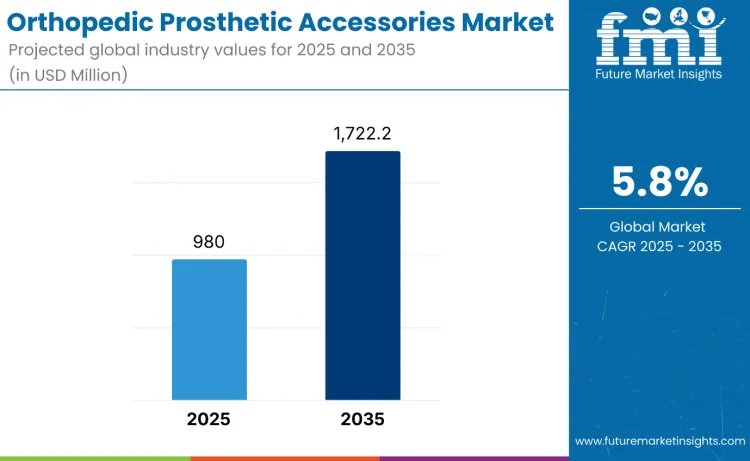
The global orthopedic prosthetic accessories market is projected to reach USD 1,722.2 million by 2035, recording an absolute increase of USD 742.20 million over the forecast period. This market is valued at USD 980.0 million in 2025 and is set to rise at a CAGR of 5.8% during the assessment period. Overall size is expected to grow by nearly 1.7 times during the same period, supported by rising limb-loss prevalence due to trauma, vascular disease, diabetes-related amputations, malignancies, and conflict-related injuries, driving demand for cushioning liners, interface socks, socket suspension systems, shock-absorbing pylons, prosthetic sleeves, adaptors, and performance-enhancing accessory components.
Expansion reflects fundamental changes in prosthetic rehabilitation, where advanced accessories improve stability, comfort, and functional mobility while maintaining consistent prosthetic fit across varied activity levels. Patients in military rehabilitation centers, orthopedic clinics, prosthetic labs, and physical therapy settings increasingly expect better residual-limb protection, enhanced comfort, and optimized gait mechanics. Next-generation liners, sleeves, and modular support systems typically deliver 30-50% improvement in daily functional performance versus traditional soft interfaces, making them central to modern prosthetic care.
Quick Stats for Orthopedic Prosthetic Accessories Market
- Orthopedic Prosthetic Accessories Market Value (2025): USD 980.0 million
- Orthopedic Prosthetic Accessories Market Forecast Value (2035): USD 1,722.2 million
- Orthopedic Prosthetic Accessories Market Forecast CAGR: 5.8%
- Leading Segment in Orthopedic Prosthetic Accessories Market: Prosthetic liners & sleeves (34% share)
- Key Growth Regions in Orthopedic Prosthetic Accessories Market: Europe, Asia Pacific, and North America
- Top Players in Orthopedic Prosthetic Accessories Market: Ottobock, Össur, Blatchford, Fillauer, Hanger
Technological advancements in residual-limb interface design, additive manufacturing, material science, and dynamic load-absorbing components are reshaping the orthopedic prosthetic accessories landscape. Modern systems incorporate thermoplastic elastomers, breathable gel-silicone composites, and bio-adaptive liners that stabilize soft tissue and distribute pressure uniformly, enabling improved suspension and comfort. Integration with digital prosthetic fitting systems, including 3D limb scanning and computer-assisted socket design, supports personalized alignment and enhanced residual-limb protection across both upper-limb and lower-limb prosthesis categories.
Orthopedic Prosthetic Accessories Market Year-over-Year Forecast (2025 to 2035)
Between 2025 and 2030, orthopedic prosthetic accessories market is projected to expand from USD 980.0 million to USD 1,299.1 million, resulting in a value increase of USD 319.1 million, which represents 43.0% of total forecast growth for the decade. This phase will be shaped by rising global amputee population linked to trauma, diabetes, vascular disease, and orthopedic complications, increasing adoption of advanced interface liners and suspension systems, as well as expanding integration of digital fitting technologies and rehabilitation-driven prosthetic customization programs.
From 2030 to 2035, growth is forecast to expand from USD 1,299.1 million to USD 1,722.2 million, adding another USD 423.1 million, which constitutes 57.0% of overall ten-year expansion. This period is expected to be characterized by adoption of next-generation prosthetic accessories including dynamic shock-absorbing pylons, activity-adaptive suspension systems, breathable skin-friendly liners, and sport-performance prosthetic components tailored for high-mobility users.
Orthopedic Prosthetic Accessories Market Key Takeaways
| Metric | Value |
|---|---|
| Market Value (2025) | USD 980.0 million |
| Market Forecast Value (2035) | USD 1,722.2 million |
| Forecast CAGR (2025-2035) | 5.8% |
Why Is the Orthopedic Prosthetic Accessories Market Growing Worldwide?
The orthopedic prosthetic accessories market expands by enabling amputees to achieve higher comfort, stability, and functional mobility while preserving natural movement and residual-limb protection. Growing expectations for prolonged wear comfort, skin-friendly interfaces, and improved gait efficiency drive adoption of advanced liners, suspension systems, and shock-absorbing components. These accessories often deliver 30-50% improvement in load distribution, comfort, and activity endurance compared to traditional materials. Rising incidence of diabetes-related amputations, trauma, vascular disorders, congenital limb differences, and combat injuries continues to enlarge the global population requiring durable, anatomically engineered prosthetic support solutions.
Government disability benefits, veteran rehabilitation programs, and healthcare investment in assistive mobility solutions are accelerating adoption across rehabilitation hospitals, prosthetic fitting centers, and community clinics. Advanced prosthetic accessories directly improve socket comfort, skin integrity, gait stability, and quality-of-life outcomes. The shift toward digital socket design, personalized rehabilitation, and modern prosthetic fabrication further increases demand for components supporting suspension control, impact absorption, rotational movement, and moisture management. Premium pricing of silicone liners and adaptive systems, along with uneven reimbursement in developing regions, may limit uptake among cost-sensitive patients and resource-constrained care settings.
How Is the Orthopedic Prosthetic Accessories Market Segmented by Product Type, Application, End User and Region?
The orthopedic prosthetic accessories market is segmented by product type, application, and end user. By product type, it includes prosthetic liners and sleeves, socket adapters and pylons, cosmetic covers and liners, suspension systems, and accessory components including prosthetic feet and joints. Based on application, it is categorized into lower-limb prosthetics, upper-limb prosthetics, pediatric prosthetics, and sports and activity prosthetics. By end user, it is divided into prosthetic clinics, hospitals and rehabilitation centers, durable medical equipment and retail channels, and direct-to-consumer distribution. Regionally, it is divided into Asia Pacific, Europe, North America, Latin America, and Middle East & Africa.
By Product Type, Prosthetic Liners and Sleeves Account for a Dominant Market Share
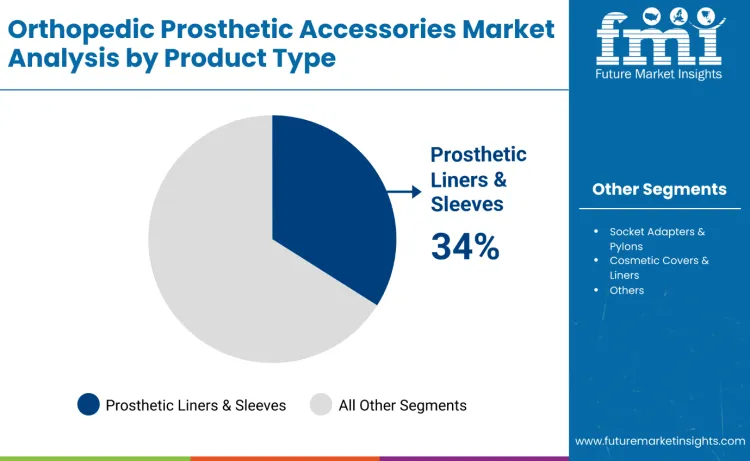
Prosthetic liners and sleeves represent the leading product category in the orthopedic prosthetic accessories market, capturing 34% share. This segment includes silicone, gel, and elastomer-based liners and suspension sleeves designed to enhance residual-limb protection, improve socket fit, and support long-duration wear comfort. Dominance reflects their essential role in daily prosthetic use across diabetic, trauma, and vascular amputees, where skin health, pressure distribution, and suspension reliability are critical.
Suspension systems and adapters follow, supported by demand for secure fixation and gait stability, while pylons and shock-absorbing components address impact management and mobility optimization.
Key advantages of driving liner and sleeve leadership include:
- Improved skin protection and pressure distribution
- Enhanced suspension security and comfort
- Compatibility with diverse prosthetic sockets
- High replacement frequency supporting recurring demand
What Are the Major Drivers, Restraints, and Emerging Trends Influencing the Orthopedic Prosthetic Accessories Market?
The orthopedic prosthetic accessories market is driven by rising limb-loss prevalence, rehabilitation modernization, and advances in interface materials. Growing incidence of diabetes-related amputations, trauma injuries, vascular disorders, and combat-related limb loss is expanding the long-term prosthetic user base, creating recurring demand for accessory replacement. Adoption of advanced socket interface technologies such as silicone liners, vacuum suspension sleeves, and shock-absorbing pylons improves gait stability, skin protection, and endurance. Rehabilitation models focused on independence, workforce reintegration, and adaptive sports further accelerate demand for comfort-enhancing, sweat-managing, and activity-responsive prosthetic accessories.
What Are the Major Restraints Limiting Adoption of Orthopedic Prosthetic Accessories?
Market restraints include high costs associated with premium silicone and gel-based interface systems, which often exceed reimbursement limits and impose out-of-pocket burdens on patients. Fit complexity and skin compatibility challenges restrict uniform adoption, as users experiencing limb-volume fluctuation or dermatologic sensitivity require frequent adjustments and specialized configurations. Limited prosthetic care infrastructure and shortages of trained prosthetists in low-resource regions further slow transition from traditional fabric socks to advanced suspension and cushioning technologies, delaying performance-focused upgrades and reducing penetration among underserved patient populations.
What Emerging Trends Are Shaping the Future of the Orthopedic Prosthetic Accessories Market?
Key trends include growing adoption of breathable antimicrobial liners, smart textile sleeves with moisture control, and energy-return pylons designed for daily mobility and high-activity use. Digital limb scanning and computer-assisted socket modeling are expanding precision-fit liner adoption and improving pressure distribution outcomes. Veteran rehabilitation programs and adaptive sports initiatives are increasing demand for lightweight, shock-attenuating, and torsion-responsive components. Market dynamics may shift as 3D-printed interface solutions and bio-responsive liner materials scale commercially, enabling enhanced personalization, durability, and performance across diverse mobility and activity profiles.
How Are Leading Countries Driving Growth in the Orthopedic Prosthetic Accessories Market?
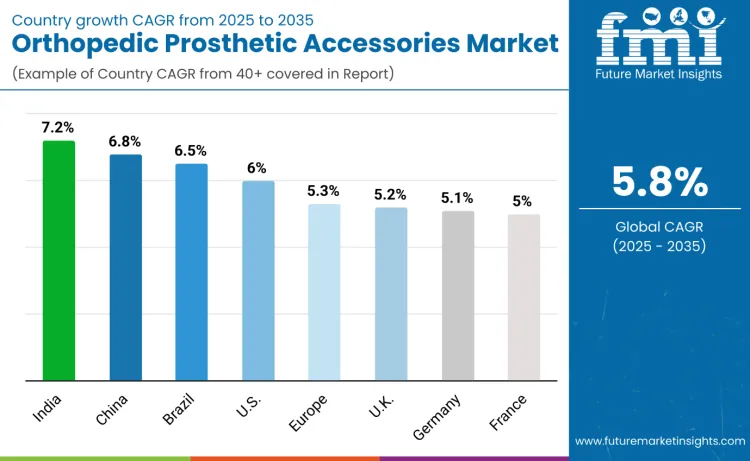
| Country/Region | CAGR (2025 to 2035) |
|---|---|
| India | 7.2% |
| China | 6.8% |
| Brazil | 6.5% |
| USA | 6.0% |
| Europe | 5.3% |
| UK | 5.2% |
| Germany | 5.1% |
| France | 5.0% |
The orthopedic prosthetic accessories market is expanding globally, led by India (7.2%) due to rising diabetes-related amputations, strong rehabilitation investments, and national assistive-device programs. China (6.8%) follows with increasing trauma-related limb loss, healthcare modernization, and growing domestic prosthetic manufacturing. The United States (6.0%) maintains steady momentum through veteran care systems, reimbursement support, and adaptive mobility programs. Brazil (6.5%) shows robust growth from expanding public rehabilitation funding. Europe (5.3%), led by the UK (5.2%), Germany (5.1%), and France (5.0%), anchors premium adoption through advanced prosthetic research, disability support frameworks, and structured prosthetist training ecosystems.
The report covers an in-depth analysis of 40+ countries top-performing countries are highlighted below.
How Is Rehabilitation Infrastructure Accelerating Growth in China?
China shows strong growth momentum in orthopedic prosthetic accessories, supported by rising diabetes-related amputations, industrial trauma, and structured national rehabilitation programs. Adoption is concentrated in major hubs such as Beijing, Shanghai, Shenzhen, and Guangzhou, where tertiary hospitals, veteran rehabilitation centers, and specialized prosthetic clinics increasingly deploy advanced liners, suspension systems, and protective interfaces. Expansion of domestic prosthetic manufacturing improves affordability and availability, while government disability-support policies enhance access to modern prosthetic care. Investment in rehabilitation technology, clinician training, and standardized fitting pathways continues to strengthen long-term mobility outcomes and sustained adoption across both public and private healthcare systems.
Why Are Rehabilitation Programs Enhancing Adoption in India?
India’s adoption of orthopedic prosthetic accessories is accelerating across metropolitan rehabilitation hubs driven by rising diabetes-related amputations, trauma incidence, and national disability-support initiatives. Hospitals and prosthetic clinics increasingly integrate advanced liners, suspension sleeves, and adaptive pylons to improve comfort, mobility, and long-duration wear tolerance. Programs such as Ayushman Bharat and Skill India strengthen patient access and clinician capability, while expanding prosthetic training centers improve fitting quality. Military rehabilitation, public mobility schemes, and growing awareness of active rehabilitation further support adoption, positioning India as a key growth engine for modern, performance-oriented prosthetic accessories.
How Does Clinical Excellence Sustain Leadership in Germany?
Germany’s prosthetic accessories landscape reflects engineering-driven clinical excellence, with strong adoption across orthopedic hospitals, certified prosthetic workshops, and military rehabilitation centers. Advanced liners, suspension systems, and shock-absorbing pylons are widely used to enhance gait efficiency, comfort, and long-term mobility. Integration with digital limb scanning, precision socket fitting, and evidence-based rehabilitation protocols supports consistent outcomes. Strong collaboration between universities, biomechanical research institutes, and manufacturers sustains demand for premium, durable components. Germany’s focus on quality, reliability, and long-term independence continues to anchor steady adoption within high-acuity rehabilitation environments.
Why Is Expanding Rehabilitation Community Fueling Demand in Brazil?
Brazil leads Latin American adoption as public rehabilitation programs expand and demand rises from trauma, vascular disease, and diabetes-related limb loss. Urban centers such as São Paulo, Rio de Janeiro, and Porto Alegre are integrating modern prosthetic accessories to improve comfort, stability, and functional reintegration. Public disability benefits and growing private rehabilitation networks support wider access to silicone liners, suspension systems, and adjustable pylons. Partnerships with international manufacturers, localized pricing strategies, and clinician training initiatives are improving availability and fitting quality, reinforcing sustained adoption across outpatient therapy, community mobility, and workforce reintegration pathways.
How Do Established Networks Strengthen Performance in United States?
The United States demonstrates mature adoption supported by veteran healthcare systems, structured reimbursement, and extensive private prosthetic networks. Advanced liners, suspension sleeves, gel interfaces, and shock-absorbing components are widely used to improve comfort, gait stability, and long-term wear outcomes. Integration across VA hospitals, military rehabilitation centers, and certified prosthetic clinics ensures standardized access to high-performance accessories. Strong collaboration between manufacturers, rehabilitation researchers, and clinicians drives continuous innovation. Focus on active lifestyles, adaptive sports, and long-term independence sustains consistent replacement demand and reinforces leadership in premium prosthetic accessory utilization.
How Is Rehabilitation Services Expansion Supporting Growth in United Kingdom?
The United Kingdom shows steady growth driven by NHS-supported rehabilitation pathways, veteran care programs, and expanding private prosthetic services. Clinics across London, Manchester, Birmingham, and Edinburgh increasingly adopt premium liners, suspension systems, and shock-attenuating adapters to improve gait recovery and skin health. Strong integration of prosthetics with physiotherapy and community rehabilitation enhances long-term mobility outcomes. Educational partnerships, amputee association involvement, and charity-led access initiatives support broader adoption. Focus on durable, skin-compatible materials and standardized fitting protocols continues to strengthen confidence in advanced prosthetic accessories across diverse patient activity levels.
How Are Rehabilitation Investments Advancing Market Expansion Across Europe?
The orthopedic prosthetic accessories market in Europe is projected to expand from USD 294.0 million in 2025 to USD 482.2 million by 2035, recording a CAGR of 5.0%. Growth is supported by structured amputee care pathways, established prosthetic fitting networks, and strong focus on bio-compatible liners, suspension systems, and adaptive pylons that improve gait stability, skin comfort, and long-term mobility. Germany leads with a share rising from 22.5% in 2025 to 23.5% by 2035, followed by France at 17.0% declining slightly to 16.5%. Italy holds around 11.5% moving to 11.0%, while Spain shifts from 9.0% to 8.5%. BENELUX and Nordic regions show steady gains, and the rest of Western Europe remains a major contributor through expanded prosthetic services.
Premium Clinical Precision Dominates Requirements in Japan
The orthopedic prosthetic accessories market in Japan reflects a mature, quality-driven environment shaped by widespread use of premium silicone liners, precision-engineered suspension sleeves, and high-stability pylons within well-established rehabilitation workflows. University hospitals, certified prosthetic centers, and defense healthcare institutions emphasize medical precision, skin compatibility, and long-term comfort, driving strong demand for advanced interface materials and biomechanically refined components designed for continuous daily use.
Close collaboration between domestic prosthetic manufacturers, biomedical engineering researchers, and rehabilitation specialists strengthens innovation focused on pressure distribution accuracy and durable fit integrity. Rehabilitation facilities across Tokyo, Osaka, Kyoto, and other metropolitan regions demonstrate advanced adoption, where high-performance accessories consistently enhance limb protection, gait stability, and patient confidence in line with national prosthetic care standards and quality frameworks.
International Providers Lead Clinical Services in South Korea
The orthopedic prosthetic accessories market in South Korea reflects a steadily advancing landscape shaped by growing participation from international prosthetic technology providers and strong domestic clinical expertise. Global component manufacturers and prosthetic care companies play an active role through advanced clinical support, technical training, and close engagement with leading rehabilitation hospitals and specialty limb-care centers.
Demand increasingly centers on high-performance silicone liners, secure suspension sleeves, and lightweight shock-absorbing adapters that align with Korea’s focus on precision medicine and patient comfort. Prosthetic clinics and tertiary hospitals in Seoul, Busan, Daegu, and Incheon collaborate closely with international suppliers to access premium materials and refined interface systems. These partnerships, supported by localized fitting services, clinician education, and structured post-care programs, are fostering hybrid care models that blend global product quality with Korean clinical standards and patient-focused rehabilitation delivery.
How Competitive Is the Global Orthopedic Prosthetic Accessories Market and What Defines Its Structure?
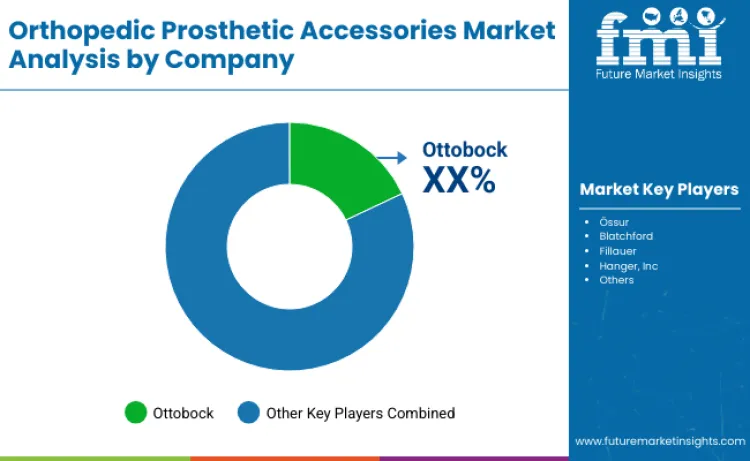
The orthopedic prosthetic accessories landscape shows moderate concentration, with a mix of established global brands and regional manufacturers active across prosthetic liners, suspension systems, and functional components. Leading companies hold a sizable portion of overall revenue, supported by strong clinical credibility, advanced material science expertise, and long-standing relationships with rehabilitation centers and prosthetic clinics. Competition focuses primarily on liner biocompatibility, suspension security, durability, shock absorption, and overall patient comfort rather than price.
Ottobock remains a clear leader due to its broad portfolio, strong clinical training presence, and extensive global technical support. Alongside Ottobock, Össur and Blatchford sustain competitive strength through proprietary silicone technologies, vacuum-assisted suspension systems, and deep rehabilitation-clinic partnerships. Challengers such as Hanger and Fillauer compete through specialized care networks and tailored mobility solutions. Emerging regional suppliers add pressure by offering cost-efficient alternatives, particularly in price-sensitive healthcare systems, while long-term reliability and clinician trust continue to define competitive success.
Key Players in the Orthopedic Prosthetic Accessories Market
- Ottobock
- Össur
- Blatchford
- Fillauer
- Hanger, Inc.
- Others
Scope of the Report
| Items | Values |
|---|---|
| Quantitative Units | USD 980.0 million |
| Product Type | Prosthetic liners & sleeves, Socket adapters & pylons, Cosmetic covers & liners, Suspension systems, Accessories (feet, joints) |
| Application | Lower-limb prosthetics, Upper-limb prosthetics, Pediatric prosthetics, Sports & activity |
| End User | Prosthetic clinics, Hospitals & rehab centers, DME & retailers, Direct-to-consumer |
| Regions Covered | Asia Pacific, Europe, North America, Latin America, Middle East & Africa |
| Country Covered | China, India, Germany, Brazil, USA, UK, Japan, and 40+ countries |
| Key Companies Profiled | Ottobock, Össur, Blatchford, Fillauer, Hanger, Inc., Others |
| Additional Attributes | Dollar sales by prosthetic accessory category and end-use, regional adoption across North America, Europe, and Asia Pacific, competitive landscape of global manufacturers, performance benchmarks for comfort and durability, integration with digital scanning and gait analysis, and innovations in silicone, textiles, and shock-mitigation technologies. |
Orthopedic Prosthetic Accessories Market by Segments
Product Type:
- Prosthetic liners & sleeves
- Socket adapters & pylons
- Cosmetic covers & liners
- Suspension systems
- Accessories (feet, joints)
Application:
- Lower-limb prosthetics
- Upper-limb prosthetics
- Pediatric prosthetics
- Sports & activity
End User:
- Prosthetic clinics
- Hospitals & rehab centers
- DME & retailers
- Direct-to-consumer
Region:
- Asia Pacific
- China
- India
- Japan
- South Korea
- Vietnam
- Australia & New Zealand
- ASEAN
- Rest of Asia Pacific
- Europe
- Germany
- United Kingdom
- France
- Italy
- Spain
- Netherlands
- Nordic
- BENELUX
- Rest of Europe
- North America
- United States
- Canada
- Mexico
- Latin America
- Brazil
- Argentina
- Rest of Latin America
- Middle East & Africa
- Kingdom of Saudi Arabia
- Other GCC Countries
- Turkey
- South Africa
- Other African Union
- Rest of Middle East & Africa
Frequently Asked Questions
How big is the orthopedic prosthetic accessories market in 2025?
The global orthopedic prosthetic accessories market is valued at USD 980.0 million in 2025.
What will be the size of the orthopedic prosthetic accessories market in 2035?
The orthopedic prosthetic accessories market is projected to reach USD 1,722.2 million by 2035.
How much will the orthopedic prosthetic accessories market grow between 2025 and 2035?
The orthopedic prosthetic accessories market is expected to grow at a 5.8% CAGR between 2025 and 2035.
Which product type leads the orthopedic prosthetic accessories market in 2025?
Prosthetic liners and sleeves lead the market with a 34.0% share in 2025.
Which region is expected to contribute significant growth in the orthopedic prosthetic accessories market?
Asia Pacific, followed by Europe and North America, is expected to contribute significant growth during the forecast period.
Preview the report firsthand - request a free sample
Get SampleGet the brochure for pricing and purchase details.
Get PDFTable of Content
- Executive Summary
- Regional Level Market Outlook
- Demand-side Trends
- Supply-side Trends
- Technology Roadmap Analysis
- Analysis and Recommendations
- Market Overview
- Market Coverage / Taxonomy
- Market Definition / Scope / Limitations
- Market Background
- Market Dynamics
- Drivers
- Restraints
- Opportunity
- Trends
- Scenario Forecast
- Demand in Optimistic Scenario
- Demand in Likely Scenario
- Demand in Conservative Scenario
- Opportunity Assessment
- Market Trade Assessment
- Products Market Assessment
- Investment Feasibility Matrix
- Value Chain Analysis
- Participants and their Roles
- Profit Margin Analysis
- Operating Margins By Region
- PESTLE and Porter’s Analysis
- Regulatory Landscape
- By Key Regions
- By Key Countries
- Regional Parent Market Outlook
- Product Launches & Development
- Technological Innovation
- Market Dynamics
- Regional Level Market Analysis 2020 to 2024 and Forecast, 2025 to 2035
- Historical Market Size USD Million Analysis, 2020 to 2024
- Current and Future Market Size USD Million Projections, 2025 to 2035
- Y-o-Y Growth Trend Analysis
- Absolute $ Opportunity Analysis
- Regional Level Market Analysis 2020 to 2024 and Forecast 2025 to 2035, By Product Type
- Introduction / Key Findings
- Historical Market Size USD Million Analysis By Product Type, 2020 to 2024
- Current and Future Market Size USD Million Analysis and Forecast By Product Type, 2025 to 2035
- Prosthetic liners & sleeves
- Socket adapters & pylons
- Cosmetic covers & liners
- Suspension systems
- Prosthetic liners & sleeves
- Y-o-Y Growth Trend Analysis By Product Type, 2020 to 2024
- Absolute $ Opportunity Analysis By Product Type, 2025 to 2035
- Regional Level Market Analysis 2020 to 2024 and Forecast 2025 to 2035, By Application
- Introduction / Key Findings
- Historical Market Size USD Million Analysis By Application, 2020 to 2024
- Current and Future Market Size USD Million Analysis and Forecast By Application, 2025 to 2035
- Lower-limb prosthetics
- Upper-limb prosthetics
- Pediatric prosthetics
- Sports & activity
- Y-o-Y Growth Trend Analysis By Application, 2020 to 2024
- Absolute $ Opportunity Analysis By Application, 2025 to 2035
- Regional Level Market Analysis 2020 to 2024 and Forecast 2025 to 2035, By End User
- Introduction / Key Findings
- Historical Market Size USD Million Analysis By End User, 2020 to 2024
- Current and Future Market Size USD Million Analysis and Forecast By End User, 2025 to 2035
- Prosthetic clinics
- Hospitals & rehab centers
- DME & retailers
- Direct-to-consumer
- Y-o-Y Growth Trend Analysis By End User, 2020 to 2024
- Absolute $ Opportunity Analysis By End User, 2025 to 2035
- Regional Level Market Analysis 2020 to 2024 and Forecast 2025 to 2035, By Region
- Introduction
- Historical Market Size USD Million Analysis By Region, 2020 to 2024
- Current Market Size USD Million Analysis and Forecast By Region, 2025 to 2035
- North America
- Latin America
- East Asia
- South Asia
- Western Europe
- Eastern Europe
- Middle East & Africa
- Market Attractiveness Analysis By Region
- North America Market Analysis 2020 to 2024 and Forecast 2025 to 2035, By Country
- Historical Market Size USD Million Trend Analysis By Market Taxonomy, 2020 to 2024
- Market Size USD Million Forecast By Market Taxonomy, 2025 to 2035
- By Country
- USA
- Canada
- Mexico
- By Product Type
- By Application
- By End User
- By Country
- Market Attractiveness Analysis
- By Country
- By Product Type
- By Application
- By End User
- Key Takeaways
- Latin America Market Analysis 2020 to 2024 and Forecast 2025 to 2035, By Country
- Historical Market Size USD Million Trend Analysis By Market Taxonomy, 2020 to 2024
- Market Size USD Million Forecast By Market Taxonomy, 2025 to 2035
- By Country
- Brazil
- Argentina
- Rest of Latin America
- By Product Type
- By Application
- By End User
- By Country
- Market Attractiveness Analysis
- By Country
- By Product Type
- By Application
- By End User
- Key Takeaways
- East Asia Market Analysis 2020 to 2024 and Forecast 2025 to 2035, By Country
- Historical Market Size USD Million Trend Analysis By Market Taxonomy, 2020 to 2024
- Market Size USD Million Forecast By Market Taxonomy, 2025 to 2035
- By Country
- China
- Japan
- South Korea
- By Product Type
- By Application
- By End User
- By Country
- Market Attractiveness Analysis
- By Country
- By Product Type
- By Application
- By End User
- Key Takeaways
- South Asia Market Analysis 2020 to 2024 and Forecast 2025 to 2035, By Country
- Historical Market Size USD Million Trend Analysis By Market Taxonomy, 2020 to 2024
- Market Size USD Million Forecast By Market Taxonomy, 2025 to 2035
- By Country
- India
- ASEAN Countries
- Australia & New Zealand
- Rest of South Asia
- By Product Type
- By Application
- By End User
- By Country
- Market Attractiveness Analysis
- By Country
- By Product Type
- By Application
- By End User
- Key Takeaways
- Western Europe Market Analysis 2020 to 2024 and Forecast 2025 to 2035, By Country
- Historical Market Size USD Million Trend Analysis By Market Taxonomy, 2020 to 2024
- Market Size USD Million Forecast By Market Taxonomy, 2025 to 2035
- By Country
- Germany
- UK
- France
- Italy
- Spain
- BENELUX
- Nordic Countries
- Rest of Western Europe
- By Product Type
- By Application
- By End User
- By Country
- Market Attractiveness Analysis
- By Country
- By Product Type
- By Application
- By End User
- Key Takeaways
- Eastern Europe Market Analysis 2020 to 2024 and Forecast 2025 to 2035, By Country
- Historical Market Size USD Million Trend Analysis By Market Taxonomy, 2020 to 2024
- Market Size USD Million Forecast By Market Taxonomy, 2025 to 2035
- By Country
- Russia
- Hungary
- Poland
- Rest of Eastern Europe
- By Product Type
- By Application
- By End User
- By Country
- Market Attractiveness Analysis
- By Country
- By Product Type
- By Application
- By End User
- Key Takeaways
- Middle East & Africa Market Analysis 2020 to 2024 and Forecast 2025 to 2035, By Country
- Historical Market Size USD Million Trend Analysis By Market Taxonomy, 2020 to 2024
- Market Size USD Million Forecast By Market Taxonomy, 2025 to 2035
- By Country
- Saudi Arabia
- Other GCC Countries
- Türkiye
- South Africa
- Rest of MEA
- By Product Type
- By Application
- By End User
- By Country
- Market Attractiveness Analysis
- By Country
- By Product Type
- By Application
- By End User
- Key Takeaways
- Market Structure Analysis
- Competition Dashboard
- Competition Benchmarking
- Market Share Analysis of Top Players
- By Regional
- By Product Type
- By Application
- By End User
- Competition Analysis
- Competition Deep Dive
- Ottobock
- Overview
- Product Portfolio
- Key Financials
- Key Developments
- Global/Regional Footprint
- Strategy Overview
- Marketing Strategy
- SWOT
- Analyst Comment
- Össur
- Overview
- Product Portfolio
- Key Financials
- Key Developments
- Global/Regional Footprint
- Strategy Overview
- Marketing Strategy
- SWOT
- Analyst Comment
- Blatchford
- Overview
- Product Portfolio
- Key Financials
- Key Developments
- Global/Regional Footprint
- Strategy Overview
- Marketing Strategy
- SWOT
- Analyst Comment
- Fillauer
- Overview
- Product Portfolio
- Key Financials
- Key Developments
- Global/Regional Footprint
- Strategy Overview
- Marketing Strategy
- SWOT
- Analyst Comment
- Hanger, Inc.
- Overview
- Product Portfolio
- Key Financials
- Key Developments
- Global/Regional Footprint
- Strategy Overview
- Marketing Strategy
- SWOT
- Analyst Comment
- Ottobock
- Competition Deep Dive
- Assumptions & Acronyms Used
- Research Methodology


