

- Market Size (2026)
- USD 1420.6 Mn
- Forecast (2036)
- USD 3124.2 Mn
- CAGR (2026 to 2036)
- 8.2%
How big is the Package Test Sockets Market?
The Package Test Sockets Market is projected to grow from USD 1420.6 million in 2026 to USD 3124.2 million by 2036, at a CAGR of 8.2%.
The Package Test Sockets Market was valued at USD 1312.939 million in 2025 and is expected to reach USD 1420.6 million in 2026. The market is projected to reach USD 3124.2 million by 2036 at a CAGR of 8.2% from 2026 to 2036. SEMI projected semiconductor test equipment sales at USD 11.2 billion in 2025 and expected further back-end equipment growth in 2026 and 2027.
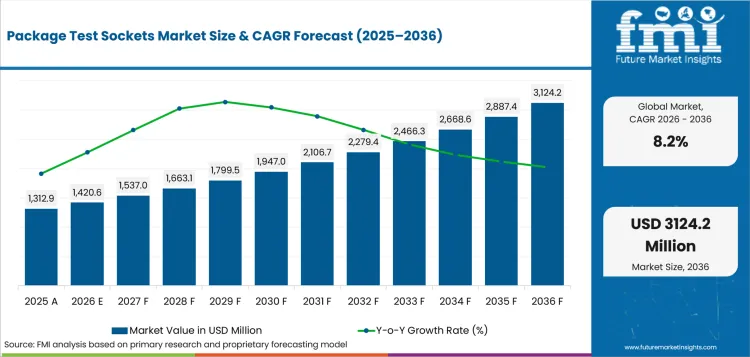
| Metric | Value |
|---|---|
| 2025 Market Size | USD 1312.939 million. |
| 2026 Market Size | USD 1420.6 million. |
| 2036 Market Size | USD 3124.2 million. |
| Forecast CAGR | 8.2% from 2026 to 2036. |
| Featured Socket Type | Final Test Sockets. |
| Final Test Sockets Share in 2026 | 46.0%. |
| Featured Contact Technology | Spring Probe. |
| Spring Probe Share in 2026 | 38.0%. |
Summary of the Package Test Sockets Market
| Market Signal | Commercial Impact |
|---|---|
| Demand and Growth Drivers | Semiconductor testing requirements are driving demand for high-performance package test sockets.
|
| Product and Segment View | Final test sockets and spring probe technology continue to lead the market.
|
| Geography and Competitive Outlook | Asia remains the primary growth region for semiconductor package testing.
|
| Analyst Perspective | Package test sockets are becoming a critical performance factor in semiconductor back-end operations.
|
In April 2025, Smiths Interconnect launched DaVinci Gen V for semiconductor test socket applications. The launch strengthens its position in high-reliability socket programs. In June 2024, Johnstech published technical guidance on test contactor specifications for semiconductor testing. This is framed as source material for buyer education around RF and contactor selection, not as a standalone market launch.
That matters for socket suppliers because socket life, contact resistance, pitch control, and thermal stability now affect cost of test as directly as handler speed or tester uptime.
Why is the Package Test Sockets Market growing?
Final test volumes are expanding as chipmakers move more screening steps to packaged-device validation. Advanced packages need tighter socket tolerances since contact variation can distort electrical results.
- Final test volumes are expanding as chipmakers move more screening steps to packaged-device validation.
- Advanced packages need tighter socket tolerances since contact variation can distort electrical results.
- RF sockets are gaining attention as signal loss affects high-frequency package qualification.
High-volume package test is changing the socket from a low-visibility consumable into a controlled test-floor asset. SEMI expects semiconductor test equipment growth after a strong 2025 recovery, with test equipment sales projected to grow 12.0% in 2026 and 7.1% in 2027. This means socket demand benefits not only from new testers but from higher utilization of each test cell. Socket suppliers gain when they reduce cleaning frequency, prevent false fails, and keep contact resistance stable. The practical result is a wider margin gap between commodity sockets and engineered sockets. Advanced packaging creates a second growth layer for sockets through geometry and thermal stress.
How is the Package Test Sockets Market segmented?
The Package Test Sockets Market is segmented by socket type, contact technology, package type, end use, sales channel, and region.
- Final Test Sockets are projected to account for a 46.0% share in 2026 as production test drives the elevated replacement frequency.
- With an estimated 38.0% share in 2026, Spring Probe is expected to support contact technology due to broad package coverage.
- BGA / CSP packages are anticipated to represent a 41.0% share in 2026 with dense package designs needing stable pad contact.
How does Final Test Sockets contribute to the socket type category?
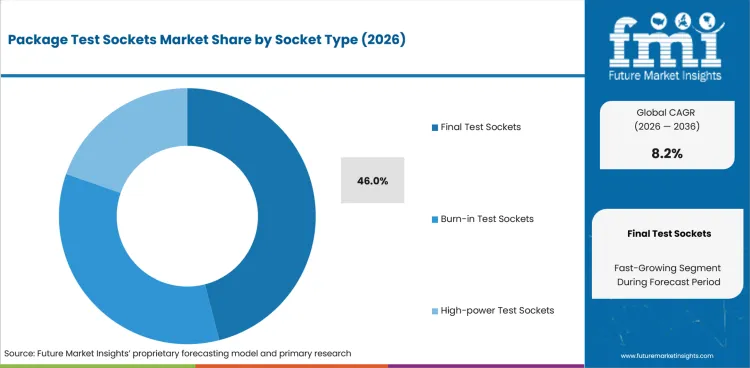
- Final Test Sockets are projected to account for a 46.0% share in 2026 as high-volume production floors replace sockets faster than burn-in boards or lab fixtures.
- Buyers judge final test sockets by first-pass yield and cleaning interval since socket wear can create false failures that look like device defects.
What supports demand for Spring Probe?
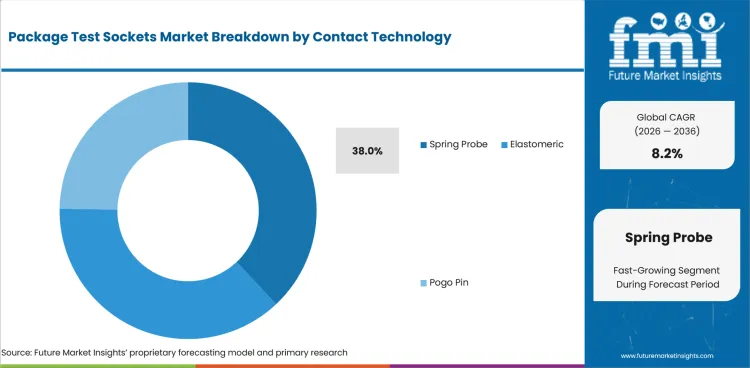
- Spring Probe is expected to hold a 38.0% share in 2026 as it works across many package types and supports repeated insertion cycles.
- Cohu lists cBoa contactors with operation from -55°C to +155°C and bandwidth up to 35 GHz, showing why spring structures fit RF and high-speed test.
How do buyers evaluate BGA / CSP within the package type category?
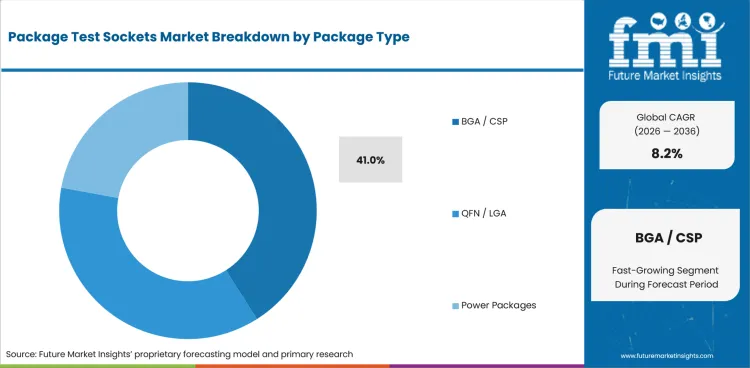
- BGA / CSP is anticipated to represent a 41.0% share in 2026 as dense package pads need aligned contact pressure across the socket cavity.
- Smiths Interconnect lists socket support for QFN, QFP, SOIC, BGA, and LGA packages, which shows why package breadth is a supplier filter.
What market factors influence demand for OSATs?
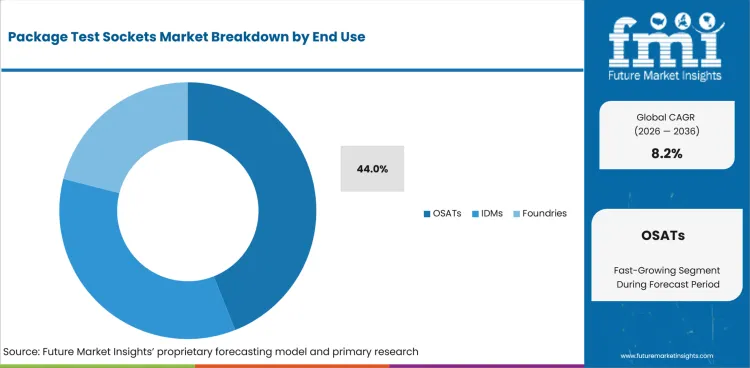
- OSATs are projected to account for a 44.0% share in 2026 as outsourced assembly and test plants qualify sockets across many customer programs.
- OSAT buyers tend to prefer suppliers with fast engineering changes since load board revisions can force socket redesign before volume release.
How does Direct affect the sales channel outlook?
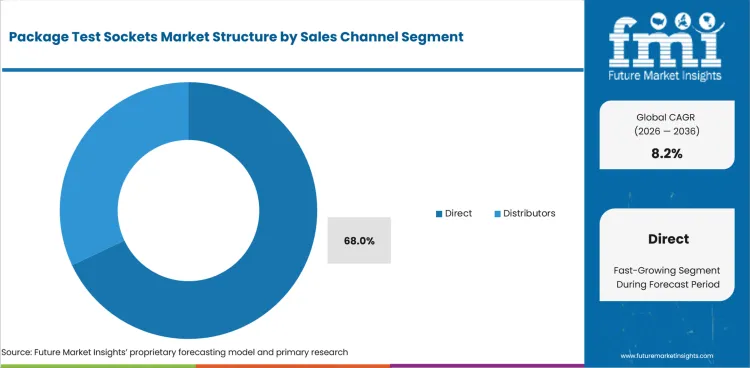
- Direct is estimated to hold a 68.0% share in 2026 as custom sockets need close coordination between device teams and socket engineers.
- Distributors matter for lab sockets and replacements, but direct routes dominate when buyers need thermal simulation or RF matching support.
What drives and restrains the market?
Driver: Chiplet package validation increases socket value since package-level contact must support dense signal maps; restraint: Long custom design cycles can slow socket approval when package drawings change late in qualification; opportunity: local OSAT buildouts create demand for regional socket support and distributor-backed replacement programs.
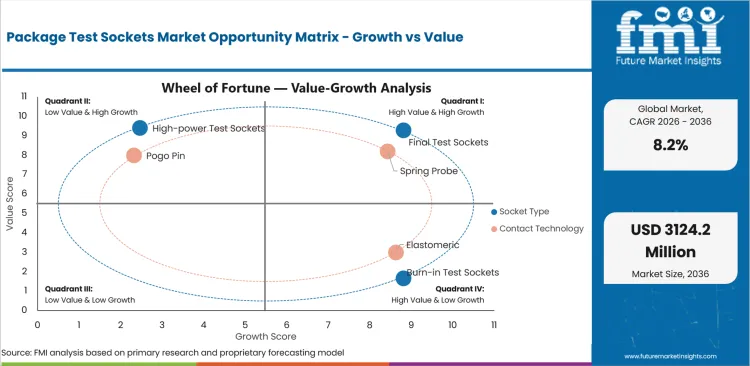
The market reflects a balance between the identified demand driver, adoption constraints, and the supplier opportunity outlined below.
- Driver: Chiplet package validation increases socket value since package-level contact must support dense signal maps.
- Restraint: Long custom design cycles can slow socket approval when package drawings change late in qualification.
- Opportunity: local OSAT buildouts create demand for regional socket support and distributor-backed replacement programs.
Fine-Pitch Contact Stress Fine-pitch packages are raising the technical burden on socket contacts. Yamaichi Electronics lists NP584 universal sockets with pitch from 0.30 mm and applicability across BGA, LGA, QFN, and SON packages. That range shows how socket suppliers must serve irregular pitch layouts without losing insertion repeatability. The mechanism is simple: smaller pads leave less room for mechanical tolerance. A slight contact shift can create false opens or noisy measurements. Buyers therefore pay more attention to pin design, housing stiffness, and pusher design.
RF Signal Loss Control: RF and high-speed sockets grow when test accuracy depends on the signal path through the socket itself. Cohu’s HYDRA COAX contactor is designed for high-end digital applications to 60 Gbps and is built to maintain native device impedance. That requirement changes sourcing behavior because buyers cannot treat the socket as a passive holder. The socket becomes part of the measurement circuit. This means RF loss, return loss, and crosstalk affect whether a socket passes qualification. Suppliers able to document these values gain a clear advantage in 5G, data center, and high-speed interface devices.
Which factors support expansion?
Commercial expansion is reinforced by the value, workflow, and recurring-demand factors below.
- Market value is rising as packaged semiconductor volumes require more dedicated sockets for final test, burn-in, and system-level screening.
- Socket spending is expected to follow burn-in and system-level test platforms as AI accelerator test plans add thermal stress steps.
- Advanced packaging raises the value per socket because fine pitch and higher pin counts need tighter machining tolerance.
Which country markets are included in the CAGR comparison?
The selected CAGR comparison covers India (9.2%), China (9.0%), South Korea (8.8%), United States (8.4%), and Japan (7.8%) through 2036.
.webp "Top Country Growth Comparison Package Test Sockets Market Cagr (2026 2036)")
| Country | CAGR |
|---|---|
| India | 9.2% |
| China | 9.0% |
| South Korea | 8.8% |
| United States | 8.4% |
| Japan | 7.8% |
Source: Future Market Insights analysis based on the supplied country forecast table.
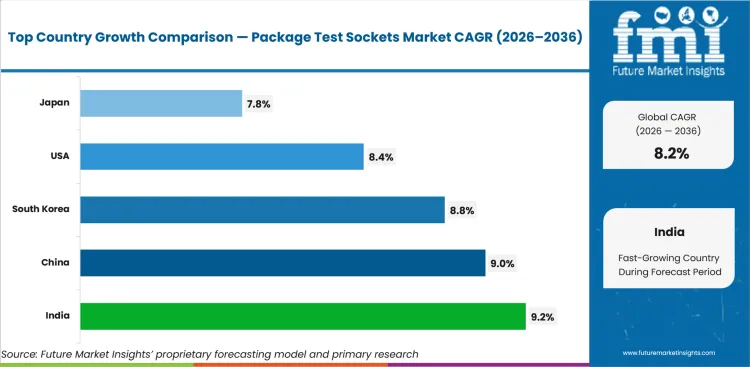
How do country-level CAGRs compare?
- India (CAGR: 9.2%): New OSAT and ATMP projects are creating first-wave local socket demand.
- China (CAGR: 9.0%): China has large semiconductor manufacturing and back-end test activity.
- South Korea (CAGR: 8.8%): Memory and advanced package testing support high socket intensity.
- United States (CAGR: 8.4%): Arizona packaging capacity is creating a new domestic route for package test socket qualification.
- Japan (CAGR: 7.8%): Japan has deep socket, connector, materials, and semiconductor equipment expertise.
The global Package Test Sockets Market is forecast to record a CAGR of 8.2% from 2026 to 2036. The supplied study covers 8 named country forecasts across the report regions.
How is the Package Test Sockets Market developing in India?
India is projected to record a CAGR of 9.2% through 2036. The country outlook identifies this demand signal: New OSAT and ATMP projects are creating first-wave local socket demand.
Country Market Snapshot
| Country | India |
|---|---|
| Forecast CAGR | 9.2% |
| Demand anchor | New OSAT and ATMP projects are creating first-wave local socket demand. |
| Policy context | India’s semiconductor mission supports fabs, OSAT, ATMP, design, and materials. |
| Buyer behavior | Early buyers may rely on proven imported sockets during initial qualification. |
| Application mix | Display drivers, power devices, automotive chips, and SiP modules shape demand. |
| Restraint | Local socket engineering and repair capability remains early-stage. |
| Channel signal | Distributors and global supplier representatives will be important during ramp-up. |
| Primary demand signal | New OSAT and ATMP projects are creating first-wave local socket demand. |
Market Outlook
India is projected to record a CAGR of 9.2% through 2036 as new assembly and test capacity moves from approval to production. India’s Press Information Bureau reported in February 2026 that 10 semiconductor projects with total investment of ₹1.60 lakh crore had been approved across six states. These include advanced packaging and specialised assembly and testing infrastructure. India’s socket demand will start with imported and distributor-supported solutions. New OSAT buyers cannot risk socket-related false failures during customer qualification.
Key Growth Drivers
- Approved OSAT and ATMP projects create new package test infrastructure.
- Government-backed electronics manufacturing supports local semiconductor demand.
- New facilities in Gujarat, Assam, Uttar Pradesh, and Odisha create regional socket opportunities.
- New OSAT and ATMP projects are creating first-wave local socket demand.
Key Restraints
- Local socket design depth is limited compared with Japan or South Korea.
- New test floors may face long import lead times for custom sockets.
- Local socket engineering and repair capability remains early-stage.
Country Market FAQs
Why should executives monitor Package Test Sockets Market demand in India?
Executives should monitor India because local buyer readiness, new osat and atmp projects are creating first-wave local socket demand, and service capacity can influence account timing and market-entry priorities.
What should suppliers localize for India?
Suppliers should localize proof points, pricing logic, partner coverage, and training support around buyer access and account ownership and distributors and global supplier representatives will be important during ramp-up.
What adoption risk needs attention in India?
Executive teams should watch adoption risk because local socket design depth is limited compared with japan or south korea can delay conversion from evaluation to commercial deployment.
How is the Package Test Sockets Market developing in China?
China is projected to record a CAGR of 9.0% through 2036. The country outlook identifies this demand signal: China has large semiconductor manufacturing and back-end test activity.
Country Market Snapshot
| Country | China |
|---|---|
| Forecast CAGR | 9.0% |
| Demand anchor | China has large semiconductor manufacturing and back-end test activity. |
| Policy context | Self-sufficiency goals support local supplier development across test components. |
| Buyer behavior | Buyers compare imported precision sockets with local cost-effective alternatives. |
| Application mix | Consumer electronics, RF devices, power chips, and industrial ICs drive demand. |
| Restraint | Export controls and geopolitical limits can affect access to high-end socket technology. |
| Channel signal | Distributors and local engineering representatives play a larger role than in Japan. |
| Primary demand signal | China has large semiconductor manufacturing and back-end test activity. |
Market Outlook
China is forecast to grow at a CAGR of 9.0% through 2036 as domestic packaging and test capacity expands across large production ecosystems. SEMI’s World Fab Forecast page states that China is projected to maintain the substantial installed capacity volume in both 2026 and 2027. This does not measure package test sockets directly, but it signals the production scale that later supports packaged-device test demand. China’s socket demand is split between premium imported solutions and local alternatives.
Key Growth Drivers
- Large semiconductor capacity creates steady replacement demand for production sockets.
- RF and consumer electronics test floors require high socket throughput.
- Domestic supplier development supports lower-cost alternatives for mature packages.
- China has large semiconductor manufacturing and back-end test activity.
Key Restraints
- Export controls can restrict access to some advanced test technologies.
- Quality variation among local suppliers can raise qualification risk for critical packages.
- Export controls and geopolitical limits can affect access to high-end socket technology.
Country Market FAQs
Why should executives monitor Package Test Sockets Market demand in China?
Executives should monitor China because local buyer readiness, china has large semiconductor manufacturing and back-end test activity, and service capacity can influence account timing and market-entry priorities.
What should suppliers localize for China?
Suppliers should localize proof points, pricing logic, partner coverage, and training support around buyer access and account ownership and distributors and local engineering representatives play a larger role than in japan.
What adoption risk needs attention in China?
Executive teams should watch adoption risk because export controls can restrict access to some advanced test technologies can delay conversion from evaluation to commercial deployment.
How is the Package Test Sockets Market developing in South Korea?
South Korea is projected to record a CAGR of 8.8% through 2036. The country outlook identifies this demand signal: Memory and advanced package testing support high socket intensity.
Country Market Snapshot
| Country | South Korea |
|---|---|
| Forecast CAGR | 8.8% |
| Demand anchor | Memory and advanced package testing support high socket intensity. |
| Supply base | ISC, LEENO Industrial, and TSE are strong domestic socket suppliers. |
| Buyer behavior | Korean buyers evaluate socket life, pitch accuracy, and throughput impact. |
| Application mix | DRAM, NAND, logic, AI memory, and mobile devices shape socket demand. |
| Restraint | Cyclical memory spending can affect socket order timing. |
| Channel signal | Direct technical sales dominate for high-volume semiconductor accounts. |
| Primary demand signal | Memory and advanced package testing support high socket intensity. |
Market Outlook
South Korea is expected to record a CAGR of 8.8% through 2036 as memory and advanced package demand supports socket replacement. LEENO states that it provides system-level test sockets with pitch of at least 0.25 mm and pin count up to 10,000. This shows the technical burden created by large advanced packages and system-level test. South Korean demand is highly technical and production-oriented. Domestic suppliers compete close to major semiconductor customers, which shortens design feedback loops.
Key Growth Drivers
- Memory test volume supports high replacement demand for socket contacts.
- Domestic socket suppliers can co-develop contact structures with nearby semiconductor customers.
- AI memory and advanced package programs raise demand for high-pin-count sockets.
- Memory and advanced package testing support high socket intensity.
Key Restraints
- Memory cycle volatility can delay socket orders during capex pauses.
- Large customers may concentrate orders among preferred domestic suppliers.
- Cyclical memory spending can affect socket order timing.
Country Market FAQs
Why should executives monitor Package Test Sockets Market demand in South Korea?
Executives should monitor South Korea because local buyer readiness, memory and advanced package testing support high socket intensity, and service capacity can influence account timing and market-entry priorities.
What should suppliers localize for South Korea?
Suppliers should localize proof points, pricing logic, partner coverage, and training support around buyer access and account ownership and direct technical sales dominate for high-volume semiconductor accounts.
What adoption risk needs attention in South Korea?
Executive teams should watch adoption risk because memory cycle volatility can delay socket orders during capex pauses can delay conversion from evaluation to commercial deployment.
How is the Package Test Sockets Market developing in the United States?
The United States is projected to record a CAGR of 8.4% through 2036. The country outlook identifies this demand signal: Arizona packaging capacity is creating a new domestic route for package test socket qualification.
Country Market Snapshot
| Country | United States |
|---|---|
| Forecast CAGR | 8.4% |
| Demand anchor | Arizona packaging capacity is creating a new domestic route for package test socket qualification. |
| Policy context | NIST’s packaging program ties advanced packaging to national semiconductor capacity. |
| Buyer behavior | USA IDMs and OSATs prefer direct engineering support for custom test contactors. |
| Channel signal | Specialist suppliers such as Smiths Interconnect, Cohu, Ironwood Electronics, and Johnstech support domestic buyers. |
| Restraint | Lead times and engineering labor can limit fast socket redesign for advanced packages. |
| Application mix | AI accelerators, RF devices, automotive chips, and defense electronics shape socket requirements. |
| Primary demand signal | Arizona packaging capacity is creating a new domestic route for package test socket qualification. |
Market Outlook
The United States is projected to record a CAGR of 8.4% through 2036 as domestic packaging and test investment expands the socket customer pool. CHIPS for America states that the CHIPS and Science Act provided USD 50 billion for USA semiconductor research, development, and manufacturing. This funding does not buy sockets directly. It creates packaging and test sites that need socket qualification, local replacements, and failure-analysis support. USA demand behaves like an engineering-led market.
Key Growth Drivers
- Arizona and Indiana packaging investments create new demand for package-specific test sockets.
- AI accelerator programs raise the need for high-pin-count and thermal-capable sockets.
- Defense and aerospace electronics support low-volume custom sockets with strict reliability needs.
- Arizona packaging capacity is creating a new domestic route for package test socket qualification.
Key Restraints
- Domestic socket engineering capacity can lag advanced packaging schedules.
- Custom sockets face longer qualification cycles when device drawings change late.
- Lead times and engineering labor can limit fast socket redesign for advanced packages.
Country Market FAQs
Why should executives monitor Package Test Sockets Market demand in the United States?
Executives should monitor the United States because local buyer readiness, arizona packaging capacity is creating a new domestic route for package test socket qualification, and service capacity can influence account timing and market-entry priorities.
What should suppliers localize for the United States?
Suppliers should localize proof points, pricing logic, partner coverage, and training support around buyer access and account ownership and specialist suppliers such as smiths interconnect, cohu, ironwood electronics, and johnstech support domestic buyers.
What adoption risk needs attention in the United States?
Executive teams should watch adoption risk because domestic socket engineering capacity can lag advanced packaging schedules can delay conversion from evaluation to commercial deployment.
How is the Package Test Sockets Market developing in Japan?
Japan is projected to record a CAGR of 7.8% through 2036. The country outlook identifies this demand signal: Japan has deep socket, connector, materials, and semiconductor equipment expertise.
Country Market Snapshot
| Country | Japan |
|---|---|
| Forecast CAGR | 7.8% |
| Demand anchor | Japan has deep socket, connector, materials, and semiconductor equipment expertise. |
| Policy context | METI continues to support semiconductor revitalization and advanced node programs. |
| Supply base | Yamaichi Electronics, Enplas, and Yokowo are relevant domestic suppliers. |
| Buyer behavior | Japanese buyers value precision machining and long qualification history. |
| Application mix | Automotive, sensors, RF, memory-related equipment, and advanced logic shape demand. |
| Restraint | Mature domestic buyers can be conservative when qualifying new socket suppliers. |
| Primary demand signal | Japan has deep socket, connector, materials, and semiconductor equipment expertise. |
Market Outlook
Japan is projected to grow at a CAGR of 7.8% through 2036 as domestic semiconductor investment and supplier depth support socket demand. Japan’s Ministry of Economy, Trade and Industry lists semiconductor revitalization strategy materials as a policy reference, showing continued policy focus on the sector. Japan also hosts several socket and connector suppliers with strong precision manufacturing capabilities. Japanese demand behaves differently from import-dependent markets.
Key Growth Drivers
- Domestic socket supplier depth supports fast design feedback for Japanese device makers.
- Automotive and industrial semiconductor demand keeps burn-in sockets commercially relevant.
- Advanced logic and packaging programs support fine-pitch contact development.
- Japan has deep socket, connector, materials, and semiconductor equipment expertise.
Key Restraints
- Established supplier relationships can make new entry difficult.
- Buyers may require extensive reliability proof before switching socket platforms.
- Mature domestic buyers can be conservative when qualifying new socket suppliers.
Country Market FAQs
Why should executives monitor Package Test Sockets Market demand in Japan?
Executives should monitor Japan because local buyer readiness, japan has deep socket, connector, materials, and semiconductor equipment expertise, and service capacity can influence account timing and market-entry priorities.
What should suppliers localize for Japan?
Suppliers should localize proof points, pricing logic, partner coverage, and training support around buyer access and account ownership and local support coverage.
What adoption risk needs attention in Japan?
Executive teams should watch adoption risk because established supplier relationships can make new entry difficult can delay conversion from evaluation to commercial deployment.
Which companies are discussed in the Package Test Sockets Market?
The preview discusses Smiths Interconnect, Yamaichi Electronics, Cohu, ISC, and Enplas among the companies active in this market.
The market is moderately concentrated among specialist socket suppliers with strong contact libraries and package experience. Established suppliers win by proving contact life, thermal stability, RF performance, and custom design speed. Smaller firms compete in lab sockets, quick-turn prototypes, and package-specific engineering work.
Entry barriers are high because buyers qualify sockets around yield, signal integrity, and device safety. Direct access to test engineers is a stronger advantage than broad catalog size alone. Supplier competition is shaped by the ability to solve package-specific contact problems.
How is competition structured?
Competition reflects differences in specialization, portfolio scope, geographic reach, evidence, and customer access.
Competition is suitable viewed by supplier role because socket buyers choose partners by contact technology and support depth.
- Full-Stack Socket Specialists: Smiths Interconnect, Cohu, Yamaichi Electronics, and Enplas compete with broad socket portfolios for burn-in, final test, RF, and package validation. Smiths offers spring-contact socket families. Cohu provides contactors and probe heads for production test.
- Contact Technology Specialists: ISC, LEENO Industrial, TSE, and Yokowo compete through elastomeric, spring probe, pogo pin, and high-density contact capabilities. ISC is known for silicone rubber sockets. LEENO offers test probes, IC test sockets, and system-level sockets.
- Ironwood Electronics and Johnstech compete where evaluation, high-frequency testing, custom mechanical fit, or fast prototype support is critical. Ironwood covers BGA, LGA, QFN, WLCSP, and other packages.
How do selected companies compare?
The selected companies differ in portfolio focus, geographic reach, evidence depth, and channel strength.
| Company | Competitive position |
|---|---|
| Smiths Interconnect | Smiths Interconnect launched DaVinci Gen V in April 2025 for next-generation semiconductor test socket applications. |
| Yamaichi Electronics | Full-Stack Socket Specialists: Smiths Interconnect, Cohu, Yamaichi Electronics, and Enplas compete with broad socket portfolios for burn-in, final test, RF, and package validation. |
| Cohu | Cohu provides contactors and probe heads for production test. |
| ISC | ISC is known for silicone rubber sockets. |
| Enplas | Enplas offers test and burn-in sockets across IC package applications. |
What are the key developments in the Package Test Sockets Market?
- In April 2025, Smiths Interconnect launched DaVinci Gen V for semiconductor test socket applications. The launch strengthens its position in high-reliability socket programs.
- In June 2024, Johnstech published technical guidance on test contactor specifications for semiconductor testing. This is framed as source material for buyer education around RF and contactor selection, not as a standalone market launch.
- In 2024, Yamaichi Electronics published a product guide covering burn-in sockets, high-power sockets, and universal pitch sockets. This is used as portfolio evidence for package coverage, not as a dated product-launch claim.
Selected Companies in the Package Test Sockets Market
Companies referenced in this preview
- Smiths Interconnect.
- Yamaichi Electronics.
- Cohu.
- ISC.
- Enplas.
- Ironwood Electronics.
- LEENO Industrial.
- Johnstech.
- TSE.
- Yokowo.
Market Scope & Definition
| Metric | Value |
|---|---|
| Market definition | Package test sockets are precision electromechanical interfaces used to connect packaged semiconductor devices to test hardware. Scope includes burn-in sockets, final test sockets, RF sockets, high-power sockets, and related contact technologies used after wafer fabrication. |
| Functions covered | Burn-in Test Sockets, Final Test Sockets, RF Test Sockets, High-power Test Sockets |
| Applications covered | Burn-in testing, final testing, RF testing, high-power device testing, and package validation |
| End-use industries | OSATs, IDMs, Foundries, Test Labs |
| Inclusions | Market scope covers Burn-in Test Sockets, Final Test Sockets, RF Test Sockets, High-power Test Sockets, Spring Probe, Elastomeric, Pogo Pin, MEMS / Other, BGA / CSP, QFN / LGA, SiP / Advanced Packages, Power Packages, OSATs, IDMs, Foundries, Test Labs, Direct, Distributors, and the selected countries covered in this study. |
| Exclusions | Scope excludes wafer probe cards, probe stations, complete ATE mainframes, handlers, load boards without sockets, generic board connectors, engineering breadboards, and sockets used only for consumer electronics repair. |
Research Methodology
| Metric | Value |
|---|---|
| Primary Research | FMI analysts reviewed buying behavior across OSATs, IDMs, foundries, test labs, socket suppliers, load board designers, and semiconductor equipment distributors. Interviews focused on qualification cycles, replacement rates, contact technology preferences, and local support expectations. |
| Desk Research | used official semiconductor policy documents, trade association data, company product pages, technical white papers, and test equipment references. Sources helped define addressable socket demand by package type, socket role, and end-use test workflow. |
| Market Sizing and Forecasting | The model combined socket replacement demand, package test volume, contact technology mix, and country-level semiconductor investment signals. Pricing assumptions were adjusted for fine pitch sockets, RF designs, high-current sockets, and custom direct-sales programs. |
| Data Validation | Forecasts were checked against semiconductor test equipment growth, assembly and packaging activity, supplier portfolios, and country-specific manufacturing programs. The final numbers were tested against parent semiconductor manufacturing equipment signals and back-end capacity trends. |
What does the report cover?
The report covers socket type, contact technology, package type, end use, sales channel, and region across the 2026-2036 forecast period in 30+ countries.
| Metric | Value |
|---|---|
| Periods | Base year 2025; estimated year 2026; forecast period 2026-2036 |
| Segment axes | socket type, contact technology, package type, end use, sales channel, and region |
| Regions | North America, Western Europe, East Asia, South Asia and Pacific |
| Countries | United States, United Kingdom, Germany, France, Japan, China, South Korea, India and 30+ |
| Companies | Smiths Interconnect, Yamaichi Electronics, Cohu, ISC, Enplas, Ironwood Electronics, LEENO Industrial, Johnstech, TSE, Yokowo |
| Approach | Hybrid bottom-up and selected-down methodology starting with verified transaction data and projecting adoption velocity across segments and regions. |
Market Segmentation Analysis
Segmented by Socket Type
- Burn-in Test Sockets.
- Final Test Sockets.
- RF Test Sockets.
- High-power Test Sockets.
Segmented by Contact Technology
- Spring Probe.
- Elastomeric.
- Pogo Pin.
- MEMS / Other.
Segmented by Package Type
- BGA / CSP.
- QFN / LGA.
- SiP / Advanced Packages.
- Power Packages.
Segmented by End Use
- OSATs.
- IDMs.
- Foundries.
- Test Labs.
Segmented by Sales Channel
- Direct.
- Distributors.
By Region
- North America.
- United States.
- Western Europe.
- Germany.
- France.
- East Asia.
- China.
- Japan.
- South Korea.
- South Asia and Pacific.
- India.
- United Kingdom.
Research Sources and Bibliography
- 1. SEMI. (2025, December 16). Global semiconductor equipment sales projected to reach a record of $156 billion in 2027. SEMI
- 2. National Institute of Standards and Technology. (2024). National Advanced Packaging Manufacturing Program. NIST.
- 3. Semiconductor Industry Association. (2025, July). 2025 State of the USA Semiconductor Industry. SIA.
- 4. UK Research and Innovation. (2024, September 27). £11.5m to improve semiconductor manufacturing and supply chains. UKRI.
- 5. European Commission. (2024, August 20). Commission approves €5 billion German State aid measure to support ESMC in setting up a new semiconductor manufacturing facility. European Commission.
- 6. Direction générale des Entreprises. (2025, January). Théma n°27: Les semi-conducteurs. Ministère de l’Économie. https://www.entreprises.gouv.fr/files/files/Publications/2025/Th%C3%A9mas/thema-semicond-0108.pdf
- 7. Ministry of Economy, Trade and Industry. (2025). Information Policy. METI.
- 8. Press Information Bureau. (2026, February 7). India Semiconductor Mission 2.0. Government of India.
- 9. Smiths Interconnect. (2025, April 28). Smiths Interconnect launches DaVinci Gen V next-generation test socket. Smiths Group.
- 10. Cohu. (2026). Test Contactors (Sockets) / Probe Heads. Cohu.
- 11. Yamaichi Electronics. (2024). Product Guide. Yamaichi Electronics.
- 12. Ironwood Electronics. (2025). Ironwood Electronics assumes control of HSIO Grypper socket line. Ironwood Electronics.
- 13. Johnstech International. (2024, June 14). Understanding the Importance of Test Contactor Specifications. Johnstech International.
- 14. LEENO Industrial. (2026). System Level Test Socket. LEENO Industrial.
- 15. SEMI. (2025). ISC Co., Ltd. SEMICON Korea 2025 profile. SEMI.
The bibliography is provided for reader reference and uses primary non-commercial government, regulatory, official trade body, and company-published sources.
This Report Answers
- What is the projected value of the Package Test Sockets Market in 2026?
- What value is forecast for the Package Test Sockets Market by 2036?
- What CAGR is forecast for the Package Test Sockets Market from 2026 to 2036?
- What 2026 share is projected for Final Test Sockets within the socket type category?
- What 2026 share is projected for Spring Probe within the contact technology category?
- Which demand factors support the Package Test Sockets Market outlook?
- Which restraints and opportunities affect adoption in the Package Test Sockets Market?
- How are country CAGR outlooks, including India at 9.2%, compared?
- Which companies and product developments are covered in the competitive analysis?
- What is included in the market scope, and how is the forecast validated?
Frequently Asked Questions
Why should executives track the Package Test Sockets Market?
Executives should track this market because it can affect capital allocation, supplier strategy, operating risk, and competitive positioning across end-use settings.
What business problem does the Package Test Sockets Market address?
It helps executive teams judge where customer pain, supplier capability, compliance exposure, and implementation economics justify investment, procurement, or market-entry decisions.
What should procurement leaders evaluate before selecting suppliers?
Procurement leaders should assess evidence quality, integration fit, service coverage, compliance readiness, total cost of ownership, and supplier execution capability.
What can limit return on investment for buyers?
Return on investment can be limited by low utilization, integration delays, training gaps, unclear ownership, pricing pressure, or weak fit with existing workflows.
How can suppliers build executive confidence?
Suppliers can build confidence by proving implementation speed, risk reduction, support depth, reference use cases, and measurable outcomes for budget owners.
Preview the report firsthand - request a free sample
Get SampleGet the brochure for pricing and purchase details.
Get PDFTable of Content
- Key Takeaways
- Market Size and CAGR
- Top Growth Driver
- Fastest Growing Segment
- Leading Region
- Key Companies
- Emerging Opportunities
- Executive Summary
- Global Market Outlook
- Demand-side Trends
- Supply-side Trends
- Technology Roadmap Analysis
- Analysis and Recommendations
- Analyst Perspective (What is happening? Why now? What should investors know?)
- Key Questions Answered
- How large is the market?
- What is the CAGR?
- What are key trends?
- Which region dominates?
- Who are the leaders?
- Market Overview
- Market Coverage / Taxonomy
- Market Definition / Scope / Limitations
- Research Methodology
- Chapter Orientation
- Analytical Lens and Working Hypotheses
- Market Structure, Signals, and Trend Drivers
- Benchmarking and Cross-market Comparability
- Market Sizing, Forecasting, and Opportunity Mapping
- Research Design and Evidence Framework
- Desk Research Programme (Secondary Evidence)
- Expert Input and Fieldwork (Primary Evidence)
- Tooling, Models, and Reference Databases
- Data Engineering and Model Build
- Quality Assurance and Audit Trail
- Market Background
- Market Dynamics (Drivers, Restraints, Opportunity, Trends)
- Scenario Forecast (Optimistic, Likely, Conservative)
- Impact Analysis
- AI Impact
- Sustainability Impact
- Regulatory Impact
- Technology Impact
- Consumer / Buyer Analysis
- Purchase Drivers
- Adoption Barriers
- Buyer Journey
- Opportunity Map Analysis
- Product Life Cycle Analysis
- Supply Chain Analysis
- Investment Feasibility Matrix
- Value Chain Analysis
- PESTLE and Porter's Analysis
- Regulatory Landscape
- Regional Parent Market Outlook
- Production and Consumption Statistics
- Import and Export Statistics
- Global Market Analysis and Forecast, 2021 to 2036
- Historical Market Size Value (USD Million) Analysis, 2021 to 2025
- Current and Future Market Size Value (USD Million) Projections, 2026 to 2036
- Y-o-Y Growth Trend Analysis
- Absolute $ Opportunity Analysis
- Global Market Pricing Analysis, 2021 to 2036
- Global Market Analysis and Forecast, By Socket Type, 2021 to 2036
- Introduction / Key Findings
- Historical Market Size Value (USD Million) Analysis By Socket Type, 2021 to 2025
- Current and Future Market Size Value (USD Million) Analysis and Forecast By Socket Type, 2026 to 2036
- Final Test Sockets
- Burn-in Test Sockets
- High-power Test Sockets
- Final Test Sockets
- Y-o-Y Growth Trend Analysis By Socket Type, 2021 to 2025
- Absolute $ Opportunity Analysis By Socket Type, 2026 to 2036
- Global Market Analysis and Forecast, By Contact Technology, 2021 to 2036
- Introduction / Key Findings
- Historical Market Size Value (USD Million) Analysis By Contact Technology, 2021 to 2025
- Current and Future Market Size Value (USD Million) Analysis and Forecast By Contact Technology, 2026 to 2036
- Spring Probe
- Elastomeric
- Pogo Pin
- Spring Probe
- Y-o-Y Growth Trend Analysis By Contact Technology, 2021 to 2025
- Absolute $ Opportunity Analysis By Contact Technology, 2026 to 2036
- Global Market Analysis and Forecast, By Package Type, 2021 to 2036
- Introduction / Key Findings
- Historical Market Size Value (USD Million) Analysis By Package Type, 2021 to 2025
- Current and Future Market Size Value (USD Million) Analysis and Forecast By Package Type, 2026 to 2036
- BGA / CSP
- QFN / LGA
- Power Packages
- BGA / CSP
- Y-o-Y Growth Trend Analysis By Package Type, 2021 to 2025
- Absolute $ Opportunity Analysis By Package Type, 2026 to 2036
- Global Market Analysis and Forecast, By End Use, 2021 to 2036
- Introduction / Key Findings
- Historical Market Size Value (USD Million) Analysis By End Use, 2021 to 2025
- Current and Future Market Size Value (USD Million) Analysis and Forecast By End Use, 2026 to 2036
- OSATs
- IDMs
- Foundries
- OSATs
- Y-o-Y Growth Trend Analysis By End Use, 2021 to 2025
- Absolute $ Opportunity Analysis By End Use, 2026 to 2036
- Global Market Analysis and Forecast, By Sales Channel, 2021 to 2036
- Introduction / Key Findings
- Historical Market Size Value (USD Million) Analysis By Sales Channel, 2021 to 2025
- Current and Future Market Size Value (USD Million) Analysis and Forecast By Sales Channel, 2026 to 2036
- Direct
- Distributors
- Direct
- Y-o-Y Growth Trend Analysis By Sales Channel, 2021 to 2025
- Absolute $ Opportunity Analysis By Sales Channel, 2026 to 2036
- Global Market Analysis and Forecast, By Region, 2021 to 2036
- Introduction
- Historical Market Size Value (USD Million) Analysis By Region, 2021 to 2025
- Current Market Size Value (USD Million) Analysis and Forecast By Region, 2026 to 2036
- North America
- Latin America
- Western Europe
- Eastern Europe
- East Asia
- South Asia and Pacific
- Middle East & Africa
- Market Attractiveness Analysis By Region
- North America Market Analysis and Forecast, By Country, 2021 to 2036
- Historical Market Size Value (USD Million) Trend Analysis By Market Taxonomy, 2021 to 2025
- Market Size Value (USD Million) Forecast By Market Taxonomy, 2026 to 2036
- By Country
- USA
- Canada
- Mexico
- By Socket Type
- By Contact Technology
- By Package Type
- By End Use
- By Sales Channel
- By Country
- Market Attractiveness Analysis
- By Country
- By Socket Type
- By Contact Technology
- By Package Type
- By End Use
- By Sales Channel
- Key Takeaways
- Latin America Market Analysis and Forecast, By Country
- Historical Market Size Value (USD Million) Trend Analysis By Market Taxonomy, 2021 to 2025
- Market Size Value (USD Million) Forecast By Market Taxonomy, 2026 to 2036
- By Country
- Brazil
- Chile
- Rest of Latin America
- By Socket Type
- By Contact Technology
- By Package Type
- By End Use
- By Sales Channel
- By Country
- Market Attractiveness Analysis
- By Country
- By Socket Type
- By Contact Technology
- By Package Type
- By End Use
- By Sales Channel
- Key Takeaways
- Western Europe Market Analysis and Forecast, By Country
- Historical Market Size Value (USD Million) Trend Analysis By Market Taxonomy, 2021 to 2025
- Market Size Value (USD Million) Forecast By Market Taxonomy, 2026 to 2036
- By Country
- Germany
- UK
- Italy
- Spain
- France
- Nordic
- BENELUX
- Rest of Western Europe
- By Socket Type
- By Contact Technology
- By Package Type
- By End Use
- By Sales Channel
- By Country
- Market Attractiveness Analysis
- By Country
- By Socket Type
- By Contact Technology
- By Package Type
- By End Use
- By Sales Channel
- Key Takeaways
- Eastern Europe Market Analysis and Forecast, By Country
- Historical Market Size Value (USD Million) Trend Analysis By Market Taxonomy, 2021 to 2025
- Market Size Value (USD Million) Forecast By Market Taxonomy, 2026 to 2036
- By Country
- Russia
- Poland
- Hungary
- Balkan & Baltic
- Rest of Eastern Europe
- By Socket Type
- By Contact Technology
- By Package Type
- By End Use
- By Sales Channel
- By Country
- Market Attractiveness Analysis
- By Country
- By Socket Type
- By Contact Technology
- By Package Type
- By End Use
- By Sales Channel
- Key Takeaways
- East Asia Market Analysis and Forecast, By Country
- Historical Market Size Value (USD Million) Trend Analysis By Market Taxonomy, 2021 to 2025
- Market Size Value (USD Million) Forecast By Market Taxonomy, 2026 to 2036
- By Country
- China
- Japan
- South Korea
- By Socket Type
- By Contact Technology
- By Package Type
- By End Use
- By Sales Channel
- By Country
- Market Attractiveness Analysis
- By Country
- By Socket Type
- By Contact Technology
- By Package Type
- By End Use
- By Sales Channel
- Key Takeaways
- South Asia and Pacific Market Analysis and Forecast, By Country
- Historical Market Size Value (USD Million) Trend Analysis By Market Taxonomy, 2021 to 2025
- Market Size Value (USD Million) Forecast By Market Taxonomy, 2026 to 2036
- By Country
- India
- ASEAN
- Australia & New Zealand
- Rest of South Asia and Pacific
- By Socket Type
- By Contact Technology
- By Package Type
- By End Use
- By Sales Channel
- By Country
- Market Attractiveness Analysis
- By Country
- By Socket Type
- By Contact Technology
- By Package Type
- By End Use
- By Sales Channel
- Key Takeaways
- Middle East & Africa Market Analysis and Forecast, By Country
- Historical Market Size Value (USD Million) Trend Analysis By Market Taxonomy, 2021 to 2025
- Market Size Value (USD Million) Forecast By Market Taxonomy, 2026 to 2036
- By Country
- Kingdom of Saudi Arabia
- Other GCC Countries
- Türkiye
- South Africa
- Other African Union
- Rest of Middle East & Africa
- By Socket Type
- By Contact Technology
- By Package Type
- By End Use
- By Sales Channel
- By Country
- Market Attractiveness Analysis
- By Country
- By Socket Type
- By Contact Technology
- By Package Type
- By End Use
- By Sales Channel
- Key Takeaways
- Key Countries Market Analysis
- USA
- Pricing Analysis
- Market Share Analysis, 2025
- By Socket Type
- By Contact Technology
- By Package Type
- By End Use
- By Sales Channel
- Canada
- Pricing Analysis
- Market Share Analysis, 2025
- By Socket Type
- By Contact Technology
- By Package Type
- By End Use
- By Sales Channel
- Mexico
- Pricing Analysis
- Market Share Analysis, 2025
- By Socket Type
- By Contact Technology
- By Package Type
- By End Use
- By Sales Channel
- Brazil
- Pricing Analysis
- Market Share Analysis, 2025
- By Socket Type
- By Contact Technology
- By Package Type
- By End Use
- By Sales Channel
- Chile
- Pricing Analysis
- Market Share Analysis, 2025
- By Socket Type
- By Contact Technology
- By Package Type
- By End Use
- By Sales Channel
- Germany
- Pricing Analysis
- Market Share Analysis, 2025
- By Socket Type
- By Contact Technology
- By Package Type
- By End Use
- By Sales Channel
- UK
- Pricing Analysis
- Market Share Analysis, 2025
- By Socket Type
- By Contact Technology
- By Package Type
- By End Use
- By Sales Channel
- Italy
- Pricing Analysis
- Market Share Analysis, 2025
- By Socket Type
- By Contact Technology
- By Package Type
- By End Use
- By Sales Channel
- Spain
- Pricing Analysis
- Market Share Analysis, 2025
- By Socket Type
- By Contact Technology
- By Package Type
- By End Use
- By Sales Channel
- France
- Pricing Analysis
- Market Share Analysis, 2025
- By Socket Type
- By Contact Technology
- By Package Type
- By End Use
- By Sales Channel
- India
- Pricing Analysis
- Market Share Analysis, 2025
- By Socket Type
- By Contact Technology
- By Package Type
- By End Use
- By Sales Channel
- ASEAN
- Pricing Analysis
- Market Share Analysis, 2025
- By Socket Type
- By Contact Technology
- By Package Type
- By End Use
- By Sales Channel
- Australia & New Zealand
- Pricing Analysis
- Market Share Analysis, 2025
- By Socket Type
- By Contact Technology
- By Package Type
- By End Use
- By Sales Channel
- China
- Pricing Analysis
- Market Share Analysis, 2025
- By Socket Type
- By Contact Technology
- By Package Type
- By End Use
- By Sales Channel
- Japan
- Pricing Analysis
- Market Share Analysis, 2025
- By Socket Type
- By Contact Technology
- By Package Type
- By End Use
- By Sales Channel
- South Korea
- Pricing Analysis
- Market Share Analysis, 2025
- By Socket Type
- By Contact Technology
- By Package Type
- By End Use
- By Sales Channel
- Russia
- Pricing Analysis
- Market Share Analysis, 2025
- By Socket Type
- By Contact Technology
- By Package Type
- By End Use
- By Sales Channel
- Poland
- Pricing Analysis
- Market Share Analysis, 2025
- By Socket Type
- By Contact Technology
- By Package Type
- By End Use
- By Sales Channel
- Hungary
- Pricing Analysis
- Market Share Analysis, 2025
- By Socket Type
- By Contact Technology
- By Package Type
- By End Use
- By Sales Channel
- Kingdom of Saudi Arabia
- Pricing Analysis
- Market Share Analysis, 2025
- By Socket Type
- By Contact Technology
- By Package Type
- By End Use
- By Sales Channel
- Türkiye
- Pricing Analysis
- Market Share Analysis, 2025
- By Socket Type
- By Contact Technology
- By Package Type
- By End Use
- By Sales Channel
- South Africa
- Pricing Analysis
- Market Share Analysis, 2025
- By Socket Type
- By Contact Technology
- By Package Type
- By End Use
- By Sales Channel
- USA
- Market Structure Analysis
- Competition Dashboard
- Competition Benchmarking
- Market Share Analysis of Top Players
- By Regional
- By Socket Type
- By Contact Technology
- By Package Type
- By End Use
- By Sales Channel
- Emerging Startups
- Innovation Benchmarking
- Competition Analysis
- Competition Deep Dive
- Smiths Interconnect
- Overview
- Product Portfolio
- Profitability by Market Segments (Product/Region/Sales Channel)
- Sales Footprint
- Strategy Overview
- Marketing Strategy
- Product Strategy
- Channel Strategy
- Yamaichi Electronics
- Cohu
- ISC
- Enplas
- Ironwood Electronics
- LEENO Industrial
- Johnstech
- Smiths Interconnect
- Case Studies
- Success Stories
- Recent Developments
- Competition Deep Dive
- Assumptions & Acronyms Used


