

- Market Size (2026)
- USD 1407.9 Mn
- Forecast (2036)
- USD 5219.4 Mn
- CAGR (2026 to 2036)
- 14.0%
How big is PFAS-Free Food Packaging & Compliance Testing Market in 2026?
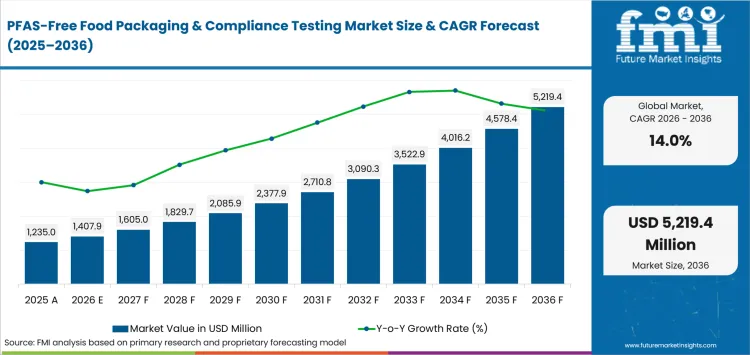
USD 1,407.9 million in 2026 and USD 5,219.4 million by 2036 at a 14.0% CAGR.
Demand for PFAS-free food packaging & compliance testing is projected to expand at 14.0% CAGR from 2026 to 2036, pushing value from USD 1,407.9 million in 2026 and USD 5,219.4 million by 2036. Growing scrutiny of PFAS detection and contamination control is increasing demand for rigorous testing protocols that support regulatory compliance and packaging certification. NIST explained in March 2025 that PFAS-coated laboratory components can contaminate samples and require controlled replacement during measurement. Packaging testing services therefore need sampling controls and reporting limits that separate laboratory background from material signals. Laboratories using food packaging test systems also require matrix-specific extraction and blank control across coated paper or multilayer polymer structures. Commercial value depends on reproducible release decisions rather than isolated instrument readings across each submitted packaging structure.
European compliance planning changed under Regulation (EU) 2025/40 for food-contact packaging placed on the Union market. From August 12, 2026 the regulation sets targeted PFAS thresholds alongside a broader total-PFAS limit. A total-fluorine result above the stated level requires evidence that separates PFAS from other fluorine sources. PFAS detection devices support practical early screening across packaging material portfolios with uncertain formulation histories. Compound-specific conclusions require methods aligned with the applicable threshold and the tested packaging matrix during compliance review. Food safety testing programs also need migration conditions that reflect the intended food type and contact duration. Packaging manufacturers must connect each result with declarations and corrective actions for the exact commercial specification. Isolated instrument readings cannot support broad PFAS-free claims across packaging structures that were not included in testing.
Key Takeaways of PFAS-Free Food Packaging and Compliance Testing Market
- Food-contact restrictions increase demand for laboratory evidence that separates intentionally added PFAS from background fluorine across regulated packaging decisions.
- By solution, PFAS screening is expected to represent 41.8% share in 2026 due to its role as the first analytical decision gate.
- Food contact is projected to account for 57.1% of end use revenue in 2026, reflecting direct migration exposure across regulated packaging structures.
- Testing programs must connect sample preparation with reporting limits and national definitions before packaging teams approve material declarations for commercial release.
- No single method resolves every PFAS question across mixed packaging structures, so matrix contamination and incomplete compound lists restrain adoption.
- Norner, Recyda, Eurofins Scientific, SGS, Intertek, Mérieux NutriSciences, ALS, and TÜV Rheinland compete through analytical depth, certification, or packaging-document control.
Analyst Perspective
“PFAS-free packaging claims fail at the boundary between a screening result and a defensible release decision. Total fluorine can expose an unresolved signal, but it cannot identify every source or prove compliance by itself. Laboratories create commercial value by linking targeted analysis, migration conditions and formulation records to the exact packaging structure. That discipline prevents one result from being stretched across coatings, recycled inputs or destination rules that require different evidence.”
- Nandini Roy Choudhury, Principal Analyst, Future Market Insights
How is the PFAS-Free Food Packaging and Compliance Testing Market segmented?
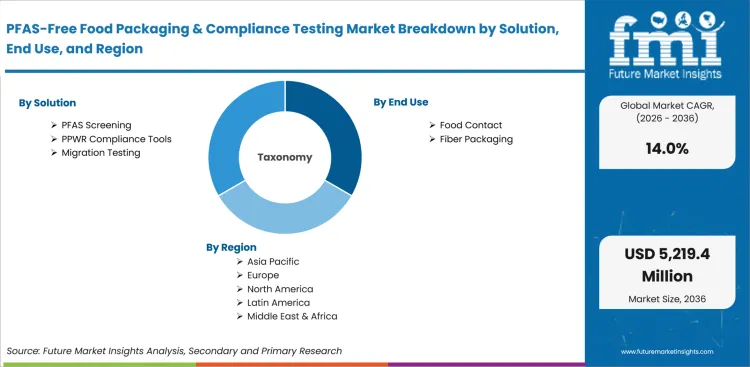
The market is segmented by solution, end use, and region.
The market is segmented by solution, end use, and region to reflect analytical routes, packaging exposure, and national compliance conditions. Solution compares PFAS screening, PPWR compliance tools, and migration testing according to the compliance decision each supports. End use separates food contact from fiber packaging through different exposure conditions and material risk. PFAS screening identifies samples that need targeted confirmation, PPWR compliance tools organize declarations and technical files, and migration testing measures transfer under defined contact conditions. Food contact covers packaging used directly with food, whereas fiber packaging captures paper-based structures that may include coatings or recycled inputs. Regional analysis compares regulatory definitions, documentation routes, and laboratory access across national markets serving food-grade packaging.
Why does PFAS screening lead the solution category?
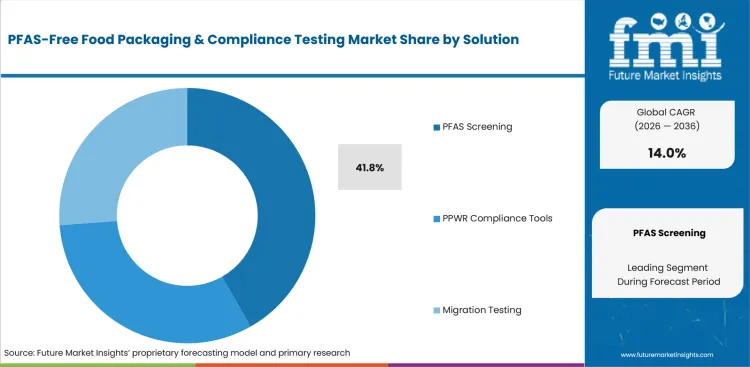
PFAS screening provides the first decision point for packaging samples with uncertain fluorine content during initial compliance review. Laboratories use a broad measurement to determine whether a sample needs compound-specific analysis or formulation evidence. In December 2025, Mérieux NutriSciences expanded validated PFAS food matrices and linked contamination controls with upcoming food-contact packaging limits. Laboratories using packaging testing equipment must also control blanks across coatings and recycled inputs with unclear chemical histories. Screening guides escalation without treating a broad fluorine signal as proof of a regulated PFAS concentration.
- PFAS screening is set to lead the solution category with 41.8% share in 2026 due to its role as the first analytical decision gate. The result directs clean samples toward release review and unresolved samples toward targeted confirmation during compliance assessment. This staged route controls testing cost without assigning compound identity to a broad fluorine measurement during initial triage.
- Packaging manufacturers use screening across coated paper and multilayer portfolios that would make full compound panels expensive. Defined escalation rules reserve specialist methods for samples with unresolved signals or incomplete formulation records. Separate prices for routine screening and confirmation give laboratories a clearer basis for capacity planning and turnaround commitments.
How does food contact shape the end use category?
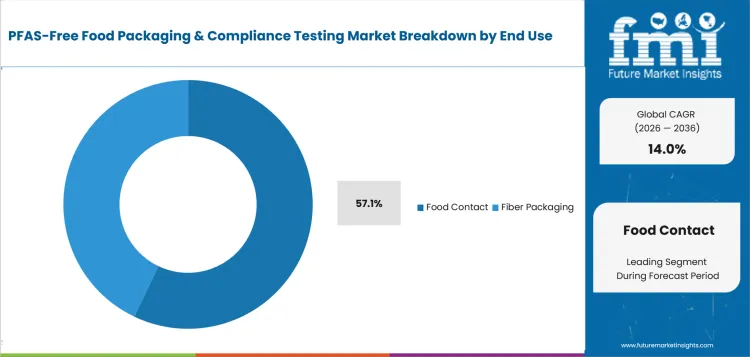
Food-contact packaging requires evidence that reflects the tested article and its intended exposure conditions during commercial release review. In December 2025, SGS documented a food-container assessment combining migration tests with analysis for 630 PFAS substances. The program shows why the food packaging market cannot rely on a material label without article-specific chemical review. Barrier packaging formats also need separate plans for coatings and multilayer components across each article. Laboratories must connect every result with the food type and contact duration used during testing.
- The end use category is forecast to be led by food contact at 57.1% share in 2026 due to direct migration exposure. Migration testing gives packaging manufacturers a stronger release basis than general composition statements during product approval. Repeated coating changes also create recurring validation needs across food types and destination-specific contact requirements.
- Food manufacturers use compliance testing to compare substitute coatings without relying on performance claims alone. Representative simulants connect laboratory results with intended food types and documented contact duration for each tested packaging article. Traceable specifications help brand owners repeat the same decision across factories and prevent one test from covering an untested package structure.
What are the drivers, restraints, and opportunities in the PFAS-Free Food Packaging and Compliance Testing Market?
Tighter food-contact limits increase testing demand, analytical ambiguity restrains broad claims, and integrated documentation creates recurring service opportunities.
- Driver: Food-contact limits require packaging manufacturers to document PFAS conditions before releasing revised material specifications across regulated applications.
- Restraint: Analytical uncertainty raises testing expense and delays release decisions across complex coatings or recycled material structures.
- Opportunity: Integrated laboratory and documentation services can support recurring compliance work across product changes and national reporting systems.
Regulatory limits create repeat testing demand whenever a packaging specification changes ahead of commercial release. The European Commission confirmed in February 2025 that the PPWR had entered into force and would generally apply from August 2026. The change makes laboratory evidence central to release decisions for every revised food-contact packaging structure. Paper packaging programs therefore need sample plans and formulation records tied to every coating or fiber combination. Laboratories gain recurring work as manufacturers replace barriers and require fresh evidence for revised specifications.
Targeted lists can omit compounds and broad fluorine methods can capture unrelated sources, raising analytical cost across complex packaging reviews. Laboratories must control blanks and reporting limits for each matrix to avoid disputes during release review. The UK PFAS Plan stated in February 2026 that aggregated fluorine methods may support screening as scientific understanding develops. Packaging teams therefore need a defined confirmation route for every unresolved screening result in commercial review. Extra analysis delays commercial release whenever the first method does not answer the original compliance question.
Integrated documentation creates a recurring service opening across packaging changes and national reporting systems worldwide. Laboratories can connect screening results with migration evidence and formulation records for each commercial packaging specification. The April 2025 UK recyclability methodology classifies intentionally added PFAS as an automatic red condition for most household packaging materials. The rule makes PFAS evidence relevant to both chemical compliance and recyclability classification for molded fiber packaging. Service revenue becomes recurring as updated material files prevent separate investigations across repeated internal reviews.
Which country CAGRs are profiled in the PFAS-Free Food Packaging and Compliance Testing Market?
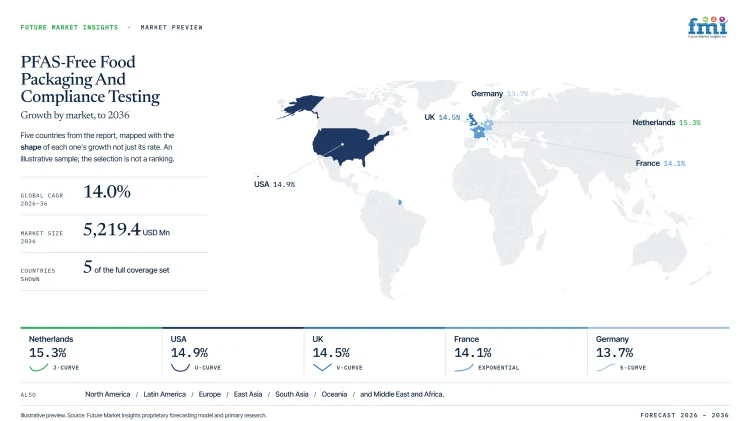
| Country | CAGR |
|---|---|
| USA | 14.9% |
| Germany | 13.7% |
| Netherlands | 15.3% |
| UK | 14.5% |
| France | 14.1% |
How do country-level CAGRs compare in the PFAS-Free Food Packaging and Compliance Testing Market?
The country forecasts remain tightly grouped across the PFAS-free food packaging and compliance testing market, indicating broad momentum toward safer packaging materials and stricter verification requirements. The Netherlands, USA and UK form a closely aligned upper group with less than one percentage point separating their forecasts. France remains close to this cluster and creates a gradual transition toward Germany rather than a clear break in market performance.
- The Netherlands shows a notable position within the comparison as packaging innovation and sustainability initiatives continue to support the transition toward PFAS-free food-contact materials.
- The USA remains closely aligned with the Netherlands as food manufacturers and packaging suppliers increase investment in PFAS alternatives and third-party compliance verification.
- The UK benefits from growing demand for safer packaging materials, encouraging greater adoption of testing and certification services to demonstrate regulatory compliance.
- France reflects steady market development as packaging producers strengthen material assessment and testing programs in response to evolving food safety and environmental requirements.
- Germany maintains a meaningful position within the comparison as regulatory compliance, product stewardship and sustainable packaging objectives support demand for PFAS-free solutions and testing services.
Comparable CAGRs do not create identical market conditions across countries. Differences in regulatory timelines, testing protocols, packaging material preferences and certification requirements can influence adoption patterns and commercialization strategies. Similar growth forecasts may therefore reflect distinct compliance pathways and market entry requirements across the food packaging sector. The full report provides country-level CAGR analysis across North America, Latin America, Europe, East Asia, South Asia, Oceania and the Middle East and Africa.
Country-wise Analysis
- United States packaging programs must separate federal food-contact authorization from state restrictions on intentionally added PFAS in plant-based materials. PFAS-free food packaging compliance testing demand in the USA is forecast to rise at 14.9% CAGR over the forecast period, supported by recurring verification across paper and fiber formats. In January 2025, FDA made 35 PFAS-related food contact notifications ineffective and described a screening method for paper packaging. Federal method development gives laboratories a direct route for grease-proofing substances in paper and paperboard. State definitions and total-fluorine thresholds create material friction for companies managing national packaging portfolios across several jurisdictions. Testing contracts should name each destination jurisdiction so one result does not cover incompatible legal definitions.
- German packaging programs combine EU food-contact law with BfR recommendations for paper and board materials. In April 2026, BfR opened a consultation on consolidated recommendations that included tabular substance entries and CAS references. Adoption of PFAS-free food packaging compliance testing in Germany is estimated to expand at 13.7% CAGR through 2036, underpinned by method review and documented coating substitutions. Local laboratory expertise provides a direct enabler across paper and polymer matrices during routine compliance review. Revised substance entries create friction for manufacturers using additives that need new documentation across affected packaging specifications. Contracts should assign responsibility for recommendation changes and repeat testing across every affected commercial specification.
- Dutch packaging assessments combine EU food-contact duties with a national regulation covering paper and coatings across several material classes. In the Netherlands, PFAS-free food packaging compliance testing demand is predicted to advance at 15.3% CAGR through 2036, influenced by documentation needs across traded packaging portfolios. Concentrated laboratory and logistics networks support regional testing for products moving through European distribution routes. RIVM published an English translation of the revised regulation in January 2026 and stated that it applied from 27 November 2025. Material-specific rules create friction for dossiers containing plastic parts with paper or coating layers across one packaging structure. Controlled document handoffs must preserve the link between each result and its exact material structure.
- United Kingdom packaging programs must separate food-contact authorization routes from recyclability reporting and PFAS monitoring across national jurisdictions. Government guidance updated in July 2026 confirms that food-contact materials remain within the regulated-products authorization framework for England, Northern Ireland and Wales. By 2036, the UK PFAS-free food packaging compliance testing market is projected to grow at 14.5% CAGR, reinforced by recurring evidence needs across packaging changes. Official registers provide a direct enabler for checking authorization status during each packaging specification review. Separate chemical and recyclability duties create material friction for commercial portfolios that cross devolved national jurisdictions. Laboratories should record the destination jurisdiction and guidance version for every submitted packaging sample during intake.
- French food-contact controls examine traceability and declarations across manufacturers or importers throughout the distribution chain. PFAS-free food packaging compliance testing sales in France are forecast to expand at 14.1% CAGR by 2036, shaped by inspection activity and documentation review. National laboratory and enforcement routes provide a direct enabler for corrective testing across several material classes. In April 2026, DGCCRF reported that 21.7% of 356 analyzed food-contact products failed applicable requirements. The result covers food-contact materials broadly and does not establish PFAS prevalence within the inspected sample. Inspection exposure creates friction through retesting and corrective documentation for products carrying unsupported safety or material claims.
Who are the notable companies in the PFAS-Free Food Packaging and Compliance Testing Market?
Norner; Recyda; Eurofins Scientific; SGS; Intertek; Mérieux NutriSciences; ALS; and TÜV Rheinland are notable companies shaping the PFAS-Free Food Packaging & Compliance Testing Market.
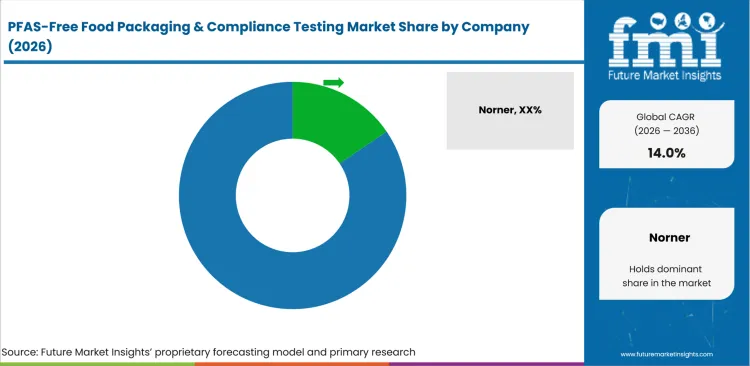
Competition landscape in the industry include global laboratory networks with specialist analytical groups and packaging-data platforms across distinct compliance stages. In November 2025, Eurofins described food-contact packaging testing against PPWR limits and migration requirements within its European PFAS update. ALS published a February 2025 food-testing update that covered packaging and LC-MS/MS analysis across regulated matrices. TÜV Rheinland expanded worldwide PFAS testing capacity in March 2025 for industries that include food packaging. Method scope determines which regulatory or commercial question a laboratory can answer with defensible evidence. Turnaround capacity and document control determine whether the same evidence remains usable across large packaging portfolios.
- Norner and Mérieux NutriSciences provide complementary routes for broad screening and targeted analysis across complex packaging materials. Their commercial test concerns clear reporting boundaries and documented escalation rules for every unresolved fluorine signal. Packaging manufacturers should compare whether each service distinguishes screening results from compound-specific evidence across mixed portfolios.
- Intertek and SGS combine PFAS testing with certification or multi-jurisdiction food-contact support across extensive laboratory networks. Selection depends on verified method limits and certificate scope across every tested packaging material family. Brand owners need evidence that remains valid for the tested material and its declared destination.
- Eurofins Scientific and ALS provide targeted PFAS analysis and migration support for food-contact materials across broad laboratory networks. TÜV Rheinland adds worldwide PFAS analysis for food packaging through expanded testing capacity and regulatory support. Recyda connects laboratory outputs with declarations and technical files across packaging portfolios containing many specifications.
Competitive Benchmarking: PFAS-Free Food Packaging & Compliance Testing Market
| Company | PFAS Screening | Food-Contact Support | Compliance Documentation | Geographic Reach |
|---|---|---|---|---|
| Norner | High | Medium | Medium | Europe with international projects |
| Recyda | Low | Medium | High | Europe with global enterprise users |
| Eurofins Scientific | High | High | High | Global laboratory network |
| SGS | High | High | High | Global laboratory network |
| Intertek | High | High | High | Global laboratory network |
| Mérieux NutriSciences | Medium | High | High | Global laboratory network |
| TÜV Rheinland | Medium | Medium | Medium | Global laboratory network |
| ALS | High | High | Medium | Global laboratory network |
Key Developments in the PFAS-Free Food Packaging & Compliance Testing Market
- In May 2025, Intertek launched a PFAS-Free Certification Program that uses total organic fluorine testing with a 20 ppm threshold. The program covers consumer and industrial products including food packaging and raw materials across several regulated applications. The launch gives packaging manufacturers a third-party route for substantiating claims across complex material portfolios.
- In October 2025, SGS expanded PFAS testing at its Fairfield laboratory in New Jersey for food packaging and other consumer products. The ISO/IEC 17025 facility added total fluorine and total organic fluorine screening alongside targeted analysis for 233 PFAS compounds. The expansion gives United States packaging programs a regional route for staged screening and confirmation. Each client must match the selected method with the material type and regulatory question across intended destination markets.
- In June 2026, Recyda launched its PPWR Navigator for declarations of conformity and technical documentation across packaging portfolios. The platform evaluates Article 5 substances-of-concern data and identifies missing information across extensive SKU structures. The development connects laboratory results with scalable document generation across regulated packaging files and extensive product portfolios.
- In June 2026, Norner introduced total organic fluorine analysis by Pyrolysis-GC/MS for material screening and PPWR support. The method excludes inorganic fluorine from the reported organic signal and can examine plastics or coatings alongside composites and recycled materials. The addition provides another staged route ahead of targeted PFAS analysis across complex packaging materials.
Key Players in the PFAS-Free Food Packaging & Compliance Testing Market
Global Testing and Certification Networks
- Eurofins Scientific
- SGS
- Intertek
- Mérieux NutriSciences
Specialist Packaging and Analytical Providers
- Norner
- ALS
- TÜV Rheinland
Compliance Data and Documentation Platforms
- Recyda
PFAS-Free Food Packaging & Compliance Testing Market - Report Scope
| Coverage field | Report scope |
|---|---|
| Market breakdown | solution, end use, and region. |
| Quantitative Units | Revenue in USD Million, CAGR in %. |
| Market Definition | Revenue includes third-party PFAS screening, targeted analysis, total fluorine assessment, migration testing, substitution verification, and packaging compliance-documentation services. In-house laboratory activity and broader environmental PFAS testing are excluded. |
| Regions Covered | North America, Latin America, Europe, East Asia, South Asia, Oceania, and Middle East and Africa. |
| Countries Covered | USA, Germany, Netherlands, UK, France, and more than twenty-five additional countries in the full report. |
| Key Companies Profiled | Norner; Recyda; Eurofins Scientific; SGS; Intertek; Mérieux NutriSciences; ALS; TÜV Rheinland |
| Forecast Period | 2026 to 2036. |
| Approach | Hybrid bottom-up and top-down market sizing supported by primary interviews and official desk research. |
PFAS-Free Food Packaging & Compliance Testing Market - Research Methodology
| Method | Approach |
|---|---|
| Primary Research | FMI analysts gathered input from manufacturers, service providers, technology developers, distributors, end users, sourcing teams, and subject-matter experts. Interviews examined purchasing decisions, product or service evaluation, adoption barriers, approval requirements, pricing considerations, and expectations for technical or commercial support. Respondents were also asked what evidence is required before a trial, pilot, or initial order develops into regular purchasing. |
| Desk Research | Desk research covered government statistics, regulatory publications, trade data, industry associations, technical literature, standards, company filings, product information, and official corporate announcements. Sources were reviewed for relevance, publication date, geographic coverage, and consistency with the defined market scope. Claims relating to performance, applications, approvals, capacity, investment, and commercial activity were retained only when supported by credible public evidence. |
| Market Sizing and Forecasting | The market model combined the baseline value with historical performance, segment structure, pricing and volume indicators, adoption levels, company participation, and country-level demand conditions. Forecast assumptions considered economic activity, investment trends, regulatory developments, technology adoption, purchasing cycles, supply availability, and barriers to wider market use. Segment and regional estimates were reconciled before the final market total was calculated. |
| Data Validation | Estimates were checked against multiple independent indicators, including public data, company activity, trade patterns, industry developments, and findings from primary interviews. Validation also tested whether products, services, applications, and company revenues fell within the defined market boundaries. Adjacent categories, unsupported claims, overlapping revenues, and activities without direct market relevance were excluded to reduce double counting and maintain consistency across segments and countries. |
PFAS-Free Food Packaging & Compliance Testing Market by Segments
PFAS-Free Food Packaging & Compliance Testing Market segmented by Solution:
- PFAS screening
- PPWR compliance tools
- Migration testing
PFAS-Free Food Packaging & Compliance Testing Market segmented by End Use:
- Food contact
- Fiber packaging
PFAS-Free Food Packaging & Compliance Testing Market by Region:
- North America
- United States
- Canada
- Latin America
- Brazil
- Mexico
- Argentina
- Chile
- Western Europe
- Germany
- France
- United Kingdom
- Italy
- Spain
- Benelux
- Nordics
- Eastern Europe
- Poland
- Czech Republic
- Romania
- Hungary
- East Asia
- China
- Japan
- South Korea
- South Asia and Pacific
- India
- ASEAN
- Australia and New Zealand
- Middle East and Africa
- GCC Countries
- South Africa
- Türkiye
- Israel
Research Sources and Bibliography
- National Institute of Standards and Technology. (2025, March 4). How Do You Measure PFAS?
- European Parliament & Council of the European Union. (2025, January 22). Regulation (EU) 2025/40 of the European Parliament and of the Council of 19 December 2024 on packaging and packaging waste.
- European Commission, Directorate-General for Environment. (2025, February 11). New rules enter into force for a more sustainable and competitive packaging economy.
- USA Food and Drug Administration. (2025, January 3). FDA Determines Authorization for 35 Food Contact Notifications Related to PFAS Are No Longer Effective.
- Department for Environment, Food & Rural Affairs. (2026, February 3). PFAS Plan: building a safer future together.
- Department for Environment, Food & Rural Affairs, Environment Agency, & Natural Resources Wales. (2025, April 28). Recyclability assessment methodology: how to assess your packaging waste.
- Department for Environment, Food & Rural Affairs. (2026, July 3). Reforms to the market authorisations process for regulated products.
- German Federal Institute for Risk Assessment. (2026, April 10). Public Consultation on the Draft Revision of BfR Recommendations on paper and board for food contact.
- National Institute for Public Health and the Environment. (2026, January 26). Dutch Commodities Act Regulation on Packaging and Consumer Articles.
- Direction générale de la concurrence, de la consommation et de la répression des fraudes. (2026, April 3). Contrôle des matériaux au contact des denrées alimentaires : plus de 20 % des produits analysés non conformes.
- SGS. (2025, December 23). Food Contact Material Testing for 44west.
- Intertek. (2025, May 30). Intertek Launches Industry-Leading PFAS-Free Certification Program to Advance Safer, More Transparent Consumer Products.
- Mérieux NutriSciences. (2025, December 1). PFAS Analysis in Food: Expansion of Validated Food Matrices.
- Norner. (2026, June 25). Strengthening PFAS Risk Assessment with TOF Analysis.
- Recyda. (2026, June 30). Recyda Launches PPWR Navigator.
- Eurofins Sustainability Services. (2025, November 20). 2025 PFAS Regulations: A Year of Rapid Change in Europe.
- TÜV Rheinland. (2025, March 20). PFAS: TÜV Rheinland expands global testing capabilities.
- ALS. (2025, February 26). PFAS testing for food: facing a new era of regulations with confidence.
- SGS. (2025, October 9). PFAS Testing Service Expansion at Fairfield Laboratory.
This bibliography is provided for reader reference and is not exhaustive. The full report contains the complete reference list and detailed citations.
This Report Answers
- How large is the pfas-free food packaging and compliance testing market in 2026 and 2036?
- Which regulatory and analytical conditions convert packaging changes into testing demand?
- Why does PFAS screening hold the selected solution position in 2026?
- How does food contact influence demand within the end use category?
- How do targeted methods and fluorine screening support different compliance decisions?
- How do country growth rates differ across the USA, Germany, Netherlands, UK, and France?
- Which companies provide laboratory testing, certification, or compliance-documentation support?
- Which analytical limitations restrain broad PFAS-free claims across packaging materials?
- What should decision-makers evaluate before selecting a PFAS compliance-testing service?
Frequently Asked Questions
How big is the PFAS-Free Food Packaging & Compliance Testing Market in 2026?
The PFAS-free food packaging & compliance testing market is valued at USD 1407.9 million in 2026 and is forecast to reach USD 5219.4 million by 2036.
What is the CAGR of the PFAS-Free Food Packaging & Compliance Testing Market from 2026 to 2036?
The PFAS-free food packaging & compliance testing market is projected to grow at a CAGR of 14.0% between 2026 and 2036, supported by tightening food-contact regulations driving recurring laboratory verification demand across revised packaging specifications and national compliance programs.
Which solution segment leads the PFAS-Free Food Packaging & Compliance Testing Market?
PFAS screening accounts for 41.8% of the PFAS-free food packaging & compliance testing market by solution in 2026, driven by its role as the first analytical decision gate that directs clean samples toward release and unresolved samples toward targeted confirmation during compliance assessment.
Which country is growing fastest in the PFAS-Free Food Packaging & Compliance Testing Market?
The Netherlands is the fastest-growing country in the PFAS-free food packaging & compliance testing market, expanding at a 15.3% CAGR through 2036, ahead of the market average of 14.0%, supported by concentrated laboratory networks, national material-specific regulations, and documentation needs across traded packaging portfolios.
Who are the leading companies in the PFAS-Free Food Packaging & Compliance Testing Market?
Leading companies in the PFAS-free food packaging & compliance testing market include Eurofins Scientific, SGS, Intertek, Mérieux NutriSciences, Norner, ALS, TÜV Rheinland, and Recyda, spanning global laboratory networks, specialist analytical services, and compliance documentation platforms.
Preview the report firsthand - request a free sample
Get SampleGet the brochure for pricing and purchase details.
Get PDFTable of Content
- Key Takeaways
- Market Size and CAGR
- Top Growth Driver
- Fastest Growing Segment
- Leading Region
- Key Companies
- Emerging Opportunities
- Executive Summary
- Global Market Outlook
- Demand-side Trends
- Supply-side Trends
- Technology Roadmap Analysis
- Analysis and Recommendations
- Analyst Perspective (What is happening? Why now? What should investors know?)
- Key Questions Answered
- How large is the market?
- What is the CAGR?
- What are key trends?
- Which region dominates?
- Who are the leaders?
- Market Overview
- Market Coverage / Taxonomy
- Market Definition / Scope / Limitations
- Research Methodology
- Chapter Orientation
- Analytical Lens and Working Hypotheses
- Market Structure, Signals, and Trend Drivers
- Benchmarking and Cross-market Comparability
- Market Sizing, Forecasting, and Opportunity Mapping
- Research Design and Evidence Framework
- Desk Research Programme (Secondary Evidence)
- Expert Input and Fieldwork (Primary Evidence)
- Tooling, Models, and Reference Databases
- Data Engineering and Model Build
- Quality Assurance and Audit Trail
- Market Background
- Market Dynamics (Drivers, Restraints, Opportunity, Trends)
- Scenario Forecast (Optimistic, Likely, Conservative)
- Impact Analysis
- AI Impact
- Sustainability Impact
- Regulatory Impact
- Technology Impact
- Consumer / Buyer Analysis
- Purchase Drivers
- Adoption Barriers
- Buyer Journey
- Opportunity Map Analysis
- Product Life Cycle Analysis
- Supply Chain Analysis
- Investment Feasibility Matrix
- Value Chain Analysis
- PESTLE and Porter's Analysis
- Regulatory Landscape
- Regional Parent Market Outlook
- Production and Consumption Statistics
- Import and Export Statistics
- Global Market Analysis and Forecast, 2021 to 2036
- Historical Market Size Value (USD Million) Analysis, 2021 to 2025
- Current and Future Market Size Value (USD Million) Projections, 2026 to 2036
- Y-o-Y Growth Trend Analysis
- Absolute $ Opportunity Analysis
- Global Market Pricing Analysis, 2021 to 2036
- Global Market Analysis and Forecast, By Solution, 2021 to 2036
- Introduction / Key Findings
- Historical Market Size Value (USD Million) Analysis By Solution, 2021 to 2025
- Current and Future Market Size Value (USD Million) Analysis and Forecast By Solution, 2026 to 2036
- PFAS Screening
- PPWR Compliance Tools
- Migration Testing
- PFAS Screening
- Y-o-Y Growth Trend Analysis By Solution, 2021 to 2025
- Absolute $ Opportunity Analysis By Solution, 2026 to 2036
- Global Market Analysis and Forecast, By End Use, 2021 to 2036
- Introduction / Key Findings
- Historical Market Size Value (USD Million) Analysis By End Use, 2021 to 2025
- Current and Future Market Size Value (USD Million) Analysis and Forecast By End Use, 2026 to 2036
- Food Contact
- Fiber Packaging
- Food Contact
- Y-o-Y Growth Trend Analysis By End Use, 2021 to 2025
- Absolute $ Opportunity Analysis By End Use, 2026 to 2036
- Global Market Analysis and Forecast, By Region, 2021 to 2036
- Introduction
- Historical Market Size Value (USD Million) Analysis By Region, 2021 to 2025
- Current Market Size Value (USD Million) Analysis and Forecast By Region, 2026 to 2036
- North America
- Latin America
- Western Europe
- Eastern Europe
- East Asia
- South Asia and Pacific
- Middle East & Africa
- Market Attractiveness Analysis By Region
- North America Market Analysis and Forecast, By Country, 2021 to 2036
- Historical Market Size Value (USD Million) Trend Analysis By Market Taxonomy, 2021 to 2025
- Market Size Value (USD Million) Forecast By Market Taxonomy, 2026 to 2036
- By Country
- USA
- Canada
- By Solution
- By End Use
- By Country
- Market Attractiveness Analysis
- By Country
- By Solution
- By End Use
- Key Takeaways
- Latin America Market Analysis and Forecast, By Country
- Historical Market Size Value (USD Million) Trend Analysis By Market Taxonomy, 2021 to 2025
- Market Size Value (USD Million) Forecast By Market Taxonomy, 2026 to 2036
- By Country
- Brazil
- Mexico
- Chile
- Rest of Latin America
- By Solution
- By End Use
- By Country
- Market Attractiveness Analysis
- By Country
- By Solution
- By End Use
- Key Takeaways
- Western Europe Market Analysis and Forecast, By Country
- Historical Market Size Value (USD Million) Trend Analysis By Market Taxonomy, 2021 to 2025
- Market Size Value (USD Million) Forecast By Market Taxonomy, 2026 to 2036
- By Country
- Germany
- UK
- Italy
- Spain
- France
- Nordic
- BENELUX
- Rest of Western Europe
- By Solution
- By End Use
- By Country
- Market Attractiveness Analysis
- By Country
- By Solution
- By End Use
- Key Takeaways
- Eastern Europe Market Analysis and Forecast, By Country
- Historical Market Size Value (USD Million) Trend Analysis By Market Taxonomy, 2021 to 2025
- Market Size Value (USD Million) Forecast By Market Taxonomy, 2026 to 2036
- By Country
- Russia
- Poland
- Hungary
- Balkan & Baltic
- Rest of Eastern Europe
- By Solution
- By End Use
- By Country
- Market Attractiveness Analysis
- By Country
- By Solution
- By End Use
- Key Takeaways
- East Asia Market Analysis and Forecast, By Country
- Historical Market Size Value (USD Million) Trend Analysis By Market Taxonomy, 2021 to 2025
- Market Size Value (USD Million) Forecast By Market Taxonomy, 2026 to 2036
- By Country
- China
- Japan
- South Korea
- By Solution
- By End Use
- By Country
- Market Attractiveness Analysis
- By Country
- By Solution
- By End Use
- Key Takeaways
- South Asia and Pacific Market Analysis and Forecast, By Country
- Historical Market Size Value (USD Million) Trend Analysis By Market Taxonomy, 2021 to 2025
- Market Size Value (USD Million) Forecast By Market Taxonomy, 2026 to 2036
- By Country
- India
- ASEAN
- Australia & New Zealand
- Rest of South Asia and Pacific
- By Solution
- By End Use
- By Country
- Market Attractiveness Analysis
- By Country
- By Solution
- By End Use
- Key Takeaways
- Middle East & Africa Market Analysis and Forecast, By Country
- Historical Market Size Value (USD Million) Trend Analysis By Market Taxonomy, 2021 to 2025
- Market Size Value (USD Million) Forecast By Market Taxonomy, 2026 to 2036
- By Country
- Kingdom of Saudi Arabia
- Other GCC Countries
- Türkiye
- South Africa
- Other African Union
- Rest of Middle East & Africa
- By Solution
- By End Use
- By Country
- Market Attractiveness Analysis
- By Country
- By Solution
- By End Use
- Key Takeaways
- Key Countries Market Analysis
- USA
- Pricing Analysis
- Market Share Analysis, 2025
- By Solution
- By End Use
- Canada
- Pricing Analysis
- Market Share Analysis, 2025
- By Solution
- By End Use
- Mexico
- Pricing Analysis
- Market Share Analysis, 2025
- By Solution
- By End Use
- Brazil
- Pricing Analysis
- Market Share Analysis, 2025
- By Solution
- By End Use
- Chile
- Pricing Analysis
- Market Share Analysis, 2025
- By Solution
- By End Use
- Germany
- Pricing Analysis
- Market Share Analysis, 2025
- By Solution
- By End Use
- UK
- Pricing Analysis
- Market Share Analysis, 2025
- By Solution
- By End Use
- Italy
- Pricing Analysis
- Market Share Analysis, 2025
- By Solution
- By End Use
- Spain
- Pricing Analysis
- Market Share Analysis, 2025
- By Solution
- By End Use
- France
- Pricing Analysis
- Market Share Analysis, 2025
- By Solution
- By End Use
- India
- Pricing Analysis
- Market Share Analysis, 2025
- By Solution
- By End Use
- ASEAN
- Pricing Analysis
- Market Share Analysis, 2025
- By Solution
- By End Use
- Australia & New Zealand
- Pricing Analysis
- Market Share Analysis, 2025
- By Solution
- By End Use
- China
- Pricing Analysis
- Market Share Analysis, 2025
- By Solution
- By End Use
- Japan
- Pricing Analysis
- Market Share Analysis, 2025
- By Solution
- By End Use
- South Korea
- Pricing Analysis
- Market Share Analysis, 2025
- By Solution
- By End Use
- Russia
- Pricing Analysis
- Market Share Analysis, 2025
- By Solution
- By End Use
- Poland
- Pricing Analysis
- Market Share Analysis, 2025
- By Solution
- By End Use
- Hungary
- Pricing Analysis
- Market Share Analysis, 2025
- By Solution
- By End Use
- Kingdom of Saudi Arabia
- Pricing Analysis
- Market Share Analysis, 2025
- By Solution
- By End Use
- Türkiye
- Pricing Analysis
- Market Share Analysis, 2025
- By Solution
- By End Use
- South Africa
- Pricing Analysis
- Market Share Analysis, 2025
- By Solution
- By End Use
- USA
- Market Structure Analysis
- Competition Dashboard
- Competition Benchmarking
- Market Share Analysis of Top Players
- By Regional
- By Solution
- By End Use
- Emerging Startups
- Innovation Benchmarking
- Competition Analysis
- Competition Deep Dive
- Norner
- Overview
- Product Portfolio
- Profitability by Market Segments
- Sales Footprint
- Strategy Overview
- Marketing Strategy
- Product Strategy
- Channel Strategy
- Recyda
- Eurofins
- SGS
- Intertek
- Bureau Veritas
- Norner
- Norner
- Case Studies
- Success Stories
- Recent Developments
- Competition Deep Dive
- Assumptions & Acronyms Used


