

- Market Size (2026)
- USD 101.6 Mn
- Forecast (2036)
- USD 178.5 Mn
- CAGR (2026 to 2036)
- 5.8%
How big is the PFAS-Free Grease Resistant Paper Packaging Market in 2026?
USD 101.6 million in 2026 and USD 178.5 million by 2036 at a 5.8% CAGR.
Demand for PFAS-free grease resistant paper packaging is projected to expand at 5.8% CAGR between 2026 and 2036. Market valuation increased from USD 96.0 million in 2025 to USD 101.6 million in 2026 and is expected to reach USD 178.5 million by 2036. Food packaging producers need oil resistance that remains dependable through printing and sealing across commercial production runs. The FDA determined in January 2025 that 35 food-contact notifications for PFAS grease-proofing coatings were no longer effective. The decision ended those authorization routes for paper and paperboard food packaging in the United States. Replacement greaseproof paper sheets must protect bakery items and prepared meals without reducing production speed or weakening food-contact documentation. Repeat orders depend on stable performance across approved package configurations and repeated commercial production runs.
European food packaging follows a prescriptive documentation route under Regulation (EU) 2025/40 across member states. Regulation (EU) 2025/40 entered into force in February 2025 and sets PFAS limits for covered food-contact packaging, with those limits applying from August 2026. Covered European packages face explicit concentration limits and technical documentation under one regional framework unlike the authorization-based United States route. Mills selling barrier coated papers into both markets must prepare separate composition records and test files. European qualification also requires packaging producers to reconcile barrier performance with package-design and recovery obligations. Commercial release requires full-line trials that confirm printing and sealing performance with the intended food. Country-specific documentation can delay launch even if the selected base paper grade remains unchanged across national markets.
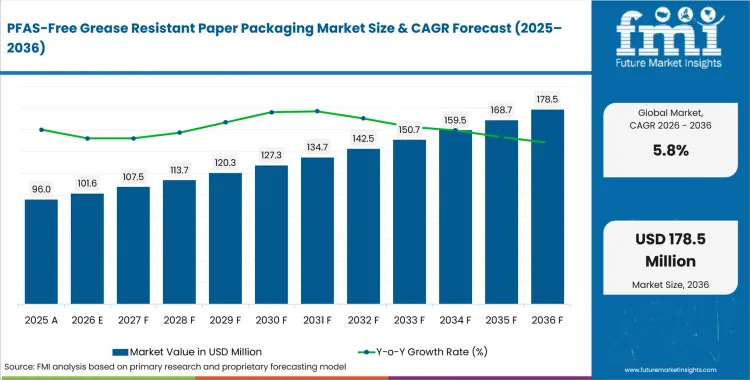
Key Takeaways of PFAS-Free Grease Resistant Paper Packaging Market
- Food packaging producers need dependable grease protection without intentionally added PFAS across established printing and sealing operations.
- Paper is expected to account for 51.0% of material demand in 2026, supported by compatibility with established printing and converting equipment.
- Pouches are projected to capture 23.0% in 2026, reflecting repeated use around snacks and prepared foods requiring dependable seals.
- Food is estimated to represent 68.0% in 2026, reinforced by recurring purchases across retail and foodservice packaging programs.
- Grease resistant packaging is projected to hold 10.0% of the barrier or feature segment in 2026, with qualification costs and unfavorable recyclability classifications capable of delaying conversion across multi-site food packaging programs and national recovery systems.
- Ahlstrom and UPM Specialty Materials offer PFAS-free barrier papers across several food formats and established converting routes. Solenis and Michelman add coating chemistry; Pixelle Specialty Solutions and Twin Rivers Paper provide North American production and development capacity. Stora Enso and Smurfit Westrock extend competition into formed food packaging through integrated material and package systems.
Analyst Perspective
“PFAS-free grease barriers perform reliably if paper grade and coating weight match the food’s oil profile under actual packing conditions. A material can pass a laboratory kit test yet fail on hot fillings or folded edges during high-speed sealing. Strong qualification programs test the intended food on commercial equipment and prepare composition records for every selling market. Documented application evidence reduces repeat trials and protects launch schedules across multi-site food packaging portfolios.”
- Nandini Roy Choudhury, Principal Analyst, Future Market Insights
How is the PFAS-Free Grease Resistant Paper Packaging Market segmented?
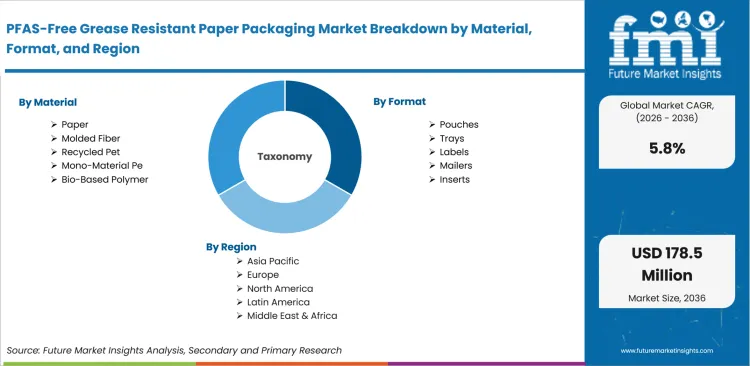
The PFAS-free grease resistant paper packaging industry is segmented by material, format, barrier or feature, end use, and region.
The market is segmented by material, format, barrier or feature, end use, and region to reflect each commercial decision point. Material analysis covers paper, molded fiber, recycled PET, mono-material PE, and bio-based polymer across alternative substrate routes. Format analysis includes pouches, trays, labels, mailers, and inserts with distinct forming or sealing requirements. Barrier or feature analysis compares grease resistance, high barrier protection, tamper evidence, traceability, and freshness indication across specific package functions. End-use analysis covers food, pharmaceutical, e-commerce, personal care, and cold chain applications with different contact or handling requirements. Regional analysis compares food-contact rules, converting capacity, material availability, and recovery systems that shape acceptance for PFAS-free paper packaging structures across formats.
Why does paper account for the largest material share in the PFAS-free grease resistant paper packaging market?
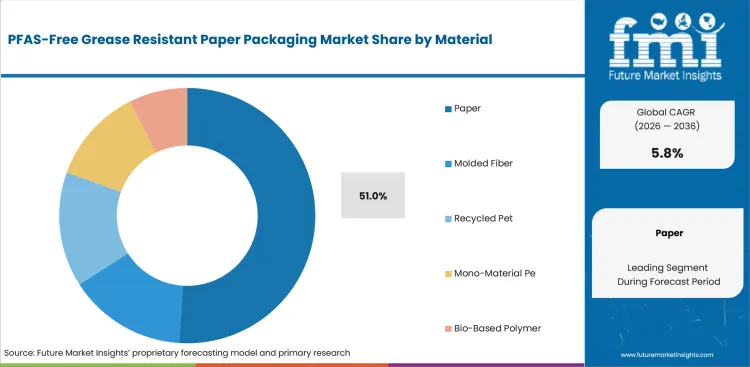
Paper supports grease resistance through refined fiber structures or applied barrier chemistry across familiar converting systems. Metsä Tissue reported in January 2025 that its greaseproof papers achieve grease protection through mechanical fiber refining without PFAS additives. The route reduces dependence on a separate fluorochemical layer and preserves a paper-based structure for direct food contact. Packaging producers can qualify these paper packaging formats on established printing and folding equipment and control oil holdout through grade selection and application testing.
- The material category is forecast to be led by paper at 51.0% share in 2026 due to its fit with established printing and folding equipment. Existing paper-processing equipment reduces conversion changes during qualification across familiar package formats and commercial production lines. Multiple basis weights and surface finishes let packaging producers match barrier strength with food oils without replacing the complete converting route.
- Wrap and liner producers adopt paper first for applications requiring moderate barrier performance and predictable folding behavior. Development teams can increase grease resistance through refining or coatings across the same substrate family. Adoption slows if higher barrier treatments reduce repulpability or create sealing behavior that differs from existing customer equipment.
What supports pouches within the format category?
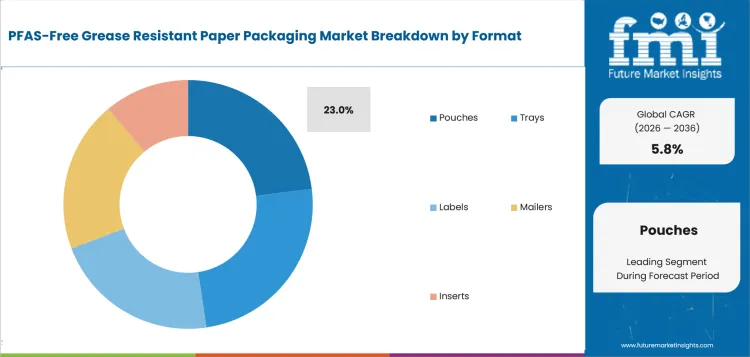
Pouches combine broad printable surfaces with seals that protect snacks and prepared foods during retail distribution. Flexible structures must balance grease coverage with closure strength across repeated filling and transport cycles. Ahlstrom expanded its LamiBak portfolio in March 2025 with a PFAS-free base paper that provides a natural grease barrier for flexible food packaging. The grade supports coating and metallization routes for sachets and flow packs or flexible pouch structures.
- Pouches are set to lead the format category with 23.0% share in 2026 due to repeated use for snacks and prepared foods requiring dependable seals. Pouch seal design determines whether grease weakens closure strength during storage or transport across retail distribution networks. Lightweight pouch structures also reduce material use across single-serve portions and compact retail food packs.
- Snack and bakery producers favor pouches that protect oily products without adding rigid packaging weight throughout distribution. Small coating defects can create visible staining across folds and seal regions; adoption therefore requires uniform coverage across the complete pouch structure. Plants also need reliable opening behavior and print quality that remains consistent across repeated production campaigns and customer artwork changes.
How does grease resistant shape the barrier or feature category?
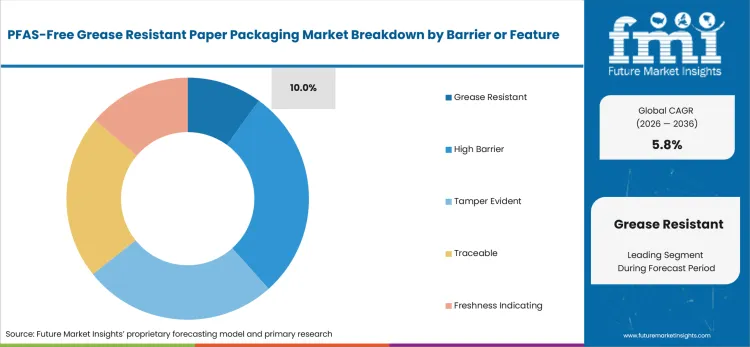
Grease resistance controls visible staining and oil migration across paper packages exposed to fatty foods during holding and transport. Standard kit tests provide an initial comparison but cannot reproduce every temperature or contact period. Commercial evaluation therefore uses the intended food and package geometry across printing or forming conditions. The feature creates value by protecting product appearance and pack integrity without requiring heavier plastic structures across selected food packaging applications.
- Grease resistant is projected to hold 10.0% share in 2026 owing to oil-migration control across food-contact packs. The feature protects wraps and liners or trays against oil penetration during the intended holding period. Use across several food formats supports the segment position without dependence on one package type. Material developers must define temperature and contact-time limits for every recommended barrier level used commercially.
- Paper producers adopt grease-resistant structures that run through familiar coating and printing equipment without separate offline processing. Solenis documented a commercial PFAS replacement at Reynolds Consumer Products’ Red Bluff paper-plate facility in April 2025. The barrier additive maintained oil and grease resistance across production; process changes improved operating efficiency at the facility. The result shows that barrier coating systems require equipment and substrate validation rather than a direct chemical substitution.
Why does food represent the central end use category?
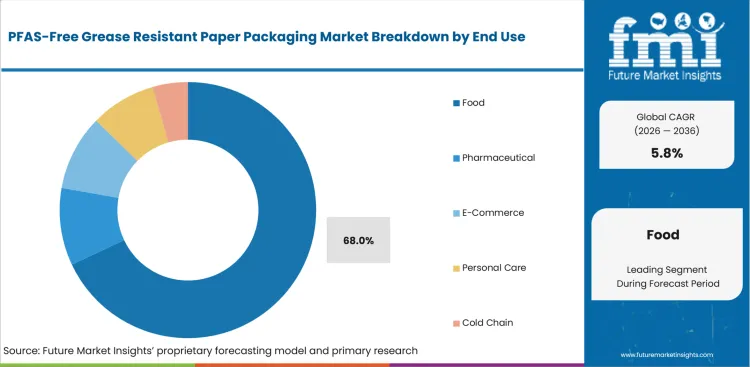
Food packaging exposes grease barriers to oils and fats during filling and storage across distribution routes. Stora Enso reported in June 2026 that Mouty commercialized a paperboard cup for chilled rillettes following two years of development. The package resisted grease migration and condensation during industrial filling across a commercial chilled-food production line. The commercial result also shows why food packaging applications need product-specific trials; generic paper tests cannot reproduce every temperature and fat profile.
- Food is likely to capture 68.0% share in 2026 attributable to recurring packaging purchases across retail and foodservice programs. Bakery and prepared-food programs create repeat demand across wraps or pouches and grease-resistant foodservice trays. Food contact raises the cost of barrier failure; visible staining can damage package integrity and product presentation across retail channels. Repeated purchases and broad regulatory exposure preserve the segment position across composition and migration requirements.
- Food processors adopt PFAS-free paper structures through product-specific trials that test oil contact and package handling across actual production conditions. Technical teams compare barrier performance with printing and sealing output prior to expanding a grade across multiple products. Adoption can slow if one formulation performs well for dry bakery items but fails with hot or chilled fatty foods.
What are the drivers, restraints, and opportunities in the PFAS-Free Grease Resistant Paper Packaging Market?
Food-contact restrictions support material replacement; recyclability classifications can delay coated-paper approval. Material developers can expand adoption through grease barriers that also fit practical fiber recovery routes.
- Driver: Direct restrictions on intentionally added PFAS require food packaging producers to qualify replacement grease barriers across recurring paper package programs.
- Restraint: Greaseproof coatings can receive unfavorable recyclability classifications if sorting or repulping systems cannot recover the paper fibers effectively.
- Opportunity: Barrier developers can reduce conversion risk through formulations that combine product-specific grease protection with documented recovery performance across national systems.
Direct food-contact restrictions create a measurable replacement requirement for paper packages that previously relied on fluorochemical grease barriers. Maine’s environment department confirmed that its prohibition covers specified paper or plant-fiber food packaging from May 2026. The rule directly affects bags and sleeves or wraps and liners used for freshly prepared food. Material producers gain commercial access through verified PFAS-free composition and application testing rather than broad environmental claims.
Recyclability requirements can slow adoption even if a coating provides dependable grease resistance during food use. A coated paper structure can lose commercial acceptance if fibers cannot enter established recovery routes. Germany’s Central Agency Packaging Register published its 2025 minimum standard in August and retained practical sorting or recovery as the basis for recyclability. Development programs must test repulping behavior alongside grease holdout and converting performance under representative commercial conditions.
Producer-fee systems create an opening for barrier papers that achieve favorable recyclability classifications without sacrificing food protection. Developers of barrier packaging materials can improve commercial value through documented recovery performance across national assessment systems. Successful adoption requires evidence that each package protects the intended food within the applicable recovery route. PackUK updated its modulation statement in February 2026 and confirmed higher disposal fees for red-rated packaging from the 2026 to 2027 cycle. The fee structure rewards documented recyclability but leaves performance qualification as a separate commercial requirement.
Which country CAGRs are profiled in the PFAS-Free Grease Resistant Paper Packaging Market?
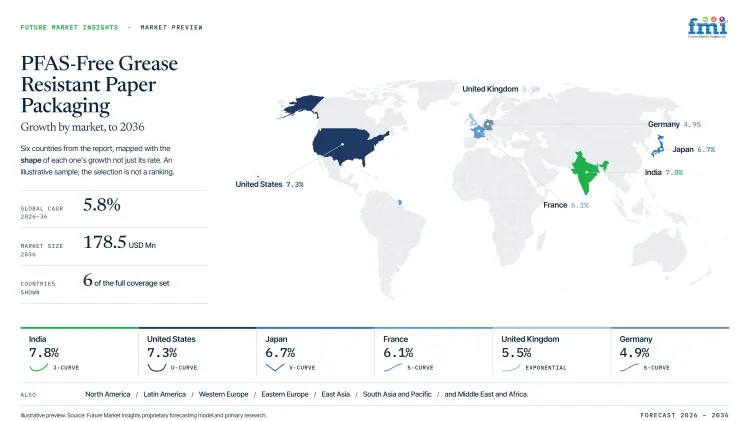
| Country | CAGR |
|---|---|
| India | 7.8% |
| United States | 7.3% |
| Japan | 6.7% |
| France | 6.1% |
| United Kingdom | 5.5% |
| Germany | 4.9% |
How do country-level CAGRs compare in the PFAS-Free Grease Resistant Paper Packaging Market?
The country comparison spans 2.9 percentage points between India and Germany across the approved forecasts. India and the United States form a close upper pair separated by 0.5 percentage points. Japan and France create a middle range with a 0.6-point difference between their rates. The United Kingdom and Germany form another 0.6-point pair at the lower end of the displayed range. Local rule timing and converting capacity explain more commercial variation than the modest numerical gaps alone. Entry strategies must also account for recyclability assessments and technical support routes in each country.
- India’s 0.5-point gap above the United States reflects earlier-stage conversion potential under active food-contact rulemaking. Domestic paper and packaging capacity can support controlled local trials as final technical requirements become clearer for commercial programs.
- The United States combines federal authorization changes with separate state purchasing rules and material restrictions for food-contact packaging. Regional production capacity supports trials but compliance files may require adjustment across customer selling territories.
- Japan remains 0.6 percentage points above France within the middle group of approved country forecasts. Its positive-list system places greater weight on composition records and formal information transfer across manufacturing relationships.
- France combines professional packaging responsibility with established food-processing activity across several major domestic production regions. Commercial programs need material records that support producer obligations across packages used outside household consumption routes.
- The United Kingdom remains 0.6 percentage points above Germany within the final pair of approved forecasts. Recyclability ratings and fee modulation create a direct commercial test for greaseproof paper structures across national selling programs.
- Germany combines formal food-contact guidance with mature sorting and recovery standards across its paper value chain. Alternative barriers must satisfy grease performance and practical recycling expectations to achieve broad commercial use.
- The full report provides country-level CAGR analysis across North America and Latin America; Europe and East Asia; South Asia and Oceania; and the Middle East and Africa.
Country-wise Analysis
- India’s food-contact packaging rules remain under active review through the national safety authority and its formal draft-notification process. India’s PFAS-free grease resistant paper packaging market outlook is anticipated to advance at 7.8% CAGR over the assessment period, supported by active PFAS rulemaking and domestic paper converting capacity. The Food Safety and Standards Authority of India published a draft packaging amendment in October 2025 covering PFAS and BPA in food-contact materials. The proposal gives paper mills and packaging producers a direct reason to review coating composition ahead of final requirements. Domestic paper production and regional converting clusters support application trials across foodservice and retail formats. Unsettled testing or declaration details remain a material friction and can delay broad investment until the final compliance route becomes clear.
- Food packaging in the United States operates under federal food-contact oversight and a widening set of state material or purchasing rules. Domestic mills and foodservice packaging operations support multi-site trials across printing and forming equipment on commercial production lines. PFAS-free grease resistant paper packaging demand in the United States is forecast to rise at 7.3% CAGR over the forecast period, aided by domestic mills and established foodservice converting capacity. CalRecycle completed its first reevaluation of approved state foodservice packaging in October 2025 and identified unavailable items for removal. The state program gives public facilities a practical purchasing filter for foodservice packages across approved product lists. State variation remains a material friction; one compliance file may not satisfy every customer location or public purchasing program.
- Japan’s food-contact packaging system applies a positive list to synthetic resin components under national food sanitation controls. The positive-list framework requires defined composition records and formal information transfer across each manufacturing relationship. Domestic food packaging producers can run controlled trials for prepared-food and bakery applications on tightly managed production lines. Japan’s PFAS-free grease resistant paper packaging sector is projected to record 6.7% CAGR during the assessment period, reinforced by precise material records and controlled manufacturing systems. The Consumer Affairs Agency completed the transition in June 2025 and published duties covering manufacturing management and information transfer. Imported grades face language and documentation friction that can extend approval schedules across several customer production systems.
- France combines established food-processing networks with producer-responsibility rules for professional packaging placed on the domestic market. PFAS-free grease resistant paper packaging sales in France are forecast to expand at 6.1% CAGR by 2036, underpinned by food converting experience and professional packaging rules. France issued Decree 2025-1081 in November 2025 and established a producer-responsibility route for packaging used by professionals. The framework gives commercial packaging users a defined reporting structure for materials placed into circulation. Paper and board processors near major food regions support trials for bakery and chilled-food formats. Detailed reporting duties remain a friction for smaller brands that need composition records from several material producers.
- Food packaging purchases in the United Kingdom increasingly reflect producer fees and formal recyclability assessments across paper or fiber-based structures. Domestic paper converters can support short-run printing and barrier trials for foodservice or retail programs. Adoption of PFAS-free grease resistant paper packaging in the United Kingdom is estimated to expand at 5.5% CAGR through 2036, influenced by recyclability classification and producer-fee planning. The environment department updated its recyclability methodology in September 2025 and classified greaseproof or parchment papers as red without qualifying take-back routes. The rule creates a direct friction for coated paper structures that perform well during food use but lack accepted collection. Local coating and converting support remains an enabler for reformulation and package testing across commercial food formats.
- German food-contact paper programs follow BfR recommendations and detailed recovery requirements across mature paper networks. Local mills and laboratories support coating qualification across several food formats and commercial converting lines. The German Environment Agency reported in February 2025 that PFAS remain in selected specialty papers used for hot or fatty food contact. PFAS-free grease resistant paper packaging demand across Germany is predicted to advance at 4.9% CAGR through 2036, sustained by experienced paper processors and formal recovery standards. The official review gives material developers a clear replacement target for hamburger wraps and other grease-exposed papers. Germany’s paper-processing base supports local qualification through familiar food packaging routes and established technical service networks. Alternative barriers must meet grease and food-contact requirements without disrupting domestic recycling streams or commercial converting performance.
Who are the notable companies in the PFAS-Free Grease Resistant Paper Packaging Market?
Ahlstrom, Pixelle Specialty Solutions, Twin Rivers Paper, Stora Enso, UPM Specialty Materials, Solenis, Michelman, and Smurfit Westrock are the notable companies shaping this market.
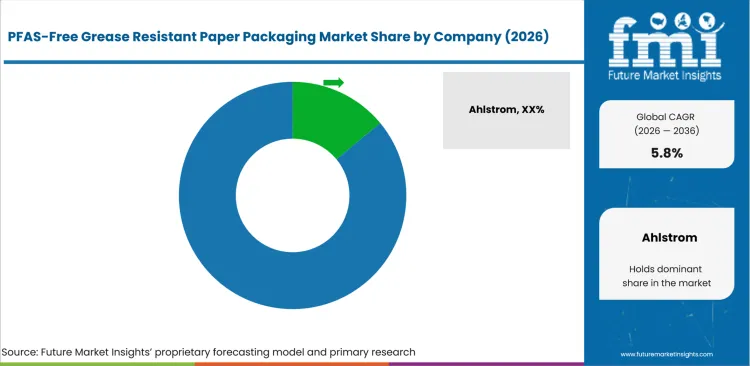
Specialty paper mills compete with coating developers and integrated packaging groups through qualification routes across food-contact applications. Ahlstrom and UPM Specialty Materials offer PFAS-free barrier papers across food formats and established converting systems. Pixelle Specialty Solutions and Twin Rivers Paper provide North American food-paper capacity and technical support for commercial trials. Solenis and Michelman supply barrier chemistry for reformulation projects across paper substrates and commercial coating lines. Stora Enso and Smurfit Westrock connect paperboard materials with formed food packaging through established channels. Material selection depends on verified PFAS-free evidence across parchment paper or other grease-exposed commercial structures. Application support and converting compatibility remain decisive during commercial qualification across multiple customer production systems.
- Ahlstrom and UPM Specialty Materials provide PFAS-free barrier papers across wraps and pouches or food-to-go formats. Pixelle Specialty Solutions adds integrated paper development and pilot coating resources within the United States. Twin Rivers Paper offers separate grades for light and heavy grease exposure across common foodservice applications.
- Solenis and Michelman compete through water-based or bio-based coatings that add oil and grease resistance to paper structures. Coating developers become more valuable during reformulation projects that retain an existing paper substrate and converting route. Application testing and equipment compatibility determine whether formulations progress from controlled trials into repeat commercial production.
- Stora Enso and Smurfit Westrock connect barrier paperboard production with foodservice and retail packaging formats across established channels. Integrated format experience supports trials across folded cartons or takeout packages and bakery applications on commercial equipment. Material and package knowledge can reduce design coordination; local certification requirements continue to shape final selection across each selling market.
Competitive Benchmarking: PFAS-Free Grease Resistant Paper Packaging Market
| Company | PFAS-Free Barrier Portfolio | Paper and Coating Integration | Food Packaging Commercial Reach | Geographic Reach |
|---|---|---|---|---|
| Ahlstrom | High | High | High | Global |
| Pixelle Specialty Solutions | Medium | High | Medium | North America |
| Twin Rivers Paper | High | High | High | North America |
| Stora Enso | High | High | High | Global |
| UPM Specialty Materials | High | High | High | Global |
| Solenis | High | High | Medium | Global |
| Michelman | High | High | Medium | Global |
| Smurfit Westrock | Medium | Medium | High | Global |
Key Developments in the PFAS-Free Grease Resistant Paper Packaging Market
- In April 2025, Ahlstrom received home compostability certification from the Australasian Bioplastics Association (ABA) for its Sulpack flexible packaging range. The PFAS-free parchment serves fresh and greasy applications such as butter wraps and cheese interlayers. The certification expands a verified disposal route for regional packaging programs and preserves natural grease resistance with food-contact performance. Commercial use requires product-specific trials that confirm folding and sealing behavior under planned temperatures and contact periods.
- In March 2026, UPM Specialty Materials and Paramelt introduced a bio-based paper food-packaging concept pairing UPM barrier base papers with Paramelt's water-based coating Aquavate Bio SB 2383. The combination provides grease protection and heat-seal performance for bakery and convenience applications on existing vertical form-fill-seal lines at low coating weights. The development gives flexible packaging producers a commercially relevant route for testing recyclable paper structures without rebuilding standard production equipment.
- In April 2026, Stora Enso launched Performa Natura Aqua as a dispersion-coated folding boxboard for foodservice and bakery packaging. The board combines a double pigment-coated top side with a dispersion barrier-coated reverse side that provides grease resistance, while the coated surface supports printing and converting across food packaging production lines. The product broadens board options for fast food and bakery formats using existing converting processes. Qualification must confirm forming behavior and package integrity across each food product and commercial production line.
- In late April 2026, Michelman introduced Nuvita Life 4002 and Nuvita Life 4605 as bio-based barrier coatings for paper packaging. Nuvita Life 4002 is a heat seal coating that provides oil and grease resistance along with a mineral oil barrier, while Nuvita Life 4605 is a topcoat that also carries oil and grease resistance and adds water resistance and moisture barrier performance for retail food packages. Target applications include pouches and sachets for dry foods, flow wraps for food bars, and tea envelopes. Adoption depends on coating weight and drying control that preserve barrier performance and production output across commercial lines.
Key Players in the PFAS-Free Grease Resistant Paper Packaging Market
Material and Paper Specialists
- Ahlstrom
- Pixelle Specialty Solutions
- Twin Rivers Paper
- Stora Enso
- UPM Specialty Materials
Barrier Chemistry Specialists
- Solenis
- Michelman
Integrated Packaging Producer
- Smurfit Westrock
PFAS-Free Grease Resistant Paper Packaging Market - Report Scope
| Coverage field | Report scope |
|---|---|
| Market breakdown | Material, format, barrier or feature, end use, and region. |
| Quantitative Units | Revenue in USD Million, CAGR in %. |
| Market Definition | Commercial demand for paper packaging that provides grease resistance without intentionally added PFAS across food and adjacent end-use applications. |
| Regions Covered | North America, Latin America, Western Europe, Eastern Europe, East Asia, South Asia and Pacific, and Middle East and Africa. |
| Countries Covered | India, United States, Japan, France, United Kingdom, Germany, and 30+ countries. |
| Key Companies Profiled | Ahlstrom, Pixelle Specialty Solutions, Twin Rivers Paper, Stora Enso, UPM Specialty Materials, Solenis, Michelman, and Smurfit Westrock. |
| Forecast Period | 2026 to 2036. |
| Approach | Hybrid bottom-up and top-down market sizing supported by primary interviews and official desk research. |
PFAS-Free Grease Resistant Paper Packaging Market - Research Methodology
| Method | Approach |
|---|---|
| Primary Research | FMI analysts gathered input from manufacturers, service providers, technology developers, distributors, end users, sourcing teams, and subject-matter experts. Interviews examined purchasing decisions, product or service evaluation, adoption barriers, approval requirements, pricing considerations, and expectations for technical or commercial support. Respondents were also asked what evidence is required before a trial, pilot, or initial order develops into regular purchasing. |
| Desk Research | Desk research covered government statistics, regulatory publications, trade data, industry associations, technical literature, standards, company filings, product information, and official corporate announcements. Sources were reviewed for relevance, publication date, geographic coverage, and consistency with the defined market scope. Claims relating to performance, applications, approvals, capacity, investment, and commercial activity were retained only when supported by credible public evidence. |
| Market Sizing and Forecasting | The market model combined the baseline value with historical performance, segment structure, pricing and volume indicators, adoption levels, company participation, and country-level demand conditions. Forecast assumptions considered economic activity, investment trends, regulatory developments, technology adoption, purchasing cycles, supply availability, and barriers to wider market use. Segment and regional estimates were reconciled before the final market total was calculated. |
| Data Validation | Estimates were checked against multiple independent indicators, including public data, company activity, trade patterns, industry developments, and findings from primary interviews. Validation also tested whether products, services, applications, and company revenues fell within the defined market boundaries. Adjacent categories, unsupported claims, overlapping revenues, and activities without direct market relevance were excluded to reduce double counting and maintain consistency across segments and countries. |
PFAS-Free Grease Resistant Paper Packaging Market by Segments
PFAS-Free Grease Resistant Paper Packaging Market segmented by Material:
- Paper
- Molded Fiber
- Recycled PET
- Mono-material PE
- Bio-based Polymer
PFAS-Free Grease Resistant Paper Packaging Market segmented by Format:
- Pouches
- Trays
- Labels
- Mailers
- Inserts
PFAS-Free Grease Resistant Paper Packaging Market segmented by Barrier or Feature:
- Grease Resistant
- High Barrier
- Tamper Evident
- Traceable
- Freshness Indicating
PFAS-Free Grease Resistant Paper Packaging Market segmented by End Use:
- Food
- Pharmaceutical
- E-commerce
- Personal Care
- Cold Chain
PFAS-Free Grease Resistant Paper Packaging Market by Region:
- North America
- United States
- Canada
- Mexico
- Latin America
- Brazil
- Chile
- Rest of Latin America
- Western Europe
- Germany
- UK
- Italy
- Spain
- France
- Nordic
- BENELUX
- Rest of Western Europe
- Eastern Europe
- Russia
- Poland
- Hungary
- Balkan and Baltic
- Rest of Eastern Europe
- East Asia
- China
- Japan
- South Korea
- South Asia and Pacific
- India
- ASEAN
- Australia and New Zealand
- Rest of South Asia and Pacific
- Middle East and Africa
- Kingdom of Saudi Arabia
- Other GCC Countries
- Turkiye
- South Africa
- Other African Union
- Rest of Middle East and Africa
Research Sources and Bibliography
- USA Food and Drug Administration. (2025, January 3). FDA Determines Authorization for 35 Food Contact Notifications Related to PFAS Are No Longer Effective.
- European Parliament and Council of the European Union. (2025, January 22). Regulation (EU) 2025/40 of the European Parliament and of the Council of 19 December 2024 on packaging and packaging waste, amending Regulation (EU) 2019/1020 and Directive (EU) 2019/904, and repealing Directive 94/62/EC.
- Food Safety and Standards Authority of India. (2025, October 13). Draft Food Safety and Standards (Packaging) Amendment Regulations, 2025 regarding provisions related to Poly- and perfluoroalkyl substances (PFAs) and Bisphenol A (BPA) for food contact materials.
- Consumer Affairs Agency. (2025, June 1).
- Metsä Tissue. (2025, January 22). Product Safety is in the core of our value proposition.
- Ahlstrom. (2025, March 17). Ahlstrom expands LamiBak™ portfolio with a new base paper for flexible food packaging.
- Solenis. (n.d.). Barrier Coatings.
- Stora Enso. (2026, June 18). Paperboard cup packaging for rillettes: how Mouty applied Cupforma Natura by Stora Enso to a new chilled food application.
- Solenis. (2025, April 3). Reynolds Consumer Products Recognized with 2024 Solenis Sustainability Award for PFAS Elimination and Process Optimization.
- Maine Department of Environmental Protection. (2026, May 25). Maine Toxics in Food Packaging Program.
- Zentrale Stelle Verpackungsregister. (2025, August 28). Minimum standard for determining the recyclability of packaging.
- PackUK. (2026, February 17). PackUK extended producer responsibility (EPR) for packaging: producer disposal fees modulation statement.
- California Department of Resources Recycling and Recovery. (2025, October). Sustainable Packaging for the State of California Act of 2018 (SB 1335).
- French Republic. (2025, November 17). Décret n° 2025-1081 du 17 novembre 2025 relatif aux emballages ainsi qu’aux déchets d’emballages et instituant la filière de responsabilité élargie des producteurs d’emballages consommés ou utilisés par les professionnels.
- Department for Environment, Food & Rural Affairs. (2025, September 4). Recyclability assessment methodology: assessing materials.
- German Environment Agency. (2025, February 18). Einsatz von PFAS in der Papierindustrie.
- Vermont General Assembly. (2026, January 1). 9 V.S.A. § 2494x. Food packaging.
- Ahlstrom. (2025, April 7). Ahlstrom receives home compostable certification in Australia and New Zealand for Sulpack® Flexible packaging.
- Stora Enso. (2026, April 30). Stora Enso launches Performa Natura Aqua, a dispersion-coated board for foodservice and bakery packaging.
- Michelman. (2026, April 30). Michelman Introduces Nuvita® Life 4002 & Nuvita® Life 4605: Bio-Based Barrier Coatings for Paper Packaging Applications.
- Ahlstrom. (2025, September 2). Driving innovation in sustainable food packaging: an interview with Rafael Yamamoto, R&D global manager at Ahlstrom.
- Twin Rivers Paper Company. (n.d.). EcoBarrier® Choice Food Packaging Paper.
- Twin Rivers Paper Company. (n.d.). EcoBarrier® Plus Food Packaging Paper.
- Stora Enso. (2026, March 25). Engineering grease resistance for foodservice packaging: Aristo’s success with CKB Nude Aqua.
- Stora Enso. (n.d.). Product and service stewardship.
- UPM Specialty Materials. (2026, March 24). UPM and Paramelt introduce bio-based food packaging concept.
- UPM Specialty Materials. (2026, April 21). UPM and Royal Vaassen bring recyclable paper innovation to pet treat packaging.
- Smurfit Westrock. (n.d.). EnShield® Paperboard | Grease Resistant Food Packaging.
This bibliography is provided for reader reference and is not exhaustive. The full report contains the complete reference list and detailed citations
This Report Answers
- How large is the PFAS-free grease resistant paper packaging market in 2026 and 2036?
- Which regulatory changes support demand for PFAS-free grease resistant paper packaging?
- Why does paper account for the largest material share during 2026?
- How do pouches and grease resistance shape format and barrier demand?
- Why does food represent the central end-use category within this market?
- How do country growth rates differ across India, the United States, Japan, France, the United Kingdom, and Germany?
- Which companies provide PFAS-free papers, coating chemistries, or integrated food packaging formats?
- What recyclability and qualification issues can delay commercial conversion programs?
- How should food packaging operations evaluate grease resistance across actual filling and distribution conditions?
Frequently Asked Questions
How big is the PFAS-Free Grease Resistant Paper Packaging Market in 2026?
The PFAS-free grease resistant paper packaging market is valued at USD 101.6 million in 2026 and is forecast to reach USD 178.5 million by 2036.
What is the CAGR of the PFAS-Free Grease Resistant Paper Packaging Market from 2026 to 2036?
The PFAS-free grease resistant paper packaging market is projected to grow at a CAGR of 5.8% between 2026 and 2036, supported by direct restrictions on intentionally added PFAS requiring food packaging producers to qualify replacement grease barriers across recurring paper package programs.
Which end use leads the PFAS-Free Grease Resistant Paper Packaging Market?
Food accounts for 68.0% of the PFAS-free grease resistant paper packaging market by end use in 2026, driven by recurring packaging purchases across retail and foodservice programs where barrier failure creates visible staining that damages product presentation and pack integrity.
Which country is growing fastest in the PFAS-Free Grease Resistant Paper Packaging Market?
India is the fastest-growing country in the PFAS-free grease resistant paper packaging market, expanding at a 7.8% CAGR through 2036, ahead of the market average of 5.8%, supported by active PFAS rulemaking and domestic paper converting capacity across foodservice and retail packaging programs.
Who are the leading companies in the PFAS-Free Grease Resistant Paper Packaging Market?
Leading companies in the PFAS-free grease resistant paper packaging market include Ahlstrom, Pixelle Specialty Solutions, Twin Rivers Paper, Stora Enso, UPM Specialty Materials, Solenis, Michelman, and Smurfit Westrock, competing across material and paper specialization, barrier chemistry development, and integrated food packaging production.
Preview the report firsthand - request a free sample
Get SampleGet the brochure for pricing and purchase details.
Get PDFTable of Content
- Key Takeaways
- Market Size and CAGR
- Top Growth Driver
- Fastest Growing Segment
- Leading Region
- Key Companies
- Emerging Opportunities
- Executive Summary
- Global Market Outlook
- Demand-side Trends
- Supply-side Trends
- Technology Roadmap Analysis
- Analysis and Recommendations
- Analyst Perspective (What is happening? Why now? What should investors know?)
- Key Questions Answered
- How large is the market?
- What is the CAGR?
- What are key trends?
- Which region dominates?
- Who are the leaders?
- Market Overview
- Market Coverage / Taxonomy
- Market Definition / Scope / Limitations
- Research Methodology
- Chapter Orientation
- Analytical Lens and Working Hypotheses
- Market Structure, Signals, and Trend Drivers
- Benchmarking and Cross-market Comparability
- Market Sizing, Forecasting, and Opportunity Mapping
- Research Design and Evidence Framework
- Desk Research Programme (Secondary Evidence)
- Expert Input and Fieldwork (Primary Evidence)
- Tooling, Models, and Reference Databases
- Data Engineering and Model Build
- Quality Assurance and Audit Trail
- Market Background
- Market Dynamics (Drivers, Restraints, Opportunity, Trends)
- Scenario Forecast (Optimistic, Likely, Conservative)
- Impact Analysis
- AI Impact
- Sustainability Impact
- Regulatory Impact
- Technology Impact
- Consumer / Buyer Analysis
- Purchase Drivers
- Adoption Barriers
- Buyer Journey
- Opportunity Map Analysis
- Product Life Cycle Analysis
- Supply Chain Analysis
- Investment Feasibility Matrix
- Value Chain Analysis
- PESTLE and Porter's Analysis
- Regulatory Landscape
- Regional Parent Market Outlook
- Production and Consumption Statistics
- Import and Export Statistics
- Global Market Analysis and Forecast, 2021 to 2036
- Historical Market Size Value (USD Million) Analysis, 2021 to 2025
- Current and Future Market Size Value (USD Million) Projections, 2026 to 2036
- Y-o-Y Growth Trend Analysis
- Absolute $ Opportunity Analysis
- Global Market Pricing Analysis, 2021 to 2036
- Global Market Analysis and Forecast, By Material, 2021 to 2036
- Introduction / Key Findings
- Historical Market Size Value (USD Million) Analysis By Material, 2021 to 2025
- Current and Future Market Size Value (USD Million) Analysis and Forecast By Material, 2026 to 2036
- Paper
- Molded Fiber
- Recycled Pet
- Mono-Material Pe
- Bio-Based Polymer
- Paper
- Y-o-Y Growth Trend Analysis By Material, 2021 to 2025
- Absolute $ Opportunity Analysis By Material, 2026 to 2036
- Global Market Analysis and Forecast, By Format, 2021 to 2036
- Introduction / Key Findings
- Historical Market Size Value (USD Million) Analysis By Format, 2021 to 2025
- Current and Future Market Size Value (USD Million) Analysis and Forecast By Format, 2026 to 2036
- Pouches
- Trays
- Labels
- Mailers
- Inserts
- Pouches
- Y-o-Y Growth Trend Analysis By Format, 2021 to 2025
- Absolute $ Opportunity Analysis By Format, 2026 to 2036
- Global Market Analysis and Forecast, By Barrier or Feature, 2021 to 2036
- Introduction / Key Findings
- Historical Market Size Value (USD Million) Analysis By Barrier or Feature, 2021 to 2025
- Current and Future Market Size Value (USD Million) Analysis and Forecast By Barrier or Feature, 2026 to 2036
- Grease Resistant
- High Barrier
- Tamper Evident
- Traceable
- Freshness Indicating
- Grease Resistant
- Y-o-Y Growth Trend Analysis By Barrier or Feature, 2021 to 2025
- Absolute $ Opportunity Analysis By Barrier or Feature, 2026 to 2036
- Global Market Analysis and Forecast, By End Use, 2021 to 2036
- Introduction / Key Findings
- Historical Market Size Value (USD Million) Analysis By End Use, 2021 to 2025
- Current and Future Market Size Value (USD Million) Analysis and Forecast By End Use, 2026 to 2036
- Food
- Pharmaceutical
- E-Commerce
- Personal Care
- Cold Chain
- Food
- Y-o-Y Growth Trend Analysis By End Use, 2021 to 2025
- Absolute $ Opportunity Analysis By End Use, 2026 to 2036
- Global Market Analysis and Forecast, By Region, 2021 to 2036
- Introduction
- Historical Market Size Value (USD Million) Analysis By Region, 2021 to 2025
- Current Market Size Value (USD Million) Analysis and Forecast By Region, 2026 to 2036
- North America
- Latin America
- Western Europe
- Eastern Europe
- East Asia
- South Asia and Pacific
- Middle East & Africa
- Market Attractiveness Analysis By Region
- North America Market Analysis and Forecast, By Country, 2021 to 2036
- Historical Market Size Value (USD Million) Trend Analysis By Market Taxonomy, 2021 to 2025
- Market Size Value (USD Million) Forecast By Market Taxonomy, 2026 to 2036
- By Country
- USA
- Canada
- By Material
- By Format
- By Barrier or Feature
- By End Use
- By Country
- Market Attractiveness Analysis
- By Country
- By Material
- By Format
- By Barrier or Feature
- By End Use
- Key Takeaways
- Latin America Market Analysis and Forecast, By Country
- Historical Market Size Value (USD Million) Trend Analysis By Market Taxonomy, 2021 to 2025
- Market Size Value (USD Million) Forecast By Market Taxonomy, 2026 to 2036
- By Country
- Brazil
- Mexico
- Chile
- Rest of Latin America
- By Material
- By Format
- By Barrier or Feature
- By End Use
- By Country
- Market Attractiveness Analysis
- By Country
- By Material
- By Format
- By Barrier or Feature
- By End Use
- Key Takeaways
- Western Europe Market Analysis and Forecast, By Country
- Historical Market Size Value (USD Million) Trend Analysis By Market Taxonomy, 2021 to 2025
- Market Size Value (USD Million) Forecast By Market Taxonomy, 2026 to 2036
- By Country
- Germany
- UK
- Italy
- Spain
- France
- Nordic
- BENELUX
- Rest of Western Europe
- By Material
- By Format
- By Barrier or Feature
- By End Use
- By Country
- Market Attractiveness Analysis
- By Country
- By Material
- By Format
- By Barrier or Feature
- By End Use
- Key Takeaways
- Eastern Europe Market Analysis and Forecast, By Country
- Historical Market Size Value (USD Million) Trend Analysis By Market Taxonomy, 2021 to 2025
- Market Size Value (USD Million) Forecast By Market Taxonomy, 2026 to 2036
- By Country
- Russia
- Poland
- Hungary
- Balkan & Baltic
- Rest of Eastern Europe
- By Material
- By Format
- By Barrier or Feature
- By End Use
- By Country
- Market Attractiveness Analysis
- By Country
- By Material
- By Format
- By Barrier or Feature
- By End Use
- Key Takeaways
- East Asia Market Analysis and Forecast, By Country
- Historical Market Size Value (USD Million) Trend Analysis By Market Taxonomy, 2021 to 2025
- Market Size Value (USD Million) Forecast By Market Taxonomy, 2026 to 2036
- By Country
- China
- Japan
- South Korea
- By Material
- By Format
- By Barrier or Feature
- By End Use
- By Country
- Market Attractiveness Analysis
- By Country
- By Material
- By Format
- By Barrier or Feature
- By End Use
- Key Takeaways
- South Asia and Pacific Market Analysis and Forecast, By Country
- Historical Market Size Value (USD Million) Trend Analysis By Market Taxonomy, 2021 to 2025
- Market Size Value (USD Million) Forecast By Market Taxonomy, 2026 to 2036
- By Country
- India
- ASEAN
- Australia & New Zealand
- Rest of South Asia and Pacific
- By Material
- By Format
- By Barrier or Feature
- By End Use
- By Country
- Market Attractiveness Analysis
- By Country
- By Material
- By Format
- By Barrier or Feature
- By End Use
- Key Takeaways
- Middle East & Africa Market Analysis and Forecast, By Country
- Historical Market Size Value (USD Million) Trend Analysis By Market Taxonomy, 2021 to 2025
- Market Size Value (USD Million) Forecast By Market Taxonomy, 2026 to 2036
- By Country
- Kingdom of Saudi Arabia
- Other GCC Countries
- Türkiye
- South Africa
- Other African Union
- Rest of Middle East & Africa
- By Material
- By Format
- By Barrier or Feature
- By End Use
- By Country
- Market Attractiveness Analysis
- By Country
- By Material
- By Format
- By Barrier or Feature
- By End Use
- Key Takeaways
- Key Countries Market Analysis
- USA
- Pricing Analysis
- Market Share Analysis, 2025
- By Material
- By Format
- By Barrier or Feature
- By End Use
- Canada
- Pricing Analysis
- Market Share Analysis, 2025
- By Material
- By Format
- By Barrier or Feature
- By End Use
- Mexico
- Pricing Analysis
- Market Share Analysis, 2025
- By Material
- By Format
- By Barrier or Feature
- By End Use
- Brazil
- Pricing Analysis
- Market Share Analysis, 2025
- By Material
- By Format
- By Barrier or Feature
- By End Use
- Chile
- Pricing Analysis
- Market Share Analysis, 2025
- By Material
- By Format
- By Barrier or Feature
- By End Use
- Germany
- Pricing Analysis
- Market Share Analysis, 2025
- By Material
- By Format
- By Barrier or Feature
- By End Use
- UK
- Pricing Analysis
- Market Share Analysis, 2025
- By Material
- By Format
- By Barrier or Feature
- By End Use
- Italy
- Pricing Analysis
- Market Share Analysis, 2025
- By Material
- By Format
- By Barrier or Feature
- By End Use
- Spain
- Pricing Analysis
- Market Share Analysis, 2025
- By Material
- By Format
- By Barrier or Feature
- By End Use
- France
- Pricing Analysis
- Market Share Analysis, 2025
- By Material
- By Format
- By Barrier or Feature
- By End Use
- India
- Pricing Analysis
- Market Share Analysis, 2025
- By Material
- By Format
- By Barrier or Feature
- By End Use
- ASEAN
- Pricing Analysis
- Market Share Analysis, 2025
- By Material
- By Format
- By Barrier or Feature
- By End Use
- Australia & New Zealand
- Pricing Analysis
- Market Share Analysis, 2025
- By Material
- By Format
- By Barrier or Feature
- By End Use
- China
- Pricing Analysis
- Market Share Analysis, 2025
- By Material
- By Format
- By Barrier or Feature
- By End Use
- Japan
- Pricing Analysis
- Market Share Analysis, 2025
- By Material
- By Format
- By Barrier or Feature
- By End Use
- South Korea
- Pricing Analysis
- Market Share Analysis, 2025
- By Material
- By Format
- By Barrier or Feature
- By End Use
- Russia
- Pricing Analysis
- Market Share Analysis, 2025
- By Material
- By Format
- By Barrier or Feature
- By End Use
- Poland
- Pricing Analysis
- Market Share Analysis, 2025
- By Material
- By Format
- By Barrier or Feature
- By End Use
- Hungary
- Pricing Analysis
- Market Share Analysis, 2025
- By Material
- By Format
- By Barrier or Feature
- By End Use
- Kingdom of Saudi Arabia
- Pricing Analysis
- Market Share Analysis, 2025
- By Material
- By Format
- By Barrier or Feature
- By End Use
- Türkiye
- Pricing Analysis
- Market Share Analysis, 2025
- By Material
- By Format
- By Barrier or Feature
- By End Use
- South Africa
- Pricing Analysis
- Market Share Analysis, 2025
- By Material
- By Format
- By Barrier or Feature
- By End Use
- USA
- Market Structure Analysis
- Competition Dashboard
- Competition Benchmarking
- Market Share Analysis of Top Players
- By Regional
- By Material
- By Format
- By Barrier or Feature
- By End Use
- Emerging Startups
- Innovation Benchmarking
- Competition Analysis
- Competition Deep Dive
- Ahlstrom
- Overview
- Product Portfolio
- Profitability by Market Segments
- Sales Footprint
- Strategy Overview
- Marketing Strategy
- Product Strategy
- Channel Strategy
- Pixelle Specialty Solutions
- Twin Rivers Paper
- Stora Enso
- Sappi
- Solenis
- Michelman
- Smurfit Westrock
- Ahlstrom
- Case Studies
- Success Stories
- Recent Developments
- Competition Deep Dive
- Assumptions & Acronyms Used


