

- Industry Size (2026)
- USD 216 Mn
- Forecast (2036)
- USD 505 Mn
- CAGR (2026 to 2036)
- 8.9%
Passive Sampler Sorbents for Emerging Pollutants Market Forecast and Outlook 2026 to 2036
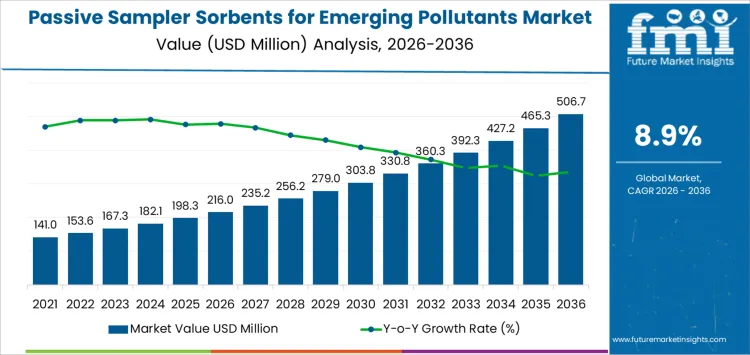
The global passive sampler sorbents for emerging pollutants market is projected to grow from USD 216 million in 2026 to USD 505 million by 2036, with a forecasted CAGR of 8.9%. The market's expansion is driven by the increasing demand for reliable, real-time monitoring of emerging pollutants such as pharmaceutical residues, pesticides, and industrial chemicals in water, air, and soil. Passive samplers utilize sorbent materials to continuously absorb or adsorb pollutants, offering a cost-effective and efficient alternative to traditional active sampling methods. This technology is gaining adoption across environmental agencies, research institutions, and water utilities due to its ability to provide long-term, continuous monitoring with reduced operational costs. Heavy metal detection remains a key application, accounting for 28% of the market share, with applications in environmental site assessments, industrial spill response, and agriculture.
Quick Stats for Passive Sampler Sorbents for Emerging Pollutants Market
- Passive Sampler Sorbents for Emerging Pollutants Market Value (2026): USD 216 million
- Passive Sampler Sorbents for Emerging Pollutants Market Forecast Value (2036): USD 505 million
- Passive Sampler Sorbents for Emerging Pollutants Market Forecast CAGR (2026 to 2036): 8.9%
- Leading Sorbent Type in Passive Sampler Sorbents for Emerging Pollutants Market: Polymer-Based Sorbents (e.g., POCIS-type) Key Growth Regions in Passive Sampler Sorbents for Emerging Pollutants
- Market: India, China, USA, Germany
- Top Players in Passive Sampler Sorbents for Emerging Pollutants Market: Restek, Sigma-Aldrich / Merck, Eurofins Technologies, Pacific Rim Laboratories, SiREM, ALS / Envirotech
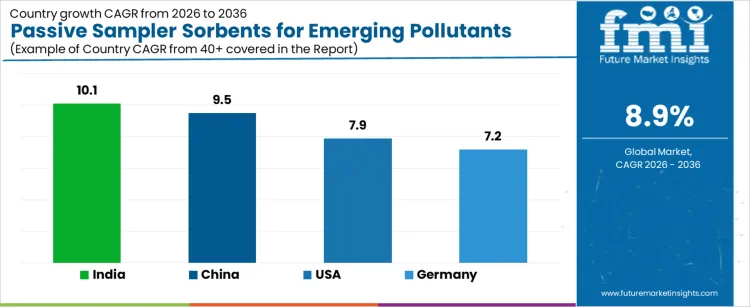
Regional growth is robust, with India leading at a 10.1% CAGR, driven by rising environmental awareness and urbanization. China follows with a 9.5% CAGR, fueled by its industrialization and regulatory focus on environmental monitoring. The USA’s market grows at 7.9%, supported by regulatory demands for more efficient pollution control, while Germany’s market expands at 7.2%, propelled by strong environmental regulations. Innovations in sorbent chemistry, such as molecularly imprinted polymers (MIPs) and hybrid nano-sorbent formulations, are enhancing the performance and selectivity of these samplers. As the global focus on pollution management intensifies, these innovations, combined with growing regulatory requirements, will further accelerate market growth, making passive samplers a crucial tool for environmental surveillance and pollution control.
Passive Sampler Sorbents for Emerging Pollutants Market Key Takeaways
| Metric | Value |
|---|---|
| Industry Value (2026) | USD 216 million |
| Forecast Value (2036) | USD 505 million |
| Forecast CAGR (2026 to 2036) | 8.9% |
How is the Global Passive Sampler Sorbents for Emerging Pollutants Sector Advancing?
The global passive sampler sorbents for emerging pollutants market is expanding as environmental monitoring efforts intensify and the need for efficient detection of pollutants grows. Emerging pollutants such as pharmaceutical residues, personal care chemicals, pesticides, and industrial compounds are increasingly found in water bodies, air, and soil. Passive samplers use sorbent materials that absorb or adsorb these contaminants over time, enabling continuous monitoring without active pumping systems. This approach provides reliable data on pollutant levels with lower operational costs and simplified field deployment compared with traditional active sampling methods.
Adoption of passive sampler sorbents is rising among environmental agencies, research institutions, and water utilities seeking real-time insights into emerging contaminants. Advances in sorbent chemistry are improving sensitivity, selectivity, and stability, allowing detection of trace levels of pollutants across diverse environmental matrices. These developments are enhancing the value of passive samplers for long-term monitoring programs and compliance with tightening regulatory standards on environmental quality.
Looking ahead, market growth will be driven by increased awareness of the risks posed by emerging pollutants to ecosystems and human health, particularly in regions with stringent environmental protection policies. Challenges such as the need for standardized deployment protocols, calibration complexities, and ensuring consistent performance across varied environmental conditions may influence adoption. Continued innovation in sorbent materials and integration with digital data platforms will support broader use of passive samplers for environmental surveillance and pollution management globally.
What Is the Segment-Wise Analysis for the Global Passive Sampler Sorbents for Emerging Pollutants Market?
The global passive sampler sorbents for emerging pollutants market is segmented by sorbent type and end-user. Polymer-based sorbents (e.g., POCIS-type) lead the market with a 32% share due to their efficiency in detecting emerging pollutants. Other significant sorbent types include activated carbon & carbon composites, ion-exchange & functionalized resins, molecularly imprinted polymers (MIPs), zeolites & mineral sorbents, and hybrid nano-sorbent formulations. In terms of end-users, environmental regulatory agencies hold the largest share at 28%, followed by research & academic institutions, industrial operators, water & wastewater utilities, environmental consulting & monitoring firms, and NGOs involved in global monitoring programs.
Why Do Polymer-Based Sorbents Lead the Global Passive Sampler Sorbents Market?
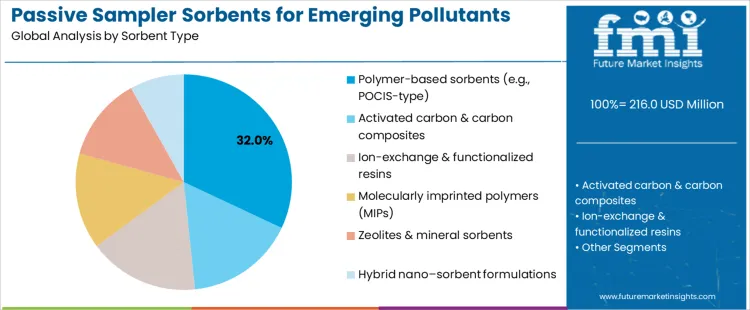
Polymer-based sorbents, such as POCIS-type sorbents, hold a 32% share in the global passive sampler sorbents for emerging pollutants market due to their high efficiency in capturing a wide range of pollutants over extended periods. These sorbents are valued for their ability to passively sample pollutants in water with minimal maintenance, making them a cost-effective and reliable method for environmental monitoring. Their widespread use in regulatory monitoring underscores their importance in detecting emerging pollutants. Polymer-based sorbents are highly versatile and provide high-quality data, making them increasingly popular for long-term environmental assessments, which is why they lead the market.
Why Do Environmental Regulatory Agencies Hold the Largest Market Share?
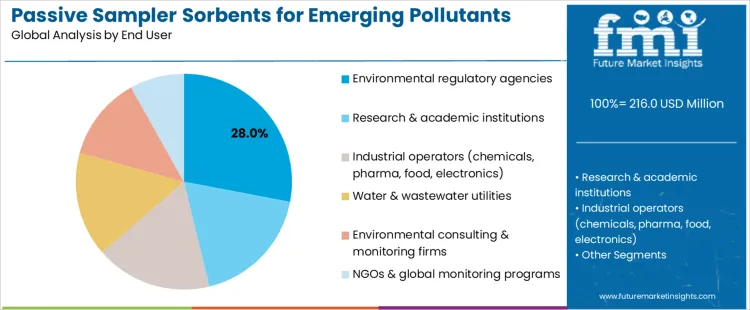
Environmental regulatory agencies hold the largest share of 28% in the global passive sampler sorbents for emerging pollutants market due to their essential role in monitoring environmental quality and enforcing regulations. These agencies rely on passive sampler sorbents to detect and measure emerging pollutants in various ecosystems, ensuring compliance with environmental standards. As concerns over new pollutants increase, these agencies are using these sorbents to assess pollution levels and take appropriate actions. Their focus on public health and environmental protection continues to drive their dominance in the market, making them a key end-user of these sorbents.
What Is Driving the Passive Sampler Sorbents for Emerging Pollutants Market?
The passive sampler sorbents for emerging pollutants market is driven by rising concern over contaminants such as pharmaceuticals, personal care products, pesticides, industrial chemicals, and PFAS in water, air, and soil. These emerging pollutants often occur at trace levels and require sensitive, reliable sampling methods. Passive samplers using advanced sorbent materials enable continuous pollutant uptake without active pumping, making them cost effective and field friendly for environmental monitoring programs. Increasing regulatory focus on monitoring emerging contaminants and the need for robust baseline data in environmental assessment are key market drivers.
What Challenges Are Limiting Adoption of Passive Sampler Sorbents for Emerging Pollutants?
Adoption faces challenges related to sorbent selectivity and performance variability across pollutant types and environmental matrices. Emerging pollutants span diverse chemical classes, so a single sorbent may not capture all target analytes effectively, requiring specialized or combined sorbent approaches. Calibration and interpretation of passive sampling data can be complex, demanding technical expertise and standardized protocols. Cost considerations for advanced sorbent materials and analytical follow up testing can be barriers for budget constrained agencies or consultants. Field conditions such as temperature, flow variability, and biofouling can also impact sampling efficiency.
How Are Innovations Transforming the Passive Sampler Sorbents for Emerging Pollutants Market?
Innovations focus on developing sorbents with enhanced affinity, broader analyte range, and improved resistance to environmental interferences. New polymer based, carbonaceous, and molecularly imprinted sorbents are being engineered to target specific classes of emerging contaminants with high sensitivity. Integration with modular sampler designs allows customization for air, water, or soil monitoring. Coupling passive samplers with digital data loggers, time weighted average analysis, and cloud based reporting tools enhances real time environmental assessment. Partnerships between research institutions, environmental agencies, and sorbent developers are accelerating the translation of laboratory advances into field ready solutions.
What is the Growth Outlook for the Passive Sampler Sorbents for Emerging Pollutants Market by Country?
| Country | CAGR (%) |
|---|---|
| USA | 7.9% |
| China | 9.5% |
| Germany | 7.2% |
| India | 10.1% |
Source: FMI analysis based on primary research and proprietary forecasting model
The passive sampler sorbents for emerging pollutants market is witnessing steady growth, with India leading at a 10.1% CAGR, driven by increasing concerns over water and soil contamination. China follows with 9.5%, supported by its industrial base and the growing need for efficient monitoring of pollutants. The USA shows moderate growth at 7.9%, driven by regulatory requirements and the demand for environmental monitoring solutions. Germany’s market grows at 7.2%, influenced by strong environmental regulations and increasing awareness of emerging pollutants.
Why is India Leading in the Passive Sampler Sorbents for Emerging Pollutants Market?
India’s passive sampler sorbents for emerging pollutants market is growing at 10.1%, driven by increasing industrialization, rapid urbanization, and growing environmental awareness. As India faces rising pollution levels in water and soil, there is a significant demand for effective monitoring tools to track emerging pollutants. Government initiatives to address pollution in urban and industrial areas are encouraging the adoption of passive sampler sorbents to monitor environmental contaminants. The agriculture sector, which is dealing with the impacts of soil and water pollution, is increasingly adopting these sorbents for pollution monitoring. As India continues to focus on improving environmental health, the market for passive sampler sorbents is expected to maintain strong growth.
What is Contributing to the Growth of the Passive Sampler Sorbents for Emerging Pollutants Market in China?
China’s passive sampler sorbents for emerging pollutants market is growing at 9.5%, fueled by the country’s industrial expansion and heightened environmental concerns. As one of the world’s largest manufacturers, China faces significant challenges related to environmental contamination, particularly in water and soil. The government’s increasing regulatory efforts to monitor and manage pollutants are driving the demand for efficient pollution monitoring solutions like passive sampler sorbents. These sorbents provide a cost-effective way to measure the presence of pollutants over extended periods. China’s push toward cleaner production methods and better environmental management is contributing to market growth. With rising concerns about environmental pollution, the market for passive sampler sorbents is expected to grow steadily in China.
How is the Passive Sampler Sorbents for Emerging Pollutants Market Expanding in the United States?
The USA’s passive sampler sorbents for emerging pollutants market is growing at 7.9%, driven by the increasing regulatory requirements for environmental monitoring and the growing awareness of emerging pollutants. As concerns over water contamination and air pollution rise, there is an increasing need for reliable, efficient monitoring solutions. The use of passive sampler sorbents allows for long-term monitoring of pollutants without the need for constant intervention, making them ideal for detecting pollutants that may not be immediately apparent. The USA’s established environmental protection regulations and growing focus on pollution control are contributing to the demand for these sorbents. As the need for more precise monitoring tools continues to grow, the market for passive sampler sorbents is expected to expand steadily.
What is Contributing to the Growth of the Passive Sampler Sorbents for Emerging Pollutants Market in Germany?
Germany’s passive sampler sorbents for emerging pollutants market is growing at 7.2%, supported by the country’s strong environmental regulations and focus on pollution control. As one of Europe’s leaders in environmental protection, Germany is increasingly adopting innovative technologies to monitor pollutants, especially emerging ones in water, air, and soil. The demand for passive sampler sorbents is growing as they offer an effective and low-cost solution for long-term pollutant monitoring. Germany’s commitment to reducing environmental impacts through sustainable industrial practices and better pollution management is driving the adoption of these monitoring solutions. With the growing emphasis on environmental health and regulatory compliance, the market for passive sampler sorbents is expected to continue its steady growth in Germany.
How Are Companies Competing in the Passive Sampler Sorbents for Emerging Pollutants Market?
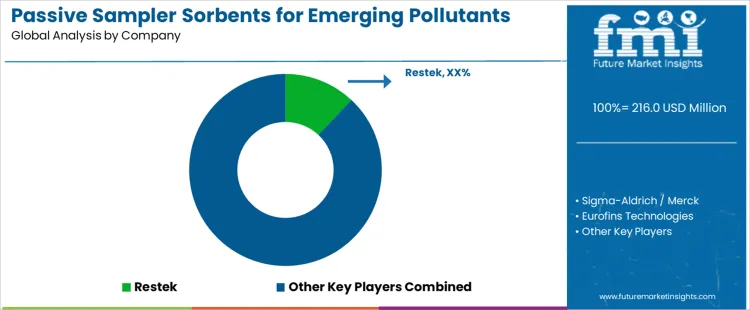
In the passive sampler sorbents segment, Restek, Sigma-Aldrich / Merck, Eurofins Technologies, Pacific Rim Laboratories, SiREM, and ALS / Envirotech are positioned with specialized offerings aimed at reliable on-site pollutant monitoring. Restek brochures present a range of sorbent materials optimized for trace organics, with clear guidance on deployment and analytical compatibility. Product literature highlights high selectivity and stability under varied field conditions. Sigma-Aldrich / Merck materials emphasize certified sorbents and standardized formats designed to support laboratory and field workflows. Technical attributes such as low background and broad chemical capture are detailed with specifications and handling notes. Eurofins Technologies positions its passive sampling consumables with data on detection limits and sorbent performance for emerging contaminants, appealing to environmental professionals focused on regulatory compliance.
Pacific Rim Laboratories is marketed with specialty passive sampler technologies and bespoke sorbents tailored to specific pollutant classes. Brochures emphasize customization options and support services for complex monitoring challenges. SiREM literature focuses on integrated passive samplers paired with sorbent media engineered to capture priority emerging pollutants. Performance metrics and ease of deployment are highlighted to support decision making in long-term field studies. ALS / Envirotech materials present monitoring consumables that include sorbent cartridges and pads designed for routine screening, with clear instructions on use and result interpretation.
Across all firms, strategies are shaped by differentiation in sorbent chemistries, clarity of product documentation, and support resources. Product brochures are crafted to prioritize performance data, application guidance, and compatibility with analytical methods. Competitive positioning rests on reputation for quality, breadth of offerings, and ability to meet evolving pollutant monitoring demands.
Key Players in Passive Sampler Sorbents for Emerging Pollutants Market
- Restek
- Sigma-Aldrich / Merck
- Eurofins Technologies
- Pacific Rim Laboratories (specialty passive sampler tech)
- SiREM (passive samplers & remediation tools)
- ALS / Envirotech (monitoring consumables)
Scope of Report
| Items | Values |
|---|---|
| Quantitative Units (2026) | USD million |
| End Use Application | Environmental Regulatory Agencies, Research & Academic Institutions, Industrial Operators (Chemicals, Pharma, Food, Electronics), Water & Wastewater Utilities, Environmental Consulting & Monitoring Firms, NGOs & Global Monitoring Programs |
| Sorbent Type | Polymer-Based Sorbents (e.g., POCIS-Type), Activated Carbon & Carbon Composites, Ion-Exchange & Functionalized Resins, Molecularly Imprinted Polymers (MIPs), Zeolites & Mineral Sorbents, Hybrid Nano-Sorbent Formulations |
| Regions Covered | Asia Pacific, Europe, North America, Latin America, Middle East & Africa |
| Countries Covered | USA, China, Japan, South Korea, India, Australia & New Zealand, ASEAN, Germany, UK, France, Italy, Spain, Nordic, BENELUX, Brazil, Chile, Mexico, Saudi Arabia, Other GCC Countries, Turkey, South Africa, Other African Union |
| Key Companies Profiled | Restek, Sigma-Aldrich / Merck, Eurofins Technologies, Pacific Rim Laboratories (Specialty Passive Sampler Tech), SiREM (Passive Samplers & Remediation Tools), ALS / Envirotech (Monitoring Consumables) |
| Additional Attributes | Dollar sales by sorbent type, end-use application, and region; regional CAGR and growth outlook; distribution channels including regulatory agencies, research institutions, and environmental consultants; innovation trends in passive sampling and emerging pollutants; competitive positioning of global vs regional suppliers. |
Passive Sampler Sorbents for Emerging Pollutants Market by Segments
Sorbent Type:
- Polymer-based sorbents (e.g., POCIS-type)
- Activated carbon & carbon composites
- Ion-exchange & functionalized resins
- Molecularly imprinted polymers (MIPs)
- Zeolites & mineral sorbents
- Hybrid nano-sorbent formulations
End User:
- Environmental regulatory agencies
- Research & academic institutions
- Industrial operators (chemicals, pharma, food, electronics)
- Water & wastewater utilities
- Environmental consulting & monitoring firms
- NGOs & global monitoring programs
Region
- Asia Pacific
- China
- Japan
- South Korea
- India
- Australia & New Zealand
- ASEAN
- Rest of Asia Pacific
- Europe
- Germany
- United Kingdom
- France
- Italy
- Spain
- Nordic
- BENELUX
- Rest of Europe
- North America
- United States
- Canada
- Mexico
- Latin America
- Brazil
- Chile
- Rest of Latin America
- Middle East & Africa
- Kingdom of Saudi Arabia
- Other GCC Countries
- Turkey
- South Africa
- Other African Union
- Rest of Middle East & Africa
Bibliography
- United States Environmental Protection Agency. (2023). Guidance on passive sampling methods for monitoring emerging contaminants in water and air. EPA Technical Guidance Documents.
- International Organization for Standardization. (2023). Environmental monitoring and measurement standards including passive sampler performance criteria. ISO Standards Publications.
- American Chemical Society. (2023). Research on sorbent materials and passive sampling technologies for environmental pollutants. ACS Publications and Technical Reports.
- World Health Organization. (2023). Guidelines for environmental surveillance of emerging pollutants and analytical detection methods. WHO Environmental Health Guidance.
Frequently Asked Questions
How big is the passive sampler sorbents for emerging pollutants market in 2026?
The global passive sampler sorbents for emerging pollutants market is estimated to be valued at USD 216.0 million in 2026.
What will be the size of passive sampler sorbents for emerging pollutants market in 2036?
The market size for the passive sampler sorbents for emerging pollutants market is projected to reach USD 506.7 million by 2036.
How much will be the passive sampler sorbents for emerging pollutants market growth between 2026 and 2036?
The passive sampler sorbents for emerging pollutants market is expected to grow at a 8.9% CAGR between 2026 and 2036.
What are the key product types in the passive sampler sorbents for emerging pollutants market?
The key product types in passive sampler sorbents for emerging pollutants market are polymer-based sorbents (e.g., pocis-type), activated carbon & carbon composites, ion-exchange & functionalized resins, molecularly imprinted polymers (mips), zeolites & mineral sorbents and hybrid nano–sorbent formulations.
Which end user segment to contribute significant share in the passive sampler sorbents for emerging pollutants market in 2026?
In terms of end user, environmental regulatory agencies segment to command 28.0% share in the passive sampler sorbents for emerging pollutants market in 2026.
Preview the report firsthand - request a free sample
Get SampleGet the brochure for pricing and purchase details.
Get PDFTable of Content
- Executive Summary
- Global Market Outlook
- Demand-side Trends
- Supply-side Trends
- Technology Roadmap Analysis
- Analysis and Recommendations
- Market Overview
- Market Coverage / Taxonomy
- Market Definition / Scope / Limitations
- Market Background
- Market Dynamics
- Drivers
- Restraints
- Opportunity
- Trends
- Scenario Forecast
- Demand in Optimistic Scenario
- Demand in Likely Scenario
- Demand in Conservative Scenario
- Opportunity Map Analysis
- Product Life Cycle Analysis
- Supply Chain Analysis
- Investment Feasibility Matrix
- Value Chain Analysis
- PESTLE and Porter’s Analysis
- Regulatory Landscape
- Regional Parent Market Outlook
- Production and Consumption Statistics
- Import and Export Statistics
- Market Dynamics
- Global Market Analysis 2021 to 2025 and Forecast, 2026 to 2036
- Historical Market Size Value (USD Million) Analysis, 2021 to 2025
- Current and Future Market Size Value (USD Million) Projections, 2026 to 2036
- Y-o-Y Growth Trend Analysis
- Absolute $ Opportunity Analysis
- Global Market Pricing Analysis 2021 to 2025 and Forecast 2026 to 2036
- Global Market Analysis 2021 to 2025 and Forecast 2026 to 2036, By Sorbent Type
- Introduction / Key Findings
- Historical Market Size Value (USD Million) Analysis By Sorbent Type , 2021 to 2025
- Current and Future Market Size Value (USD Million) Analysis and Forecast By Sorbent Type , 2026 to 2036
- Polymer-based sorbents (e.g., POCIS-type)
- Activated carbon & carbon composites
- Ion-exchange & functionalized resins
- Molecularly imprinted polymers (MIPs)
- Zeolites & mineral sorbents
- Hybrid nano-sorbent formulations
- Y-o-Y Growth Trend Analysis By Sorbent Type , 2021 to 2025
- Absolute $ Opportunity Analysis By Sorbent Type , 2026 to 2036
- Global Market Analysis 2021 to 2025 and Forecast 2026 to 2036, By End User
- Introduction / Key Findings
- Historical Market Size Value (USD Million) Analysis By End User, 2021 to 2025
- Current and Future Market Size Value (USD Million) Analysis and Forecast By End User, 2026 to 2036
- Environmental regulatory agencies
- Research & academic institutions
- Industrial operators (chemicals, pharma, food, electronics)
- Water & wastewater utilities
- Environmental consulting & monitoring firms
- NGOs & global monitoring programs
- Y-o-Y Growth Trend Analysis By End User, 2021 to 2025
- Absolute $ Opportunity Analysis By End User, 2026 to 2036
- Global Market Analysis 2021 to 2025 and Forecast 2026 to 2036, By Region
- Introduction
- Historical Market Size Value (USD Million) Analysis By Region, 2021 to 2025
- Current Market Size Value (USD Million) Analysis and Forecast By Region, 2026 to 2036
- North America
- Latin America
- Western Europe
- Eastern Europe
- East Asia
- South Asia and Pacific
- Middle East & Africa
- Market Attractiveness Analysis By Region
- North America Market Analysis 2021 to 2025 and Forecast 2026 to 2036, By Country
- Historical Market Size Value (USD Million) Trend Analysis By Market Taxonomy, 2021 to 2025
- Market Size Value (USD Million) Forecast By Market Taxonomy, 2026 to 2036
- By Country
- USA
- Canada
- Mexico
- By Sorbent Type
- By End User
- By Country
- Market Attractiveness Analysis
- By Country
- By Sorbent Type
- By End User
- Key Takeaways
- Latin America Market Analysis 2021 to 2025 and Forecast 2026 to 2036, By Country
- Historical Market Size Value (USD Million) Trend Analysis By Market Taxonomy, 2021 to 2025
- Market Size Value (USD Million) Forecast By Market Taxonomy, 2026 to 2036
- By Country
- Brazil
- Chile
- Rest of Latin America
- By Sorbent Type
- By End User
- By Country
- Market Attractiveness Analysis
- By Country
- By Sorbent Type
- By End User
- Key Takeaways
- Western Europe Market Analysis 2021 to 2025 and Forecast 2026 to 2036, By Country
- Historical Market Size Value (USD Million) Trend Analysis By Market Taxonomy, 2021 to 2025
- Market Size Value (USD Million) Forecast By Market Taxonomy, 2026 to 2036
- By Country
- Germany
- UK
- Italy
- Spain
- France
- Nordic
- BENELUX
- Rest of Western Europe
- By Sorbent Type
- By End User
- By Country
- Market Attractiveness Analysis
- By Country
- By Sorbent Type
- By End User
- Key Takeaways
- Eastern Europe Market Analysis 2021 to 2025 and Forecast 2026 to 2036, By Country
- Historical Market Size Value (USD Million) Trend Analysis By Market Taxonomy, 2021 to 2025
- Market Size Value (USD Million) Forecast By Market Taxonomy, 2026 to 2036
- By Country
- Russia
- Poland
- Hungary
- Balkan & Baltic
- Rest of Eastern Europe
- By Sorbent Type
- By End User
- By Country
- Market Attractiveness Analysis
- By Country
- By Sorbent Type
- By End User
- Key Takeaways
- East Asia Market Analysis 2021 to 2025 and Forecast 2026 to 2036, By Country
- Historical Market Size Value (USD Million) Trend Analysis By Market Taxonomy, 2021 to 2025
- Market Size Value (USD Million) Forecast By Market Taxonomy, 2026 to 2036
- By Country
- China
- Japan
- South Korea
- By Sorbent Type
- By End User
- By Country
- Market Attractiveness Analysis
- By Country
- By Sorbent Type
- By End User
- Key Takeaways
- South Asia and Pacific Market Analysis 2021 to 2025 and Forecast 2026 to 2036, By Country
- Historical Market Size Value (USD Million) Trend Analysis By Market Taxonomy, 2021 to 2025
- Market Size Value (USD Million) Forecast By Market Taxonomy, 2026 to 2036
- By Country
- India
- ASEAN
- Australia & New Zealand
- Rest of South Asia and Pacific
- By Sorbent Type
- By End User
- By Country
- Market Attractiveness Analysis
- By Country
- By Sorbent Type
- By End User
- Key Takeaways
- Middle East & Africa Market Analysis 2021 to 2025 and Forecast 2026 to 2036, By Country
- Historical Market Size Value (USD Million) Trend Analysis By Market Taxonomy, 2021 to 2025
- Market Size Value (USD Million) Forecast By Market Taxonomy, 2026 to 2036
- By Country
- Kingdom of Saudi Arabia
- Other GCC Countries
- Turkiye
- South Africa
- Other African Union
- Rest of Middle East & Africa
- By Sorbent Type
- By End User
- By Country
- Market Attractiveness Analysis
- By Country
- By Sorbent Type
- By End User
- Key Takeaways
- Key Countries Market Analysis
- USA
- Pricing Analysis
- Market Share Analysis, 2025
- By Sorbent Type
- By End User
- Canada
- Pricing Analysis
- Market Share Analysis, 2025
- By Sorbent Type
- By End User
- Mexico
- Pricing Analysis
- Market Share Analysis, 2025
- By Sorbent Type
- By End User
- Brazil
- Pricing Analysis
- Market Share Analysis, 2025
- By Sorbent Type
- By End User
- Chile
- Pricing Analysis
- Market Share Analysis, 2025
- By Sorbent Type
- By End User
- Germany
- Pricing Analysis
- Market Share Analysis, 2025
- By Sorbent Type
- By End User
- UK
- Pricing Analysis
- Market Share Analysis, 2025
- By Sorbent Type
- By End User
- Italy
- Pricing Analysis
- Market Share Analysis, 2025
- By Sorbent Type
- By End User
- Spain
- Pricing Analysis
- Market Share Analysis, 2025
- By Sorbent Type
- By End User
- France
- Pricing Analysis
- Market Share Analysis, 2025
- By Sorbent Type
- By End User
- India
- Pricing Analysis
- Market Share Analysis, 2025
- By Sorbent Type
- By End User
- ASEAN
- Pricing Analysis
- Market Share Analysis, 2025
- By Sorbent Type
- By End User
- Australia & New Zealand
- Pricing Analysis
- Market Share Analysis, 2025
- By Sorbent Type
- By End User
- China
- Pricing Analysis
- Market Share Analysis, 2025
- By Sorbent Type
- By End User
- Japan
- Pricing Analysis
- Market Share Analysis, 2025
- By Sorbent Type
- By End User
- South Korea
- Pricing Analysis
- Market Share Analysis, 2025
- By Sorbent Type
- By End User
- Russia
- Pricing Analysis
- Market Share Analysis, 2025
- By Sorbent Type
- By End User
- Poland
- Pricing Analysis
- Market Share Analysis, 2025
- By Sorbent Type
- By End User
- Hungary
- Pricing Analysis
- Market Share Analysis, 2025
- By Sorbent Type
- By End User
- Kingdom of Saudi Arabia
- Pricing Analysis
- Market Share Analysis, 2025
- By Sorbent Type
- By End User
- Turkiye
- Pricing Analysis
- Market Share Analysis, 2025
- By Sorbent Type
- By End User
- South Africa
- Pricing Analysis
- Market Share Analysis, 2025
- By Sorbent Type
- By End User
- USA
- Market Structure Analysis
- Competition Dashboard
- Competition Benchmarking
- Market Share Analysis of Top Players
- By Regional
- By Sorbent Type
- By End User
- Competition Analysis
- Competition Deep Dive
- Restek
- Overview
- Product Portfolio
- Profitability by Market Segments (Product/Age /Sales Channel/Region)
- Sales Footprint
- Strategy Overview
- Marketing Strategy
- Product Strategy
- Channel Strategy
- Sigma-Aldrich / Merck
- Eurofins Technologies
- Pacific Rim Laboratories (specialty passive sampler tech)
- SiREM (passive samplers & remediation tools)
- ALS / Envirotech (monitoring consumables)
- Restek
- Competition Deep Dive
- Assumptions & Acronyms Used
- Research Methodology


