

- Market Size (2026)
- USD 1420.6 Mn
- Forecast (2036)
- USD 2691.8 Mn
- CAGR (2026 to 2036)
- 6.6%
How big is the PDC Drill Bit Cutters Market?
The PDC Drill Bit Cutters Market is projected to grow from USD 1420.6 million in 2026 to USD 2691.8 million by 2036, at a CAGR of 6.6%.
The PDC Drill Bit Cutters Market was valued at USD 1332.6454 million in 2025 and is expected to reach USD 1420.6 million in 2026. The market is forecast to reach USD 2691.8 million by 2036 at a CAGR of 6.6%. Standard PDC Cutters are projected to account for a 48.0% share in 2026. The 13–16 mm diameter group is expected to represent a 46.0% share in 2026 as bit makers use it across common oilfield and mining bit designs.
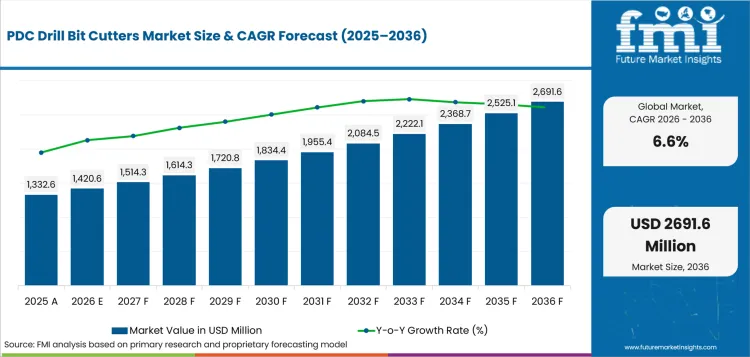
| Metric | Value |
|---|---|
| 2025 Market Size | USD 1332.6454 million. |
| 2026 Market Size | USD 1420.6 million. |
| 2036 Market Size | USD 2691.8 million. |
| Forecast CAGR | 6.6% from 2026 to 2036. |
| Featured Cutter Type | Standard PDC Cutters. |
| Standard PDC Cutters Share in 2026 | 48.0%. |
| Featured Diameter | 13–16 mm. |
| 13–16 mm Share in 2026 | 46.0%. |
| Country CAGR Highlight | China. |
| China CAGR | 7.4% by 2036. |
Summary of the PDC Drill Bit Cutters Market
| Market Signal | Commercial Impact |
|---|---|
| Demand and Growth Drivers | Demand for advanced PDC cutters is increasing as drilling operations require longer bit life and higher performance.
|
| Product and Segment View | Standard PDC cutters and oil & gas drilling continue to dominate market demand.
|
| Geography and Competitive Outlook | The United States and China are expected to remain key growth markets for PDC cutters.
|
| Analyst Perspective | PDC cutter performance is becoming the primary factor influencing drilling efficiency and bit economics.
— Nikhil Kaitwade, Principal Consultant, Oil & Gas Domain, Future Market Insights |
In June 2024, SLB published MegaDiamond PDC cutter material covering standard and 3D PDC cutters for oilfield, geothermal, and abrasive drilling. This reinforced segment depth in shaped cutter applications. In April 2024, SLB published PDC cutter technical material covering Stinger, Enduro 360, Thermal-resistant, Axe, Strata, Hyper, and FireStorm cutters. This showed how cutter families map to damage modes.
USA crude production averaged 13.2 million barrels per day in 2024 and kept unconventional drilling efficiency at the center of cutter demand.
Why is the PDC Drill Bit Cutters Market growing?
Long lateral drilling raises cutter wear exposure as each bit must drill farther before a costly trip becomes acceptable. Shaped cutter designs gain attention when drilling teams need better bite depth without losing cutter edge control.
- Long lateral drilling raises cutter wear exposure as each bit must drill farther before a costly trip becomes acceptable.
- Shaped cutter designs gain attention when drilling teams need better bite depth without losing cutter edge control.
- High-temperature geothermal drilling supports thermally stable cutters as ordinary grades face heat and impact damage.
Oilfield buyers are shifting attention from bit price to the cost of each drilled foot. The United States averaged 13.2 million barrels per day of crude production in 2024, which kept high-efficiency drilling central to shale economics. This scale means cutter failures carry a direct cost when a bit comes out before the planned section ends. Suppliers that prove wear life and impact resistance gain a stronger place in bit design programs. That supports the 6.6% CAGR during the forecast period and keeps premium cutter grades tied to drilling performance. Geothermal drilling is a smaller application, but it changes the technical ceiling for cutter design.
How is the PDC Drill Bit Cutters Market segmented?
The PDC Drill Bit Cutters Market is segmented by cutter type, diameter, application, bit type, sales channel, and region.
- Standard PDC Cutters are projected to account for a 48.0% share in 2026 as routine oilfield bits need predictable wear life and broad supplier availability.
- With an estimated 46.0% share in 2026, 13–16 mm cutters are expected to retain a notable position in the diameter segment through fit across common blade layouts.
- Oil & Gas Drilling is anticipated to represent a 79.0% share in 2026 as well construction remains the substantial consumer of PDC cutter volume.
How does Standard PDC Cutters contribute to the cutter type category?
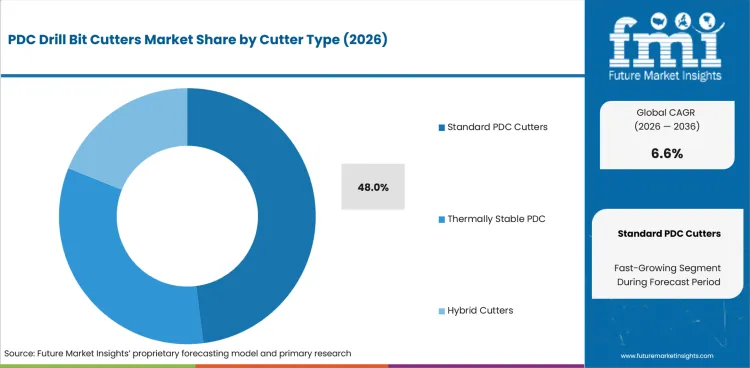
- Standard PDC Cutters are projected to account for a 48.0% share in 2026 as they offer relatively low qualification risk for routine oilfield and mining bits.
- Bit makers use standard cutters for known formations before shifting to shaped designs, since field history reduces test time and protects program schedules.
What supports demand for 13-16 mm?
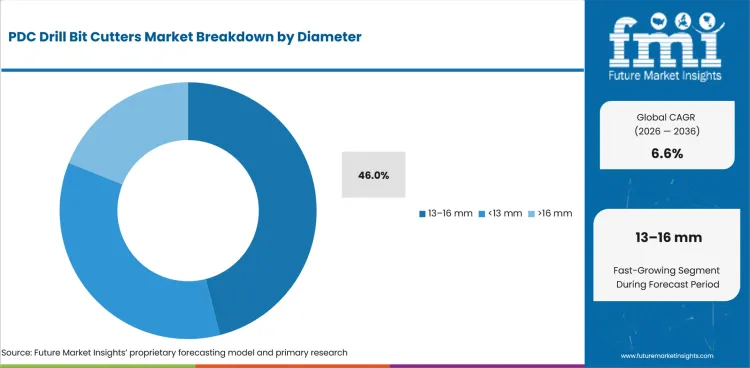
- The 13–16 mm group is expected to represent a 46.0% share in 2026 as it balances cutter density and blade strength across common bit sizes.
- Larger cutters increase contact load on the rock face, while smaller cutters allow denser layouts for stable torque in harder intervals.
How do buyers evaluate Oil & Gas Drilling within the application category?
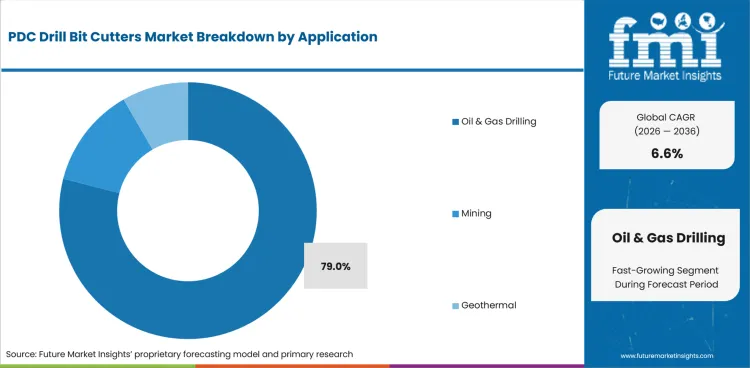
- Oil & Gas Drilling is anticipated to account for a 79.0% share in 2026 as well construction consumes cutters across development and exploration programs.
- Offshore and shale buyers compare cutter grades by dull condition after each run, since worn cutters change steering response and trip timing.
What market factors influence demand for Fixed Cutter Bits?
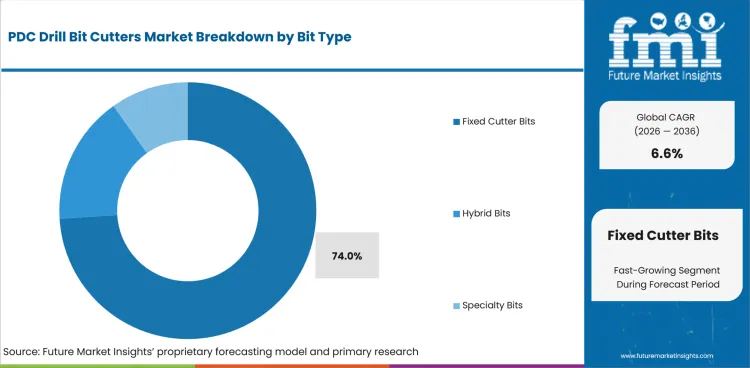
- Fixed Cutter Bits are projected to account for a 74.0% share in 2026 as PDC cutter placement supports continuous shearing in rotary drilling.
- Hybrid bits use PDC cutters differently because roller cone elements absorb shock, which makes cutter positioning a stability choice as much as a cutting choice.
How does Direct to Bit OEMs affect the sales channel outlook?
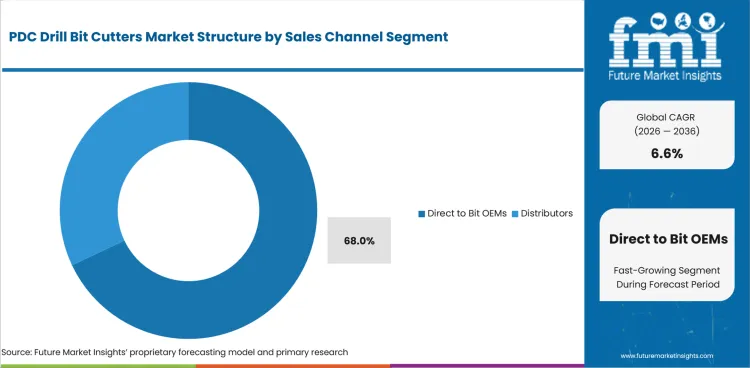
- Direct to Bit OEMs are estimated to hold a 68.0% share in 2026 as cutter qualification usually happens inside bit design and field-test programs.
- Distributors serve mining and smaller drilling users where fast cutter availability can outweigh customized geometry and long approval cycles.
What drives and restrains the market?
The market reflects a balance between the identified demand driver, adoption constraints, and the supplier opportunity outlined below.
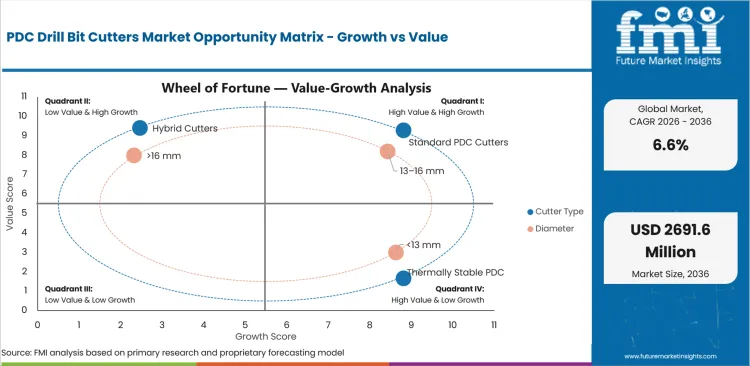
Driver: Longer well sections drive cutter upgrades as a single failed bit can add rig time and disrupt drilling schedules; restraint: Price volatility in diamond and carbide inputs restrains adoption when contractors cannot recover premium cutter cost; opportunity: local cutter manufacturing creates opportunity in China and South Korea as buyers seek shorter supply chains.
- Driver: Longer well sections drive cutter upgrades as a single failed bit can add rig time and disrupt drilling schedules.
- Restraint: Price volatility in diamond and carbide inputs restrains adoption when contractors cannot recover premium cutter cost.
- Opportunity: local cutter manufacturing creates opportunity in China and South Korea as buyers seek shorter supply chains.
Longer Lateral Cutter Stress Long lateral drilling changes the buying decision because cutter life now affects the economics of the full drilling section. NOV reported record drilling results in 2025 using ION+ Intrepid 14.5 mm PDC cutters across Bakken production sections, including long laterals. This signal shows why cutter diameter and wear stability matter when operators try to finish a section without extra trips. The practical result is stronger demand for tested cutter packages that combine impact resistance and efficient cutting.
Heat weakens ordinary cutter edges by stressing the diamond table and substrate bond. This pushes drilling engineers toward cutter grades that maintain edge strength under temperature and impact. The opportunity is important because geothermal drilling uses oilfield-style drilling skills but often faces different rock and heat conditions. Qualification Time Restraint: The main restraint is not only cutter cost, but the time needed to qualify a new cutter in a bit platform. Bit OEMs need lab evidence, field data, and dull grading before shifting cutter grades in high-value wells.
Which factors support expansion?
Commercial expansion is reinforced by the value, workflow, and recurring-demand factors below.
- Market value is rising as longer lateral wells place higher stress on cutter edges and raise the cost of early bit replacement.
- Bit OEM qualification is becoming more demanding, which supports direct cutter supply with tested grades and stable manufacturing controls.
- Geothermal drilling creates a second demand pocket as high heat and crystalline rock expose weakness in standard cutter packages.
Which country markets are included in the CAGR comparison?
The selected CAGR comparison covers China (7.4%), India (7.2%), United States (6.8%), South Korea (6.3%), and Japan (6.1%) through 2036.
.webp "Top Country Growth Comparison Pdc Drill Bit Cutters Market Cagr (2026 2036)")
| Country | CAGR |
|---|---|
| China | 7.4% |
| India | 7.2% |
| United States | 6.8% |
| South Korea | 6.3% |
| Japan | 6.1% |
Source: Future Market Insights analysis based on the supplied country forecast table.
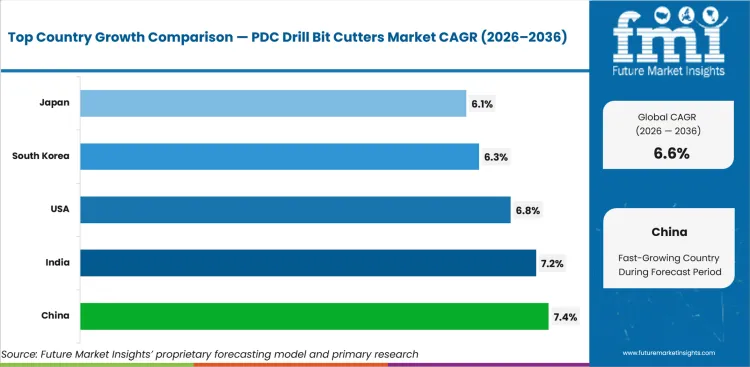
How do country-level CAGRs compare?
- China (CAGR: 7.4%): Oilfield drilling, mining, and domestic cutter production combine to support broad demand.
- India (CAGR: 7.2%): Oil and gas exploration supports drilling tool demand across public and private operators.
- United States (CAGR: 6.8%): U.S. shale drilling keeps cutter wear and rate of penetration central to bit selection.
- South Korea (CAGR: 6.3%): Local demand is smaller, but superhard-material supply gives the country strategic relevance.
- Japan (CAGR: 6.1%): Geothermal resource development drives specialized drilling interest in high-heat formations.
The global PDC Drill Bit Cutters Market is forecast to record a CAGR of 6.6% from 2026 to 2036. The supplied study covers 8 named country forecasts across the report regions.
How is the PDC Drill Bit Cutters Market developing in China?
China is projected to record a CAGR of 7.4% through 2036. The country outlook identifies this demand signal: Oilfield drilling, mining, and domestic cutter production combine to support broad demand.
Country Market Snapshot
| Country | China |
|---|---|
| Forecast CAGR | 7.4% |
| Demand anchor | Oilfield drilling, mining, and domestic cutter production combine to support broad demand. |
| Supply signal | SF Diamond lists PDC cutter series for oil and gas, mining, and downhole tools. |
| Channel route | Local manufacturing supports direct supply to bit makers and distributors. |
| Application mix | Oil and gas drilling supports, while mining adds replacement demand. |
| Diameter signal | SF Diamond lists commercial PDC cutter diameters including 13.44 mm, 15.88 mm, and 19.05 mm. |
| Restraint | Price competition can pressure premium cutter margins. |
| Primary demand signal | Oilfield drilling, mining, and domestic cutter production combine to support broad demand. |
Market Outlook
China is forecast to grow at a CAGR of 7.4% through 2036 as domestic drilling demand and local cutter production reinforce each other. The country has both large end-use demand and a stronger manufacturing base for superhard drilling products. Demand behaves differently from import-reliant markets because local suppliers can compete on availability and cost. Premium suppliers still need field performance proof, especially for hard formations and long runs.
Key Growth Drivers
- Domestic oilfield and gas drilling supports direct cutter demand through bit manufacturers.
- Mining drilling adds a separate replacement channel for hard-rock cutter consumption.
- Local superhard-material manufacturers shorten supply lead times for standard cutter grades.
- Oilfield drilling, mining, and domestic cutter production combine to support broad demand.
Key Restraints
- Low-cost competition can make premium shaped cutters harder to price in routine drilling.
- Export market scrutiny can require stronger documentation for quality and material control.
- Price competition can pressure premium cutter margins.
Country Market FAQs
Why should executives monitor PDC Drill Bit Cutters Market demand in China?
Executives should monitor China because local buyer readiness, oilfield drilling, mining, and domestic cutter production combine to support broad demand, and service capacity can influence account timing and market-entry priorities.
What should suppliers localize for China?
Suppliers should localize proof points, pricing logic, partner coverage, and training support around local manufacturing supports direct supply to bit makers and distributors.
What adoption risk needs attention in China?
Executive teams should watch adoption risk because low-cost competition can make premium shaped cutters harder to price in routine drilling can delay conversion from evaluation to commercial deployment.
How is the PDC Drill Bit Cutters Market developing in India?
India is projected to record a CAGR of 7.2% through 2036. The country outlook identifies this demand signal: Oil and gas exploration supports drilling tool demand across public and private operators.
Country Market Snapshot
| Country | India |
|---|---|
| Forecast CAGR | 7.2% |
| Demand anchor | Oil and gas exploration supports drilling tool demand across public and private operators. |
| Local proof point | India drilled 741 wells in FY 2023-24 across exploratory and development categories. |
| Policy context | Exploration acreage and seismic programs support future drilling tool demand. |
| Application mix | Oilfield drilling supports, while mining drilling adds distributor-based cutter demand. |
| Channel route | Importers and service companies influence cutter availability for bit programs. |
| Restraint | Price sensitivity can limit premium cutter use outside critical wells. |
| Primary demand signal | Oil and gas exploration supports drilling tool demand across public and private operators. |
Market Outlook
India is expected to grow at a CAGR of 7.2% through 2036 as exploration and development drilling support cutter demand. The market combines energy-security drilling with cost-sensitive procurement, so premium cutters must prove lower drilling cost. Demand tends to move through oilfield service firms, bit OEM channels, and technical distributors. Buyers value supply reliability because delayed cutter availability can affect bit build schedules and drilling plans.
Key Growth Drivers
- Exploration licensing and seismic programs support future drilling activity and bit demand.
- Development wells create recurring demand for standard cutters and fixed cutter bit designs.
- Mining activity supports distributor demand for hard-rock drilling cutter replacement.
- Oil and gas exploration supports drilling tool demand across public and private operators.
Key Restraints
- Price-sensitive procurement can delay adoption of shaped or thermally stable cutters.
- Import dependence can expose buyers to support-time risk and currency movement.
- Price sensitivity can limit premium cutter use outside critical wells.
Country Market FAQs
Why should executives monitor PDC Drill Bit Cutters Market demand in India?
Executives should monitor India because local buyer readiness, oil and gas exploration supports drilling tool demand across public and private operators, and service capacity can influence account timing and market-entry priorities.
What should suppliers localize for India?
Suppliers should localize proof points, pricing logic, partner coverage, and training support around importers and service companies influence cutter availability for bit programs and importers and service companies influence cutter availability for bit programs.
What adoption risk needs attention in India?
Executive teams should watch adoption risk because price-sensitive procurement can delay adoption of shaped or thermally stable cutters can delay conversion from evaluation to commercial deployment.
How is the PDC Drill Bit Cutters Market developing in the United States?
The United States is projected to record a CAGR of 6.8% through 2036. The country outlook identifies this demand signal: U.S. shale drilling keeps cutter wear and rate of penetration central to bit selection.
Country Market Snapshot
| Country | United States |
|---|---|
| Forecast CAGR | 6.8% |
| Demand anchor | U.S. shale drilling keeps cutter wear and rate of penetration central to bit selection. |
| Production signal | U.S. crude production averaged 13.2 million barrels per day in 2024. |
| Channel route | Direct sales into bit OEMs dominate premium cutter qualification for shale and offshore bits. |
| Supplier context | US Synthetic, SLB, NOV, Halliburton, Baker Hughes, and Hyperion Materials support the local supply ecosystem. |
| Application mix | Oil and gas drilling remains the core application, with mining and geothermal adding smaller pockets. |
| Restraint | Lower drilling budgets can delay premium cutter upgrades when operators protect well economics. |
| Primary demand signal | U.S. shale drilling keeps cutter wear and rate of penetration central to bit selection. |
Market Outlook
The United States is projected to record a CAGR of 6.8% through 2036 as shale wells keep pushing cutter life requirements higher. Longer laterals make cutter wear a measurable drilling-cost issue, so buyers compare dull grading and field run history before approving a new grade. U.S. demand behaves like a performance market in which a cutter must survive torque, vibration, and abrasive intervals. Supplier access matters because bit OEMs need repeated manufacturing quality before using a cutter across large drilling programs.
Key Growth Drivers
- Permian and Bakken drilling programs support cutter demand where longer sections increase bit endurance requirements.
- Offshore Gulf of Mexico drilling sustains premium bit use where trip costs are high and failure tolerance is low.
- Local bit engineering teams support faster cutter trials through field feedback and design changes.
- U.S. shale drilling keeps cutter wear and rate of penetration central to bit selection.
Key Restraints
- Rig activity cycles can reduce cutter orders quickly when operators defer drilling programs.
- Premium cutter pricing faces pressure when well economics weaken and contractors avoid unproven grades.
- Lower drilling budgets can delay premium cutter upgrades when operators protect well economics.
Country Market FAQs
Why should executives monitor PDC Drill Bit Cutters Market demand in the United States?
Executives should monitor the United States because local buyer readiness, u.s. shale drilling keeps cutter wear and rate of penetration central to bit selection, and service capacity can influence account timing and market-entry priorities.
What should suppliers localize for the United States?
Suppliers should localize proof points, pricing logic, partner coverage, and training support around direct sales into bit oems dominate premium cutter qualification for shale and offshore bits and direct sales into bit oems dominate premium cutter qualification for shale and offshore bits.
What adoption risk needs attention in the United States?
Executive teams should watch adoption risk because rig activity cycles can reduce cutter orders quickly when operators defer drilling programs can delay conversion from evaluation to commercial deployment.
How is the PDC Drill Bit Cutters Market developing in South Korea?
South Korea is projected to record a CAGR of 6.3% through 2036. The country outlook identifies this demand signal: Local demand is smaller, but superhard-material supply gives the country strategic relevance.
Country Market Snapshot
| Country | South Korea |
|---|---|
| Forecast CAGR | 6.3% |
| Demand anchor | Local demand is smaller, but superhard-material supply gives the country strategic relevance. |
| Supply signal | ILJIN Diamond lists PDC products for downhole oil and gas drilling. |
| Energy context | Korea relies heavily on imported energy, which keeps drilling demand more indirect. |
| Application mix | Export-oriented cutter supply is more relevant than domestic oilfield drilling. |
| Channel route | Global bit and tool supply chains matter more than local exploration demand. |
| Restraint | Domestic drilling volume is limited compared with the United States, China, and India. |
| Primary demand signal | Local demand is smaller, but superhard-material supply gives the country strategic relevance. |
Market Outlook
South Korea is expected to record a CAGR of 6.3% through 2036 as supplier-side participation supports market relevance. The country is not a large drilling basin, but its industrial diamond capabilities connect it to global bit and downhole tool demand. Demand is shaped by export channels and relationships with bit makers. Buyers value material consistency, heat resistance, and wear performance when approving PDC products from Korean suppliers.
Key Growth Drivers
- ILJIN Diamond’s PDC product presence supports Korea’s role in the cutter supply chain.
- Export-oriented manufacturing links Korean suppliers to global oilfield and mining drilling demand.
- Advanced materials capability supports premium cutter development for harsher drilling applications.
- Local demand is smaller, but superhard-material supply gives the country strategic relevance.
Key Restraints
- Limited domestic hydrocarbon drilling reduces local end-use demand for cutters.
- Supplier growth depends on global qualification cycles that can be slow and costly.
- Domestic drilling volume is limited compared with the United States, China, and India.
Country Market FAQs
Why should executives monitor PDC Drill Bit Cutters Market demand in South Korea?
Executives should monitor South Korea because local buyer readiness, local demand is smaller, but superhard-material supply gives the country strategic relevance, and service capacity can influence account timing and market-entry priorities.
What should suppliers localize for South Korea?
Suppliers should localize proof points, pricing logic, partner coverage, and training support around global bit and tool supply chains matter more than local exploration demand and global bit and tool supply chains matter more than local exploration demand.
What adoption risk needs attention in South Korea?
Executive teams should watch adoption risk because limited domestic hydrocarbon drilling reduces local end-use demand for cutters can delay conversion from evaluation to commercial deployment.
How is the PDC Drill Bit Cutters Market developing in Japan?
Japan is projected to record a CAGR of 6.1% through 2036. The country outlook identifies this demand signal: Geothermal resource development drives specialized drilling interest in high-heat formations.
Country Market Snapshot
| Country | Japan |
|---|---|
| Forecast CAGR | 6.1% |
| Demand anchor | Geothermal resource development drives specialized drilling interest in high-heat formations. |
| Policy context | JOGMEC supports geological surveys and drilling surveys for geothermal development. |
| Procurement route | Public-backed exploration support shapes drilling contractor demand. |
| Application mix | Geothermal drilling has higher local relevance than oilfield drilling. |
| Buyer behavior | Japanese buyers favor proven materials and careful supplier qualification. |
| Restraint | Environmental permitting and community review can slow geothermal drilling. |
| Primary demand signal | Geothermal resource development drives specialized drilling interest in high-heat formations. |
Market Outlook
Japan is projected to grow at a CAGR of 6.1% through 2036 as geothermal drilling supports selective cutter demand. The country has limited oilfield drilling volume, but its geothermal resource focus creates a need for high-temperature drilling tools. Demand tends to move through project-backed exploration and contractor selection. Cutter suppliers must show heat resistance, stable wear, and bit compatibility before winning a place in Japanese drilling programs.
Key Growth Drivers
- Geothermal exploration support creates a route for thermally stable cutter use in hard formations.
- Mountainous volcanic geology increases interest in drilling tools that resist heat and impact.
- Careful procurement favors suppliers with documented cutter quality and repeatable performance.
- Geothermal resource development drives specialized drilling interest in high-heat formations.
Key Restraints
- Permitting timelines can delay geothermal drilling activity and cutter consumption.
- Smaller oilfield activity limits broad local demand for routine standard cutters.
- Environmental permitting and community review can slow geothermal drilling.
Country Market FAQs
Why should executives monitor PDC Drill Bit Cutters Market demand in Japan?
Executives should monitor Japan because local buyer readiness, geothermal resource development drives specialized drilling interest in high-heat formations, and service capacity can influence account timing and market-entry priorities.
What should suppliers localize for Japan?
Suppliers should localize proof points, pricing logic, partner coverage, and training support around public-backed exploration support shapes drilling contractor demand and local support coverage.
What adoption risk needs attention in Japan?
Executive teams should watch adoption risk because permitting timelines can delay geothermal drilling activity and cutter consumption can delay conversion from evaluation to commercial deployment.
Which companies are discussed in the PDC Drill Bit Cutters Market?
The preview discusses Element Six, US Synthetic, SLB / Smith Bits / MegaDiamond, Baker Hughes, and Halliburton among the companies active in this market.
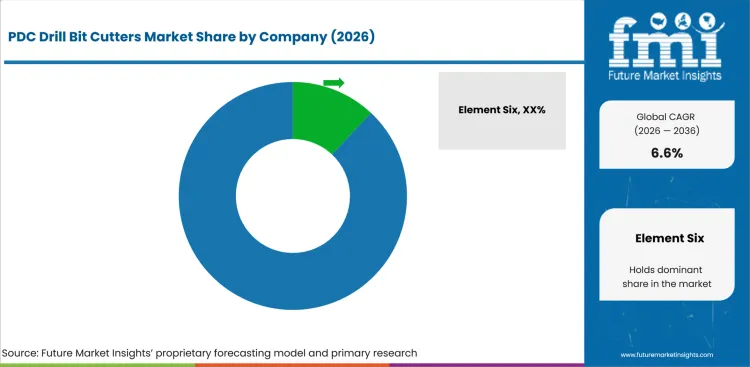
The market is moderately concentrated as a few cutter specialists and bit OEMs control premium qualification channels. established suppliers win through diamond table design, substrate consistency, and field evidence in demanding well sections. Smaller suppliers compete on standard cutters, mining channels, and regional availability where qualification barriers are lower.
Entry barriers are high because premium cutters need field proof, repeatable manufacturing, and trusted bit OEM relationships. Competitive positioning starts with proof that a cutter can survive the intended formation and drilling load. SLB’s MegaDiamond portfolio includes standard PDC cutters and 3D PDC cutters for onshore, offshore, geothermal, and abrasive formations.
How is competition structured?
Competition reflects differences in specialization, portfolio scope, geographic reach, evidence, and customer access.
The competitive structure includes cutter specialists, integrated bit OEMs, and regional superhard-material suppliers.
- Cutter and substrate specialists: Element Six, US Synthetic, Hyperion Materials, SF Diamond, and ILJIN Diamond compete through PDC cutter grades, carbide substrates, and superhard-material production depth.
- Bit OEM and drilling-systems integrators: SLB, Baker Hughes, Halliburton, and NOV compete by integrating cutters into fixed cutter, hybrid, and specialty bit platforms. Their advantage comes from field data, bit design software, drilling service relationships, and qualification access.
- Regional superhard-material suppliers: SF Diamond and ILJIN Diamond strengthen regional supply options for buyers seeking PDC products outside the substantial Western supplier groups. Their role is important in Asia because local material access and price control influence standard cutter demand.
How do selected companies compare?
The selected companies differ in portfolio focus, geographic reach, evidence depth, and channel strength.
| Company | Competitive position |
|---|---|
| Element Six | Cutter and substrate specialists: Element Six, US Synthetic, Hyperion Materials, SF Diamond, and ILJIN Diamond compete through PDC cutter grades, carbide substrates, and superhard-material production depth. |
| US Synthetic | US Synthetic presents itself as a producer of PDC inserts for oil exploration, while Element Six lists PDC cutters and related downhole materials for oil and gas tools. |
| SLB / Smith Bits / MegaDiamond | Positioned within the cutter and substrate specialists category in the supplied competitive assessment. |
| Baker Hughes | Baker Hughes also highlights shaped cutter and hybrid bit technology within its drilling portfolio. |
| Halliburton | Bit OEM and drilling-systems integrators: SLB, Baker Hughes, Halliburton, and NOV compete by integrating cutters into fixed cutter, hybrid, and specialty bit platforms. |
What are the key developments in the PDC Drill Bit Cutters Market?
- In June 2024, SLB published MegaDiamond PDC cutter material covering standard and 3D PDC cutters for oilfield, geothermal, and abrasive drilling. This reinforced segment depth in shaped cutter applications.
- In April 2024, SLB published PDC cutter technical material covering Stinger, Enduro 360, Thermal-resistant, Axe, Strata, Hyper, and FireStorm cutters. This showed how cutter families map to damage modes.
- In April 2024, SLB introduced AccuStrike short-makeup drill bit material with compatibility for 3D-shaped cutters. This supported premium cutter placement in short-bit directional applications.
Selected Companies in the PDC Drill Bit Cutters Market
Companies referenced in this preview
- Element Six.
- US Synthetic.
- SLB / Smith Bits / MegaDiamond.
- Baker Hughes.
- Halliburton.
- NOV / ReedHycalog.
- SF Diamond.
- Hyperion Materials.
- ILJIN Diamond.
Market Scope & Definition
| Market definition | The PDC Drill Bit Cutters Market covers polycrystalline diamond compact cutters used in drilling bits for oilfield, mining, geothermal, and specialty drilling. |
|---|---|
| Functions covered | Standard PDC Cutters, Thermally Stable PDC, 3D / Shaped Cutters, Hybrid Cutters |
| Applications covered | Oil & Gas Drilling, Mining, Geothermal, Other |
| End-use industries | Oil & Gas Drilling, Mining, Geothermal, Other |
| Inclusions | Market scope covers commercially traded PDC drill bit cutters by cutter type, diameter, application, bit type, sales channel, and selected countries, while stakeholders include cutter manufacturers, substrate suppliers, bit OEMs, oilfield service firms, mining drilling contractors, geothermal developers, distributors, and drilling procurement teams. |
| Exclusions | Market scope excludes complete bit assemblies, roller cone inserts, drill pipe, casing, drilling motors, mud systems, rig equipment, non-drilling diamond tools, and superhard tools used outside drilling applications. |
Research Methodology
| Primary Research | FMI analysts reviewed buying behavior across bit OEMs, oilfield service providers, drilling contractors, mining tool distributors, and geothermal project teams. Inputs focused on cutter qualification, field failure modes, supplier approval cycles, and pricing differences between standard and premium cutter grades. |
|---|---|
| Desk Research | used government energy data, trade body material, standards references, official company product pages, and technical product evidence from cutter and bit suppliers. Public information from oilfield equipment companies helped define the addressable product pool and verified active supplier participation. |
| Market Sizing and Forecasting | The model combined bit production assumptions, cutter count per bit, replacement patterns, average cutter pricing, and country-level drilling activity. Forecasting then adjusted demand by application mix, cutter grade shift, and direct OEM channel share. |
| Data Validation | Forecasts were checked against oil and gas drilling signals, mining drilling demand, geothermal drilling activity, and supplier product portfolios. Company-level cutter offerings and bit technology evidence were cross-referenced before final values were finalized. |
What does the report cover?
The report covers cutter type, diameter, application, bit type, sales channel, and region across the 2026-2036 forecast period in 30+ countries.
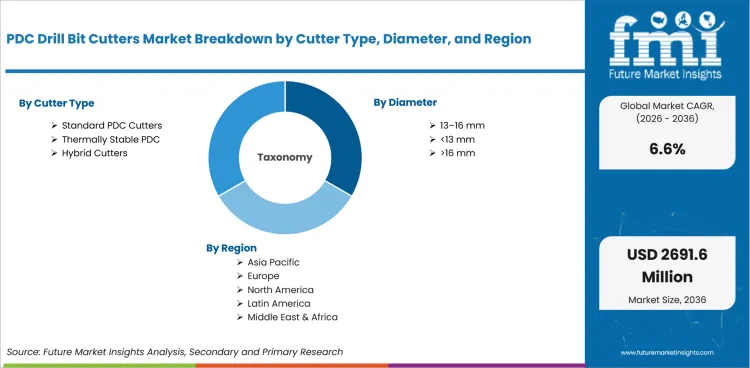
| Periods | Base year 2025; estimated year 2026; forecast period 2026-2036 |
|---|---|
| Quantitative units | USD 1420.6 million in 2026 to USD 2691.8 million by 2036, at a CAGR of 6.6% |
| Segment axes | cutter type, diameter, application, bit type, sales channel, and region |
| Regions | North America, Latin America, Europe, East Asia, South Asia and Pacific, Middle East and Africa |
| Countries | United States, United Kingdom, Germany, France, Japan, China, South Korea, India and 30+ |
| Companies | Element Six; US Synthetic; SLB / Smith Bits / MegaDiamond; Baker Hughes; Halliburton; NOV / ReedHycalog; SF Diamond; Hyperion Materials; ILJIN Diamond |
| Approach | Hybrid bottom-up and selected-down methodology using bit demand, cutter pricing, segment use rates, country drilling activity, and verified supplier portfolios. |
Market Segmentation Analysis
Segmented by Cutter Type
- Standard PDC Cutters.
- Thermally Stable PDC.
- 3D / Shaped Cutters.
- Hybrid Cutters.
Segmented by Diameter
- <13 mm.
- 13–16 mm.
- >16 mm.
Segmented by Application
- Oil & Gas Drilling.
- Mining.
- Geothermal.
- Other.
Segmented by Bit Type
- Fixed Cutter Bits.
- Hybrid Bits.
- Specialty Bits.
Segmented by Sales Channel
- Direct to Bit OEMs.
- Distributors.
Research Sources and Bibliography
- 1. Energy Information Administration.
- 2. International Energy Agency. (2025, June 17). Oil 2025: Executive summary. International Energy Agency.
- 3. International Energy Agency. (2024, December 13). The Future of Geothermal Energy. International Energy Agency.
- 4. REN21. (2025). Renewables 2025 Global Status Report. REN21.
- 5. North Sea Transition Authority. (2025, October 28). Wells Insights Report 2025. North Sea Transition Authority.
- 6. Arbeitsgemeinschaft Energiebilanzen. (2025, August). Energy Consumption in Germany in 2024. Arbeitsgemeinschaft Energiebilanzen.
- 7. Bundesverband Erdgas, Erdöl und Geoenergie. (2025, December). Guideline for drilling in deep geothermal systems. BVEG.
- 8. Bureau de Recherches Géologiques et Minières. (2024, February 21). Geothermal energy in the Paris region. BRGM.
- 9. Japan Organization for Metals and Energy Security. (2025). Geothermal business activities. JOGMEC.
- 10. Press Information Bureau. (2025, January 7). Year End Review 2024: Ministry of Petroleum and Natural Gas. Government of India.
- 11. Korea Energy Economics Institute. (2025). Korea Energy Outlook 2025. Korea Energy Economics Institute.
- 12. SLB. (2024, June 21). MegaDiamond PDC Cutters. SLB.
- 13. SLB. (2024, April 11). PDC cutters. SLB.
- 14. SLB. (2024, April 5). AccuStrike short-makeup drill bit. SLB.
- 15. NOV. (2025, July 28). NOV reports second quarter 2025 results. NOV.
- 16. NOV. (2025, April 28). NOV reports first quarter 2025 results. NOV.
The bibliography is provided for reader reference, and all sources are primary government, official company, official trade body, or institutional publications.
This Report Answers
- What is the projected value of the PDC Drill Bit Cutters Market in 2026?
- What value is forecast for the PDC Drill Bit Cutters Market by 2036?
- What CAGR is forecast for the PDC Drill Bit Cutters Market from 2026 to 2036?
- What 2026 share is projected for Standard PDC Cutters within the cutter type category?
- What 2026 share is projected for 13–16 mm within the diameter category?
- Which demand factors support the PDC Drill Bit Cutters Market outlook?
- Which restraints and opportunities affect adoption in the PDC Drill Bit Cutters Market?
- How are country CAGR outlooks, including China at 7.4%, compared?
- Which companies and product developments are covered in the competitive analysis?
- What is included in the market scope, and how is the forecast validated?
Frequently Asked Questions
Why should executives track the PDC Drill Bit Cutters Market?
Executives should track this market because it can affect capital allocation, supplier strategy, operating risk, and competitive positioning across applications.
What business problem does the PDC Drill Bit Cutters Market address?
It helps executive teams judge where customer pain, supplier capability, compliance exposure, and implementation economics justify investment, procurement, or market-entry decisions.
What should procurement leaders evaluate before selecting suppliers?
Procurement leaders should assess evidence quality, integration fit, service coverage, compliance readiness, total cost of ownership, and supplier execution capability.
What can limit return on investment for buyers?
Return on investment can be limited by low utilization, integration delays, training gaps, unclear ownership, pricing pressure, or weak fit with existing workflows.
How can suppliers build executive confidence?
Suppliers can build confidence by proving implementation speed, risk reduction, support depth, reference use cases, and measurable outcomes for budget owners.
Preview the report firsthand - request a free sample
Get SampleGet the brochure for pricing and purchase details.
Get PDFTable of Content
- Key Takeaways
- Market Size and CAGR
- Top Growth Driver
- Fastest Growing Segment
- Leading Region
- Key Companies
- Emerging Opportunities
- Executive Summary
- Global Market Outlook
- Demand-side Trends
- Supply-side Trends
- Technology Roadmap Analysis
- Analysis and Recommendations
- Analyst Perspective (What is happening? Why now? What should investors know?)
- Key Questions Answered
- How large is the market?
- What is the CAGR?
- What are key trends?
- Which region dominates?
- Who are the leaders?
- Market Overview
- Market Coverage / Taxonomy
- Market Definition / Scope / Limitations
- Research Methodology
- Chapter Orientation
- Analytical Lens and Working Hypotheses
- Market Structure, Signals, and Trend Drivers
- Benchmarking and Cross-market Comparability
- Market Sizing, Forecasting, and Opportunity Mapping
- Research Design and Evidence Framework
- Desk Research Programme (Secondary Evidence)
- Expert Input and Fieldwork (Primary Evidence)
- Tooling, Models, and Reference Databases
- Data Engineering and Model Build
- Quality Assurance and Audit Trail
- Market Background
- Market Dynamics (Drivers, Restraints, Opportunity, Trends)
- Scenario Forecast (Optimistic, Likely, Conservative)
- Impact Analysis
- AI Impact
- Sustainability Impact
- Regulatory Impact
- Technology Impact
- Consumer / Buyer Analysis
- Purchase Drivers
- Adoption Barriers
- Buyer Journey
- Opportunity Map Analysis
- Product Life Cycle Analysis
- Supply Chain Analysis
- Investment Feasibility Matrix
- Value Chain Analysis
- PESTLE and Porter's Analysis
- Regulatory Landscape
- Regional Parent Market Outlook
- Production and Consumption Statistics
- Import and Export Statistics
- Global Market Analysis and Forecast, 2021 to 2036
- Historical Market Size Value (USD Million) Analysis, 2021 to 2025
- Current and Future Market Size Value (USD Million) Projections, 2026 to 2036
- Y-o-Y Growth Trend Analysis
- Absolute $ Opportunity Analysis
- Global Market Pricing Analysis, 2021 to 2036
- Global Market Analysis and Forecast, By Cutter Type, 2021 to 2036
- Introduction / Key Findings
- Historical Market Size Value (USD Million) Analysis By Cutter Type, 2021 to 2025
- Current and Future Market Size Value (USD Million) Analysis and Forecast By Cutter Type, 2026 to 2036
- Standard PDC Cutters
- Thermally Stable PDC
- Hybrid Cutters
- Standard PDC Cutters
- Y-o-Y Growth Trend Analysis By Cutter Type, 2021 to 2025
- Absolute $ Opportunity Analysis By Cutter Type, 2026 to 2036
- Global Market Analysis and Forecast, By Diameter, 2021 to 2036
- Introduction / Key Findings
- Historical Market Size Value (USD Million) Analysis By Diameter, 2021 to 2025
- Current and Future Market Size Value (USD Million) Analysis and Forecast By Diameter, 2026 to 2036
- 13–16 mm
- <13 mm
- >16 mm
- 13–16 mm
- Y-o-Y Growth Trend Analysis By Diameter, 2021 to 2025
- Absolute $ Opportunity Analysis By Diameter, 2026 to 2036
- Global Market Analysis and Forecast, By Application, 2021 to 2036
- Introduction / Key Findings
- Historical Market Size Value (USD Million) Analysis By Application, 2021 to 2025
- Current and Future Market Size Value (USD Million) Analysis and Forecast By Application, 2026 to 2036
- Oil & Gas Drilling
- Mining
- Geothermal
- Oil & Gas Drilling
- Y-o-Y Growth Trend Analysis By Application, 2021 to 2025
- Absolute $ Opportunity Analysis By Application, 2026 to 2036
- Global Market Analysis and Forecast, By Bit Type, 2021 to 2036
- Introduction / Key Findings
- Historical Market Size Value (USD Million) Analysis By Bit Type, 2021 to 2025
- Current and Future Market Size Value (USD Million) Analysis and Forecast By Bit Type, 2026 to 2036
- Fixed Cutter Bits
- Hybrid Bits
- Specialty Bits
- Fixed Cutter Bits
- Y-o-Y Growth Trend Analysis By Bit Type, 2021 to 2025
- Absolute $ Opportunity Analysis By Bit Type, 2026 to 2036
- Global Market Analysis and Forecast, By Sales Channel, 2021 to 2036
- Introduction / Key Findings
- Historical Market Size Value (USD Million) Analysis By Sales Channel, 2021 to 2025
- Current and Future Market Size Value (USD Million) Analysis and Forecast By Sales Channel, 2026 to 2036
- Direct to Bit OEMs
- Distributors
- Direct to Bit OEMs
- Y-o-Y Growth Trend Analysis By Sales Channel, 2021 to 2025
- Absolute $ Opportunity Analysis By Sales Channel, 2026 to 2036
- Global Market Analysis and Forecast, By Region, 2021 to 2036
- Introduction
- Historical Market Size Value (USD Million) Analysis By Region, 2021 to 2025
- Current Market Size Value (USD Million) Analysis and Forecast By Region, 2026 to 2036
- North America
- Latin America
- Western Europe
- Eastern Europe
- East Asia
- South Asia and Pacific
- Middle East & Africa
- Market Attractiveness Analysis By Region
- North America Market Analysis and Forecast, By Country, 2021 to 2036
- Historical Market Size Value (USD Million) Trend Analysis By Market Taxonomy, 2021 to 2025
- Market Size Value (USD Million) Forecast By Market Taxonomy, 2026 to 2036
- By Country
- USA
- Canada
- Mexico
- By Cutter Type
- By Diameter
- By Application
- By Bit Type
- By Sales Channel
- By Country
- Market Attractiveness Analysis
- By Country
- By Cutter Type
- By Diameter
- By Application
- By Bit Type
- By Sales Channel
- Key Takeaways
- Latin America Market Analysis and Forecast, By Country
- Historical Market Size Value (USD Million) Trend Analysis By Market Taxonomy, 2021 to 2025
- Market Size Value (USD Million) Forecast By Market Taxonomy, 2026 to 2036
- By Country
- Brazil
- Chile
- Rest of Latin America
- By Cutter Type
- By Diameter
- By Application
- By Bit Type
- By Sales Channel
- By Country
- Market Attractiveness Analysis
- By Country
- By Cutter Type
- By Diameter
- By Application
- By Bit Type
- By Sales Channel
- Key Takeaways
- Western Europe Market Analysis and Forecast, By Country
- Historical Market Size Value (USD Million) Trend Analysis By Market Taxonomy, 2021 to 2025
- Market Size Value (USD Million) Forecast By Market Taxonomy, 2026 to 2036
- By Country
- Germany
- UK
- Italy
- Spain
- France
- Nordic
- BENELUX
- Rest of Western Europe
- By Cutter Type
- By Diameter
- By Application
- By Bit Type
- By Sales Channel
- By Country
- Market Attractiveness Analysis
- By Country
- By Cutter Type
- By Diameter
- By Application
- By Bit Type
- By Sales Channel
- Key Takeaways
- Eastern Europe Market Analysis and Forecast, By Country
- Historical Market Size Value (USD Million) Trend Analysis By Market Taxonomy, 2021 to 2025
- Market Size Value (USD Million) Forecast By Market Taxonomy, 2026 to 2036
- By Country
- Russia
- Poland
- Hungary
- Balkan & Baltic
- Rest of Eastern Europe
- By Cutter Type
- By Diameter
- By Application
- By Bit Type
- By Sales Channel
- By Country
- Market Attractiveness Analysis
- By Country
- By Cutter Type
- By Diameter
- By Application
- By Bit Type
- By Sales Channel
- Key Takeaways
- East Asia Market Analysis and Forecast, By Country
- Historical Market Size Value (USD Million) Trend Analysis By Market Taxonomy, 2021 to 2025
- Market Size Value (USD Million) Forecast By Market Taxonomy, 2026 to 2036
- By Country
- China
- Japan
- South Korea
- By Cutter Type
- By Diameter
- By Application
- By Bit Type
- By Sales Channel
- By Country
- Market Attractiveness Analysis
- By Country
- By Cutter Type
- By Diameter
- By Application
- By Bit Type
- By Sales Channel
- Key Takeaways
- South Asia and Pacific Market Analysis and Forecast, By Country
- Historical Market Size Value (USD Million) Trend Analysis By Market Taxonomy, 2021 to 2025
- Market Size Value (USD Million) Forecast By Market Taxonomy, 2026 to 2036
- By Country
- India
- ASEAN
- Australia & New Zealand
- Rest of South Asia and Pacific
- By Cutter Type
- By Diameter
- By Application
- By Bit Type
- By Sales Channel
- By Country
- Market Attractiveness Analysis
- By Country
- By Cutter Type
- By Diameter
- By Application
- By Bit Type
- By Sales Channel
- Key Takeaways
- Middle East & Africa Market Analysis and Forecast, By Country
- Historical Market Size Value (USD Million) Trend Analysis By Market Taxonomy, 2021 to 2025
- Market Size Value (USD Million) Forecast By Market Taxonomy, 2026 to 2036
- By Country
- Kingdom of Saudi Arabia
- Other GCC Countries
- Türkiye
- South Africa
- Other African Union
- Rest of Middle East & Africa
- By Cutter Type
- By Diameter
- By Application
- By Bit Type
- By Sales Channel
- By Country
- Market Attractiveness Analysis
- By Country
- By Cutter Type
- By Diameter
- By Application
- By Bit Type
- By Sales Channel
- Key Takeaways
- Key Countries Market Analysis
- USA
- Pricing Analysis
- Market Share Analysis, 2025
- By Cutter Type
- By Diameter
- By Application
- By Bit Type
- By Sales Channel
- Canada
- Pricing Analysis
- Market Share Analysis, 2025
- By Cutter Type
- By Diameter
- By Application
- By Bit Type
- By Sales Channel
- Mexico
- Pricing Analysis
- Market Share Analysis, 2025
- By Cutter Type
- By Diameter
- By Application
- By Bit Type
- By Sales Channel
- Brazil
- Pricing Analysis
- Market Share Analysis, 2025
- By Cutter Type
- By Diameter
- By Application
- By Bit Type
- By Sales Channel
- Chile
- Pricing Analysis
- Market Share Analysis, 2025
- By Cutter Type
- By Diameter
- By Application
- By Bit Type
- By Sales Channel
- Germany
- Pricing Analysis
- Market Share Analysis, 2025
- By Cutter Type
- By Diameter
- By Application
- By Bit Type
- By Sales Channel
- UK
- Pricing Analysis
- Market Share Analysis, 2025
- By Cutter Type
- By Diameter
- By Application
- By Bit Type
- By Sales Channel
- Italy
- Pricing Analysis
- Market Share Analysis, 2025
- By Cutter Type
- By Diameter
- By Application
- By Bit Type
- By Sales Channel
- Spain
- Pricing Analysis
- Market Share Analysis, 2025
- By Cutter Type
- By Diameter
- By Application
- By Bit Type
- By Sales Channel
- France
- Pricing Analysis
- Market Share Analysis, 2025
- By Cutter Type
- By Diameter
- By Application
- By Bit Type
- By Sales Channel
- India
- Pricing Analysis
- Market Share Analysis, 2025
- By Cutter Type
- By Diameter
- By Application
- By Bit Type
- By Sales Channel
- ASEAN
- Pricing Analysis
- Market Share Analysis, 2025
- By Cutter Type
- By Diameter
- By Application
- By Bit Type
- By Sales Channel
- Australia & New Zealand
- Pricing Analysis
- Market Share Analysis, 2025
- By Cutter Type
- By Diameter
- By Application
- By Bit Type
- By Sales Channel
- China
- Pricing Analysis
- Market Share Analysis, 2025
- By Cutter Type
- By Diameter
- By Application
- By Bit Type
- By Sales Channel
- Japan
- Pricing Analysis
- Market Share Analysis, 2025
- By Cutter Type
- By Diameter
- By Application
- By Bit Type
- By Sales Channel
- South Korea
- Pricing Analysis
- Market Share Analysis, 2025
- By Cutter Type
- By Diameter
- By Application
- By Bit Type
- By Sales Channel
- Russia
- Pricing Analysis
- Market Share Analysis, 2025
- By Cutter Type
- By Diameter
- By Application
- By Bit Type
- By Sales Channel
- Poland
- Pricing Analysis
- Market Share Analysis, 2025
- By Cutter Type
- By Diameter
- By Application
- By Bit Type
- By Sales Channel
- Hungary
- Pricing Analysis
- Market Share Analysis, 2025
- By Cutter Type
- By Diameter
- By Application
- By Bit Type
- By Sales Channel
- Kingdom of Saudi Arabia
- Pricing Analysis
- Market Share Analysis, 2025
- By Cutter Type
- By Diameter
- By Application
- By Bit Type
- By Sales Channel
- Türkiye
- Pricing Analysis
- Market Share Analysis, 2025
- By Cutter Type
- By Diameter
- By Application
- By Bit Type
- By Sales Channel
- South Africa
- Pricing Analysis
- Market Share Analysis, 2025
- By Cutter Type
- By Diameter
- By Application
- By Bit Type
- By Sales Channel
- USA
- Market Structure Analysis
- Competition Dashboard
- Competition Benchmarking
- Market Share Analysis of Top Players
- By Regional
- By Cutter Type
- By Diameter
- By Application
- By Bit Type
- By Sales Channel
- Emerging Startups
- Innovation Benchmarking
- Competition Analysis
- Competition Deep Dive
- Element Six
- Overview
- Product Portfolio
- Profitability by Market Segments (Product/Region/Sales Channel)
- Sales Footprint
- Strategy Overview
- Marketing Strategy
- Product Strategy
- Channel Strategy
- US Synthetic
- SLB / Smith Bits / MegaDiamond
- Baker Hughes
- Halliburton
- NOV / ReedHycalog
- Element Six
- Case Studies
- Success Stories
- Recent Developments
- Competition Deep Dive
- Assumptions & Acronyms Used


