

- Market Size (2026)
- USD 8.2618 Mn
- Forecast (2036)
- USD 10.0518 Mn
- CAGR (2026 to 2036)
- 1.9%
How big is the Pirfenidone Market?
The Pirfenidone Market is projected to grow from USD 8.2618 million in 2026 to USD 10.0518 million by 2036, at a CAGR of 1.9805%.
The Pirfenidone Market was valued at USD 8.1067 million in 2025 and is expected to reach USD 8.2618 million in 2026. The market is projected to reach USD 10.0518 million by 2036 at a CAGR of 1.9805% from 2026 to 2036. Powder is projected to account for a 64.0% share in 2026 as formulators prefer easier weighing and blending. The ≥99.5% purity grade is expected to represent a 57.0% share in 2026 as regulated buyers give priority to assay consistency.
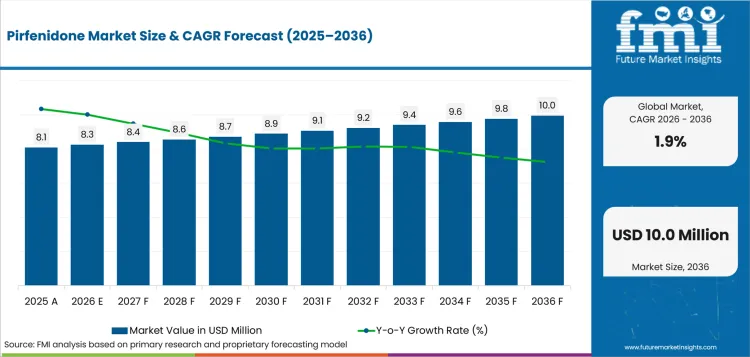
| Metric | Value |
|---|---|
| 2025 Market Size | USD 8.1067 million |
| 2026 Market Size | USD 8.2618 million |
| 2036 Market Size | USD 10.0518 million |
| Forecast CAGR (2026–2036) | 1.9805% |
| Featured Form | Powder |
| Powder Share (2026) | 64.0% |
| Featured Purity Grade | ≥99.5% |
| ≥99.5% Share (2026) | 57.0% |
| Country CAGR Highlight | India |
| India CAGR (2026–2036) | 2.9% |
Summary of the Pirfenidone Market
| Market Signal | Commercial Impact |
|---|---|
| Demand and Growth Drivers | Specialty respiratory therapies continue to support steady demand for high-purity pirfenidone APIs.
|
| Product and Segment View | Powder form and high-purity grades continue to dominate the pirfenidone API market.
|
| Geography and Competitive Outlook | India and China remain important manufacturing and supply hubs for pirfenidone APIs.
|
| Analyst Perspective | Pirfenidone is increasingly becoming a supplier qualification market where regulatory readiness outweighs price competition.
— Anurag Sharma, Principal Consultant, Healthcare Domain, Future Market Insights |
In February 2024, Dr. Reddy’s Laboratories Australia received ARTG listing for Pirfenidone Dr.Reddy’s 267 mg tablets. The listing supports Australian access. In June 2024, EMA’s product-specific bioequivalence guidance for pirfenidone became effective. The guidance raised clarity for generic product development.
DailyMed listings in the United States show several generic labelers with 267 mg and 801 mg presentations.
Why is the Pirfenidone Market growing?
Approved idiopathic pulmonary fibrosis use keeps repeat API demand active across specialty respiratory channels. Generic product listings create steady sourcing needs for 267 mg and 801 mg finished-dose formats.
- Approved idiopathic pulmonary fibrosis use keeps repeat API demand active across specialty respiratory channels.
- Generic product listings create steady sourcing needs for 267 mg and 801 mg finished-dose formats.
- Bioequivalence guidance keeps technical entry standards clear for suppliers serving European buyers.
Specialty respiratory demand in pirfenidone is shaped by treatment continuity rather than large patient pools. FDA labeling states a recommended daily maintenance dosage of 801 mg three times daily for a total of 2,403 mg per day. That dose schedule creates predictable API pull for active patient cohorts and supports regular finished-dose manufacturing. The practical result is a market with stable replenishment rather than sharp expansion. Suppliers need reliable batch performance and clear deviation control, which gives qualified API producers a stronger position than opportunistic traders. Regulatory clarity is another reason the market keeps moving forward. The European Medicines Agency listed product-specific bioequivalence guidance for pirfenidone film-coated tablets and hard capsules with a June 2024 effective date.
How is the Pirfenidone Market segmented?
The Pirfenidone Market is segmented by form, purity grade, application, sales channel, and region.
- Powder is projected to account for a 64.0% share in 2026 by form as it supports weighing control in oral solid manufacturing.
- With an estimated 57.0% share in 2026, ≥99.5% purity grade is expected to support due to filing and release needs.
- Idiopathic Pulmonary Fibrosis buyers are projected to direct 91.0% of application demand in 2026 toward approved therapy supply.
How does Powder contribute to the form category?
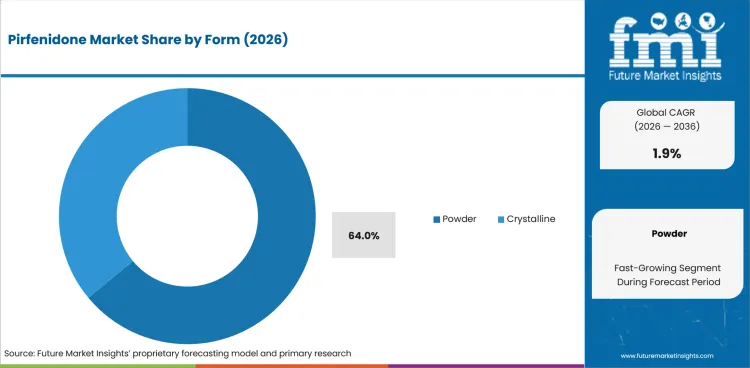
- Powder is projected to account for a 64.0% share in 2026 as oral solid manufacturers need flow control during blending and compression.
- Crystalline forms stay relevant for suppliers managing particle size and storage behavior, especially where finished-dose clients test dissolution sensitivity.
What supports demand for ≥99.5%?
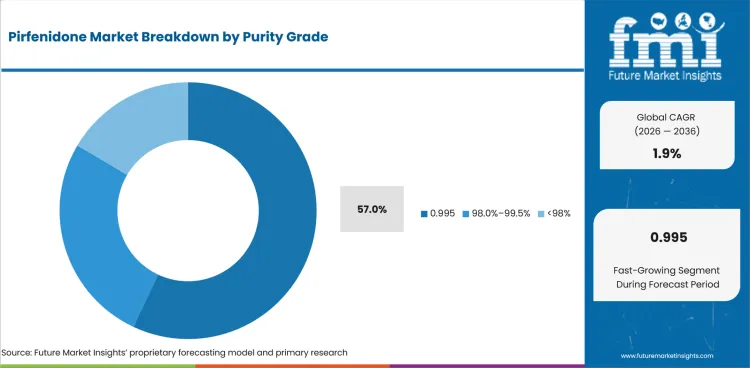
- The ≥99.5% purity grade is expected to represent a 57.0% share in 2026 as regulated buyers prefer stronger impurity and assay margins.
- Lower-purity material is mainly suited to early development or less demanding channels, while commercial dossiers usually need tighter quality records.
How do buyers evaluate Idiopathic Pulmonary Fibrosis within the application category?
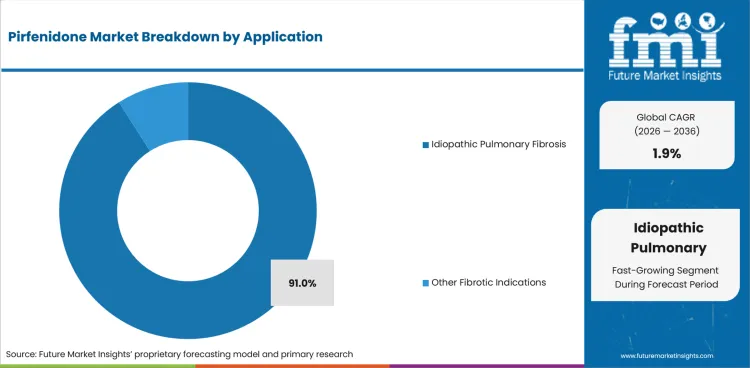
- Idiopathic Pulmonary Fibrosis is projected to account for a 91.0% share in 2026 as the approved indication anchors commercial use.
- Other fibrotic indications remain a watch area, but most commercial orders stay tied to approved respiratory prescribing and reimbursement.
What market factors influence demand for Direct?
- Direct sales are expected to account for a 68.0% share in 2026 as buyers prefer supplier audits and controlled quality communication.
- Distributor sales work suitable for smaller buyers, but large finished-dose firms usually need direct technical access to the API source.
How does Europe affect the regional outlook?
- Europe is projected to account for a 31.0% share in 2026 as centralized product guidance supports consistent generic entry.
- The region’s buyer behavior favors suppliers able to support idiopathic pulmonary fibrosis management products with strong regulatory files.
What drives and restrains the market?
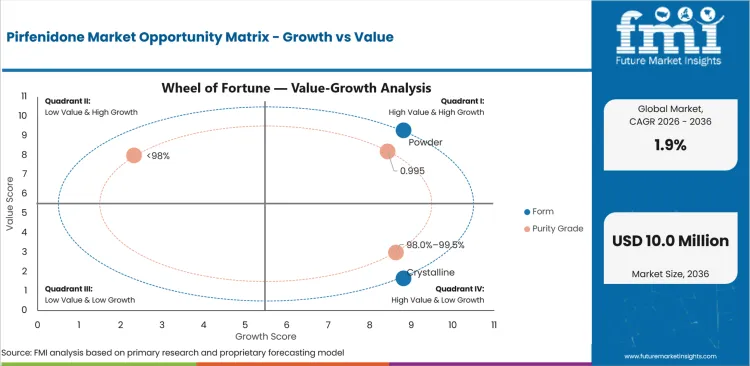
Driver: Approved IPF therapy demand supports repeat API buying across regulated finished-dose supply chains; restraint: Price pressure restrains margin upside as multiple generic labels reduce room for premium pricing; opportunity: aPI makers can improve position by offering stability support and fast regulatory response packages.
The market reflects a balance between the identified demand driver, adoption constraints, and the supplier opportunity outlined below.
- Driver: Approved IPF therapy demand supports repeat API buying across regulated finished-dose supply chains.
- Restraint: Price pressure restrains margin upside as multiple generic labels reduce room for premium pricing.
- Opportunity: aPI makers can improve position by offering stability support and fast regulatory response packages.
IPF Label Continuity Pirfenidone demand is sustained by product labels that keep the drug in the approved IPF treatment path. The USA label states that pirfenidone tablets are indicated for idiopathic pulmonary fibrosis and need liver function tests before treatment. This creates a clinical access route that is stable but monitored. Suppliers therefore sell into a quality-sensitive chain rather than a mass-volume chain. Finished-dose customers value API partners able to prevent supply gaps and support safe product use. The implication is steady demand for compliant supply rather than fast market broadening.
A batch that meets assay but creates dissolution concerns can still delay a dossier. Suppliers with particle control, impurity tracking, and stability evidence gain practical advantage. The progressive fibrosing interstitial lung disease treatment space adds context, but pirfenidone API remains filing-driven. Price and Safety Restraints The main restraint is that pirfenidone is a mature molecule with known tolerability limits and generic competition. DailyMed states that 14.6% of patients receiving 2,403 mg per day permanently discontinued treatment due to adverse events in three trials. That safety profile keeps prescriber monitoring important and limits unchecked volume growth.
Which factors support expansion?
Commercial expansion is reinforced by the value, workflow, and recurring-demand factors below.
- Repeat API orders are expected to rise as approved idiopathic pulmonary fibrosis products need stable supply during the forecast decade.
- The market value is supported by high-purity API demand as buyers link supplier approval to impurity and stability records.
- Direct buying is expected to protect supplier margins as finished-dose clients prefer audited partners over spot purchases.
Which country markets are included in the CAGR comparison?
The selected CAGR comparison covers India (2.9%), China (2.7%), South Korea (2.4%), United States (2.1%), and Germany (1.8%) through 2036.
.webp "Top Country Growth Comparison Pirfenidone Market Cagr (2026 2036)")
| Country | CAGR |
|---|---|
| India | 2.9% |
| China | 2.7% |
| South Korea | 2.4% |
| United States | 2.1% |
| Germany | 1.8% |
Source: Future Market Insights analysis based on the supplied country forecast table.
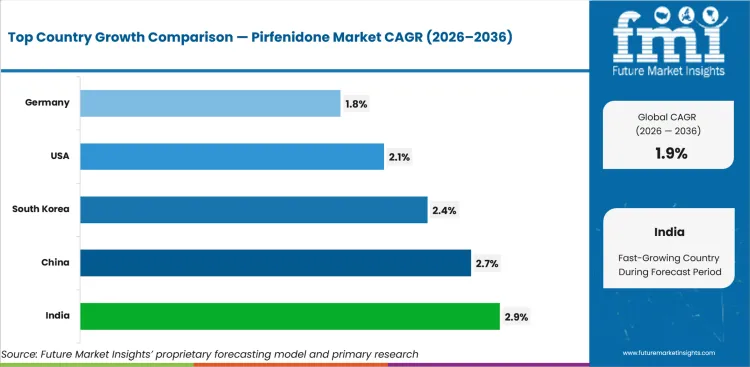
How do country-level CAGRs compare?
- India (CAGR: 2.9%): Domestic brands support wider access to pirfenidone therapy.
- China (CAGR: 2.7%): Hospital respiratory care supports approved antifibrotic use in IPF.
- South Korea (CAGR: 2.4%): Specialist hospital pulmonology supports treatment of rare fibrotic lung disease.
- United States (CAGR: 2.1%): FDA-approved IPF use supports repeat orders for 267 mg and 801 mg finished-dose products.
- Germany (CAGR: 1.8%): Specialist pulmonology centers guide IPF diagnosis and treatment decisions.
The global Pirfenidone Market is forecast to record a CAGR of 1.9805% from 2026 to 2036. The supplied study covers 8 named country forecasts across the report regions.
How is the Pirfenidone Market developing in India?
India is projected to record a CAGR of 2.9% through 2036. The country outlook identifies this demand signal: Domestic brands support wider access to pirfenidone therapy.
Country Market Snapshot
| Country | India |
|---|---|
| Forecast CAGR | 2.9% |
| Demand anchor | Domestic brands support wider access to pirfenidone therapy. |
| Supply structure | India has several API and finished-dose firms with pirfenidone relevance. |
| Channel signal | Pulmonologists and retail pharmacies influence brand choice. |
| Cost behavior | Affordability is a stronger factor than in Western markets. |
| Export role | Indian suppliers support regulated and semi-regulated product filings. |
| Restraint | Price sensitivity can compress API margins. |
| Primary demand signal | Domestic brands support wider access to pirfenidone therapy. |
Market Outlook
India is the higher-CAGR selected country because it combines local API capability and domestic generic demand. Indian retail listings show multiple pirfenidone brands across companies such as Cipla and MSN Laboratories. This creates a broader brand field than many regulated Western markets. API suppliers benefit from both local formulation and export-oriented dossier support. India is projected to record a CAGR of 2.9% through 2036 as domestic and export channels support repeat manufacturing. Growth remains measured because pirfenidone is still a specialty therapy.
Key Growth Drivers
- Local generic brands support wider affordability for specialist respiratory therapy.
- API manufacturing capabilities support export-facing finished-dose customers.
- Pulmonologist-led prescribing creates recurring demand for known brands.
- Domestic brands support wider access to pirfenidone therapy.
Key Restraints
- Price sensitivity limits margin expansion across API and finished-dose supply.
- Diagnosis access outside major cities can restrict treated patient growth.
- Cost pressure influences brand choice and API sourcing.
Country Market FAQs
Why should executives monitor Pirfenidone Market demand in India?
Executives should monitor India because local buyer readiness, domestic brands support wider access to pirfenidone therapy, and service capacity can influence account timing and market-entry priorities.
What should suppliers localize for India?
Suppliers should localize proof points, pricing logic, partner coverage, and training support around buyer access and account ownership and pulmonologists and retail pharmacies influence brand choice.
What adoption risk needs attention in India?
Executive teams should watch adoption risk because price sensitivity limits margin expansion across api and finished-dose supply can delay conversion from evaluation to commercial deployment.
How is the Pirfenidone Market developing in China?
China is projected to record a CAGR of 2.7% through 2036. The country outlook identifies this demand signal: Hospital respiratory care supports approved antifibrotic use in IPF.
Country Market Snapshot
| Country | China |
|---|---|
| Forecast CAGR | 2.7% |
| Demand anchor | Hospital respiratory care supports approved antifibrotic use in IPF. |
| Local role | China combines domestic manufacturing with large specialty hospital networks. |
| Channel signal | Tender and hospital listing access influence finished-dose reach. |
| Supply behavior | Buyers often weigh cost against regulatory and quality assurance. |
| Restraint | Provincial access variation can slow uniform uptake. |
| Competitive context | Local suppliers influence price and availability. |
| Primary demand signal | Hospital respiratory care supports approved antifibrotic use in IPF. |
Market Outlook
China’s pirfenidone demand is shaped by hospital access and local production economics. Large respiratory centers can support diagnosis and specialist prescribing, but access differs across provinces. This creates uneven demand for finished-dose manufacturers. API suppliers must therefore support cost-sensitive customers without weakening quality records. China is forecast to grow at a CAGR of 2.7% through 2036 as domestic access and local manufacturing support gradual expansion.
Key Growth Drivers
- Large hospital networks support specialist diagnosis and treatment access.
- Domestic manufacturing can lower cost barriers for finished-dose products.
- Tender access creates repeat procurement once products gain listings.
- Hospital respiratory care supports approved antifibrotic use in IPF.
Key Restraints
- Provincial access differences can delay uniform demand growth.
- Price competition can reduce incentives for high-cost API sourcing.
- Provincial access variation can slow uniform uptake.
Country Market FAQs
Why should executives monitor Pirfenidone Market demand in China?
Executives should monitor China because hospital respiratory pathways, access variation, and local supplier readiness can influence timing for antifibrotic API and finished-dose opportunities.
What should suppliers localize for China?
Suppliers should localize proof points, pricing logic, partner coverage, and training support around buyer access and account ownership and tender and hospital listing access influence finished-dose reach.
What adoption risk needs attention in China?
Executive teams should watch adoption risk because provincial access differences can delay uniform demand growth can delay conversion from evaluation to commercial deployment.
How is the Pirfenidone Market developing in South Korea?
South Korea is projected to record a CAGR of 2.4% through 2036. The country outlook identifies this demand signal: Specialist hospital pulmonology supports treatment of rare fibrotic lung disease.
Country Market Snapshot
| Country | South Korea |
|---|---|
| Forecast CAGR | 2.4% |
| Demand anchor | Specialist hospital pulmonology supports treatment of rare fibrotic lung disease. |
| Channel signal | Reimbursement and hospital prescribing guide access. |
| Safety context | Korean post-marketing experience supports monitored use. |
| Supply behavior | Buyers favor reliable quality documentation for imported and local products. |
| Restraint | Small patient pools limit scale for API suppliers. |
| Competitive context | Hospital relationships influence product continuity. |
| Primary demand signal | Specialist hospital pulmonology supports treatment of rare fibrotic lung disease. |
Market Outlook
South Korea is a specialist-driven market where hospital access shapes therapy uptake. Pirfenidone use is tied to rare respiratory disease care and closely monitored treatment. This creates steady demand but limits broad channel expansion. Finished-dose suppliers need dependable API sources that can support product quality and continuity. South Korea is expected to record a CAGR of 2.4% through 2036 as specialist recognition supports gradual use.
Key Growth Drivers
- Specialist hospital systems support diagnosis and treatment monitoring.
- Rare disease reimbursement structures can support access for eligible patients.
- Quality-sensitive importing favors documented API supply.
- Specialist hospital pulmonology supports treatment of rare fibrotic lung disease.
Key Restraints
- Small treated patient pools restrict annual API volume.
- Hospital formulary access can slow product entry for new suppliers.
- Small patient pools limit scale for API suppliers.
Country Market FAQs
Why should executives monitor Pirfenidone Market demand in South Korea?
Executives should monitor South Korea because local buyer readiness, specialist hospital pulmonology supports treatment of rare fibrotic lung disease, and service capacity can influence account timing and market-entry priorities.
What should suppliers localize for South Korea?
Suppliers should localize proof points, pricing logic, partner coverage, and training support around buyer access and account ownership and reimbursement and hospital prescribing guide access.
What adoption risk needs attention in South Korea?
Executive teams should watch adoption risk because small treated patient pools restrict annual api volume can delay conversion from evaluation to commercial deployment.
How is the Pirfenidone Market developing in the United States?
The United States is projected to record a CAGR of 2.1% through 2036. The country outlook identifies this demand signal: FDA-approved IPF use supports repeat orders for 267 mg and 801 mg finished-dose products.
Country Market Snapshot
| Country | United States |
|---|---|
| Forecast CAGR | 2.1% |
| Demand anchor | FDA-approved IPF use supports repeat orders for 267 mg and 801 mg finished-dose products. |
| Channel signal | Specialty pharmacies and respiratory prescribers influence access more than broad retail channels. |
| Supply structure | DailyMed lists multiple generic packagers and labelers for pirfenidone products. |
| Regulatory context | ANDA-based product listings shape supplier qualification and finished-dose substitution. |
| Restraint | Price pressure rises when buyers can compare several generic sources. |
| Application mix | Idiopathic pulmonary fibrosis stays the main commercial use. |
| Primary demand signal | FDA-approved IPF use supports repeat orders for 267 mg and 801 mg finished-dose products. |
Market Outlook
The United States market is driven by generic availability and specialty respiratory care. FDA labeling requires liver function testing before starting pirfenidone tablets, which keeps prescribing tied to monitored care. That requirement affects refill stability and channel choice. Finished-dose firms therefore need API suppliers with dependable documentation and low interruption risk. USA demand is projected to record a CAGR of 2.1% through 2036 as generic labels support steady finished-dose manufacturing. Buyers compare API suppliers on filing support and history of quality performance.
Key Growth Drivers
- FDA product listings support repeat procurement for established oral pirfenidone formats.
- Specialty respiratory prescribing keeps demand concentrated among monitored IPF patients.
- Generic competition increases supplier needs for cost control and consistent batch release.
- FDA-approved IPF use supports repeat orders for 267 mg and 801 mg finished-dose products.
Key Restraints
- Safety monitoring can reduce persistence and lower finished-dose refill stability.
- Multiple generic options limit supplier pricing power in contract renewals.
- Price pressure rises when buyers can compare several generic sources.
Country Market FAQs
Why should executives monitor Pirfenidone Market demand in the United States?
Executives should monitor the United States because local buyer readiness, fda-approved IPF use supports repeat orders for 267 mg and 801 mg finished-dose products, and service capacity can influence account timing and market-entry priorities.
What should suppliers localize for the United States?
Suppliers should localize proof points, pricing logic, partner coverage, and training support around buyer access and account ownership and specialty pharmacies and respiratory prescribers influence access more than broad retail channels.
What adoption risk needs attention in the United States?
Executive teams should watch adoption risk because safety monitoring can reduce persistence and lower finished-dose refill stability can delay conversion from evaluation to commercial deployment.
How is the Pirfenidone Market developing in Germany?
Germany is projected to record a CAGR of 1.8% through 2036. The country outlook identifies this demand signal: Specialist pulmonology centers guide IPF diagnosis and treatment decisions.
Country Market Snapshot
| Country | Germany |
|---|---|
| Forecast CAGR | 1.8% |
| Demand anchor | Specialist pulmonology centers guide IPF diagnosis and treatment decisions. |
| Regulatory signal | German safety bulletins have referenced pirfenidone adverse reaction updates. |
| Procurement route | Statutory insurance and pharmacy channels shape medicine access. |
| Supply behavior | Buyers value EU documentation and pharmacovigilance responsiveness. |
| Restraint | Safety updates can raise monitoring burdens for prescribers. |
| Application mix | IPF remains the main commercial use. |
| Primary demand signal | Specialist pulmonology centers guide IPF diagnosis and treatment decisions. |
Market Outlook
Germany’s market is shaped by physician-led diagnosis and high attention to safety updates. German pharmacovigilance communication in March 2024 referenced pirfenidone and DRESS safety wording following European review. That signal matters for API suppliers because finished-dose clients need quick label and quality response. Demand remains steady but documentation expectations are high. Germany is forecast to grow at a CAGR of 1.8% through 2036 as access remains mature and closely monitored. Buyers prefer EU-compliant suppliers with strong quality communication.
Key Growth Drivers
- Specialist pulmonology networks support diagnosis and continued treatment decisions.
- EU product guidance gives generic sponsors a clear technical route.
- Safety communication raises the value of suppliers with strong response systems.
- IPF remains the main commercial use.
Key Restraints
- Pharmacovigilance scrutiny can slow switching and raise documentation costs.
- Mature reimbursement reduces room for rapid demand expansion.
- Safety updates can raise monitoring burdens for prescribers.
Country Market FAQs
Why should executives monitor Pirfenidone Market demand in Germany?
Executives should monitor Germany because local buyer readiness, specialist pulmonology centers guide IPF diagnosis and treatment decisions, and service capacity can influence account timing and market-entry priorities.
What should suppliers localize for Germany?
Suppliers should localize proof points, pricing logic, partner coverage, and training support around statutory insurance and pharmacy channels shape medicine access and local support coverage.
What adoption risk needs attention in Germany?
Executive teams should watch adoption risk because pharmacovigilance scrutiny can slow switching and raise documentation costs can delay conversion from evaluation to commercial deployment.
Which companies are discussed in the Pirfenidone Market?
The preview discusses Cipla, MSN Laboratories, Hetero Drugs, Aurobindo Pharma, and Laurus Labs among the companies active in this market.
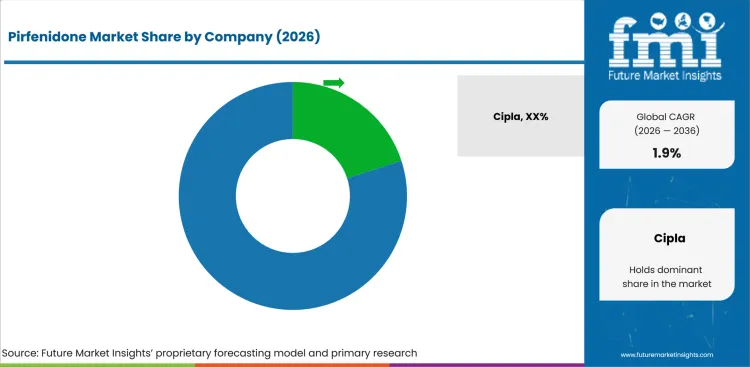
The market is moderately fragmented, with regulated API suppliers and finished-dose companies competing around quality records. Established Indian firms hold ground through manufacturing scale, filing experience, and export documentation. Smaller specialists compete where they can offer custom batch support and responsive technical service.
Entry barriers remain high due to impurity control, stability evidence, and buyer audit requirements. Competitive positioning in pirfenidone depends on proof rather than promotion. Finished-dose customers want suppliers with stable assay results, impurity controls, and usable documentation for regulated filings.
How is competition structured?
Competition reflects differences in specialization, portfolio scope, geographic reach, evidence, and customer access.
The competitive structure includes finished-dose leaders, regulated API suppliers, and regional specialists with respiratory product links.
- Integrated API and formulation suppliers: Laurus Labs, Aurobindo Pharma, Cipla, and MSN Laboratories benefit from regulated manufacturing experience and generic product portfolios. Laurus Labs shows USA evidence for API manufacture in pirfenidone listings.
- Regional API and specialty manufacturers: Hetero Drugs, Optimus Drugs, Biophore, and MetroChem API compete through India’s broader small molecule API ecosystem. Their relevance is notable where buyers need cost-effective synthesis, impurity control, and document support.
- Country and channel participants: Dr. Reddy’s Laboratories and Shanghai Sine are relevant through local or regional pharmaceutical channels. Dr. Reddy’s has evidence of pirfenidone products in Australia. Shanghai Sine is relevant to China’s domestic respiratory supply context.
How do selected companies compare?
The selected companies differ in portfolio focus, geographic reach, evidence depth, and channel strength.
| Company | Competitive position |
|---|---|
| Cipla | Cipla and MSN Laboratories support Indian finished-dose access through known pirfenidone brands. |
| MSN Laboratories | Cipla and MSN Laboratories support Indian finished-dose access through known pirfenidone brands. |
| Hetero Drugs | Regional API and specialty manufacturers: Hetero Drugs, Optimus Drugs, Biophore, and MetroChem API compete through India’s broader small molecule API ecosystem. |
| Aurobindo Pharma | Aurobindo Pharma has USA pirfenidone tablet labeling activity. |
| Laurus Labs | Laurus Labs shows USA evidence for API manufacture in pirfenidone listings. |
What are the key developments in the Pirfenidone Market?
- In February 2024, Dr. Reddy’s Laboratories Australia received ARTG listing for Pirfenidone Dr.Reddy’s 267 mg tablets. The listing supports Australian access.
- In June 2024, EMA’s product-specific bioequivalence guidance for pirfenidone became effective. The guidance raised clarity for generic product development.
- DailyMed labeling for Aurobindo Pharma’s pirfenidone tablets is used as product-label evidence supporting regulated generic supply; it is not treated as a standalone company launch.
Selected Companies in the Pirfenidone Market
Companies referenced in this preview
- Cipla.
- MSN Laboratories.
- Hetero Drugs.
- Aurobindo Pharma.
- Laurus Labs.
- Optimus Drugs.
- Biophore.
- Dr. Reddy’s Laboratories.
- MetroChem API.
- Shanghai Sine.
Market Scope & Definition
| Market definition | The Pirfenidone Market covers commercially traded pirfenidone active pharmaceutical ingredient used in oral tablets and capsules. The market serves finished-dose manufacturers supplying approved idiopathic pulmonary fibrosis therapy and limited research use in other fibrotic indications. |
|---|---|
| Functions covered | Powder, Crystalline |
| Applications covered | Idiopathic Pulmonary Fibrosis, Other Fibrotic Indications |
| End-use industries | Pharmaceutical manufacturers, generic formulation companies, hospital procurement channels, and regulated distributors |
| Inclusions | Market scope covers powder and crystalline pirfenidone API, purity grades of ≥99.5%, 98.0%–99.5%, and <98%, applications in idiopathic pulmonary fibrosis and other fibrotic indications, direct and distributor sales, and the selected regions covered in this report. |
| Exclusions | The scope excludes finished pirfenidone tablets and capsules sold to patients, branded respiratory drug revenue, unrelated antifibrotic APIs, inhaled experimental forms, clinical trial services, and hospital treatment costs. |
Research Methodology
| Primary Research | FMI analysts reviewed inputs from API buyers, finished-dose manufacturers, quality teams, and respiratory product distributors. Interviews focused on supplier qualification, batch documentation, impurity expectations, and order stability. |
|---|---|
| Desk Research | The desk review covered regulator labels, product-specific bioequivalence guidance, national medicine listings, company product information, and official drug databases. These sources helped define the approved use boundary and supplier participation. |
| Market Sizing and Forecasting | The model combined API volume estimates, average regulated-market pricing, country demand signals, and application use rates. Forecast assumptions were tested against product listings and specialty respiratory access patterns. |
| Data Validation | Forecasts were checked against generic label activity, country reimbursement context, and company portfolios. The final view was aligned with the specialty active pharmaceutical ingredients supply pattern. |
What does the report cover?
The report covers form, purity grade, application, sales channel, and region across the 2026-2036 forecast period in 30+ countries.
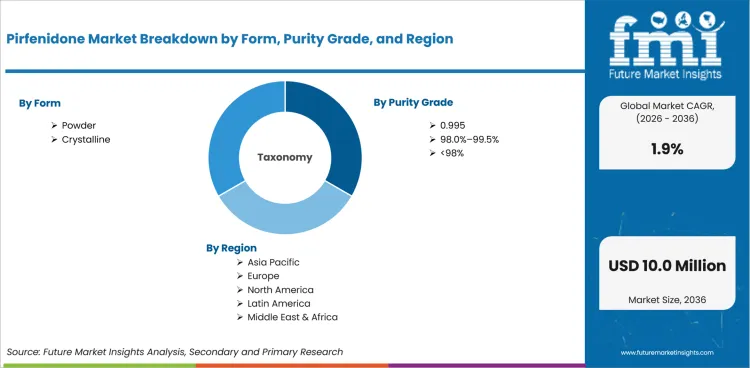
| Periods | Base year 2025; estimated year 2026; forecast period 2026-2036 |
|---|---|
| Quantitative units | USD 8.2618 million in 2026 to USD 10.0518 million in 2036, at a CAGR of 1.9805% |
| Segment axes | form, purity grade, application, sales channel, and region |
| Regions | North America, Latin America, Europe, East Asia, South Asia and Pacific, Middle East and Africa |
| Countries | United States, United Kingdom, Germany, France, Japan, China, South Korea, India and 30+ |
| Companies | Cipla, MSN Laboratories, Hetero Drugs, Aurobindo Pharma, Laurus Labs, Optimus Drugs, Biophore, Dr. Reddy’s Laboratories, MetroChem API, Shanghai Sine |
| Approach | Hybrid bottom-up and selected-down methodology using product listings, application use rates, and regulated supplier evidence. |
Market Segmentation Analysis
Segmented by Form
- Powder.
- Crystalline.
Segmented by Purity Grade
- ≥99.5%.
- 98.0%-99.5%.
- <98%.
Segmented by Application
- Idiopathic Pulmonary Fibrosis.
- Other Fibrotic Indications.
Segmented by Sales Channel
- Direct.
- Distributors.
By Region
- North America.
- United States.
- Latin America.
- East Asia.
- China.
- Japan.
- South Korea.
- South Asia and Pacific.
- India.
- Middle East & Africa.
- Europe.
- United Kingdom.
Research Sources and Bibliography
- 1. USA National Library of Medicine. (2026). DailyMed: Pirfenidone tablet, film coated. National Institutes of Health. https://dailymed.nlm.nih.gov/dailymed/drugInfo.cfm? setid=94362a07-7c64-42ce-adef-f49585af55d6
- 2. European Medicines Agency. (2025, August 14). Pirfenidone product-specific bioequivalence guidance. European Medicines Agency. https://www.ema.europa.eu/en/pirfenidone-product-specific-bioequivalence-guidance
- 3. European Medicines Agency. (2025, December 19). Pirfenidone Viatris: EPAR product information. European Medicines Agency. https://www.ema.europa.eu/en/medicines/human/EPAR/pirfenidone-viatris
- 4. USA National Library of Medicine. (2025). DailyMed: Pirfenidone capsule and tablet, film coated, Laurus Labs. National Institutes of Health. https://dailymed.nlm.nih.gov/dailymed/drugInfo.cfm? setid=29b0fd0e-5a2b-4da7-8524-177dc28bf55e
- 5. USA National Library of Medicine. (2025). DailyMed: Pirfenidone tablet, Aurobindo Pharma. National Institutes of Health. https://dailymed.nlm.nih.gov/dailymed/drugInfo.cfm? setid=50958060-c904-4374-997d-59df54007fa4
- 6. Therapeutic Goods Administration. (2024, February 2). PIRFENIDONE DR REDDY’S pirfenidone 267 mg film-coated tablet bottle. Australian Government Department of Health and Aged Care. https://www.tga.gov.au/resources/artg/407541
- 7. Pharmaceutical Benefits Scheme. (2026). PIRFENIDONE 11406H. Australian Government Department of Health and Aged Care. https://www.pbs.gov.au/medicine/item/11406H
- 8. National Health Service. (2024). Idiopathic pulmonary fibrosis: Treatment. NHS. https://www.NHS.uk/conditions/idiopathic-pulmonary-fibrosis/treatment/
- 9. Paul-Ehrlich-Institut. (2024, March). Bulletin zur Arzneimittelsicherheit, Ausgabe 1/2024. Federal Institute for Vaccines and Biomedicines. https://www.pei.de/SharedDocs/Downloads/DE/newsroom/bulletin-arzneimittelsicherheit/2024/1-2024.pdf
- 10. Pharmaceuticals and Medical Devices Agency. (2024, September 30). Pirfenidone 200 mg tablets product information. PMDA. https://www.pmda.go.jp/PmdaSearch/rdSearch/02/3999025F1030
- 11. Ministry of Health, Labour and Welfare. (2024, August 2). Pharmaceutical Affairs Council, Second Committee on Drugs, meeting minutes. MHLW. https://www.mhlw.go.jp/stf/newpage_54433.html
- 12. Centers for Disease Control and Prevention. (2025). Idiopathic pulmonary fibrosis mortality by industry and occupation. Morbidity and Mortality Weekly Report. https://www.cdc.gov/mmwr/volumes/74/wr/mm7407a1.htm
The bibliography is provided for reader reference and uses primary regulatory, government, public health, and official medicine information sources.
This Report Answers
- What is the projected value of the Pirfenidone Market in 2026?
- What value is forecast for the Pirfenidone Market by 2036?
- What CAGR is forecast for the Pirfenidone Market from 2026 to 2036?
- What 2026 share is projected for Powder within the form category?
- What 2026 share is projected for ≥99.5% within the purity grade category?
- Which demand factors support the Pirfenidone Market outlook?
- Which restraints and opportunities affect adoption in the Pirfenidone Market?
- How are country CAGR outlooks, including India at 2.9%, compared?
- Which companies and product developments are covered in the competitive analysis?
- What is included in the market scope, and how is the forecast validated?
Frequently Asked Questions
Why should executives track the Pirfenidone Market?
Executives should track this market because it can affect capital allocation, supplier strategy, operating risk, and competitive positioning across applications.
What business problem does the Pirfenidone Market address?
It helps executive teams judge where customer pain, supplier capability, compliance exposure, and implementation economics justify investment, procurement, or market-entry decisions.
What should procurement leaders evaluate before selecting suppliers?
Procurement leaders should assess evidence quality, integration fit, service coverage, compliance readiness, total cost of ownership, and supplier execution capability.
What can limit return on investment for buyers?
Return on investment can be limited by low utilization, integration delays, training gaps, unclear ownership, pricing pressure, or weak fit with existing workflows.
How can suppliers build executive confidence?
Suppliers can build confidence by proving implementation speed, risk reduction, support depth, reference use cases, and measurable outcomes for budget owners.
Preview the report firsthand - request a free sample
Get SampleGet the brochure for pricing and purchase details.
Get PDFTable of Content
- Key Takeaways
- Market Size and CAGR
- Top Growth Driver
- Fastest Growing Segment
- Leading Region
- Key Companies
- Emerging Opportunities
- Executive Summary
- Global Market Outlook
- Demand-side Trends
- Supply-side Trends
- Technology Roadmap Analysis
- Analysis and Recommendations
- Analyst Perspective (What is happening? Why now? What should investors know?)
- Key Questions Answered
- How large is the market?
- What is the CAGR?
- What are key trends?
- Which region dominates?
- Who are the leaders?
- Market Overview
- Market Coverage / Taxonomy
- Market Definition / Scope / Limitations
- Research Methodology
- Chapter Orientation
- Analytical Lens and Working Hypotheses
- Market Structure, Signals, and Trend Drivers
- Benchmarking and Cross-market Comparability
- Market Sizing, Forecasting, and Opportunity Mapping
- Research Design and Evidence Framework
- Desk Research Programme (Secondary Evidence)
- Expert Input and Fieldwork (Primary Evidence)
- Tooling, Models, and Reference Databases
- Data Engineering and Model Build
- Quality Assurance and Audit Trail
- Market Background
- Market Dynamics (Drivers, Restraints, Opportunity, Trends)
- Scenario Forecast (Optimistic, Likely, Conservative)
- Impact Analysis
- AI Impact
- Sustainability Impact
- Regulatory Impact
- Technology Impact
- Consumer / Buyer Analysis
- Purchase Drivers
- Adoption Barriers
- Buyer Journey
- Opportunity Map Analysis
- Product Life Cycle Analysis
- Supply Chain Analysis
- Investment Feasibility Matrix
- Value Chain Analysis
- PESTLE and Porter's Analysis
- Regulatory Landscape
- Regional Parent Market Outlook
- Production and Consumption Statistics
- Import and Export Statistics
- Global Market Analysis and Forecast, 2021 to 2036
- Historical Market Size Value (USD Million) Analysis, 2021 to 2025
- Current and Future Market Size Value (USD Million) Projections, 2026 to 2036
- Y-o-Y Growth Trend Analysis
- Absolute $ Opportunity Analysis
- Global Market Pricing Analysis, 2021 to 2036
- Global Market Analysis and Forecast, By Form, 2021 to 2036
- Introduction / Key Findings
- Historical Market Size Value (USD Million) Analysis By Form, 2021 to 2025
- Current and Future Market Size Value (USD Million) Analysis and Forecast By Form, 2026 to 2036
- Powder
- Crystalline
- Powder
- Y-o-Y Growth Trend Analysis By Form, 2021 to 2025
- Absolute $ Opportunity Analysis By Form, 2026 to 2036
- Global Market Analysis and Forecast, By Purity Grade, 2021 to 2036
- Introduction / Key Findings
- Historical Market Size Value (USD Million) Analysis By Purity Grade, 2021 to 2025
- Current and Future Market Size Value (USD Million) Analysis and Forecast By Purity Grade, 2026 to 2036
- ≥99.5%
- 98.0%–99.5%
- <98%
- ≥99.5%
- Y-o-Y Growth Trend Analysis By Purity Grade, 2021 to 2025
- Absolute $ Opportunity Analysis By Purity Grade, 2026 to 2036
- Global Market Analysis and Forecast, By Application, 2021 to 2036
- Introduction / Key Findings
- Historical Market Size Value (USD Million) Analysis By Application, 2021 to 2025
- Current and Future Market Size Value (USD Million) Analysis and Forecast By Application, 2026 to 2036
- Idiopathic Pulmonary Fibrosis
- Other Fibrotic Indications
- Idiopathic Pulmonary Fibrosis
- Y-o-Y Growth Trend Analysis By Application, 2021 to 2025
- Absolute $ Opportunity Analysis By Application, 2026 to 2036
- Global Market Analysis and Forecast, By Sales Channel, 2021 to 2036
- Introduction / Key Findings
- Historical Market Size Value (USD Million) Analysis By Sales Channel, 2021 to 2025
- Current and Future Market Size Value (USD Million) Analysis and Forecast By Sales Channel, 2026 to 2036
- Direct sales
- Distributors
- Direct sales
- Y-o-Y Growth Trend Analysis By Sales Channel, 2021 to 2025
- Absolute $ Opportunity Analysis By Sales Channel, 2026 to 2036
- Global Market Analysis and Forecast, By Region, 2021 to 2036
- Introduction
- Historical Market Size Value (USD Million) Analysis By Region, 2021 to 2025
- Current Market Size Value (USD Million) Analysis and Forecast By Region, 2026 to 2036
- North America
- Latin America
- Western Europe
- Eastern Europe
- East Asia
- South Asia and Pacific
- Middle East & Africa
- Market Attractiveness Analysis By Region
- North America Market Analysis and Forecast, By Country, 2021 to 2036
- Historical Market Size Value (USD Million) Trend Analysis By Market Taxonomy, 2021 to 2025
- Market Size Value (USD Million) Forecast By Market Taxonomy, 2026 to 2036
- By Country
- USA
- Canada
- Mexico
- By Form
- By Purity Grade
- By Application
- By Sales Channel
- By Country
- Market Attractiveness Analysis
- By Country
- By Form
- By Purity Grade
- By Application
- By Sales Channel
- Key Takeaways
- Latin America Market Analysis and Forecast, By Country
- Historical Market Size Value (USD Million) Trend Analysis By Market Taxonomy, 2021 to 2025
- Market Size Value (USD Million) Forecast By Market Taxonomy, 2026 to 2036
- By Country
- Brazil
- Chile
- Rest of Latin America
- By Form
- By Purity Grade
- By Application
- By Sales Channel
- By Country
- Market Attractiveness Analysis
- By Country
- By Form
- By Purity Grade
- By Application
- By Sales Channel
- Key Takeaways
- Western Europe Market Analysis and Forecast, By Country
- Historical Market Size Value (USD Million) Trend Analysis By Market Taxonomy, 2021 to 2025
- Market Size Value (USD Million) Forecast By Market Taxonomy, 2026 to 2036
- By Country
- Germany
- UK
- Italy
- Spain
- France
- Nordic
- BENELUX
- Rest of Western Europe
- By Form
- By Purity Grade
- By Application
- By Sales Channel
- By Country
- Market Attractiveness Analysis
- By Country
- By Form
- By Purity Grade
- By Application
- By Sales Channel
- Key Takeaways
- Eastern Europe Market Analysis and Forecast, By Country
- Historical Market Size Value (USD Million) Trend Analysis By Market Taxonomy, 2021 to 2025
- Market Size Value (USD Million) Forecast By Market Taxonomy, 2026 to 2036
- By Country
- Russia
- Poland
- Hungary
- Balkan & Baltic
- Rest of Eastern Europe
- By Form
- By Purity Grade
- By Application
- By Sales Channel
- By Country
- Market Attractiveness Analysis
- By Country
- By Form
- By Purity Grade
- By Application
- By Sales Channel
- Key Takeaways
- East Asia Market Analysis and Forecast, By Country
- Historical Market Size Value (USD Million) Trend Analysis By Market Taxonomy, 2021 to 2025
- Market Size Value (USD Million) Forecast By Market Taxonomy, 2026 to 2036
- By Country
- China
- Japan
- South Korea
- By Form
- By Purity Grade
- By Application
- By Sales Channel
- By Country
- Market Attractiveness Analysis
- By Country
- By Form
- By Purity Grade
- By Application
- By Sales Channel
- Key Takeaways
- South Asia and Pacific Market Analysis and Forecast, By Country
- Historical Market Size Value (USD Million) Trend Analysis By Market Taxonomy, 2021 to 2025
- Market Size Value (USD Million) Forecast By Market Taxonomy, 2026 to 2036
- By Country
- India
- ASEAN
- Australia & New Zealand
- Rest of South Asia and Pacific
- By Form
- By Purity Grade
- By Application
- By Sales Channel
- By Country
- Market Attractiveness Analysis
- By Country
- By Form
- By Purity Grade
- By Application
- By Sales Channel
- Key Takeaways
- Middle East & Africa Market Analysis and Forecast, By Country
- Historical Market Size Value (USD Million) Trend Analysis By Market Taxonomy, 2021 to 2025
- Market Size Value (USD Million) Forecast By Market Taxonomy, 2026 to 2036
- By Country
- Kingdom of Saudi Arabia
- Other GCC Countries
- Türkiye
- South Africa
- Other African Union
- Rest of Middle East & Africa
- By Form
- By Purity Grade
- By Application
- By Sales Channel
- By Country
- Market Attractiveness Analysis
- By Country
- By Form
- By Purity Grade
- By Application
- By Sales Channel
- Key Takeaways
- Key Countries Market Analysis
- USA
- Pricing Analysis
- Market Share Analysis, 2025
- By Form
- By Purity Grade
- By Application
- By Sales Channel
- Canada
- Pricing Analysis
- Market Share Analysis, 2025
- By Form
- By Purity Grade
- By Application
- By Sales Channel
- Mexico
- Pricing Analysis
- Market Share Analysis, 2025
- By Form
- By Purity Grade
- By Application
- By Sales Channel
- Brazil
- Pricing Analysis
- Market Share Analysis, 2025
- By Form
- By Purity Grade
- By Application
- By Sales Channel
- Chile
- Pricing Analysis
- Market Share Analysis, 2025
- By Form
- By Purity Grade
- By Application
- By Sales Channel
- Germany
- Pricing Analysis
- Market Share Analysis, 2025
- By Form
- By Purity Grade
- By Application
- By Sales Channel
- UK
- Pricing Analysis
- Market Share Analysis, 2025
- By Form
- By Purity Grade
- By Application
- By Sales Channel
- Italy
- Pricing Analysis
- Market Share Analysis, 2025
- By Form
- By Purity Grade
- By Application
- By Sales Channel
- Spain
- Pricing Analysis
- Market Share Analysis, 2025
- By Form
- By Purity Grade
- By Application
- By Sales Channel
- France
- Pricing Analysis
- Market Share Analysis, 2025
- By Form
- By Purity Grade
- By Application
- By Sales Channel
- India
- Pricing Analysis
- Market Share Analysis, 2025
- By Form
- By Purity Grade
- By Application
- By Sales Channel
- ASEAN
- Pricing Analysis
- Market Share Analysis, 2025
- By Form
- By Purity Grade
- By Application
- By Sales Channel
- Australia & New Zealand
- Pricing Analysis
- Market Share Analysis, 2025
- By Form
- By Purity Grade
- By Application
- By Sales Channel
- China
- Pricing Analysis
- Market Share Analysis, 2025
- By Form
- By Purity Grade
- By Application
- By Sales Channel
- Japan
- Pricing Analysis
- Market Share Analysis, 2025
- By Form
- By Purity Grade
- By Application
- By Sales Channel
- South Korea
- Pricing Analysis
- Market Share Analysis, 2025
- By Form
- By Purity Grade
- By Application
- By Sales Channel
- Russia
- Pricing Analysis
- Market Share Analysis, 2025
- By Form
- By Purity Grade
- By Application
- By Sales Channel
- Poland
- Pricing Analysis
- Market Share Analysis, 2025
- By Form
- By Purity Grade
- By Application
- By Sales Channel
- Hungary
- Pricing Analysis
- Market Share Analysis, 2025
- By Form
- By Purity Grade
- By Application
- By Sales Channel
- Kingdom of Saudi Arabia
- Pricing Analysis
- Market Share Analysis, 2025
- By Form
- By Purity Grade
- By Application
- By Sales Channel
- Türkiye
- Pricing Analysis
- Market Share Analysis, 2025
- By Form
- By Purity Grade
- By Application
- By Sales Channel
- South Africa
- Pricing Analysis
- Market Share Analysis, 2025
- By Form
- By Purity Grade
- By Application
- By Sales Channel
- USA
- Market Structure Analysis
- Competition Dashboard
- Competition Benchmarking
- Market Share Analysis of Top Players
- By Regional
- By Form
- By Purity Grade
- By Application
- By Sales Channel
- Emerging Startups
- Innovation Benchmarking
- Competition Analysis
- Competition Deep Dive
- Cipla
- Overview
- Product Portfolio
- Profitability by Market Segments (Product/Region/Sales Channel)
- Sales Footprint
- Strategy Overview
- Marketing Strategy
- Product Strategy
- Channel Strategy
- MSN Laboratories
- Hetero Drugs
- Aurobindo Pharma
- Laurus Labs
- Optimus Drugs
- Biophore
- Cipla
- Case Studies
- Success Stories
- Recent Developments
- Competition Deep Dive
- Assumptions & Acronyms Used


