

- Industry Size (2026)
- USD 610.0 Mn
- Forecast (2036)
- USD 1222.6 Mn
- CAGR (2026 to 2036)
- 7.20%
Pitch Irrigation System Market Forecast and Outlook 2026 to 2036
The pitch irrigation system market is likely to be valued at USD 610.0 million in 2026 and is projected to reach USD 1,222.6 million by 2036, expanding at a CAGR of 7.2% over the forecast period. Between 2026 and 2036, value creation is shaped by who controls specification and installation quality, because poor uniformity or drainage interaction shows up immediately in playability and turf replacement costs. Pricing power is typically defended by premium suppliers and contractor networks through proven rotor performance, warranty-backed reliability, and controller ecosystems that lock in ongoing service and replacement parts.
Entry barriers are sustained by the need for sports-turf design capability, calibration know-how, and the ability to deliver within narrow event windows without disrupting pitch availability. Fragmentation persists because many venues buy locally through specialist turf contractors, and maintenance intensity varies by climate, sport, and usage level, keeping regional integrators relevant. Margin concentration tends to sit with branded control platforms, high-spec sprinklers, and contractor-led design-build packages, while commodity fittings and basic distribution face tighter price pressure.
Quick Stats for Pitch Irrigation System Market
- Pitch Irrigation System Market Value (2026): USD 610.0 Million
- Pitch Irrigation System Market Forecast Value (2036): USD 1,222.6 Million
- Pitch Irrigation System Market Forecast CAGR 2026 to 2036: 7.20%
- Leading Irrigation Type in Pitch Irrigation System Market: Pop-Up Sprinkler Systems
- Leading Sales Channel in Pitch Irrigation System Market: Specialist Turf Contractors
- Key Growth Regions in Pitch Irrigation System Market: Asia Pacific, Middle East & Africa, Latin America, North America
- Top Key Players in Pitch Irrigation System Market: Rain Bird, Hunter Industries, Toro, Netafim, Rivulis, Nelson Irrigation, Jain Irrigation, Toro (Irritrol brand), K-Rain
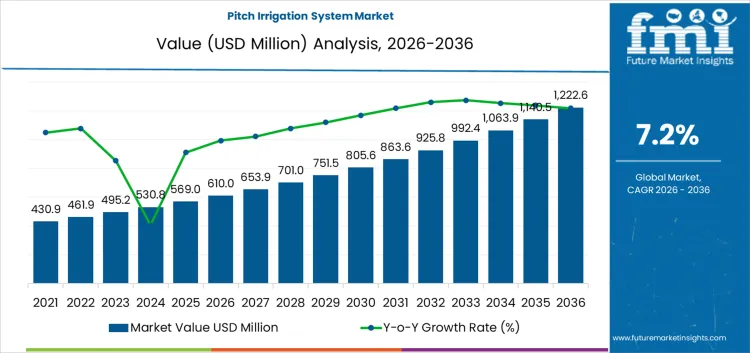
Pitch Irrigation System Market Key Takeaways
| Metric | Value |
|---|---|
| Industry Value (2026) | USD 610.0 Million |
| Forecast Value (2036) | USD 1,222.6 Million |
| Forecast CAGR 2026 to 2036 | 7.20% |
How Is the Global Pitch Irrigation System Market Advancing?
The global pitch irrigation system market is advancing steadily, driven by increasing investment in sports infrastructure and the growing need for precise water management on natural and artificial playing surfaces. Pitch irrigation systems are widely used across football, cricket, rugby, and multi-sport facilities to maintain consistent turf quality, control surface temperature, and support optimal playing conditions.
A key driver supporting market growth is the rising emphasis on turf performance and durability in professional and community sports venues. Proper irrigation helps maintain grass health, reduce surface hardness, and minimize dust generation, which is critical for player safety and pitch longevity. Sports authorities and facility managers are increasingly adopting automated irrigation systems to achieve uniform water distribution while reducing manual labor and water wastage.
Technological advancements are further strengthening market adoption. Innovations in smart controllers, soil moisture sensors, and weather-based irrigation scheduling are improving system efficiency and control accuracy. Integration with ground management software enables real-time monitoring and precise irrigation planning. As sports facilities continue to prioritize pitch quality, operational efficiency, and long-term maintenance optimization, the pitch irrigation system market is expected to experience consistent growth over the forecast period.
What Is the Segment-Wise Overview of the Pitch Irrigation System Market?
The pitch irrigation system market is driven by the need for consistent turf quality and professional field management. Pop-up sprinkler systems lead with a 46% share, reflecting their ability to deliver uniform irrigation while remaining hidden during play to protect athletes and equipment. These systems are widely used across professional and semi-professional sports pitches. On the sales channel side, specialist turf contractors account for 44% of demand, as sports facilities rely on expert design, installation, and maintenance services to meet performance standards. Together, these segments highlight a market focused on precision irrigation, turf performance, and contractor-led system deployment.
Why Do Pop-Up Sprinkler Systems Lead the Pitch Irrigation System Market?
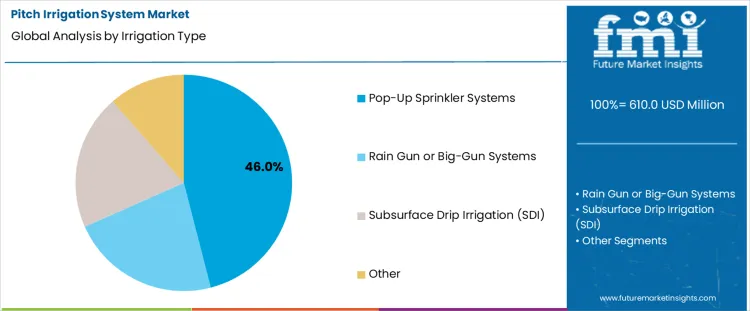
Pop-up sprinkler systems account for 46% of the pitch irrigation system market due to their reliability, uniform water distribution, and suitability for professional sports turf. These systems are widely used in football, cricket, golf, and multi-sport pitches where consistent surface quality is critical. Pop-up sprinklers remain concealed below ground when inactive, protecting players and maintenance equipment while preserving field aesthetics. Their ability to deliver controlled spray patterns and adjustable arc coverage ensures even irrigation across large turf areas. Integration with automated control systems allows grounds managers to optimize watering schedules based on weather and soil conditions. Proven performance, ease of maintenance, and compatibility with modern turf management practices continue to position pop-up sprinkler systems as the preferred irrigation solution for professional and semi-professional sports pitches.
Why Do Specialist Turf Contractors Dominate Sales Channels in the Pitch Irrigation System Market?
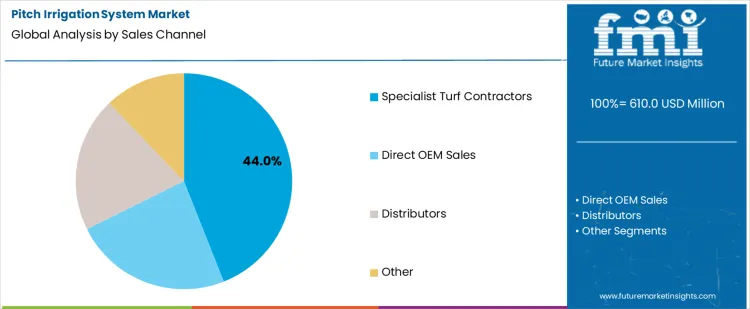
Specialist turf contractors represent 44% of sales channel demand, making them the dominant route in the pitch irrigation system market. Sports pitches require highly customized irrigation designs that account for turf type, soil structure, drainage, and usage intensity. Specialist contractors provide end-to-end services, including system design, installation, calibration, and ongoing maintenance. Their expertise ensures compliance with sports governing standards and optimal playing conditions throughout the season. Stadium owners, sports academies, and municipalities prefer working with experienced contractors to minimize performance risks and long-term maintenance issues. These contractors also act as trusted advisors, recommending suitable equipment and upgrades. As professional turf management becomes more technical and performance-driven, specialist turf contractors continue to lead system procurement and deployment.
What Are the Key Dynamics for the Pitch Irrigation System Market?
Pitch irrigation systems including rotating sprinklers, drip lines, and automated control units are designed to ensure uniform water distribution, reduce wastage, and maintain optimal turf health. Key market dynamics include increasing investments in sports infrastructure, rising demand for high-performance irrigation solutions that support turf durability and playability, and greater awareness of water conservation in urban and recreational environments. Technological developments such as sensor-based irrigation scheduling, weather-adaptive controllers, and low-pressure systems improve efficiency, making advanced pitch irrigation solutions attractive to facility managers and groundskeepers focused on sustainability and operational cost savings.
Why Is the Pitch Irrigation System Market Growing?
The pitch irrigation system market is growing as demand for well-maintained sports facilities and landscaped spaces increases globally. Professional and community sports venues require precise irrigation to prevent dry patches, reduce turf stress, and enhance field aesthetics, elevating the importance of reliable irrigation solutions. Urban expansion and recreational area development are boosting investment in green spaces that rely on effective irrigation systems to preserve vegetation health. Advances in irrigation technology, such as remote monitoring, automated timers, and moisture sensors, enhance water efficiency and help lower utility costs. Greater awareness of water scarcity and regulatory encouragement of efficient irrigation practices are driving adoption.
How Are the Key Drivers Shaping the Pitch Irrigation System Market?
Key drivers shaping the pitch irrigation system market include rising water scarcity concerns and regulatory frameworks that promote judicious water use, motivating end users to invest in efficient irrigation technologies. Technological improvements, such as smart irrigation controllers that adjust watering schedules based on soil moisture and weather forecasts, are enhancing system effectiveness. Integration of IoT-enabled sensors, mobile app controls, and cloud-based data analytics supports real-time system management, reducing waste and labor requirements. Expansion of sports infrastructure in emerging economies and renovation of existing facilities in mature markets both increase demand. Pressure to reduce operational costs and improve turf surface quality at golf courses, stadiums, and parks encourages adoption of systems that optimize water delivery while ensuring consistent coverage and minimal runoff.
What Is the Growth Outlook for the Pitch Irrigation System Market by Country?
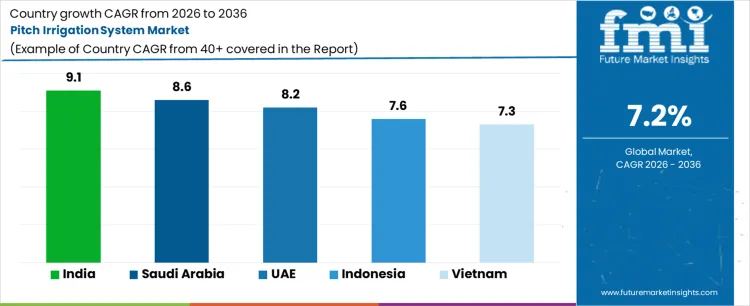
| Country | CAGR (%) |
|---|---|
| India | 9.1% |
| Saudi Arabia | 8.6% |
| UAE | 8.2% |
| Indonesia | 7.6% |
| Vietnam | 7.3% |
What Is Driving the Growth of the Pitch Irrigation System Market in India?
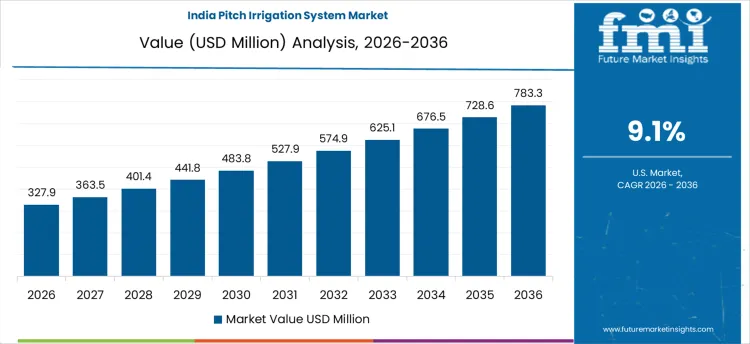
The pitch irrigation system market in India is growing at a CAGR of 9.1%, driven by rising demand for high-quality sports infrastructure and increasing investment in professional and semi-professional sports facilities. Expansion of cricket grounds, football stadiums, hockey turfs, and training academies is creating strong demand for advanced irrigation systems that ensure uniform turf health and playability. Climate variability and water scarcity concerns are pushing facility managers to adopt efficient irrigation solutions that reduce water wastage while maintaining pitch quality. Government-backed sports development programs and private investments in academies and leagues are further supporting market growth. In addition, modernization of existing stadiums and increased hosting of domestic and international sporting events are driving retrofit demand. As sports infrastructure continues to expand across urban and tier-2 cities, adoption of pitch irrigation systems in India is expected to grow steadily.
How Is the Pitch Irrigation System Market Expanding in Saudi Arabia?
The pitch irrigation system market in Saudi Arabia is expanding at a CAGR of 8.6%, supported by large-scale investments in sports infrastructure and recreational facilities. The country’s focus on developing football stadiums, multi-sport complexes, and training centers is driving demand for advanced irrigation solutions capable of operating in arid conditions. Extreme heat and limited natural rainfall make controlled irrigation essential for maintaining high-quality natural grass pitches. Facility operators are increasingly adopting automated and sensor-based irrigation systems to optimize water usage and turf performance. Government-led initiatives to promote sports, entertainment, and international events are further accelerating stadium development. Premium turf standards for professional leagues and international tournaments are influencing adoption of advanced systems. As Saudi Arabia continues to expand its sports ecosystem, demand for pitch irrigation systems is expected to rise consistently.
What Is Supporting Growth of the Pitch Irrigation System Market in the UAE?
The pitch irrigation system market in the UAE is growing at a CAGR of 8.2%, driven by strong emphasis on premium sports facilities and landscaping standards. The UAE hosts numerous football grounds, cricket pitches, golf-adjacent sports areas, and school-level sports facilities that require precise irrigation management. Harsh climatic conditions and limited freshwater availability are encouraging adoption of water-efficient irrigation technologies. Stadium operators and sports clubs are increasingly investing in automated irrigation systems with scheduling and moisture-monitoring capabilities to maintain turf quality year-round. Growth of international sporting events, sports academies, and community recreation facilities further supports demand. High expectations for visual appeal and playability are influencing system upgrades. As the UAE continues to invest in world-class sports infrastructure, demand for pitch irrigation systems is expected to grow steadily.
How Is the Pitch Irrigation System Market Developing in Indonesia?
The pitch irrigation system market in Indonesia is expanding at a CAGR of 7.6%, supported by growing investment in football and multi-purpose sports facilities. Rising participation in organized sports and development of regional stadiums are increasing demand for reliable turf maintenance solutions. Tropical climate conditions with alternating heavy rainfall and dry periods create challenges for pitch management, encouraging adoption of controlled irrigation systems. Sports authorities and facility managers are increasingly focusing on improving pitch durability and drainage efficiency. Government investments in sports infrastructure and preparation for regional tournaments are also supporting market growth. In addition, growth of school and university sports programs is contributing to broader adoption. As Indonesia continues to improve sports facility standards nationwide, demand for pitch irrigation systems is expected to increase steadily.
How Is the Pitch Irrigation System Market Expanding in Vietnam?
The pitch irrigation system market in Vietnam is growing at a CAGR of 7.3%, driven by increasing development of football stadiums and community sports facilities. Rising interest in professional sports and youth training programs is encouraging investment in high-quality natural grass pitches. Variable weather conditions, including seasonal rainfall and dry spells, are increasing the need for efficient irrigation management. Facility operators are adopting automated irrigation systems to maintain consistent turf conditions and reduce manual maintenance effort. Government support for sports development and urban recreation infrastructure is further strengthening demand. Renovation of older stadiums is creating retrofit opportunities for modern irrigation solutions. As Vietnam continues to expand and modernize its sports infrastructure, demand for pitch irrigation systems is expected to grow at a stable pace.
How Are Companies Competing in the Pitch Irrigation System Market?
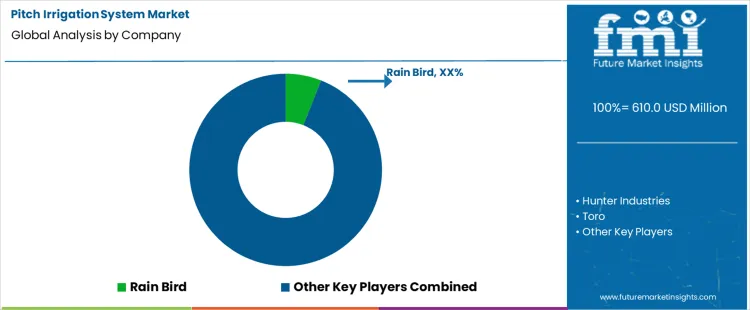
Competition in the pitch irrigation system market is driven by water distribution uniformity, system reliability, ease of control, and the ability to maintain consistent playing surface conditions across professional and community sports facilities. Stadiums and turf managers require irrigation systems that support precise moisture control, rapid drainage recovery, and minimal disruption to play schedules. Companies compete on sprinkler performance, zoning accuracy, smart control integration, and adaptability to different turf types and pitch layouts. Differentiation increasingly centers on precision irrigation, remote monitoring, and systems that reduce overwatering while preserving turf health and playability.
Rain Bird, Hunter Industries, Toro, Netafim, and Rivulis lead competition through specialized sports turf portfolios, advanced control systems, and global installer networks. Rain Bird and Hunter Industries differentiate with high-performance rotors, variable arc control, and robust central control platforms widely adopted in professional stadiums. Toro leverages strong turf management expertise, integrating irrigation with mowing and turf care solutions. Netafim and Rivulis bring precision irrigation and hydraulic expertise, particularly for subsurface and hybrid systems used in training grounds and high-performance pitches requiring uniform root-zone moisture management.
Nelson Irrigation, Jain Irrigation, Toro (Irritrol brand), K-Rain compete through customization, cost efficiency, and localized service. Nelson and Toro (Irritrol brand) focus on durable sprinkler designs and controller flexibility for mid-scale sports facilities. Jain Irrigation competes by adapting agricultural irrigation expertise to sports turf applications, particularly in emerging regions. K-Rain differentiate through tailored system design, installation, and maintenance services. Across the market, competitive advantage is defined by irrigation precision, system uptime, smart control capability, and the ability to deliver consistent, high-quality playing surfaces under varying climate and usage conditions.
Key Players in Pitch Irrigation System Market
- Rain Bird
- Hunter Industries
- Toro
- Netafim
- Rivulis
- Nelson Irrigation
- Jain Irrigation
- Toro (Irritrol brand)
- K-Rain
Scope of Report
| Attributes | Description |
|---|---|
| Quantitative Unit (2026) | USD Million |
| Irrigation Type | Pop-Up Sprinkler Systems, Rain Gun or Big-Gun Systems, Subsurface Drip Irrigation (SDI), Other |
| Sales Channel | Specialist Turf Contractors, Direct OEM Sales, Distributors, Other |
| Regions Covered | Asia Pacific, Europe, North America, Latin America, Middle East & Africa |
| Countries Covered | China, Japan, South Korea, India, Australia & New Zealand, ASEAN, Rest of Asia Pacific, Germany, United Kingdom, France, Italy, Spain, Nordic, BENELUX, Rest of Europe, United States, Canada, Mexico, Brazil, Chile, Rest of Latin America, Kingdom of Saudi Arabia, Other GCC Countries, Turkey, South Africa, Other African Union, Rest of Middle East & Africa |
| Key Companies Profiled | Rain Bird, Hunter Industries, Toro, Netafim, Rivulis, Nelson Irrigation, Jain Irrigation, Toro (Irritrol brand), K-Rain |
| Additional Attributes | Dollar sales by irrigation type and sales channel; regional market size and forecast analysis; growth outlook across major regions; adoption trends for precision turf and pitch irrigation solutions; assessment of water efficiency requirements, system reliability, and demand patterns across professional sports pitches, training grounds, and managed turf facilities. |
Pitch Irrigation System Market by Key Segments
Irrigation Type
- Pop-Up Sprinkler Systems
- Rain Gun or Big-Gun Systems
- Subsurface Drip Irrigation (SDI)
- Other
Sales Channel
- Specialist Turf Contractors
- Direct OEM Sales
- Distributors
- Other
Region:
- Asia Pacific
- China
- Japan
- South Korea
- India
- Australia & New Zealand
- ASEAN
- Rest of Asia Pacific
- Europe
- Germany
- United Kingdom
- France
- Italy
- Spain
- Nordic
- BENELUX
- Rest of Europe
- North America
- United States
- Canada
- Mexico
- Latin America
- Brazil
- Chile
- Rest of Latin America
- Middle East & Africa
- Kingdom of Saudi Arabia
- Other GCC Countries
- Turkey
- South Africa
- Other African Union
- Rest of Middle East & Africa
Bibliography
- Food and Agriculture Organization of the United Nations. (2023). Guidelines for efficient irrigation management practices in sports and recreational turf systems. FAO.
- European Committee for Standardization. (2024). EN 1717: Protection against pollution of potable water in irrigation systems — General principles and requirements. CEN.
- Irrigation Association. (2024). Smart irrigation technologies and industry best practices. Irrigation Association.
- United Nations Environment Programme. (2023). Water resource efficiency and sustainable irrigation practices for urban green infrastructure. UNEP.
- World Health Organization. (2024). Water safety and irrigation reuse standards for non-food turf applications. WHO.
Frequently Asked Questions
How big is the pitch irrigation system market in 2026?
The global pitch irrigation system market is estimated to be valued at USD 610.0 million in 2026.
What will be the size of pitch irrigation system market in 2036?
The market size for the pitch irrigation system market is projected to reach USD 1,222.6 million by 2036.
How much will be the pitch irrigation system market growth between 2026 and 2036?
The pitch irrigation system market is expected to grow at a 7.2% CAGR between 2026 and 2036.
What are the key product types in the pitch irrigation system market?
The key product types in pitch irrigation system market are pop-up sprinkler systems, rain gun or big-gun systems, subsurface drip irrigation (sdi) and other.
Which sales channel segment to contribute significant share in the pitch irrigation system market in 2026?
In terms of sales channel, specialist turf contractors segment to command 44.0% share in the pitch irrigation system market in 2026.
Preview the report firsthand - request a free sample
Get SampleGet the brochure for pricing and purchase details.
Get PDFTable of Content
- Executive Summary
- Global Market Outlook
- Demand-side Trends
- Supply-side Trends
- Technology Roadmap Analysis
- Analysis and Recommendations
- Market Overview
- Market Coverage / Taxonomy
- Market Definition / Scope / Limitations
- Market Background
- Market Dynamics
- Drivers
- Restraints
- Opportunity
- Trends
- Scenario Forecast
- Demand in Optimistic Scenario
- Demand in Likely Scenario
- Demand in Conservative Scenario
- Opportunity Map Analysis
- Product Life Cycle Analysis
- Supply Chain Analysis
- Investment Feasibility Matrix
- Value Chain Analysis
- PESTLE and Porter’s Analysis
- Regulatory Landscape
- Regional Parent Market Outlook
- Production and Consumption Statistics
- Import and Export Statistics
- Market Dynamics
- Global Market Analysis 2021 to 2025 and Forecast, 2026 to 2036
- Historical Market Size Value (USD Million) Analysis, 2021 to 2025
- Current and Future Market Size Value (USD Million) Projections, 2026 to 2036
- Y-o-Y Growth Trend Analysis
- Absolute $ Opportunity Analysis
- Global Market Pricing Analysis 2021 to 2025 and Forecast 2026 to 2036
- Global Market Analysis 2021 to 2025 and Forecast 2026 to 2036, By Irrigation Type
- Introduction / Key Findings
- Historical Market Size Value (USD Million) Analysis By Irrigation Type , 2021 to 2025
- Current and Future Market Size Value (USD Million) Analysis and Forecast By Irrigation Type , 2026 to 2036
- Pop-Up Sprinkler Systems
- Rain Gun or Big-Gun Systems
- Subsurface Drip Irrigation (SDI)
- Other
- Pop-Up Sprinkler Systems
- Y-o-Y Growth Trend Analysis By Irrigation Type , 2021 to 2025
- Absolute $ Opportunity Analysis By Irrigation Type , 2026 to 2036
- Global Market Analysis 2021 to 2025 and Forecast 2026 to 2036, By Sales Channel
- Introduction / Key Findings
- Historical Market Size Value (USD Million) Analysis By Sales Channel, 2021 to 2025
- Current and Future Market Size Value (USD Million) Analysis and Forecast By Sales Channel, 2026 to 2036
- Specialist Turf Contractors
- Direct OEM Sales
- Distributors
- Other
- Specialist Turf Contractors
- Y-o-Y Growth Trend Analysis By Sales Channel, 2021 to 2025
- Absolute $ Opportunity Analysis By Sales Channel, 2026 to 2036
- Global Market Analysis 2021 to 2025 and Forecast 2026 to 2036, By Region
- Introduction
- Historical Market Size Value (USD Million) Analysis By Region, 2021 to 2025
- Current Market Size Value (USD Million) Analysis and Forecast By Region, 2026 to 2036
- North America
- Latin America
- Western Europe
- Eastern Europe
- East Asia
- South Asia and Pacific
- Middle East & Africa
- Market Attractiveness Analysis By Region
- North America Market Analysis 2021 to 2025 and Forecast 2026 to 2036, By Country
- Historical Market Size Value (USD Million) Trend Analysis By Market Taxonomy, 2021 to 2025
- Market Size Value (USD Million) Forecast By Market Taxonomy, 2026 to 2036
- By Country
- USA
- Canada
- Mexico
- By Irrigation Type
- By Sales Channel
- By Country
- Market Attractiveness Analysis
- By Country
- By Irrigation Type
- By Sales Channel
- Key Takeaways
- Latin America Market Analysis 2021 to 2025 and Forecast 2026 to 2036, By Country
- Historical Market Size Value (USD Million) Trend Analysis By Market Taxonomy, 2021 to 2025
- Market Size Value (USD Million) Forecast By Market Taxonomy, 2026 to 2036
- By Country
- Brazil
- Chile
- Rest of Latin America
- By Irrigation Type
- By Sales Channel
- By Country
- Market Attractiveness Analysis
- By Country
- By Irrigation Type
- By Sales Channel
- Key Takeaways
- Western Europe Market Analysis 2021 to 2025 and Forecast 2026 to 2036, By Country
- Historical Market Size Value (USD Million) Trend Analysis By Market Taxonomy, 2021 to 2025
- Market Size Value (USD Million) Forecast By Market Taxonomy, 2026 to 2036
- By Country
- Germany
- UK
- Italy
- Spain
- France
- Nordic
- BENELUX
- Rest of Western Europe
- By Irrigation Type
- By Sales Channel
- By Country
- Market Attractiveness Analysis
- By Country
- By Irrigation Type
- By Sales Channel
- Key Takeaways
- Eastern Europe Market Analysis 2021 to 2025 and Forecast 2026 to 2036, By Country
- Historical Market Size Value (USD Million) Trend Analysis By Market Taxonomy, 2021 to 2025
- Market Size Value (USD Million) Forecast By Market Taxonomy, 2026 to 2036
- By Country
- Russia
- Poland
- Hungary
- Balkan & Baltic
- Rest of Eastern Europe
- By Irrigation Type
- By Sales Channel
- By Country
- Market Attractiveness Analysis
- By Country
- By Irrigation Type
- By Sales Channel
- Key Takeaways
- East Asia Market Analysis 2021 to 2025 and Forecast 2026 to 2036, By Country
- Historical Market Size Value (USD Million) Trend Analysis By Market Taxonomy, 2021 to 2025
- Market Size Value (USD Million) Forecast By Market Taxonomy, 2026 to 2036
- By Country
- China
- Japan
- South Korea
- By Irrigation Type
- By Sales Channel
- By Country
- Market Attractiveness Analysis
- By Country
- By Irrigation Type
- By Sales Channel
- Key Takeaways
- South Asia and Pacific Market Analysis 2021 to 2025 and Forecast 2026 to 2036, By Country
- Historical Market Size Value (USD Million) Trend Analysis By Market Taxonomy, 2021 to 2025
- Market Size Value (USD Million) Forecast By Market Taxonomy, 2026 to 2036
- By Country
- India
- ASEAN
- Australia & New Zealand
- Rest of South Asia and Pacific
- By Irrigation Type
- By Sales Channel
- By Country
- Market Attractiveness Analysis
- By Country
- By Irrigation Type
- By Sales Channel
- Key Takeaways
- Middle East & Africa Market Analysis 2021 to 2025 and Forecast 2026 to 2036, By Country
- Historical Market Size Value (USD Million) Trend Analysis By Market Taxonomy, 2021 to 2025
- Market Size Value (USD Million) Forecast By Market Taxonomy, 2026 to 2036
- By Country
- Kingdom of Saudi Arabia
- Other GCC Countries
- Turkiye
- South Africa
- Other African Union
- Rest of Middle East & Africa
- By Irrigation Type
- By Sales Channel
- By Country
- Market Attractiveness Analysis
- By Country
- By Irrigation Type
- By Sales Channel
- Key Takeaways
- Key Countries Market Analysis
- USA
- Pricing Analysis
- Market Share Analysis, 2025
- By Irrigation Type
- By Sales Channel
- Canada
- Pricing Analysis
- Market Share Analysis, 2025
- By Irrigation Type
- By Sales Channel
- Mexico
- Pricing Analysis
- Market Share Analysis, 2025
- By Irrigation Type
- By Sales Channel
- Brazil
- Pricing Analysis
- Market Share Analysis, 2025
- By Irrigation Type
- By Sales Channel
- Chile
- Pricing Analysis
- Market Share Analysis, 2025
- By Irrigation Type
- By Sales Channel
- Germany
- Pricing Analysis
- Market Share Analysis, 2025
- By Irrigation Type
- By Sales Channel
- UK
- Pricing Analysis
- Market Share Analysis, 2025
- By Irrigation Type
- By Sales Channel
- Italy
- Pricing Analysis
- Market Share Analysis, 2025
- By Irrigation Type
- By Sales Channel
- Spain
- Pricing Analysis
- Market Share Analysis, 2025
- By Irrigation Type
- By Sales Channel
- France
- Pricing Analysis
- Market Share Analysis, 2025
- By Irrigation Type
- By Sales Channel
- India
- Pricing Analysis
- Market Share Analysis, 2025
- By Irrigation Type
- By Sales Channel
- ASEAN
- Pricing Analysis
- Market Share Analysis, 2025
- By Irrigation Type
- By Sales Channel
- Australia & New Zealand
- Pricing Analysis
- Market Share Analysis, 2025
- By Irrigation Type
- By Sales Channel
- China
- Pricing Analysis
- Market Share Analysis, 2025
- By Irrigation Type
- By Sales Channel
- Japan
- Pricing Analysis
- Market Share Analysis, 2025
- By Irrigation Type
- By Sales Channel
- South Korea
- Pricing Analysis
- Market Share Analysis, 2025
- By Irrigation Type
- By Sales Channel
- Russia
- Pricing Analysis
- Market Share Analysis, 2025
- By Irrigation Type
- By Sales Channel
- Poland
- Pricing Analysis
- Market Share Analysis, 2025
- By Irrigation Type
- By Sales Channel
- Hungary
- Pricing Analysis
- Market Share Analysis, 2025
- By Irrigation Type
- By Sales Channel
- Kingdom of Saudi Arabia
- Pricing Analysis
- Market Share Analysis, 2025
- By Irrigation Type
- By Sales Channel
- Turkiye
- Pricing Analysis
- Market Share Analysis, 2025
- By Irrigation Type
- By Sales Channel
- South Africa
- Pricing Analysis
- Market Share Analysis, 2025
- By Irrigation Type
- By Sales Channel
- USA
- Market Structure Analysis
- Competition Dashboard
- Competition Benchmarking
- Market Share Analysis of Top Players
- By Regional
- By Irrigation Type
- By Sales Channel
- Competition Analysis
- Competition Deep Dive
- Rain Bird
- Overview
- Product Portfolio
- Profitability by Market Segments (Product/Age /Sales Channel/Region)
- Sales Footprint
- Strategy Overview
- Marketing Strategy
- Product Strategy
- Channel Strategy
- Hunter Industries
- Toro
- Netafim
- Rivulis
- Nelson Irrigation
- Jain Irrigation
- Toro (Irritrol brand)
- K-Rain
- Rain Bird
- Competition Deep Dive
- Assumptions & Acronyms Used
- Research Methodology


