

- Market Size (2026)
- USD 60.0 Mn
- Forecast (2036)
- USD 135.0 Mn
- CAGR (2026 to 2036)
- 8.4%
How big is the Point-of-Care Respiratory Diagnostic Panels Market in 2026?
USD 60.0 million in 2026 and USD 135.0 million by 2036 at an 8.4% CAGR.
Sales of point-of-care respiratory diagnostic panels are estimated to rise at 8.4% CAGR through 2036, increasing valuation from USD 60.0 million in 2026 to USD 135.0 million by 2036 as health systems expanded rapid testing across near-patient settings. Respiratory viruses often produce similar symptoms during the same seasonal period and rapid differentiation can alter treatment or isolation decisions. The FDA granted a CLIA waiver in April 2025 for Roche’s four-target cobas liat respiratory assay. The decision widened access to point-of-care molecular diagnostics without sending every specimen to a central laboratory. Related multiplex PCR assays support one-sample testing that separates four common respiratory targets during a patient visit.
Testing choices differ across care settings since molecular panels emphasize greater analytical sensitivity for symptomatic patients. CDC guidance published in April 2026 states that molecular tests provide higher sensitivity than antigen tests for respiratory viruses. The guidance explains that multiplex results can support antiviral decisions and broader clinical management during one patient encounter. Hospital networks often connect panel results with laboratory information systems and electronic records across several departments. Urgent care centers evaluate respiratory pathogen testing through turnaround time and operator training alongside supported treatment decisions. Commercial adoption therefore depends on matched test menus and reliable controls together with service coverage rather than analytical performance alone.
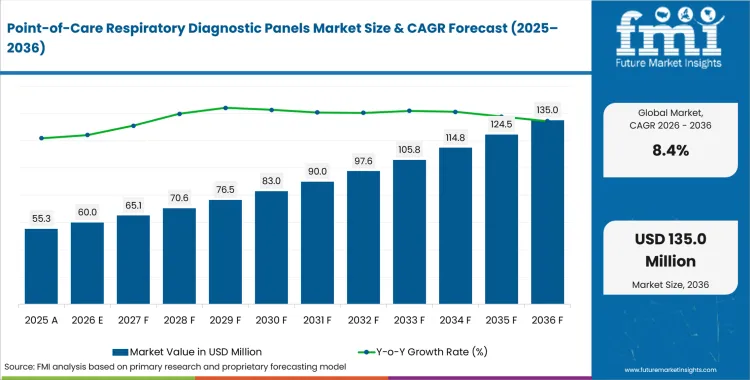
Key Takeaways of Point-of-Care Respiratory Diagnostic Panels Market
- Demand for point-of-care respiratory diagnostic panels reflects one-visit differentiation of common infections and immediate treatment decisions across near-patient care settings.
- Diagnostic kit is expected to account for 44.0% share in 2026 within product type, supported by standardized consumables and familiar testing procedures.
- Hospital is projected to capture 38.0% of care setting demand in 2026, reflecting concentrated respiratory volumes and immediate treatment requirements.
- Variable sensitivity and reimbursement requirements remain material constraints for decentralized programs that need dependable results across routine clinical operators.
- Competition centers on Abbott, Roche, bioMérieux, QuidelOrtho, Cepheid, Waters Advanced Diagnostics, DiaSorin, and Baebies across antigen and molecular respiratory testing formats.
Analyst Perspective
"Point-of-care respiratory panels create commercial value if one result changes antiviral treatment or patient placement during the initial visit. A wider target menu adds little if collection steps and reimbursement rules prevent consistent use outside central laboratories. Successful platforms pair clinically useful differentiation with simple specimen handling and dependable seasonal test supply across care networks. Hospital groups need service coverage that preserves the same result workflow during seasonal respiratory peaks."
- Anurag Sharma, Principal Analyst, Future Market Insights
How is the Point-of-Care Respiratory Diagnostic Panels Market segmented?
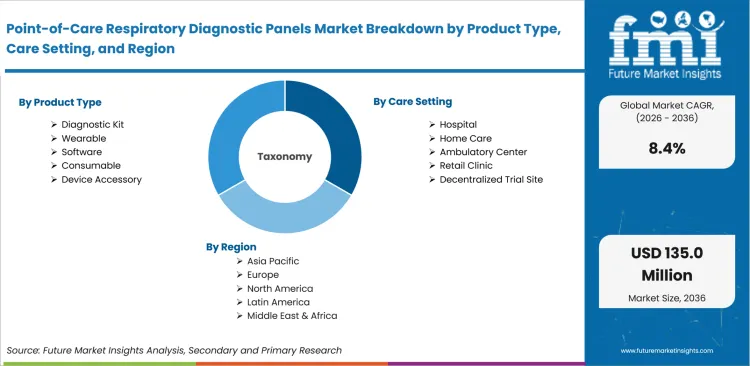
The point-of-care respiratory diagnostic panels industry is segmented by product type, care setting, application, end user, and region.
The market is segmented by product type, care setting, application, end user, and region across five commercial and clinical dimensions. Product type includes software, diagnostic kits, consumables, instruments, and device accessories used across different operating workflows. Care setting covers hospitals, home care, ambulatory centers, retail clinics, and decentralized trial sites with distinct staffing models. Application separates monitoring, diagnosis, workflow automation, therapy support, and infection control according to the result’s intended clinical role. End user analysis compares hospitals, payers, diagnostic laboratories, medtech firms, and patients according to who controls use, payment, or implementation. Regional analysis examines regulatory access, reimbursement, service coverage, and respiratory surveillance needs across major healthcare systems. The segmentation structure shows how molecular and immunoassay formats reach near-patient workflows through different purchasing and operating routes.
What supports demand for diagnostic kit within the product type category?
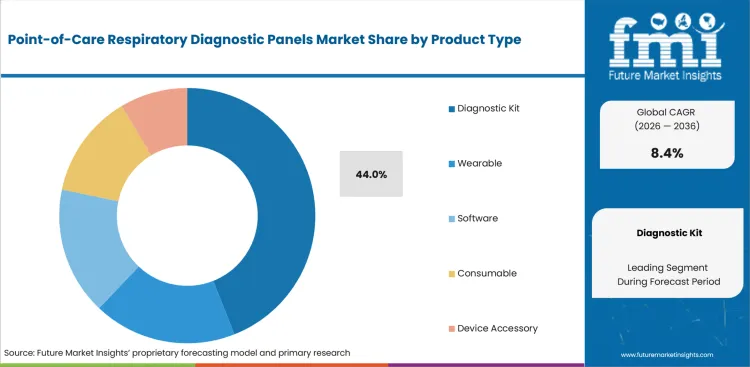
Diagnostic kits combine reagents and collection materials within a repeatable workflow that clinics can teach across rotating staff. QuidelOrtho announced professional availability of the QUICKVUE Influenza + SARS Test in September 2025 for waived and higher-complexity settings. The launch added three differentiated results from one nasal sample for physician offices and urgent care centers. Broader point-of-care diagnostics adoption favors kits with clear controls and predictable storage requirements across seasonal demand.
- Diagnostic kit is set to lead the product type category with 44.0% share in 2026 due to standardized contents that simplify recurring orders. Clinics can compare kit cost with the number of reportable results produced during each patient visit. Packaged reagents reduce separate purchasing decisions for swabs and control materials across routine testing programs.
- Urgent care networks favor respiratory kits that can be stocked ahead of seasonal peaks without complicated instrument planning. Consistent collection steps and result rules simplify training across multiple locations with rotating operator groups. Laboratory managers must track expiration patterns and control frequency because unused seasonal inventory can weaken the operating case.
How is hospital positioned within the care setting category?
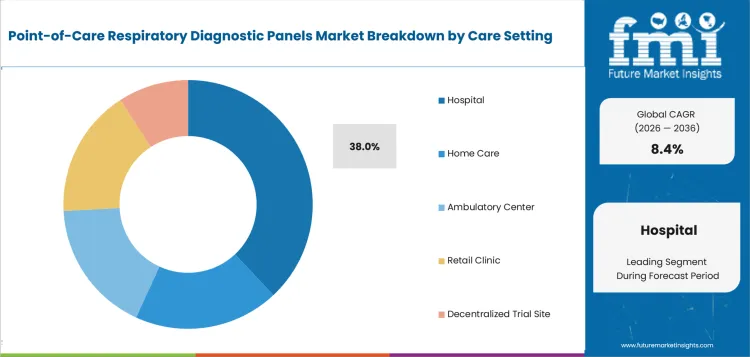
Hospital respiratory pathways connect emergency intake with inpatient decisions across several departments and testing locations. Emergency teams need results soon enough to guide antiviral treatment and patient placement during the initial encounter. Laboratory oversight remains necessary for operators outside the central laboratory who follow specimen and quality procedures consistently. The setting favors compact clinical diagnostics platforms that combine simple collection with electronic reporting across several departments.
- The hospital segment is likely to capture 38.0% share in 2026 attributable to concentrated respiratory volumes and immediate treatment decisions. Emergency departments can use rapid differentiation to support cohorting and antiviral choices during the same encounter. Concentrated placement supports centralized training and consistent quality review across several testing locations within one health system.
- Health systems expand near-patient testing through controlled placements that concentrate training and quality review in high-volume departments. bioMérieux announced FDA clearance and a CLIA waiver in August 2025 for anterior nasal specimens on the BIOFIRE SPOTFIRE R/ST Panel Mini . The simpler specimen route can reduce collection burden during emergency intake and preserve laboratory oversight across connected sites.
What makes monitoring central to the application category?
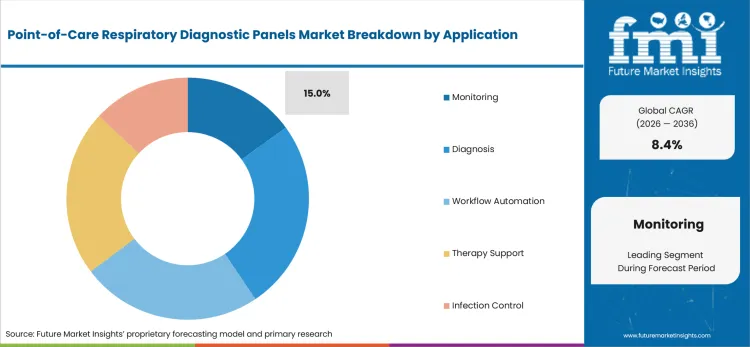
Monitoring demand arises from repeated surveillance and changing virus circulation across seasonal testing programs and reporting networks. Public health laboratories need consistent result formats to compare circulation across locations and respiratory seasons. Hospital networks use surveillance signals to align panel menus with local treatment and infection-control needs. Related infectious disease diagnostics help teams connect routine patient testing with reporting systems and seasonal operating plans.
- Based on application, monitoring is projected to account for 15.0% in 2026 due to recurring surveillance needs across seasonal and high-risk care pathways. CDC described its Flu SC2 multiplex assay in September 2025 as supporting simultaneous influenza and SARS-CoV-2 surveillance. Consistent result formats help hospital and public health teams compare circulation patterns across defined service areas.
- Public health laboratories and hospital networks adopt monitoring workflows that connect routine testing with defined reporting systems. Operators need stable target performance as viral patterns change across seasons and local patient populations. Commercial value depends on result standardization across sites rather than adding targets that lack a clear surveillance purpose.
How do decision-makers evaluate payers within the end user category?
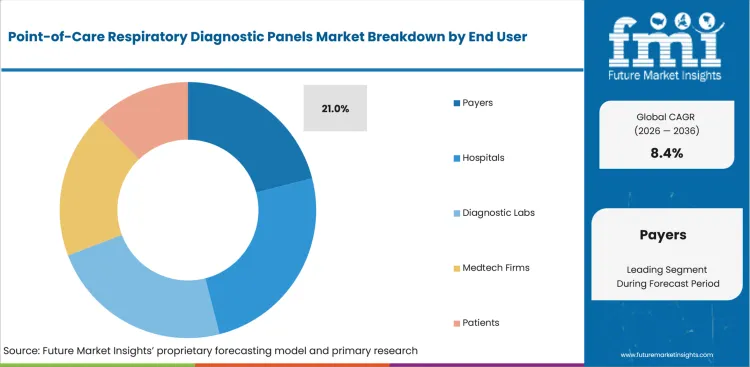
Coverage decisions depend on whether a respiratory panel meets medical-necessity rules and produces billable results under an applicable policy. Health plans assess whether the panel changes treatment or follow-up enough to justify one bundled service. CMS revised its respiratory pathogen panel billing article in July 2025 and required each panel to remain one bundled service. The policy makes code structure and documented clinical purpose central to infectious disease molecular diagnostics reimbursement planning.
- By end user, payers are estimated to hold 21.0% in 2026 owing to coverage control and measurable consequences for treatment or follow-up. A panel can reduce separate testing steps but payment depends on correct coding and documented clinical need. Manufacturers need pathway-specific economic evidence that connects test results with treatment choices and follow-up requirements.
- Health plans and public programs evaluate respiratory panels through code structure and expected changes in treatment or follow-up. Coverage can vary across contractors and patient groups for the same technically identical respiratory panel. Commercial teams should map each panel to current policy language rather than assume analytical clearance guarantees reimbursement in every setting.
What are the drivers, restraints, and opportunities in the Point-of-Care Respiratory Diagnostic Panels Market?
Seasonal respiratory volumes support panel adoption while test sensitivity and reimbursement rules determine which decentralized workflows produce repeat purchasing.
- Driver: Overlapping respiratory symptoms increase the value of one-sample testing that supports treatment decisions during the same patient visit.
- Restraint: Lower antigen sensitivity and variable operator requirements can limit confidence across broader decentralized respiratory testing programs.
- Opportunity: Expanded waived molecular platforms create new routes for accurate testing within urgent care and physician-office settings.
Large respiratory caseloads are expected to drive the need for tests that distinguish common viruses without several separate collection steps. CDC estimated in March 2026 that influenza caused 23 million United States outpatient medical visits during the 2024-2025 season. High visit volumes support panel utilization at clinics that need results during the treatment window. A stronger commercial case emerges if one panel replaces sequential assays and supports a clear decision during the same encounter.
Analytical tradeoffs remain a material restraint for sites choosing between rapid antigen formats and molecular panels. CDC guidance published in December 2025 states that negative antigen results do not exclude infection among symptomatic high-risk outpatients. Clinicians can require molecular confirmation if treatment decisions remain uncertain following a negative rapid result. The added confirmation step raises total testing cost and weakens convenience across decentralized clinical workflows with limited staffing. Testing programs therefore need clear escalation rules and patient communication plans across every participating clinical location.
New distribution agreements create a commercial opening for waived molecular systems entering decentralized care channels. DiaSorin announced an exclusive United States hospital-channel agreement with Fisher Scientific in January 2026 for the LIAISON NES platform. The agreement followed FDA clearance and a CLIA waiver for DiaSorin’s four-target respiratory panel in December 2025. Established distribution can shorten account access and support instrument or test inventory across hospital networks. DiaSorin must demonstrate consistent testing volume and operator competency across recurring respiratory seasons within participating hospital networks.
Which country CAGRs are profiled in the Point-of-Care Respiratory Diagnostic Panels Market?
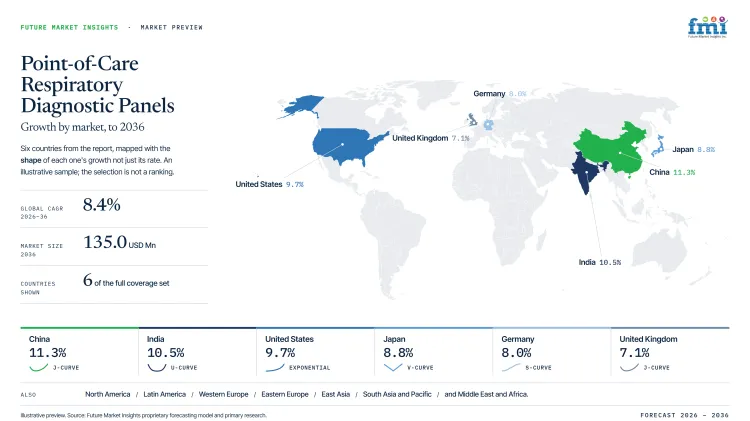
| Country | CAGR |
| China | 11.3% |
| India | 10.5% |
| United States | 9.7% |
| Japan | 8.8% |
| Germany | 8.0% |
| United Kingdom | 7.1% |
How do country-level CAGRs compare in the Point-of-Care Respiratory Diagnostic Panels Market?
The six country forecasts form a measured progression across the assessment period rather than sharply separated growth groups. China and India differ by 0.8 percentage point within the upper range of the displayed national forecasts. The United States and Japan form the middle range with a measured 0.9-point gap between forecasts. Germany and the United Kingdom complete the comparison with another 0.9-point interval between national outlooks. The total spread equals 4.2 percentage points from the first displayed country to the last. National outcomes depend on regulatory access and decentralized care capacity together with reimbursement and service coverage. The pattern reflects distinct commercialization routes rather than one universal model for respiratory panel manufacturers.
- China combines concentrated urban hospital networks with weekly surveillance signals that help clinical laboratories adjust respiratory testing menus during seasonal changes.
- India pairs an expanding district laboratory network with uneven technical support across smaller cities and lower-volume diagnostic locations.
- United States adoption benefits from waived testing routes while reimbursement rules create different economics across outpatient clinical pathways.
- Japan favors compact near-patient systems that fit smaller clinical footprints and connect with structured national sentinel surveillance programs.
- Germany combines mandatory pathogen reporting with fragmented purchasing requirements across hospitals and ambulatory physician practices.
- United Kingdom commercialization depends on national evidence requirements and regional service capacity within centralized health-system purchasing routes.
Comparable growth rates can produce different entry conditions as payment routes and service networks vary across national healthcare systems. Manufacturers should evaluate approval status and distributor capability together with training capacity during comparisons of commercial timing. The full report provides country-level CAGR analysis across North America, Latin America, Europe, East Asia, South Asia, Oceania and the Middle East and Africa.
Country-wise Analysis
- China’s national surveillance system reports weekly influenza testing and outbreak activity across northern and southern regions. Point-of-care respiratory panel demand in China is forecast to rise at 11.3% CAGR over the forecast period, supported by concentrated hospital demand and recurring surveillance-led testing decisions. Large urban hospital networks support adoption by concentrating respiratory testing volume within connected clinical systems. The Chinese National Influenza Center reported 201 influenza-like illness outbreaks in December 2025 during surveillance week 51. Weekly reporting helps hospital laboratories adjust test menus as circulating viruses change across provinces and seasons. Service distance and operator training remain material frictions for clinical facilities outside major metropolitan areas. Manufacturers need provincial reagent coverage and technical support routes that maintain instrument uptime across dispersed clinical networks.
- India’s ICMR opened a technology-transfer route for a multiplex RT-PCR assay covering influenza A and B alongside RSV A and B and SARS-CoV-2. India’s point-of-care respiratory panel outlook is anticipated to advance at 10.5% CAGR over the assessment period, reinforced by domestic assay development and expanding diagnostic networks. ICMR set an April 6, 2026 deadline for commercial expressions of interest in the multiplex technology. The program gives local manufacturers a route to develop assay supply and reduce dependence on imported respiratory panels. Near-patient deployment requires compact instrument integration and regulatory authorization alongside operator training and service coverage beyond major cities. Commercial partners must convert the laboratory technology into a validated cartridge workflow that fits decentralized clinical use.
- United States physician offices and urgent care centers can operate CLIA-waived respiratory tests outside traditional high-complexity laboratories. Point-of-care respiratory diagnostic panel sales in the United States are forecast to expand at 9.7% CAGR by 2036, aided by established waived pathways and outpatient access. Existing distributor channels and trained clinical operators provide a direct adoption enabler for decentralized testing. Coverage rules and confirmatory testing requirements create material friction across payer contracts and treatment pathways. CDC reported in January 2026 that RESP-NET monitors laboratory-confirmed influenza and RSV together with COVID-19 hospitalizations. The network helps health systems compare severe respiratory activity across participating locations and patient groups. Commercial teams should separate throughput gains from sensitivity and reimbursement performance during prospective site evaluations.
- Japan introduced acute respiratory infection as a Category V condition under sentinel surveillance during April 2025. The Japan Institute for Health Security states that the category includes influenza and COVID-19 together with RSV and other common respiratory infections. Adoption of point-of-care respiratory panels in Japan is estimated to expand at 8.8% CAGR through 2036, shaped by structured surveillance and compact care environments. Smaller clinical footprints favor systems with limited hands-on steps and predictable maintenance access across outpatient settings. Local validation and operator training requirements can slow expansion beyond early hospital or clinic placements. Manufacturers need Japanese-language technical support and clear service routes for dependable routine use across regional clinical networks.
- German laboratories must report detected influenza viruses and SARS-CoV-2 together with RSV through the national infectious disease system. Regional purchasing and middleware requirements create material friction across independent hospitals and ambulatory care organizations. In Germany, point-of-care respiratory panel demand is predicted to advance at 8.0% CAGR through 2036, influenced by formal surveillance and dense ambulatory care networks. The Robert Koch Institute explained in May 2025 that respiratory surveillance combines several data sources and updates its central dashboard weekly. Formal reporting favors panel workflows that produce consistent digital results across hospital and ambulatory settings. Manufacturers need dependable service coverage and reporting integration across regional purchasing routes and clinical networks.
- England combines national respiratory surveillance with centralized health-service purchasing and primary care sentinel sampling across regions. The United Kingdom point-of-care respiratory panel market is projected to record 7.1% CAGR during the assessment period, linked to NHS evidence requirements and recurring seasonal testing needs. UKHSA reported in December 2025 that week 51 general-practice samples showed 28.1% influenza positivity and 10.3% RSV positivity. National surveillance provides an adoption enabler for targeted testing and seasonal resource planning across participating care settings. Regional service coverage and formal purchasing reviews can extend deployment timelines for newer respiratory platforms. Manufacturers need evidence packages that address workflow fit and training capacity within each purchasing route.
Who are the notable companies in the Point-of-Care Respiratory Diagnostic Panels Market?
Abbott, Roche, bioMérieux, QuidelOrtho, Cepheid, Waters Advanced Diagnostics, DiaSorin, and Baebies are the notable companies shaping this market.
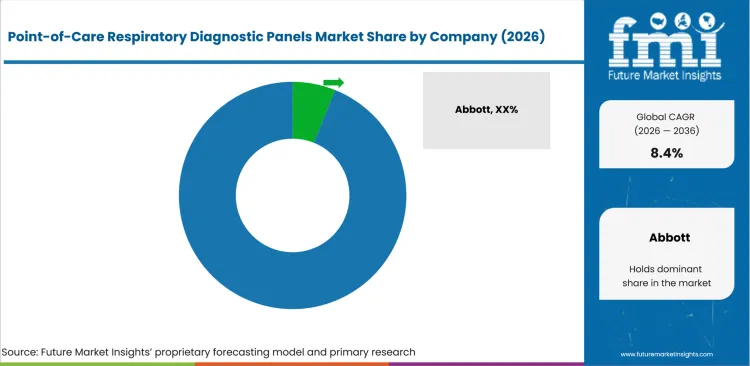
Competition combines rapid antigen specialists with molecular platform developers serving distinct respiratory testing settings and purchasing routes. Roche and Cepheid emphasize cartridge-based PCR systems with broad target menus for near-patient use settings. bioMérieux and DiaSorin extend multiplex molecular testing through compact platforms designed for decentralized clinical care. Abbott and Waters Advanced Diagnostics compete through rapid antigen formats that prioritize simple operation and outpatient access. QuidelOrtho combines established immunoassay channels with the acquired LEX molecular platform for faster decentralized testing. Baebies adds an automated RT-PCR route based on digital microfluidics within an enclosed cartridge for decentralized settings. Commercial differentiation depends on target breadth and workflow fit together with service response during respiratory peaks.
- Roche and bioMérieux compete with Cepheid through multiplex molecular systems designed for respiratory testing near the patient. Their platforms emphasize rapid PCR workflows and automated result reporting across distributed hospitals and outpatient sites. Commercial differentiation depends on target breadth and instrument capacity together with dependable technical service during respiratory peaks.
- Abbott and Waters Advanced Diagnostics compete through rapid antigen formats that reduce hands-on complexity across routine point-of-care locations. QuidelOrtho spans visual and instrument-read immunoassays while adding an ultra-fast molecular platform through the completed LEX acquisition. Their commercial position reflects channel access and workflow familiarity alongside the cost of each reportable result.
- DiaSorin and Baebies provide newer decentralized molecular routes through different equipment designs and operating models. DiaSorin uses a compact automated instrument and Baebies applies digital microfluidics within an enclosed cartridge. Their expansion depends on distributor coverage and reliable test supply together with evidence that smaller sites can sustain routine utilization.
Competitive Benchmarking: Point-of-Care Respiratory Diagnostic Panels Market
| Company | Panel Target Breadth | Point-of-Care Workflow Depth | Regulated Decentralized Access | Geographic Reach |
| Abbott | Medium | High | High | United States |
| Roche | High | High | High | United States |
| bioMérieux | High | High | High | North America and Europe |
| QuidelOrtho | Medium | High | High | United States |
| Cepheid | High | High | High | United States |
| Waters Advanced Diagnostics | Medium | High | Medium | United States |
| DiaSorin | High | High | Medium | United States |
| Baebies | Medium | High | Low | United States |
Key Developments in the Point-of-Care Respiratory Diagnostic Panels Market
- In March 2026, bioMérieux received IVDR CE marking for two BIOFIRE SPOTFIRE respiratory and sore throat panels across Europe. The certification covered near-patient testing outside traditional laboratories and supported results during a patient visit. Each multiplex PCR panel identifies common viral and bacterial targets through the compact SPOTFIRE system. The development expands a regulated decentralized testing route across European hospitals and outpatient care settings.
- In April 2026, QuidelOrtho completed its acquisition of LEX Diagnostics for cash consideration of approximately USD 100 million LEX VELO had received FDA clearance and a CLIA waiver during February 2026 for multiplex influenza and COVID-19 testing. The platform returns results within six to ten minutes through a direct-swab workflow with minimal manual processing. The completed transaction adds an ultra-fast molecular route to QuidelOrtho’s point-of-care respiratory portfolio and broader commercial strategy.
- In February 2026, Waters completed its combination with BD’s Biosciences and Diagnostic Solutions businesses through a closed corporate transaction. The transaction created Waters Advanced Diagnostics as one of four operating divisions serving regulated clinical testing. Waters stated that the division covers microbiology and molecular testing alongside multiplex and point-of-care workflows. The ownership change places diagnostic operations under a new corporate structure that can influence respiratory platform investment and service continuity.
- In December 2025, DiaSorin received FDA clearance and a CLIA waiver for its four-target respiratory panel on LIAISON NES. The assay differentiates influenza A and influenza B together with RSV and SARS-CoV-2 in about fifteen minutes. LIAISON NES uses a compact automated workflow with barcode reading and wireless connectivity for decentralized sites. The clearance gives DiaSorin a regulated molecular entry into United States physician offices and urgent care centers.
Key Players in the Point-of-Care Respiratory Diagnostic Panels Market
Connected Molecular Platform Providers
- Roche
- bioMérieux
- Cepheid
Rapid Antigen and Multi-Format Providers
- Abbott
- QuidelOrtho
- Waters Advanced Diagnostics
Emerging Decentralized Molecular Providers
- DiaSorin
- Baebies
Point-of-Care Respiratory Diagnostic Panels Market - Report Scope
| Coverage field | Report scope |
| Market breakdown | Product type, care setting, application, end user, and region. |
| Quantitative Units | Revenue in USD Million, CAGR in %. |
| Market Definition | Point-of-care respiratory diagnostic panels that detect and differentiate respiratory pathogens through antigen or molecular methods in near-patient settings. |
| Regions Covered | North America, Latin America, Western Europe, Eastern Europe, East Asia, South Asia and Pacific, and Middle East and Africa. |
| Countries Covered | China, India, United States, Japan, Germany, and United Kingdom. |
| Key Companies Profiled | Abbott, Roche, bioMérieux, QuidelOrtho, Cepheid, Waters Advanced Diagnostics, DiaSorin, and Baebies |
| Forecast Period | 2026 to 2036. |
| Approach | Hybrid bottom-up and top-down market sizing supported by primary interviews and official desk research. |
Point-of-Care Respiratory Diagnostic Panels Market - Research Methodology
| Method | Approach |
| Primary Research | FMI analysts gathered input from manufacturers, service providers, technology developers, distributors, end users, sourcing teams, and subject-matter experts. Interviews examined purchasing decisions, product or service evaluation, adoption barriers, approval requirements, pricing considerations, and expectations for technical or commercial support. Respondents were also asked what evidence is required before a trial, pilot, or initial order develops into regular purchasing. |
| Desk Research | Desk research covered government statistics, regulatory publications, trade data, industry associations, technical literature, standards, company filings, product information, and official corporate announcements. Sources were reviewed for relevance, publication date, geographic coverage, and consistency with the defined market scope. Claims relating to performance, applications, approvals, capacity, investment, and commercial activity were retained only when supported by credible public evidence. |
| Market Sizing and Forecasting | The market model combined the baseline value with historical performance, segment structure, pricing and volume indicators, adoption levels, company participation, and country-level demand conditions. Forecast assumptions considered economic activity, investment trends, regulatory developments, technology adoption, purchasing cycles, supply availability, and barriers to wider market use. Segment and regional estimates were reconciled before the final market total was calculated. |
| Data Validation | Estimates were checked against multiple independent indicators, including public data, company activity, trade patterns, industry developments, and findings from primary interviews. Validation also tested whether products, services, applications, and company revenues fell within the defined market boundaries. Adjacent categories, unsupported claims, overlapping revenues, and activities without direct market relevance were excluded to reduce double counting and maintain consistency across segments and countries. |
Point-of-Care Respiratory Diagnostic Panels Market by Segments
Point-of-Care Respiratory Diagnostic Panels Market segmented by Product Type:
- Software
- Wearable
- Diagnostic Kit
- Consumable
- Device Accessory
Point-of-Care Respiratory Diagnostic Panels Market segmented by Care Setting:
- Hospital
- Home Care
- Ambulatory Center
- Retail Clinic
- Decentralized Trial Site
Point-of-Care Respiratory Diagnostic Panels Market segmented by Application:
- Monitoring
- Diagnosis
- Workflow Automation
- Therapy Support
- Infection Control
Point-of-Care Respiratory Diagnostic Panels Market segmented by End User:
- Hospitals
- Payers
- Diagnostic Labs
- Medtech Firms
- Patients
Point-of-Care Respiratory Diagnostic Panels Market by Region:
- North America
- United States
- Canada
- Mexico
- Latin America
- Brazil
- Chile
- Rest of Latin America
- Western Europe
- Germany
- UK
- Italy
- Spain
- France
- Nordic
- BENELUX
- Rest of Western Europe
- Eastern Europe
- Russia
- Poland
- Hungary
- Balkan and Baltic
- Rest of Eastern Europe
- East Asia
- China
- Japan
- South Korea
- South Asia and Pacific
- India
- ASEAN
- Australia and New Zealand
- Rest of South Asia and Pacific
- Middle East and Africa
- Kingdom of Saudi Arabia
- Other GCC Countries
- Turkiye
- South Africa
- Other African Union
- Rest of Middle East and Africa
Research Sources and Bibliography
- USA Food and Drug Administration. (2024, July 22). Influenza Diagnostic Tests.
- Centers for Disease Control and Prevention. (2026, April 27). Multiplex Tests to Detect Influenza, SARS-CoV-2, and RSV.
- QuidelOrtho Corporation. (2025, September 22). QuidelOrtho Announces Availability of QUICKVUE™ Influenza + SARS Test for Professional Use.
- bioMérieux. (2025, August 18). bioMérieux receives USA 510(k) clearance and CLIA-waiver for Anterior Nasal Swab specimens, an additional sample type for use with the BIOFIRE® SPOTFIRE® Respiratory/Sore Throat (R/ST) Panel Mini.
- Centers for Disease Control and Prevention. (2025, September 2). CDC’s Influenza SARS-CoV-2 Multiplex Assay.
- Centers for Medicare & Medicaid Services. (2025, July 31). Billing and Coding: Respiratory Pathogen Panel Testing (A58741).
- Baebies. (2026, March 31). Breaking the PCR-Only Barrier: Dual 510(k) Clearance and CLIA-Waiver Establish FINDER as the First Molecular Point-of-Care Platform with Multifunctional Capabilities.
- Centers for Disease Control and Prevention. (2026, March 12). 2024-2025 Influenza Season Summary: Severity, Disease Burden, and Burden Prevented.
- Centers for Disease Control and Prevention. (2025, December 19). Clinical Guidance for Outpatients With Acute Respiratory Illness at Higher Risk of Severe COVID-19 and/or Influenza.
- DiaSorin. (2026, January 26). DIASORIN SIGNS EXCLUSIVE DISTRIBUTION AGREEMENT FOR THE LIAISON NES® MOLECULAR POINT-OF-CARE PLATFORM AND THE FLU A/B, RSV & COVID-19 PANEL.
- Chinese National Influenza Center. (2025, December 21). Week 51 2025.
- Indian Council of Medical Research. (2026, April 6). Invitation for EoI for Transfer of Technology of Multiplex RT-PCR for simultaneous detection of Influenza A and B, RSV A/B and SARS-CoV2 (Diagnostics) Last Date: April 6, 2026.
- Centers for Disease Control and Prevention. (2026, January 30). Respiratory Virus Hospitalization Surveillance Network (RESP-NET).
- Japan Institute for Health Security. (2025, April 7). Acute Respiratory Infection (ARI).
- Robert Koch Institute. (2025, May 28). Surveillance akuter Atemwegserkrankungen.
- UK Health Security Agency. (2025, December 24). National flu and COVID-19 surveillance report: 24 December 2025 (week 52).
- bioMérieux. (2026, March 19). bioMérieux Receives IVDR CE‑Marking for Two BIOFIRE® SPOTFIRE® Panels to Strengthen Near‑Patient Respiratory and Sore Throat Diagnostics Across Europe.
- QuidelOrtho Corporation. (2026, April 20). QuidelOrtho Corporation Completes Acquisition of LEX Diagnostics.
- Waters Corporation. (2026, February 9). Waters Completes Combination with BD's Biosciences & Diagnostic Solutions Businesses.
- DiaSorin. (2025, December 28). DIASORIN RECEIVES FDA 510(K) CLEARANCE AND CLIA-WAIVER FOR ITS FIRST ASSAY, THE 4-PLEX RESPIRATORY PANEL, ON THE LIAISON NES MOLECULAR DIAGNOSTICS PLATFORM.
- USA Food and Drug Administration. (2025, April 25). CLIA Waiver by Application Approval Determination Decision Summary (CW240026).
- USA Food and Drug Administration. (2025, August 14). CLIA Waiver by Application Approval Determination Decision Summary (CW240028).
- USA Food and Drug Administration. (2025, January 10). CLIA Waiver by Application Approval Determination Decision Summary (CW240019).
- USA Food and Drug Administration. (2026, July 13). Establishment Registration & Device Listing.
This bibliography is provided for reader reference and is not exhaustive. The full report contains the complete reference list and detailed citations
This Report Answers
- How large is the point-of-care respiratory diagnostic panels market in 2026 and 2036?
- Which clinical pressures support rapid respiratory panel adoption across near-patient care settings?
- Why does diagnostic kit account for the largest product type share in 2026?
- How does hospital use influence purchasing and respiratory testing workflow decisions?
- How do monitoring and payers affect commercial adoption across respiratory testing programs?
- How do country growth rates differ across China, India, the United States, and Europe?
- Which companies compete through antigen and molecular point-of-care respiratory testing formats?
- What limits decentralized respiratory panel adoption across routine clinical operators?
- Which factors should executives evaluate before expanding respiratory panel deployment across several sites?
Frequently Asked Questions
How big is the Point-of-Care Respiratory Diagnostic Panels Market in 2026?
The point-of-care respiratory diagnostic panels market is valued at USD 60.0 million in 2026 and is forecast to reach USD 135.0 million by 2036.
What is the CAGR of the Point-of-Care Respiratory Diagnostic Panels Market from 2026 to 2036?
The point-of-care respiratory diagnostic panels market is projected to grow at a CAGR of 8.4% between 2026 and 2036, supported by overlapping respiratory symptoms increasing the value of one-sample testing that supports treatment decisions during the same patient visit.
Which product type leads the Point-of-Care Respiratory Diagnostic Panels Market?
Diagnostic kit accounts for 44.0% of the point-of-care respiratory diagnostic panels market by product type in 2026, driven by standardized consumables and familiar testing procedures that simplify recurring orders and reduce separate purchasing decisions across routine respiratory testing programs.
Which country is growing fastest in the Point-of-Care Respiratory Diagnostic Panels Market?
China is the fastest-growing country in the point-of-care respiratory diagnostic panels market, expanding at an 11.3% CAGR through 2036, ahead of the market average of 8.4%, supported by concentrated urban hospital networks and recurring surveillance-led testing decisions driven by weekly national influenza reporting.
Who are the leading companies in the Point-of-Care Respiratory Diagnostic Panels Market?
Leading companies in the point-of-care respiratory diagnostic panels market include Abbott, Roche, bioMérieux, QuidelOrtho, Cepheid, Waters Advanced Diagnostics, DiaSorin, and Baebies, competing across connected molecular platforms, rapid antigen and multi-format systems, and emerging decentralized molecular testing routes.
Preview the report firsthand - request a free sample
Get SampleGet the brochure for pricing and purchase details.
Get PDFTable of Content
- Key Takeaways
- Market Size and CAGR
- Top Growth Driver
- Fastest Growing Segment
- Leading Region
- Key Companies
- Emerging Opportunities
- Executive Summary
- Global Market Outlook
- Demand-side Trends
- Supply-side Trends
- Technology Roadmap Analysis
- Analysis and Recommendations
- Analyst Perspective (What is happening? Why now? What should investors know?)
- Key Questions Answered
- How large is the market?
- What is the CAGR?
- What are key trends?
- Which region dominates?
- Who are the leaders?
- Market Overview
- Market Coverage / Taxonomy
- Market Definition / Scope / Limitations
- Research Methodology
- Chapter Orientation
- Analytical Lens and Working Hypotheses
- Market Structure, Signals, and Trend Drivers
- Benchmarking and Cross-market Comparability
- Market Sizing, Forecasting, and Opportunity Mapping
- Research Design and Evidence Framework
- Desk Research Programme (Secondary Evidence)
- Expert Input and Fieldwork (Primary Evidence)
- Tooling, Models, and Reference Databases
- Data Engineering and Model Build
- Quality Assurance and Audit Trail
- Market Background
- Market Dynamics (Drivers, Restraints, Opportunity, Trends)
- Scenario Forecast (Optimistic, Likely, Conservative)
- Impact Analysis
- AI Impact
- Sustainability Impact
- Regulatory Impact
- Technology Impact
- Consumer / Buyer Analysis
- Purchase Drivers
- Adoption Barriers
- Buyer Journey
- Opportunity Map Analysis
- Product Life Cycle Analysis
- Supply Chain Analysis
- Investment Feasibility Matrix
- Value Chain Analysis
- PESTLE and Porter's Analysis
- Regulatory Landscape
- Regional Parent Market Outlook
- Production and Consumption Statistics
- Import and Export Statistics
- Global Market Analysis and Forecast, 2021 to 2036
- Historical Market Size Value (USD Million) Analysis, 2021 to 2025
- Current and Future Market Size Value (USD Million) Projections, 2026 to 2036
- Y-o-Y Growth Trend Analysis
- Absolute $ Opportunity Analysis
- Global Market Pricing Analysis, 2021 to 2036
- Global Market Analysis and Forecast, By Product Type, 2021 to 2036
- Introduction / Key Findings
- Historical Market Size Value (USD Million) Analysis By Product Type, 2021 to 2025
- Current and Future Market Size Value (USD Million) Analysis and Forecast By Product Type, 2026 to 2036
- Diagnostic Kit
- Wearable
- Software
- Consumable
- Device Accessory
- Diagnostic Kit
- Y-o-Y Growth Trend Analysis By Product Type, 2021 to 2025
- Absolute $ Opportunity Analysis By Product Type, 2026 to 2036
- Global Market Analysis and Forecast, By Care Setting, 2021 to 2036
- Introduction / Key Findings
- Historical Market Size Value (USD Million) Analysis By Care Setting, 2021 to 2025
- Current and Future Market Size Value (USD Million) Analysis and Forecast By Care Setting, 2026 to 2036
- Hospital
- Home Care
- Ambulatory Center
- Retail Clinic
- Decentralized Trial Site
- Hospital
- Y-o-Y Growth Trend Analysis By Care Setting, 2021 to 2025
- Absolute $ Opportunity Analysis By Care Setting, 2026 to 2036
- Global Market Analysis and Forecast, By Application, 2021 to 2036
- Introduction / Key Findings
- Historical Market Size Value (USD Million) Analysis By Application, 2021 to 2025
- Current and Future Market Size Value (USD Million) Analysis and Forecast By Application, 2026 to 2036
- Monitoring
- Diagnosis
- Workflow Automation
- Therapy Support
- Infection Control
- Monitoring
- Y-o-Y Growth Trend Analysis By Application, 2021 to 2025
- Absolute $ Opportunity Analysis By Application, 2026 to 2036
- Global Market Analysis and Forecast, By End User, 2021 to 2036
- Introduction / Key Findings
- Historical Market Size Value (USD Million) Analysis By End User, 2021 to 2025
- Current and Future Market Size Value (USD Million) Analysis and Forecast By End User, 2026 to 2036
- Payers
- Hospitals
- Diagnostic Labs
- Medtech Firms
- Patients
- Payers
- Y-o-Y Growth Trend Analysis By End User, 2021 to 2025
- Absolute $ Opportunity Analysis By End User, 2026 to 2036
- Global Market Analysis and Forecast, By Region, 2021 to 2036
- Introduction
- Historical Market Size Value (USD Million) Analysis By Region, 2021 to 2025
- Current Market Size Value (USD Million) Analysis and Forecast By Region, 2026 to 2036
- North America
- Latin America
- Western Europe
- Eastern Europe
- East Asia
- South Asia and Pacific
- Middle East & Africa
- Market Attractiveness Analysis By Region
- North America Market Analysis and Forecast, By Country, 2021 to 2036
- Historical Market Size Value (USD Million) Trend Analysis By Market Taxonomy, 2021 to 2025
- Market Size Value (USD Million) Forecast By Market Taxonomy, 2026 to 2036
- By Country
- USA
- Canada
- By Product Type
- By Care Setting
- By Application
- By End User
- By Country
- Market Attractiveness Analysis
- By Country
- By Product Type
- By Care Setting
- By Application
- By End User
- Key Takeaways
- Latin America Market Analysis and Forecast, By Country
- Historical Market Size Value (USD Million) Trend Analysis By Market Taxonomy, 2021 to 2025
- Market Size Value (USD Million) Forecast By Market Taxonomy, 2026 to 2036
- By Country
- Brazil
- Mexico
- Chile
- Rest of Latin America
- By Product Type
- By Care Setting
- By Application
- By End User
- By Country
- Market Attractiveness Analysis
- By Country
- By Product Type
- By Care Setting
- By Application
- By End User
- Key Takeaways
- Western Europe Market Analysis and Forecast, By Country
- Historical Market Size Value (USD Million) Trend Analysis By Market Taxonomy, 2021 to 2025
- Market Size Value (USD Million) Forecast By Market Taxonomy, 2026 to 2036
- By Country
- Germany
- UK
- Italy
- Spain
- France
- Nordic
- BENELUX
- Rest of Western Europe
- By Product Type
- By Care Setting
- By Application
- By End User
- By Country
- Market Attractiveness Analysis
- By Country
- By Product Type
- By Care Setting
- By Application
- By End User
- Key Takeaways
- Eastern Europe Market Analysis and Forecast, By Country
- Historical Market Size Value (USD Million) Trend Analysis By Market Taxonomy, 2021 to 2025
- Market Size Value (USD Million) Forecast By Market Taxonomy, 2026 to 2036
- By Country
- Russia
- Poland
- Hungary
- Balkan & Baltic
- Rest of Eastern Europe
- By Product Type
- By Care Setting
- By Application
- By End User
- By Country
- Market Attractiveness Analysis
- By Country
- By Product Type
- By Care Setting
- By Application
- By End User
- Key Takeaways
- East Asia Market Analysis and Forecast, By Country
- Historical Market Size Value (USD Million) Trend Analysis By Market Taxonomy, 2021 to 2025
- Market Size Value (USD Million) Forecast By Market Taxonomy, 2026 to 2036
- By Country
- China
- Japan
- South Korea
- By Product Type
- By Care Setting
- By Application
- By End User
- By Country
- Market Attractiveness Analysis
- By Country
- By Product Type
- By Care Setting
- By Application
- By End User
- Key Takeaways
- South Asia and Pacific Market Analysis and Forecast, By Country
- Historical Market Size Value (USD Million) Trend Analysis By Market Taxonomy, 2021 to 2025
- Market Size Value (USD Million) Forecast By Market Taxonomy, 2026 to 2036
- By Country
- India
- ASEAN
- Australia & New Zealand
- Rest of South Asia and Pacific
- By Product Type
- By Care Setting
- By Application
- By End User
- By Country
- Market Attractiveness Analysis
- By Country
- By Product Type
- By Care Setting
- By Application
- By End User
- Key Takeaways
- Middle East & Africa Market Analysis and Forecast, By Country
- Historical Market Size Value (USD Million) Trend Analysis By Market Taxonomy, 2021 to 2025
- Market Size Value (USD Million) Forecast By Market Taxonomy, 2026 to 2036
- By Country
- Kingdom of Saudi Arabia
- Other GCC Countries
- Türkiye
- South Africa
- Other African Union
- Rest of Middle East & Africa
- By Product Type
- By Care Setting
- By Application
- By End User
- By Country
- Market Attractiveness Analysis
- By Country
- By Product Type
- By Care Setting
- By Application
- By End User
- Key Takeaways
- Key Countries Market Analysis
- USA
- Pricing Analysis
- Market Share Analysis, 2025
- By Product Type
- By Care Setting
- By Application
- By End User
- Canada
- Pricing Analysis
- Market Share Analysis, 2025
- By Product Type
- By Care Setting
- By Application
- By End User
- Mexico
- Pricing Analysis
- Market Share Analysis, 2025
- By Product Type
- By Care Setting
- By Application
- By End User
- Brazil
- Pricing Analysis
- Market Share Analysis, 2025
- By Product Type
- By Care Setting
- By Application
- By End User
- Chile
- Pricing Analysis
- Market Share Analysis, 2025
- By Product Type
- By Care Setting
- By Application
- By End User
- Germany
- Pricing Analysis
- Market Share Analysis, 2025
- By Product Type
- By Care Setting
- By Application
- By End User
- UK
- Pricing Analysis
- Market Share Analysis, 2025
- By Product Type
- By Care Setting
- By Application
- By End User
- Italy
- Pricing Analysis
- Market Share Analysis, 2025
- By Product Type
- By Care Setting
- By Application
- By End User
- Spain
- Pricing Analysis
- Market Share Analysis, 2025
- By Product Type
- By Care Setting
- By Application
- By End User
- France
- Pricing Analysis
- Market Share Analysis, 2025
- By Product Type
- By Care Setting
- By Application
- By End User
- India
- Pricing Analysis
- Market Share Analysis, 2025
- By Product Type
- By Care Setting
- By Application
- By End User
- ASEAN
- Pricing Analysis
- Market Share Analysis, 2025
- By Product Type
- By Care Setting
- By Application
- By End User
- Australia & New Zealand
- Pricing Analysis
- Market Share Analysis, 2025
- By Product Type
- By Care Setting
- By Application
- By End User
- China
- Pricing Analysis
- Market Share Analysis, 2025
- By Product Type
- By Care Setting
- By Application
- By End User
- Japan
- Pricing Analysis
- Market Share Analysis, 2025
- By Product Type
- By Care Setting
- By Application
- By End User
- South Korea
- Pricing Analysis
- Market Share Analysis, 2025
- By Product Type
- By Care Setting
- By Application
- By End User
- Russia
- Pricing Analysis
- Market Share Analysis, 2025
- By Product Type
- By Care Setting
- By Application
- By End User
- Poland
- Pricing Analysis
- Market Share Analysis, 2025
- By Product Type
- By Care Setting
- By Application
- By End User
- Hungary
- Pricing Analysis
- Market Share Analysis, 2025
- By Product Type
- By Care Setting
- By Application
- By End User
- Kingdom of Saudi Arabia
- Pricing Analysis
- Market Share Analysis, 2025
- By Product Type
- By Care Setting
- By Application
- By End User
- Türkiye
- Pricing Analysis
- Market Share Analysis, 2025
- By Product Type
- By Care Setting
- By Application
- By End User
- South Africa
- Pricing Analysis
- Market Share Analysis, 2025
- By Product Type
- By Care Setting
- By Application
- By End User
- USA
- Market Structure Analysis
- Competition Dashboard
- Competition Benchmarking
- Market Share Analysis of Top Players
- By Regional
- By Product Type
- By Care Setting
- By Application
- By End User
- Emerging Startups
- Innovation Benchmarking
- Competition Analysis
- Competition Deep Dive
- Abbott
- Overview
- Product Portfolio
- Profitability by Market Segments
- Sales Footprint
- Strategy Overview
- Marketing Strategy
- Product Strategy
- Channel Strategy
- Roche
- bioMerieux
- QuidelOrtho
- Cepheid
- Thermo Fisher Scientific
- Bio-Rad
- Siemens Healthineers
- Abbott
- Case Studies
- Success Stories
- Recent Developments
- Competition Deep Dive
- Assumptions & Acronyms Used


