

- Market Size (2026)
- USD 453.2 Mn
- Forecast (2036)
- USD 1260.0 Mn
- CAGR (2026 to 2036)
- 10.8%
How big is Point-of-Care Sepsis Diagnostic Panels Market in 2026?
USD 453.2 million in 2026 and USD 1,260.0 million by 2036 at a 10.8% CAGR.
Demand for point-of-care sepsis diagnostic panels is projected to expand at 10.8% CAGR between 2026 and 2036, pushing valuation from USD 453.2 million in 2026 to USD 1260.0 million by 2036. Emergency clinicians need decision support before conventional cultures provide organism identification or susceptibility results during the first treatment window. CDC reported in January 2025 that United States hospitals record an estimated 1.7 million adult sepsis admissions each year. Its Hospital Sepsis Program Core Elements connect early recognition with coordinated management and continuous outcome tracking across departments. The wider sepsis diagnostics category increasingly rewards products that explain clinical action rather than presenting an isolated laboratory value. Broader point-of-care diagnostics adoption supports compact systems that convert standard blood samples into timely risk information for emergency teams.
United States hospitals can assess cleared host-response systems against established sepsis quality measures, while United Kingdom purchasers work through national guidance and local NHS adoption reviews. NHS England stated in June 2025 that Category 2 ambulance responses for conditions including sepsis should improve from 35 minutes to 30 minutes. Faster transfer increases pressure on emergency departments to obtain reliable results without extending triage or delaying treatment decisions. Molecular diagnostics platforms can support that objective through automated host-response scoring and structured reports that fit existing electronic records. Local laboratory teams must validate interfaces and assign clear staff responsibilities throughout each implementation phase. European in vitro diagnostics purchasing requires country-specific conformity documentation and dependable service coverage throughout the instrument life cycle. Commercial expansion favors manufacturers that pair regulatory clearance with implementation evidence and local technical support.
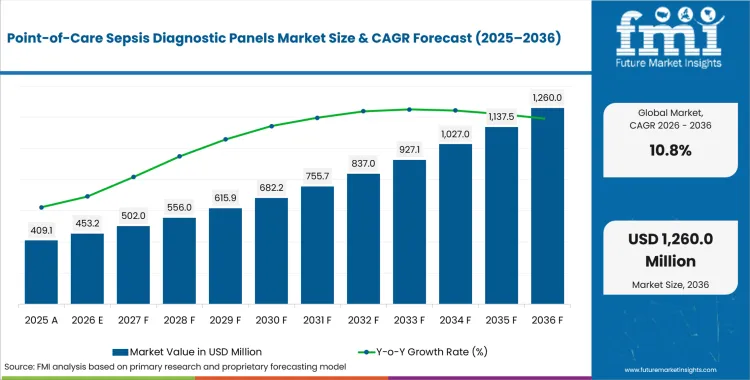
Key Takeaways of Point-of-Care Sepsis Diagnostic Panels Market
- Emergency departments need faster sepsis risk information that fits established blood collection and escalation pathways without replacing clinical assessment.
- Diagnostic kit is expected to lead product type with 48.0% share in 2026, attributable to recurring cartridge use and a defined per-patient workflow.
- Hospital is projected to represent 68.0% of care setting demand in 2026, underpinned by concentrated sepsis volume and established laboratory oversight.
- Monitoring is anticipated to capture 19.0% share in 2026, reflecting the need for documented reassessment and pathway review.
- Local validation and interface work can extend deployment timelines across smaller acute-care facilities with limited technical coverage.
- Competition spans host-response testing from Cytovale alongside Inflammatix and Immunexpress; digital assessment from Prenosis; pathogen workflows from bioMérieux and T2 Biosystems; and biomarker testing from Beckman Coulter Diagnostics and DiaSys Diagnostic Systems.
Analyst Perspective
“Point-of-care sepsis panels earn adoption by reducing uncertainty during the first emergency assessment without disrupting blood collection or clinical escalation. Hospital laboratories need evidence that each score changes a documented decision and remains supported throughout every shift. Developers that combine rapid output with clear interpretation, electronic integration and dependable service will build repeat use more effectively than companies offering speed without an implementation plan.”
- Anurag Sharma, Principal Analyst, Future Market Insights
How is the Point-of-Care Sepsis Diagnostic Panels Market segmented?
The point-of-care sepsis diagnostic panels industry is segmented by product type, care setting, application, end user, and region.
The market is segmented by product type, care setting, application, end user, and region to show distinct purchasing and operating routes. Product type separates diagnostic kits from software, wearables, consumables, and accessories used within acute-care testing. Care setting identifies the clinical environment that controls staffing, laboratory oversight, and turnaround expectations for each panel. Application distinguishes diagnosis, monitoring, workflow automation, therapy support, and infection control according to the clinical purpose. End user identifies the organization that funds or operates each testing pathway and carries implementation responsibility. Regional analysis compares authorization routes, hospital infrastructure, and service conditions that shape commercial execution across major markets. Current clinical diagnostics investment increasingly weighs assay performance against electronic connectivity and documented escalation protocols. The selected outlooks examine diagnostic kit, hospital, monitoring, payers, and North America. Each selected category carries a defined 2026 share position and a distinct commercial mechanism that warrants separate analysis.
Why does diagnostic kit lead product type demand in the point-of-care sepsis diagnostic panels market?
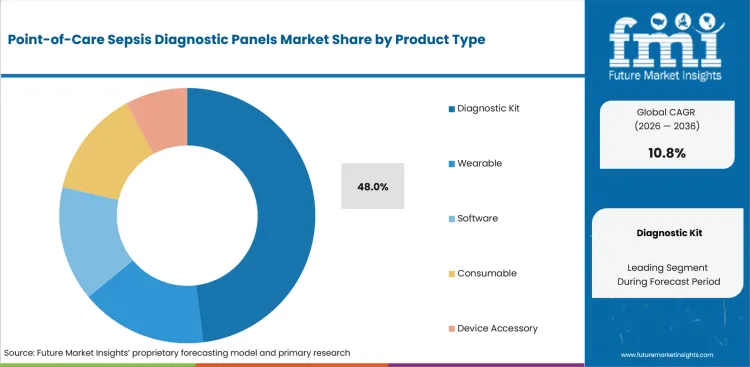
Diagnostic kits turn rapid testing into a repeatable laboratory purchase without requiring hospitals to replace their complete analyzer base. Inflammatix reported in September 2025 that TriVerity generated results in about 30 minutes with less than one minute of operator handling. The development expanded point-of-care molecular diagnostics through a validated cartridge workflow suited to emergency laboratory use. Hospital committees can therefore evaluate a defined operating process rather than a research workflow that lacks a validated operating route.
- Diagnostic kit is projected to hold 48.0% share in 2026 owing to recurring cartridge demand and defined per-patient use. Hospital laboratories can budget test volumes separately from analyzer capacity while simplified lot controls improve inventory planning across emergency testing areas. A predictable consumable cycle also helps finance teams compare recurring assay spending with instrument and service commitments.
- Emergency departments favor kits that use standard blood collection and require limited manual preparation during crowded shifts. Closed cartridges reduce transfer steps and create consistent digital outputs for laboratory and clinical systems. Adoption weakens if specialized staffing or long preparation places results outside the first treatment decision window during initial treatment planning.
Why does hospital remain central to care setting demand?
Hospital adoption depends on a workflow that connects emergency triage with laboratory governance and gives both teams clear ordering and escalation responsibilities. Cytovale reported in December 2025 that IntelliSep implementation at an academic medical center was associated with 42% lower risk-adjusted mortality and nearly two fewer hospital days. The reported outcomes give hospital committees measurable clinical and operating endpoints for evaluating rapid host-response testing during capital review. Smaller facilities often lack equivalent validation capacity and continuous technical support across every operating shift.
- The care setting category is forecast to be led by hospital at 68.0% share in 2026, supported by concentrated sepsis volume and established laboratory oversight. Acute-care facilities can connect results with emergency protocols and intensive-care escalation while tracking outcomes through quality programs. Their committees also have greater capacity to evaluate clinical evidence and integration requirements during formal investment reviews.
- Hospital systems extend deployment across affiliated emergency departments once an initial site demonstrates reproducible ordering and interpretation. Central laboratory teams can standardize controls and training while local clinical leaders manage appropriate test use. Adoption slows across facilities that lack overnight staffing or dependable technical service for compact analyzers during urgent clinical operations.
Where does monitoring create the clearest application demand?
Monitoring demand reflects the need to track changing risk and document whether treatment decisions remain aligned with patient condition. Cytovale announced in September 2025 that an emergency protocol combining IntelliSep with electronic documentation increased SEP-1 compliance by 29%. The development shows how rapid scores can support repeated quality review rather than a single diagnostic label. Procalcitonin assays provide an adjacent benchmark for hospitals comparing serial biomarkers with host-response panels during pathway design and quality review.
- The monitoring segment is likely to capture 19.0% share in 2026, attributable to hospital requirements for documented reassessment and escalation. Repeated measurements support care reviews across emergency and inpatient teams if results remain comparable over time. The application carries less value if clinicians cannot connect score changes with a defined action.
- Quality leaders favor monitoring workflows that place results inside the electronic record and connect them with treatment timestamps. Consistent documentation helps hospitals review pathway performance and identify delays across departments during formal quality meetings. Adoption requires clear limits since no single panel replaces clinical assessment or the broader evidence used for sepsis management.
Why do coverage decisions make payers central to end user demand?
Payers influence access through coverage decisions and documentation requirements that determine whether newer diagnostic approaches receive consistent payment support. Prenosis announced in October 2025 that CMS created ICD-10-PCS code XXEZXCB for computer-aided infection measurement and triage. The code gives hospitals a standardized method for recording Sepsis ImmunoScore use inside administrative workflows. Payment decisions remain separate from coding, so manufacturers need economic evidence that connects testing with measurable resource use.
- Payers are set to lead the end user category with 20.0% share in 2026, reflecting coverage reviews and evidence requirements for new diagnostic pathways. Health plans examine whether testing changes admissions or treatment intensity rather than adding another laboratory charge. Manufacturers need outcome and utilization measures that align with payer review methods across comparable hospital populations.
- Hospital finance teams can present stronger payment cases once coding and documentation routes are established for the diagnostic service. Clear records support contract discussions and later reimbursement applications across health systems with different payment arrangements. Adoption remains constrained if economic claims rely on modeled savings without verified implementation data from comparable patient groups.
What are the drivers, restraints, and opportunities in the Point-of-Care Sepsis Diagnostic Panels Market?
Emergency care pressure and clearer authorization pathways are increasing demand, while implementation evidence and payment alignment determine wider adoption.
- Driver: Emergency teams need faster risk stratification that supports treatment and disposition decisions before conventional microbiology results become available.
- Restraint: Hospitals require local validation and workflow integration that can extend adoption timelines despite favorable regulatory status.
- Opportunity: Developers can connect rapid panels with documented quality outcomes and coding support to strengthen hospital investment cases.
Hospital sepsis programs are projected to generate recurring demand by linking rapid panels with coordinated clinical decisions rather than isolated laboratory results. CDC reported in August 2025 that 5,377 hospitals completed the 2024 NHSN annual survey on sepsis practices. The response base shows that many hospitals already operate governance structures that can review blood culture testing and newer host-response tools. Adoption becomes more defensible if a panel improves recognition and documentation across the same clinical pathway.
Rapid sepsis tests enter pathways that already combine symptoms and several laboratory findings, which makes evidence requirements a material restraint. NICE reported in November 2025 that evidence for multiplex PCR in suspected sepsis remained low quality and insufficient for a practice recommendation. Hospitals therefore need local validation that demonstrates patient selection and result interpretation inside existing protocols. Adoption slows further if integration costs exceed the operational value established during a structured hospital evaluation.
Documented workflow value creates an opening for companies that connect rapid results with health outcomes and hospital resource use. In April 2026, bioMérieux announced that a G7 analysis evaluated early fast diagnostics for bloodstream infections carrying high sepsis risk. The model covered seven national health systems and measured clinical plus economic effects across different care pathways. Developers across infectious disease diagnostics can use comparable country evidence to reduce uncertainty for hospital committees and payers.
Which country CAGRs are profiled in the Point-of-Care Sepsis Diagnostic Panels Market?
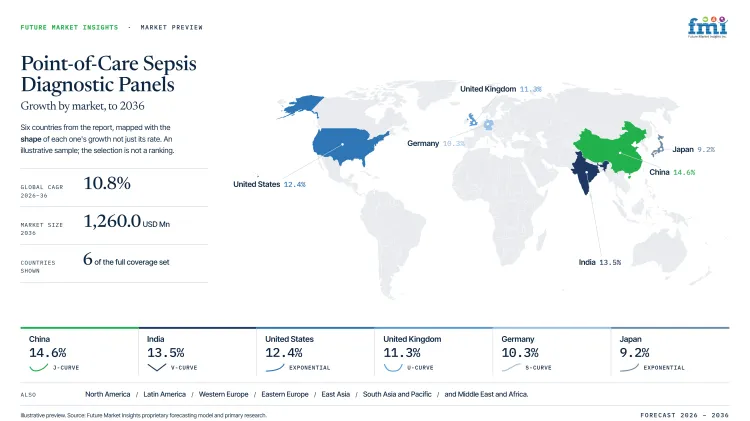
| Country | CAGR |
|---|---|
| China | 14.6% |
| India | 13.5% |
| United States | 12.4% |
| United Kingdom | 11.3% |
| Germany | 10.3% |
| Japan | 9.2% |
How do country-level CAGRs compare in the Point-of-Care Sepsis Diagnostic Panels Market?
The country forecasts show a gradual progression across the point-of-care sepsis diagnostic panels market, with each market separated by a relatively consistent margin rather than forming sharply distinct tiers. China and India define the upper end of the comparison, reflecting increasing emphasis on rapid infectious disease diagnosis and expanded access to decentralized testing. The United States follows as a transition market between the higher-growth Asian countries and the more mature healthcare systems of Western Europe and Japan. The United Kingdom, Germany and Japan create a lower grouping where differences are incremental rather than pronounced. This pattern reflects varying levels of unmet diagnostic need, emergency care testing priorities and the pace of adoption of rapid sepsis identification technologies. The comparison suggests that growth is influenced as much by healthcare deployment requirements and testing accessibility as by technological innovation.
- China benefits from expanding hospital diagnostic capacity and growing investment in rapid testing technologies that support earlier sepsis detection and clinical decision-making.
- India's outlook is supported by increasing efforts to strengthen critical care diagnostics and improve access to point-of-care testing in high-burden healthcare environments.
- The United States reflects continued demand for faster identification of sepsis cases, with adoption supported by established emergency care infrastructure and a strong focus on reducing diagnostic delays.
- The United Kingdom continues to advance the use of rapid diagnostic tools through initiatives aimed at improving patient outcomes and supporting timely treatment pathways.
- Germany's market development is influenced by the integration of advanced diagnostic technologies into clinical workflows and a strong emphasis on evidence-based healthcare practices.
- Japan maintains steady momentum as healthcare providers evaluate rapid diagnostic platforms that can improve efficiency in acute care settings while meeting rigorous clinical validation standards.
Countries with similar CAGRs may still present very different commercialization conditions for point-of-care sepsis diagnostics. Differences in procurement systems, clinical adoption pathways, reimbursement structures and healthcare infrastructure can influence how quickly diagnostic panels move from evaluation to routine use. As a result, deployment strategies often vary more than growth rates alone would suggest. The full report provides country-level CAGR analysis across North America, Latin America, Europe, East Asia, South Asia, Oceania and the Middle East and Africa.
Country-wise Analysis
- Hospitals in China require imported Class II and Class III in vitro diagnostic reagents to complete NMPA registration before commercial sale. NMPA provisions republished in June 2024 assign those imported products to national review and approval. The National Healthcare Security Administration updated its national IVD reagent classification and code database in May 2025. Adoption of point-of-care sepsis panels in China is estimated to expand at 14.6% CAGR through 2036, reflecting more standardized product records across hospital payment systems. Large tertiary hospitals provide a practical entry route through combined emergency volume and laboratory oversight. Systems lacking Chinese dossiers and local technical service face a material access barrier during hospital qualification.
- India-based hospitals evaluate high-risk infectious disease IVDs through CDSCO review and performance validation across approved laboratory routes. The portal allows manufacturers to submit evidence and track validation status through a defined process. India’s point-of-care sepsis diagnostic panels outlook is anticipated to advance at 13.5% CAGR over the assessment period, reinforced by expanding diagnostic capacity and clearer review procedures. Large private hospital groups can support early adoption through centralized laboratory governance and coordinated capital planning. Technical staffing and service coverage remain uneven across smaller cities and public facilities outside major diagnostic hubs. Commercial plans should include local application training and maintenance commitments for every installed testing system.
- United States hospitals can purchase cleared sepsis tests through established diagnostic channels and evaluate them against defined quality measures. T2 Biosystems reported in January 2025 that it secured 27 T2Dx instrument contracts during 2024 and appointed Cardinal Health as its exclusive United States distributor. The development gives hospital systems a documented route for instruments and consumables across an established channel. By 2036, the United States point-of-care sepsis diagnostic panels market is projected to grow at 12.4% CAGR owing to commercial distribution and mature laboratory infrastructure. Large systems can standardize training and electronic interfaces across several emergency departments through shared implementation teams. Independent hospitals may struggle with analyzer utilization and continuous technical support during nights and weekends.
- United Kingdom hospitals operate through national clinical guidance and local NHS purchasing decisions that require evidence for each testing pathway. Point-of-care sepsis panel demand in the United Kingdom is forecast to rise at 11.3% CAGR over the forecast period, shaped by pressure for earlier identification and escalation. NHS England reported in July 2026 that England recorded more than 118,000 emergency sepsis admissions during 2024/25. The Sepsis Modern Service Framework also calls for faster implementation of near-patient diagnostic tools across urgent pathways. Shared guidance and established quality systems support adoption across larger trusts with specialist laboratory teams. Local business cases and workforce capacity remain material frictions during trust-level implementation and clinical staff training programs. Manufacturers need clinical support teams that can work with individual trusts throughout validation and rollout.
- Germany-based hospitals evaluate rapid IVD systems through European conformity requirements and decentralized purchasing across regional hospital groups. Destatis reported in December 2025 that German emergency departments handled 13.0 million outpatient cases during 2024. The German point-of-care sepsis diagnostic panels sector is projected to record 10.3% CAGR during the assessment period, supported by acute-care volume and laboratory modernization. Established automation integrators can support interface validation across common analyzer environments and hospital information systems. Fragmented purchasing and IVDR documentation can extend sales cycles between institutions with separate technical committees. German-language training and dependable field service are necessary for expansion beyond the largest university hospitals.
- Japan concentrates advanced emergency care within designated lifesaving centers that combine specialist teams with tightly managed hospital workflows. The Ministry of Health published its national list of lifesaving emergency centers in April 2025. The network gives developers a focused route for clinical evaluation and specialist training across recognized acute-care sites. Point-of-care sepsis panel sales in Japan are forecast to expand at 9.2% CAGR by 2036, influenced by compact testing needs and structured emergency pathways. Local approval and reimbursement dossiers require Japanese documentation plus experienced regulatory partners throughout the application process. Instrument footprint and service response remain important constraints inside smaller urban facilities with limited laboratory space. Market entry should prioritize a qualified local partner that provides clinical application support and dependable maintenance.
Who are the notable companies in the Point-of-Care Sepsis Diagnostic Panels Market?
Cytovale, Inflammatix, Immunexpress, Prenosis, bioMérieux, T2 Biosystems, Beckman Coulter Diagnostics, and DiaSys Diagnostic Systems are the notable companies shaping this market.
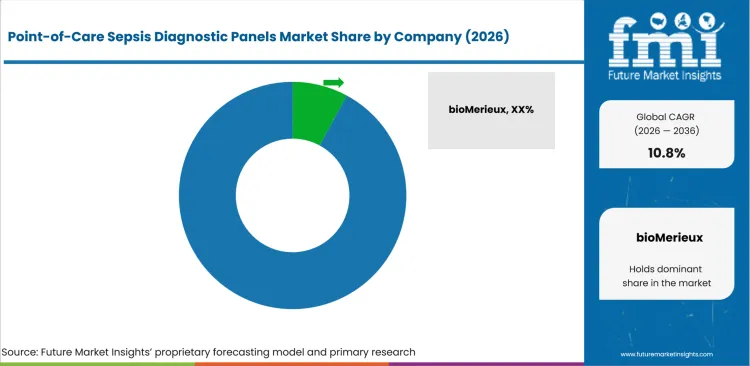
Competition separates rapid host-response specialists from laboratory companies that identify pathogens or measure adjunct biomarkers. Inflammatix announced in January 2025 that FDA cleared TriVerity for adults with suspected acute infection or sepsis in emergency care. Cytovale and Immunexpress also provide host-response results, while Prenosis combines biomarker data with clinical records for risk assessment. The pathogen-focused group includes bioMérieux and T2 Biosystems through culture-linked and direct-from-blood systems used by hospital laboratories. Beckman Coulter Diagnostics and DiaSys Diagnostic Systems add hematology and procalcitonin information through routine analyzer workflows. The wider septicemia testing field therefore competes across clinical question, turnaround time and workflow position.
- Cytovale and Inflammatix focus on rapid host-response systems designed for time-sensitive emergency decisions during initial patient assessment. Immunexpress adds a one-hour molecular cartridge while Prenosis provides software-based risk assessment from biomarker and clinical inputs. Their commercial position depends on clinical evidence plus dependable electronic integration across complex hospital workflows and operating shifts.
- The FDA device listing updated in July 2026 identifies Beckman Coulter as the manufacturer of the UniCel DxH 800 system with its Early Sepsis Indicator application. A separate FDA lifecycle record updated in July 2026 lists DiaSys Diagnostic Systems under the PTF procalcitonin assay classification for critically ill patients. Both approaches add routine laboratory risk markers without replacing culture results or the physician’s final interpretation.
- The FDA 510(k) database updated in June 2026 lists the T2Bacteria Panel under T2 Biosystems and records its substantially equivalent decision. In May 2026, bioMérieux announced that its new French facility would expand BIOFIRE PCR test production for European customers. Both companies compete through broader pathogen coverage and dependable laboratory support across each installed hospital system.
Competitive Benchmarking: Point-of-Care Sepsis Diagnostic Panels Market
| Company | Sepsis-Specific Diagnostic Evidence | Near-Patient Workflow | Commercial Deployment and Support | Geographic Reach |
|---|---|---|---|---|
| Cytovale | High | High | High | United States |
| Inflammatix | High | High | Medium | United States |
| Immunexpress | High | Medium | Medium | United States and Australia |
| Prenosis | High | High | Medium | United States |
| bioMérieux | Medium | Low | High | Global |
| T2 Biosystems | High | Low | Medium | Global |
| Beckman Coulter Diagnostics | Medium | Medium | High | Global |
| DiaSys Diagnostic Systems | Medium | Low | Medium | Global |
Key Developments in the Point-of-Care Sepsis Diagnostic Panels Market
- In July 2025, Cytovale reported multicenter findings from 4,650 emergency patients across four hospitals using the IntelliSep sepsis test. The company stated that protocolized implementation was associated with a 56% relative increase in safe emergency discharges without higher 30-day returns. The development gave hospital committees a measurable operating endpoint for evaluating rapid host-response testing during service planning.
- In January 2026, Prenosis announced a USD 20 million BARDA contract and a separate USD 20 million Series A financing round. The funding supports commercial delivery and clinical development for integrated diagnostic tools in critical care. Prenosis also plans controlled studies that can expand evidence for biology-based patient assessment and future hospital implementation decisions across several acute conditions.
- In January 2026, Immunexpress announced Australian Therapeutic Goods Administration inclusion for SeptiCyte RAPID in pediatric patients suspected of sepsis. The clearance extended the one-hour host-response test beyond adult use and added a regulated pediatric pathway. Australian hospitals can now evaluate the platform across a broader clinical population through an established distribution route and defined regulatory status.
- In May 2025, DiaSys Diagnostic Systems received FDA 510(k) clearance for Procalcitonin FS to support risk assessment in critically ill patients. The reagent runs on automated clinical chemistry analyzers and broadens access through existing laboratory platforms. The clearance adds a regulated biomarker route for hospital laboratories evaluating sepsis management tools during routine operations.
Key Players in the Point-of-Care Sepsis Diagnostic Panels Market
Rapid Host-Response Diagnostics
- Cytovale
- Inflammatix
- Immunexpress
Digital Sepsis Assessment
- Prenosis
Pathogen and Biomarker Diagnostics
- bioMérieux
- T2 Biosystems
- Beckman Coulter Diagnostics
- DiaSys Diagnostic Systems
Point-of-Care Sepsis Diagnostic Panels Market - Report Scope
| Coverage field | Report scope |
|---|---|
| Market breakdown | Product Type, Care Setting, Application, End User, and Region. |
| Market Definition | Commercial demand for rapid sepsis diagnostic panels and associated software, consumables, devices, and accessories used near acute-care decision points. |
| Regions Covered | North America, Latin America, Western Europe, Eastern Europe, East Asia, South Asia and Pacific, and Middle East and Africa. |
| Countries Covered | United States, Germany, United Kingdom, Japan, China, India, and 30+ countries. |
| Key Companies Profiled | Cytovale, Inflammatix, Immunexpress, Prenosis, bioMérieux, T2 Biosystems, Beckman Coulter Diagnostics, and DiaSys Diagnostic Systems. |
| Forecast Period | 2026 to 2036. |
| Approach | Hybrid bottom-up and top-down market sizing supported by primary interviews and official desk research. |
Point-of-Care Sepsis Diagnostic Panels Market - Research Methodology
| Method | Approach |
|---|---|
| Primary Research | FMI analysts gathered input from manufacturers, service providers, technology developers, distributors, end users, procurement teams, and subject-matter experts. Interviews examined purchasing decisions, product or service evaluation, adoption barriers, approval requirements, pricing considerations, and expectations for technical or commercial support. Respondents were also asked what evidence is required before a trial, pilot, or initial order develops into regular purchasing. |
| Desk Research | Desk research covered government statistics, regulatory publications, trade data, industry associations, technical literature, standards, company filings, product information, and official corporate announcements. Sources were reviewed for relevance, publication date, geographic coverage, and consistency with the defined market scope. Claims relating to performance, applications, approvals, capacity, investment, and commercial activity were retained only when supported by credible public evidence. |
| Market Sizing and Forecasting | The market model combined the baseline value with historical performance, segment structure, pricing and volume indicators, adoption levels, company participation, and country-level demand conditions. Forecast assumptions considered economic activity, investment trends, regulatory developments, technology adoption, purchasing cycles, supply availability, and barriers to wider market use. Segment and regional estimates were reconciled before the final market total was calculated. |
| Data Validation | Estimates were checked against multiple independent indicators, including public data, company activity, trade patterns, industry developments, and findings from primary interviews. Validation also tested whether products, services, applications, and company revenues fell within the defined market boundaries. Adjacent categories, unsupported claims, overlapping revenues, and activities without direct market relevance were excluded to reduce double counting and maintain consistency across segments and countries. |
Point-of-Care Sepsis Diagnostic Panels Market by Segments
Point-of-Care Sepsis Diagnostic Panels Market segmented by Product Type:
- Software
- Wearable
- Diagnostic Kit
- Consumable
- Device Accessory
Point-of-Care Sepsis Diagnostic Panels Market segmented by Care Setting:
- Hospital
- Home Care
- Ambulatory Center
- Retail Clinic
- Decentralized Trial Site
Point-of-Care Sepsis Diagnostic Panels Market segmented by Application:
- Monitoring
- Diagnosis
- Workflow Automation
- Therapy Support
- Infection Control
Point-of-Care Sepsis Diagnostic Panels Market segmented by End User:
- Hospitals
- Payers
- Diagnostic Labs
- Medtech Firms
- Patients
Point-of-Care Sepsis Diagnostic Panels Market by Region:
- North America
- United States
- Canada
- Mexico
- Latin America
- Brazil
- Chile
- Rest of Latin America
- Western Europe
- Germany
- United Kingdom
- Italy
- Spain
- France
- Nordic
- BENELUX
- Rest of Western Europe
- Eastern Europe
- Russia
- Poland
- Hungary
- Balkan and Baltic
- Rest of Eastern Europe
- East Asia
- China
- Japan
- South Korea
- South Asia and Pacific
- India
- ASEAN
- Australia and New Zealand
- Rest of South Asia and Pacific
- Middle East and Africa
- Saudi Arabia
- Other GCC Countries
- Turkiye
- South Africa
- Other African Union
- Rest of Middle East and Africa
Research Sources and Bibliography
- Centers for Disease Control and Prevention. (2025, January 31). Hospital Sepsis Program Core Elements.
- Centers for Disease Control and Prevention. (2025, August 21). Hospital Sepsis Management and Practices: Findings from the 2024 NHSN Annual Survey.
- NHS England. (2025, June 6). Urgent and emergency care plan 2025/26.
- National Institute for Health and Care Excellence. (2025, November 19). Rationale and impact: Suspected sepsis in people aged 16 or over.
- Inflammatix. (2025, January 21). Inflammatix receives FDA clearance for first-in-class TriVerity test.
- Inflammatix. (2025, March 25). Inflammatix ships TriVerity test cartridges and Myrna instruments to the USA military.
- Inflammatix. (2025, September 4). Inflammatix data in Journal of Clinical Microbiology validate accuracy, robustness, and ease of use of TriVerity Test System.
- Cytovale. (2025, July 29). Cytovale’s rapid sepsis test drives 56% increase in ED discharges without compromise to patient safety, study finds.
- Cytovale. (2025, September 7). New data reveals path to SEP-1 success includes early sepsis risk stratification.
- Cytovale. (2025, December 10). Rapid sepsis test enables hospital to reduce mortality by 42% and shorten hospital stay by two days, according to academic medical center study.
- Prenosis. (2025, October 1). New ICD-10-PCS code available for AI sepsis diagnostic tools.
- Prenosis. (2026, January 29). Prenosis announces $20M BARDA contract and $20M Series A financing round, advancing mission to deliver integrated diagnostics and therapeutics.
- Immunexpress. (2026, January 20). Immunexpress’ sepsis test receives regulatory clearance from Australian Therapeutic Goods Administration for paediatric patients suspected of sepsis.
- National Healthcare Security Administration. (2025, May 27). Notice on updating the medical insurance in vitro diagnostic reagent classification and code database.
- Ministry of Health and Family Welfare. (2025, September 11). Union Minister of State for Health and Family Welfare inaugurates National Virus Research and Diagnostic Laboratory Conclave 2025.
- National Medical Products Administration. (2024, June 5). Provisions for In-vitro Diagnostic Reagent Registration and Filing.
- NHS England. (2026, July 14). Sepsis modern service framework.
- Federal Statistical Office of Germany. (2025, December 3). 13 Millionen Behandlungen in Notfallambulanzen im Jahr 2024.
- Ministry of Health, Labour and Welfare. (2025, April 1). List of lifesaving emergency centers.
- bioMérieux. (2026, April 20). First-of-its-Kind Health Economic Analysis Shows Early Use of Fast Diagnostics in Sepsis Care Could Save Thousands of Lives and Reduce Health System Costs Across G7 Countries.
- bioMérieux. (2026, May 29). bioMérieux invests in France with a new facility to produce innovative diagnostics for the European market.
- T2 Biosystems. (2025, January 7). T2 Biosystems Announces Preliminary Fourth Quarter and Full Year 2024 Financial Results.
- USA Food and Drug Administration. (2026, June 29). 510(k) Premarket Notification [T2Bacteria Panel, K233184].
- USA Food and Drug Administration. (2026, July 13). Establishment Registration & Device Listing [UniCel DxH 800 Coulter Cellular Analysis System with Early Sepsis Indicator Application].
- USA Food and Drug Administration. (2026, July 20). TPLC - Total Product Life Cycle [Product code PTF].
- USA Food and Drug Administration. (2025, May 9). 510(k) premarket notification: DiaSys Procalcitonin FS (K242294).
This bibliography is provided for reader reference and is not exhaustive. The full report contains the complete reference list and detailed citations.
This Report Answers
- How large is the point-of-care sepsis diagnostic panels market in 2026 and 2036?
- Which clinical pressures support investment in rapid sepsis panels?
- Why does diagnostic kit lead product type demand?
- How do hospital and monitoring shape adoption?
- Which barriers slow implementation across local health systems?
- How do country growth rates differ across the six profiled markets?
- Which companies compete across host-response and pathogen workflows?
- What evidence should hospital committees examine before deployment?
- How do coding and service coverage affect commercial expansion?
Frequently Asked Questions
How big is the Point-of-Care Sepsis Diagnostic Panels Market in 2026?
The point-of-care sepsis diagnostic panels market is valued at USD 453.2 million in 2026 and is forecast to reach USD 1260.0 million by 2036, driven by emergency clinicians requiring faster risk stratification before conventional culture results become available during the first treatment window.
What is the CAGR of the Point-of-Care Sepsis Diagnostic Panels Market from 2026 to 2036?
The point-of-care sepsis diagnostic panels market is projected to grow at a CAGR of 10.8% between 2026 and 2036, supported by expanding hospital sepsis programs, clearer authorization pathways, and growing demand for rapid host-response scoring that connects directly with electronic records and clinical escalation protocols.
Which product type leads the Point-of-Care Sepsis Diagnostic Panels Market?
Diagnostic kits account for 48.0% of the point-of-care sepsis diagnostic panels market by product type in 2026, driven by recurring cartridge demand, defined per-patient workflows, and the ability to deliver consistent digital outputs for laboratory and clinical systems without replacing existing analyzer infrastructure.
Which country is growing fastest in the Point-of-Care Sepsis Diagnostic Panels Market?
The point-of-care sepsis diagnostic panels market in China is projected to grow at a CAGR of 14.6% through 2036, supported by expanding hospital diagnostic capacity, growing investment in rapid testing technologies, and more standardized product records across hospital payment systems following NMPA registration requirements.
Who are the leading companies in the Point-of-Care Sepsis Diagnostic Panels Market?
Leading companies in the point-of-care sepsis diagnostic panels market include Cytovale, Inflammatix, Immunexpress, Prenosis, bioMérieux, T2 Biosystems, Beckman Coulter Diagnostics, and DiaSys Diagnostic Systems, spanning rapid host-response testing, digital risk assessment, pathogen identification, and routine biomarker workflows.
Preview the report firsthand - request a free sample
Get SampleGet the brochure for pricing and purchase details.
Get PDFTable of Content
- Key Takeaways
- Market Size and CAGR
- Top Growth Driver
- Fastest Growing Segment
- Leading Region
- Key Companies
- Emerging Opportunities
- Executive Summary
- Global Market Outlook
- Demand-side Trends
- Supply-side Trends
- Technology Roadmap Analysis
- Analysis and Recommendations
- Analyst Perspective (What is happening? Why now? What should investors know?)
- Key Questions Answered
- How large is the market?
- What is the CAGR?
- What are key trends?
- Which region dominates?
- Who are the leaders?
- Market Overview
- Market Coverage / Taxonomy
- Market Definition / Scope / Limitations
- Research Methodology
- Chapter Orientation
- Analytical Lens and Working Hypotheses
- Market Structure, Signals, and Trend Drivers
- Benchmarking and Cross-market Comparability
- Market Sizing, Forecasting, and Opportunity Mapping
- Research Design and Evidence Framework
- Desk Research Programme (Secondary Evidence)
- Expert Input and Fieldwork (Primary Evidence)
- Tooling, Models, and Reference Databases
- Data Engineering and Model Build
- Quality Assurance and Audit Trail
- Market Background
- Market Dynamics (Drivers, Restraints, Opportunity, Trends)
- Scenario Forecast (Optimistic, Likely, Conservative)
- Impact Analysis
- AI Impact
- Sustainability Impact
- Regulatory Impact
- Technology Impact
- Consumer / Buyer Analysis
- Purchase Drivers
- Adoption Barriers
- Buyer Journey
- Opportunity Map Analysis
- Product Life Cycle Analysis
- Supply Chain Analysis
- Investment Feasibility Matrix
- Value Chain Analysis
- PESTLE and Porter's Analysis
- Regulatory Landscape
- Regional Parent Market Outlook
- Production and Consumption Statistics
- Import and Export Statistics
- Global Market Analysis and Forecast, 2021 to 2036
- Historical Market Size Value (USD Million) Analysis, 2021 to 2025
- Current and Future Market Size Value (USD Million) Projections, 2026 to 2036
- Y-o-Y Growth Trend Analysis
- Absolute $ Opportunity Analysis
- Global Market Pricing Analysis, 2021 to 2036
- Global Market Analysis and Forecast, By Product Type, 2021 to 2036
- Introduction / Key Findings
- Historical Market Size Value (USD Million) Analysis By Product Type, 2021 to 2025
- Current and Future Market Size Value (USD Million) Analysis and Forecast By Product Type, 2026 to 2036
- Diagnostic Kit
- Wearable
- Software
- Consumable
- Device Accessory
- Diagnostic Kit
- Y-o-Y Growth Trend Analysis By Product Type, 2021 to 2025
- Absolute $ Opportunity Analysis By Product Type, 2026 to 2036
- Global Market Analysis and Forecast, By Care Setting, 2021 to 2036
- Introduction / Key Findings
- Historical Market Size Value (USD Million) Analysis By Care Setting, 2021 to 2025
- Current and Future Market Size Value (USD Million) Analysis and Forecast By Care Setting, 2026 to 2036
- Hospital
- Home Care
- Ambulatory Center
- Retail Clinic
- Decentralized Trial Site
- Hospital
- Y-o-Y Growth Trend Analysis By Care Setting, 2021 to 2025
- Absolute $ Opportunity Analysis By Care Setting, 2026 to 2036
- Global Market Analysis and Forecast, By Application, 2021 to 2036
- Introduction / Key Findings
- Historical Market Size Value (USD Million) Analysis By Application, 2021 to 2025
- Current and Future Market Size Value (USD Million) Analysis and Forecast By Application, 2026 to 2036
- Monitoring
- Diagnosis
- Workflow Automation
- Therapy Support
- Infection Control
- Monitoring
- Y-o-Y Growth Trend Analysis By Application, 2021 to 2025
- Absolute $ Opportunity Analysis By Application, 2026 to 2036
- Global Market Analysis and Forecast, By End User, 2021 to 2036
- Introduction / Key Findings
- Historical Market Size Value (USD Million) Analysis By End User, 2021 to 2025
- Current and Future Market Size Value (USD Million) Analysis and Forecast By End User, 2026 to 2036
- Payers
- Hospitals
- Diagnostic Labs
- Medtech Firms
- Patients
- Payers
- Y-o-Y Growth Trend Analysis By End User, 2021 to 2025
- Absolute $ Opportunity Analysis By End User, 2026 to 2036
- Global Market Analysis and Forecast, By Region, 2021 to 2036
- Introduction
- Historical Market Size Value (USD Million) Analysis By Region, 2021 to 2025
- Current Market Size Value (USD Million) Analysis and Forecast By Region, 2026 to 2036
- North America
- Latin America
- Western Europe
- Eastern Europe
- East Asia
- South Asia and Pacific
- Middle East & Africa
- Market Attractiveness Analysis By Region
- North America Market Analysis and Forecast, By Country, 2021 to 2036
- Historical Market Size Value (USD Million) Trend Analysis By Market Taxonomy, 2021 to 2025
- Market Size Value (USD Million) Forecast By Market Taxonomy, 2026 to 2036
- By Country
- USA
- Canada
- By Product Type
- By Care Setting
- By Application
- By End User
- By Country
- Market Attractiveness Analysis
- By Country
- By Product Type
- By Care Setting
- By Application
- By End User
- Key Takeaways
- Latin America Market Analysis and Forecast, By Country
- Historical Market Size Value (USD Million) Trend Analysis By Market Taxonomy, 2021 to 2025
- Market Size Value (USD Million) Forecast By Market Taxonomy, 2026 to 2036
- By Country
- Brazil
- Mexico
- Chile
- Rest of Latin America
- By Product Type
- By Care Setting
- By Application
- By End User
- By Country
- Market Attractiveness Analysis
- By Country
- By Product Type
- By Care Setting
- By Application
- By End User
- Key Takeaways
- Western Europe Market Analysis and Forecast, By Country
- Historical Market Size Value (USD Million) Trend Analysis By Market Taxonomy, 2021 to 2025
- Market Size Value (USD Million) Forecast By Market Taxonomy, 2026 to 2036
- By Country
- Germany
- UK
- Italy
- Spain
- France
- Nordic
- BENELUX
- Rest of Western Europe
- By Product Type
- By Care Setting
- By Application
- By End User
- By Country
- Market Attractiveness Analysis
- By Country
- By Product Type
- By Care Setting
- By Application
- By End User
- Key Takeaways
- Eastern Europe Market Analysis and Forecast, By Country
- Historical Market Size Value (USD Million) Trend Analysis By Market Taxonomy, 2021 to 2025
- Market Size Value (USD Million) Forecast By Market Taxonomy, 2026 to 2036
- By Country
- Russia
- Poland
- Hungary
- Balkan & Baltic
- Rest of Eastern Europe
- By Product Type
- By Care Setting
- By Application
- By End User
- By Country
- Market Attractiveness Analysis
- By Country
- By Product Type
- By Care Setting
- By Application
- By End User
- Key Takeaways
- East Asia Market Analysis and Forecast, By Country
- Historical Market Size Value (USD Million) Trend Analysis By Market Taxonomy, 2021 to 2025
- Market Size Value (USD Million) Forecast By Market Taxonomy, 2026 to 2036
- By Country
- China
- Japan
- South Korea
- By Product Type
- By Care Setting
- By Application
- By End User
- By Country
- Market Attractiveness Analysis
- By Country
- By Product Type
- By Care Setting
- By Application
- By End User
- Key Takeaways
- South Asia and Pacific Market Analysis and Forecast, By Country
- Historical Market Size Value (USD Million) Trend Analysis By Market Taxonomy, 2021 to 2025
- Market Size Value (USD Million) Forecast By Market Taxonomy, 2026 to 2036
- By Country
- India
- ASEAN
- Australia & New Zealand
- Rest of South Asia and Pacific
- By Product Type
- By Care Setting
- By Application
- By End User
- By Country
- Market Attractiveness Analysis
- By Country
- By Product Type
- By Care Setting
- By Application
- By End User
- Key Takeaways
- Middle East & Africa Market Analysis and Forecast, By Country
- Historical Market Size Value (USD Million) Trend Analysis By Market Taxonomy, 2021 to 2025
- Market Size Value (USD Million) Forecast By Market Taxonomy, 2026 to 2036
- By Country
- Kingdom of Saudi Arabia
- Other GCC Countries
- Türkiye
- South Africa
- Other African Union
- Rest of Middle East & Africa
- By Product Type
- By Care Setting
- By Application
- By End User
- By Country
- Market Attractiveness Analysis
- By Country
- By Product Type
- By Care Setting
- By Application
- By End User
- Key Takeaways
- Key Countries Market Analysis
- USA
- Pricing Analysis
- Market Share Analysis, 2025
- By Product Type
- By Care Setting
- By Application
- By End User
- Canada
- Pricing Analysis
- Market Share Analysis, 2025
- By Product Type
- By Care Setting
- By Application
- By End User
- Mexico
- Pricing Analysis
- Market Share Analysis, 2025
- By Product Type
- By Care Setting
- By Application
- By End User
- Brazil
- Pricing Analysis
- Market Share Analysis, 2025
- By Product Type
- By Care Setting
- By Application
- By End User
- Chile
- Pricing Analysis
- Market Share Analysis, 2025
- By Product Type
- By Care Setting
- By Application
- By End User
- Germany
- Pricing Analysis
- Market Share Analysis, 2025
- By Product Type
- By Care Setting
- By Application
- By End User
- UK
- Pricing Analysis
- Market Share Analysis, 2025
- By Product Type
- By Care Setting
- By Application
- By End User
- Italy
- Pricing Analysis
- Market Share Analysis, 2025
- By Product Type
- By Care Setting
- By Application
- By End User
- Spain
- Pricing Analysis
- Market Share Analysis, 2025
- By Product Type
- By Care Setting
- By Application
- By End User
- France
- Pricing Analysis
- Market Share Analysis, 2025
- By Product Type
- By Care Setting
- By Application
- By End User
- India
- Pricing Analysis
- Market Share Analysis, 2025
- By Product Type
- By Care Setting
- By Application
- By End User
- ASEAN
- Pricing Analysis
- Market Share Analysis, 2025
- By Product Type
- By Care Setting
- By Application
- By End User
- Australia & New Zealand
- Pricing Analysis
- Market Share Analysis, 2025
- By Product Type
- By Care Setting
- By Application
- By End User
- China
- Pricing Analysis
- Market Share Analysis, 2025
- By Product Type
- By Care Setting
- By Application
- By End User
- Japan
- Pricing Analysis
- Market Share Analysis, 2025
- By Product Type
- By Care Setting
- By Application
- By End User
- South Korea
- Pricing Analysis
- Market Share Analysis, 2025
- By Product Type
- By Care Setting
- By Application
- By End User
- Russia
- Pricing Analysis
- Market Share Analysis, 2025
- By Product Type
- By Care Setting
- By Application
- By End User
- Poland
- Pricing Analysis
- Market Share Analysis, 2025
- By Product Type
- By Care Setting
- By Application
- By End User
- Hungary
- Pricing Analysis
- Market Share Analysis, 2025
- By Product Type
- By Care Setting
- By Application
- By End User
- Kingdom of Saudi Arabia
- Pricing Analysis
- Market Share Analysis, 2025
- By Product Type
- By Care Setting
- By Application
- By End User
- Türkiye
- Pricing Analysis
- Market Share Analysis, 2025
- By Product Type
- By Care Setting
- By Application
- By End User
- South Africa
- Pricing Analysis
- Market Share Analysis, 2025
- By Product Type
- By Care Setting
- By Application
- By End User
- USA
- Market Structure Analysis
- Competition Dashboard
- Competition Benchmarking
- Market Share Analysis of Top Players
- By Regional
- By Product Type
- By Care Setting
- By Application
- By End User
- Emerging Startups
- Innovation Benchmarking
- Competition Analysis
- Competition Deep Dive
- bioMerieux
- Overview
- Product Portfolio
- Profitability by Market Segments
- Sales Footprint
- Strategy Overview
- Marketing Strategy
- Product Strategy
- Channel Strategy
- Roche
- Abbott
- Thermo Fisher Scientific
- Danaher
- Siemens Healthineers
- QuidelOrtho
- BD
- bioMerieux
- Case Studies
- Success Stories
- Recent Developments
- Competition Deep Dive
- Assumptions & Acronyms Used


