

- Industry Size (2025)
- USD 203.4 Mn
- Forecast (2035)
- USD 387.4 Mn
- CAGR (2025 to 2035)
- 6.7%
Polyglyceryl-6 Stearate Market Forecast and Outlook 2025 to 2035
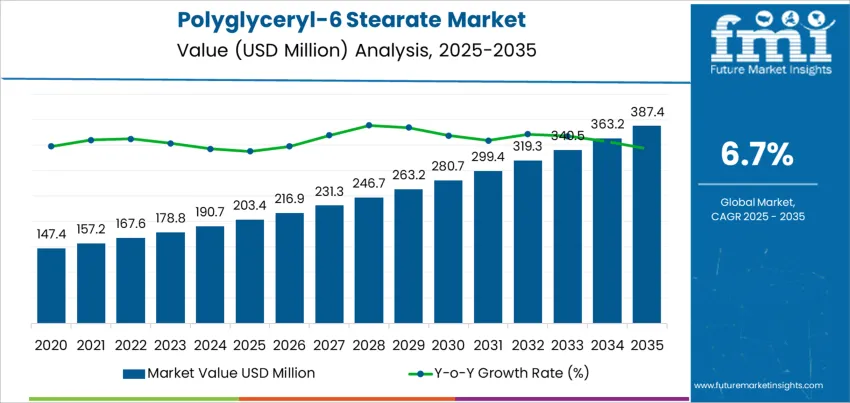
The global demand for polyglyceryl-6 stearate is expected to grow from USD 203.4 million in 2025 to USD 387.4 million by 2035, reflecting a compound annual growth rate (CAGR) of 6.7%. Polyglyceryl-6 stearate, a widely used emulsifier in cosmetics, personal care, and food industries, is gaining traction due to its ability to stabilize emulsions, improve texture, and enhance product performance. As the demand for clean-label, natural, and eco-friendly ingredients continues to rise, polyglyceryl-6 stearate is increasingly being incorporated into skincare and personal care products, driven by consumer preferences for safer, natural formulations. The market is also benefiting from the ingredient's growing adoption in food products, where its emulsifying properties contribute to the formulation of smooth, stable textures.
The market will experience steady growth, starting at USD 203.4 million in 2025 and rising to USD 216.9 million in 2026, USD 231.3 million in 2027, and USD 246.7 million in 2028. By 2029, demand for polyglyceryl-6 stearate will rise to USD 263.2 million, continuing its upward trajectory through the 2030s. By 2035, the demand for polyglyceryl-6 stearate is projected to reach USD 387.4 million, driven by rising consumer demand for clean-label ingredients and sustainable formulations, and by the growing use of emulsifiers in cosmetics, personal care, and food products.
Quick Stats of the Polyglyceryl-6 Stearate Market
- Polyglyceryl-6 Stearate Market Value (2025): USD 203.4 million
- Polyglyceryl-6 Stearate Market Forecast Value (2035): USD 387.4 million
- Polyglyceryl-6 Stearate Market Forecast CAGR (2025-2035): 6.7%
- Polyglyceryl-6 Stearate Market Leading Product Form: Powder (14.8%)
- Polyglyceryl-6 Stearate Market Key Growth Regions: India, China, Japan, UK, Germany, USA
- Polyglyceryl-6 Stearate Market Key Players: BASF SE, Croda International, Evonik Industries, Symrise (incl. IFF/Givaudan actives), Dow / Dow Inc., Ashland, Clariant, Seppic
What is the Growth Forecast for the Global Polyglyceryl-6 Stearate Industry through 2035?
The market share erosion or gain analysis for the polyglyceryl-6 stearate market suggests net market share gains during the forecast period, primarily driven by the increasing demand for natural and eco-friendly ingredients in the personal care, food, and cosmetics industries. From 2025 to 2029, the market will grow from USD 203.4 million to USD 263.2 million, marking an increase of USD 59.8 million in demand. This growth is expected to be fueled by the ingredient's expanding role in clean-label formulations and its continued adoption in both personal care and food sectors.
In the second phase of the forecast period (2029–2035), the market will continue to expand, reaching USD 387.4 million by 2035. The significant growth in the later years will be driven by an increase in the adoption of polyglyceryl-6 stearate in high-end cosmetics, skincare products, and functional food products, where consumers increasingly demand emulsifiers that align with their values of sustainability and natural formulations. As more industries embrace clean-label and eco-friendly product offerings, polyglyceryl-6 stearate’s market share will likely increase in both the personal care and food sectors, contributing to its overall market gain.
Polyglyceryl-6 Stearate Market Key Takeaways
| Metric | Value |
|---|---|
| Industry Sales Value (2025) | USD 203.4 million |
| Industry Forecast Value (2035) | USD 387.4 million |
| Industry Forecast CAGR (2025-2035) | 6.7% |
Why is the Demand for Polyglyceryl-6 Stearate Growing Globally?
Demand for polyglyceryl 6 stearate is rising globally as manufacturers across cosmetics, personal care, and hygiene sectors increasingly prefer mild, plant derived, and sustainable emulsifiers. Polyglyceryl 6 stearate enables smooth blending of oil and water based components, which is essential in lotions, creams, sunscreens, cleansers and other emulsified formulations. Its gentle, skin friendly nature makes it especially attractive for sensitive skin products and for consumers who avoid harsh synthetic surfactants. As consumer awareness grows about ingredient safety, environmental impact, and “clean label” formulations, demand for such natural ester-based emulsifiers including polyglyceryl 6 stearate increases.
At the same time, broader market trends and industrial dynamics support expansion of polyglyceryl 6 stearate usage. The global market for polyglycerol esters, the broader family to which polyglyceryl 6 stearate belongs, is forecast to expand significantly over the coming decade, reflecting rising demand in cosmetics, food, pharmaceutical and personal care applications. Improvements in ester production and formulation technologies have enhanced stability, performance and cost effectiveness of polyglycerol esters-making them viable for both premium and mass market brands. As trends such as sustainability, skin health awareness, and multifunctional cosmetic formulations continue to grow, polyglyceryl 6 stearate is likely to see steadily increasing demand globally.
What Drives the Global Demand for Polyglyceryl-6 Stearate in Terms of Application and Product Form?
The global demand for polyglyceryl-6 stearate is primarily driven by application and product form. The leading end-use application is skin care, which accounts for 8.8% of the market share, while powder holds the largest share in the product form segment, capturing 14.8%. Polyglyceryl-6 stearate, known for its emulsifying and skin-conditioning properties, is widely used in the formulation of personal care products. As consumer interest in natural, effective, and multifunctional skincare ingredients grows, polyglyceryl-6 stearate continues to see increasing demand in global personal care and beauty markets.
Why Is Skin Care the Leading Application for Polyglyceryl-6 Stearate?
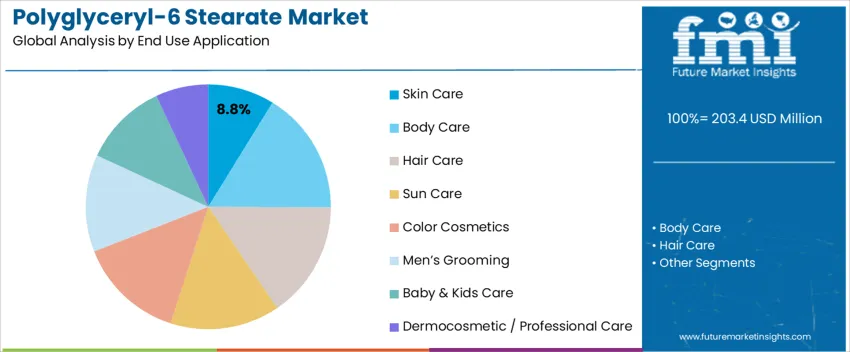
Skin care leads the end-use application demand for polyglyceryl-6 stearate, capturing 8.8% of the market share. This ingredient is valued in skincare formulations for its emulsifying capabilities, which help combine oil and water-based ingredients, creating stable and smooth creams, lotions, and serums. Polyglyceryl-6 stearate also has moisturizing and soothing properties that enhance the texture and performance of skincare products.
The demand for polyglyceryl-6 stearate in skin care is driven by the increasing preference for clean and natural beauty products. As consumers seek ingredients that are effective yet gentle on the skin, polyglyceryl-6 stearate is becoming a popular choice for its ability to improve the stability, texture, and sensory experience of personal care products. Its use in products that target hydration, anti-aging, and sensitive skin care further strengthens its position in the growing global skincare market.
Why Is Powder the Leading Product Form for Polyglyceryl-6 Stearate?
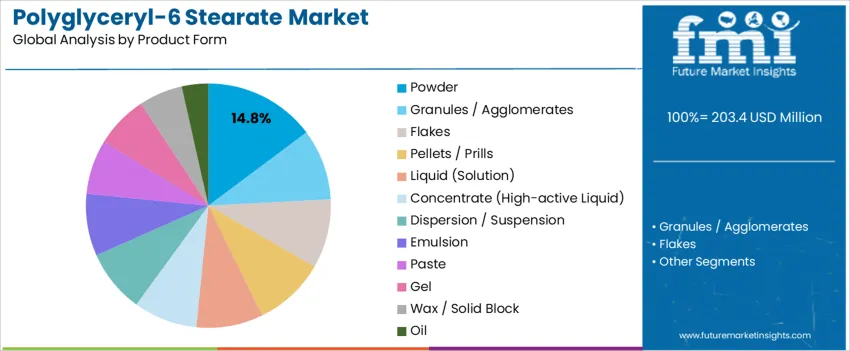
Powder is the leading product form for polyglyceryl-6 stearate globally, holding 14.8% of the market share. The powdered form is preferred for its stability, ease of incorporation into formulations, and longer shelf life compared to liquid or gel forms. It allows for precise control over the concentration of active ingredients and is easily handled in manufacturing.
The demand for powdered polyglyceryl-6 stearate is driven by its ability to provide concentrated, stable formulations that retain their effectiveness over time. Powders are also more cost-effective and easier to transport and store than liquids or gels. As the personal care industry continues to trend towards clean beauty and high-performance ingredients, the powdered form of polyglyceryl-6 stearate remains a preferred choice for manufacturers looking to deliver stable and customized skincare products.
What is the Demand Outlook for Polyglyceryl-6 Stearate Globally?
Demand for polyglyceryl-6 stearate is rising globally as manufacturers in cosmetics, personal care, food, and specialty products increasingly turn to mild, plant-derived emulsifiers and surfactants. Polyglyceryl-6 stearate, a sucrose-fatty acid ester, is valued for its ability to stabilize emulsions, improve texture, and impart moisturizing or skin-conditioning effects in creams, lotions, cleansers, and body care products. As consumers globally favor formulations that are gentle, non-irritating, and compatible with sensitive skin, polyglyceryl-6 stearate is gaining traction. The broader market for sucrose esters, within which polyglyceryl-6 stearate is a key variant, is expanding with rising demand in food, personal care, and specialty applications across regions.
What are the Drivers of Global Demand for Polyglyceryl-6 Stearate?
Several factors drive the global demand for polyglyceryl-6 stearate. Increasing consumer demand for natural and clean-label cosmetics leads formulators to choose sugar-derived emulsifiers rather than synthetic surfactants. Growth in skincare and personal care consumption globally, driven by rising disposable incomes, urbanization, and greater awareness of skin health, boosts demand for lotions, creams, cleansers, and body-care products that often use polyglyceryl-6 stearate. The versatile emulsifying and emollient properties of polyglyceryl-6 stearate allow stable oil-in-water or water-in-oil formulations that deliver smooth skin feel, light texture, and good stability, making it especially attractive for products targeting sensitive skin or clean-ingredient positioning. In parallel, demand from food, beverage, and pharmaceutical sectors, where sucrose esters are used as emulsifiers, stabilizers, or fat-replacement agents, supports the overall growth of the sucrose ester market, lifting demand for polyglyceryl-6 stearate as part of that trend.
What are the Restraints on Global Demand for Polyglyceryl-6 Stearate?
Despite favorable demand drivers, several restraints may curtail widespread adoption of polyglyceryl-6 stearate. High-purity sucrose-fatty acid esters can be more expensive than simpler or synthetic emulsifiers, which makes them less attractive for low-cost or mass-market products in price-sensitive regions. Competition from other emulsifiers or moisturizers such as glycerin, synthetic surfactants, mineral oils, or silicone-based emollients, which may offer similar performance at lower cost or with simpler supply chains, can limit polyglyceryl-6 stearate uptake. Lipids like sucrose esters require careful balancing to ensure emulsion stability, shelf life, and compatibility with other actives; poor formulation can lead to separation or performance issues, discouraging use. Regulatory and supply-chain variations across regions, such as availability of plant-derived fatty acids and purity standards, may restrict consistent global scaling.
What are the Key Trends Influencing Global Demand for Polyglyceryl-6 Stearate?
A major trend is the shift toward clean-label, plant-derived, and "skin-friendly" personal care and cosmetic products. Consumers worldwide increasingly prefer formulations perceived as natural, gentle, and free from harsh chemicals, driving demand for sugar-derived surfactants like polyglyceryl-6 stearate. Another trend is growth in multifunctional formulations. Polyglyceryl-6 stearate is used in oil-to-milk cleansers, gentle foaming cleansers, lotions, shampoos, and body washes, appealing to consumers seeking minimal-ingredient, versatile products that suit sensitive skin or daily use. In the food and beverage industry, sucrose esters, including polyglyceryl-6 stearate, continue to be used to stabilize emulsions, improve texture, and support low-fat or reduced-fat formulations, especially as clean-label and "better-for-you" foods grow in popularity. Advances in formulation science and emulsification technology, which enable stable, effective, and pleasant-feeling emulsions with natural ester surfactants, make polyglyceryl-6 stearate more attractive to global brands. Finally, growth in emerging markets, with rising disposable income and expanding demand for personal care and processed foods, such as in Asia-Pacific, Latin America, and the Middle East, supports the global expansion of polyglyceryl-6 stearate use.
What is the Regional Demand Outlook for the Polyglyceryl-6 Stearate Market?
The global market for Polyglyceryl-6 Stearate is projected to grow steadily, with India at a CAGR of 9.0%. China follows with 8.3%, while Japan is expected to grow at 7.7%. The UK, Germany, and the USA show more modest growth, with CAGRs of 7.0%, 6.3%, and 5.7 % respectively. Polyglyceryl 6 Stearate is a plant-derived, PEG-free emulsifier and emollient used widely in cosmetics and personal care products to blend water and oil phases and improve texture, spreadability, and skin feel. Its growing use in clean label, natural and sensitive skin formulations underpins rising adoption across markets.
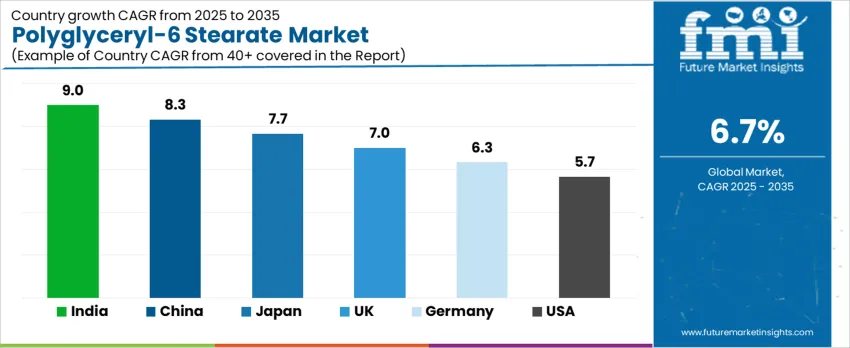
| Country | CAGR (%) |
|---|---|
| India | 9.0 |
| China | 8.3 |
| Japan | 7.7 |
| UK | 7.0 |
| Germany | 6.3 |
| USA | 5.7 |
What Drives Adoption of Polyglyceryl-6 Stearate in India?
In India, the projected CAGR of 9.0 % for polyglyceryl 6 stearate reflects growing demand for gentle, natural emulsifiers in cosmetics and personal care products. As consumers become more ingredient aware and concerned about irritants, manufacturers increasingly turn to plant-derived, PEG-free emulsifiers such as Polyglyceryl 6 Stearate to formulate products suitable for sensitive skin. Its ability to combine oil and water phases while delivering a smooth, non-greasy texture makes it useful in lotions, creams, serums, and moisturizers that appeal to skincare-conscious consumers. Rising disposable incomes and expanding skincare penetration in urban and semi-urban India further support adoption. In addition, the growing preference for “clean beauty” products and the increased availability of global cosmetic brands boost demand. As the domestic beauty and personal care market matures, formulators are likely to adopt Polyglyceryl 6 Stearate more widely for stable, skin-friendly formulations.
Why is Polyglyceryl-6 Stearate Demand Growing in China?
China’s projected 8.3 % CAGR for Polyglyceryl 6 Stearate reflects a large and rapidly evolving cosmetics and personal care market shifting toward cleaner, milder formulations. Increasing awareness of skin sensitization and demand for products suitable for sensitive skin encourages the use of plant-based, non-ionic emulsifiers. Polyglyceryl 6 Stearate provides good emulsification for creams, lotions, and sunscreens while offering a light, skin-friendly feel. The expanding middle class and rising disposable incomes support the adoption of premium and mid-range skincare products. In addition, as Chinese consumers increasingly seek natural and sustainable formulations, interest in ingredients derived from renewable sources grows. The trend toward multifunctional personal care products that combine hydration, barrier support, and gentle texture aligns with Polyglyceryl 6 Stearate’s properties. Consequently, formulators are likely to continue adopting it for stable, consumer friendly products.
What Supports Use of Polyglyceryl-6 Stearate in Japan?
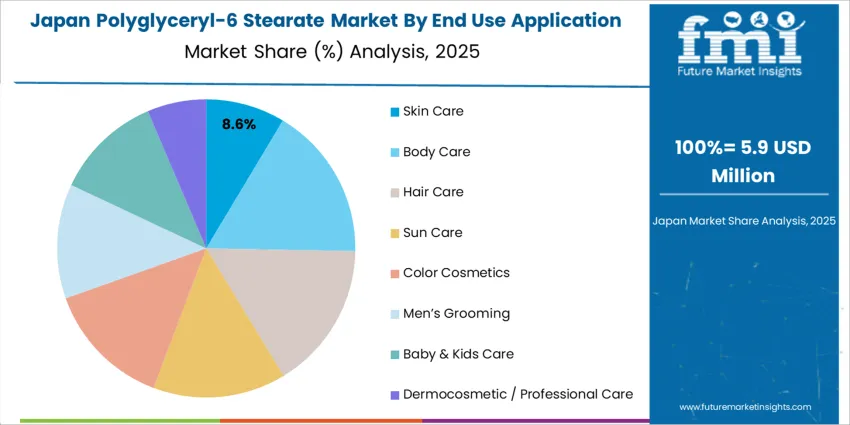
In Japan, the projected CAGR of 7.7 % for Polyglyceryl 6 Stearate aligns with the country’s strong tradition of high-quality skincare and preference for mild, effective ingredients. Japanese consumers often favor products that deliver hydration, barrier protection, and comfort without irritation. As a high HLB emulsifier suitable for oil-in-water emulsions, Polyglyceryl 6 Stearate helps create light, easily absorbed creams and lotions. Its plant-derived and PEG-free nature resonates with growing demand for natural and gentle formulations. Because Japan’s skincare market is mature with a strong emphasis on innovation and formulation quality, companies are likely to use Polyglyceryl 6 Stearate in moisturizers, sunscreens, and anti-aging creams that meet consumers’ high expectations for performance and skin compatibility. Aging demographics and demand for sensitive-skin formulations further support its adoption.
What Factors Encourage Polyglyceryl-6 Stearate Use in the UK?
In the UK, a projected CAGR of 7.0 % reflects growing consumer interest in natural, clean-label cosmetics and personal care products. As awareness of ingredient transparency and skin tolerance increases among British consumers, demand for PEG-free, plant-derived emulsifiers rises. Polyglyceryl 6 Stearate helps create stable emulsions in moisturizers, lotions, and sunscreens while delivering a smooth, pleasant skin feel and avoiding greasiness. The clean beauty trend, sustainability concerns, and preference for gentle skincare support its inclusion in both mainstream and niche product lines. In addition, as manufacturers reformulate to meet consumer demand for minimal irritation products, Polyglyceryl 6 Stearate provides a reliable emulsifying base for sensitive skin and eco-friendly formulations, which supports market growth in the UK.
Why is Polyglyceryl-6 Stearate Growing in Germany?
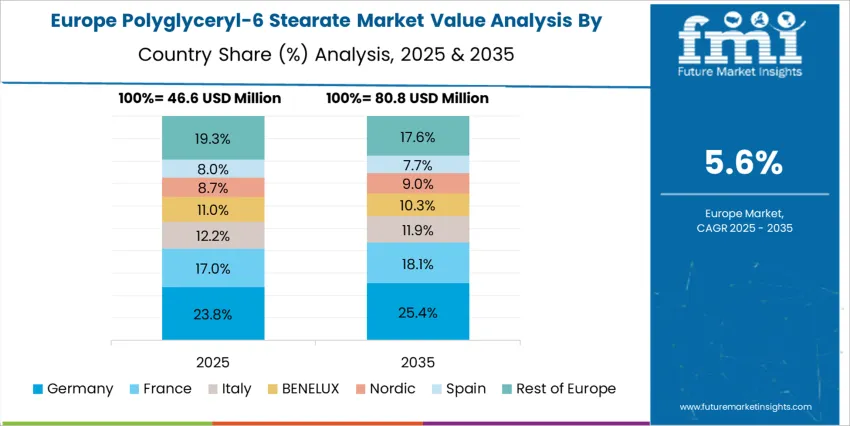
Germany’s projected CAGR of 6.3 % indicates stable growth driven by consumer demand for effective yet gentle skincare and personal care products. German consumers often value high-quality, dermatologically tested formulations, and there is increasing demand for natural, sustainably produced ingredients. Polyglyceryl 6 Stearate, being plant-derived, PEG-free, and gentle, matches these preferences. It enables formulation of moisturizers, creams, and lotions that deliver hydration and skin conditioning while minimizing the risk of irritation. As awareness of skin barrier health and sensitive skin needs rises, and with the ongoing growth of clean beauty products in Europe, Polyglyceryl 6 Stearate is likely to maintain steady demand in Germany’s skincare and personal care industry.
What Limits Polyglyceryl-6 Stearate Growth in the USA but Still Supports Moderate Uptake?
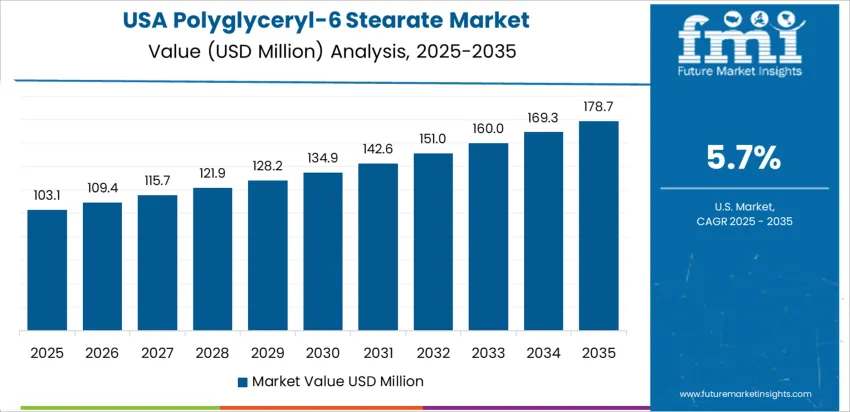
In the USA, the projected CAGR of 5.7 % indicates that, while growth is more modest than in Asia, Polyglyceryl 6 Stearate remains relevant. The U.S. market for emulsifiers and personal care ingredients is large and diverse, but consumer preferences vary widely. Some consumers and brands prefer synthetic or traditional emulsifiers, which may limit faster adoption of newer, plant-derived alternatives like Polyglyceryl 6 Stearate. Nevertheless, growing interest in clean beauty, ingredient transparency, and formulations for sensitive skin is driving gradual uptake. As more consumers become aware of the benefits of PEG-free, non-ionic emulsifiers, and as demand rises for skin-gentle and eco-friendly skincare, Polyglyceryl 6 Stearate is likely to see slow but steady growth in the U.S. market. Its utility in moisturizers, lotions, and sun care products, where mildness and spreadability matter, helps maintain its relevance.
What is the Competitive Landscape for the Global Polyglyceryl 6 Stearate Market?
Demand for polyglyceryl 6 stearate has grown globally as manufacturers of personal care and cosmetic products increasingly prefer mild, skin-compatible, and clean-label emulsifiers. Polyglyceryl 6 stearate acts as a non-ionic, plant-derived emulsifier that supports stable oil-in-water formulations while preserving skin barrier integrity and minimizing irritation. Its compatibility with sensitive skin, biodegradability, and suitability for creams, lotions, cleansers, shampoos, and conditioners make it appealing for both premium and mass market skincare and haircare lines. Increasing consumer awareness of ingredient transparency, environmental impact, and skin health has reinforced demand across major markets such as North America, Europe, and Asia Pacific. As trends shift toward sustainable, vegan, and eco-friendly products, polyglyceryl 6 stearate offers formulators an alternative to traditional surfactants and emulsifiers, supporting the growth of this ingredient segment.
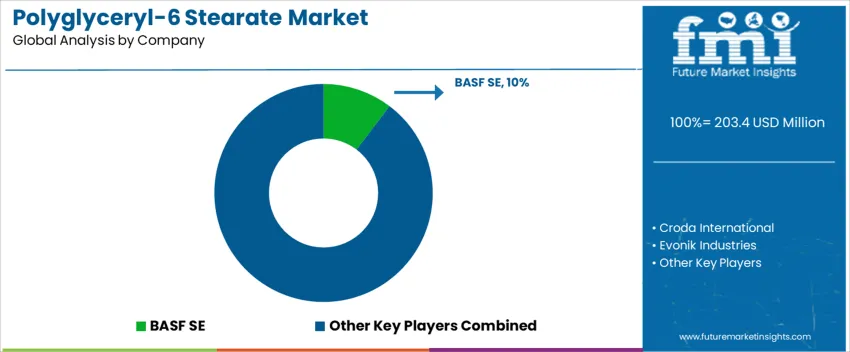
On the supply side, a concentrated group of major ingredient producers competes to serve global demand. Leading suppliers include BASF SE, Croda International, Evonik Industries, Symrise (including IFF/Givaudan actives), Dow Inc., Ashland, Clariant, and Seppic. Among them, BASF SE holds a recognizable position. Competition centers on the purity and quality consistency of polyglyceryl 6 stearate batches, the ability to meet cosmetic regulatory standards, the scalability of production, and the reliability of the supply chain. Some firms differentiate by offering broad portfolios of compatible natural emulsifiers and co-emulsifier blends to help formulators create mild yet effective formulations. Others focus on cost-efficient production to serve high-volume, low-cost personal care brands. Suppliers that deliver high-quality, stable, safe emulsifier products with robust manufacturing practices and strong regulatory compliance are best positioned to capture growth as global demand for clean-label, skin-friendly, and environmentally conscious personal care products rises.
Key Players of the Polyglyceryl-6 Stearate Market
- BASF SE
- Croda International
- Evonik Industries
- Symrise (incl. IFF/Givaudan actives)
- Dow / Dow Inc.
- Ashland
- Clariant
- Seppic
Scope of the Report
| Items | Details |
|---|---|
| Quantitative Units | USD Million |
| Regions Covered | North America, Europe, Asia Pacific, The Middle East & Africa, Latin America |
| Countries Covered | United States, Canada, United Kingdom, Germany, France, China, Japan, South Korea, Brazil, Australia |
| End Use Application | Skin Care, Body Care, Hair Care, Sun Care, Color Cosmetics, Men’s Grooming, Baby & Kids Care, Dermocosmetic / Professional Care |
| Product Form | Powder, Granules / Agglomerates, Flakes, Pellets / Prills, Liquid (Solution), Concentrate (High-active Liquid), Dispersion / Suspension, Emulsion, Paste, Gel, Wax / Solid Block, Oil |
| Key Companies Profiled | BASF SE, Croda International, Evonik Industries, Symrise (incl. IFF/Givaudan actives), Dow / Dow Inc., Ashland, Clariant, Seppic |
| Additional Attributes | Dollar sales by end-use application and product form show strong demand for inulin, particularly in skin care and body care products. Powder and liquid forms dominate, with concentrate and emulsion forms also growing in demand. Major companies like BASF, Evonik, and Ashland are key players, providing a wide range of inulin-based products for the cosmetic and dermocosmetic industries. The market is expected to grow with increasing demand for natural ingredients and innovative skincare solutions. |
Key Segments in the Polyglyceryl-6 Stearate Market
End Use Application
- Skin Care
- Body Care
- Hair Care
- Sun Care
- Color Cosmetics
- Men’s Grooming
- Baby & Kids Care
- Dermocosmetic / Professional Care
Product Form
- Powder
- Granules / Agglomerates
- Flakes
- Pellets / Prills
- Liquid (Solution)
- Concentrate (High-active Liquid)
- Dispersion / Suspension
- Emulsion
- Paste
- Gel
- Wax / Solid Block
- Oil
Region
- Asia Pacific
- China
- Japan
- South Korea
- India
- Australia & New Zealand
- ASEAN
- Rest of Asia Pacific
- Europe
- Germany
- United Kingdom
- France
- Italy
- Spain
- Nordic
- BENELUX
- Rest of Europe
- North America
- United States
- Canada
- Mexico
- Latin America
- Brazil
- Chile
- Rest of Latin America
- Middle East & Africa
- Kingdom of Saudi Arabia
- Other GCC Countries
- Turkey
- South Africa
- Other African Union
- Rest of Middle East & Africa
Frequently Asked Questions
How big is the polyglyceryl-6 stearate market in 2025?
The global polyglyceryl-6 stearate market is estimated to be valued at USD 203.4 million in 2025.
What will be the size of polyglyceryl-6 stearate market in 2035?
The market size for the polyglyceryl-6 stearate market is projected to reach USD 387.4 million by 2035.
How much will be the polyglyceryl-6 stearate market growth between 2025 and 2035?
The polyglyceryl-6 stearate market is expected to grow at a 6.7% CAGR between 2025 and 2035.
What are the key product types in the polyglyceryl-6 stearate market?
The key product types in polyglyceryl-6 stearate market are skin care, body care, hair care, sun care, color cosmetics, men’s grooming, baby & kids care and dermocosmetic / professional care.
Which product form segment to contribute significant share in the polyglyceryl-6 stearate market in 2025?
In terms of product form , powder segment to command 14.8% share in the polyglyceryl-6 stearate market in 2025.
Preview the report firsthand - request a free sample
Get SampleGet the brochure for pricing and purchase details.
Get PDFTable of Content
- Executive Summary
- Global Market Outlook
- Demand-side Trends
- Supply-side Trends
- Technology Roadmap Analysis
- Analysis and Recommendations
- Market Overview
- Market Coverage / Taxonomy
- Market Definition / Scope / Limitations
- Market Background
- Market Dynamics
- Drivers
- Restraints
- Opportunity
- Trends
- Scenario Forecast
- Demand in Optimistic Scenario
- Demand in Likely Scenario
- Demand in Conservative Scenario
- Opportunity Map Analysis
- Product Life Cycle Analysis
- Supply Chain Analysis
- Investment Feasibility Matrix
- Value Chain Analysis
- PESTLE and Porter’s Analysis
- Regulatory Landscape
- Regional Parent Market Outlook
- Production and Consumption Statistics
- Import and Export Statistics
- Market Dynamics
- Global Market Analysis 2020 to 2024 and Forecast, 2025 to 2035
- Historical Market Size Value (USD Million) Analysis, 2020 to 2024
- Current and Future Market Size Value (USD Million) Projections, 2025 to 2035
- Y-o-Y Growth Trend Analysis
- Absolute $ Opportunity Analysis
- Global Market Pricing Analysis 2020 to 2024 and Forecast 2025 to 2035
- Global Market Analysis 2020 to 2024 and Forecast 2025 to 2035, By End Use Application
- Introduction / Key Findings
- Historical Market Size Value (USD Million) Analysis By End Use Application , 2020 to 2024
- Current and Future Market Size Value (USD Million) Analysis and Forecast By End Use Application , 2025 to 2035
- Skin Care
- Body Care
- Hair Care
- Sun Care
- Color Cosmetics
- Men’s Grooming
- Baby & Kids Care
- Dermocosmetic / Professional Care
- Y-o-Y Growth Trend Analysis By End Use Application , 2020 to 2024
- Absolute $ Opportunity Analysis By End Use Application , 2025 to 2035
- Global Market Analysis 2020 to 2024 and Forecast 2025 to 2035, By Product Form
- Introduction / Key Findings
- Historical Market Size Value (USD Million) Analysis By Product Form, 2020 to 2024
- Current and Future Market Size Value (USD Million) Analysis and Forecast By Product Form, 2025 to 2035
- Powder
- Granules / Agglomerates
- Flakes
- Pellets / Prills
- Liquid (Solution)
- Concentrate (High-active Liquid)
- Dispersion / Suspension
- Emulsion
- Paste
- Gel
- Wax / Solid Block
- Y-o-Y Growth Trend Analysis By Product Form, 2020 to 2024
- Absolute $ Opportunity Analysis By Product Form, 2025 to 2035
- Global Market Analysis 2020 to 2024 and Forecast 2025 to 2035, By Region
- Introduction
- Historical Market Size Value (USD Million) Analysis By Region, 2020 to 2024
- Current Market Size Value (USD Million) Analysis and Forecast By Region, 2025 to 2035
- North America
- Latin America
- Western Europe
- Eastern Europe
- East Asia
- South Asia and Pacific
- Middle East & Africa
- Market Attractiveness Analysis By Region
- North America Market Analysis 2020 to 2024 and Forecast 2025 to 2035, By Country
- Historical Market Size Value (USD Million) Trend Analysis By Market Taxonomy, 2020 to 2024
- Market Size Value (USD Million) Forecast By Market Taxonomy, 2025 to 2035
- By Country
- USA
- Canada
- Mexico
- By End Use Application
- By Product Form
- By Country
- Market Attractiveness Analysis
- By Country
- By End Use Application
- By Product Form
- Key Takeaways
- Latin America Market Analysis 2020 to 2024 and Forecast 2025 to 2035, By Country
- Historical Market Size Value (USD Million) Trend Analysis By Market Taxonomy, 2020 to 2024
- Market Size Value (USD Million) Forecast By Market Taxonomy, 2025 to 2035
- By Country
- Brazil
- Chile
- Rest of Latin America
- By End Use Application
- By Product Form
- By Country
- Market Attractiveness Analysis
- By Country
- By End Use Application
- By Product Form
- Key Takeaways
- Western Europe Market Analysis 2020 to 2024 and Forecast 2025 to 2035, By Country
- Historical Market Size Value (USD Million) Trend Analysis By Market Taxonomy, 2020 to 2024
- Market Size Value (USD Million) Forecast By Market Taxonomy, 2025 to 2035
- By Country
- Germany
- UK
- Italy
- Spain
- France
- Nordic
- BENELUX
- Rest of Western Europe
- By End Use Application
- By Product Form
- By Country
- Market Attractiveness Analysis
- By Country
- By End Use Application
- By Product Form
- Key Takeaways
- Eastern Europe Market Analysis 2020 to 2024 and Forecast 2025 to 2035, By Country
- Historical Market Size Value (USD Million) Trend Analysis By Market Taxonomy, 2020 to 2024
- Market Size Value (USD Million) Forecast By Market Taxonomy, 2025 to 2035
- By Country
- Russia
- Poland
- Hungary
- Balkan & Baltic
- Rest of Eastern Europe
- By End Use Application
- By Product Form
- By Country
- Market Attractiveness Analysis
- By Country
- By End Use Application
- By Product Form
- Key Takeaways
- East Asia Market Analysis 2020 to 2024 and Forecast 2025 to 2035, By Country
- Historical Market Size Value (USD Million) Trend Analysis By Market Taxonomy, 2020 to 2024
- Market Size Value (USD Million) Forecast By Market Taxonomy, 2025 to 2035
- By Country
- China
- Japan
- South Korea
- By End Use Application
- By Product Form
- By Country
- Market Attractiveness Analysis
- By Country
- By End Use Application
- By Product Form
- Key Takeaways
- South Asia and Pacific Market Analysis 2020 to 2024 and Forecast 2025 to 2035, By Country
- Historical Market Size Value (USD Million) Trend Analysis By Market Taxonomy, 2020 to 2024
- Market Size Value (USD Million) Forecast By Market Taxonomy, 2025 to 2035
- By Country
- India
- ASEAN
- Australia & New Zealand
- Rest of South Asia and Pacific
- By End Use Application
- By Product Form
- By Country
- Market Attractiveness Analysis
- By Country
- By End Use Application
- By Product Form
- Key Takeaways
- Middle East & Africa Market Analysis 2020 to 2024 and Forecast 2025 to 2035, By Country
- Historical Market Size Value (USD Million) Trend Analysis By Market Taxonomy, 2020 to 2024
- Market Size Value (USD Million) Forecast By Market Taxonomy, 2025 to 2035
- By Country
- Kingdom of Saudi Arabia
- Other GCC Countries
- Turkiye
- South Africa
- Other African Union
- Rest of Middle East & Africa
- By End Use Application
- By Product Form
- By Country
- Market Attractiveness Analysis
- By Country
- By End Use Application
- By Product Form
- Key Takeaways
- Key Countries Market Analysis
- USA
- Pricing Analysis
- Market Share Analysis, 2024
- By End Use Application
- By Product Form
- Canada
- Pricing Analysis
- Market Share Analysis, 2024
- By End Use Application
- By Product Form
- Mexico
- Pricing Analysis
- Market Share Analysis, 2024
- By End Use Application
- By Product Form
- Brazil
- Pricing Analysis
- Market Share Analysis, 2024
- By End Use Application
- By Product Form
- Chile
- Pricing Analysis
- Market Share Analysis, 2024
- By End Use Application
- By Product Form
- Germany
- Pricing Analysis
- Market Share Analysis, 2024
- By End Use Application
- By Product Form
- UK
- Pricing Analysis
- Market Share Analysis, 2024
- By End Use Application
- By Product Form
- Italy
- Pricing Analysis
- Market Share Analysis, 2024
- By End Use Application
- By Product Form
- Spain
- Pricing Analysis
- Market Share Analysis, 2024
- By End Use Application
- By Product Form
- France
- Pricing Analysis
- Market Share Analysis, 2024
- By End Use Application
- By Product Form
- India
- Pricing Analysis
- Market Share Analysis, 2024
- By End Use Application
- By Product Form
- ASEAN
- Pricing Analysis
- Market Share Analysis, 2024
- By End Use Application
- By Product Form
- Australia & New Zealand
- Pricing Analysis
- Market Share Analysis, 2024
- By End Use Application
- By Product Form
- China
- Pricing Analysis
- Market Share Analysis, 2024
- By End Use Application
- By Product Form
- Japan
- Pricing Analysis
- Market Share Analysis, 2024
- By End Use Application
- By Product Form
- South Korea
- Pricing Analysis
- Market Share Analysis, 2024
- By End Use Application
- By Product Form
- Russia
- Pricing Analysis
- Market Share Analysis, 2024
- By End Use Application
- By Product Form
- Poland
- Pricing Analysis
- Market Share Analysis, 2024
- By End Use Application
- By Product Form
- Hungary
- Pricing Analysis
- Market Share Analysis, 2024
- By End Use Application
- By Product Form
- Kingdom of Saudi Arabia
- Pricing Analysis
- Market Share Analysis, 2024
- By End Use Application
- By Product Form
- Turkiye
- Pricing Analysis
- Market Share Analysis, 2024
- By End Use Application
- By Product Form
- South Africa
- Pricing Analysis
- Market Share Analysis, 2024
- By End Use Application
- By Product Form
- USA
- Market Structure Analysis
- Competition Dashboard
- Competition Benchmarking
- Market Share Analysis of Top Players
- By Regional
- By End Use Application
- By Product Form
- Competition Analysis
- Competition Deep Dive
- BASF SE
- Overview
- Product Portfolio
- Profitability by Market Segments (Product/Age /Sales Channel/Region)
- Sales Footprint
- Strategy Overview
- Marketing Strategy
- Product Strategy
- Channel Strategy
- Croda International
- Evonik Industries
- Symrise (incl. IFF/Givaudan actives)
- Dow / Dow Inc.
- Ashland
- Clariant
- Seppic
- BASF SE
- Competition Deep Dive
- Assumptions & Acronyms Used
- Research Methodology


