

- Industry Size (2025)
- USD 372.4 Bn
- Forecast (2035)
- USD 732.6 Bn
- CAGR (2025 to 2035)
- 7.0%
Potentiometric Titrators Market Size and Share Forecast Outlook 2025 to 2035
The Potentiometric Titrators Market is estimated to be valued at USD 372.4 billion in 2025 and is projected to reach USD 732.6 billion by 2035, registering a compound annual growth rate (CAGR) of 7.0% over the forecast period.
Quick Stats for Potentiometric Titrators Market
- Potentiometric Titrators Market Value (2025): USD 372.4 billion
- Potentiometric Titrators Market Forecast Value (2035): USD 732.6 billion
- Potentiometric Titrators Market Forecast CAGR: 7.0%
- Leading Segment in Potentiometric Titrators Market in 2025: Redox Potentiometric Titration (30.0%)
- Key Growth Regions in Potentiometric Titrators Market: North America, Asia-Pacific, Europe
- Top Key Players in Potentiometric Titrators Market: Metrohm, Hanna Instruments, Mettler Toledo, Xylem, Hach, KEM, Hiranuma Sangyo, DKK-TOA, Inesa, Hanon
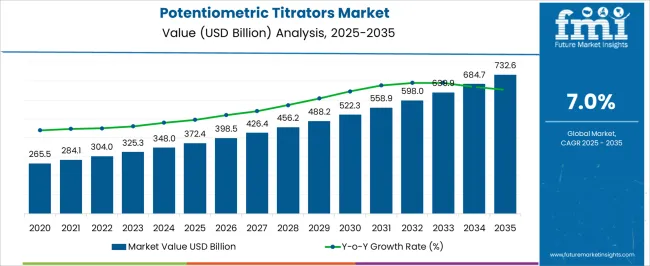
Potentiometric Titrators Market Key Takeaways
| Metric | Value |
|---|---|
| Potentiometric Titrators Market Estimated Value in (2025 E) | USD 372.4 billion |
| Potentiometric Titrators Market Forecast Value in (2035 F) | USD 732.6 billion |
| Forecast CAGR (2025 to 2035) | 7.0% |
Why is the Potentiometric Titrators Market Growing?
The Potentiometric Titrators market is experiencing steady growth driven by increasing demand for precise, automated titration in laboratories, research facilities, and quality control environments. Current market dynamics indicate that automation, reliability, and accuracy are becoming critical factors for laboratories across pharmaceuticals, chemicals, and food and beverage sectors.
The market is being influenced by growing emphasis on process standardization, regulatory compliance, and the need to minimize human errors during chemical analysis. Advances in sensor technology, software integration, and data logging capabilities have enhanced the operational efficiency of potentiometric titrators.
Furthermore, rising investments in laboratory modernization and the adoption of digital analytical techniques are fostering market expansion The outlook for the market is positive, with potential growth arising from applications in new industrial sectors, increasing automation trends, and the integration of titration systems with advanced laboratory information management systems to deliver faster, reproducible, and reliable results.
Segmental Analysis
The potentiometric titrators market is segmented by application, end use industry, and geographic regions. By application, potentiometric titrators market is divided into Redox Potentiometric Titration, Acid-Base Potentiometric Titration, Precipitation Potentiometric Titration, Potentiometric Titrators For COD Measurement, and Neutralization Potentiometric Titration. In terms of end use industry, potentiometric titrators market is classified into Potentiometric Titrators For Food & Beverage, Potentiometric Titrators For Pharmaceuticals, Potentiometric Titrators For Electronics, Potentiometric Titrators For Paper & Pulp, Potentiometric Titrators For Chemical Manufacturing, Potentiometric Titrators For Oil & Gas, Potentiometric Titrators For Wastewater Treatment, and Potentiometric Titrators For Metallurgical And Other Industries. Regionally, the potentiometric titrators industry is classified into North America, Latin America, Western Europe, Eastern Europe, Balkan & Baltic Countries, Russia & Belarus, Central Asia, East Asia, South Asia & Pacific, and the Middle East & Africa.
Insights into the Redox Potentiometric Titration Segment
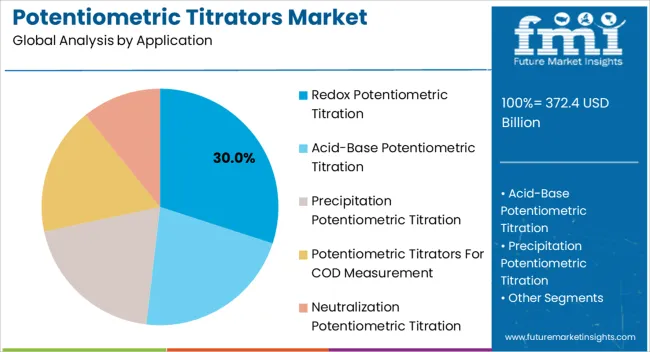
The Redox Potentiometric Titration application segment is projected to hold 30.00% of the overall market revenue in 2025, establishing it as the leading application. The growth of this segment is being driven by its ability to provide highly accurate measurements for oxidation-reduction reactions, which are critical in chemical, pharmaceutical, and environmental laboratories.
The segment has benefited from widespread adoption due to its compatibility with automated systems, enabling precise endpoint detection and reproducible results. Laboratories increasingly prefer redox potentiometric titration because it reduces operator dependency and supports complex analyses with minimal manual intervention.
In addition, integration with digital interfaces and advanced software has allowed better data tracking, calibration management, and method standardization As industries focus on quality control, regulatory adherence, and efficient analytical workflows, the redox titration segment is expected to maintain its leadership, supported by continuous improvements in sensor sensitivity and automation features.
Insights into the Potentiometric Titrators For Food & Beverage Segment
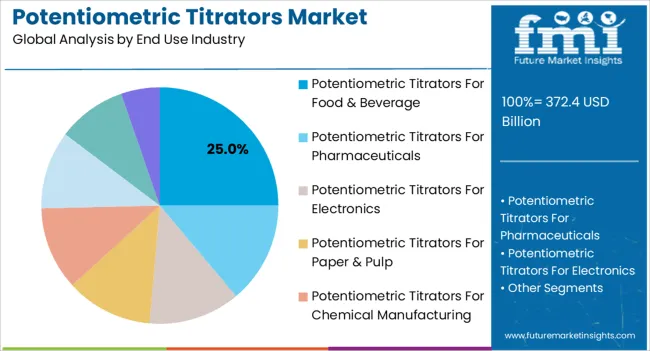
The Food and Beverage end-use industry segment is anticipated to account for 25.00% of the market revenue in 2025, making it the largest end-use sector. Growth in this segment is being driven by increasing demand for precise chemical analysis in quality control processes, including acidity, moisture, and preservative content testing.
The adoption of potentiometric titrators in food and beverage laboratories has been accelerated due to their accuracy, ease of automation, and ability to minimize human error during repetitive measurements. Compliance with food safety standards and regulatory requirements has further reinforced the need for reliable titration systems.
Additionally, the integration of software-controlled titration workflows allows better data management, traceability, and efficiency in production monitoring As global food production expands and consumer safety expectations rise, the Food and Beverage segment is expected to continue driving growth, with titration systems being increasingly preferred for consistent and reliable analytical performance.
Market Overview
Potentiometric Titrators Market Overview
With increasing demand for accurate and fast titrations in end-use industries, the market for automatic potentiometric titrators is gaining traction. Another factor expected to drive the market for potentiometric titrators is the growing concern in pharmaceutical industries about maintaining quality standards.
Titration is a quantitative chemical analysis technique for determining the concentration of a dissolved substance. Potentiometric titration determines the concentration of a chemical component in a solution by measuring the potential difference between the indicator electrode and the reference electrode when the current passed through the solution only maintains thermodynamic equilibrium. Pharmaceutical, petrochemical, chemical, food processing, and other industries use potentiometric titrators for quality control and research and development.
Analysis of Potentiometric Titrators Market By Key Countries
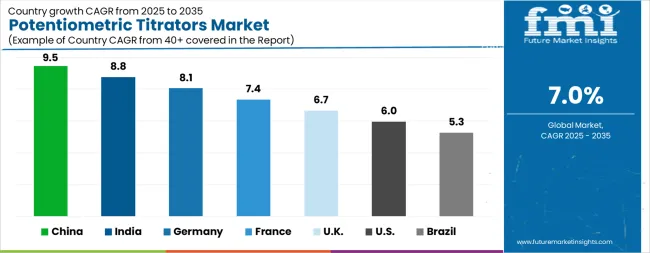
| Country | CAGR |
|---|---|
| China | 9.5% |
| India | 8.8% |
| Germany | 8.1% |
| France | 7.4% |
| UK | 6.7% |
| USA | 6.0% |
| Brazil | 5.3% |
Country-wise Analysis
The Potentiometric Titrators Market is expected to register a CAGR of 7.0% during the forecast period, exhibiting varied country level momentum. China leads with the highest CAGR of 9.5%, followed by India at 8.8%. Developed markets such as Germany, France, and the UK continue to expand steadily, while the USA is likely to grow at consistent rates. Brazil posts the lowest CAGR at 5.3%, yet still underscores a broadly positive trajectory for the global Potentiometric Titrators Market. In 2024, Germany held a dominant revenue in the Western Europe market and is expected to grow with a CAGR of 8.1%. The USA Potentiometric Titrators Market is estimated to be valued at USD 135.1 billion in 2025 and is anticipated to reach a valuation of USD 240.8 billion by 2035. Sales are projected to rise at a CAGR of 6.0% over the forecast period between 2025 and 2035. While Japan and South Korea markets are estimated to be valued at USD 19.0 billion and USD 12.8 billion respectively in 2025.
Key Players in the Potentiometric Titrators Market
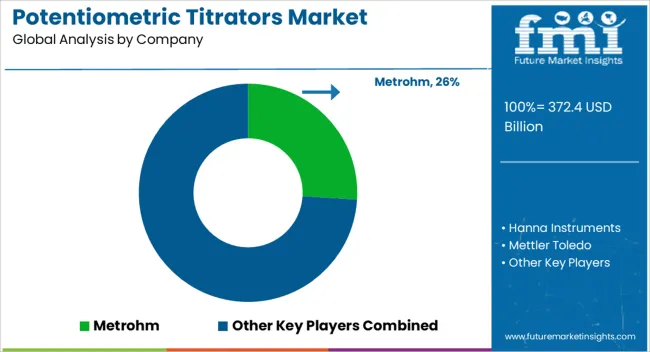
- Metrohm
- Hanna Instruments
- Mettler Toledo
- Xylem
- Hach
- KEM
- Hiranuma Sangyo
- DKK-TOA
- Inesa
- Hanon
Scope of the Report
| Item | Value |
|---|---|
| Quantitative Units | USD 372.4 Billion |
| Application | Redox Potentiometric Titration, Acid-Base Potentiometric Titration, Precipitation Potentiometric Titration, Potentiometric Titrators For COD Measurement, and Neutralization Potentiometric Titration |
| End Use Industry | Potentiometric Titrators For Food & Beverage, Potentiometric Titrators For Pharmaceuticals, Potentiometric Titrators For Electronics, Potentiometric Titrators For Paper & Pulp, Potentiometric Titrators For Chemical Manufacturing, Potentiometric Titrators For Oil & Gas, Potentiometric Titrators For Wastewater Treatment, and Potentiometric Titrators For Metallurgical And Other Industries |
| Regions Covered | North America, Europe, Asia-Pacific, Latin America, Middle East & Africa |
| Country Covered | United States, Canada, Germany, France, United Kingdom, China, Japan, India, Brazil, South Africa |
| Key Companies Profiled | Metrohm, Hanna Instruments, Mettler Toledo, Xylem, Hach, KEM, Hiranuma Sangyo, DKK-TOA, Inesa, and Hanon |
Potentiometric Titrators Market by Segments
Application:
- Redox Potentiometric Titration
- Acid-Base Potentiometric Titration
- Precipitation Potentiometric Titration
- Potentiometric Titrators For COD Measurement
- Neutralization Potentiometric Titration
End Use Industry:
- Potentiometric Titrators For Food & Beverage
- Potentiometric Titrators For Pharmaceuticals
- Potentiometric Titrators For Electronics
- Potentiometric Titrators For Paper & Pulp
- Potentiometric Titrators For Chemical Manufacturing
- Potentiometric Titrators For Oil & Gas
- Potentiometric Titrators For Wastewater Treatment
- Potentiometric Titrators For Metallurgical And Other Industries
Region:
- North America
- USA
- Canada
- Mexico
- Latin America
- Brazil
- Chile
- Rest of Latin America
- Western Europe
- Germany
- UK
- Italy
- Spain
- France
- Nordic
- BENELUX
- Rest of Western Europe
- Eastern Europe
- Russia
- Poland
- Hungary
- Balkan & Baltic
- Rest of Eastern Europe
- East Asia
- China
- Japan
- South Korea
- South Asia and Pacific
- India
- ASEAN
- Australia & New Zealand
- Rest of South Asia and Pacific
- Middle East & Africa
- Kingdom of Saudi Arabia
- Other GCC Countries
- Turkiye
- South Africa
- Other African Union
- Rest of Middle East & Africa
Frequently Asked Questions
How big is the potentiometric titrators market in 2025?
The global potentiometric titrators market is estimated to be valued at USD 372.4 billion in 2025.
What will be the size of potentiometric titrators market in 2035?
The market size for the potentiometric titrators market is projected to reach USD 732.6 billion by 2035.
How much will be the potentiometric titrators market growth between 2025 and 2035?
The potentiometric titrators market is expected to grow at a 7.0% CAGR between 2025 and 2035.
What are the key product types in the potentiometric titrators market?
The key product types in potentiometric titrators market are redox potentiometric titration, acid-base potentiometric titration, precipitation potentiometric titration, potentiometric titrators for cod measurement and neutralization potentiometric titration.
Which end use industry segment to contribute significant share in the potentiometric titrators market in 2025?
In terms of end use industry, potentiometric titrators for food & beverage segment to command 25.0% share in the potentiometric titrators market in 2025.
Preview the report firsthand - request a free sample
Get SampleGet the brochure for pricing and purchase details.
Get PDFTable of Content
- Executive Summary
- Global Market Outlook
- Demand-side Trends
- Supply-side Trends
- Technology Roadmap Analysis
- Analysis and Recommendations
- Market Overview
- Market Coverage / Taxonomy
- Market Definition / Scope / Limitations
- Market Background
- Market Dynamics
- Drivers
- Restraints
- Opportunity
- Trends
- Scenario Forecast
- Demand in Optimistic Scenario
- Demand in Likely Scenario
- Demand in Conservative Scenario
- Opportunity Map Analysis
- Product Life Cycle Analysis
- Supply Chain Analysis
- Investment Feasibility Matrix
- Value Chain Analysis
- PESTLE and Porter’s Analysis
- Regulatory Landscape
- Regional Parent Market Outlook
- Production and Consumption Statistics
- Import and Export Statistics
- Market Dynamics
- Global Market Analysis 2020 to 2024 and Forecast, 2025 to 2035
- Historical Market Size Value (USD Million) Analysis, 2020 to 2024
- Current and Future Market Size Value (USD Million) Projections, 2025 to 2035
- Y-o-Y Growth Trend Analysis
- Absolute $ Opportunity Analysis
- Global Market Pricing Analysis 2020 to 2024 and Forecast 2025 to 2035
- Global Market Analysis 2020 to 2024 and Forecast 2025 to 2035, By Application
- Introduction / Key Findings
- Historical Market Size Value (USD Million) Analysis By Application , 2020 to 2024
- Current and Future Market Size Value (USD Million) Analysis and Forecast By Application , 2025 to 2035
- Redox Potentiometric Titration
- Acid-Base Potentiometric Titration
- Precipitation Potentiometric Titration
- Potentiometric Titrators For COD Measurement
- Neutralization Potentiometric Titration
- Y-o-Y Growth Trend Analysis By Application , 2020 to 2024
- Absolute $ Opportunity Analysis By Application , 2025 to 2035
- Global Market Analysis 2020 to 2024 and Forecast 2025 to 2035, By End Use Industry
- Introduction / Key Findings
- Historical Market Size Value (USD Million) Analysis By End Use Industry, 2020 to 2024
- Current and Future Market Size Value (USD Million) Analysis and Forecast By End Use Industry, 2025 to 2035
- Potentiometric Titrators For Food & Beverage
- Potentiometric Titrators For Pharmaceuticals
- Potentiometric Titrators For Electronics
- Potentiometric Titrators For Paper & Pulp
- Potentiometric Titrators For Chemical Manufacturing
- Potentiometric Titrators For Oil & Gas
- Potentiometric Titrators For Wastewater Treatment
- Potentiometric Titrators For Metallurgical And Other Industries
- Y-o-Y Growth Trend Analysis By End Use Industry, 2020 to 2024
- Absolute $ Opportunity Analysis By End Use Industry, 2025 to 2035
- Global Market Analysis 2020 to 2024 and Forecast 2025 to 2035, By Region
- Introduction
- Historical Market Size Value (USD Million) Analysis By Region, 2020 to 2024
- Current Market Size Value (USD Million) Analysis and Forecast By Region, 2025 to 2035
- North America
- Latin America
- Western Europe
- Eastern Europe
- East Asia
- South Asia and Pacific
- Middle East & Africa
- Market Attractiveness Analysis By Region
- North America Market Analysis 2020 to 2024 and Forecast 2025 to 2035, By Country
- Historical Market Size Value (USD Million) Trend Analysis By Market Taxonomy, 2020 to 2024
- Market Size Value (USD Million) Forecast By Market Taxonomy, 2025 to 2035
- By Country
- USA
- Canada
- Mexico
- By Application
- By End Use Industry
- By Country
- Market Attractiveness Analysis
- By Country
- By Application
- By End Use Industry
- Key Takeaways
- Latin America Market Analysis 2020 to 2024 and Forecast 2025 to 2035, By Country
- Historical Market Size Value (USD Million) Trend Analysis By Market Taxonomy, 2020 to 2024
- Market Size Value (USD Million) Forecast By Market Taxonomy, 2025 to 2035
- By Country
- Brazil
- Chile
- Rest of Latin America
- By Application
- By End Use Industry
- By Country
- Market Attractiveness Analysis
- By Country
- By Application
- By End Use Industry
- Key Takeaways
- Western Europe Market Analysis 2020 to 2024 and Forecast 2025 to 2035, By Country
- Historical Market Size Value (USD Million) Trend Analysis By Market Taxonomy, 2020 to 2024
- Market Size Value (USD Million) Forecast By Market Taxonomy, 2025 to 2035
- By Country
- Germany
- UK
- Italy
- Spain
- France
- Nordic
- BENELUX
- Rest of Western Europe
- By Application
- By End Use Industry
- By Country
- Market Attractiveness Analysis
- By Country
- By Application
- By End Use Industry
- Key Takeaways
- Eastern Europe Market Analysis 2020 to 2024 and Forecast 2025 to 2035, By Country
- Historical Market Size Value (USD Million) Trend Analysis By Market Taxonomy, 2020 to 2024
- Market Size Value (USD Million) Forecast By Market Taxonomy, 2025 to 2035
- By Country
- Russia
- Poland
- Hungary
- Balkan & Baltic
- Rest of Eastern Europe
- By Application
- By End Use Industry
- By Country
- Market Attractiveness Analysis
- By Country
- By Application
- By End Use Industry
- Key Takeaways
- East Asia Market Analysis 2020 to 2024 and Forecast 2025 to 2035, By Country
- Historical Market Size Value (USD Million) Trend Analysis By Market Taxonomy, 2020 to 2024
- Market Size Value (USD Million) Forecast By Market Taxonomy, 2025 to 2035
- By Country
- China
- Japan
- South Korea
- By Application
- By End Use Industry
- By Country
- Market Attractiveness Analysis
- By Country
- By Application
- By End Use Industry
- Key Takeaways
- South Asia and Pacific Market Analysis 2020 to 2024 and Forecast 2025 to 2035, By Country
- Historical Market Size Value (USD Million) Trend Analysis By Market Taxonomy, 2020 to 2024
- Market Size Value (USD Million) Forecast By Market Taxonomy, 2025 to 2035
- By Country
- India
- ASEAN
- Australia & New Zealand
- Rest of South Asia and Pacific
- By Application
- By End Use Industry
- By Country
- Market Attractiveness Analysis
- By Country
- By Application
- By End Use Industry
- Key Takeaways
- Middle East & Africa Market Analysis 2020 to 2024 and Forecast 2025 to 2035, By Country
- Historical Market Size Value (USD Million) Trend Analysis By Market Taxonomy, 2020 to 2024
- Market Size Value (USD Million) Forecast By Market Taxonomy, 2025 to 2035
- By Country
- Kingdom of Saudi Arabia
- Other GCC Countries
- Turkiye
- South Africa
- Other African Union
- Rest of Middle East & Africa
- By Application
- By End Use Industry
- By Country
- Market Attractiveness Analysis
- By Country
- By Application
- By End Use Industry
- Key Takeaways
- Key Countries Market Analysis
- USA
- Pricing Analysis
- Market Share Analysis, 2024
- By Application
- By End Use Industry
- Canada
- Pricing Analysis
- Market Share Analysis, 2024
- By Application
- By End Use Industry
- Mexico
- Pricing Analysis
- Market Share Analysis, 2024
- By Application
- By End Use Industry
- Brazil
- Pricing Analysis
- Market Share Analysis, 2024
- By Application
- By End Use Industry
- Chile
- Pricing Analysis
- Market Share Analysis, 2024
- By Application
- By End Use Industry
- Germany
- Pricing Analysis
- Market Share Analysis, 2024
- By Application
- By End Use Industry
- UK
- Pricing Analysis
- Market Share Analysis, 2024
- By Application
- By End Use Industry
- Italy
- Pricing Analysis
- Market Share Analysis, 2024
- By Application
- By End Use Industry
- Spain
- Pricing Analysis
- Market Share Analysis, 2024
- By Application
- By End Use Industry
- France
- Pricing Analysis
- Market Share Analysis, 2024
- By Application
- By End Use Industry
- India
- Pricing Analysis
- Market Share Analysis, 2024
- By Application
- By End Use Industry
- ASEAN
- Pricing Analysis
- Market Share Analysis, 2024
- By Application
- By End Use Industry
- Australia & New Zealand
- Pricing Analysis
- Market Share Analysis, 2024
- By Application
- By End Use Industry
- China
- Pricing Analysis
- Market Share Analysis, 2024
- By Application
- By End Use Industry
- Japan
- Pricing Analysis
- Market Share Analysis, 2024
- By Application
- By End Use Industry
- South Korea
- Pricing Analysis
- Market Share Analysis, 2024
- By Application
- By End Use Industry
- Russia
- Pricing Analysis
- Market Share Analysis, 2024
- By Application
- By End Use Industry
- Poland
- Pricing Analysis
- Market Share Analysis, 2024
- By Application
- By End Use Industry
- Hungary
- Pricing Analysis
- Market Share Analysis, 2024
- By Application
- By End Use Industry
- Kingdom of Saudi Arabia
- Pricing Analysis
- Market Share Analysis, 2024
- By Application
- By End Use Industry
- Turkiye
- Pricing Analysis
- Market Share Analysis, 2024
- By Application
- By End Use Industry
- South Africa
- Pricing Analysis
- Market Share Analysis, 2024
- By Application
- By End Use Industry
- USA
- Market Structure Analysis
- Competition Dashboard
- Competition Benchmarking
- Market Share Analysis of Top Players
- By Regional
- By Application
- By End Use Industry
- Competition Analysis
- Competition Deep Dive
- Metrohm
- Overview
- Product Portfolio
- Profitability by Market Segments (Product/Age /Sales Channel/Region)
- Sales Footprint
- Strategy Overview
- Marketing Strategy
- Product Strategy
- Channel Strategy
- Hanna Instruments
- Mettler Toledo
- Xylem
- Hach
- KEM
- Hiranuma Sangyo
- DKK-TOA
- Inesa
- Hanon
- Metrohm
- Competition Deep Dive
- Assumptions & Acronyms Used
- Research Methodology


