

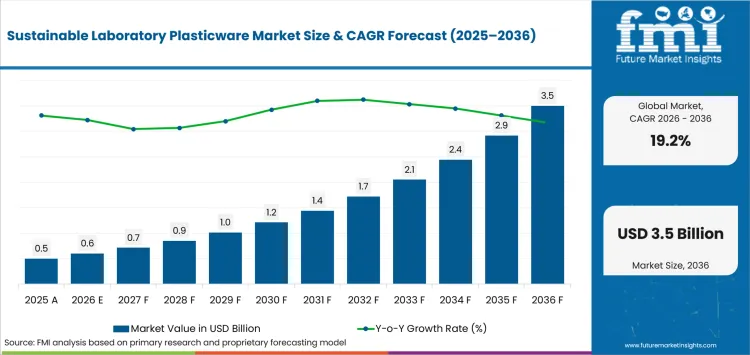
- Market Size (2026)
- USD 0.6 Bn
- Forecast (2036)
- USD 3.5 Bn
- CAGR (2026 to 2036)
- 19.2%
How big is the Sustainable Laboratory Plasticware Market in 2026?
USD 0.6 billion in 2026 and USD 3.5 billion by 2036 at a 19.2% CAGR.
Sales of sustainable laboratory plasticware are estimated at USD 0.6 billion in 2026 and USD 3.5 billion by 2036 at 19.2% CAGR. Sustainability initiatives are becoming a more visible factor in laboratory procurement decisions as research organizations seek to reduce waste and resource consumption. UCL reported 271 laboratories participating in the Laboratory Efficiency Assessment Framework (LEAF) in May 2026. The expansion of sustainability programs is increasing scrutiny of consumables selection and waste-management performance.
Research spending remains an important determinant of market activity because laboratory throughput drives plasticware consumption. OECD reported R&D expenditure equivalent to 4.9% of GDP in Korea compared with 1.8% in Canada during 2025. Higher research intensity supports greater demand for laboratory consumables across academic and industrial research settings. Procurement strategies nevertheless vary by institution, with recycling programs and recovery services influencing replacement rates and repeat purchasing patterns.
Key Takeaways of Sustainable Laboratory Plasticware Market
- Laboratories now review material and waste evidence beside purity records across recurring consumable purchasing programs.
- Bioplastic is projected at 46.0% in 2026 because lower-fossil feedstocks fit selected disposable formats.
- Polypropylene is estimated at 34.0% in 2026 owing to precision molding and chemical resistance.
- Consumables are forecast at 38.0% in 2026 due to frequent replacement of tips and tubes.
- Contamination and fragmented collection systems prevent many used items from entering ordinary recycling routes.
- Thermo Fisher Scientific Inc., Eppendorf SE, Corning Incorporated, Sartorius AG, Greiner AG, SARSTEDT AG & Co. KG, Danaher Corporation and Hamilton Company serve this market.
Analyst Perspective
"Laboratories should rank material changes by assay risk and then compare carbon claims or recovery programs. Manufacturers earn repeat orders by preserving fit and purity across lots while environmental evidence withstands purchasing and waste reviews."
- Nikhil Kaitwade, Principal Consultant for Healthcare, Future Market Insights
How is the Sustainable Laboratory Plasticware Market segmented?
The sustainable laboratory plasticware market is segmented by plastic type, polymer, plasticware, end user, application and region.
Plastic type covers bioplastic, recycled plastic and bio-based plastic across polypropylene, polyethylene, PLA and PHA. Plasticware includes consumables, containers, bottles and cell culture items. End users include research institutions, healthcare laboratories and CROs across life sciences research, drug development, diagnostics and other applications.
What supports bioplastic within the plastic type category?
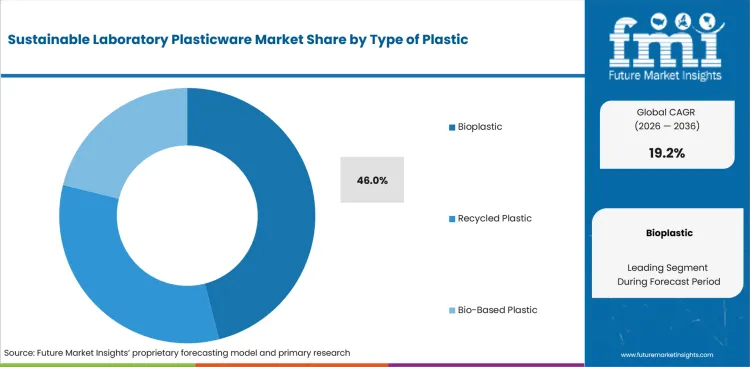
Bioplastic formats give laboratories a lower-fossil route for disposable items used in routine liquid handling and sample storage across research programs. The category covers PLA and PHA while bio-based polyethylene and polypropylene remain separate groups within approved taxonomy.
- By plastic type, bioplastic is estimated to hold 46.0% in 2026 owing to its fit with selected single-use formats and renewable feedstock routes.
- Laboratories compare thermal limits and sample-contact performance against validated methods during qualification of each proposed resin change. Clear disposal instructions remain essential because renewable content does not make every product biodegradable in regulated use.
How do laboratories evaluate polypropylene within the polymer category?
Polypropylene resin supports precision-molded tips, tubes and plates that resist chemicals without changing sample handling. Recycled and bio-based feedstock routes retain the finished polymer specification across familiar designs, which limits revalidation work for established laboratory programs.
- In 2026, polypropylene is expected to lead the polymer category with 34.0% share because its molding consistency supports high-volume consumable production.
- Manufacturers control dimensions and extractables across production lots during technical qualification of each proposed material route. Documented feedstock origin strengthens selection once technical equivalence is established for the intended assay and instrument under routine laboratory use conditions.
Why do consumables lead the plasticware category?
Consumables generate repeat demand as laboratory benchtop automation uses many tips and tubes during each instrument run across scheduled testing. Installed systems favor familiar rack geometry and dependable replenishment of pipette tips across multi-site clinical and research programs.
- By plasticware, consumables are forecast to represent 38.0% in 2026 driven by recurring purchases across pipette tips and microcentrifuge tubes.
- Refill packs reduce resin and storage volume without replacing pipettors or changing validated liquid-handling steps. Adoption weakens if centrifuge tubes or tip racks need separate accessories, additional operator training or collection arrangements at each participating laboratory site.
Why do pharmaceutical and biotechnology companies lead end-user demand?
Pharmaceutical and biotechnology laboratories combine high consumable throughput with lab automation and formal controls for purity, traceability and lot consistency. Repeated liquid transfers make laboratory supplies a direct operating requirement across scheduled drug development and quality testing.
- Pharmaceutical and biotechnology companies are set to lead the end-user category with 35.0% share in 2026 due to repeated testing and controlled liquid handling.
- Approved product lists change slowly because assay reproducibility and regional service must remain stable across commercial programs. Environmental attributes influence selection once compatibility records and recovery guidance satisfy quality teams across cell culture workflows.
What are the drivers, restraints and opportunities in the Sustainable Laboratory Plasticware Market?
Environmental purchasing expands demand, contamination limits recovery and refill systems reduce material use across recurring laboratory consumables.
- Driver: Research institutions place material disclosure and waste criteria beside purity records during recurring plasticware reviews.
- Restraint: Biological or chemical residues exclude many used tips and tubes from ordinary collection systems.
- Opportunity: Refill packs and verified recovery services lower material use without changing established liquid-handling methods.
Environmental Purchasing Criteria
Laboratory efficiency standards place material disclosure beside purity and compatibility records during recurring purchases. Environmental criteria enter the same approved-product review as technical performance across multi-site programs.
Contamination Limits Recovery
Used tips, tubes and petri dishes may carry residues that exclude them from ordinary recycling. Product-specific screening and disposal guidance determines whether technically recyclable resin can enter local collection systems.
Refill Systems Reduce Repeat Material
Refill systems reduce resin without changing established cell culture systems or pipetting steps. Corning reported in July 2025 that its ACT-labelled HybridRack used 70% less plastic than a traditional rack.
Which country CAGRs are profiled in the Sustainable Laboratory Plasticware Market?
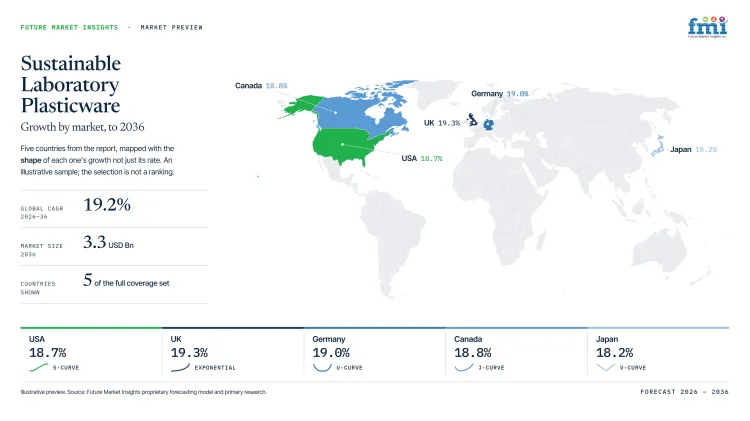
| Country | CAGR |
|---|---|
| South Korea | 20.4% |
| United Kingdom | 19.3% |
| Australia | 19.1% |
| Germany | 19.0% |
| Canada | 18.8% |
How do country-level CAGRs compare in the Sustainable Laboratory Plasticware Market?
The five-country spread reaches 1.6 percentage points between South Korea and Canada. These rates measure forecast pace rather than current market size across the approved country set.
- South Korean biotechnology programs expand consumable use across public laboratories and regional research centers.
- United Kingdom institutions apply laboratory efficiency standards within operating guidance and recurring purchasing reviews.
- Australia pairs circularity targets with reverse-logistics constraints across distant research centers and service territories.
- Germany offers technical qualification capacity although contaminated items remain outside ordinary packaging recovery systems.
- Canada integrates environmental disclosure into federal procurement while provincial collection routes remain uneven following laboratory use.
Comparable CAGRs can produce different market entry conditions. The full report provides country-level CAGR analysis across North America, Latin America, Europe, East Asia, South Asia and Pacific, and the Middle East and Africa.
Country-wise Analysis
- South Korean research facilities operate within national biotechnology programs that fund shared laboratories and regional science clusters across public institutes, commercial development centers and university campuses supporting recurring analytical work nationwide. the Ministry of Science and ICT reported that its 2026 budget was finalized at KRW 23.7 trillion, with advanced biotechnology and regional research support among stated national priorities. The sector is projected to record 20.4% CAGR during the assessment period as laboratory activity expands, but manufacturers need Korean technical files and contamination-specific collection guidance for public programs to convert trials into repeat orders.
- United Kingdom research institutions embed environmental requirements inside laboratory operating standards, and the Medical Research Council reported in September 2025 that all its research facilities achieved Gold LEAF status alongside equipment procurement guidance. Adoption of sustainable laboratory plasticware is estimated to expand at 19.3% CAGR through 2036, supported by recognized efficiency criteria that make refill formats and product disclosures easier to compare during recurring tenders. Contaminated items require controlled disposal at many sites, so manufacturers need tender-ready purity records and institution-specific recovery instructions for national standards to translate into repeat orders across university and public research networks nationwide.
- Australian laboratories operate across long service distances that make institutions dependent on regional distributors and waste contractors for deliveries, technical support and collection of eligible nonhazardous materials across state jurisdictions. The Department of Climate Change reported in May 2026 that Australia aims to safely recover 80% of resources by 2035, giving institutions a national basis for lighter packaging and reusable laboratory formats. Sustainable laboratory plasticware sales are forecast to expand at 19.1% CAGR by 2036, but companies need aggregated collection volumes and regional service coverage for circular claims to influence repeat orders across research centers and hospital networks.
- German research clusters combine technical qualification capacity with local manufacturing expertise across pharmaceutical laboratories, university institutes and consumable plants serving sample-contact applications within established science and production networks nationwide. Eppendorf reported in June 2025 that Safe-Lock Tubes BioBased used 100% bio-based polypropylene under a mass-balance approach, while retaining established tube formats plus stated purity and routine performance requirements across research programs. Germany is estimated to post 19.0% CAGR over the forecast period, although manufacturers must separate clean packaging from contaminated plasticware and preserve virgin-grade performance during site qualification plus recurring compliance testing across laboratory networks nationwide.
- Canadian public institutions increasingly require environmental disclosure within large federal purchasing processes, while laboratories depend on provincial waste rules and distributors serving distant healthcare and research locations across a decentralized national network. The Government of Canada reported in May 2026 that procurements above CAD 25 million require participating suppliers to measure and disclose greenhouse gas emissions under federal green procurement requirements. Canada's sustainable laboratory plasticware outlook is anticipated to advance at 18.8% CAGR over the assessment period, but uneven recovery systems require site guidance and distributor support before environmental claims translate into recurring orders across remote service territories nationwide.
Who are the notable companies in the Sustainable Laboratory Plasticware Market?
Thermo Fisher Scientific Inc., Eppendorf SE, Corning Incorporated, Sartorius AG, Greiner AG, SARSTEDT AG & Co. KG, Danaher Corporation and Hamilton Company.
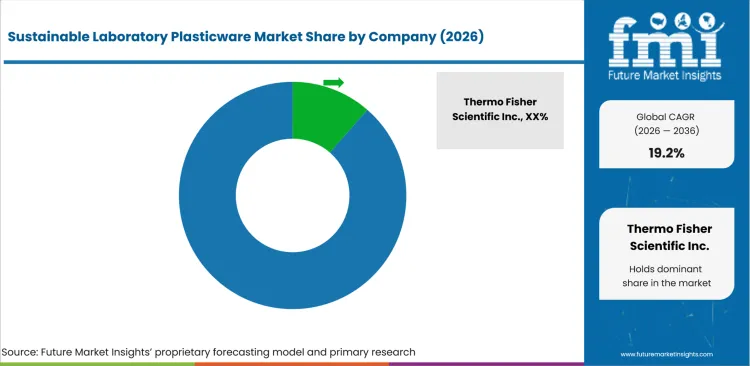
Life science platforms and consumable specialists divide a fragmented field shaped by purity records, instrument fit and material evidence.
- Thermo Fisher, Eppendorf, Corning and Greiner combine broad portfolios with product footprints or lower-plastic formats.
- Sartorius, SARSTEDT, Danaher and Hamilton compete through refill systems, recovery programs or bio-circular automation tips.
Competitive Benchmarking: Sustainable Laboratory Plasticware Market
| Company | Material Evidence | Plasticware Breadth | Circularity Evidence | Geographic Reach |
|---|---|---|---|---|
| Thermo Fisher Scientific Inc. | High | High | High | Global |
| Eppendorf SE | High | High | High | Global |
| Corning Incorporated | Medium | High | High | Global |
| Sartorius AG | Medium | Medium | High | Global |
| Greiner AG | High | High | High | Global |
| SARSTEDT AG & Co. KG | High | High | High | Global |
| Danaher Corporation | Medium | Medium | High | Global |
| Hamilton Company | High | Medium | Medium | Europe and selected markets |
Key Developments in the Sustainable Laboratory Plasticware Market
- In June 2026, Thermo Fisher reported product carbon footprints for more than 250,000 portfolio products.
- In March 2026, Greiner Bio-One added 101 ACT-certified products and reached 127 certified portfolio items.
- In October 2025, Eppendorf launched Deepwell Plates BioBased using at least 95% second-generation polymer feedstock.
- In January 2024, Danaher's Beckman Coulter Life Sciences partnered with Polycarbin to develop low-carbon lab consumables made from recycled materials with third-party-verified sustainability metrics.
Key Players in the Sustainable Laboratory Plasticware Market
Integrated Life Science Platforms
- Thermo Fisher Scientific Inc.
- Corning Incorporated
- Danaher Corporation
Laboratory Consumables Specialists
- Eppendorf SE
- Sartorius AG
- Greiner AG
- SARSTEDT AG & Co. KG
Automation-Focused Liquid Handling
- Hamilton Company
Sustainable Laboratory Plasticware Market - Report Scope
| Coverage field | Report scope |
|---|---|
| Market breakdown | By plastic type, polymer, plasticware, end user, application and region. |
| Quantitative Units | Revenue in USD billion and CAGR in %. |
| Market Definition | Laboratory plasticware using lower-impact polymers, reduced-material designs or verified recovery routes. |
| Regions Covered | North America, Latin America, Europe, East Asia, South Asia and Pacific and Middle East and Africa. |
| Countries Covered | South Korea, United Kingdom, Australia, Germany, Canada and 20+ countries included in the full report. |
| Key Companies Profiled | Thermo Fisher Scientific Inc., Eppendorf SE, Corning Incorporated, Sartorius AG, Greiner AG, SARSTEDT AG & Co. KG, Danaher Corporation, Hamilton Company. |
| Forecast Period | 2026 to 2036. |
| Approach | Primary and secondary research with market triangulation. |
Sustainable Laboratory Plasticware Market - Research Methodology
| Method | Approach |
|---|---|
| Primary Research | FMI analysts gathered input from manufacturers, service providers, technology developers, distributors, end users, procurement teams, and subject-matter experts. Interviews examined purchasing decisions, product or service evaluation, adoption barriers, approval requirements, pricing considerations, and expectations for technical or commercial support. Respondents were also asked what evidence is required before a trial, pilot, or initial order develops into regular purchasing. |
| Desk Research | Desk research covered government statistics, regulatory publications, trade data, industry associations, technical literature, standards, company filings, product information, and official corporate announcements. Sources were reviewed for relevance, publication date, geographic coverage, and consistency with the defined market scope. Claims relating to performance, applications, approvals, capacity, investment, and commercial activity were retained only when supported by credible public evidence. |
| Market Sizing and Forecasting | The market model combined the baseline value with historical performance, segment structure, pricing and volume indicators, adoption levels, company participation, and country-level demand conditions. Forecast assumptions considered economic activity, investment trends, regulatory developments, technology adoption, purchasing cycles, supply availability, and barriers to wider market use. Segment and regional estimates were reconciled before the final market total was calculated. |
| Data Validation | Estimates were checked against multiple independent indicators, including public data, company activity, trade patterns, industry developments, and findings from primary interviews. Validation also tested whether products, services, applications, and company revenues fell within the defined market boundaries. Adjacent categories, unsupported claims, overlapping revenues, and activities without direct market relevance were excluded to reduce double counting and maintain consistency across segments and countries. |
Sustainable Laboratory Plasticware Market by Segments
By Plastic Type:
- Bioplastic
- Polylactic Acid (PLA)
- Polyhydroxyalkanoates (PHA)
- Recycled Plastic
- Recycled Polypropylene (rPP)
- Recycled Polyethylene (rPE)
- Bio-Based Plastic
- Bio-Based Polyethylene
- Bio-Based Polypropylene
By Polymer:
- Polypropylene (PP)
- Recycled Polypropylene
- Bio-Based Polypropylene
- Polyethylene (PE)
- Recycled Polyethylene
- Bio-Based Polyethylene
- Polylactic Acid (PLA)
- Pure PLA
- Blend-Based PLA
- Polyhydroxyalkanoates (PHA)
- PHA-Based Labware
- Biodegradable PHA Blends
By Plasticware:
- Consumables
- Pipette Tips
- Microcentrifuge Tubes
- Containers & Bottles
- Sample Containers
- Reagent Bottles
- Cell Culture Plasticware
- Cell Culture Plates
- Cell Culture Flasks
- Other Laboratory Plasticware
- Petri Dishes
- Multiwell Plates
By End User:
- Pharmaceutical & Biotechnology Companies
- Drug Discovery Laboratories
- Biotechnology Research Laboratories
- Academic & Research Institutes
- Universities
- Government Research Laboratories
- Hospitals & Diagnostic Centers
- Hospital Laboratories
- Diagnostic Laboratories
- Contract Research Organizations
- Preclinical CROs
- Clinical Research Laboratories
By Application:
- Life Sciences Research
- Genomics & Molecular Biology
- Proteomics Research
- Drug Discovery & Development
- Preclinical Research
- Compound Screening
- Clinical Diagnostics
- Molecular Diagnostics
- Pathology & Testing
- Other Laboratory Applications
- Food & Environmental Testing
- Chemical & Industrial Research
Sustainable Laboratory Plasticware Market by Region:
- North America
- United States
- Canada
- Latin America
- Brazil
- Mexico
- Chile
- Rest of Latin America
- Western Europe
- Germany
- United Kingdom
- Italy
- Spain
- France
- Nordics
- Benelux
- Rest of Western Europe
- Eastern Europe
- Russia
- Poland
- Hungary
- Balkan and Baltic States
- Rest of Eastern Europe
- East Asia
- China
- Japan
- South Korea
- South Asia and Pacific
- India
- ASEAN
- Australia and New Zealand
- Rest of South Asia and Pacific
- Middle East and Africa
- Kingdom of Saudi Arabia
- Other GCC Countries
- Türkiye
- South Africa
- Other African Union Countries
- Rest of Middle East and Africa
Research Sources and Bibliography
- UCL. (2026, May 13). UCL publishes Annual Sustainability Report 2024-25, showcasing progress powered by community.
- OECD. (2025, May). Raising business sector productivity: OECD Economic Surveys: Canada 2025.
- Corning. (2025, July). Corning's First My Green Lab ACT Label Certified Lab Product: Axygen HybridRack.
- MSIT. (2025, December). MSIT's 2026 Budget Finalized at KRW 23.7 Trillion.
- MRC. (2025, September 23). MRC environmental sustainability programme impact report 2024 to 2025.
- DCCEEW. (2026, May 15). Circular economy resources.
- Eppendorf. (2025, June 23). Eppendorf Safe-Lock Tubes BioBased - 2nd Generation Feedstock - 1st Class Consumables.
- Canada. (2026, May). 2025 Progress Report on the 2022 to 2026 Federal Sustainable Development Strategy.
- Thermo Fisher. (n.d.). Greener by design.
- Greiner. (2026, March 30). Sustainability in the laboratory: Greiner Bio-One certifies an additional 101 products with the ACT Ecolabel.
- Eppendorf. (2025, October 15). New Eppendorf Deepwell Plates BioBased enlarge our sustainable product portfolio.
- Sartorius. (2024, May 21). Sartorius Refill Towers earn ACT Ecolabel, leading the way in sustainable pipetting.
- SARSTEDT. (n.d.). Make the difference: Refill and Recycle.
- Beckman Coulter. (2024, January 29). Beckman Coulter Life Sciences and Polycarbin partner to lead lab sustainability innovation.
- Hamilton. (n.d.). Sustainability.
This bibliography is provided for reader reference and is not exhaustive. The full report contains the complete reference list and detailed citations
This Report Answers
- What is the current size of the global Sustainable Laboratory Plasticware market, and how is it expected to grow?
- What regulatory, sustainability, and operational factors control market acceptance and adoption of sustainable laboratory plasticware?
- Why does bioplastic-based laboratory plasticware hold a leading share of the market?
- Why does polypropylene remain the dominant material choice despite growing sustainability requirements?
- Why do consumables account for recurring demand across laboratories, research facilities, and diagnostic settings?
- How do market growth rates, adoption trends, and purchasing patterns differ across key countries?
- Which leading companies are competing in the global Sustainable Laboratory Plasticware market?
- What technical, economic, and recycling infrastructure limitations restrict plasticware recovery and circularity initiatives?
Frequently Asked Questions
How big is the Sustainable Laboratory Plasticware Market in 2026?
USD 0.6 billion is the 2026 value of the Sustainable Laboratory Plasticware Market. The Sustainable Laboratory Plasticware Market is forecast to reach USD 3.5 billion by 2036 as laboratories adopt lower-impact plasticware that preserves purity, fit and validated methods.
What is the CAGR of the Sustainable Laboratory Plasticware Market from 2026 to 2036?
The Sustainable Laboratory Plasticware Market is projected to expand at 19.2% CAGR from 2026 to 2036. Repeat purchases across tips and tubes support the forecast, although contamination and fragmented collection systems restrict practical recovery following routine laboratory use.
Which plastic type is projected to account for 46.0% of the Sustainable Laboratory Plasticware Market?
Bioplastic is projected to account for 46.0% of the Sustainable Laboratory Plasticware Market by plastic type in 2026. The Sustainable Laboratory Plasticware Market retains this position because renewable feedstock routes enter familiar disposable formats once performance and disposal claims are verified.
Which application segment accounts for 36.0% of the Sustainable Laboratory Plasticware Market?
Life sciences research accounts for 36.0% of the Sustainable Laboratory Plasticware Market by application in 2026. The Sustainable Laboratory Plasticware Market receives recurring demand from genomics and proteomics workflows using tips, tubes and plates that preserve sample integrity.
Which companies are active in the Sustainable Laboratory Plasticware Market?
Thermo Fisher Scientific Inc., Eppendorf SE, Corning Incorporated, Sartorius AG, Greiner AG, SARSTEDT AG & Co. KG, Danaher Corporation and Hamilton Company are some of the notable companies in the sustainable laboratory plasticware market.
Preview the report firsthand - request a free sample
Get SampleGet the brochure for pricing and purchase details.
Get PDFTable of Content
- Key Takeaways
- Market Size and CAGR
- Top Growth Driver
- Fastest Growing Segment
- Leading Region
- Key Companies
- Emerging Opportunities
- Executive Summary
- Global Market Outlook
- Demand-side Trends
- Supply-side Trends
- Technology Roadmap Analysis
- Analysis and Recommendations
- Analyst Perspective (What is happening? Why now? What should investors know?)
- Key Questions Answered
- How large is the market?
- What is the CAGR?
- What are key trends?
- Which region dominates?
- Who are the leaders?
- Market Overview
- Market Coverage / Taxonomy
- Market Definition / Scope / Limitations
- Research Methodology
- Chapter Orientation
- Analytical Lens and Working Hypotheses
- Market Structure, Signals, and Trend Drivers
- Benchmarking and Cross-market Comparability
- Market Sizing, Forecasting, and Opportunity Mapping
- Research Design and Evidence Framework
- Desk Research Programme (Secondary Evidence)
- Expert Input and Fieldwork (Primary Evidence)
- Tooling, Models, and Reference Databases
- Data Engineering and Model Build
- Quality Assurance and Audit Trail
- Market Background
- Market Dynamics (Drivers, Restraints, Opportunity, Trends)
- Scenario Forecast (Optimistic, Likely, Conservative)
- Impact Analysis
- AI Impact
- Sustainability Impact
- Regulatory Impact
- Technology Impact
- Consumer / Buyer Analysis
- Purchase Drivers
- Adoption Barriers
- Buyer Journey
- Opportunity Map Analysis
- Product Life Cycle Analysis
- Supply Chain Analysis
- Investment Feasibility Matrix
- Value Chain Analysis
- PESTLE and Porter's Analysis
- Regulatory Landscape
- Regional Parent Market Outlook
- Production and Consumption Statistics
- Import and Export Statistics
- Global Market Analysis and Forecast, 2021 to 2036
- Historical Market Size Value (USD Billion) Analysis, 2021 to 2025
- Current and Future Market Size Value (USD Billion) Projections, 2026 to 2036
- Y-o-Y Growth Trend Analysis
- Absolute $ Opportunity Analysis
- Global Market Pricing Analysis, 2021 to 2036
- Global Market Analysis and Forecast, By Type of Plastic, 2021 to 2036
- Introduction / Key Findings
- Historical Market Size Value (USD Billion) Analysis By Type of Plastic, 2021 to 2025
- Current and Future Market Size Value (USD Billion) Analysis and Forecast By Type of Plastic, 2026 to 2036
- Bioplastic
- Polylactic Acid (PLA)
- Polyhydroxyalkanoates (PHA)
- Recycled Plastic
- Recycled Polypropylene (rPP)
- Recycled Polyethylene (rPE)
- Bio-Based Plastic
- Bio-Based Polyethylene
- Bio-Based Polypropylene
- Bioplastic
- Y-o-Y Growth Trend Analysis By Type of Plastic, 2021 to 2025
- Absolute $ Opportunity Analysis By Type of Plastic, 2026 to 2036
- Global Market Analysis and Forecast, By Type of Polymer, 2021 to 2036
- Introduction / Key Findings
- Historical Market Size Value (USD Billion) Analysis By Type of Polymer, 2021 to 2025
- Current and Future Market Size Value (USD Billion) Analysis and Forecast By Type of Polymer, 2026 to 2036
- Polypropylene (PP)
- Recycled Polypropylene
- Bio-Based Polypropylene
- Polyethylene (PE)
- Recycled Polyethylene
- Bio-Based Polyethylene
- Polylactic Acid (PLA)
- Pure PLA
- Blend-Based PLA
- Polyhydroxyalkanoates (PHA)
- PHA-Based Labware
- Biodegradable PHA Blends
- Polypropylene (PP)
- Y-o-Y Growth Trend Analysis By Type of Polymer, 2021 to 2025
- Absolute $ Opportunity Analysis By Type of Polymer, 2026 to 2036
- Global Market Analysis and Forecast, By Type of Plasticware, 2021 to 2036
- Introduction / Key Findings
- Historical Market Size Value (USD Billion) Analysis By Type of Plasticware, 2021 to 2025
- Current and Future Market Size Value (USD Billion) Analysis and Forecast By Type of Plasticware, 2026 to 2036
- Consumables
- Pipette Tips
- Microcentrifuge Tubes
- Containers & Bottles
- Sample Containers
- Reagent Bottles
- Cell Culture Plasticware
- Cell Culture Plates
- Cell Culture Flasks
- Other Laboratory Plasticware
- Petri Dishes
- Multiwell Plates
- Consumables
- Y-o-Y Growth Trend Analysis By Type of Plasticware, 2021 to 2025
- Absolute $ Opportunity Analysis By Type of Plasticware, 2026 to 2036
- Global Market Analysis and Forecast, By End User, 2021 to 2036
- Introduction / Key Findings
- Historical Market Size Value (USD Billion) Analysis By End User, 2021 to 2025
- Current and Future Market Size Value (USD Billion) Analysis and Forecast By End User, 2026 to 2036
- Pharmaceutical & Biotechnology Companies
- Drug Discovery Laboratories
- Biotechnology Research Laboratories
- Academic & Research Institutes
- Universities
- Government Research Laboratories
- Hospitals & Diagnostic Centers
- Hospital Laboratories
- Diagnostic Laboratories
- Contract Research Organizations
- Preclinical CROs
- Clinical Research Laboratories
- Pharmaceutical & Biotechnology Companies
- Y-o-Y Growth Trend Analysis By End User, 2021 to 2025
- Absolute $ Opportunity Analysis By End User, 2026 to 2036
- Global Market Analysis and Forecast, By Application, 2021 to 2036
- Introduction / Key Findings
- Historical Market Size Value (USD Billion) Analysis By Application, 2021 to 2025
- Current and Future Market Size Value (USD Billion) Analysis and Forecast By Application, 2026 to 2036
- Life Sciences Research
- Genomics & Molecular Biology
- Proteomics Research
- Drug Discovery & Development
- Preclinical Research
- Compound Screening
- Clinical Diagnostics
- Molecular Diagnostics
- Pathology & Testing
- Other Laboratory Applications
- Food & Environmental Testing
- Chemical & Industrial Research
- Life Sciences Research
- Y-o-Y Growth Trend Analysis By Application, 2021 to 2025
- Absolute $ Opportunity Analysis By Application, 2026 to 2036
- Global Market Analysis and Forecast, By Region, 2021 to 2036
- Introduction
- Historical Market Size Value (USD Billion) Analysis By Region, 2021 to 2025
- Current Market Size Value (USD Billion) Analysis and Forecast By Region, 2026 to 2036
- North America
- Latin America
- Western Europe
- Eastern Europe
- East Asia
- South Asia and Pacific
- Middle East & Africa
- Market Attractiveness Analysis By Region
- North America Market Analysis and Forecast, By Country, 2021 to 2036
- Historical Market Size Value (USD Billion) Trend Analysis By Market Taxonomy, 2021 to 2025
- Market Size Value (USD Billion) Forecast By Market Taxonomy, 2026 to 2036
- By Country
- USA
- Canada
- By Type of Plastic
- By Type of Polymer
- By Type of Plasticware
- By End User
- By Application
- By Country
- Market Attractiveness Analysis
- By Country
- By Type of Plastic
- By Type of Polymer
- By Type of Plasticware
- By End User
- By Application
- Key Takeaways
- Latin America Market Analysis and Forecast, By Country
- Historical Market Size Value (USD Billion) Trend Analysis By Market Taxonomy, 2021 to 2025
- Market Size Value (USD Billion) Forecast By Market Taxonomy, 2026 to 2036
- By Country
- Brazil
- Mexico
- Chile
- Rest of Latin America
- By Type of Plastic
- By Type of Polymer
- By Type of Plasticware
- By End User
- By Application
- By Country
- Market Attractiveness Analysis
- By Country
- By Type of Plastic
- By Type of Polymer
- By Type of Plasticware
- By End User
- By Application
- Key Takeaways
- Western Europe Market Analysis and Forecast, By Country
- Historical Market Size Value (USD Billion) Trend Analysis By Market Taxonomy, 2021 to 2025
- Market Size Value (USD Billion) Forecast By Market Taxonomy, 2026 to 2036
- By Country
- Germany
- UK
- Italy
- Spain
- France
- Nordic
- BENELUX
- Rest of Western Europe
- By Type of Plastic
- By Type of Polymer
- By Type of Plasticware
- By End User
- By Application
- By Country
- Market Attractiveness Analysis
- By Country
- By Type of Plastic
- By Type of Polymer
- By Type of Plasticware
- By End User
- By Application
- Key Takeaways
- Eastern Europe Market Analysis and Forecast, By Country
- Historical Market Size Value (USD Billion) Trend Analysis By Market Taxonomy, 2021 to 2025
- Market Size Value (USD Billion) Forecast By Market Taxonomy, 2026 to 2036
- By Country
- Russia
- Poland
- Hungary
- Balkan & Baltic
- Rest of Eastern Europe
- By Type of Plastic
- By Type of Polymer
- By Type of Plasticware
- By End User
- By Application
- By Country
- Market Attractiveness Analysis
- By Country
- By Type of Plastic
- By Type of Polymer
- By Type of Plasticware
- By End User
- By Application
- Key Takeaways
- East Asia Market Analysis and Forecast, By Country
- Historical Market Size Value (USD Billion) Trend Analysis By Market Taxonomy, 2021 to 2025
- Market Size Value (USD Billion) Forecast By Market Taxonomy, 2026 to 2036
- By Country
- China
- Japan
- South Korea
- By Type of Plastic
- By Type of Polymer
- By Type of Plasticware
- By End User
- By Application
- By Country
- Market Attractiveness Analysis
- By Country
- By Type of Plastic
- By Type of Polymer
- By Type of Plasticware
- By End User
- By Application
- Key Takeaways
- South Asia and Pacific Market Analysis and Forecast, By Country
- Historical Market Size Value (USD Billion) Trend Analysis By Market Taxonomy, 2021 to 2025
- Market Size Value (USD Billion) Forecast By Market Taxonomy, 2026 to 2036
- By Country
- India
- ASEAN
- Australia & New Zealand
- Rest of South Asia and Pacific
- By Type of Plastic
- By Type of Polymer
- By Type of Plasticware
- By End User
- By Application
- By Country
- Market Attractiveness Analysis
- By Country
- By Type of Plastic
- By Type of Polymer
- By Type of Plasticware
- By End User
- By Application
- Key Takeaways
- Middle East & Africa Market Analysis and Forecast, By Country
- Historical Market Size Value (USD Billion) Trend Analysis By Market Taxonomy, 2021 to 2025
- Market Size Value (USD Billion) Forecast By Market Taxonomy, 2026 to 2036
- By Country
- Kingdom of Saudi Arabia
- Other GCC Countries
- Türkiye
- South Africa
- Other African Union
- Rest of Middle East & Africa
- By Type of Plastic
- By Type of Polymer
- By Type of Plasticware
- By End User
- By Application
- By Country
- Market Attractiveness Analysis
- By Country
- By Type of Plastic
- By Type of Polymer
- By Type of Plasticware
- By End User
- By Application
- Key Takeaways
- Key Countries Market Analysis
- USA
- Pricing Analysis
- Market Share Analysis, 2025
- By Type of Plastic
- By Type of Polymer
- By Type of Plasticware
- By End User
- By Application
- Canada
- Pricing Analysis
- Market Share Analysis, 2025
- By Type of Plastic
- By Type of Polymer
- By Type of Plasticware
- By End User
- By Application
- Mexico
- Pricing Analysis
- Market Share Analysis, 2025
- By Type of Plastic
- By Type of Polymer
- By Type of Plasticware
- By End User
- By Application
- Brazil
- Pricing Analysis
- Market Share Analysis, 2025
- By Type of Plastic
- By Type of Polymer
- By Type of Plasticware
- By End User
- By Application
- Chile
- Pricing Analysis
- Market Share Analysis, 2025
- By Type of Plastic
- By Type of Polymer
- By Type of Plasticware
- By End User
- By Application
- Germany
- Pricing Analysis
- Market Share Analysis, 2025
- By Type of Plastic
- By Type of Polymer
- By Type of Plasticware
- By End User
- By Application
- UK
- Pricing Analysis
- Market Share Analysis, 2025
- By Type of Plastic
- By Type of Polymer
- By Type of Plasticware
- By End User
- By Application
- Italy
- Pricing Analysis
- Market Share Analysis, 2025
- By Type of Plastic
- By Type of Polymer
- By Type of Plasticware
- By End User
- By Application
- Spain
- Pricing Analysis
- Market Share Analysis, 2025
- By Type of Plastic
- By Type of Polymer
- By Type of Plasticware
- By End User
- By Application
- France
- Pricing Analysis
- Market Share Analysis, 2025
- By Type of Plastic
- By Type of Polymer
- By Type of Plasticware
- By End User
- By Application
- India
- Pricing Analysis
- Market Share Analysis, 2025
- By Type of Plastic
- By Type of Polymer
- By Type of Plasticware
- By End User
- By Application
- ASEAN
- Pricing Analysis
- Market Share Analysis, 2025
- By Type of Plastic
- By Type of Polymer
- By Type of Plasticware
- By End User
- By Application
- Australia & New Zealand
- Pricing Analysis
- Market Share Analysis, 2025
- By Type of Plastic
- By Type of Polymer
- By Type of Plasticware
- By End User
- By Application
- China
- Pricing Analysis
- Market Share Analysis, 2025
- By Type of Plastic
- By Type of Polymer
- By Type of Plasticware
- By End User
- By Application
- Japan
- Pricing Analysis
- Market Share Analysis, 2025
- By Type of Plastic
- By Type of Polymer
- By Type of Plasticware
- By End User
- By Application
- South Korea
- Pricing Analysis
- Market Share Analysis, 2025
- By Type of Plastic
- By Type of Polymer
- By Type of Plasticware
- By End User
- By Application
- Russia
- Pricing Analysis
- Market Share Analysis, 2025
- By Type of Plastic
- By Type of Polymer
- By Type of Plasticware
- By End User
- By Application
- Poland
- Pricing Analysis
- Market Share Analysis, 2025
- By Type of Plastic
- By Type of Polymer
- By Type of Plasticware
- By End User
- By Application
- Hungary
- Pricing Analysis
- Market Share Analysis, 2025
- By Type of Plastic
- By Type of Polymer
- By Type of Plasticware
- By End User
- By Application
- Kingdom of Saudi Arabia
- Pricing Analysis
- Market Share Analysis, 2025
- By Type of Plastic
- By Type of Polymer
- By Type of Plasticware
- By End User
- By Application
- Türkiye
- Pricing Analysis
- Market Share Analysis, 2025
- By Type of Plastic
- By Type of Polymer
- By Type of Plasticware
- By End User
- By Application
- South Africa
- Pricing Analysis
- Market Share Analysis, 2025
- By Type of Plastic
- By Type of Polymer
- By Type of Plasticware
- By End User
- By Application
- USA
- Market Structure Analysis
- Competition Dashboard
- Competition Benchmarking
- Market Share Analysis of Top Players
- By Regional
- By Type of Plastic
- By Type of Polymer
- By Type of Plasticware
- By End User
- By Application
- Emerging Startups
- Innovation Benchmarking
- Competition Analysis
- Competition Deep Dive
- Thermo Fisher Scientific Inc.
- Overview
- Product Portfolio
- Profitability by Market Segments
- Sales Footprint
- Strategy Overview
- Marketing Strategy
- Product Strategy
- Channel Strategy
- Eppendorf SE
- Corning Incorporated
- Sartorius AG
- Merck KGaA
- Danaher Corporation
- Greiner AG
- DWK Life Sciences
- SARSTEDT AG & Co. KG
- VITLAB GmbH
- Others
- Thermo Fisher Scientific Inc.
- Case Studies
- Success Stories
- Recent Developments
- Competition Deep Dive
- Assumptions & Acronyms Used


